
Police Destroyed Their Homes and Businesses. The Supreme Court Won't Say Who Should Pay.
Are innocent people entitled to compensation when their property is ruined by police? That will continue to be an "open question."

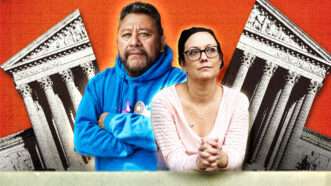
Are innocent people entitled to compensation when their property is ruined by police? That will continue to be an "open question."



The raids took place after a detective with the state Protection for Abused and Trafficked Humans Law Enforcement Task Force got four penis massages.

"There's no deals that can be made for a cabinet position when you're sacrificing our set of principles in our platform," says Evan McMahon.

A new Bears stadium and Gov. J.B. Pritzker himself stand to gain if the legislation passes.

Small-government conservatives are tripping over themselves to give millions of taxpayer dollars to billionaires.

Two petitions ask the Supreme Court to uphold the remedy required by the Fifth Amendment.
Increasing income taxes almost always results in less revenue and less economic activity.


Lawmakers across the country are introducing bills that would make it easier to build smaller single-family homes on small lots.

It's an insane—and frighteningly dystopian—interpretation of the law.

After her husband’s ex repeatedly called child protective services over harmless parenting decisions, Hannah Bright is advocating for a new law to protect families from weaponized reporting.

Cities and states promised to use opioid settlement money to fight addiction. Instead, they’re spending it on concerts, police cars, and political perks.

Plus: Formula 1’s bet on Apple TV, and the awkwardness of Chad Powers

Law enforcement launched 30 tear gas canisters into Amy Hadley's home, smashed windows, ransacked furniture, destroyed security cameras, and more. The government gave her nothing.



Local governments love giving sweetheart deals to billion-dollar companies—now data centers instead of football stadiums.

The researchers found that drug seizures in San Francisco were associated with a substantial increase in fatal opioid overdoses.

These bills—in Indiana, North Dakota, Oklahoma, and South Carolina—could also imperil IVF practices and threaten care for women with pregnancy complications.



A class action lawsuit claims Indianapolis law enforcement is using civil asset forfeiture to seize millions in cash from packages routed through a major FedEx hub, without notifying the owners of what crime they're suspected of committing.
The Department of Justice alleges that the South Bend Police Department is violating the Civil Rights Act due to disparate acceptance rates for female and black applicants.

The Institute for Justice says Indianapolis police and prosecutors are exploiting one of the biggest FedEx hubs in the U.S. to seize cash for alleged crimes they never explain.

And the Supreme Court agrees to weigh in.


The Sixth Amendment was originally seen as vital to preserving liberty. Yet it has been consistently watered down.

All too often, admission is only open to students whose families can afford a home inside the districts’ boundaries or pay transfer student tuition.

An error-prone investigation in search of a fugitive led police to Amy Hadley's house.


The law makes it harder to record and observe police activity.


The lawsuit claims the ban has no "legitimate penological justification"
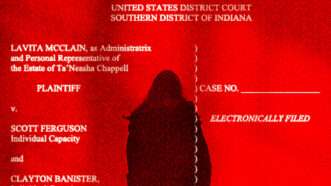
"They had a duty to protect her," says Ta'Neasha Chappell's sister. "She was not attended to because she was a Black woman and they didn't feel like she was worth getting any attention."

The idea has limitations, but would be a major improvement over the status quo.

Stellantis, one of the largest automakers on the planet with billions in cash on hand, got a generous handout from the state of Indiana for choosing to build its battery manufacturing plant there.

Seventeen retired federal judges, appointed by both Republicans and Democrats, filed a brief supporting his appeal.

The lawsuit alleges that TikTok's algorithm funnels inappropriate content directly to teens. That not only defies logic, but it is also antithetical to how a social media platform keeps users.


The Supreme Court's 2018 ruling in Timbs v. Indiana revived the Excessive Fines Clause. Now state courts have to come up with tests to determine what's excessive.

Taking personal responsibility turns out to be a better idea than putting faith in the state.


Terry Abbott couldn't afford representation, because the state took the cash he'd use to pay for it.

Plus: Ukraine war developments, Biden's new tax scheme, and more...

Both argue that the bills open the state up to costly lawsuits for very little, if any, gain.


New from Reason: a look into what Javier Milei has accomplished and what it will take to make the most of Argentina’s window for real change. Out now for subscribers.

