Increases in Coronavirus Cases Are Happening Mainly in States With Stricter COVID-19 Rules
The Washington Post nevertheless blames "a broad loosening of public health measures."


The Washington Post nevertheless blames "a broad loosening of public health measures."

The increase in the estimated infection fatality rate is especially large for the oldest age group.

A rough and optimistic projection for the pandemic ending sooner rather than later.

The comparison poses a puzzle for people who believe lockdowns were crucial in controlling the pandemic.

Research in Israel, the U.K., and the U.S. has found dramatic reductions in asymptomatic infections.

Greg Abbott's fear is hard to take seriously, but it jibes with hoary stereotypes about immigrants.

The governor's new policy represents a pretty modest shift from the existing rules.

Wondering what "95 percent efficacy" means? I've got some good news for you.

The same is true of Texas and California, which suggests that legal restrictions are not as important as politicians imagine.

Despite taking a much more restrictive approach, California saw a bigger surge than Texas, and the drop began around the same time in both states.

A comparison of Texas and California suggests that legal edicts matter less than The New York Times thinks.

Recent upward trends in cases and deaths seem to reflect virus transmission tied to holiday gatherings.

Good news from the latest Cancer Statistics 2021 report

Ramp up the vaccinations now!

It's not clear how long those hopeful trends will continue.

Centralization makes sense only if you ignore differences in local conditions—and trust the feds to make the right choices.

The evidence is limited and mixed, but data from New York, Minnesota, and California suggest that restaurants there account for a small share of infections.

We could double the number of Americans vaccinated against COVID-19.

The ban is "not a comment on the relative safety of outdoor dining," Mark Ghaly says, but part of the effort to keep people from leaving home.
Press coverage of the pandemic tends to exaggerate risk and ignore encouraging information.

The vaccines are great news, but the winter still looks bleak.

Everyone has a right to dissent from the epidemiologists' contentment with the way things are now.

Especially if the COVID-19 inoculations are deployed speedily and accepted widely.

Blood test study finds that only about 10 percent of Americans are immune to the virus.
That makes the disease much deadlier than the seasonal flu but not nearly as deadly as modelers initially assumed.

Legal responses to this fall's surge in new cases, like last spring's lockdowns, are frequently illogical and unscientific.

They help keep the disease from spreading, but they won't single-handedly keep the COVID-19 numbers from going up.

So far the president-elect's "expectation" is off by a factor of more than three, which does not bode well for his approach to the pandemic.

The president's COVID-19 adviser is not always right, but at least he is attempting to describe reality.
Peaks and valleys, a fall peak, or a slow burn?

Even after adjusting for age and comorbidities, researchers in New York and England found large improvements in patient survival.

That claim is wildly implausible and contradicted by the president's suggestion that COVID-19 was never much of a threat.

COVID-19 Cases are increasing faster than is testing, and that's not "fake news."

The president claims success based on a completely implausible worst-case scenario, while his opponent projects more than 3,700 deaths a day.
That is much lower than the toll from unintentional injuries, cancer, or heart disease but higher than the loss attributed to suicide or homicide.

The findings suggest that people infected in Connecticut were 10 times as likely to die as people infected in Utah or Oregon.

Both sides in the debate about face masks make claims that are not justified by the scientific evidence.
In younger age groups, the estimated risk is substantially lower than the overall IFR for the seasonal flu.

And is their luck running out?

Government officials think Americans can't handle the truth, an assumption that tends to backfire.

The comparison between Sweden and the U.S. casts doubt on the importance of broad legal restrictions.
The trends suggest that Sweden's less restrictive policy has been more successful at reducing fatal outcomes.

If the goal is minimizing the death toll over the long run, it is too soon to say.
The risk for the elderly is much higher, probably largely because of preexisting medical conditions.
The New York Times thinks so, but the data do not fit that hypothesis very well.
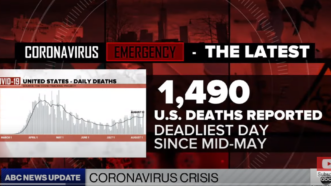
The coronavirus pandemic has ushered in an age of sloppy, inaccurate journalism and a heightened need for media literacy.
That scenario seems highly implausible based on what we know about the epidemic.
The trend means we should see declining daily deaths in the coming weeks.
Celebrate your independence with a subscription to Reason magazine, your most trusted source of honest, insightful news and analysis.