
The Volokh Conspiracy

Mostly law professors | Sometimes contrarian | Often libertarian | Always independent | Est. 2002

The Volokh Conspiracy

Eclipse Report

My encounter with totality.

|

What a day!  After two solid weeks of typical Vermont early spring weather - rain and snow and heavy cloud cover - Monday dawned bright and beautiful: blue skies, no humidity, and not a cloud in the sky. Along with a couple of old friends, we headed north from our house in southern Vermont in the early morning. We had originally planned to meet other friends in Burlington, but the weather reports were talking about clouds rolling in from the west, so we decided to find a spot up in Vermont's "Northeast Kingdom," near St. Johnsbury. We ended up in a great spot for viewing - a little local bar in the tiny town of East Burke, with a big grassy picnic area behind it with a great view, and maybe 40 or 50 so other folks, including lots of kids, hanging out and waiting for the Big Event.

The first hour leading up to totality was fabulous. With the glasses on, watching the moon - which was itself completely invisible - take a little chunk out of the sun, and then a bigger chunk, then a bigger chunk, … A gorgeous sight - the deep black of the moon's shadow against the intense gold of the sun, and the sharpness of the line between them, like it had been cut out with an Exacto knife.  It occurred to me that this was the first time I had ever seen a crescent sun. And when your neck got tired and you took off the glasses and looked around, the light was getting all weird and soft, and it was getting ominously colder and colder. It was like being outside during a sunset, but all in much speeded-up time - and with the sun, oddly, still high in the sky.

It was breath-taking, sort of in the way that your first view of the Grand Canyon, or Niagara Falls, is breath-taking. But then the last sliver of the sun gets smaller and smaller and finally disappears, and everyone whips off their glasses to look, and people start yelling and laughing hysterically and jumping up and down and hugging each other … Like shipwrecked sailors who finally spy rescue ships heading their way, to borrow a phrase from John Banville. Me included. It is, to begin with, stunningly beautiful. Suddenly, it is night. In the sky is this big black disk - blacker than any black you'll ever see - lit from behind and shooting out rays of white light across the suddenly-deep-black sky. And with one little spot of pure intense gold - the "ring" of the diamond ring - hanging off of its bottom edge. No description (or photo) can do it justice.

But it's not just that the sight is incredibly beautiful - it is that you literally cannot believe what you're seeing. We've all got a zillion images stored in our brains of what "the sky" looks like. But this!?

It doesn't compute; how can the sky look like this? When it has never looked anything like it before? It's as though all of the dogs in the neighborhood, at some pre-defined instant, sprouted wings and began to fly. This can't really be happening. But there it is - right before your eyes.

And then, having started at around high noon, and having passed through sunset and then darkest night, suddenly it's dawn, as the sun starts to come out from the shadow - a kind of reverse dawn, not with the sun "rising in the east" but emerging out of the west. And then it's around high noon again. All in the space of two hours. It's as though the whole astronomical clock on which we base everything we do had gone completely haywire.

Having been desperate to see an eclipse for the last 50 years, I was a little afraid beforehand that my expectations were so high that it would all turn out to be a bit of a bummer. Uh-uh.

The Tour de France has a grading system for the difficulty level for climbing - 1 to 5, I think, with 5 being the highest. But then there are some climbs that are so steep that they get a special category - "hors categorie," in "the category that is beyond category."  Unclassifiably steep, so steep it would be insulting to call it even a "5." That's what totality was like - hors categorie.

I will spare you a description of the drive back home. Turns out northeastern Vermont cannot handle 100,000 cars, all going south at the same time.

It does make you think: What the cavemen and cavewomen thought was going on if they ever happened to witness this display God only knows, but it must've scared the bejeesus out of them. It practically scared the bejeesus out of me, to be honest, and I knew what was happening (and, unlike the cavepeople, I knew it would be over soon).

And when you think that there's only one place in the universe (as far as we know) that has intelligent life on it, and that ours is the only planet in the universe (as far as we know) whose satellite moon, when viewed from the planet's surface, is precisely the right size and distance away from the planet to fit exactly over the (much larger and much more distant) star around which that planet is revolving … Like I said, it makes you think.
personal jurisdiction

Dormant Commerce and Corporate Jurisdiction

A look at personal jurisdiction after Mallory.

|

Personal jurisdiction aficionados have been buzzing about the Court's decision last summer in Mallory v. Norfolk Southern Railway Co. and what it might mean for jurisdiction over interstate corporations. In particular, Justice Alito's concurrence reintroduced some dormant-commerce questions that used to play a major role but have largely been forgotten since International Shoe.

I've got a new paper, forthcoming in The Supreme Court Review, which takes on the question. As it turns out, modern dormant-commerce doctrine puts some limits on state consent-by-registration statutes—but states can still do some important things that they couldn't do through minimum contacts alone. And as an original matter, assuming a "dormant" commerce clause exists, it likely doesn't say much about corporate recognition or internal affairs—or place many limits on a state's personal jurisdiction.

From the abstract:

Since 1945, the Court has sought for substantive rules of personal jurisdiction in the depths of Fourteenth Amendment due process. Mallory v. Norfolk Southern Railway Co. returns "dormant commerce" doctrine to the field—a place it occupied for several decades in the twentieth century, before being swept away and largely forgotten after International Shoe.

This Article assesses the impact of dormant commerce's return. Under today's doctrines, plaintiffs like Robert Mallory may face an uphill battle; yet they also have some good arguments on their side. On original grounds, moreover, it's far from clear that there is any dormant commerce doctrine, or that such a doctrine would have anything to say about the existence, powers, or internal affairs of state-created corporations in other states. At the Founding, states didn't have to recognize the privileges of foreign corporations at all, so they could make consent to local jurisdiction a condition of those privileges' local exercise.

By destroying the foundations of this earlier doctrine, the Supreme Court's turn-of-the-century dormant commerce cases eventually led to the recentering of personal jurisdiction on due process instead—and on complex and contradictory jurisdictional rules, less concerned with enforcing the actual Fourteenth Amendment than with preserving the legacy of International Shoe. If our doctrines of personal jurisdiction aren't going to make sense anyway, they may as well actually be law. Mallory doesn't quite get us there, but at least it points us in the right direction.

And from the introduction:

The intuition here is a simple one: "states don't have to have corporate law." If six Pennsylvanians at the Founding wanted to incorporate their backyard wheatfields, buying supplies and holding property under a common name, they'd have needed a Pennsylvania charter to do it; a permission slip from Virginia's legislature wouldn't have helped. For Pennsylvania to refuse to recognize Virginia's corporate charter wouldn't be to prefer its own goods and services over Virginia's (a potential dormant-commerce problem) or its own citizens over Virginia's (a potential Privileges-and-Immunities problem); at most, it'd prefer its own law over Virginia's for governing affairs inside its borders, something Pennsylvania has every right to do (and not a Full Faith and Credit problem). Nor would it treat these six citizens unfairly or arbitrarily (an equal protection problem); they could ask Pennsylvania to incorporate them on the same terms that anyone else can.

. . . [O]ver the last century or so, the Court developed a set of dormant-commerce limits on state corporate law—which by the early 1900s treated recognition of out-of-state corporations as something of a constitutional requirement, and which eventually extended to all aspects of a foreign corporation's internal affairs. As a matter of economic policy, maybe this wasn't so bad; if the Court's job in dormant-commerce cases is to act as a "junior-varsity Congress," maybe it succeeded in doing what Congress would have wanted done.

But policy decisions like these still need a basis in law—and not just in mistakes preserved as precedents, especially ones that depart demonstrably from the original rules. . . .

If the jurisdictional rules the twentieth-century Court came up with were uniquely sensible as a matter of policy, maybe their shaky origins wouldn't matter so much. But what we've been given is a system in which jurisdiction over a distant drug company turns on whether (unbeknownst to the defendant) a tourist ingested the defective pill in State A or State B; in which the forum for a local car accident turns on whether (unbeknownst to the plaintiff) the Ford Explorer XLT is marketed there or only the base model; and in which all these rules are ostensibly derived from the Fourteenth Amendment. The law may not have to make sense, but if our personal jurisdiction doctrines aren't going to make sense anyway, they may as well actually be law. Mallory doesn't quite get us there, but at least it points us in the right direction.

Or, as Larry Solum puts it:

Magnificent. Highly recommended. Download it while it's hot!

Do what the man says!

Politics

Hiring Opportunities with NCLA and SLF

|

I am happy to pass along two hiring announcements.

First, the New Civil Liberties Alliance is looking to hire a constitutional litigaiton fellow:

Eligibility: Lawyers at private law firms with 1-2 years of litigation experience OR fresh from one or more judicial clerkships. Someone between judicial clerkships would also be eligible.

Bar: Must have passed a bar exam that makes you eligible for admission to the DC Bar.

Highly competitive selection nationwide: Clerkship strongly preferred. Prior litigation experience required.

Fellowship Awarded by May 1: Decisions may be made on a rolling basis.

Work Location: NCLA's Washington, DC office with travel as needed for litigation. NCLA's office location will move to Virginia before the end of the Fellowship.

Litigation Experience: Fellows will start as 'second chair' on three cases. They will be expected to co-lead one case and initiate one other case throughout the one-year term of the CLiF.

Court Appearances: Fellows will make court appearances.

Fellowship Duration: 12 months, non-renewable.

Case Continuation: Fellows may 'keep' a case and work on it for NCLA as a pro bono firm project.

Second, the Southeastern Legal Foundation is looking to hiring a Litigation Attorney:

What our Litigation Attorneys do: 

  • Report to the VP of Litigation, work with our litigation team and Executive Director to execute with excellence the organization's strategies
  • Serve as lead counsel for SLF and as co-counsel with partner organizations in select cases under the guidance of the Director of Litigation and organizational leadership
  • Identify and represent pro-bono clients in court and through other legal processes
  • Identify creative legal strategies to help advance SLF's litigation priorities
  • Represent SLF publicly in various fora, including with allied organizations and the public
  • Support the work of other attorneys on the litigation team as needed
  • Support branding, communications, and marketing of the organization
  • Support key functions and organizational growth (development, communications, outreach, litigation)
  • Coordinate operations and strategies with like-minded organizations
  • Jump in, as the rest of the team does, when something needs doing!

What we're looking for: 

  • 2+ years of litigation experience preferred (Senior Attorneys 7+ years encouraged to apply also)
  • Demonstrated interest in the public interest approach to legal practice
  • Knowledge of the law in the areas of SLF's focus, with relevant policy knowledge being a plus
  • Willingness to take on issue areas or unpopular causes
  • Dedication to serving clients with the highest ethical standards
  • Commitment to the SLF mission
  • Ability to work difficult collaboratively but also manage responsibilities independently
  • Demonstrated ability to draft detailed memoranda on complicated issue of unsettled law
  • Experience in complex discovery
  • Strong verbal and interpersonal skills, media experience preferred
  • Admitted to one or more state bars
  • A sense of humor
  • Ability to travel occasionally
  • Judicial clerkship experience is a plus, but not required

I'm always happy to pass along other hiring opportunities.

Voting

Increased Voter Turnout Now Benefits Republicans

Survey data shows relatively infrequent voters are significantly more likely to support the Trump-era GOP than those who vote more often. Will this change traditional left and right-wing attitudes towards mandatory voting and other policies intended to increase turnout?

|

NA

Traditionally, Democrats and progressives have been sympathetic to policies intended to increase voter turnout, while conservative Republicans have been highly skeptical. Advocates of the most extreme such policy - mandatory voting - have also mostly been on the left. Most notably, then-president Barack Obama endorsed the idea back in 2015.

Both sides in this debate cite high-minded, nonpartisan rationales for their positions. For example, supporters of mandatory voting traditionally argue that voting is a civic duty. Opponents contend that it infringes individual liberty. But cynics have long wondered whether the real motive was partisan gain: perhaps liberal Democrats supported efforts to increase turnout because it would help them win, while conservative Republicans opposed them for the very same reason.

There was disagreement among scholars about the extent to which increased turnout really helped Democrats. The effect probably wasn't as great as many partisans imagined. Still, conventional political wisdom held that increased turnout at least benefited the political left at the margin.

Recent polling trends may put both cynical and idealistic explanations for these views to the test. In the Trump era, it is increasingly Republican candidates - especially Trump himself - who stand to benefit from higher turnout.

Dan Hopkins recently summarized some of these trends at the 538 website, in an article entitled "The Less You Vote, the More You Back Trump":

In 2016, former President Donald Trump was a political outsider looking to win the GOP nomination for president. In part, his campaign sought to appeal to voters who were disenchanted with politics.

Despite that, though, Trump wasn't significantly more popular with infrequent voters than with consistent voters….

Between Feb. 20 and March 18, 2024,* Gall Sigler and I oversaw a survey, fielded by NORC, of 2,462 English- and Spanish-speaking adults living in the U.S. According to public records, 63 percent of our respondents who reported being U.S. citizens turned out to vote in 2020…

And when we broke out respondents by their voting history, we found dramatic differences in whom they support for president in 2024. President Joe Biden performed much better among frequent voters, while Trump had a large lead among people who haven't voted recently. Specifically, among respondents who voted in the 2018, 2020 and 2022 general elections, Biden outpaced Trump 50 percent to 39 percent. But among respondents who were old enough to vote but voted in none of those three elections, Trump crushed Biden 44 percent to 26 percent.

Hopkins goes on to note that this pattern helps explain why the Democrats did relatively better in the comparatively lower-turnout off-year elections of 2018 and 2022 than in the presidential election year of 2020.

One obvious explanation for Democrats' newfound advantage among more frequent voters is the rise of the "diploma gap" under which voters - especially whites - with higher levels of education have become more likely to support Democrats, while lesser-educated voters have moved in the opposite direction. Education is highly correlated with voter turnout, with more educated citizens being much more likely to vote.

Perhaps the diploma gap - and resulting partisan turnout differences - will diminish or disappear. But if it persists, it will be interesting to see if intellectuals' and political activists attitudes towards turnout will switch. Will Republicans become advocates of increasing turnout, or even embrace mandatory voting? Will Democrats become more skeptical of such measures? Time will tell.

I myself have long been skeptical of the value of increasing turnout, and am also a longtime opponent of mandatory voting (see, e.g., here, here, and here). I think most people do not have a duty to vote, even in high-stakes elections. And I have argued that relatively ignorant citizens can often do more good by abstaining from voting than by casting poorly informed votes (though I am also skeptical of arguments that government should try to weed out ignorant voters, primarily because I doubt that it can be trusted to do so in an unbiased way). The latter skepticism also makes me wary of "epistocracy."

In addition to libertarian objections to the coercion inherent in mandatory voting, my main reason for these stances is that nonvoters and infrequent voters tend to be even more ignorant about government and public policy than those who vote more often. Thus, major increases in turnout are likely to exacerbate the already severe problem of political ignorance. Mandatory voting would be even worse. I held those views back when increased turnout was generally believed to benefit Democrats, and I continue to hold them today.

It isn't just that a more ignorant electorate is likely to make worse choices among the options before them. It is that those options are likely to be worse to begin with. Parties facing a relatively ignorant election are likely to select lower-quality candidates and policies than those facing a more knowledgeable one. I describe the logic behind this more fully in my book Democracy and Political Ignorance.

This connection between voter knowledge and relatively good policy outcomes is not an iron law. In Chapter 2 of my book, I go over some scenarios where voter ignorance can actually be beneficial. But I also explain why such situations are likely to be unusual.

You might still support increased turnout or mandatory voting if you believe political ignorance doesn't matter much; for example, some scholars argue ignorant voters can use "information shortcuts" to make good decisions, or that "miracles of aggregation" lead the electorate to make good aggregate judgments even if most individual voters know very little.

I am a longtime critic of such voter-knowledge optimism, for reasons discussed in detail in Chapter 4 of Democracy and Political Ignorance. On that score, I notice greater sympathy for my pessimism among left-liberals since the rise of Trump, than before. At the very least, it may be hard for people on the left to praise higher turnout and dismiss concerns about voter knowledge in a world where less-frequent and more ignorant voters tend to back candidates like Trump, whose agenda left-wingers believe (often for good reason!) to be horrendously awful.

By contrast, right-wing intellectuals and activists sympathetic to Trumpism might potentially become advocates of policies that boost turnout, or even mandatory voting. They could also downplay or dismiss concerns about ignorance, perhaps by adopting traditionally left-wing shortcut and miracle of aggregation arguments. The latter might be a natural extension of the MAGA right's embrace of populism. I think we already see some elements of this in the right's tendency to dismiss the dangers of political misinformation.

I am far from sure that the right and left will completely switch sides on issues related to voter turnout. Long-held attitudes may be "sticky." But I would not be surprised to see at least some significant movement in that direction.

Equal Protection

Indiana Court Rejects Claim That Driver's Licenses Must Include Third Gender Option

The court reverses a contrary trial court decision.

|

From Indiana Bureau of Motor Vehicles v. Simmons, decided yesterday by the Indiana Court of Appeals, in an opinion by Judge Randall Shepard, joined by Judges Cale Bradford and Paul Felix:

The Appellees initiated litigation seeking to compel the Indiana Bureau of Motor Vehicles and Commissioner Joseph B. Hoage to include a third gender option on driver's licenses and identification cards. The trial court so ordered. Finding error, we reverse and remand with instructions….

Statutory Interpretation: The court also concluded that the Indiana statute requiring that driver's licenses include the person's "gender" was intended to refer to "sex," and that in turn "refers only to the binary biological classifications of male and female or whether it is a broader term that also includes non-binary classifications."

Equal Protection: The court rejected the trial court's conclusion "that the agency's refusal to issue a non-binary designation on state credentials violates the Appellees' Fourteenth Amendment right to equal protection by impermissibly treating them differently from persons who identify as binary":

Read More

Berkeley Students Post Anti-Semitic Cartoons, Disrupt Dinner at Dean Chemerinsky's Home

"I never thought I would see such blatant antisemitism."

|

Back in October, UC Berkeley Dean Erwin Chemerinsky wrote that "Nothing has prepared me for the antisemitism I see on college campuses now." At the time, I praised Erwin's bold remarks, though I feared things would only get worse. And they have.

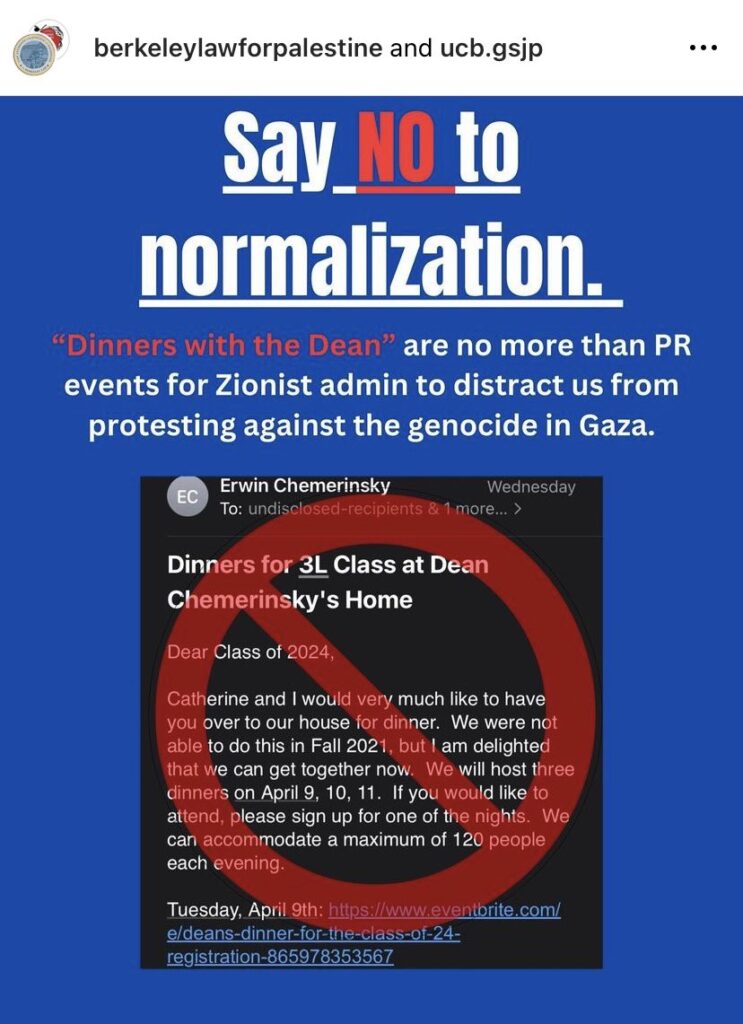
Last week, Berkeley Law Students for Justice in Palestine depicted Dean Chemerinsky in a cartoon with blood-soaked utensils. This image appeals to the ancient blood libel that has pervaded anti-semitic propaganda for millennia. That students thought this image was appropriate is shocking. Failure to use the appropriate pronouns is immediately grounds for cancellation. But invoking the trope that Jews eat children is just another meme.

The purpose of this cartoon was to encourage students to protest a student dinner that Chemerinsky was scheduled to hold at his home.

Regrettably, students protested the dinner at Erwin's home. So far, I have only found a short video posted by supporters of the protest. It shows Chemerinsky's wife, Prof. Catherine Fisk, trying to take the microphone away from the student. We do not know what happened beforehand. Remarkably, the student said she had a First Amendment right to protest in Erwin's home. Erwin, ever the teacher, actually said "the First Amendment does not apply." Even as these students are disrupting a dinner at Chemerinsky's own home, Erwin still felt compelled to be the bigger person, and an educator.

Here is Erwin's description of the event:

I write this with profound sadness. Since I became a dean, my wife and I have invited the first-year students to our home for dinner. We were asked this year by the presidents of the third year class to have the graduating students over for dinner because they began in Fall 2021 when COVID prevented us from having dinners for them. We were delighted to oblige and designated three nights – April 9, 10, 11 – that graduating students could choose among. I never imagined that something that we do to help our community would become ugly and divisive.

Last week, there was an awful poster, on social media and bulletin boards in the law school building, of a caricature of me holding a bloody knife and fork, with the words in large letters, "No dinner with Zionist Chem while Gaza starves." I never thought I would see such blatant antisemitism, with an image that invokes the horrible antisemitic trope of blood libel and that attacks me for no apparent reason other than I am Jewish. Although many complained to me about the posters and how it deeply offended them, I felt that though deeply offensive, they were speech protected by the First Amendment. But I was upset that those in our community had to see this disturbing, antisemitic poster around the law school.

The students responsible for this had the leaders of our student government tell me that if we did not cancel the dinners, they would protest at them. I was sad to hear this, but made clear that we would not be intimidated and that the dinners would go forward for those who wanted to attend. I said that I assumed that any protest would not be disruptive.

On April 9, about 60 students came to our home for the dinner. All had registered in advance. All came into our backyard and were seated at tables for dinner. While guests were eating, a woman stood up with a microphone, stood on the top step in the yard, and began a speech, including about the plight of the Palestinians. My wife and I immediately approached her and asked her to stop and leave. The woman continued. When she continued, there was an attempt to take away her microphone. Repeatedly, we said to her that you are a guest in our home, please stop and leave. About 10 students were clearly with her and ultimately left as a group.

The dinner, which was meant to celebrate graduating students, was obviously disrupted and disturbed. I am enormously sad that we have students who are so rude as to come into my home, in my backyard, and use this social occasion for their political agenda.

The dinners will go forward on Wednesday and Thursday. I hope that there will be no disruptions; my home is not a forum for free speech. But we will have security present. Any student who disrupts will be reported to student conduct and a violation of the student conduct code is reported to the Bar.

I have spent my career staunchly defending freedom of speech. I have spent my years as dean trying hard to create a warm, inclusive community. I am deeply saddened by these events and take solace that it is just a small number of our students who would behave in such a clearly inappropriate manner.

Erwin

Things will only continue to get worse.

UPDATE: Here is a video that shows more of the disruption. The student says that the National Lawyers Guild informed her she has a First Amendment right to speak at Chemerinsky's home. The NLG also organized the protest of my event at CUNY on (checks note) the importance of free speech.

Judge Gibbons's Replacement By Her Former Clerk Would "Flip" The Sixth Circuit

Gibbons declined to take senior status during the Trump years, but will now be replaced by her former law clerk.

|

The Sixth Circuit, where I clerked more than a decade ago, has sixteen active judgeships. At present, there are four nominees from President George W. Bush (Sutton, Gibbons, Griffin, Kethledge) and six nominees from President Trump (Thapar, Bush, Larsen, Nalbandian, Readler, Murphy). And there are two nominees from President Clinton (Moore and Clay), one from President Obama (Stranch), and three from President Biden (Davis, Mathis, Bloomekatz).

One might think that an en banc court with ten appointees from Republican Presidents and six appointees from Democratic Presidents would consistently lean to the right. But not so. To command a majority on this even-numbered court, you need nine votes. And in recent years, finding those nine votes has been tougher and tougher. For starters, Chief Judge Sutton has long taken the policy that en banc review should be used sparingly, as the Supreme Court can correct errors. Maybe that policy made some sense a decade ago, but with the Supreme Court taking fewer and fewer cases, and circuit splits festering, the en banc/certiorari calculus should be rejiggered. (Sutton may have departed from that policy, at least in part).

Making the math even tougher is that two of the W. Bush appointees have voted more and more with the Court's liberals: Judge Richard Alan Griffin from Michigan and Judge Julia Smith Gibbons from Tennessee. One such case from 2021 was the OSHA Vaccine mandate case. The en banc court split 8-8, with Judges Griffith and Gibbons declining to join Judge Sutton's dissental. In reality, what looks like a 10-6 court on paper is probably closer to a 9-7 or 8-8 court in practice.

Whatever the split is now, it is poised to change. In August 2023, Judge Gibbons announced that she would assume senior status "upon confirmation of [her] successor." In recent years, it has been very rare for a circuit judge to be voluntarily replaced by a President of the opposite party--the so-called "flipped" seat. Judge Gibbons, who was appointed as a district court judge in 1983 at the age of 32, has been eligible for senior status since 2015 or so. But she chose not to take senior status during the four years of the Trump presidency. I have been reliably informed that she did not want President Trump nominating her replacement.

On March 20, 2024, nearly seven months after Gibbons's letter, President Biden announced his intent to nominate Kevin Ritz, the U.S. Attorney for the Western District of Tennessee, to replace Judge Gibbons.

Ritz, a white man, is unlike most of Biden's circuit nominees. Indeed, his other three appointees to the Sixth Circuit were a black woman, a black man, and a white woman. Why would Biden make such a undiverse pick? Perhaps the most salient line on Ritz's biography is that he clerked for Judge Gibbons in 2004.

It is not difficult to speculate that Ritz may have been selected to induce Judge Gibbons to take senior status. This sort of understanding is common enough. There were many rumors that Justice Kennedy was encouraged to retire, with the knowledge that he would be replaced by one of his clerks, namely Justice Brett Kavanaugh. Ditto for Justice Breyer, who was replaced by his former clerk, Justice Ketanji Brown Jackson. On the Ninth Circuit, Judge Johnnie Rawlinson told the Biden administration that she could be "persuaded" to take senior status if one of her former clerks to replace her. (Rawlinson has not yet taken senior status.) On the Seventh Circuit, Judge Michael Kanne withdrew his senior status announcement when President Trump did not nominate his former clerk. (Kanne died in 2022 and was replaced by a Biden nominee.) On the Ninth Circuit, Judge Diarmud O'Scannlain was almost replaced by former-clerk Ryan Bounds, but after his nomination faltered, he was replaced by another clerk, Danielle Forest (formerly Hunsaker). On the Eighth Circuit, Judge Roger Leland Wollman was replaced by his former clerk, Jonathan A. Kobes. I'm sure there are more judges who were replaced by their former clerks that I'm forgetting, but these recent selections are fresh in my mind.

For those curious, the Office of Legal Counsel found that the federal nepotism statute cannot be used to constrain the President's appointment power of federal judges. This issue arose after President Clinton nominated Judge William Fletcher to sit on the Ninth Circuit along with his mother, Judge Betty Fletcher. I think there could be other neutral reforms to constrain judges hand-picking their successors, which I'll address for another time.

I'll let Tennessee politicos speculate about whatever backroom deals led to Ritz's appointment. I have been reliably informed that Ritz will not receive blue slips from the two Republican Senators in Tennessee. For present purposes, it is enough to state the Gibbons's replacement with Ritz would effectively flip the en banc court from a nominally conservative circuit to a evenly-balanced, if not left-leaning circuit. Litigants who may have otherwise found the Sixth Circuit favorable will now look to greener (redder?) pastures, such as the Fifth Circuit. There are consequences here that stretch far beyond Judge Gibbons and any potential desire to be replaced by her former law clerk. We are getting close to the end of President Biden's first term. The Ritz nomination, along with the Mangi which would flip the Third Circuit, will come down to the wire.

McConnell and Schumer Offer Dueling Approaches To Judicial Reform

McConnell's bill would ensure that no one can benefit from nationwide injunctions. Schumer's bill would ensure that liberal litigants still benefit from nationwide injunctions.

|

One of the few silver linings on the Judicial Conference's ill-fated "guidance" document is that the judges have stimulated debate in the legislature--where these debates belong. Now, the senate leaders of the Democratic and Republican parties have introduced judicial reform bills. I have not obtained a copy of Schumer's bill, though the New York Times offers this description:

Senator Schumer's bill tracks the guidance last month from the Judicial Conference, the federal judiciary's policymaking body. It would end the most targeted form of judge shopping, where plaintiffs game a district's case-assignment system by filing in a small division staffed by one or two judges.

The Schumer bill, as I understand it, would in no way limit the remedy that a particular judge can issue. It would simply limit which judges can issue that remedy. Again, the "random" reassignment will necessarily take cases away from judges in remote outposts, and transfer those cases to judges in urban areas. That is a feature, not a bug of the Judicial Conference's policy, and now Schumer's bill. And nothing will diminish the ability to draw a favorable court in San Francisco, Green Belt, Portland, and a host of other friendly venues.

Senator McConnell's bill, which I do have copy of, addresses the actual underlying problem: single judges immediately altering nationwide policy. The Times explains:

Senator McConnell's bill does not address concerns about plaintiffs who strategically file in single-judge divisions. Instead, it seeks to curtail the power of a single district court judge to issue a nationwide injunction and block federal policy across the entire country. The bill would limit the scope of district-court rulings to the parties in the case, or similar parties within the borders of the district. If a federal judge found that a U.S. immigration policy were unconstitutional, for example, that decision would not, under Mr. McConnell's bill, have any immediate effect outside the borders of the judge's district. The McConnell bill also would set new limits on where litigants in patent cases and debtors seeking bankruptcy can file their cases.

Here is the text:

''Notwithstanding any other provision of law, a district court may not issue any order providing injunctive relief unless such order is applicable only to—

''(1) the parties to the case before the court; or

''(2) similarly situated individuals in the judicial district in which the district court has jurisdiction.''

If district courts could not issue universal injunctions, the incentive to forum shop those judges would be far, far less. It is not clear that this bill would apply to APA vacatur under Section 706. It would be useful for Congress to clarify the scope of Section 706 relief in another policy.

Professor Steve Vladeck criticized the McConnell bill:

Stephen Vladeck, a professor at the University of Texas Law School, said that Senator McConnell's proposed elimination of nationwide injunctions would go too far. "The most sensible view is that there are too many, but not that they should be none," he said. "To say 'no more nationwide injunctions ever' is to solve the wrong problem."

Let's be very clear here. Under the Schumer bill, the California Attorney General can still reliably obtain nationwide relief against a Republican President by filing in the bastion that is NDCA. But the Texas Attorney General will be curtailed in his ability to seek similar relief against a Democratic President by filing anywhere in Texas. The Schumer bill, much like the Judicial Conference policy, fixates on the specter of "judge shopping" without even recognizing how the forums are stacked in urban areas.

The McConnell bill has the virtue of addressing the underlying problem in a way that would impact both sides of the aisle equally. The McConnell bill also addresses actual judge shopping in bankruptcy and patent cases.

At bottom, we are left with nationwide injunctions for me but not for thee. Or, my nationwide injunctions are good and yours are bad.

For what it's worth, the Supreme Court could actually do something to reform nationwide relief, instead of just complaining about it on the emergency docket. Chief Justice Roberts is fine with the D.C. Circuit issuing a dozen vacaturs before lunch, but heaven forbid a few judges in Texas issue them. And if Trump wins the election, all voices about limiting nationwide injunctions will immediately silence.

I am working on a series of proposals for judicial reform that would weaken both sides equally. For any bill to pass, it cannot be unilateral disarmament. The Schumer bill, and the Judicial Conference policy, amount to unilateral disarmament. I think the McConnell bill accomplishes bilateral disarmament.

Update: My friend Sam Bray made similar points in a post published shortly before mine:

And there is a new push from Senator McConnell to end the national injunction–which should be welcomed by Democrats and Republicans alike, because everyone has felt and will feel the pain. (The counter-argument in the NY Times article just linked to, given by Professor Vladeck, that we should have some national injunctions instead of none, doesn't work, because no one has come up with an effective limiting principle and it inevitably turns into ideological station identification: "good" national injunctions for me, "bad" national injunctions for thee.)

New Light on the National Injunction

|

Sometimes it seems like nothing ever changes with the national injunction. Federal district courts still give them, with all of the predictable consequences related to forumshopping, percolation, end runs around class actions, and rushed decisionmaking with slender factual records. But there are changes. Some federal courts of appeals have been growing noticeably more skeptical about national injunctions (e.g., the Eleventh). There has been a shift from injunctions to the so-called remedy of "vacatur." And there is a new push from Senator McConnell to end the national injunction--which should be welcomed by Democrats and Republicans alike, because everyone has felt and will feel the pain. (The counter-argument in the NY Times article just linked to, given by Professor Vladeck, that we should have some national injunctions instead of none, doesn't work, because no one has come up with an effective limiting principle and it inevitably turns into ideological station identification: "good" national injunctions for me, "bad" national injunctions for thee.)

And now we have another new development--quite literally, because the Harvard Law Review's new Developments in the Law has just dropped. Chapter 4 is called District Court Reform: Nationwide Injunctions, and it's very impressive. Here are a couple paragraphs from the introduction:

A robust scholarly literature has grappled with these questions. Some scholars, jurists, and attorneys criticize the practice of district courts issuing nationwide injunctions as an inappropriate abuse of power.14 Others defend nationwide injunctions as a powerful way to check federal agency overreach and ensure robust relief for plaintiffs.

This Chapter explores these arguments, considering court reform at the district-court level. It also builds on a list of injunctions solicited from the Department of Justice (DOJ) to provide the first empirical evidence documenting a trend that has not been, until now, fully quantified: nationwide injunctions have indeed grown much more common, dramatically spiking during the Trump Administration before decreasing during the Biden Administration. Section A of this Chapter quantitatively surveys this rise. Given this trend, section B identifies the troubling policy consequences of more frequent nationwide injunctions. Section C surveys proposals for reform, taking into consideration the ways in which judges have recently responded to this trend with apparent self-restraint and self-awareness.

One note--although national injunctions have fallen dramatically during the Biden administration, as the Developments chapter notes this is to a substantial degree an artifact of litigants and district courts switching from national injunctions to "universal vacatur." The bi-partisan destruction that the national injunction and its "evil twin" bring--thwarting most major domestic presidential initiatives since 2014--continues apace.

Here is the appendix with the dataset. And I have it on good authority that the authors of this terrific contribution to the debate are Laura Aguilar and Layla Rao--well done!

Harvard

Remarks to the HLS FedSoc Alumni Dinner

And in memory of Prof. Charles Fried.

|

Recently I was honored to be chosen as the faculty advisor to Harvard's student chapter of the Federalist Society, the successor to the late Charles Fried. This past weekend I gave some remarks at their annual alumni banquet, both to remember Prof. Fried and to set out some challenges before us. In case any of you have an interest in reading them, I thought I'd post the remarks here.


I'm very honored and deeply grateful to be here as the second faculty advisor to the Harvard Law student chapter of the Federalist Society.

It's unusual, to say the least, in a chapter now four decades old, that I would be only the second such advisor. And so I don't think we can let this occasion pass without remembering the first such advisor, Charles Fried, and without raising a glass in his memory.

Charles Fried led a life and career that should offer grounds for admiration to all of us. Solicitor General of the United States, Associate Justice of the Supreme Judicial Court of Massachusetts, the Beneficial Professor of Law, a teacher and mentor to many, a father and a grandfather—as they say, we should all be so lucky.

My father Alan Sachs, HLS Class of 1970, was Prof. Fried's student and remembers him and his class fondly. Another of Prof. Fried's students, a dissertation advisee, recently told me how her first substantive meeting with him involved the two of them starting to discuss what she had written and then arguing with raised voices and at full tilt for an hour—at the end of which he broke into a broad smile and asked when they should meet to discuss the next chapter.

Those of my colleagues who've had more time to share with him on this faculty universally praise his wit, his collegiality, and his generosity of spirit. And if, when my turn comes, my successor as the third faculty advisor to our FedSoc chapter can have as much respect for me as all those I've met here have for Prof. Fried, I'd be a lucky man indeed.

And Prof. Fried was, as well as an extraordinary man, extraordinarily lucky.

Karel Fried was born in Prague in 1935—and for Jews, "born in Prague in 1935" is not usually the prologue to a long or happy life. His family was able to flee in 1939 just ahead of the Nazis, arriving in New York in 1941. As he told us at the faculty lunch table a few months ago, his father initially intended that the family settle in South America; it was only the happenstance of the young Charles's contracting a childhood illness, restricting their immigration for several months, that kept them in the United States instead of Bogotá. That was our good fortune as well as his; but it wasn't just good fortune that made the United States a place where the Fried family could go, and where they could be among the few who were safe in a very dangerous world.

The principles of the Federalist Society, whose Harvard chapter Prof. Fried long advised, are very familiar to you, and I have no need to repeat them. But I worry, thinking of Prof. Fried's life and example, that we often think of them in reverse order.

We spend a lot of time talking about the third principle, how the province and duty of the judiciary is to say what the law is, and not what it should be. Most of our time in class, and a good deal of your time out of class, is spent reading, and discussing, and underlining, and highlighting, and annotating, and summarizing, the work of courts and judges, and seeing how often they fall short of that ideal. And this is worth doing, both for its own sake and as part of your training to be lawyers.

When we can raise our eyes a little bit from the details of the casebooks, we're able to spend a reasonable amount of time—though somewhat less than before—on the second principle, that the separation of governmental powers is central to our Constitution. We debate it, we design student symposia around it, we center on it our abstract debates of constitutional interpretation and legal theory. And this, too, is worth doing, both as scholars and as citizens.

But the most important principle, on which we spend perhaps the least amount of our very limited time, is the one that's listed first—that the state exists to preserve freedom. And it is this that our Constitution and its separation of powers, and our judges and courts and lawyers who work under them, are designed to serve.

In 1861, in the early days of a Civil War in which no one yet knew that the Union would survive, Abraham Lincoln jotted down some fragmentary thoughts on how the Constitution, even the Union itself, didn't exist for their own sake, but rather to preserve the freedoms named in the Declaration of Independence—the Proverbial "golden apple in the silver frame."

Thinking of the remarkable prosperity and energy of the Republic he now led, he wrote,

All this is not the result of accident. It has a philosophical cause. Without the Constitution and the Union, we could not have attained the result; but even these are not the primary cause of our great prosperity. There is something back of these, entwining itself more closely about the human heart. That something is the principle of "Liberty to all"—the principle that clears the path for all—gives hope to all—and, by consequence, enterprize, and industry to all.

The expression of that principle in our Declaration of Independence was most happy, and fortunate. Without this, as well as with it, we could have declared our independence of Great Britain; but without it, we could not, I think, have secured our free government and consequent prosperity. No oppressed people will fight and endure, as our fathers did, without the promise of something better than a mere change of masters.

The assertion of that principle, at that time, was the word, "fitly spoken" which has proved an "apple of gold" to us. The Union, and the Constitution, are the picture of silver, subsequently framed around it. The picture was made not to conceal or destroy the apple; but to adorn and preserve it. The picture was made for the apple—not the apple for the picture.

So let us act, that neither picture or apple shall ever be blurred, or bruised or broken.

That we may so act, we must study, and understand the points of danger.

The fragment breaks off there. And while our days, thankfully, are not so dark as Lincoln's were, we, too, must study and understand the points of danger, even as we study and understand secured transactions or the Chenery doctrine or whether the executive has a removal power.

To have a government that's strong enough to preserve freedom from those who would destroy it from without—those from whom Prof. Fried's family fled—and yet principled enough to resist the shortcuts and compromises and self-serving impulses that can undermine freedom from within, is something historically rare and practically difficult.

We don't have a world in which men are angels, as Federalist 51 tells us; nor do we have a ready supply of angels who are to govern men. All we've got is "a government which is to be administered by men over men," in which "the great difficulty lies in this: You must first enable the government to controul the governed; and in the next place, oblige it to controul itself."

Sometimes it may seem like we're faced with a choice between leaders who would scorn the powers of government, the better to praise its limits; and those who would scorn the limits on government, the better to praise its powers.

Our work in the law is only one small corner of the work that has to be done to create a society whose strength can adequately protect its freedoms, and whose freedoms—as Lincoln described—can properly inspire and justify that strength.

That's why FedSoc is a society for law and public policy studies—considering not only the work set out for lawyers and judges, but that set out for legislators, officials, soldiers, scholars, and ordinary citizens. It is not for us to complete that work, but neither are we free to refuse it.

Only a few months before he died, Professor Fried gave his last Harvard faculty workshop, on a book project entitled Metanoia—a term with which I'm willing to admit I was unfamiliar beforehand (and maybe some of my colleagues were too), but which Oxford defines as "The act or process of changing one's mind."

The book discussed a series of people who had changed their minds on very important issues, even late in life. But in particular, metanoia is defined as an act of "penitence" or "repentance." Not just a rending of garments, with ashes and sackcloth and such, but a returning, a renewing—the kind of repentance that the author of Lamentations hoped would "renew our lives as in days of old."

I'm sure I disagreed with Prof. Fried on a variety of things, both before and after his various changes of mind. But I am convinced that his willingness to reconsider, to seek after the truth even late in life with the same energy and in the same spirit of inquiry as at the beginning, is a quality to which we should all aspire—and a quality that a nation that many see as in need of renewal needs too, just as much in its two-hundred-and-fiftieth year as in its first.

It's often said of child-rearing—and with girls at nine and eleven, I can authoritatively agree—that the days are long but the years are short.

Your time in law school may seem like a very long three years, but it also goes by very quickly, more quickly than you might expect. And indeed our lives in the law, as well as out of it, even lives as long and accomplished as Professor Fried's, are shorter than we think too. My hope tonight is that we may all use them as well as he did, and leave something even better for those who come after us.

Free Speech

From Prof. Adam Candeub on the Texas Social Media Law

|

I'm glad to be able to pass along this item from Prof. Candeub (who has written extensively on this general subject):

The Texas social media law (H.B. 20) requires the major social media platforms to refrain from discrimination on the basis of viewpoint, thereby allowing those of all political, religious, and social views to participate in what the Supreme Court has called our "modern public square." The platforms challenged the law on First Amendment grounds in NetChoice v. Paxton, and the Court heard argument last February.

One of the arguments in favor of the law is that Texas can impose non-discrimination mandates on social media firms pursuant to its power to regulate public accommodation and common carriers. Grounded in actions of assumpsit dating back to the early-17th century common law, public accommodation law traditionally required businesses making generalized offerings of goods or services to the public to accept all customers—though at common law, such businesses could refuse or terminate a service offered to all in a general undertaking if they offered a legally valid reason, as Adam J. MacLeod explains. Property owners do not have absolute rights under the First Amendment to exclude speakers or speech they dislike or wish to suppress. Modern public accommodation, first codified in the mid-19th century, rejects certain types of discrimination as valid.

Similarly, under common carrier law, a legal category that predates public accommodations, firms that engage in the business of transmitting messages as part of an undertaking to provide carriage to everyone, such as letter and package carriers, telephones and telegraphs, must carry the speech of all regardless of viewpoint or the content of the message, as I explain.

Read More

Free Speech

Pennsylvania Trial Court Rejects Pseudonymity in Defamation Suit Over Sexual Assault Allegations

(as well as other allegations).

|

Allegheny County Judge Chelsa Wagner's decision last week in Doe v. Hardy (Pa. Ct. Com. Pl.), didn't explain its rationale, but here is the argument that the court rejected, which also includes the background factual allegations:

Plaintiff John Doe and Defendant Brian Hardy are both members of the Phi Kappa Tau ("PKT") Fraternity and alumni of the Westminster College chapter. Doe and Hardy maintained their involvement with PKT and the Westminster chapter following their respective graduations.  They held various positions with the national fraternity and held advisory board positions with the Westminster chapter.

In 2021, Doe raised concerns regarding a loan received for fraternity house renovations and possible self-dealing and policy violations, which involved Hardy.  In retaliation, Hardy took steps to harm Doe's reputation and professional relationships by defaming and disparaging him.

Hardy falsely accused Doe of sexually assaulting a student, being a predator, preying upon vulnerable undergraduate students, victimizing Westminster College students, offering alcohol to underage students, plying underage students with alcohol, regularly visiting the Westminster fraternity house and partying with fraternity brothers, intentionally failing to report fraternity brothers selling drugs and the alleged sexual assault of a student, and having been banned from PKT's headquarters from working in any capacity with undergraduate students.

Read More

Donald Trump

What Should a Textualist Think about Trump's Claims of Presidential Immunity?

An interesting amicus brief urges the justices not to rely upon penumbras and emanations in construing the scope of Presidential immunity.

|

Lots of amicus briefs have been filed for and against former President Trump's claims of immunity from prosecution for his actions on January 6 in Trump v. United States. Among the more interesting briefs filed on behalf of respondents is an amicus brief for Stephen McAllister and Scott Paul (with Erik Jaffe and James Heilpern on brief as counsel) argues that existing precedents on presidential immunity lack a textual basis and that, if the Supreme Court's majority is to be as textualist as it purports to be, it should not extend or build upon this non-textual precedent.

Here is the brief's summary:

Amici agree with Respondent and the panel below regarding the question presented that Presidents, like all other citizens, are not immune from the consequences of violating federal criminal law. Amici take no position here on any potential legal questions antecedent or subsequent to the question presented. And they take no position on whether the facts and the law will ultimately result in conviction, acquittal, or dismissal on other grounds.

Amici write separately to emphasize how Petitioner's claims of immunity lack any basis in the Constitution's text. Indeed, Petitioner's claims flout this Court's repeated and recently enhanced emphasis on looking to the original meaning of such text, as interpreted by history and tradition, rather than relying on penumbras, emanations, reading between the lines, historical practices not incorporated into the text, or, ultimately, the policy preferences and balancing of judges imposed upon such Rorschach-like non-textual approaches.

It has been the decades-long project of conservative jurisprudence to get away from such subjective and malleable approaches to constitutional and statutory interpretation, and this case is not the place to backslide on such jurisprudential principles. Alleged violations of federal criminal law are not discretionary choices left to the President by the Constitution or statute. Even Presidents must be legally accountable for violations of the laws they are sworn to faithfully execute.

The Constitution itself provides no textual basis for Presidential immunity from federal criminal laws. When Petitioner cites actual constitutional provisions, he either invokes the strained implications— penumbras and emanations, perhaps—of clauses that say nothing about immunity, or gets things exactly backwards. When it comes to text, reading is fundamental.

The mere vesting of executive authority says nothing about immunity when such authority is abused or exercised in violation of laws enacted pursuant to Congress' legislative authority. Nothing in the text suggests it is left to the discretion of the President to violate federal or constitutional commands and limitations. And nothing in the text precludes the executive branch from deciding whether to lawfully prosecute previous Presidential violations of the law in the federal courts.

The Impeachment and Impeachment Judgment Clauses likewise provide no immunity to Presidents and do not establish a condition precedent for prosecution. Indeed, the Impeachment Judgment Clause supports exactly the opposite conclusion, serving as a negation of any imagined double jeopardy constraints based on conviction by the Senate. In doing so it confirms that ordinary legal accountability against Presidents is the default legal regime that is not to be displaced regardless of the outcome of impeachment and trial.

Structural concerns and other provisions of the Constitution likewise do not support presidential immunity from federal criminal law. The mere delegation of power does not imply absolute discretion in its exercise, and other so-called structural arguments amount to little more than policy arguments regarding which courts are not the proper arbiters. And, where the Constitution intended immunity for elected officials, it said so explicitly and with built-in limitations, such as in the Speech and Debate Clause, providing specific, but certainly not absolute, immunity to Senators and Representatives. The absence of a comparable provision for Presidents and other executive officers should be more than sufficient to dispose of Petitioner's claimed immunity.

Unable to point to any immunity provision in the Constitution itself, Petitioner relies on older precedent based upon the very methodologies now viewed as illegitimate. While others will discuss the finer points of this Court's past precedent and why it does not apply to this case, Amici here merely note that such precedent lacks any coherent textual basis and, at a minimum, should not be extended further.

Finally, this Court should resist any policy urges to invent immunities for the President and instead hold that the agent of the People charged with faithfully executing the laws is also subject to those self-same laws and will not be given a free pass out of fear for the consequences of applying the Constitution as written. If there is a problem with perceived risk to future Presidents, it is Congress, via legislation, that is best suited to strike that balance and provide any limited immunity it might deem appropriate. While there are legitimate differences of opinion regarding the proper balance between rule of law versus executive timidity, it is decidedly not the role of this Court to strike that balance.

Insofar as the Court insists on drawing lines, however, it should take a narrow view of what presidential conduct is "discretionary" and hold that even otherwise "official" conduct that violates federal criminal law is ultra vires and hence neither discretionary nor immunized from the criminal consequences of such violation. Indeed, the constitutional command that a President "take Care that the Laws be faithfully executed" provides as good a basis as any for holding, at a minimum, that intentional or reckless violations of federal criminal laws are not part of the "faithful[]" execution of the laws and not entitled to immunity. The alternative proposed by Petitioner would lead to absurd results or subjective and policy-driven judicial determinations of what conduct goes too far beyond the "outer bounds" of official action.

Free Speech

Louis Farrakhan Loses Lawsuit Against Anti-Defamation League

|

From Friday's decision by Judge Denise Cote (S.D.N.Y.) in Farrakhan v. Anti-Defamation League:

The challenged statements referring to Farrakhan as antisemitic are non-actionable statements of opinion. The communications in which they were published contain "a recitation of the facts on which [they are] based"—namely, direct quotes from Farrakhan. Thus, the statements calling Farrakhan antisemitic cannot be "reasonably understood as implying the assertion of undisclosed facts justifying the opinion.".

The challenged ADL blog post title ("Farrakhan Predicts Another Holocaust") appears at first blush to be a statement "capable of being proven true or false," but "the full context of the communication in which the statement appears [and] the broader social context and surrounding circumstances are such as to signal" to readers that what is being read "is likely to be opinion, not fact." The full title of the post, and its lede, indicate that its subject is the Savior's Day speech. The post contains direct quotes from that speech {such as "[t]he Synagogue of Satan has destroyed the country"}, including one that could be fairly interpreted as a reference to the Holocaust. [The relevant quote is this: {A Jewish man said to me, 'You know, we say never again. Never again will we be in the oven. Never again.' I said, 'Hold it.' You can say that to men, but you can't say that to God. Because the Bible says, behold the day cometh that shall burn—as a what?—as an oven.}] The full context of the communication indicates that its title is an interpretation of the facts disclosed within the article. The same is true for the statement in the SWC article that Farrakhan "invoked the New Testament's 'Synagogue of Satan' to demonize Judaism." …

Read More

More