The Volokh Conspiracy

Mostly law professors | Sometimes contrarian | Often libertarian | Always independent | Est. 2002

The Volokh Conspiracy

Some Questions About An Autodidactic Autopen

|

In the abstract, the use of an autopen is not problematic. But in practice, there may be serious problems. Consider a few scenarios.

First, imagine the President has a stroke, and is unable to move any parts of his body. He cannot even pick up a pen. But the President retains all of his mental faculties and can communicate instructions orally. The President instructs his trusted aide to use an autopen to sign a bill, pardon, or executive order. Would anyone think that use of an autopen is problematic? I suppose an argument could be made that the enfeebled President is unable to discharge his duties, and should be removed under the 25th Amendment, but I am doubtful that step is necessary.

Second, imagine that the President is about to take an international trip, and he knows that Congress is about to pass an important bill that must go into effect right away. The President instructs his trusted aide to use an autopen to sign the bill as soon as it arrives at the White House. Would anyone think that use of an autopen is problematic? There was once the thought that the President should not leave the country. And in some states, when the Governor leaves the state, the Lieutenant Governor can exercise the powers of the Governor. But under our Constitution, the President can, and indeed is expected to engage in foreign diplomacy, and will often be away from the Capital when important bills are passed. Why should important legislation remain un-enacted because the bill cannot be brought to the President quickly enough?

Third, imagine that the President is about to take an international trip, and Congress is debating a key provision of an important bill. It is unclear how the final bill will be structured. The President instructs his aide to make a judgment: if the aide thinks the final bill is consistent with the President's preferences, he should use the autopen to sign bill; if the aide thinks the final bill is inconsistent with the President's preferences, he should use the autopen to veto the bill. This example strikes me as problematic, as the President is delegating to an aide the  discretion to sign or veto a bill. Here, there are no clear instructions, but rather a judgment call--a call the President has to make.

Fourth, imagine that the President tells his Pardon Attorney to grant any pardons that the Pardon Attorney thinks are consistent with the President's preferences, and authorizes the Pardon Attorney to use the autopen to sign the pardon. The President never even sees the pardon applications. (I thank my colleague Seth Barrett Tillman for this example.)  I do not think the pardon power is delegable in this context. The President must make the individualized determination for each pardon. Now it might be the case that an aide simply puts a piece of paper in front of the President, and the President signs it without reading it--perhaps based on an aide's summary. But that signature is prima facie evidence that the President intended to grant the pardon. With an autopen, by contrast, that prima facie evidence the President intended to grant the pardon is not present. In my hypothetical, the instruction given to the Pardon Attorney rebuts any presumption of presidential determination.

Fifth, imagine that the President is clearly suffering from senility. He is capable of reading from a script, and can sign a paper placed in front of him, but he has no capacity to know what he is doing. Imagine further that his cabinet is unwilling to invoke the 25th Amendment for various reasons. Given these facts, a number of documents are released from the White House signed with an autopen, including statutes, pardons, and executive orders. There is no clear record of whether the President instructed aides to use the autopen on any particular document. The President never made personally any public statements about whether the authorized the signing of any particular document. There may be some press statements attributed to the President, but it is not clear the President authorized such statements. Would this use of the autopen be valid? Is there something like an enrolled bill rule, where a bill that has the President's signature is presumed valid? Or could we consider the President's underlying senility?

Sixth, imagine that the President suffers from a stroke, and the status of his medical condition is kept secret from the public. Given these facts, a number of documents are released from the White House signed with an autopen, including statutes, pardons, and executive orders. We later learn that the President may have been in a coma when some of these documents were signed, and his wife (let's call her Edith Wilson) instructed aides to use an autopen to sign those documents. Would those bills, pardons, or executive orders be valid? Could they be collaterally challenged?

I think the use of the autopen raises some very difficult questions.
Immigration

National Constitution Center Podcast on the Alien Enemies Act and Mahmoud Khalil Immigration Cases [Updated]

The participants were Adam Cox (NYU) and myself.

|

NCC

The National Constitution Center recently recorded a podcast on the currently ongoing Alien Enemies Act litigation, and the Mahmoud Khalil deportation/free speech case. The participants were Prof. Adam Cox (NYU), a leading expert on the constitutional law of immigration, and myself. National Constitution Center President Jeffrey Rosen moderated. You can listen to the podcast here or here.

UPDATE: The podcast is now embedded below:

The National Constitution Center compiled this helpful list of links to our writing about these issues, plus a couple cases mentioned in the discussion:

Free Speech

Lawsuit Over Binghamton University's Alleged Suppression of Lecture by Economist Arthur Laffer Can Go Forward

|

From Judge Lawrence Kahn's opinion yesterday in Young America's Found. v. Stenger (N.D.N.Y.):

On the morning of the Laffer Event [at a lecture hall in Binghatom], the University's Senior Director of Media and Public Relations forwarded to UPD [University Police Department], [Brian Rose, University VP for Student Affairs], and other members of the University an email from the College Progressives and an online post ostensibly written on behalf of the College Progressives, PLOT [Progressive Leaders of Tomorrow], and other groups, saying that they "will be taking away … the College Republicans' space by disrupting their event." On the afternoon of the Laffer Event, UPD saw a social media post by PLOT promoting the disruption of the Laffer Event.

[UPD Chief John] Pelletier decided to personally meet Dr. Laffer at the airport when he arrived on November 18, 2019, to inform him that his lecture may be protested. In his deposition for this action, Dr. Laffer stated that Pelletier told him the University "did not want [him] to come," asked him to cancel the event, and "intimated" that he should return to his plane.

At the Laffer Event that evening, there were about nine UPD officers, including Pelletier, inside the lecture hall and fourteen officers in the surrounding hallways. YAF and the College Republicans chose for the Laffer Event to be open to the public and not ticketed because they wanted to attract as many people as possible. A large crowd entered the lecture hall. Dr. Laffer entered through a private entrance with his security team and UPD Investigator Joseph Gallagher. College Republicans president John Restuccia introduced Dr. Laffer and told the audience that if they had any disagreements, they should reserve their questions to the end of the lecture.

Seconds after Dr. Laffer began his lecture, a man in the audience stood up and started reading a speech off his phone about economics, racial oppression, President Trump, and the justice system. Someone from the audience gave the disrupter a megaphone. During the disruption, College Republicans walked in front of Dr. Laffer's podium and held up "free speech" signs.

Over a minute into the disruption, UPD officers began to slowly approach the disrupter. As they were approaching, approximately ten to fifteen audience members surrounded the disrupter, forming a human barrier to prevent the officers from reaching him. Gallagher asked Dr. Laffer how he was doing, to which Dr. Laffer replied something to the effect of, "Let's give it ten minutes."

Read More

Warrantless Home Searches Under the Alien Enemies Act?

Trying to figure out a reported new legal argument.

|

In the New York Times, Devlin Barrett reports that "Trump administration lawyers have determined that an 18th-century wartime law the president has invoked to deport suspected members of a Venezuelan gang allows federal agents to enter homes without a warrant, according to people familiar with internal discussions."

From the story:

The disclosure reflects the Trump administration's aggressive view of presidential power, including setting aside a key provision of the Fourth Amendment that requires a court order to search someone's home. * * * *

Last week, Mr. Trump quietly signed a proclamation invoking the law, known as the Alien Enemies Act of 1798. It grants him the authority to remove from the United States foreign citizens he has designated as "alien enemies" in the cases of war or an invasion.

His order took aim at Venezuelan citizens 14 or older who belong to the Tren de Aragua gang, and who are not naturalized or lawful permanent residents. "All such alien enemies, wherever found within any territory subject to the jurisdiction of the United States, are subject to summary apprehension," the proclamation said.

Senior lawyers at the Justice Department view that language, combined with the historical use of the law, to mean that the government does not need a warrant to enter a home or premises to search for people believed to be members of that gang, according to two officials familiar with the new policy. * * *

The curious part of the story is that it's hard to tell  what the government's legal theory is.  What specifically do they think suspends the usual Fourth Amendment warrant requirement?

Read More

Second Amendment Roundup: 18 to 20 Age Ban Cases Coming to a Head

Both sides agree the Supreme Court should grant cert.

|

On March 10, the respondents in the successful challenge to Minnesota's ban on issuance of pistol carry permits to persons aged 18 to 20, Jacobson v. Worth, agreed with the state petitioner that the Supreme Court should grant certiorari in the case.  The Commissioner of the Department of Public Safety, the petitioner, asked the Court to grant, vacate, and remand (GVR) the case and in the alternative to resolve it on the merits.  I previously analyzed the Eighth Circuit's reasoning in finding the exclusion of persons in the 18-20 age group to violate the Second Amendment here.

Days later, on March 14, the Eleventh Circuit issued its long-awaited en banc decision in National Rifle Association v. Bondi, upholding Florida's prohibition on purchase of a firearm by persons aged 18 to 20.  That followed the Fifth Circuit's holding in Reese v. Bureau of Alcohol, Tobacco, Firearms and Explosives on January 30 that the federal restriction on handgun sales to persons under 21 violates the Second Amendment (see my post here).  On the same date, that same issue was also argued in the Fourth Circuit in Brown v. ATF.

The Eighth Circuit in Jacobson was the first federal court of appeals to resolve a Second Amendment case following the Supreme Court's decision in Rahimi, which upheld the federal ban on possession of firearms by a person subject to a court order finding him to be a credible threat to the physical safety of an intimate partner.  The court held that Minnesota failed to support its claim that 18 to 20-year-olds are a danger to the public. Contrast that with Rahimi, which repeatedly emphasized that the law at issue "applies only once a court has found that the defendant 'represents a credible threat to the physical safety' of another." The statistics applicable to the subject age group did not show that an 18-year-old, in Rahimi's words, "poses a clear threat of physical violence to another." Unlike the Minnesota law, the statute in Rahimi did "not broadly restrict arms use by the public generally."

Despite the Jacobson court's extensive analysis of Rahimi, the cert petition asks the Supreme Court to GVR the case because "instead of inviting supplemental briefing regarding the impact of Rahimi or remanding to the district court to conduct that analysis, the Eighth Circuit simply added Rahimi ornamentation to the Bruen-based opinion it had drafted."  It argues that the Court should treat Jacobson the same as the several others that it GVRed for reconsideration in light of Rahimi.  But all of those cases were decided before Rahimi.  And again, Jacobson took full account of Rahimi.

Alternatively, the cert petition argues that the circuit conflict warrants the Court's plenary review.  It claims that the "robust evidentiary record of historical principles and empirical data supports the constitutionality" of the statute based on two expert reports.  Both turn out to be two of the most prominent suspects in anti-Second Amendment litigation.

The first expert is Professor Saul Cornell, touted to be a historian on "early American history on guns and people under 21."  He's one and the same partisan who characterized the Court's decisions in Heller, McDonald, and Bruen as "the Federalist Society's latest intellectual scam," calling Bruen in particular "an ideological fantasy" and "an illustration of the current Supreme Court's new interpretive model: 'Fiction, Fantasy, and Mythology.'"

The second expert is Professor John J. Donohue, who opined on "the risks of gun violence from 18-to20-year-olds."   Another partisan, Donohue repeated Justice Stevens' statement that Heller was "the worst decision [written by Justice Scalia] during his 34 years on the Supreme Court" and added that "Bruen has created an unworkable and largely nonsensical standard for evaluating gun regulations based on history when the history has very little to say about wise policy today."

As the cert petition notes, the challengers "submitted no expert reports on any issue or rebuttal facts on these issues."  That's because, just as in Heller and Bruen, pure questions of law are the only issues.

The Jacobson respondents agree that the Court should grant cert and decide the merits, but should not GVR the case given that the Eighth Circuit already considered the issue in light of Rahimi.

As noted, the en banc Eleventh Circuit in NRA v. Bondi upheld Florida's ban on purchase of a firearm by a person in the 18-20 age group.  The majority decision was written by Chief Judge William Pryor, who ironically won a high award from the NRA when he was the Alabama Attorney General, and whose Eleventh Circuit nomination was opposed in part for his supposed status as an "opponent of gun control legislation."

The panel decision had unabashedly ruled that "Historical sources from the Reconstruction Era are more probative of the Second Amendment's scope than those from the Founding Era."  Everytown Law has been citing that conclusion in all of its briefs, even after the petition for rehearing was granted and the decision was vacated.

Chief Judge Pryor wrote to the contrary that "the Founding era is the primary period against which we compare the Florida law."  Not only has the Supreme Court "warned against the overuse of history from Reconstruction," but also its interpretation of other amendments "reflect the preeminence of Founding-era sources to the meaning of the Bill of Rights."  However, "we may look to historical practice from the mid-to-late nineteenth century at least to confirm the Founding-era understanding of the Second Amendment."

Fair enough.  But the problem is that there are no Founding-era analogues for Florida's criminalization of the purchase of a firearm to a person who is in the 18-20 age group.  Instead, the majority relies primarily on the fact that at the Founding, a contract with a person under 21 was revocable, and thus it was more difficult for such person to purchase a firearm on credit.  That was because minors were not considered reliable, which is also the reason for Florida's law, thus satisfying Bruen's "why" component.  As to "how" the right was burdened, at the Founding minors may have found it difficult to purchase firearms because they "lacked cash and the capacity to contract," whereas the Florida law imposes up to five years in the penitentiary for purchase of a firearm.  The court doesn't say it that way, but that's the reality.  To call that a valid analogue for the Florida law seems incredible.

For the majority, that premise opened the floodgates to out-of-bounds, post-enactment history: "The laws from the mid-to-late nineteenth century make explicit what was implicit at the Founding: laws may regulate the purchase of firearms by minors."  But even then, the court concedes that the state laws of that period (for the states that had any such laws) only regulated sale of concealable weapons, not rifles or shotguns.

Moreover, the court adds, "some of these laws permitted women to purchase arms at 18 years of age instead of 21."  That's the only use of the word "women" in the majority opinion or any of the concurrences.  Florida purported to ban firearm purchases because of the higher rate of violence of "people" in the affected age group, but that rate is largely limited to males.  What was the justification for banning purchases by females?

Unwittingly, the majority opinion likely would support banning married women from buying guns, since like minors at the Founding, they too lacked contract rights under the doctrine of coverture. This highlights the majority's "law trapped in amber" problem—even if it were true that 18-to-20-year-olds and married women may have had difficulty acquiring a firearm at the Founding because of limitations on their right to contract, that would not support limitations on those groups today because 18-to-20-year-olds now are generally considered adults and we have repudiated the doctrine of coverture. And there is no historical principle that would support banning gun sales to any group of adults on account of their age or sex.

Three judges joined in Judge Brasher's dissenting opinion, two of which also wrote their own dissents.  Today, 18 is the age of majority, and not just for contract rights.  The Commissioner of the Department of Law Enforcement (the nominal defendant) conceded that such persons are part of "the people" under the Second Amendment.  Further:

The Commissioner concedes that young adults at the Founding could purchase guns with money up front; the very thing they are prohibited from doing by Florida's ban. He concedes that they could even purchase guns on credit as long as the seller was willing to bear the risk that the contract might be voided, and the gun returned.

As in all of these age cases, the elephant in the kitchen is that males 18 and over were required, most prominently by the federal Militia Act of 1792, to obtain their own arms and bring them to militia musters.  (The majority wrote this off because some parents bought the arms for their children in this age group.)  Further, as the Georgia Supreme Court wrote in Nunn v. State (1846), the Second Amendment protects the "right of the whole people, old and young, men, women and boys, and not militia only, to keep and bear arms."

No question exists that a cert petition will be filed in NRA v. Bondi.  It will be interesting to see how Attorney General Pam Bondi's Department of Justice will respond.  At any rate, the circuit court decisions are split and have now percolated to the boiling point, and so the Supreme Court may as well grant cert in Jacobson v. Worth and resolve the issue.

Guns

Our Guest-Blogger Prof. Robert Leider (George Mason) Is New ATF Chief Counsel/Assistant Director

|

So reports the ATF page. Prof. Leider is a noted scholar of criminal law, the law of self-defense, and gun control (among other topics), and a former clerk for Justice Thomas.

You can read Prof. Leider's guest posts, which stemmed from his article The Modern Common Law of Crime, here; we've also quoted him extensively in other posts, such as Guns, Background Checks, Administrative Law, and the Sixth Circuit Michigan Case; Are Parents Responsible for School Shootings Committed by their Children?; and Military Federalism and State Sovereign Immunity. He's also the coauthor, with our own Will Baude, of The General-Law Right to Bear Arms.

Religion and the Law

Justice Gorsuch's Dissent in Death Penalty / Religious Objection Case

|

In Tuesday's Hoffman v. Westcott, the Court denied a stay of execution; Justices Sotomayor, Kagan, and Jackson would have granted a stay, but didn't write an opinion; and Justice Gorsuch dissented, for himself:

The State of Louisiana plans to execute Jessie Hoffman tonight. Mr. Hoffman is a Buddhist. And he argues that the State's chosen method of execution—nitrogen hypoxia—violates his rights under the Religious Land Use and Institutionalized Persons Act of 2000. Nitrogen hypoxia will, he says, substantially burden his religious exercise by interfering with his meditative breathing as he dies. No one has questioned the sincerity of Mr. Hoffman's religious beliefs. Yet the district court rejected his RLUIPA claim anyway based on its own "find[ing]" about the kind of breathing Mr. Hoffman's faith requires.

That finding contravened the fundamental principle that courts have "no license to declare … whether an adherent has 'correctly perceived' the commands of his religion." The Court of Appeals failed to confront the district court's apparent legal error—or even to mention the RLUIPA claim Mr. Hoffman pressed on appeal. Perhaps that claim ultimately lacks merit. But the Fifth Circuit's unexplained omission leaves this Court poorly positioned to assess it. I would therefore grant the stay application and petition for writ of certiorari, vacate the judgment of the Fifth Circuit, and remand for that court to address Mr. Hoffman's RLUIPA claim in the first instance.

Note that Justice Gorsuch was speaking only about the district court's decision to interpret for itself what Buddhism demands (which is indeed something secular courts aren't allowed to do under First Amendment precedent), not the ultimate bottom line question of whether this form of execution could indeed be applied to Hoffman.

Here, by the way, is what seems to be the relevant passage from the district court decision:

Read More

Free Speech

"A Statement from Constitutional Law Scholars on Columbia"

by "Eugene Volokh, Michael C. Dorf, David Cole, and 15 other scholars."

|

Published this morning in the New York Review of Books:

We write as constitutional scholars—some liberal and some conservative—who seek to defend academic freedom and the First Amendment in the wake of the federal government's recent treatment of Columbia University.

The First Amendment protects speech many of us find wrongheaded or deeply offensive, including anti-Israel advocacy and even antisemitic advocacy. The government may not threaten funding cuts as a tool to pressure recipients into suppressing such viewpoints. This is especially so for universities, which should be committed to respecting free speech.

At the same time, the First Amendment of course doesn't protect antisemitic violence, true threats of violence, or certain kinds of speech that may properly be labeled "harassment." Title VI rightly requires universities to protect their students and other community members from such behavior. But the lines between legally unprotected harassment on the one hand and protected speech on the other are notoriously difficult to draw and are often fact-specific. In part because of that, any sanctions imposed on universities for Title VI violations must follow that statute's well-established procedural rules, which help make clear what speech is sanctionable and what speech is constitutionally protected.

Yet the administration's March 7 cancellation of $400 million in federal funding to Columbia University did not adhere to such procedural safeguards. Neither did its March 13 ultimatum stipulating that Columbia make numerous changes to its academic policies—including the demand that, within one week, it "provide a full plan" to place an entire "department under academic receivership for a minimum of five years"—as "a precondition for formal negotiations regarding Columbia University's continued financial relationship with the United States government."

Read More

Academic Freedom

Diversity Statements Coming to an End at the University of California

Is the experiment over?

|

The University of California is the godfather of the use of so-called diversity statements in faculty hiring. I have a piece forthcoming at the Nebraska Law Review arguing that such diversity statement requirements for general faculty hiring at state universities violate the First Amendment and violate academic freedom principles everywhere. It seems quite likely that in practice such diversity statement requirements are also used to facilitate illegal racial discrimination in faculty hiring.

The University of California system's board of regents has now put an end to the use of such diversity statements at those schools. This is a truly remarkable development. Not unreasonably, this decision is being put in the context of the Trump administration's extraordinary attack on Columbia University, a move that I think is both lawless and itself a threat to academic freedom. But there's no question that it got the attention of university leaders across the country, and if it encourages some of them to rededicate themselves to their core institutional mission and its central values then at least some good will come of it. So silver linings and all that.

Surely diversity statements are on their last legs in higher ed -- at least until the next Democratic administration comes into power and demands that every university start using them.

Academic Freedom

The Trump Administration and Columbia University

A threat to academic freedom

|

Yesterday the Trump administration launched yet another massive financial blow at a university because it has done some things the administration does not like. This time the University of Pennsylvania's medical research is being decimated because the administration disagrees with the Penn athletic department's transgender policies.

Today I have a piece out in The Dispatch focusing on the earlier actions regarding Columbia University. New reporting suggests Columbia will soon cave to the administration's demands. Not surprising given the stakes at issue, but it will be important to see the details of what Columbia actually agrees to do and how the administration actually responds to the win.

My piece is titled "Funding with Strings Attached Risks Strangling Academic Freedom." A bit overstated, as titles often are, but this action by the administration certainly poses such a threat. Both the administration's approach to handling funding cut-offs under the Civil Rights Act and the specific demands being made of Columbia pose extraordinary threat to a pluralistic society and universities as independent centers of scholarly activity and intellectual exchange. Columbia deserves the reputational blow that it is now suffering, but Columbia's bad actions do not justify the administration's own troubling behavior.

From the piece:

These actions by the administration do not comply with existing federal civil rights laws and severely impose on the independence of a private university to set its own policies regarding speech and scholarship. The administration has seized any weapon at hand—without much concern for the legality of how it is using that weapon—to try to bend a university to its will. In doing so, it goes far beyond attempting to remedy any particular civil rights violation. No, the White House wants to force Columbia to pursue its educational and scholarly mission differently. This is not something the government should demand of a private university.

You can read the whole thing here.

The Next Best Defense Of Justice Barrett: She May Disagree With Justice Thomas A Lot, But You Better Learn To Deal With It, Because She Will Be Here For A Long Time

|

On Monday, I wrote about Mike Fragoso's defense of President Trump's decision to appoint Justice Barrett. Fragoso has now published a second installment, which defends Justice Barrett's record on the Court. Fragoso, to his credit, acknowledges that Justice Barrett votes differently than Justice Thomas. He chalks Barrett's different voting patterns to what he calls the Justice's "apolitical proceduralism." Fragoso has written what I think are the best defenses of Barrett's appointment and her record on the bench. Ultimately, I think his essay backfires, and furthers my case.

First, we can start with the merits docket. Fragoso writes, "Most importantly, Barrett got rid of Roe v. Wade." True enough, but there is more than meets the eye. The New York Times reported that Barrett changed her vote to deny cert in Dobbs. That the case was granted was due to Justice Kavanaugh, and not Justice Barrett. Pulling back, every judicial conservative has understood for nearly half a century that Roe had to be overturned. Should we really be celebrating a decision like Dobbs that was so clearly right? And in Moyle, an important follow-up case to Dobbs, Justice Barrett was not with Justices Thomas, Alito, and Gorsuch.

Second, Fragoso praises Barrett's record on the Seventh Circuit. "Her time on the Seventh Circuit demonstrated a record of clarity and analytical rigor that followed precedent and—where appropriate—urged the court to better align its jurisprudence with the original understanding of the Constitution." Fragoso does not cite any cases here. But one case worth mentioning, that did not appear on Barrett's SJC questionnaire, was St. Joan Antida High School Inc. v. Milwaukee Public School District. I described the case back in 2023:

Read More

Donald Trump

How Trump's Alien Enemies Act Deportations Violate the Due Process Clause of the Fifth Amendment

The people deported are incarcerated in Salvadoran prisons without any due process whatsoever.

|


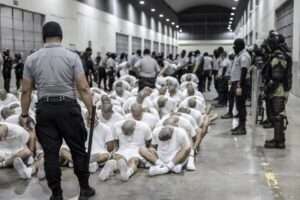
A prison guard transfers deportees from the U.S., alleged to be Venezuelan gang members, to the Terrorism Confinement Center in Tecoluca, El Salvador. Mar. 16, 2025 (El Salvador Presidential Press Office)


Most public debate over the Trump Administration's efforts to use the Alien Enemies Act as a tool for deportation have focused on whether the invocation of the AEA is legal, and the administration's apparent defiance of a court order blocking the deportation of some 137 Venezuelans under the Act. These are important issues. But not enough attention has focused on what is being done to the Venezuelans after their deportation: they are to be incarcerated for one year or more in El Salvador's awful prison system.

This is much worse than "normal" deportation of undocumented immigrants, which is bad enough. With conventional deportation, the government removes the migrants from the US, but then sets them free in their country of origin (or at least as free as they can be under the oppressive regimes that govern places like Venezuela). In this case, by contrast, the deportees are sent to prison in terrible conditions. And that's without ever being charged or convicted of any crime related to the ostensible reason for the deportation (supposed membership in the Tren de Aragua drug gang). The migrants in question did not get any opportunity at all to contest claims that they are members of TdA. All we have is the administration's unsupported word.  The government actually admits that "many" of the deportees do not have any criminal convictions of any kind. Moreover, publicly evidence suggests many of them are probably not actually gang members, and some even entered the US legally.

This policy is obviously unjust. Imprisoning people without any due process whatsoever is a cruel and evil practice usually used only by authoritarian states. And if the Trump administration gets away with it here, there is an obvious danger it will expand the practice. While the current AEA proclamation is limited to Venezuelan members of Tren de Aragua, if courts uphold it, it could potentially be expanded to other Venezuelans and migrants from other countries. And, of course, as already noted, the administration isn't giving any due process rights to those targeted for AEA deportation, which enables it to deport people simply by claiming they are gang members, even if they really aren't.

Legally, imprisonment without due process violates the Due Process Clause of the Fifth Amendment, which states that people may not be deprived of "life, liberty, or property, without due process of law." Imprisonment is an obvious deprivation of liberty, and here we have a complete absence of due process of any kind.

Like most other constitutional rights, the Due Process Clause protects all persons, not just citizens. If the US government arbitrarily imprisoned non-citizens within its territory, there is no doubt that would be unconstitutional. Some argue it does not apply to non-citizens outside the US. But legal scholar Nathan Chapman showed, in an important 2017 article, that in the Founding Era, the Due Process Clause was understood to apply even to foreign-citizen pirates captured in international waters. If so, it also obviously applies to deported immigrants.

Another possible rationale for not applying the Due Process Clause in this situation is that the imprisonment is being done by the Salvadoran government, rather than the US. But the Salvadorans are obviously doing it at the behest of the Trump Administration, which is paying them a $6 million fee for this "service." It would be perverse to allow the federal government to circumvent the Due Process Clause by paying a foreign state to do its dirty work. Licensing such subterfuge would create dangerous perverse incentives: the feds could potentially detain anyone they want without due process, simply by outsourcing the "job" to a foreign government willing to do it for the money, or to curry favor with the US administration.

It is true that current legal precedent and practice (wrongly) allows weaker due process protections for immigration detention than for most other deprivations of severe liberty. But here, the Administration is going beyond merely detaining illegal migrants until they can be deported. It is facilitating their imprisonment even after deportation - and without any due process whatsoever. Moreover, in ordinary deportation proceedings, the migrant in question generally is at least entitled to a hearing. Trump's AEA deportees didn't even get that.

There may be various procedural and practical obstacles to courts ordering the administration and El Salvador to release the imprisoned Venezuelans and allow them to return to the US. I won't try to go over them here.  But these technical legal issues don't change the reality that this imprisonment without due process is both unjust and unconstitutional.

Copyright

Sorry A.I., No Copyrights for You

The D. C. Circuit concludes that software cannot be the author of a work for copyright purposes.

|

The U.S. Court of Appeals for the D.C. Circuit waded into the question of whether software or A.I. can qualify as an author for copyright purposes. In Thaler v. Perlmutter, a unanimous panel concluded that such non-human entities cannot be authors.

Judge Millett wrote for the panel, joined by Judge Wilkins and Senior Judge Rogers. Here is her summary of the case and decision:

This case presents a question made salient by recent advances in artificial intelligence: Can a non-human machine be an author under the Copyright Act of 1976? The use of artificial intelligence to produce original work is rapidly increasing across industries and creative fields. Who—or what—is the "author" of such work is a question that implicates important property rights undergirding economic growth and creative innovation.

In this case, a computer scientist attributes authorship of an artwork to the operation of software. Dr. Stephen Thaler created a generative artificial intelligence named the "Creativity Machine." The Creativity Machine made a picture that Dr. Thaler titled "A Recent Entrance to Paradise." Dr. Thaler submitted a copyright registration application for "A Recent Entrance to Paradise" to the United States Copyright Office. On the application, Dr. Thaler listed the Creativity Machine as the work's sole author and himself as just the work's owner.

The Copyright Office denied Dr. Thaler's application based on its established human-authorship requirement. This policy requires work to be authored in the first instance by a human being to be eligible for copyright registration. Dr. Thaler sought review of the Office's decision in federal district court and that court affirmed.

We affirm the denial of Dr. Thaler's copyright application. The Creativity Machine cannot be the recognized author of a copyrighted work because the Copyright Act of 1976 requires all eligible work to be authored in the first instance by a human being. Given that holding, we need not address the Copyright Office's argument that the Constitution itself requires human authorship of all copyrighted material. Nor do we reach Dr. Thaler's argument that he is the work's author by virtue of making and using the Creativity Machine because that argument was waived before the agency.

Appointments Clause

President Trump Targets Humphrey's Executor Directly

President Trump acts to remove two Democratic commissioners from the Federal Trade Commission. Litigation is likely.

|

The New York Times reports that President Trump has acted to remove two Democratic commissioners from the Federal Trade Commission.

President Trump fired the two Democratic members of the Federal Trade Commission on Tuesday, a rejection of the corporate regulator's traditional independence that may clear the way for the administration's agenda.

The White House told the Democrats, Rebecca Kelly Slaughter and Alvaro Bedoya, that the president was terminating their roles, according to statements from the pair. The F.T.C., which enforces consumer protection and antitrust laws, typically has five members, with the president's party holding three seats and the opposing party two. . . .

"I am writing to inform you that you have been removed from the Federal Trade Commission, effective immediately," said a letter sent to one of the commissioners, which was reviewed by The New York Times. "Your continued service on the F.T.C. is inconsistent with my administration's priorities."

This action , even more than the removal of National Labor Relations Board Chair Gwynne Wilcox, targets Humphrey's Executor v. United States as that case concerned the constitutionality of limits on the removal of FTC commissioners. As least one of the removed FTC commissioners has stated his plans to sue.

The removals leave the FTC with two sitting commissioners. Assuming that the President's action is upheld (either by overturning Humphrey's or distinguishing on the grounds that the FTC today exercises more core executive power than it did in the 1930s), this will free up the FTC to act in line with the President's policy priorities.

With four commissioners, the FTC was potentially deadlocked and was unlikely to reverse Biden Administration policies or adopt new initiatives and measures ought by Chair Andrew Ferguson. With only two commissioners of the same party, however, that is no longer a problem. Commissioner Holyoak is likely to agree with Chair Ferguson on most issues.

But can the FTC act with only two commissioners? Is that a quorum? Apparently it is under existing FTC regulations. 16 CFR § 24.14 provides:

(b) A majority of the members of the Commission in office and not recused from participating in a matter (by virtue of 18 U.S.C. 208 or otherwise) constitutes a quorum for the transaction of business in that matter.


[Note: As originally posted, I had accidentally cited and quoted the SEC's quorum regulation instead of the FTC's regulation. I regret the error and the post has been corrected.]

Partisan Ideology and the Judiciary

It seems that "liberal" judges are no more likely to rule against the Trump Administration than "conservative" judges.

|

With all the talk of "Radical Left Lunatics" and "Crooked Judges" in the federal judiciary, all of whom "should be IMPEACHED!!!," [see  note ** at end], it's worth taking a look at some interesting analyses by Stanford political scientist Adam Bonica of the relationship between "judicial ideology"** and the outcomes in the many cases challenging Trump Administration policies.

The bottom line:

Judges across ideological lines are ruling against Trump at strikingly similar rates (84% liberal, 86% centrist, 82% conservative).…

Judicial ideology doesn't predict ruling outcomes [in these cases]. This isn't commonly the case—ideology is typically a moderate to strong predictor of case outcomes, making this ideological consensus particularly noteworthy. The pattern diverges from what Maya Sen and I found during Trump's first term, when judge ideology strongly predicted case outcomes. What changed? [emphasis added]

It's an important point. A judge's ideology is, usually, a "moderate to strong predictor" of case outcomes - but not here, not in the cases challenging Administration actions on constitutional or statutory grounds. [As noted before, there is a very useful compilation of these cases - now numbering around 155! - available here].

I'm sure that this fact will have no bearing whatsoever on the campaign by the folks calling the shots at the White House and on Capitol Hill in their attacks on the federal judiciary.

Bonica suggests that "what changed" between Trump's first term and today is that "today's cases pose more fundamental constitutional violations uniting judges across partisan divides," and that strikes me as, broadly speaking, basically correct.  One might expect - or at least hope - that the judiciary as a whole, liberal and conservative, would close ranks when faced with a serious threat to its power, and that may indeed be what is happening.

Read More

More