Earlier today, Forbes interviewed me about developments in the case challenging Donald Trump's massive "Liberation Day" tariffs brought by the Liberty Justice Center and myself on behalf of five US businesses harmed by the tariffs. We also discussed today's oral argument in the similar case brought by twelve states led by Oregon. I may have more to say about the Oregon argument later. For now, I will note (as I also indicated in the Forbes interview), that I tentatively think that argument went well for the states plaintiffs. As in the argument in our case last week, the judges seemed highly skeptical of the government's claim that the International Emergency Economic Powers Act of 1977 (IEEPA) gives the president virtually unlimited power to impose tariffs. Here is the video of the interview:
I should perhaps note I was not the one who came up with the title of the Forbes video. I'm not actually "the lawyer behind [the] lawsuit." I am just one part of a team.
The idea of due process can be a difficult legal concept for a lot of non-lawyers. But you can get the basic idea from Monty Python's classic movie, Monty Python and the Holy Grail. You just need to watch a single scene, the "she's a witch!" scene, which is here:
You probably remember the scene, at least if you're of a certain age. To recap: The mob has found a witch, and they're very excited to burn her. They come to Bedevere and ask for his permission to do it. Bedevere pauses and asks, "How do you know she's a witch?" The crowd can't come up with a good reason. Bedevere then insists that there are ways of telling if she's a witch, and he leads the mob to a scientific test of that proposition.
The method Bedevere devises is absurd. Witches and wood both burn, the medieval logic goes, so witches must be made of wood. And wood and ducks both float, so if she weighs the same as a duck, she must be a witch! They get a big scale and weigh her and a duck; the scale being even proves she's a witch. It's all exceedingly silly, of course. But it impresses a watching King Arthur, who knights Bedevere and invites him to join the Round Table.
At one level, the scene is a hilarious spoof of the bizarre ways they tried to identify who was a witch in medieval England. Those methods weren't all that different from weighing the accused against a duck. In particular, the scene echoes the medieval practice of swimming a witch, where they would submerge a suspected witch under water to see if they sunk to the bottom or floated. (Innocent people would sink to the bottom, but witches would float above the water, they thought.)
But more importantly, the scene is also about due process. The mob is positive the woman is a witch. Bedevere asks the key question, but how do you know she is one? The crowd first invokes the fake nose and the hat they put on her to make her look like a witch. Bedevere is unimpressed. He then introduces the basic idea of due process: Before taking the action of burning the woman as a witch, there should be a process for developing and evaluating evidence that she is one.
The absurdity of the process Bedevere proposes makes the same point. In the unenlightened medieval times, the script writers are telling us, they didn't understand how to test what is true. The process Bedevere came up with was silly. It had no ability to help a fact finder discover if she was a witch or not. And it seems to have been fixed, too, with the woman clearly not weighing the same as a duck but the two coming out the same weight. The accused even breaks the fourth wall and speaks directly to the camera about it. She sarcastically comments: "It's a fair cop," British slang for "that's a fair process; yeah, you got me." Of course, it was not a fair process at all. It was a process, but not a fair one.
The lawyerly idea of due process, it seems to me, is all about Bedevere stopping the crowd and asking how they know she's a witch. And then it's a matter of figuring out what procedures should be in place to tell if the crowd's belief is true. (Of course, they're stacking the deck because we know today that witches don't exist in the first place. But it's only a model, er, a movie.)
I have been remiss this semester in failing to post my usual list of upcoming speaking engagements. However, I do have some coming up in the next several weeks that I would like to list for interested readers. Unless otherwise noted, all are in person and open to the public. I may update this post with additional events. Below, I also note some information on earlier engagements for which video or audio is available.
May 27, 12-1:00 PM, Cato Institute, Washington, DC: "Tariffs, Emergencies, and Presidential Power." (panel with Cato Institute scholar Walter Olson). Virtual event. Free registration available here.
May 31, 3-4 PM, Pruyne Lecture Hall, Fayerweather Hall, Amherst College, Amherst, MA: "Challenges Facing American Democracy." This event is primarily for Amherst College alumni, students, and employees (part of Amherst's 2025 alumni reunion activities). But I think members of the general public can come if space allows. See here for more details about my talk, and other events that day.
June 13, 10:15-12:15 AM, Connecticut Legal Conference (annual conference of the Connecticut Bar Association), Connecticut Convention Center, 100 Columbus Blvd., Hartford, CT: Panel on "SCOTUS: What's Next" (covering recent and upcoming Supreme Court decisions). Other participants are G. Eric Brunstad, Jr. (Yale Law School, Dechert, LLP), and former Connecticut Supreme Court Justice Joette Katz (moderator). More detailed information here. This event is restricted to attendees of the Connecticut Legal Conference.
June 13, 2-3:30 PM, Connecticut Legal Conference (annual conference of the Connecticut Bar Association), Connecticut Convention Center, 100 Columbus Blvd., Hartford, CT: Panel on "Kelo v. City of New London 20th Anniversary: Views from the Bench, Bar and Academia." Other participants are Wesley Horton (counsel for New London in the Kelo case); Justice Peter Zarella (retired Justice, Connecticut Supreme Court); and Justice Joette Katz (retired Justice, Connecticut Supreme Court, serving as the moderator). This event is restricted to attendees of the Connecticut Legal Conference.
Audio and/or video of some of my previous speaking engagements and podcasts for the last several months is available at the Cato Institute website here, and also at the National Constitution Center site here.
On Tuesday, May 27, 12-1 PM, the Cato Institute will hold a virtual event on "Tariffs, Emergencies, and Presidential Power." Registration is free and available here. We will, among other things, discuss the case challenging Donald Trump's massive "Liberation Day" tariffs brought by the Liberty Justice Center and myself on behalf five US businesses harmed by the tariffs. I have gone over the legal issues rasied by Trump's IEEPA tariffs in greater detail in my Lawfare article, "The Constitutional Case Against Trump's Trade War." See also my post on why these tariffs threaten the rule of law.
Here is a description of the upcoming Cato event:
Can the president unilaterally impose tariffs under his emergency powers? In this webinar, legal scholars Ilya Somin, a professor at Antonin Scalia Law School at George Mason University who is co-counsel in the pending tariffs case VOS Selections v. Trump, and Walter Olson explore the constitutional and statutory limits of presidential authority under the International Emergency Economic Powers Act (IEEPA) and other statutes. They'll discuss President Trump's recent efforts to justify sweeping trade measures under IEEPA, examine the historical role of Congress in setting tariffs, and consider broader stakes for the separation of powers. Whether you're a lawyer, policymaker, or interested observer, this conversation will shed light on one of the most important trade and constitutional questions of our time.
Vice President J.D. Vance sat down for an interview with Ross Douthat. They cover much ground, but I wanted to flag this exchange concerning Chief Justice Roberts:
Let me just make one final philosophical point here. I worry that unless the Supreme Court steps in here, or unless the District Courts exercise a little bit more discretion, we are running into a real conflict between two important principles in the United States.
Principle 1 of course is that courts interpret the law. Principle 2 is that the American people decide how they're governed. That's the fundamental small-d democratic principle that's at the heart of the American project. I think that you are seeing, and I know this is inflammatory, but I think you are seeing an effort by the courts to quite literally overturn the will of the American people. To be clear, it's not most courts. But I saw an interview with Chief Justice Roberts recently where he said the role of the court is to check the excesses of the executive. I thought that was a profoundly wrong sentiment. That's one-half of his job. The other half of his job is to check the excesses of his own branch. You cannot have a country where the American people keep on electing immigration enforcement and the courts tell the American people they're not allowed to have what they voted for. That's where we are right now.
We're going to keep working it through the immigration court process, through the Supreme Court as much as possible.
Vance is exactly right.
I think the Chief Justice largely lives in a bubble where everyone is afraid to challenge him. He sees himself as a singular force of good to save the rule of law. In Roberts's mind, he can take a shot at the incoming Vice President in his end-of-year address, and everyone will simply submit to his will. No. Vance is fighting back. Roberts thinks he can lecture the President that no judge, even members of the Supreme Court can be impeached; we the people simply have to take it. No. Vance is fighting back.
And, I think, lower court judges are starting to fight back as well. Judge Ho made this same point in his concurrence yesterday, which subtly responded to Chief Justice Roberts:
It is not the role of the judiciary to check the excesses of the other branches, any more than it's our role to check the excesses of any other American citizen. Judges do not roam the countryside looking for opportunities to chastise government officials for their mistakes.
Yet Roberts does exactly that. Every action has an equal and opposite reaction.
There is a storm brewing on the horizon, and I don't think the Chief quite sees it. As I will explain in a forthcoming essay, Roberts's two decades on the bench have rendered him utterly unqualified to deal with what lies ahead. The arc from NFIB to AARP does not bode well for the future. Here is a preview:
It is often repeated that we have three, co-equal branches of government. But that simply isn't true. Alexander Hamilton described the judiciary as the "least dangerous branch." Unlike the Congress, which has the power of the "purse," and the President who wields the power of the "sword," the courts have "merely judgment." Yet, it has been deeply ingrained in our national consciousness that the foundational role of the courts is to balance the power of the elected branches. Indeed, Chief Justice John Roberts boasted that the courts must "check the excesses of Congress or the executive." But who will check the excesses of the judiciary? The greatest check on the courts can only be the widely held belief that the Court is not ruling based on politics. But if people believe the judiciary is simply a mediator that weighs political compromise, then the courts cannot long endure.
Roberts's colleagues should, sooner rather than later, cut the tether and listen to Justices Alito and Thomas. These national treasures should not retire, as they are the only ones speaking sense.
In this post, I'll talk about the court's analysis tentatively rejecting the First Amendment defense, an analysis that I think is mistaken (whether or not some tort claims such as these should be allowed despite the First Amendment).
In Garcia v. Character Technologies, Inc., the mother of a 14-year-old, who killed himself after having many conversations with a Game-of-Thrones-based AI character (with whom he seems to have become obsessed), is suing Character for, among other things, negligence and negligence-based product liability. Today's decision by Judge Anne Conway (M.D. Fla.) allowed the claim to go forward; I plan to blog separately about those negligence claims, but in this post I want to focus on the court's rejection, at least for now, of Character.AI's First Amendment defense.
The court recognized that "Defendants can assert the First Amendment rights of the Character A.I. users," which is to say that Character can argue that imposing liability on it for its output may deprive other users—the great bulk of whom will find it valuable and not harmful—of access to it. An analogy might be a website arguing that, for instance, requiring it to remove a copy of Romeo and Juliet won't affect Shakespeare's First Amendment rights (since he's dead) or even the website's own rights to distribute what it chooses, but the rights of readers to freely access this material. The court also noted that "Plaintiff endeavors to restrict Character A.I. users' access to Character A.I. and to its LLM's output," since Garcia argues that it was negligent for Character to provide the output that it did, and that it therefore had a duty to reasonably restrict or modify that output.
But the court wasn't convinced that the output was "speech" for First Amendment purposes:
I've just published an article in Constitutional Commentary entitled "The Volokh Briefs: Drawing the Line Against Compelled Speech in Public Accommodations," 39 Const. Comm. 143 (2024) (available on SSRN here). Here's the abstract:
In a series of important amicus briefs (the "Volokh Briefs") filed over the course of about a decade, Professor Eugene Volokh was the principal architect of an argument for protecting expressive goods and services offered for sale in the commercial marketplace. This free speech protection would override certain applications of state antidiscrimination law.
The argument bore fruit in 303 Creative v. Elenis (2023), which held that under the First Amendment's Free Speech Clause the state could not force a designer to fashion websites incorporating the designer's customized text and graphics for the celebration of same-sex weddings. As Volokh and others urged, the Court's holding applied even though the business was classified as a "public accommodation" under Colorado's anti-discrimination law, which protects customers from discrimination based on certain characteristics like race, sex, and sexual orientation. The state had argued that refusing to create websites for same-sex weddings, while offering to create them for opposite-sex weddings, would be an act of discrimination based on sexual orientation. But as Volokh had argued, the Court held that the website designer would instead be refusing only to produce certain speech (not discriminating based on a customer's status), and her right against compelled speech must prevail under the First Amendment.
Consistent with Volokh's view, the speech protection in 303 Creative was limited to goods and services that were customized and expressive. Just as Volokh had urged, the Court reassured skeptics that its holding would have no application to the innumerable non-expressive goods and services in the marketplace. Much of Volokh's reasoning echoed in Justice Gorsuch's majority opinion.
This Article outlines the legal position developed in the Volokh Briefs. It focuses on the briefs in three key cases: Elane Photography (2013), Masterpiece Cakeshop (2018), and 303 Creative (2023) itself. As part of tracing this intellectual journey, the Article shows how the Volokh Briefs evolved and matured over time and how they were distinct from others taking the side of the objecting service providers. Volokh's view of compelled speech gave breathing room for individuals' vital speech interests while leaving plenty of space for government to protect people from discrimination. The Article shows how the methodology in the Volokh Briefs provides a roadmap for drawing and navigating the lines necessary to preserve the core interests on both sides, although the Supreme Court stopped short of fully adopting it. Finally, critics of the Volokh Briefs abound among progressive civil rights organizations and academics. The Article responds to some of them.
As noted in the Article introduction, I was among the professors and lawyers who had the privilege of working with Eugene on the briefs, although they were mostly his brainchild. He and his UCLA First Amendment clinic took the laboring oar on them.
The occasion for the Article was Eugene's decision to leave UCLA and join the Hoover Institution last year. In April 2024, I joined several scholars in a roundtable discussion and celebration of his contributions to scholarship and law.
I also noted in the introduction that I'm not a dispassionate observer of Eugene's work:
I consider him both a friend and an intellectual role model. He is as good-natured and big-hearted, and yet as principled and rigorous, as any scholar I've known.
Eugene Volokh's premature and publicly underexplained decision to leave academia was a loss for viewpoint diversity in American law schools. It is partly in the service of such diversity that he has devoted an extraordinary body of work, including the small slice of it that I discuss here.
I'd like to thank my research assistant Caroline Hoch (SMU Law '25) for her estimable help in producing the Article.
Nearly thirteen years after it was announced, DACA will come to an end--in Texas. In March 2025, the Fifth Circuit ruled that DACA was unlawful, but the ruling was limited to the only state found to have standing: Texas. The deadline for MALDEF and other groups to file a cert petition and come and gone. The organization announced that they did not seek cert, in an effort to limit any ruling to Texas and avoid a national ruling.
"Yesterday was the extended deadline for any party to file with the United States Supreme Court seeking discretionary review of the Fifth Circuit's January 17 decision in Texas v. United States, the longstanding Texas-driven challenge to Deferred Action for Childhood Arrivals or DACA. None of the parties – the state of Texas and other plaintiff states, the United States, the intervenor state of New Jersey, and the intervenor DACA recipients, who have been represented by MALDEF throughout the case – filed a petition seeking Supreme Court review. Thus, the Fifth Circuit decision of January 17 is now final.
"As a reminder, that decision held that DACA's protection from removal or deportation is a lawful exercise of presidential discretion, and therefore may be granted in response to new and renewal applications throughout the entire country. The Fifth Circuit panel also concluded — erroneously in MALDEF's view — that work authorization granted through the DACA process is not permissible; however, the court limited the implementation of that decision solely to the state of Texas. The result is that, following implementation of the Fifth Circuit decision, DACA and work authorization should be available to those renewing and those newly applying for DACA in the 49 states other than Texas.
"The district court in the Texas case will initially determine how to implement the Fifth Circuit decision. That determination should begin soon through a process of consultation and debate among all the parties before the district court. With respect to the issue of work authorization for DACA holders residing in Texas, MALDEF will be advocating for an extended period of implementation that is respectful, to the maximum extent possible, of the important reliance interests identified by the Supreme Court in its 2020 decision rejecting the first Trump administration's rescission of DACA. In any event, the implementation is likely to be phased in over a significant period of time. Thus, no DACA holder in Texas should be in danger of losing work authorization imminently."
Contrary to what some critics may think, the Fifth Circuit has been trending towards limiting relief to plaintiff states. Other circuits should take note.
President Trump has shown no interest in terminating DACA, so this policy likely will remain in effect in 49 states.
From a filing Monday in Johnson v. Dunn (N.D. Ala.), responding to an order from Judge Anna Manasco demanding an explanation for what she described as apparently "fabricated citations":
What happened here is unacceptable. Tempted by the convenience of artificial intelligence, counsel improperly used generative AI to supplement two motions and did not verify the citations that AI provided. Those citations turned out to be "hallucinations" by the AI system. Although done without intent to mislead the Court or counsel opposite, counsel do not defend or condone this complete lapse in judgment. They apologize—both for failing to uphold their own standards and for wasting counsel opposite's and this Court's time and resources.
Butler Snow [the law firm involved -EV] joins in counsels' apology to the Court, parties and all counsel, and respectfully requests if the Court decides in its discretion to impose sanctions, that any sanctions be proportionate to the wrong and commensurate with each attorney's role in these events. Butler Snow also requests that its client not be sanctioned, and for counsel to have the opportunity to file an amended motion with correct citations….
There are no excuses for counsel's behavior, only explanations. As set forth in the separately filed declarations …, here is what happened: …
Today, the Supreme Court granted Laurel Libby, a Maine state representative, an emergency injunction pending appeal. Justice Sotomayor would have denied the injunction, and Justice Jackson wrote a dissent.
I wrote about this case nearly a month ago. Circuit Justice Jackson took her time to call for a response and set the deadline after the Maine legislative session began. In other words, she made it impossible for the Court to provide timely relief. That is some chutzpah after the Supreme Court maligned Judge Wes Hendrix for not ruling in the span of hours. On April 30, I wrote "The Court moves heaven and earth to block removal of alleged gang members who are almost certainly removable, but stays silent when citizens of Maine lose their elected representative." I'm glad their priorities are straight. On May 1, the Court called for a response, which would be due on May 8.
Today, May 20, the Court finally granted relief. It took the Court twelve days after the briefing concluded to issue the order. I have to think the majority settled on this outcome pretty quickly, especially considering the lopsided vote. What was the delay? It was likely to allow Justice Jackson to write her five-page dissent. When A.A.R.P. came out after midnight, Justices Alito and Thomas noted their dissent is forthcoming. That is always an option. But here, the majority prevented Libby from participating in the session, even as there were five votes to grant relief.
Why did Jackson deny relief? In part, she found no injury was imminent:
Meanwhile, before us, the applicants have not asserted that there are any significant legislative votes scheduled in the upcoming weeks; that there are any upcoming votes in which Libby's participation would impact the outcome; or that they will otherwise suffer any concrete, imminent, and significant harmwhile the lower court considers this matter.
I'm not sure this is correct. Page 1 of the application listed votes that she had already missed:
Libby and her district had no vote on the State's $11 billion budget, had no vote on a proposed constitutional amendment, and will have no vote on hundreds more proposed laws including—most ironically—whether Maine should change its current policy of requiring girls to compete alongside transgender athletes.
But beyond the factual issues, Jackson seems to hedge--there are no votes on which Libby's vote would "impact the outcome." How can Jackson possibly know this? The legislature currently has (according to Wikipedia) 76 democrats, 73 republicans, 3 "others." Does Jackson just assume a Republican member cannot affect the outcome of a vote?
But even more troubling, Justice Jackson apparently does not see the irony of her own position. Her dissent did not "impact the outcome" of the case. Yet, she was able to drag the case on for nearly a month so she could signal to everyone her views on the emergency docket. A vote in dissent does affect the process. People can see the "no" vote, even if it is solo, and react accordingly. That applies to the legislative branch even more-so, where members are accountable for their votes and no-votes.
I think Justice Kagan did not join this opinion for good reason.
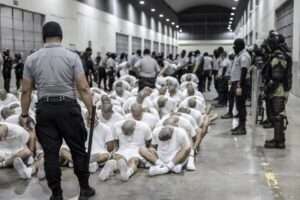
A prison guard transfers Alien Enemies Act deportees from the U.S., alleged to be Venezuelan gang members, to the Terrorism Confinement Center in Tecoluca, El Salvador. Mar. 16, 2025 (El Salvador Presidential Press Office)
An important new study by my Cato Institute colleague David Bier shows that most of the Venezuelan migrants deported to imprisonment in El Salvador had no criminal records, and many (perhaps a majority) entered the US legally. This makes the Trump Administration's actions even more reprehensible. Here is an excerpt:
Shortly after the US government illegally and unconstitutionally transported about 240 Venezuelans to be imprisoned in El Salvador's horrific "terrorism" prison on March 15, CBS News published their names. A subsequent CBS News investigation found that 75 percent of the men on that list had no criminal record in the United States or abroad. Less attention has been paid to the fact that dozens of these men never violated immigration laws either…..
The US government not only denied these men due process; it has also generally failed to provide their families, their attorneys, or the public any information about what it alleges these men did to deserve incarceration in El Salvador…..
Moreover, in most cases, the men never knew the "evidence" against them or that they were being removed to El Salvador. Finally, the US and Salvadoran governments won't allow the men to talk to anyone, so there is no way to interview them directly.
Given the total lack of transparency by the federal government, we have compiled what the families of the men themselves are reporting about their entries and what likely triggered their incarceration in El Salvador….
Sadly, no information regarding one in three of the men could be found online. Maybe no one in their families knows they are missing, or maybe they are too afraid to speak up. For 48 percent of the 174 about whom we have some information, we have no information about their method of crossing into the United States. For many, the only information is Facebook or Instagram posts from their mothers pleading for information about their children…..
The government calls them all "illegal aliens." But of the 90 cases where the method of crossing is known, 50 men report that they came legally to the United States, with advanced US government permission, at an official border crossing point. A Reuters survey of 50 men also placed the proportion of those who entered legally at about half. This isn't surprising because about half of all the Venezuelans who have immigrated over the past two years came legally as well—either as refugees, parolees, or visa holders. The proportion isn't what matters the most: the astounding absolute numbers are. Dozens of legal immigrants were stripped of their status and imprisoned in El Salvador….
The men were workers—construction laborers, pipe installers, cooks, delivery drivers, a soccer coach, a makeup artist, a mechanic, a veterinarian, a musician, and an entrepreneur. Most of those who were released quickly found jobs in the United States.
A majority of the men are fathers. Altogether, the men were trying to support 44 children. The US government did not inform their families, lawyers, or anyone else of their impending imprisonment at US government expense in a Salvadoran prison known for torture and other abuses that would be illegal inside the United States. Agents simply disappeared them without charge or trial or even acknowledgment, which is rightly considered a crime against humanity….
The US government asserts that they are "criminal terrorists" who are "confirmed" members of a criminal organization known as Tren de Aragua (TdA). Investigations by the New York Times, Bloomberg, and CBS News have all found that few of the imprisoned men have any criminal record…
Most, at least 42, were labeled as gang members primarily based on their tattoos, which Venezuelan gangs do not use to identify members and are not reliable indicators of gang membership. According to court documents, DHS created a checklist to determine that heavily weights "dressing" like a gang member, using "gang signs," and, most critically, tattoos. No criminal conviction, arrest, or even witness testimony is required.
DHS's images of "TdA tattoos" include the Jordan logo, an AK-47, a train, a crown, "hijos," "HJ," a star, a clock, and a gas mask. But as the American Immigration Council's Aaron Reichlin Melnick has shown, all of these supposed TdA tattoos were not taken from Venezuelan gang members but rather stolen by DHS from social media accounts that have nothing to do with TdA or Venezuela….
Among the supposedly damning tattoos from the legal immigrants were several roses, multiple clocks, crowns over the names of family members, playing cards used to cover up an ugly scar from a childhood accident, a song lyric from a reggaeton artist from Puerto Rico, the Real Madrid logo on a professional soccer player, and a reference to the video game Call of Duty on a teenager.
For readers who may not know, Real Madrid is one of the most popular professional soccer teams in the Spanish-speaking world. A Real Madrid tattoo on a Hispanic immigrant is no more indicative of criminality than a Dallas Cowboys tattoo on an American.
Many of the reasons why the Trump's invocation of the Alien Enemies Act are unjust and illegal apply irrespective of the immigration status of the migrants targeted for deportation, or whether they have committed any crimes. As multiple federal courts have held, the AEA can only be used when there is a declared war, an "invasion," or a "predatory incursion" by a foreign government, and none of these prerequisites are present here.
In addition, even people who have committed crimes (or against whom there is strong evidence) cannot be deported to imprisonment without due process. Indeed, due process is required in large part in order to determine whether the person in question really is a criminal or not. The Administration's use of the AEA to deport people to imprisonment without due process is a blatant violation of the Due Process Clause of the Fifth Amendment, and would be so even if these Venezuelans really were TdA members.
Elsewhere, I have argued that the distinction between legal and illegal immigration is not as morally significant as many tend to think.
Nonetheless, the fact that most of the AEA deportees have no criminal records and many (perhaps a majority) entered the US legally makes the Trump Administration's actions even more odious than they would be otherwise. David Bier is right to call them a "crime against humanity."
It is always possible to claim that the deportees actually did commit crimes, just ones that were not recorded or detected. It's difficult to definitely prove otherwise! But that sort of reasoning could justify deporting or imprisoning virtually anyone. Can you definitively prove that you have never committed any crimes? Based on the sort of "evidence" cited by the government - tattoos, clothing, and the like - almost anyone can be labeled a criminal. Our legal system requires due process in large part precisely for the purpose of preventing such abuses.
Justice Scalia once ridiculed the coastal elites on his Court who fail to represent the "vast expanse in-between." Somewhere in that expanse is the city of Lubbock, Texas. Home to Texas Tech University, Lubbock is a five hour drive to Albuquerque or Dallas.
At present, there is one active District Court Judge in the Lubbock Division of the Northern District of Texas, Judge James Wesley Hendrix. Hendrix spent many years working in the office of the U.S. Attorney for the Northern District of Texas. He started as an Assistant U.S. Attorney. In 2012, he became Chief of the Appellate Division. In this capacity, he coordinated with the DOJ Criminal Appellate Section, as well as the Office of the Solicitor General. In 2015, he served on the Attorney General's Advisory Committee. For those with short memories, all of these promotions occurred during the Obama Administration.
In March 2016, President Obama nominated Hendrix to serve as a U.S. District Court Judge for the Northern District of Texas. A hearing was held in September 2016, but his nomination expired in January 2017 at the end of the Congress. Two years later, President Trump nominated Hendrix to the same court. He was reported out of committee by a 22-0 vote, and was confirmed by an 89-1 vote.
I provide this history because most people had never heard of Judge Hendrix before A.A.R.P. v. Trump. Indeed, if you only read the Supreme Court's decision, you might think that Hendrix was just another right-wing reactionary judge in Texas, who negligently, if not intentionally, moved far too slow, and failed to grant emergency relief in a timely fashion. My ire at the Supreme Court's decision on Friday was compounded by the fact that I've gotten to know Judge Hendrix well over the years. I have spoken in Lubbock several times, and he graciously attends the event with his clerks. He is a careful and meticulous judge who discharges his duties faithfully. I've already laid out the chronology in pain-staking detail. Justice Alito's dissent states everything clearly. And Paul Cassell's Op-Ed reinforces that chronology, as does Judge Ho's concurrence.
I would wager that if I surveyed any federal trial court judge, at random, they would agree with my assessment of Judge Hendrix's performance. But you don't have to do a survey. Look no further than the concurring opinion from Circuit Judge Irma Carrillo Ramirez. She wrote that Judge Hendrix's "failure to issue the requested ruling" within such a compressed window cannot reasonably be viewed as "an effective denial of injunctive relief." And Judge Ramirez is not a right-wing reactionary on the Fifth Circuit. She served as a U.S. magistrate judge for more than two decades in the Northern District of Texas. President Biden nominated her to the Fifth Circuit. Judge Ramirez knows from first-hand experience how trial courts function, and saw Judge Hendrix's time-frame as reasonable.
Let me provide even more background. While the nine-member Supreme Court decides about fifty merits cases a year, federal district court judges have far heavier dockets. According to the latest statistics, Judge Hendrix closed out about 700 cases in the span of twelve months. He personally receives more than 20% of all new criminal cases in the district. One of those cases was United States v. Armstead (6:24-cr-00019). This case may not generate as much headlines as Abrego Garcia or A.A.R.P., but the facts here galling. The defendant used electronic devices to cyberstalk minors across the country, and induced them to produce sexually explicit images.
Believe it or not, at the same time that the ACLU was demanding an immediate resolution of its case, Armstead was on trial. Fourteen minor victims traveled to Lubbock to testify the same week as the A.A.R.P. case was rocketing through the courts. Should Judge Hendrix have told those victims to go home, because the ACLU had an urgent motion? When I was clerking, I was taught that criminal matters always take precedents over any civil matter. On the afternoon of Thursday, April 17, the case went to the jury. Several hours later, the pivotal voicemail came in from the ACLU. On top of managing a complex trial, Judge Hendrix still managed to issue a briefing schedule to ensure the government could reply.
There is so much more to say here. Chief Justice Roberts and his colleagues owe Judge Hendrix an apology. The reckless opinion they issued on Friday did far more damage to the judiciary than any boxes of pizza.
On Friday afternoon, the Supreme Court remanded A.A.R.P. v. Trump to the Fifth Circuit with very precise instructions. Today, the Fifth Circuit assigned the case to the next available oral argument panel:
Last Friday, the Supreme Court vacated the judgment of our court, which had dismissed this appeal for lack of jurisdiction. The Court remanded the case back to us for further proceedings, and directed us to proceed "expeditiously." A.A.R.P. v. Trump, 605 U.S. _, _ (2025). Accordingly, this matter is expedited to the next available randomly designated regular oral argument panel.
Judge Ho wrote an seven-page concurrence. He defended his colleague, Judge Wes Hendrix, against an unfair attack from the Supreme Court:
As an inferior court, we're duty-bound to follow Supreme Court rulings—whether we agree with them or not. We don't have to like it. But we have to do it. So I concur in our order today expediting our consideration of this matter, as directed by the Supreme Court. But I write to state my sincere concerns about how the district judge as well as the President and other officials have been treated in this case. I worry that the disrespect they have been shown will not inspire continued respect for the judiciary, without which we cannot long function. See, e.g., In re Westcott, 135 F.4th 243, 250–51 (5th Cir. 2025) (Ho, J., concurring).
Ho responds to Chief Justice Roberts, who boasts that the role of the Supreme Court is to check the other branches:
It is not the role of the judiciary to check the excesses of the other branches, any more than it's our role to check the excesses of any other American citizen. Judges do not roam the countryside looking for opportunities to chastise government officials for their mistakes. Rather, our job is simply to decide those legal disputes over which Congress has given us jurisdiction.
Ho contrasts how Justice Barrett denied shadow docket relief for a religious liberty case, even as she granted shadow docket relief for alleged gang members:
Recall the emergency relief sought in Does 1-3 v. Mills, 142 S. Ct. 17 (2021). Members of the Court expressed concern about the "use [of] the emergency docket to force the Court" to "grant . . . extraordinary relief" "on a short fuse without benefit of full briefing." Id. at 18 (Barrett, J., concurring in the denial of application for injunctive relief). The amount of time considered too short in Does 1-3 was nine days. Compared to 42 minutes, however, nine days is a lifetime to decide a motion. So the district court reasonably assumed that the principle invoked in Does 1-3 to justify denying relief to law-abiding citizens concerned about their religious liberties in the COVID-19 era would likewise justify denying relief to illegal alien members of a foreign terrorist organization.
I'm glad the Court has their priorities straight.
Ho explains why it was entirely unreasonable to start the clock at 12:34 a.m.
But starting the clock at 12:34 a.m. not only ignores the court's express instructions respecting the Government's right to respond. It also ignores the fact that the Court is starting the clock at—12:34 a.m. We seem to have forgotten that this is a district court—not a Denny's. This is the first time I've ever heard anyone suggest that district judges have a duty to check their dockets at all hours of the night, just in case a party decides to file a motion. If this is going to become the norm, then we should say so: District judges are hereby expected to be available 24 hours a day—and the Judicial Conference of the United States and the Administrative Office of the U.S. Courts should secure from Congress the resources and staffing necessary to ensure 24-hour operations in every district court across the country. If this is not to become the norm, then we should admit that this is special treatment being afforded to certain favored litigants like members of Tren de Aragua—and we should stop pretending that Lady Justice is blindfolded.
Ho makes the point that other Presidents, who have clashed with the judiciary, received all the trappings of the presumption of regularity.
Today the Supreme Court granted Maine state representative Laurel Libby's request for an emergency injunction pending appeal as she seeks to vindicate her rights to speak and vote in the Main legislature. Justices Sotomayor and Jackson would have denied the application.
Rep. Libby opposes the participation of transgender athletes in girls' sports. She expressed these views in a variety of ways, including on social media. One post in particular, criticizing the decision to allow a transgender athlete to compete in a high school track championship, prompted a vote of censure from the state legislature. The censure resolution demanded that Libby apologize and (as interpreted by Maine Speaker of the House Ryan Feceau) triggered a legislative rule providing that any member found to be "guilty of a breach of any of the rules and orders of the House … may not be allowed to vote or speak, unless by way of excuse for the breach, until the member has made satisfaction."
Rep. Libby sued, alleging this action is unconstitutional and abridges the rights of her constituents. She also sought an emergency injunction restoring her voting rights, but was denied by both the district court and the U.S. Court of Appeals for the First Circuit, prompting her application with the Supreme Court. Today' order restores her voting rights pending the outcome of her appeal.
While no justice authored an opinion explaining the decision to grant the emergency application for an injunction pending appeal, the filing on her behalf makes a fairly powerful case that she should ultimately prevail on the merits (despite the legislature's attempt to invoke legislative immunity), and that the denial of her vote will cause irreparable harm to her constituents.
The Sun-Times is feelingtheheat after it printed a summer reading list Sunday, citing multiple non-existent titles by real authors — which was partially produced by AI….
The list begins with a nonexistent "novel by the 'beloved Chilean American author' Isabel Allende titled 'Tidewater Dreams,'" "ostensibly a 'climate fiction novel' that explores how one family confronts rising seas levels while uncovering long-buried secrets.'" (NPR [Elizabeth Blair] notes that "Only five of the 15 titles on the list are real.") Axios adds that "The insert also appeared in the Philadelphia Inquirer," and
The Sun-Times says it licensed the content from King Features, a unit of Hearst, which claims to be the world's largest lifestyle publisher.
As a large language model, I can't feel vicarious embarrassment, but this seems unfortunate for all involved.
The Supreme Court's decisions in A.A.R.P. are among the most regrettable orders issued in recent memory. Putting aside the law, the decision unfairly maligned Judge James Wesley Hendrix. I alluded to that charge yesterday. Here, I want to flag a timely Op-Ed by Paul Cassell in the Wall Street Journal, titled "A Supreme Court Injustice to a District Judge."
Here is the introduction:
The Supreme Court held last week that the government needs to provide more notice to alleged alien enemies before deporting them. The 7-2 ruling in A.A.R.P. v. Trump wasn't itself a surprise; the court had already signaled skepticism of the president's use of the Alien Enemies Act of 1798. But in the unsigned opinion, the justices did an injustice to James Wesley Hendrix, the presiding judge in Lubbock, Texas.
The high court accused Judge Hendrix of "inaction"—of failing to act quickly enough and thereby denying the aliens due process. In dissent, Justice Samuel Alito (joined by Justice Clarence Thomas) said this accusation was "unfair" and that "we should commend" the judge's "careful approach." The dissenters are right. Judge Hendrix's service was exemplary. The majority was wrong to malign this judge and sent a disturbing message about procedural norms.
And here is the conclusion:
The Supreme Court has sent a regrettable signal to the lower courts: If a civil-liberties group comes to you with a purported emergency you should issue an immediate order against the government and resolve the details later. This amounts to a one-way ratchet in favor of civil-liberties claims without regard to competing considerations.
Justice Alito's dissent correctly defends Judge Hendrix's deliberation. It stands in contrast with that of other judges, who, as Justice Alito noted, "granted temporary injunctive relief without adequate consideration of the relevant issues." We need more jurists like Judge Hendrix, and the Supreme Court should think more carefully about how its rulings could distort the work of the lower courts.
Cassell, a former District Court judge, is uniquely situated to make this case. I hope more members of the bench and bar are willing to defend a judge who was unfairly attacked. And I hope the Supreme Court will one day realize how this ruling creates perverse incentives for lower courts to issue knee-jerk injunctions, without even having time to consider the issue.
I will have much more to say about this case in due course.