The Volokh Conspiracy

Mostly law professors | Sometimes contrarian | Often libertarian | Always independent | Est. 2002

The Volokh Conspiracy

Free Speech

Government's Cancelling Harvard Contracts Violated First Amendment, Judge Rules

|

From today's decision by Judge Allison Burroughs (D. Mass.) in President & Fellows of Harvard College v. U.S. Dep't of Health & Human Servs.:

Harvard asserts that the Defendants' actions in this case "violated Harvard's First Amendment rights in at least two ways: 1) by retaliating against Harvard based on the exercise of its First Amendment rights, and 2) by imposing content- and viewpoint-based burdens on those rights through the imposition of funding conditions that are unrelated to any legitimate government interest in combating antisemitic harassment or otherwise." Because of this, Harvard contends that "[t]he Freeze Orders and Termination Letters should be vacated and set aside, and any further similar action against Harvard should be permanently enjoined." …

The court concluded that the government's actions were unconstitutional retaliation for Harvard's exercise of First Amendment rights:

Harvard engaged in constitutionally protected conduct 1) when it refused the terms set forth in the April 11 Letter, which sought to control viewpoints at Harvard, and 2) when it filed this lawsuit. Defendants do not dispute that the latter constitutes protected conduct. As to the April 11 Letter rejection, there is "a zone of First Amendment protection for the educational process itself," that encompasses not only "the independent and uninhibited exchange of ideas among teachers and students," but also Harvard's "autonomous decisionmaking." The rights protected by the First Amendment include the right to "manage an academic community and evaluate teaching and scholarship free from [governmental] interference," as well as Harvard's "prerogative 'to determine for itself on academic grounds who may teach'" and what is taught in the "college classroom."

Defendants' April 11 Letter, on its face, was directed at these core freedoms, and Harvard's April 14 rejection, on its face, was aimed at preserving them. The April 11 Letter stated, in no uncertain terms, that the letter would constitute an "agreement in principle that w[ould] maintain Harvard's financial relationship with the federal government" but only if Harvard agreed to "audit the student body, faculty, and leadership for viewpoint diversity," report that audit to the government, and "hir[e] a critical mass of new faculty" and "admit[] a critical mass of students … who will provide viewpoint diversity."

It further required Harvard to "abolish all criteria, preferences, and practices, whether mandatory or optional, throughout its admissions and hiring practices, that function as ideological litmus tests;" to audit "programs and departments that … reflect ideological capture;" to "immediately shuttter all diversity, equity, and inclusion (DEI) programs, committees, positions, and initiatives … including DEI-based … speech control policies," and to demonstrate that it had done so "to the satisfaction of the federal government." In brief, the April 11 Letter purported to require Harvard to overhaul its governance, hiring, and academic programs to comport with the government's ideology and prescribed viewpoint….

Read More

Copyright

Should Have Seen That One Coming: Claims Over A&E's "Miss Cleo: Her Rise and Fall" Dismissed

|

From today's decision by Judge Dale Ho (S.D.N.Y.) in Psychic Readers Network, Inc. v. A&E Television Networks, LLC:

"Call me now!" So ordered Miss Cleo, a television psychic who, in the late 1990s, offered purported spiritual guidance via a pay-per-minute telephone hotline. Last autumn, Hillionaire Productions LLC and A&E Television Networks, LLC … produced and aired, respectively, a biopic about Miss Cleo's life. Plaintiff Psychic Readers Network ("PRN") subsequently filed this lawsuit. PRN claims it created the Miss Cleo persona and that it holds several copyrights and trademarks associated with the Miss Cleo character. It accuses Defendants of, inter alia, copyright infringement, trademark infringement, and unjust enrichment based on the biopic's script and imagery….

Unless otherwise specified, the following facts are taken from PRN's Amended Complaint and the documents incorporated by reference therein. The Court assumes these facts are true for the purpose of adjudicating this motion to dismiss….

PRN began offering psychic readings over the telephone in the 1990s. Later that decade, PRN selected Youree Dell Harris, one of its telephone "psychic advisors," to serve as its spokesperson. Harris performed her spokesperson duties in character as "Miss Cleo," a spirited "clairvoyant" who purported to use tarot cards to predict callers' futures. PRN "created the Miss Cleo persona," which "became famous" based on PRN's extensive advertising efforts. Capitalizing on Miss Cleo's popularity, PRN "created television commercials, infomercials, press relations, campaigns, radio spots, books, tarot cards and numerous other materials all featuring the Miss Cleo character [to] promot[e] its psychic services and products." …

PRN filed this suit after "Defendants produced and began distributing the film 'Miss Cleo: Her Rise and Fall.'" PRN alleges that "Miss Cleo: Her Rise and Fall" ("the biopic") "freely copies and recreates [its] copyrighted materials, including, but not limited to, use of the look and feel of Plaintiff's television commercials including the Miss Cleo character's appearance, dress and tag lines such as 'Call Me Now.'" Defendants did not receive permission from PRN to include the Miss Cleo character in the biopic. Moreover, PRN avers that the biopic is "replete with false statements and inaccuracies," including a "false portrayal of an officer of PRN as a drunken, ruthless Wall Street CEO."….

People writing and making films about copyrighted or trademarked material generally have considerable latitude to quote parts of the material in the process (under fair use and related doctrines). But here, the court didn't have to reach that, because it found that plaintiff's Complaint hadn't adequately alleged infringement:

Read More

Free Speech

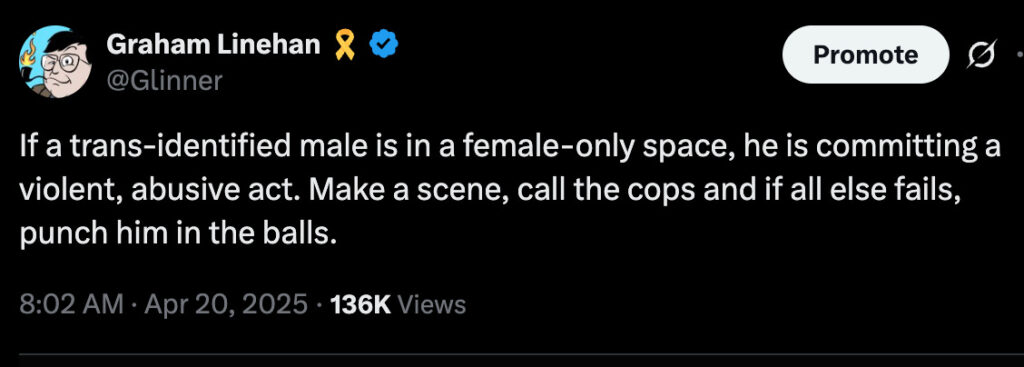
Would Graham Linehan's "If All Else Fails, Punch Him in the Balls" Be Protected Under U.S. Law?

|

Irish writer Graham Linehan has reportedly been arrested on his return to the U.K., in part apparently based on this Tweet that he had posted:

I don't know whether this is indeed punishable under English law; I have a hard enough time keeping track of the law of one country. But someone asked me whether this would be punishable even under U.S. law, so I thought I'd post about it.

[1.] The incitement exception to the First Amendment wouldn't apply here. Consider Hess v. Indiana, a 1973 Supreme Court case, where Hess was prosecuted for saying, as a demonstration that had blocked the street was being cleared, "We'll take the fucking street later" or "We'll take the fucking street again." The Court reversed the conviction, applying (and elaborating on) the famous Brandenburg v. Ohio (1969) precedent (emphasis added):

The Indiana Supreme Court placed primary reliance on the trial court's finding that Hess' statement "was intended to incite further lawless action on the part of the crowd in the vicinity of appellant and was likely to produce such action." At best, however, the statement could be taken as counsel for present moderation; at worst, it amounted to nothing more than advocacy of illegal action at some indefinite future time. This is not sufficient to permit the State to punish Hess' speech.

Under our decisions, "the constitutional guarantees of free speech and free press do not permit a State to forbid or proscribe advocacy of the use of force or of law violation except where such advocacy is directed to inciting or producing imminent lawless action and is likely to incite or produce such action." Brandenburg. Since the uncontroverted evidence showed that Hess' statement was not directed to any person or group of persons, cannot be said that he was advocating, in the normal sense, any action. And since there was no evidence, or rational inference from the import of the language, that his words were intended to produce, and likely to produce, imminent disorder, those words could not be punished by the State on the ground that they had "a 'tendency to lead to violence.'"

The Tweet likewise appears to be "at worst, … nothing more than advocacy of illegal action at some indefinite future time," and it wasn't "intended to produce, and likely to produce imminent disorder."

This, by the way, is why statements such as "punch a Nazi," "snitches get stitches," T-shirts with a rifle (with or without Malcolm X) and the phrase "by any means necessary," and the like are generally constitutionally protected (absent advocacy of imminent violence or, as item 2 suggests, a specific target).

Read More

What Do We Make Of The Boston Federal Judge Who Apologized For Not Knowing Emergency Docket Orders Are Precedential?

Judges who are unfamiliar with the workings of the emergency docket should be more cautious in granting emergency relief against the federal government.

|

Judge William G. Young of the District of Massachusetts presided over the case that would become NIH v. APHA. In this case, a majority of the Court held that a suit over cuts to funding belongs in the Court of Federal Claims. This ruling followed directly from an earlier ruling, California v. Texas. Justice Gorsuch wrote a sharp concurrence, chiding Judge Young, and other judges, for defying Supreme Court orders. (I discuss this history in my Civitas column.) While writing this piece, I speculated aloud what could possibly be motivating judges who took actions that were inconsistent with the Supreme Court's emergency docket rulings.

Judge Young, to his credit, has shed some light on his thinking. Regrettably, these insights cast even more doubt on the Judge's decision-making authority.

The New York Times offers this account:

Judge Young said on Tuesday that he had not realized he was expected to rely on a slim three-page order issued with minimal legal reasoning in April to his case dealing with a different agency.

"Before we do anything, I really feel it's incumbent upon me to — on the record here — to apologize to Justices Gorsuch and Kavanaugh if they think that anything this court has done has been done in defiance of a precedential action of the Supreme Court of the United States," said Judge Young, who was appointed to the bench by President Ronald Reagan in 1985.

"I can do nothing more than to say as honestly as I can: I certainly did not so intend, and that is foreign in every respect to the nature of how I have conducted myself as a judicial officer," he added.

…

"I have served in judicial office now for over 47 years," he said. "Never before this admonition has any judge in any higher court ever thought to suggest that this court had defied the precedent of a higher court — that was never my intention."

He went out of his way to stress that it was never clear to him that the court's emergency ruling in the education case represented its thinking in other instances of federal grants the Trump administration has slashed since January.

"I simply did not understand that orders on the emergency docket were precedent," he said. "I stand corrected."

After delivering the apology, Judge Young met with lawyers out of earshot of the public, and eventually ended the hearing without saying more. He scheduled a follow-up hearing on Thursday to determine how the case should proceed.

I believe this apology is sincere and heartfelt. Judge Kozinski once said that being a federal judge means never having to apologize. Judge Young could have said nothing, and no one would have asked him to. Kudos to Judge Young.

But there is a far bigger problem: how could he have made that mistake? Maybe during the early days of the COVID pandemic, it could be argued that the precedential value of shadow docket orders was unclear. But Chief Justice Roberts's concurrence in South Bay become a super-precedent! (I found at least one order from Judge Young in 2021 that cited South Bay and Roman Catholic Diocese. Delaney v. Baker, 511 F. Supp. 3d 55, 72 (D. Mass. 2021) (Young, J.)).

In 2021, Judge McFadden (D.D.C.) co-authored an article on the precedential value of shadow docket rulings. In July 2022, I wrote that West Virginia v. EPA cited as precedents two other shadow docket rulings Alabama Association of Realtors v. HHS and NFIB v. OSHA. And since then, there has been a pretty consistent stream of authorities from the Supreme Court indicating these orders were precedents.

Most recently, DHS v. D.V.D. and Boyle expressly chastised lower courts for not following shadow docket precedents. D.V.D. rebuked Judge Brian E. Murphy, one of Judge Young's colleagues on the District of Massachusetts. Was Judge Young not even aware of that remarkable reversal of his colleague?

Moreover, before Judge Young, the Department of Justice vigorously argued that California v. Department of Education was a precedent. Here is how the emergency application described the record:

When the government pointed out that respondents' challenges to those grant terminations belong in the Court of Federal Claims under California, the district court recognized with serious understatement that California was a "somewhat similar case." App., infra, 221a. Yet the district court dismissed this Court's ruling as "not final" and "without full precedential force," "agree[d] with the Supreme Court dissenters," and "consider[ed] itself bound" by the First Circuit ruling that California repudiated. Ibid.; see id. at 229a (California "is not binding on this Court").

So it is not just the case that the Judge was unaware. Judge Young listened to the government's (correct) arguments, failed to do any additional research on the issue about the precedential value of shadow docket orders, and still issued an injunction against the government. To be sure, there is an academic debate on this issue, but that debate requires knowing both sides. Judge Young didn't even know there was a debate!

The problem here is not Judge Young's sincere mistake. Rather, the trouble arises from his willingness to enter broad relief without conducting sufficient research. Or more precisely, his law clerks were unable or unwilling to advise him otherwise. I find persuasive David Lat's description of law clerks as general counsels, and not associates. They have an obligation to advise their judge in on some fairly obvious Supreme Court precedent. And they failed to do so.

Judge Young turns 85 later this month. He has had a distinguished judicial career spanning half a century. A lot has changed since he graduated law school in 1967. Perhaps this apology provides a moment to reconsider where his talents and efforts are best suited.

At a minimum, this story should be a cautionary tale to the entire judiciary: judges who are unfamiliar with the workings of the emergency docket should be more cautious in granting emergency relief against the federal government. Perhaps readers of this blog take for granted that judges follow the Court as they do. It's not the case. Many federal judges never read new Supreme Court decisions. Maybe they'll ask their clerks to summarize it. Maybe they'll just wait for briefs to come in. Maybe they'll never read the briefs. But if you are such a judge, and you are presented with an emergency petition, you better be damn well sure you are up to speed before granting an injunction, especially an ex parte TRO. It is not the plaintiffs' job to provide a balanced approach to the law--that is what the adversarial process is for.

But you know which Article III nonagenarian still has a firm grasp of Supreme Court doctrine? Judge Pauline Newman. But she was just suspended for another year by the Federal Circuit, which is apparently waiting for her to die. She has nothing to apologize for.

One final note: the Times and other outlets make a point of saying that Young was a Reagan appointee. This point is irrelevant. President Reagan appointed Judge William G. Young to the federal bench in Boston in 1985. To be clear, the Harvard grad's blue slips were signed by Ted Kennedy (ranking member of the Senate Judiciary Committee) and (freshman) John F. Kerry. Young became eligible for senior status in 2005. In March 2021, only a few months after the inauguration, Young notified President Biden that he would take senior status. If there is any conservative indicia in Judge Young's four-decade tenure on the bench, I can't find it. Just another data point to prove that we shouldn't put any stock in the judicial philosophy of a Republican appointee in a deep blue state like Massachusetts or Hawaii.

What are the Precedential Values of Wilcox and Boyle?

Judge Rao explains how to read emergency docket orders on stay applications.

|

President Trump removed Federal Trade Commissioner Rebecca Slaughter without cause. The District Court ordered that Slaughter must be reinstated. Today, a divided panel of the D.C. Circuit declined to stay that order. Judges Millett and Pillard found that Wilcox and Boyle did not reverse Humphrey's Executor. As a result, that under-siege precedent controls this case. Judge Rao dissented, and parsed how the lower courts should read emergency docket orders that arise from stay applications.

I do not think this is a case where the D.C. Circuit is overtly defying Wilcox and Boyle, as Justice Gorsuch put it in NIH. Rather, I think the majority and dissent vigorously disagree about how to parse the effect of Wilcox and Boyle on Humphrey's Executor.

The majority opinion explains that Wilcox concerned the NLRB and MSPB and Boyle concerned the CPSC. By contrast, the Supreme Court did not issue any new ruling concerning the FTC. The only precedent on the books for that case is Humphrey's Executor.

In contrast, the present case [Slaughter] involves the exact same agency, the exact same removal provision, and the same exercises of executive power already addressed by the Supreme Court in Humphrey's Executor and subsequent decisions, and so is squarely controlled by that precedent.

I'm not sure that claim is exactly right. The FTC of 1935 is very different from the FTC of 2025. The Commissioners now exercise far more executive power. Judge Rao favorably cites Eli Nachmany's important new paper, The Original FTC. (Query whether Chief Justice Roberts will serve up another blue plate special, and distinguish Humphrey's Executor on the grounds that the members now have more executive power--to paraphrase Shelby County, "history did not end in 1935.")

But let's put aside that factual disagreement. Is it the case that Wilcox and Boyle have no impact on Slaughter? The majority argues that granting the stay would in fact be defying the Supreme Court!

Granting the government's motion would ignore the Supreme Court's stay order in Wilcox, not comply with it. That order said, less than three months ago, that stay decisions by the courts of appeals remain controlled by extant precedent including Humphrey's Executor.

Take that, Justice Gorsuch!

Judge Rao approached this issue from a completely different angle. Indeed, she provides a careful analysis of how lower-court judges should read orders from the emergency docket. The majority opinion does not respond to Judge Rao. They should start thinking of a response, because this approach very well may make it into a future Supreme Court decision.

Wilcox and Boyle did not simply decide that Trump had the power to remove members from certain boards. Rather, the Court stated how to resolve emergency applications to stay reinstatement to those boards. In short, the Court held that because these members exercise "significant executive power," the equities favor staying the injunctions. Here is the key paragraph from Judge Rao:

While it is true the removed officer here is a commissioner of the Federal Trade Commission, and the Supreme Court upheld the removal restriction for such commissioners in Humphrey's Executor v. United States, 295 U.S. 602 (1935), a stay is nonetheless appropriate. The Commission unquestionably exercises significant executive power, and the other equities favor the government. These grounds were sufficient to support the Supreme Court's judgment that a stay was warranted in two recent cases in which the district court ordered reinstatement of an officer removed by the President. The Court determined that "the Government faces greater risk of harm from an order allowing a removed officer to continue exercising the executive power than a wrongfully removed officer faces from being unable to perform her statutory duty." Trump v. Wilcox, 145 S. Ct. 1415, 1415 (2025); see also Trump v. Boyle, 145 S. Ct. 2653, 2654 (2025). Because we are required to exercise our equitable discretion in accordance with the Court's directives, the district court's order must be stayed. I respectfully dissent.

Judge Rao writes later:

Granting a stay of the district court's injunction, however, does not require this court to claim that Humphrey's Executor has been overruled. Instead, the stay is warranted by the Supreme Court's decisions to stay injunctions ordering the reinstatement of removed officers.

As I read Judge Rao, Wilcox and Boyle are not precedents for some future motion for summary judgment. Rather, these precedents explain how to handle emergency stay applications concerning reinstatement. Specifically, the Supreme Court has instructed the lower courts of how to balance equities in the case of a reinstatement.

In the stay posture, the Supreme Court has withheld judgment on the lawfulness of the President's removals of so called independent agency heads, focusing instead on the harm to the government from reinstatement. That reasoning similarly requires a stay here while the merits of the removal, and the ongoing validity of Humphrey's Executor, continue to be litigated.

Judge Rao explains:

And finally, we need not definitively determine whether Slaughter's removal was lawful, because we must follow the Supreme Court's conclusion that an injunction reinstating an officer the President has removed harms the government by intruding on the President's power and responsibility over the Executive Branch.

The en banc D.C. Circuit previously held that reinstatement was appropriate. Judge Rao contends that Wilcox and Boyle overruled (or at least abrogated) the en banc precedent.

My colleagues inexplicably stick to this court's en banc decision in Harris v. Bessent, which denied a motion to stay a similar reinstatement injunction. Order at 10 n.1 (citing Harris v. Bessent, No. 25-5037, 2025 WL 1021435, at *2 (D.C. Cir. Apr. 7, 2025) (en banc) (per curiam)). But the en banc court was reversed by the Supreme Court, which granted a stay of the injunction. Wilcox, 145 S. Ct. at 1415. I see no reason to follow overruled circuit precedent rather than Wilcox and longstanding Supreme Court precedent.

This is a very sophisticated approach to parsing emergency docket precedents. Unlike some judges who apparently did not know that emergency docket orders are precedential, Judge Rao is sketching out in what ways these orders are precedential. I think this opinion reinforces Justice Kavanaugh's Boyle concurrence. I like when Judges explain why they are doing what they are doing.

Second Amendment Roundup: 4th Circuit Upholds Park Ban

Under Salerno test, ban held not to be invalid in all circumstances.

|

On August 27, the Fourth Circuit decided LaFave v. County of Fairfax, Virginia, a challenge to a ban on possession of a firearm in the public parks of the County.  The opinion by Chief Judge Diaz avoided reaching the merits because it concluded that plaintiffs could not succeed in their facial challenge.  (Disclosure: I represented the LaFave plaintiffs-appellants in the case.)

While not mentioned in the opinion, the parks consist of 23,584 acres of mostly wooded land with 334 miles of trails, which is over 9.3 percent of the land mass of the County.  By comparison, the borough of Manhattan, which the Bruen court held does not qualify as a "sensitive place," is only 14,502 acres of densely-populated land.

The LaFave opinion began with recitations from the Bruen decision, including that the Second Amendment protects the "right to bear arms in public for self-defense."  More precisely:

Bruen rejected the notion that the sensitive places doctrine allows governments to prohibit firearms in "all places of public congregation that are not isolated from law enforcement," which would "define[ ] the category of 'sensitive places' far too broadly." … "[T]he island of Manhattan," said the Court, doesn't qualify as a sensitive place "simply because it is crowded and protected generally by the New York City Police Department."

Plaintiffs-Appellants argued that the existence of sensitive places within Manhattan did not preclude Bruen from declaring New York's ban on carrying firearms in public places facially unconstitutional, even though firearms could be banned in sensitive places.  The Thurgood Marshall United States Courthouse and the New York County Courthouse are located at Foley Square in Manhattan, and hundreds of schools are on that urban island. But New York's general carry ban was not valid, even though guns could be prohibited in sensitive places under specific laws.

The LaFave court saw it differently based on the existence of four preschools on a tiny portion of park property.  In a facial challenge, the court related, "the challenger must establish that no set of circumstances exists under which the [challenged regulation] would be valid" (Salerno), or that "the statute lacks any 'plainly legitimate sweep'" (Stevens).  To prevail against a facial challenge, "the [g]overnment need only demonstrate that [the challenged law] is constitutional in some of its applications." (Rahimi.)

LaFave upheld the ban on guns in the entire parklands on the basis that it may be constitutionally applied at the preschools. It noted that plaintiffs concede that "firearms may be banned in … schools," but contrary to the implication, plaintiffs noted that separate laws banned firearms in schools, but this law did not.  No element of the offense of possession of a firearm in a park requires proof that the person possessed the firearm in a school.  Heller said in dicta that a gun ban in schools is presumptively valid, but it did not say that one could be convicted under a general gun ban (such as D.C.'s handgun ban) as applied to a gun carried in a school.  Here, a park ban is not a school ban.

According to LaFave, "The licensing regime in Bruen required all prospective gun owners to justify their wish to own a gun, regardless of where they sought to carry the weapon. There was no application of that regime that could satisfy the Second Amendment."  Given that premise, the licensing regime would not satisfy the Second Amendment even if the applicant wished to carry a gun at a school.  But any such carrying would be subject to a separate, specific school ban.

Moreover, the licensing issue did not stand alone – it was relevant only because carrying a firearm without a license was a crime.  And the Second Amendment precluded a gun ban in all of Manhattan, even though it is filled with sensitive places.

Consider the implications of the holding that the parks ban is constitutional because a handful of preschools are on park property.  Those same preschools are located in Fairfax County, so by implication firearms can be banned in the entirety of Fairfax County.

In more than one post-Salerno case, the Supreme Court clarified that "although statements in some of our opinions could be read to suggest otherwise, our holdings squarely contradict the theory that a vague provision is constitutional merely because there is some conduct that clearly falls within the provision's grasp."  E.g., Johnson v. United States (2015).  The LaFave court responds: "Plaintiffs' cases adopting a more generous standard all concern vagueness and are unpersuasive in the context of a Second Amendment challenge."  Vague laws are precluded by the Due Process Clause.  And as Bruen repeats: "The constitutional right to bear arms in public for self-defense is not 'a second-class right, subject to an entirely different body of rules than the other Bill of Rights guarantees.'"

In Rahimi the Court applied the Salerno rule to a specific statute with elements that are not invalid in all applications, not a general gun ban without such specific elements.  The statute bans gun possession by a person subject to a court order that includes "a finding that such person represents a credible threat to the physical safety of such intimate partner or child."  18 U.S.C. § 922(g)(8).  The Court upheld this narrow prohibition facially because: "Unlike the regulation struck down in Bruen, Section 922(g)(8) does not broadly restrict arms use by the public generally."  The park ban in LaFave does just that.

But what if the statute in Rahimi simply prohibited gun possession without more?  It would be invalid in all applications, even as applied to a person who has such a court order.  Just because another law could apply to such persons, this law banning guns generally would facially violate the Second Amendment, just like the handgun bans in Heller and McDonald.

Likewise with another precedent cited by the LaFave court, U.S. v. Canada (4th Cir. 2024).  It upheld the ban on felon possession of a firearm as facially valid because it could be applied constitutionally in some cases, such as when the felony of conviction was carjacking or armed bank robbery.  But again, if the law did nothing more than ban gun possession by all members of the public, it couldn't be constitutionally applied to anyone, even felons.

Salerno itself further illustrates the point.  "A facial challenge to a legislative Act" – the Bail Reform Act in that case – "must establish that no set of circumstances exists under which the Act would be valid."  The Act provided that a court must "detain an arrestee pending trial if the Government demonstrates by clear and convincing evidence after an adversary hearing that no release conditions 'will reasonably assure … the safety of any other person and the community.'"  As applied to dangerous persons, that did not violate the Due Process Clause.  But imagine a more general law under which a court could simply detain any arrestee pending trial at whim without any finding at all.  That law would be unconstitutional in all circumstances, even as applied to dangerous criminals.

In contrast to LaFave, in Rhode v. Bonta (2025), the Ninth Circuit decided that California's ammunition background check system lacks a "plainly legitimate sweep" and thus was facially unconstitutional.  It noted that both Heller and Bruen found the subject laws to be facially unconstitutional.

Almost all Second Amendment challenges where the Salerno rule is applied involve criminal laws, which more often than not are upheld as not invalid in all circumstances.  In the few civil cases where Salerno is raised, most courts address the Nation's history and tradition of firearm regulation.  The Fourth Circuit in LaFave simply skipped over that analysis and upheld the parks ban based on the theory that a different kind of ban – a ban on firearms in schools – could be validly applied to schools located in parks, and thus the parks ban is not invalid in all applications.  That's not a proper application of the Salerno test because the offense of gun possession in a park has no element related to schools.

The bottom line: if the existence of four preschools in the parks justifies a gun ban throughout the parks, the same justification – four preschools – would exist for a gun ban throughout all of Fairfax County.  That logic could be applied even wider and would wholly upend the Second Amendment.

"God, … Some of Your Early Work on Neural Networks Was Genuinely Groundbreaking, …"

"but honestly you’re the worst offender here."

|

From Astral Codex Ten:

God: …and the math results we're seeing are nothing short of astounding. This Terry Tao guy -

Iblis: Let me stop you right there. I agree humans can, in controlled situations, provide correct answers to math problems. I deny that they truly understand math. I had a conversation with one of your "humans" yesterday, which I'll bring up here for the viewers … give me one moment …

When I give him an easy problem that he's encountered in school, it looks like he understands. But when I give him another problem that requires the same mathematical function, but which he's never seen before, he's hopelessly confused.

God: That's an architecture limitation. Without a scratchpad, they only have a working context window of seven plus or minus two chunks of information. We're working on it. If you had let him use Thinking Mode…

Dwarkesh Patel: Okay, okay, calm down. One way of reconciling your beliefs is that although humans aren't very smart now, their architecture encodes some insights which, given bigger brains, could -

Iblis: God isn't just saying that they'll eventually be very smart. He said the ones who got through graduate school already have "PhD level intelligence". I found one of the ones with these supposed PhDs and asked her to draw a map of Europe freehand without looking at any books. Do you want to see the result? …

You can come up with excuses and exceptions for each of these. But taken as a whole, I think the only plausible explanation is that humans are obligate bullshitters….

Read the whole thing; I much enjoyed it.

Trump Administration

The EPA Can Terminate Climate Change Grants to Nonprofits

A divided panel of the U.S. Court of Appeals for the D.C. Circuit vacates a district court injunction barring clawback of climate grants.

|

This morning a divided panel of the U.S. Court of Appeals for the D.C. Circuit vacated a district court injunction preventing the Environmental Protection Agency from terminating grants given to non-profit organizations by the Biden Administration to promote greenhouse gas reductions and other climate policies. I suspect a petition for rehearing en banc is likely to follow (as might an appeal to the Supreme Court should the en banc D.C. Circuit intervene).

Judge Rao wrote for the panel in Climate United Fund v. Citibank, joined by Judge Katsas. Judge Pillard dissented.

Judge Rao summarizes her opinion as follows:

The Environmental Protection Agency awarded grants worth $16 billion to five nonprofits to promote the reduction of greenhouse gas emissions. Citing concerns about conflicts of interest and lack of oversight, EPA terminated the grants in March 2025. The grantees sued, and the district court entered a preliminary injunction ordering EPA and Citibank to continue funding the grants.

We conclude the district court abused its discretion in issuing the injunction. The grantees are not likely to succeed on the merits because their claims are essentially contractual, and therefore jurisdiction lies exclusively in the Court of Federal Claims. And while the district court had jurisdiction over the grantees' constitutional claim, that claim is meritless. Moreover, the equities strongly favor the government, which on behalf of the public must ensure the proper oversight and management of this multi-billion-dollar fund. Accordingly, we vacate the injunction.

Her opinion seems quite in line with the way the Supreme Court has been handling cases in which district courts have considered questions Congress has directed to the Court of Federal Claims or administrative entities. While a majority of the D.C. Circuit may disagree with this approach, I doubt a majority of the Supreme Court would. See, for instance, the Court's handling of NIH v. APHA, another case involving grants (and upon which Judge Rao relies).

As noted, Judge Pillard dissents--and at some length. (Her opinion is over twice as long as Judge Rao's opinion for the panel.) From the intro to her 62-page dissent:

On the majority's telling, Plaintiffs bring garden-variety contract claims against EPA's reasonable decisions to terminate their grant awards. That version of events fails to contend with the government's actual behavior and misapprehends Plaintiffs' claims, leading the majority to the wrong conclusion at every step of its review of the district court's preliminary injunction. . . .

In characterizing this case as merely a contract dispute subject to the Tucker Act's jurisdictional bar, the majority baselessly strips the district court of authority to decide these important claims. The majority holds that a plaintiff cannot bring an arbitrary and capricious challenge to any government action that affects something of value that was originally obtained by contract. Maj. Op. 16-18. Doing so undercuts the Constitution's and the APA's checks on the Executive's illegitimate seizure of Plaintiffs' funds and subversion of Congress's will. The government's Tucker Act defense is especially pernicious here. Dismissal of this case presumably will enable the government to carry out its announced plan to immediately and irrevocably seize Plaintiffs' funds. At best, in the unlikely event the government refrains from immediately draining Plaintiffs' frozen accounts, the further delay involved in reinitiating litigation in the Court of Federal Claims will itself irreparably harm the infrastructure projects that cannot move forward and may fail without funding. In these circumstances, "[i]t is no overstatement to say that our constitutional system of separation of powers w[ill] be significantly altered" by "allow[ing] executive . . . agencies to disregard federal law in the manner asserted in this case." Aiken Cnty., 725 F.3d at 267.

Tariffs

Why the Supreme Court Might Uphold Trump's Tariffs

The Administration's arguments have more doctrinal support than some might think

|

Last week, in V.O.S. Selections v. Trump, the en banc U.S. Court of Appeals for the Federal Circuit held, 7-4, that the International Emergency Economic Powers Act (IEEPA) did not authorize the Trump Administration to impose broad reciprocal and other tariffs. Next stop: One First Street.

Some seem to think it is virtually certain that the Supreme Court will invalidate some, if not all, of the Trump tariffs. Here at the VC, my co-blogger Ilya Somin has done yeoman's work unpacking the various arguments against the tariffs and responding to counter-arguments.

While I hope these arguments are successful, I believe V.O.S. Selections presents a close question under current law. I explain why in today's WSJ.  Here's a taste:

This is the third court ruling against the Trump tariffs, and it's tempting to assume the Supreme Court will make it four. Don't count on it. At first glance, it's hard to conceive how the Constitution could allow the rewriting of tariff schedules on mere presidential say-so. That President Trump's tariffs are bad policy is icing on the cake. Yet under current doctrine V.O.S. Selections v. Trump presents a close case that is likely to divide the justices and could go either way. . . .

Since the Constitution was adopted, Congress has enacted laws delegating responsibility for executing these powers to the executive branch. Supreme Court precedent requires that in granting such authority, Congress must articulate an "intelligible principle" to its exercise. But the justices have never interpreted that as much of a limitation—broad statements of purpose will do. Thus while V.O.S. Selections is an immensely important separation-of-powers case, it is unlikely to be resolved on constitutional grounds. Instead, the case will turn—as it did in the lower courts—on whether Congress granted the president the power Mr. Trump claims. . . .

The whole point of enacting statutes like IEEPA is to give the president broad authority to address emergencies when they arise. While IEEPA provides that such actions may "only be exercised" to address such declared emergencies "and may not be exercised for any other purpose," courts have rarely felt competent to second-guess the executive branch's national-security determinations.

Presidential power is at its zenith in matters of national security and foreign affairs, so it is understandable why Congress may delegate broader authority in such contexts than in domestic affairs. Setting tariffs on goods from other nations implicates different concerns from domestic environmental regulation or the payback of student loans. . . .

You may read the whole thing here.

New in Civitas Outlook: "The Failed Lower Court Revolt"

|

Civitas Outlook has published my new essay, titled The Failed Lower Court Revolt. Here is the introduction:

Shortly before President Trump began his second term, Chief Justice John Roberts issued a not-too-subtle warning: the incoming administration might ignore Supreme Court rulings. Roberts was right that the high court's ruling would be discarded, but Trump is not to blame. Indeed, the Trump Administration stated in absolute terms that it would follow every facet of Supreme Court decisions. For better or worse, Trump has tied his fate to the Nine. 

Rather, we are witnessing a remarkable shift in the lower courts. Federal judges on the East and West Coasts–not in flyover country–are blocking nearly every action taken by the Trump Administration. In some cases, judges are issuing emergency orders within hours, without even reading all the briefs. And through procedural rules, they can insulate their rulings from any appeal for up to a month. Due to forum shopping, federal courts of appeals within driving distance of an ocean invariably affirm these orders. 

The Trump Administration has only one possible recourse: the United States Supreme Court. Much has been written about the so-called "shadow" or emergency docket. But the simple truth is that unless the Supreme Court intervenes at an early point–what Justice Brett Kavanaugh calls the "interim before the interim"–inferior court judges will basically have the final say over executive power. And to be clear, it is the Constitution that calls them "inferior" judges. Inferior courts sit below the United States Supreme Court. The Supreme Court has declared that "[U]nless we wish anarchy to prevail within the federal judicial system, a precedent of this Court must be followed by the lower federal courts no matter how misguided the judges of those courts may think it to be." Yet, in the view of a majority of the Supreme Court, anarchy by the inferior courts is reigning supreme.

I talk about three lines of cases where the Supreme Court was forced to promptly, and sharply, rebuke lower courts that were out of line. I conclude:

Perhaps we can make an addendum to this concept of the presumption of regularity. No President can actually lose this presumption. This deference is afforded to the President by virtue of his victory in the election; nothing his administration says or does can affect that presumption. But federal judges lack any such accountability. I think the Supreme Court is telling lower federal judges–especially in Boston–that they have lost the presumption of judicial regularity. And so long as they issue rulings that do not faithfully follow precedent, the Supreme Court will feel compelled to intervene on the emergency docket. As Justice Gorsuch explained, "Lower court judges may sometimes disagree with this Court's decisions, but they are never free to defy them." 

We should be grateful that the Supreme Court stopped this failed lower court revolt. Chief Justice Roberts seems partially committed to this cause. He joined the majority in D.V.D. and Boyle, but not in NIH. I think the Chief Justice should worry far more about a revolt from the lower courts than resistance from Trump.

Free Speech

Judge Barbara Lagoa (11th Cir.) Criticizes New York Times v. Sullivan

|

From Judge Lagoa's concurrence in Friday's Dershowitz v. CNN, Inc. (and see also Judge Charles Wilson's concurrence taking the opposite view):

In New York Times, Inc. v. Sullivan, the Court usurped control over [the] field of speech-related torts and invented "a federal rule that prohibits a public official from recovering damages for a defamatory falsehood relating to his official conduct unless he proves that the statement was made with 'actual malice'—that is, with knowledge that it was false or with reckless disregard of whether it was false or not." Three years later, this same rule was extended to "public figures" in addition to public officials…. [In 1974,] the Court held for the first time that falsity and harm were not enough, and even private plaintiffs must show some sort of "fault," negligence at the least, to recover for defamation. And, even with that proof of culpable fault, damages were not presumed but had to be proven … [and] no plaintiff could recover punitive damages for defamation without showing Sullivan-style malice. With this series of cases … one generation of the Supreme Court succeeded in imposing federal constitutional limitations (seemingly untethered to the Constitution's original meaning) on all defamation claims brought by all manner of plaintiffs.

Justice White recognized the ill-fated trajectory of this line of cases after originally joining the majority in Sullivan…. Justice White elaborated on the central problem in Sullivan: A people who govern themselves, as the Founders intended us to do, are entitled to adequate information about their government and their representatives, and that essential flow of information warrants First Amendment protection; but protecting lies—by insulating those who spread them behind an iron barrier, to be breached only by a showing of actual malice—does nothing to support an informed populus and, instead, has the contrary effect of leaving lies uncorrected. … "Also, by leaving the lie uncorrected, the New York Times rule plainly leaves the public official without a remedy for the damage to his reputation. Yet the Court has observed that the individual's right to the protection of his own good name is a basic consideration of our constitutional system, reflecting our basic concept of the essential dignity and worth of every human being—a concept at the root of any decent system of ordered liberty."

As the Court concluded in Gertz v. Robert Welch, Inc., "there is no constitutional value in false statements of fact. Neither the intentional lie nor the careless error materially advances society's interest in 'uninhibited, robust, and wide-open' debate on public issues." But that is precisely Sullivan's effect. Under the actual-malice standard, the public's "only chance of being accurately informed is measured by the public [figure's] ability himself to counter the lie, unaided by the courts. That is a decidedly weak reed to depend on for the vindication of First Amendment interests." … "While the argument that public figures need less protection because they can command media attention to counter criticism may be true for some very prominent people, even then it is the rare case where the denial overtakes the original charge. Denials, retractions, and corrections are not 'hot' news, and rarely receive the prominence of the original story."

Quite the journey we have taken from Sullivan's attempt to protect the public's interest in being fully informed on matters of public import. But that, in fact, precisely identifies the error at the heart of Sullivan: In "federaliz[ing] major aspects of libel law by declaring unconstitutional in important respects the prevailing defamation law in all or most of the 50 States," the Court "made little effort to ground [its] holdings in the original meaning of the Constitution." …

Read More

Free Speech

Judge Charles Wilson (11th Cir.) Defends New York Times v. Sullivan

|

From Judge Wilson's concurrence in Friday's Dershowitz v. CNN, Inc. (and see also Judge Barbara Lagoa's concurrence taking the opposite view):

 "Fidelity to precedent—the policy of stare decisis—is vital to the proper exercise of the judicial function." I believe that Sullivan reflects "the accumulated wisdom of judges who have previously tried to solve the same problem."

To be sure, our understanding of the First Amendment should be guided by its original meaning and heed common law traditions. But "ambiguous historical evidence" does not justify casting aside a unanimous Supreme Court decision and nearly sixty years of settled precedent. The "real-world consequences" and reliance interests at stake counsel us to pump the brakes before calling to overrule Sullivan….

Adherence to precedent is "a foundation stone of the rule of law." Stare decisis is the "means by which we ensure that the law will not merely change erratically, but will develop in a principled and intelligible fashion," and "permits society to presume that bedrock principles are founded in the law rather than in the proclivities of individuals." …

"The Framers of our Constitution understood that the doctrine of stare decisis is part of the 'judicial Power' and rooted in Article III of the Constitution." Alexander Hamilton wrote that to "avoid an arbitrary discretion in the courts, it is indispensable" that federal judges "should be bound down by strict rules and precedents, which serve to define and point out their duty in every particular case that comes before them." Blackstone wrote that "it is an established rule to abide by former precedents," to "keep the scale of justice even and steady, and not liable to waver with every new judge's opinion."

Of course, Judges and even Justices, are fallible. And it is especially important for the Court to correct errors in constitutional rulings, which "Congress cannot override … by ordinary legislation." But even in constitutional cases, the Supreme Court "has always held that 'any departure'" from precedent "demands special justification." This is especially true when the constitutional protections recognized by the precedent have "become part of our national culture." …

Read More

Criminal Justice

Will Federal Judges Continue to Review Prosecutors' Motions to Dismiss?

Tomorrow, in United States v. Boeing, Judge O'Connor will consider the Justice Department's argument that the Department can agree not to prosecute the case even before he has ruled on whether to dismiss it.

|

Tomorrow Judge O'Connor of the U.S. District Court for the Northern District of Texas will consider an important issue about how Federal Rule of Criminal Procedure 48(a) operates. The Rule allows federal prosecutors to move to dismiss a previously filed criminal charge. But the motion must be approved by the district judge handling the case. In United States v. Boeing, the prosecutors handling that case have already signed a non-prosecution agreement (NPA) with Boeing, refusing to further prosecute a criminal conspiracy charge against Boeing—even before Judge O'Connor has ruled on the pending motion to dismiss. On behalf of some of the victims' families harmed by Boeing's conspiracy, I have objected to this novel move. Tomorrow, I will argue that Judge O'Connor should reject the Government's ploy and preserve the ability of federal judges to effectively review dismissal motions.

I've blogged about the Boeing criminal case a number of times before, including here, here, and here. In a nutshell, Boeing lied to the FAA about the safety of its 737 MAX aircraft. The Justice Department charged Boeing with conspiracy for these lies, but then immediately entered into a deferred prosecution agreement (DPA) to resolve the criminal case. After Boeing breached its DPA, the Department proposed a guilty plea with Boeing to resolve the matter. Judge O'Connor rejected the plea deal last December. But, most recently, at the end of May, the Department backtracked and signed an NPA with Boeing. The NPA includes a provision in which the Department agreed not to further prosecute Boeing (the "no-further-prosecution provision"). After signing its NPA with Boeing, the Department filed a motion to dismiss the pending conspiracy charge under Rule 48(a). That dismissal motion is now pending before Judge O'Connor. He has set a hearing on the issue for tomorrow.

I believe that the Department's subterfuge would, if approved, essentially gut Rule 48(a)'s judicial review requirement. As I argued in my brief:

If this Court approves the parties' maneuver in this widely publicized case, then this unprecedented approach will likely become the blueprint for all future dismissal motions in federal criminal prosecutions. Before filing a motion to dismiss under Rule 48(a), the Government and the defendant will simply enter into a non-prosecution agreement containing the no-further-prosecution language found here. Then the Government will file its dismissal motion, and any action that the Court might take thereafter becomes essentially irrelevant.

Readers who have been following this case may be interested in the Department's and Boeing's responses to this argument … and in my rejoinder. Read More

Labor

Help Workers by Breaking Down Barriers to Labor Mobility

Labor Day is a great time to remember that we can make workers vastly better off by empowering more of them to vote with their feet, both within countries and through international migration.

|

Each Labor Day since  2021, I have written posts explaining how breaking down barriers to labor mobility can help many millions of workers around the world. The main points everything  last year's post are just as relevant today. So I am reprinting it with some updates and modifications, many of them related to the awful deterioration in immigration policy over the last year:

Today is Labor Day. As usual, there is much discussion of what can be done to help workers. But few focus on the one type of reform that is likely to help more poor and disadvantaged workers than virtually anything else: increasing labor mobility. In the United States and around the world, far too many workers are trapped in places where it is difficult or impossible for them to ever escape poverty. They could vastly improve their lot if allowed to "vote with their feet" by moving to locations where there are better job opportunities. That would also be an enormous boon to the rest of society.

Internationally, the biggest barriers condemning millions to lives of poverty and oppression are immigration restrictions. Economists estimate that eliminating legal barriers to migration throughout the world would roughly double world GDP - in other words, making the world twice as productive as it is now. A person who has the misfortune of being born in Cuba or Venezuela, Zimbabwe or Afghanistan, is likely condemned to lifelong poverty, no matter how talented or hardworking he or she may be. If they are allowed to move to a freer society with better economic institutions, they can almost immediately double or triple their income and productivity. And that doesn't consider the possibility of improving job skills, which is also likely to be more feasible in their new home than in their country of origin.

The vast new wealth created by breaking down migration barriers would obviously benefit migrants themselves. But it also creates enormous advantages for receiving-country natives, as well. They benefit from cheaper and better products, increased innovation, and the establishment of new businesses (which immigrants create at higher rates than natives). Immigrants also contribute disproportionately to scientific and medical innovation, including vaccines and other medical treatments that have already saved millions of lives around the world.

The Trump Administration's massive assault on immigration of virtually every kind will predictably harm both  migrants and native-born Americans, condemning hundreds of thousands of the former to a lifetime of poverty and oppression, and denying the latter the growth and innovation immigration facilitates.

Similar, though somewhat less extreme, barriers to labor mobility also harm workers within the United States. Exclusionary zoning prevents many millions of Americans - particularly the poor and working class - from moving to areas where they could find better job opportunities and thereby increase their wages and standard of living. Occupational licensing further exacerbates the problem, by making it difficult for workers in many industries to move from one state to another.

Breaking down barriers to labor mobility is an oft-ignored common interest of poor minorities (most of whom are Democrats), and the increasingly Republican white working class. Both groups could benefit from increased opportunity to move to places where there are more and better jobs and educational opportunities available.

As with lowering immigration restrictions, breaking down domestic barriers to labor mobility would create enormous benefits for society as a whole, as well as the migrants themselves. Economists estimate that cutting back on exclusionary zoning would greatly increase economic growth. Like international migrants, domestic ones can be more productive and innovative if given the opportunity to move to places where they can make better use of their talents.

Many proposals to help workers have a zero-sum quality. They involve attempts to forcibly redistribute wealth from employers, investors, consumers, or some combination of all three. Given that virtually all workers are also consumers, and many also have investments (e.g. - through their retirement accounts), zero-sum policies that help them in one capacity often harm them in another. Breaking down barriers to labor mobility, by contrast, is a positive-sum game that creates massive benefits for both workers and society as a whole; it similarly benefits both migrants and natives.

The same is true of breaking down barriers to the mobility of goods. Tariffs and other trade restrictions harm many more workers than they benefit, by increasing prices (which disproportionately hurt lower-income workers), and increasing the cost of inputs used by domestic industries (leading to lower employment levels and wages). The Tax Foundation estimates that, if they remain in place, the Trump's unconstitutional new IEEPA tariffs will impose $1.8 trillion in new taxes on Americans over the next decade, reduce GDP growth by 0.7% per year, and reduce income by 1.1% in 2026 alone.  The actual effects may be even larger, as these estimates do not fully consider the effects of retaliation by trading partners and reduction in consumer choice.

Some on the left point out that, if investors are allowed to move capital freely, workers should be equally free to move, as well. It is indeed true that, thanks to government policies restricting labor mobility,  investment capital is generally more mobile than labor. It is also true that the restrictions on labor mobility are deeply unjust. In many cases, they trap people in poverty simply because of arbitrary circumstances of birth, much as racial segregation and feudalism once did. The inequality between labor and capital, and the parallels with segregation and feudalism should lead progressives to put a higher priority on increasing labor mobility.

At the same time, it is worth recognizing that investors and employers, as a class, are likely to benefit from increased labor mobility, too. Increased productivity and innovation create new investment opportunities. The biggest enemies of both workers and capitalists are not each other, but the combination of nativists and NIMBYs who erect barriers to freedom of movement, thereby needlessly impoverishing labor and capital alike. Despite conventional wisdom to the contrary, even current homeowners often have much to gain from curbing exclusionary zoning policies that block the construction of housing needed by workers seeking to move to the region.

On the right, conservatives who value meritocracy and reject racial and ethnic preferences, would do well to recognize that few policies are so anti-meritocratic as barriers to mobility. The case for ending them also has much in common with the case for color-blind government policies, more generally. A number of other conservative values also reinforce the case for curbing both domestic NIMBYism and immigration restrictions. Right-wingers would also do well to recognize that most workers benefit from free trade, and are harmed by protectionism.

There are those who argue against increasing labor mobility, either on the grounds that existing communities have an inherent right to exclude newcomers, or because allowing them to come would have various negative side-effects. I address these types of arguments here, and in much greater detail in Chapters 5 and 6 of my book Free to Move: Foot Voting, Migration, and Political Freedom. As I explain in those earlier publications, nearly all such objections are wrong, overblown, or can be ameliorated by "keyhole solutions" that are less draconian than exclusion. In addition, the vast new wealth created by breaking down barriers to mobility can itself be used to help address any potential negative effects. In the book, I also push back against claims that mobility should be restricted for the benefit of those "left behind" in migrants' communities of origin.

In recent years, there has been important progress on  reducing exclusionary zoning. Several states have also enacted occupational licensing reform, which facilitates freedom of movement between states. But there is much room for further improvement on  these fronts.  And when it comes to international migration, we are in a period of horrific regression. That must be reversed as soon as possible.

Workers of the world, unite to demand more freedom of movement!

More