
My New Lawfare Article on Why "The President Doesn't Have Unlimited Power to Impose Import Bans"
Many of the same constitutional and other constraints apply as with tariffs.

Many of the same constitutional and other constraints apply as with tariffs.
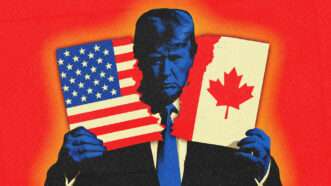
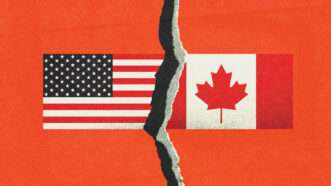
The paper provides an overview of the legal vulnerabilities of the Trump tariffs against Canadian goods, and what can be done to prevent a recurrence of his abuses.
The Cato Institute, Michael McConnell, and I filed an amicus brief in litigation challenging Trump's massive Section 301 tariffs, which use "forced labor" as a pretext for sweeping protectionism.
Why the major questions and nondelegation doctrines bolster the legal case against Trump's Section 338 tariffs.
The brief explains why the Section 122 tariffs are illegal and run afoul of the major questions and nondelegation doctrines.
The move further escalates this harmful and illegal trade war with a vital ally.
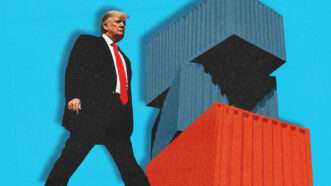
The president's latest round of broad import taxes, like the previous two, treats his statutory authority as an afterthought.
It was filed by several businesses, including Learning Resources, Inc., which was also involved in the IEEPA tariff litigation.
The complaint explains why the tariffs violate the requirements of Section 301, and also run afoul of the major questions and nondelegation doctrines.
The new policy is based on sham investigations, and runs afoul of the major questions and nondelegation doctrine.
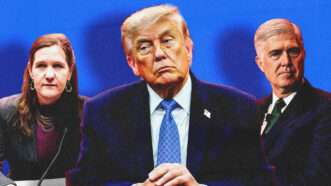
The Supreme Court has "no shortage of tools" to enforce the separation of powers, Justice Neil Gorsuch notes. "The only real question is whether we will use them."

If the laws requiring such agencies to be independent are unconstitutional, it may be that very existence of those agencies is also now illegal.

Extensive evidence indicates that the decision to end Temporary Protected Status for Haitian migrants was motivated by unconstitutional racial and ethnic discrimination. The Court's ruling on statutory issues also has flaws.
A guest post by Georgetown legal scholar Peter E. Harrell.
The ruling is flawed on both substantive and procedural grounds.
They appear to be yet another illegal power grab, one that should be challenged in court.
The 2-1 decision concludes Trump's massive new tariffs are illegal because there is no "balance of payments deficit" of the kind needed to authorize them.

Conservative legal commentator Gregg Nunziata outlines reasons why conservatives should reject broad views of executive power.
The outcome is unclear. But the judges seemed skeptical of the Trump Administration's claims that Section 122 grants them sweeping tariff powers.
I submitted the brief on behalf of the Cato Institute and myself.

The massive new tariffs are illegal, just like the IEEPA tariffs previously invalidated by the Supreme Court.
The Supreme Court's approaches of assuming agency authority to issue legislative rules and of prohibiting Congress from delegating to itself have resulted in an enormous transfer of power to the Executive.
Gregg Nunziata interviewed me.
Only time will tell how great the impact of the ruling will really be. But, at this point, it seems like a very significant decision.
The Court stopped a massive presidential power grab, but did not resolve a crucial issue about judicial review of executive use of emergency powers.
In a 6-3 decision, the Court ruled that the International Emergency Economic Powers Act does not authorize tariffs.
A recent Federalist Society Teleforum with Adam White and Ilan Wurman

It would alienate allies, impose US rule on an unwilling population, and blatantly violate both US and international law. The plan to impose tariffs on nations opposing the seizure is also illegal and harmful.

A recent White House proclamation further expands his previous travel bans, to the point of barring nearly all legal migration from some 40 countries. Legally, it further underscores that Trump is claiming virtually unlimited executive power to restrict immigration,a claim that runs afoul of the nondelegation doctrine.
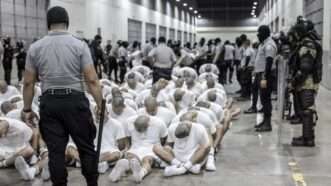
The Trump administration's claims that illegal migration and drug smuggling qualify as an "invasion" or a "predatory incursion" under the Alien Enemies Act go against the major questions doctrine.
Some observations from yesterday's argument in Learning Resources v. Trump.

This is the second lawsuit challenging the policy, which is both illegal and likely to cause great harm if allowed to stand.
The case was filed yesterday by a broad coalition of different groups, including a health care provider, education groups, religious organizations, and labor unions.
The plan violates the relevant visa law. If allowed to stand, it would significantly harm productivity and innovation.
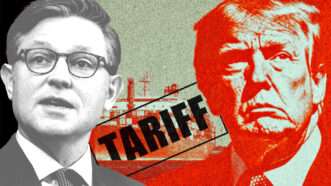
House Republicans passed a resolution that prevents Congress from ending the national emergency Trump is using to impose tariffs until March 31.
The cases will be considered on an accelerated schedule.
The Administration's arguments have more doctrinal support than some might think
In a 7-4 ruling, the en banc court upheld trial court ruling against all the challenged tariffs. The scope of the injunction against them remains to be determined.
Outcomes are hard to predict. But the judges seemed skeptical of the administration's claim that the president has virtually unlimited power to impose tariffs.
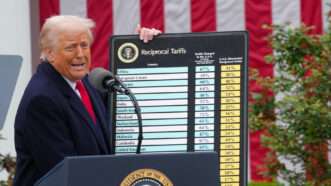
I participated along with Andrew Morris of the New Civil Liberties Alliance.

The case raises many of the same issues as our case against Trump's "Liberation Day" tariffs.
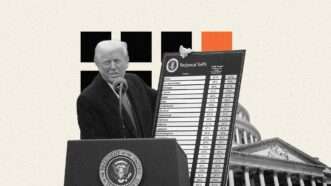
Estreicher and Babbitt are right to conclude that Trump's tariffs violate the nondelegation doctrine, but wrong to reject other arguments against them.
It's an obvious abuse of emergency powers, a claim to unconstitutional delegation of legislative power, and a threat to the economy and the rule of law.
The diversity and quality of the briefs opposing Trump's "Liberation Day" tariffs speaks for itself.
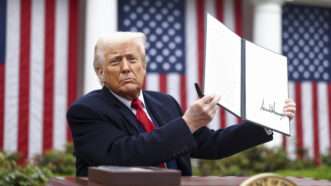
The Cato Institute and the New Civil Liberties Alliance urge the Federal Circuit to extend the logic of a decision against the president's far-reaching import taxes.
Our brief explains why the Federal Circuit should uphold the Court of International Trade decision striking down Trump's "Liberation Day" tariffs.

The Supreme Court may have reached the wrong result in FCC v. Consumers Research. But ruling emphasizes there are significant constitutional limits to legislative delegation to the executive.
It explains how these much-maligned doctrines can be valuable tools for constraining power grabs by presidents of both parties.
Celebrate your independence with a subscription to Reason magazine, your most trusted source of honest, insightful news and analysis.




