The Campaign Against 'Extremism' Looks Like an Attack on Speech
Efforts against violence are turning into restrictions on ideas.


Efforts against violence are turning into restrictions on ideas.

Plus: Laws against teaching critical race theory are un-American, ditching tariffs could save lives, and more...

Officially adopting the currency is great news, but mandating acceptance is a problem.


Plus: How Trump lost in 2020, Amazon seeks recusal of FTC chair, and more...

The cryptocurrency pioneer explains why governments can't stop bitcoin 'despite all their guns and weapons.'

Plus: Retaliatory action in Syria, developments with the delta variant, Clarence Thomas on marijuana, and more...

The process uses 99 percent less land and 96 percent less freshwater than traditional meat production.
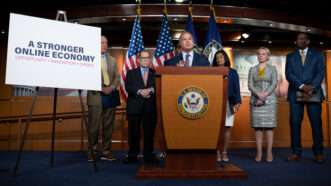
Taken together, these six measures would have a major impact on the way we shop, chat, and otherwise go about our business online.

The ShapeShift founder and early pioneer in the space talks about why bitcoin poses an existential threat to fiat money.


Law enforcers have plenty of tools; they just want to paw through our data without effort or expense.


An IBM team led by A.I. researcher Noam Slonim has devised a system that does not merely answer questions; it debates the questioners.

The former Google engineer talks about inflation, the Austrian school of economics, and how bitcoin is revolutionizing banking.

In many professional arenas, Wu's swings and misses would have consequences. In Wu's case, it landed him an advisory role in the Biden administration.

Plus: Biden to back bill ending crack/cocaine sentencing disparity, the truth about tech startup creation, and more...

Former Google engineer Vijay Boyapati talks inflation, the Austrian school of economics, and his new book on bitcoin.

We'll see about that, say anti-aging researchers.

The drug bust blurs the line between military operations and civilian law enforcement.

The Wyoming Republican says cryptocurrency will spur renewable energy, protect privacy, and possibly save the dollar.

The Wyoming Republican believes bitcoin provides a serious alternative store of value, will spur renewable energy, and just might save the dollar.

Our coverage of biohackers working on a DIY vaccine last year was solid reporting on an important subject. If YouTube insists on banning journalism like this, what's next?

A bipartisan bill aimed to help the U.S. “compete” with China would only slow down scientific progress.

People fret about online echo chambers, but offline echo chambers can be just as strong—or stronger.

"I chose to be that guy who didn't issue the apology," says Daniel Elder. "Things went from there and it wasn't good."


Two states have passed laws requiring court approval before the cops can use genetic genealogy services to track down a suspect.

The law would make a federal case out of every aggrieved internet user and compel companies to host messages they do not wish to platform.

It's ten times more powerful than the current U.S. effort.

Bloodstain pattern analysis is one of several forensic techniques that has come under scrutiny in recent years for its lack of established error rates.

Why is it so hard for him to just admit he was wrong?

Chairman Jerome Powell says the Fed will look into the "benefits and risks" of a digital dollar.

Science writer Steven Johnson, author of the new book Extra Life, on vaccines, medical breakthroughs, and life after Covid.

"A lot of what you're seeing as attacks on me quite frankly are attacks on science."

Plus: How Facebook killed blogging, the trouble with so-called common good originalism, and more...

Jones has been accused of fabricating her COVID-19 cover-up claims. Now she says she's running for Congress.

Plus: ACLU identity crisis, Texas bans vaccine rules, and more...


I don't know the correct level of content moderation by Facebook, Twitter, Google, or Amazon, and neither do you.

Like a number of other modern conservatives, Thomas seems to think that Twitter and other tech companies are effectively censoring right-of-center views.

How reactionary politicians are using monopoly concerns as cover to pursue pre-existing political agendas

The COVID-19 adviser's unsatisfying explanation of his conversion feeds skepticism about the value of a sensible precaution.

A new article's authors thanked Twitter for calling out their problematic microaggressions.


The creator of ultra-woke poet Titania McGrath makes the case against cancel culture.

Theatrical safety checks don't keep people safe—vaccines do.

The company has agreed to purchase 15 supersonic airliners from Denver-based aerospace startup Boom.

Help Reason push back with more of the fact-based reporting we do best. Your support means more reporters, more investigations, and more coverage.
Make a donation today! No thanks
Every dollar I give helps to fund more journalists, more videos, and more amazing stories that celebrate liberty.
Yes! I want to put my money where your mouth is! Not interested
So much of the media tries telling you what to think. Support journalism that helps you to think for yourself.
I’ll donate to Reason right now! No thanks
Push back against misleading media lies and bad ideas. Support Reason’s journalism today.
My donation today will help Reason push back! Not today
Back journalism committed to transparency, independence, and intellectual honesty.
Yes, I’ll donate to Reason today! No thanks
Support journalism that challenges central planning, big government overreach, and creeping socialism.
Yes, I’ll support Reason today! No thanks
Support journalism that exposes bad economics, failed policies, and threats to open markets.
Yes, I’ll donate to Reason today! No thanks
Back independent media that examines the real-world consequences of socialist policies.
Yes, I’ll donate to Reason today! No thanks
Support journalism that challenges government overreach with rational analysis and clear reasoning.
Yes, I’ll donate to Reason today! No thanks
Support journalism that challenges centralized power and defends individual liberty.
Yes, I’ll donate to Reason today! No thanks
Your support helps expose the real-world costs of socialist policy proposals—and highlight better alternatives.
Yes, I’ll donate to Reason today! No thanks
Donate today to fuel reporting that exposes the real costs of heavy-handed government.
Yes, I’ll donate to Reason today! No thanks