Just issued yesterday; not sure how much practical significance this will have, but I thought I'd note it:
[1.] No Assistance from Executive Department Agencies. Except as required by the order of a court of competent jurisdiction, no executive department agency and no employee, appointee, officer, or other person acting on behalf of any executive department agency may provide any information or expend or use time, money, facilities, property, equipment, personnel or other resources in furtherance of any investigation or proceeding initiated in or by another State that seeks to impose civil or criminal liability or professional sanction upon a person or entity for
[a.] [i.] the provision, securing, or receiving of, or any inquiry concerning reproductive health care services that are legal in this Commonwealth; or
[ii.] any assistance given to any person or entity that relates to the provision, securing, receiving of, or any inquiry concerning reproductive health care services that are legal in this Commonwealth.
[T]he vast majority of States—43 by our count—are "shall issue" jurisdictions, where authorities must issue concealed-carry licenses whenever applicants satisfy certain threshold requirements, without granting licensing officials discretion to deny licenses based on a perceived lack of need or suitability. Meanwhile, only six States and the District of Columbia have "may issue" licensing laws, under which authorities have discretion to deny concealed-carry licenses even when the applicant satisfies the statutory criteria, usually because the applicant has not demonstrated cause or suitability for the relevant license. Aside from New York, then, only California, the District of Columbia, Hawaii, Maryland, Massachusetts, and New Jersey have analogues to the "proper cause" standard.
What's the missing state? The answer, turns out, is Vermont, because it has what some call "constitutional carry"—pretty much all law-abiding adults can carry concealed weapons without the need for a license—without even the option of getting a license. The other 24 "constitutional carry" states also have shall-issue licensing schemes, which is why they're included in the Court's count of 43. (Vermont used to be the only such state.)
Note also that 41 states (43 minus three plus Vermont) are unambiguously in the "pretty much all law-abiding adult can carry concealed, with a license or sometimes without" camp. Three more states are somewhat ambiguous, but according to the Court are practically in the shall-issue camp:
Three States—Connecticut, Delaware, and Rhode Island—have discretionary criteria but appear to operate like "shall issue" jurisdictions. Although Connecticut officials have discretion to deny a concealed-carry permit to anyone who is not a "suitable person," the "suitable person" standard precludes permits only to those "individuals whose conduct has shown them to be lacking the essential character of temperament necessary to be entrusted with a weapon." Dwyer v. Farrell, 193 Conn. 7, 12, 475 A.2d 257, 260 (1984). As for Delaware, the State has thus far processed 5,680 license applications and renewals in fiscal year 2022 and has denied only 112. See Del. Courts, Super. Ct., Carrying Concealed Deadly Weapon (June 9, 2022), https://courts.delaware.gov/forms/download.aspx?ID=125408. Moreover, Delaware appears to have no licensing requirement for open carry. Finally, Rhode Island has a suitability requirement, but the Rhode Island Supreme Court has flatly denied that the "[d]emonstration of a proper showing of need" is a component of that requirement. Gadomski v. Tavares, 113 A.3d 387, 392 (2015).
So, treating Vermont as like the shall-issue jurisdictions, the total (until the Bruen decision) could be seen as 41-9, 44-6, or possibly something in between. That's apparently a change from 9-41 (the other way) in 1986, when reportedly only Alabama, Connecticut, Indiana, Maine, New Hampshire, North Dakota, South Dakota, Vermont, and Washington allowed broad concealed carry under a shall-issue licensing regime (or, in Vermont's case, even without any need for a license).
Many more states, though, have long allowed open carry even if they didn't allow concealed carry: Carrying was broadly lawful throughout much of American history, and was generally recognized as a constitutional right, as the Court noted, but states were allowed to mandate that the carrying be open (and they still can so mandate after Bruen, though it seems unlikely that they will).
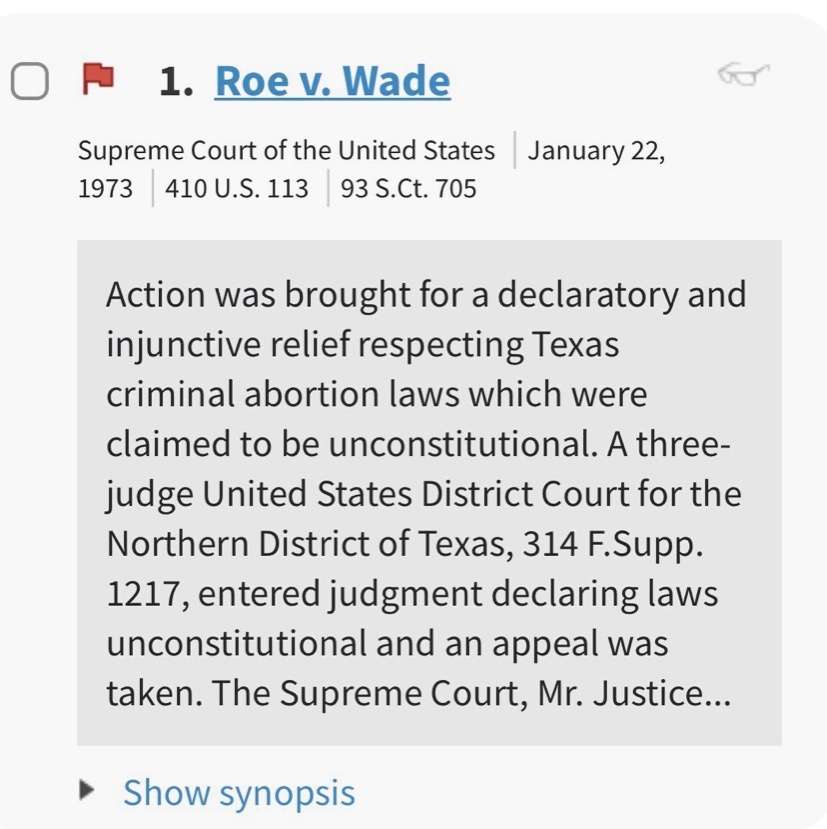
Both majority and dissenting opinions include extensive discussions of stare decisis. But the truth is whether you think Roe v. Wade should have been preserved on that basis is heavily correlated with whether you think it was wrong in the first place.
Friday's ruling in Dobbs v. Jackson Women's Health Organization includes a wide-ranging debate over whether the majority's decision to reverse Roe v. Wade and other precedents supporting abortion rights violated the principle of staredecisis. Both sides make their case well. But at the end of the day, I am left with the impression that much of the debate ultimately comes down to how bad (if at all) you think Roe was in the first place.
I have previously suggested that "Stare decisis will not stop the justices from overturning a precedent they think is badly wrong and causes significant harm" - a point I believe applies to both liberal and conservative jurists. Nothing in yesterday's opinions leads me to change that view. This point can be recast in terms of the Supreme Court's doctrinal standards for reversing previous decisions: its "precedent on precedent." The doctrine requires the Court to consider such factors as the quality of the earlier precedent's reasoning, the extent to which changing circumstances have undermined its utility, the "workability" of the precedent, and whether it has generated significant reliance interests. But much of this just a fancier and more sophisticated way of saying that courts must consider 1) how bad was the precedent, and 2) how much harm it causes, which perhaps should be weighed against the potential harm of upsetting settled expectations.
If you think, as the conservative majority obviously does, that Roe v. Wade wasn't just a mistake in legal reasoning, but "egregiously wrong and deeply damaging," you are going to want to overrule it. As most conservative jurists see it, Roe combines terrible reasoning with horrific real-world consequences comparable to sanctioning the murder of innocent people. If that's what you think, it's easy enough to justify reversing Roe under the Court's standards for overturning precedent, or under almost any theory of stare decisis, short of near-absolute deference to prior decisions, which would also require preservation of such monstrosities as Plessy v. Ferguson and Korematsu. In his majority opinion, Justice Alito compares Roe to Plessy and other notorious "anti-canon" cases.
The conservatives' reasons for overruling Roe are actually similar to liberals' own justifications for junking precedents they believe to be especially awful, like the reversal of Bowers v. Hardwick, the 1986 case upholding the constitutionality of anti-sodomy laws in Lawrence v. Texas (2003), the reversal of numerous pre-New Deal cases protecting economic liberties and property rights, and the reversal of Baker v. Nelson (1972), in Obergefell v. Hodges (2015) (thereby striking down laws banning same-sex marriage). Each of these situations ultimately came down to a liberal or liberal-leaning Supreme Court majority concluding that the precedents in question should be gotten rid of because they were badly wrong and caused profound harm. I think the liberals were right about Bowers and Baker. But that doesn't change the reality of how the reversal of those precedents came about.
The joint Dobbs dissent by the three liberal justices at times seems to suggest precedent must never be reversed unless there is some change in intervening circumstances. In response, Alito rightly points out that this theory implies Plessy could not have been justifiably reversed until some kind of social change occurred relative to the situation in 1896. One can say the same thing about Lawrence's reversal of Bowers. It's hard to think of a reason why Bowers was more wrong or more harmful in 2003 than it was in 1986. If anything, the reverse may have been true, as anti-sodomy laws caused more harm in an era when the authorities were more likely to try to actually enforce them.
Ultimately, the liberal justices concede that "we are not saying that a decision can never be overruled just because it is terribly wrong." If so, then much depends on just how wrong the decision in question actually is.
I do think the majority mishandles one aspect of the Court's standard for overruling: the problem of reliance interests. Justice Alito dismisses the idea that Roe has engendered significant reliance interests because "[t]raditional reliance interests arise 'where advance planning of great precision is most obviously a necessity.' Casey, 505 U. S., at 856…. In Casey, the controlling opinion conceded that those traditional reliance interests were not implicated because getting an abortion is generally "unplanned activity," and "reproductive planning could take virtually immediate account of any sudden restoration of state authority to ban abortions." 505 U. S., at 856. For these reasons, we agree with the Casey plurality that conventional, concrete reliance interests are not present here."
I agree that contraception and "reproductive planning" are often effective substitutes for abortion. But these tools don't work in cases where the pregnancy is the result of rape, or where the need for abortion arises from a medical problem that only became evident after the pregnancy began. Alito says that only "concrete" reliance interests deserve consideration, not "intangible form[s] of reliance" that are difficult to for courts to assess. But the examples above strike me as both concrete and tangible. Indeed, it's hard to think of many interests that are more concrete than those of a woman facing an unwanted pregnancy caused by rape, or one that poses a serious danger to her health. The dissent offers some additional examples of reliance interests overlooked by Alito, though I don't fully agree with its analysis of these points.
Even very extensive reliance interests aren't always enough to preclude reversal of a precedent. Few prominent Supreme Court cases engendered as much reliance as Plessy v. Ferguson and other decisions upholding racial segregation. Segregationists weren't entirely wrong when they asserted that the entire southern "way of life" was bound up with Jim Crow. Yet, today, almost everyone agrees the Court was right to gut Plessy, regardless. Pro-segregation decisions were so profoundly wrong and harmful that the case for getting rid of them outweighed even very large reliance interests. If you think abortion is the moral equivalent of murder, you could reasonably say the same of Roe.
I myself do not believe Roe was anywhere near as awful Plessy. But that's in large part because I'm pro-choice with respect to the vast majority of abortions, and certainly do not believe they are the moral equivalent of murder, or anything like it. I also think that, while there are indeed significant analytical errors in Roe, they are no more egregious than those in lots of other Supreme Court rulings. But I have to admit I would be far more supportive of overruling Roe if I thought abortion was a great evil, and Roe's reasoning placed it among the worst-reasoned cases of all time.
Regardless, the reliance interests underpinning Roe are more substantial than the Dobbs majority recognizes. That at least should raise the threshold of awfulness great enough to justify reversal.
Some have argued that Dobbs' reversal of Roe is especially bad because it reverses a decision expanding constitutional rights, rather than contracting them. But, as I explained at length in a previous post, the Court has an extensive history of reversing rights-protecting precedents, including many whose demise was cheered by the political left.
I think most of these reversals were actually misguided, and that it might be wise to establish an especially strong presumption against reversing precedents that protect individual rights. I would have been happy if the Supreme Court had adopted such a rule, and declined to reverse Roe on that basis. But that's not an approach you can embrace if - like many progressives - you applaud the Supreme Court's 20th century gutting of precedents protecting contract and property rights, and would be happy to see it overrule Citizens United v. FEC (2010) or various cases protecting gun rights.
In sum, despite the impressive intellectual effort both sides devote to the stare decisis question, I think the debate over the overruling of Roe mostly comes down to how bad it was in the first place. That's not to say that stare decisis never matters. Far from it. It matters a great deal in the many situations where judges think a precedent was only modestly erroneous, the mistaken precedent doesn't cause much harm, or - even better - some combination of both. Nearly all judges - yes, even Clarence Thomas - tolerate numerous precedents they think are wrong, but ultimately not all that bad.
But such tolerance wilts when it comes to decisions jurists think are horrendously awful in both their reasoning and their effects. Liberals and conservatives, originalists and living constitutionalists, all behave that way - for good reason, in my view. All are willing to reverse precedents that are "egregiously wrong and deeply damaging," as Alito puts it. The big disagreement is over which cases fall into that category.
This weekend I find myself in Louisville, Kentucky for Judge Boggs's clerk reunion. I clerked here back in 2011-12, and the last reunion was in June 2016. In many ways, these three points in time were inflection points for the conservative legal movement, and for my role in that process.
In June 2012, as I wound down my clerkship, the Supreme Court decided NFIB v. Sebelius. At the time, I was already writing my first book on the Obamacare litigation. The Chief Justice, and his saving construction, signaled to many conservatives that the Roberts Court was not what they thought it was. We chanted "No more Souters," but instead, we got a Roberts. In hindsight, all the signs were there--Roberts had more red flags than a Soviet parade. But NFIB crystalized the Chief's priorities. About a month later, right after my last sitting, I began teaching at the South Texas College of Law.
Fast-forward to February 2016. I was still an untenured professor, and hadn't been protested yet. My work was read in certain circles, but my influence was admittedly limited. Justice Scalia died, and Senate Republicans refused to even hold a hearing on whoever the President nominated. June 2016 represented one of the worst months for conservatives on the Supreme Court in recent memory. Whole Woman's Health, Fisher II, a 4-4 in Texas v. U.S., a punt in Zubik v. Burwell, and so on. Things looked bleak. Then, to (almost) everyone's surprise, Trump won. And in rapid succession, we got Gorsuch, Kavanaugh, and Barrett.
Now, in June 2022, I am back in Louisville. I'm tenured, and my work consistently drives national conversations. We have Dobbs and NYSRPA, and I played some role in both decisions. I could not have fathomed either case a decade ago after NFIB, or even six years ago after Justice Scalia's passing. For nostalgia's sake, I drove past my own apartment. I imagined going back in time, and paying a visit to Josh circa 2012. We had a chat about all that would happen over the ensuing decade. (I will assume the rules of time travel from Back to the Future are not in effect.) Would 27-year old Josh have even believed it? I wouldn't have. Would any of you--ten years younger--have fathomed what would happen in a decade?
The conservative legal movement has achieved something that was once unthinkable. Now, there will be backlash. And disorder. And contention. I don't expect the near-future to be pleasant. People on the right have long-internalized the crushing blow of defeat from Casey. Now, people on the left will have to internalize the even-more-crushing blow of defeat from Dobbs. For now, the reaction will be raw, but in time, a new equilibrium will form. What that balance is, no one knows. The courts will still be called upon to decide cases affecting abortion, but those decisions will turn on other, more established areas, far less contentious of law including federalism, separation of powers, and interstate comity--not whether the Due Process Clause protects a right to abortion.
Yesterday, the Deseret News invited me to write an op-ed on Dobbs. I thought I would have some time to think about it, but the Court moved quicker than I expected.
In 1973, Roe v. Wade created a constitutional right to abortion. Two decades later, in Planned Parenthood v. Casey, the Supreme Court refused to reverse that controversial decision, writing that "to overrule (Roe) under fire … would subvert the Court's legitimacy beyond any serious question."
Today, Roewas overruled in the Dobbs v. Jackson Women's Health Organization decision. And in doing so, the majority demonstrated real courage "under fire." Five justices were willing to take this bold and correct legal step in the face of never-ending personal attacks, efforts to pack the court, fallout from the leaked draft opinion, protests outside their homes and even an assassination attempt.
Dobbs, which is a triumph for originalism and sound constitutional law, also signals that the court is infused with judicial fortitude. This virtue, more than any particular method of deciding cases, guarantees that the court will steadfastly safeguard the rule of law.
And the conclusion:
Two years ago, I dubbed the final month of the Supreme Court's term as "Blue June." In case after case, the court's purported conservative majority went to the left. Chief Justice John Roberts, the swing vote, found creative ways to strike balances that did not really resolve contentious issues, but avoided any obvious conservative victory. He hewed closely to a jurisprudence of public relations.
Two years later, we are in a very different time — call it "Red June." Today, the court overruled Roe v. Wade; yesterday the court held that New York's restrictions on concealed carry were unconstitutional. These two decisions, separated by 24 hours, were handed down in the face of immense pressure from every facet of our society. Yet the justices did not falter. They are infused with judicial courage. And if they stick to their guns, come what may, the rule of law will be steadfastly safeguarded.
I will have much more to say about Red June, or perhaps Red Flag June in due course.
You should also check out Joel Alicea's piece in City Journal, titled "An Originalist Victory."
To acknowledge this achievement is to acknowledge the constitutional theory around which the coalition that brought it about rallied for a half-century: originalism. It was originalism that the pro-life movement adopted after Roe and supported through the confirmation defeat of Robert Bork; the attempted defeats of Clarence Thomas, Samuel Alito, and Brett Kavanaugh; and the setback of Casey. The goal of overruling Roe and Casey bound the conservative political movement to the conservative legal movement, and originalism was their common constitutional theory. Dobbs thus had the potential—as I argued in an earlier essay—to exacerbate the tensions over originalism within the conservative legal movement. It would be viewed as the acid test of originalism's ability to translate theory into practice, and there would be no avoiding the stakes for the conservative legal movement in the case: "complete victory or crisis-inducing defeat," as I put it. We now know that it was a complete victory, and it was, in large part, originalism's victory.
I count Joel, Sherif Girgis, and a few others, as leaders in the conservative legal movement who helped advance the debate in Dobbs.
On Wednesday, June 22, I delivered a Supreme Court roundup to the Arizona Judicial Conference in Tucson. Towards the end of my remarks, I suggested that the new Roberts Court would define itself over the following eight days. Little did I know that it would take far less time.
On Thursday, June 23, 2022, at 10:30 a.m., the Court decided NYS Rifle & Pistol v. Bruen. And on Friday, June 24, 2022, at 10:10 a.m., the Court decided Dobbs v. Jackson Women's Health Organization. These two days were among the most significant moments in the conservative legal movement's history--an inflection point even--and they happened back-to-back.
From my perspective, the past twenty-four hours have been a bit of a roller-coaster. Really, the entire term was a roller-coaster. The Supreme Court "reform" commission. S.B. 8. The shadow docket. Dobbs. NYS Rifle. Maskgate. The Leak. The assassination attempt. And so on. Yet, after all of these twists and turns, the Court held fast and did not falter. I will have an op-ed out shortly that develops some of these points.
In reaction to today's decision in Dobbs v. Jackson Women's Health, overruling Roe v. Wade, advocacy groups are warning about the potential implications for other rights.Some analysts are pointing specifically to Justice Thomas's concurring opinion, which calls for a reexamination of substantive due process precedents like Griswold v. Connecticut (1965), Lawrence v. Texas (2003), and Obergefell v. Hodges (2015). Certainly the three-Justice joint dissent is sounding the alarm.
Has the mask finally dropped, revealing the true intentions of the majority to wipe the slate clean of unenumerated fundamental rights that social and religious conservatives don't like?
To begin an answer to that question, I count no fewer than four places in the Dobbs opinion that disavow any implications for other rights. I refer to these as the reassurance passages. Two of them were already in the leaked draft opinion. Two more have been added because they are responses to the dissent (which would not have been available when Justice Alito circulated his first draft in February).
(1) Slip op. 32 (in the original draft), after listing numerous substantive due process rights:
What sharply distinguishes the abortion right from the rights recognized in the cases on which Roe and Casey rely is something that both those decisions acknowledged: Abortion destroys what those decisions call "potential life" and what the law at issue in this case regards as the life of an "unborn human being." See Roe, 410 U. S., at 159 (abortion is "inherently different"); Casey, 505 U. S., at 852 (abortion is "a unique act"). None of the other decisions cited by Roe and Casey involved the critical moral question posed by abortion. They are therefore inapposite. They do not support the right to obtain an abortion, and by the same token, our conclusion that the Constitution does not confer such a right does not undermine them in any way.
(2) pp. 37-38 (added to the final opinion):
The most striking feature of the dissent is the absence of any serious discussion of the legitimacy of the States' interest in protecting fetal life. This is evident in the analogy that the dissent draws between the abortion right and the rights recognized in Griswold (contraception), Eisenstadt (same), Lawrence (sexual conduct with member of the same sex), and Obergefell (same-sex marriage). Perhaps this is designed to stoke unfounded fear that our decision will imperil those other rights, but the dissent's analogy is objectionable for a more important reason: what it reveals about the dissent's views on the protection of what Roe called "potential life." The exercise of the rights at issue in Griswold, Eisenstadt, Lawrence, and Obergefell does not destroy a "potential life," but an abortion has that effect.
(3) p. 66 (in the original draft):
Unable to show concrete reliance on Roe and Casey themselves, the Solicitor General suggests that overruling those decisions would "threaten the Court's precedents holding that the Due Process Clause protects other rights." Brief for United States 26 (citing Obergefell, 576 U. S. 644; Lawrence, 539 U. S. 558; Griswold, 381 U. S. 479). That is not correct for reasons we have already discussed. As even the Casey plurality recognized, "[a]bortion is a unique act" because it terminates "life or potential life." 505 U. S., at 852; see also Roe, 410 U. S., at 159 (abortion is "inherently different from marital intimacy," "marriage," or "procreation"). And to ensure that our decision is not misunderstood or mischaracterized, we emphasize that our decision concerns the constitutional right to abortion and no other right. Nothing in this opinion should be understood to cast doubt on precedents that do not concern abortion.
(4) pp. 71-72 (added to the final opinion)
Finally, the dissent suggests that our decision calls into question Griswold, Eisenstadt, Lawrence, and Obergefell. Post, at 4–5, 26–27, n. 8. But we have stated unequivocally that "[n]othing in this opinion should be understood to cast doubt on precedents that do not concern abortion." Supra, at 66. We have also explained why that is so: rights regarding contraception and same-sex relationships are inherently different from the right to abortion because the latter (as we have stressed) uniquely involves what Roe and Casey termed "potential life." Roe, 410 U. S., at 150 (emphasis deleted); Casey, 505 U. S., at 852. Therefore, a right to abortion cannot be justified by a purported analogy to the rights recognized in those other cases or by "appeals to a broader right to autonomy." Supra, at 32. It is hard to see how we could be clearer. Moreover, even putting aside that these cases are distinguishable, there is a further point that the dissent ignores: Each precedent is subject to its own stare decisis analysis, and the factors that our doctrine instructs us to consider like reliance and workability are different for these cases than for our abortion jurisprudence.
The number and clarity of these passages are extraordinary. To these one could add the separate concurrence of Justice Kavanaugh, who addresses concerns that were raised in the briefs:
First is the question of how this decision will affect other precedents involving issues such as contraception and marriage—in particular, the decisions in Griswold v. Connecticut, 381 U. S. 479 (1965); Eisenstadt v. Baird, 405 U. S. 438 (1972); Loving v. Virginia, 388 U. S. 1 (1967); and Obergefell v. Hodges, 576 U. S. 644 (2015). I emphasize what the Court today states: Overruling Roe does not mean the overruling of those precedents, and does not threaten or cast doubt on those precedents.
(As an aside, I don't count Justice Thomas's view as portending much. It's notable that he wrote only for himself. His views about substantive due process are longstanding, well-known, and idiosyncratic. No other sitting justice has ever expressed an interest in completely abandoning substantive due process and all of the precedents it has generated.)
The reassurance passages go well beyond mere rote observations that the Court is not overruling these precedents because it has neither been asked to do so nor is it required to do so in order to decide the case before it. The passages are also not mere bald assertions, devoid of substance, which can be dropped without any pretense of consistency. Instead, they contain two substantive principles.
The first is the Court's observation that abortion, which involves the taking of what is at least potential human life, has no parallel in other rights-contexts. That distinction is admitted by just about everyone. The Court does not say precisely how this distinction should affect the constitutional analysis of whether the right exists. But I read the Court as suggesting that the analysis of whether a right should be protected turns in part on the countervailing interests at stake in not protecting it--here, the destruction of potential life (the kind of ultimate "moral question" the Court thinks judges cannot or should not resolve). Resolution of the potential life question also goes to the strength of the government's interest in regulation.
Further, to the extent new rights can be recognized (or old rights can be recognized in new contexts), we do so by analogy. But there is no analogy close to the abortion right, which is sui generis. Under this view, the right to same-sex marriage (Obergefell) is at least adjacent to the recognized right to marry (Loving) in a way that the right to end a pregnancy (Roe) is not adjacent to the recognized right to prevent a pregnancy (Griswold).
The second principle is new in the published decision. The opinion notes that, even if some other substantive due process decisions were initially wrong, the Court should continue to stand by them under stare decisis principles. Specifically, the reliance interests in, say, same-sex marriage are much more concrete. (Query, however, why the reliance interests in Lawrence and Griswold would be any greater than in Roe.) Also, protection of the rights to contraception, sexual intimacy, and marriage, are more judicially manageable (workability). Gay couples have a right to marry on the same terms as others, which does not depend on whether a regulation places an undue burden on that right. It's an on-or-off switch, not a balancing of incommensurable interests.
I have previously written that overruling Roe would present no "immediate or direct threat" to the various other substantive-due process precedents, including Obergefell. The Court has now effectively doubled-down on its reassurances about this. There are simply not five votes to overrule Obergefell or the other decisions. I'd wager there are not more than two to do so.
It is true, as both Justice Thomas and the dissent point out, that rights to contraception, sexual intimacy, and same-sex marriage do not fit easily within the Court's narrow history-and-tradition methodology. That might spell longer-term trouble under a different cast of Justices who may not feel as much obligation to ancestral precedents.
So could Obergefell, Lawrence, Griswold, and even Loving be overruled sometime in the future? Of course. We know that even half-century-old precedents are not sacred. And the future is a long time. It is a foreign land in which anything can happen. But Dobbs does not augur a majority willing to go there.
Apparently, "The Court's decision"—and by implication the position of students, staff, and faculty who endorse that decision—"is antithetical to the University of California's mission and values."
University of California President Michael V. Drake, M.D., today (June 24) issued the following statement on the United States Supreme Court's decision in Dobbs v. Jackson Women's Health Organization:
For nearly 50 years, people in the United States have had the right to make private, informed choices about their health care and their futures. I am gravely concerned that today's U.S. Supreme Court decision removes that right and will endanger lives across the country. This decision overturns decades of legal precedent and could pave the way for other fundamental rights to be removed.
The Court's decision is antithetical to the University of California's mission and values. We strongly support allowing individuals to access evidence-based health care services and to make decisions about their own care in consultation with their medical team. Despite this decision by the Court, we will continue to provide the full range of health care options possible in California, including reproductive health services, and to steadfastly advocate for the needs of our patients, students, staff, and the communities we serve. We will also continue to offer comprehensive education and training to the next generation of health care providers, and to conduct life-saving research to the fullest extent possible.
This is a sobering moment for many of us at the University of California and throughout the nation. Today, we stand with California leaders and health care advocates who are taking critical steps to protect Californians' human rights and their access to affordable and convenient health care choices.
I don't think that a public university's "mission and values" should be to promote a reading of the Constitution as securing abortion rights, or as not securing abortion rights, as opposed to promoting research on this and related questions. And while of course a public university that runs hospitals should generally perform legal medical procedures, and train doctors with regard to legal medical procedures, I don't think that justifies the university taking a stand on whether such legality is determined by state legislatures or by Supreme Court Justices.
Please enjoy the latest edition of Short Circuit, a weekly feature from the Institute for Justice.
Friends, please join us next Thursday, June 30 at UCLA—or via livestream on our Facebook page—at 1:30pm Eastern/10:30am Pacific for the debut of our interactive civil rights study as well as a live recording of the Short Circuit podcast with Professor Eugene Volokh of UCLA, Julia Yoo of the National Police Accountability Project, and Nicholas Yoka of Panish Shea Boyle Ravipudi LLP. Click here to RSVP.
NYPD officers are alerted to gunshot at Bronx apartment building by ShotSpotter, a surveillance system that involves putting microphones all over the place. A stop-and-frisk of two men near the scene turns up a gun. Defendants: ShotSpotter is not reliable, and there was no reasonable suspicion for the stop. Second Circuit: An officer testified it's usually pretty reliable in her experience. Convictions affirmed.
In 2014, the SDNY found that lawyer Steve Donziger had fraudulently obtained an $8 bil judgment against Chevron in an Ecuadorian court. Donziger then refuses to surrender his passport or produce discovery that would allow Chevron to identify assets from which it could recoup the $800k Donziger was ordered to pay. He's found first in civil contempt and, when that proves ineffective, criminal contempt. Donziger: The prosecution was unconstitutional because the special prosecutor who oversaw the contempt proceedings was appointed in violation of the Appointments Clause. Second Circuit (over a dissent): The Attorney General had the power to oversee the prosecutor. No matter that he chose not to.
After his interview for Georgetown Law goes poorly, rejected student starts a massive campaign of online harassment aimed at his interviewer, resulting in, among other things, hundreds of phone calls from strangers seeking sex with the interviewer, his wife, and his child. The would-be lawyer is convicted of cyberstalking but argues that the law is unconstitutionally overbroad. Third Circuit: Nah, it's fine. We also affirm the restitution to the interviewer, but vacate the restitution to Georgetown Law, which suffered no property harm.
In 2019, Texas amended its alcohol laws to allow breweries to sell direct to consumers for off-premises consumption, but only if they produced no more than 225,000 barrels at facilities they wholly or partially owned. After Texas orders a brewer to stop consumer sales, the brewer responds that it doesn't own the brewing facilities, it leases them. Fifth Circuit (in a pun-filled opinion): If the card says "Moops," it's Moops. If the law says "owned," it's owned.
The "open fields doctrine" allows officers to intrude upon private property without it being a "search" under the Fourth Amendment. The courts have expanded the doctrine to include areas that are neither "open" nor a "field." But the Sixth Circuit explains it hasn't been expanded enough to turn "seizures" into "non-seizures" under the Fourth Amendment, even if the seizures, as in this case, were of cows.
Husband and wife run an international illicit cigarette business, selling them tax free to customers and depriving local, state, federal gov'ts of tens of millions of dollars of tax revenue. It all comes to naught, however; they're convicted and sentenced to 10 and 5 years respectively, and they're ordered to forfeit tens of millions of dollars to the gov't. But wait! The forfeiture order was not included in their sentence; the gov't asked for it, but the district court failed to include it—and didn't tack it on until after they'd appealed their convictions and money judgment-less sentence. Sixth Circuit: So they don't have to pay it.
Eight people arrested at Rockford, Ill. Black Lives Matter protest have a rough weekend in jail. (One is denied prescription medication. Others have injuries, like an open head wound, that aren't attended to. Another is confined in solitary.) Did it violate the Fourth Amendment for them not to receive bail hearings for 48 to 68 hours? Seventh Circuit: We can see why one would think that given all the dicta out there pointing that way. But no.
The Boycott, Divestment, and Sanctions (BDS) movement encourages individuals and businesses to refrain from doing business in Israel or with Israeli companies. In response, Arkansas in 2017 enacted a law that required companies contracting with the state to certify that they would not boycott Israel. The Arkansas Times sued, alleging that the requirement violated the First Amendment. Eighth Circuit (en banc): You could read the law that way, but we read it narrowly to cover only non-expressive economic conduct. Dissent: Nothing narrow about this law.
Missouri sex offenders cannot be within 500 feet of any public park with playground equipment. Jackson County sheriff interprets this to prohibit such folks from being present at a homeless shelter near a playground, so he and his deputies conduct shelter sweeps for offenders. The shelter sues, the sheriff resigns, and the county shifts its tune and tells the court it won't prosecute people seeking the shelter's services. Eighth Circuit: Well then, the shelter's claims against the county are moot. And qualified immunity for the sheriff.
Sacramento, Calif. cop says, "F--- this guy, I'm going to hit him" before attempting to ram the man with a police cruiser. The cop and his partner then shoot the man 14 times. He dies. The man's father settles his lawsuit for $719k; the man's siblings' suit takes multiple trips up and down the federal courts. Ninth Circuit: Not anymore. Their First Amendment claim to familial association (their last remaining claim) doesn't survive because . . . well, it just doesn't.
Employees at Tampa, Fla. power plant respond to ammonia leak without first donning protective gear. A violation of OSHA's HAZWOPER standard? (For the uninitiated, that's the Hazardous Waste Operations and Emergency Response standard.) OSHA: Yep, pay this $9k fine. Eleventh Circuit: Reversed. HAZWOPER only applies to "uncontrolled" releases, and this was a controlled release from an overpressurized pipe; it gave workers a chance to sort things out before the pipe burst.
And in en banc news, the Fifth Circuit will reconsider its decision permitting the ATF to redefine the word "machinegun" to include bump stocks, rendering them illegal and requiring the owners of up to 520k legally purchased bump stocks to relinquish or destroy them—on pain of felony prosecution.
And in amicus brief news, IJ is asking the Ohio Supreme Court to uphold an appeals court ruling that power companies are not entitled to an "irrebuttable presumption of necessity" whenever they want to take land by eminent domain. Instead, the state constitution requires meaningful, fact-based review to ensure companies don't condemn more property than is actually needed for public use.
This week, the Supreme Court handed parents and students a major victory in Carson v. Makin, an IJ case, ruling that if states offer tuition assistance for families to use at private schools, they cannot prevent families from choosing to send their children to schools that teach religion. Maine officials had argued that the state was not violating the First Amendment because it did not exclude schools from its program because they are religious; rather, it excludes them if they teach religion. That distinction, which the First Circuit had embraced, is no longer of constitutional significance. Click here to read more. Or click here for the podcast, the latest episode of which covers the decision.
Two years ago, we lamented Blue June. Now, we are in the midst of what I will call Red Flag June. Bruen and Dobbs have placed red flags on hundreds of precedents.
From Manno v. Campbell, decided Wednesday by Judge Denise Cote (S.D.N.Y.):
As of September 12, 2021, [Kelly] Manno has more than 1 million followers on TikTok. Manno created and owns all rights to the two one-minute-long Videos posted on TikTok, Facebook, and Instagram entitled "HomeGirl Hotline." The first Video was posted on August 9, 2020, and the second on September 4, 2020. Both Videos revolve around a fictional service hotline through which callers can order a "homegirl."
In both Videos, a woman calls the HomeGirl Hotline to speak to a dispatcher. The caller explains the nature of her problem, the dispatcher asks clarifying questions, and the dispatcher sends a Homegirl. In the first Video, the dispatched HomeGirl throws a cheating husband's belongings out of the house and slashes his car's tires. In the second Video, the HomeGirl beats the mother of a child bully. Advertisements for "Homegirl Hoodies" available for purchase at Manno's website are interspersed throughout the Videos.
The defendants are the creators, producers, and broadcasters of a television program airing on HBO Max entitled "That Damn Michael Che." On April 26, 2021, the defendants released a 23-minute Episode of the program entitled "Only Built 4 Leather Suits." Four of Episode's ten sketches are built around the use of a fictional mobile app called "homegrrl" to order a homegirl.
The Episode begins with Che entering a confessional in a Catholic Church. While the Episode cuts to other scenes, the Episode returns to the confessional scene as Che complains that a female bouncer at a nightclub embarrassed him when she denied him entry in front of his friends. Che explains that he would never hit a woman because he doesn't want to get "cancelled" but asks the priest "do you ever want to sock a lady because she made you feel small in front of your friends?" The Episode then cuts to a scene in a supermarket, launching the first of the four "homegrrl" segments.
Rest assured, I will have much more to say about the past twenty-four hours, and Red June more broadly. For now, I would like to share an edited version of NYS Rifle & Pistol v. Bruen, which I prepared for the 2022 Barnett/Blackman supplement. I distilled the 132-page decision down to about 40 pages. It is always a tough judgment call of what to include, and what to omit. Given the gravity of this case, I erred on the side of inclusion. In particular, I focused on the historical materials on which the majority and dissent disagreed. For those sources on which there was no back-and-forth, I excerpted. I could probably teach an entire seminar on this decision, coupled with McDonald and Heller. Much more to come.
Now, onto editing the 213-page Dobbs decision.
Update: Maybe it should be Red Flag June. Between Dobbs and Bruen, hundreds of cases now have red flags next to them.
Today's Supreme Court decision in Dobbs v. Jackson Women's Health Organization reversing Roe v. Wade raises a variety of important new issues of law and policy. One of them is whether states can bar residents from traveling out-of-state to get abortions. In his concurring opinion in Dobbs, Justice Brett Kavanaugh writes that this is question is "not especially difficult," and suggests the answer is "no":
[S]ome of the other abortion-related legal questions raised by today's decision are not especially difficult as a constitutional matter. For example, may a State bar a resident of that State from traveling to another State to obtain an abortion? In my view, the answer is no based on the constitutional right to interstate travel.
You might question the propriety of Kavanaugh opining on this issue that wasn't before the Court. But opine he did. And his doing so sends a strong signal that the Court is likely to strike down state laws banning interstate travel for purposes of getting an abortion. Kavanaugh appears to be the key swing voter among the five justices who voted to overrule Roe. It is highly likely that the three liberal dissenters would also vote to strike down such laws. The same could well be true of Chief Justice John Roberts (who wrote a concurring opinion that would have preserved Roe with respect to the vast majority of abortions). That would ensure the necessary five votes to strike down state bans on travel to get an abortion.
In a previous post on this issue, I pointed out that there are actually three compelling rationales for striking down state laws banning interstate travel for purposes of getting an abortion. In addition to the right-to-travel issue raised by Kavanaugh, there are also the Dormant Commerce Clause and procedural due process limits on states' extraterritorial jurisdiction. One or more of the other justices in the Dobbs majority might well endorse at least one of these theories. This is especially likely because upholding such laws would open the door to a variety of other state restrictions on interstate movement. If states can ban travel to get an abortion, why not travel to engage in any other activity a state government doesn't approve of?
While state abortion travel bans are likely to get struck down, the same is not necessarily true for a potential federal law banning such activity. Many of the arguments that apply against state laws do not apply to the federal government, most notably the Dormant Commerce Clause theory. Interestingly, however, the right-to-travel argument embraced by Kavanaugh is one that probably does constrain the feds, as well as the states.
The issue of abortion travel bans is distinct from the question of whether the federal government has the power to ban some or all abortions outright, regardless of whether they involve interstate travel or nor. There is an argument that such a law would exceed the scope of Congress's enumerated powers under the Constitution, even if there is no constitutional right to abortion. As far as I can tell, neither Kavanaugh nor any other justice addressed that question today. In my view, current Supreme Court precedent probably does allow Congress to ban all or most abortions, but that precedent is flawed and might potentially be cut back by the Court. Similar structural issues are raised by proposals (advanced by liberal Democrats) for a federal law overriding state abortion restrictions.
Of course, there are also significant political obstacles to passing any nationwide federal abortion law. Whether either side can overcome them remains to be seen.
UPDATE: It's worth noting that Kavanaugh also indicates it would be unconstitutional for a state to "retroactively impose liability or punishment for an abortion that occurred before today's decision takes effect."
UPDATE #2: For those interested, I wrote a previous post addressing the question of whether people will "vote with their feet" for abortion in a post-Roe world.
This is a tremendously important question, as Ilya's and my posts noted in May. Justice Kavanaugh's concurrence in Dobbs today expressly noted:
[A]s I see it, some of the other abortion-related legal questions raised by today's decision are not especially difficult as a constitutional matter. For example, may a State bar a resident of that State from traveling to another State to obtain an abortion? In my view, the answer is no based on the constitutional right to interstate travel.
I expect this is fairly important because I assume that Chief Justice Roberts and the three dissenters (Justices Breyer, Sotomayor, and Kagan) and Justice Jackson, who will replace Justice Breyer, would likely go along with Kavanaugh on this. (Indeed, some of the other Justices in the majority might, too.) It's not certain, of course, especially as to Roberts; still, Kavanaugh's pronouncement here strikes me as highly significant.
And this also suggests that laws criminalizing aiding a woman going out of state to get an abortion would likely be unconstitutional, too, since they would substantially burden the woman's right to travel (just as laws restricting contributions to a political organization substantially burden the organization's right to speak). That's important because there might well be states in which the majority of the public balks at criminally punishing the woman who is getting an abortion, but is willing to punish those who aid her (as well as those who perform the abortion).
I should note, of course, that for many women traveling out of state to get an abortion may be quite burdensome, in money, time, and risk of being found out by family members and others. I expect that there will be charities that will help women out with this, but naturally pro-abortion-rights people won't view that as a fully satisfactory answer (and of course anti-abortion people won't, either). Still, the burden of having to leave one's home permanently, or else risk criminal prosecution when one returns, would be vastly greater.
And as a practical matter, if such no-travel-out-of-state-to-get-an-abortion laws exist in some states and are constitutional, it will create a sharp disincentive for many people (and businesses) to move to those states.
The complaining student alleged the students' remarks were "harassing and threatening" him because of his conservative "political affiliation" and his "religious beliefs."
So reports the Foundation for Individual Rights and Expression, with a link to a transcript of the group chat in which the speech being investigated took place; I appreciate that at this point the university is just investigating, but it seems to me that even investigations of such speech are unduly chilling of student discussions—especially when the investigations go on for a month (the university's Notice of Investigation is dated May 25).
Eight law students at American University are under investigation for participating in a heated back-and-forth following the leak of the Dobbs v. Jackson draft opinion, after another student said their pro-choice commentary harassed and discriminated against him based on his religious, pro-life beliefs.
American's disciplinary investigation stems from a class group chat in which the accused students discussed the ramifications of Justice Alito's draft majority opinion overruling Roe v. Wade and Planned Parenthood v. Casey.
"This is absurd. There's nothing even approaching harassment or discrimination in the chat," said Alex Morey, an attorney at the Foundation for Individual Rights and Expression. "American cannot let its process for investigating actual discrimination and harassment be weaponized to investigate students' opinions, but that's exactly what's happening here."
On May 2, in their class section's GroupMe chat, students criticized the leaked Supreme Court opinion and discussed options to protest and donate money to abortion advocacy groups.
One student, who later filed the harassment complaint, wrote that, "as a Republican, I find it insulting that conservatives would be thought of as overturning people's civil rights…"
Another student responded with: "Can we shut the fuck up about personal opinions while people process this?"
The self-identified conservative student later wrote:
As readers know, I've been interested in the question of abortion and religious exemption claims (see this May 9 post), so when I saw this item by Rabbi Simon, I found it much worth passing along. Rabbi Simon had been a lawyer for 20 years before becoming a full-time rabbi, and who has been an Adjunct Professor of Rabbinics at Gratz College and an Adjunct Instructor in Jewish History at Florida Atlantic University; Temple Beth Kodesh, which is in Boynton Beach, Florida, is "a traditional, conservative, egalitarian congregation." Note that it's a sermon that he plans to deliver tomorrow (we bring you tomorrow's news today), which explains the reference to the Court's decision being "yesterday."
Naturally, there are serious legal questions about whether religious exemption claims from abortion laws should be granted, but I thought it would be good to see this opinion on the subject; if others have other views on religious exemption claims from abortion laws, I'd be glad to forward them as well:
Those of you who've been here for a while know that I do not talk politics from the bimah. But there are three areas that I am willing to, and feel it is my duty to speak about, namely, Israel, Antisemitism, and Religious Liberty. This morning I want to talk about a significant issue of religious liberty, specifically as it relates to abortion.
As you are aware, yesterday the Supreme Court overturned a constitutional right to abortion. It now leaves this issue up to the individual states to decide to what extent, if at all, it will permit abortions. To be clear, I am not speaking about whether I believe the Court was right or wrong or whether I believe there is a constitutional right to an abortion. Frankly, my opinion, as a rabbi is irrelevant. My opinion on religious liberty, is however, very relevant.
As you're probably aware, the State of Florida, for instance, enacted a law limiting abortions after fifteen weeks. Rabbi Barry Silver of Congregation L'Dor Va'dor has already filed a lawsuit challenging that law. There has been quite a bit of press over this lawsuit including in the New York Times and I was interviewed on Monday by the Palm Beach Post about it for thirteen minutes, but my comments were not printed.
So let me share with you a bit about what I told that reporter and what I've been discussing with some experts in the field, especially Professor Josh Blackman who spoke to us on Zoom back in December and will come back to discuss the Court's religion cases next month.
The legalities of Religious Liberty and Church-State issues are complicated and muddled. And there are no easy solutions in a multi-religious society. I can't get into all the nuances or possibilities here. But I'll start with this by way of background.
Remember the controversy over contraceptive coverage in health plans that was opposed by various Christian organizations and businesses as violating their religion? How did you feel about that? What does Judaism say about that?
Notice that I say Judaism. I didn't say Jews. I didn't say rabbis. I said Judaism. As if there is one clear cut version of Judaism opinion out there.
You see, unlike the Catholic Church, Judaism doesn't have one authoritative voice telling us what we can and cannot do. And that is one reason why the debate over contraceptive coverage and the Catholic Church is perhaps a bit puzzling to us as Jews.
But without getting into whether it is right or wrong, or how it should be resolved, since that is beyond my role here, I do believe that we need to be more understanding of that particular religious perspective. And one way of understanding it from a Jewish perspective is to try to reframe the issue with the following example.
Will's Constitutional Liquidation was cited by the majority and by Justice Barrett's concurrence; his and Steve's Originalism and the Law of the Past was cited by the majority; and David's and Joseph Greenlee's The "Sensitive Places" Doctrine was cited by the majority as well. Nice!