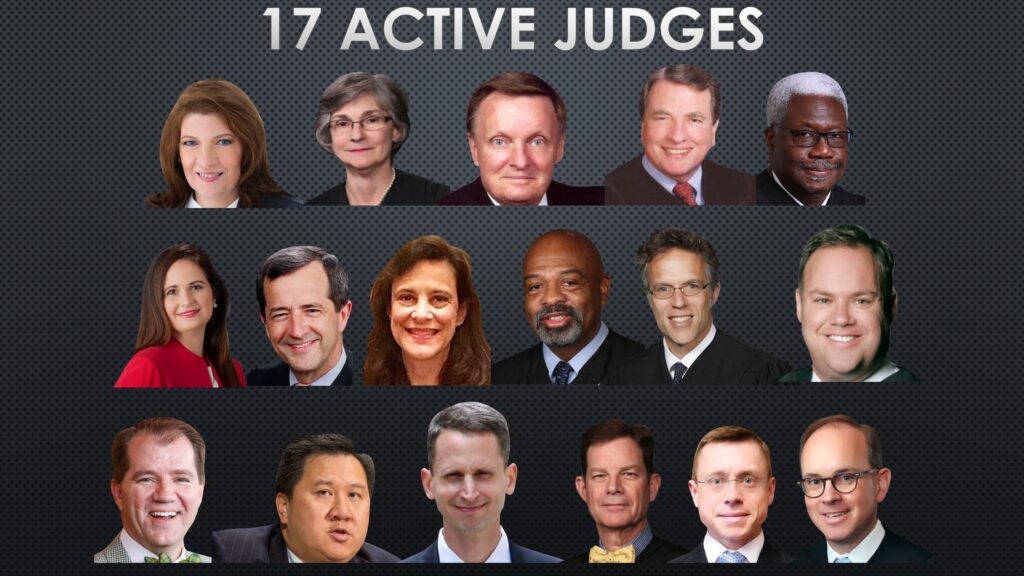
Recently, the Jackson, Mississippi Federalist Society Chapter invited me to deliver an address on the state of the Fifth Circuit. That invitation was occasioned by several posts I've written about how the judges on the Fifth Circuit often divide in unexpected ways. To prepare this address, I focused on opinons from the the en banc court over the past four years. More precisely, I focused on how the Republican-appointed judges vote on the en banc court. At present, twelve of the seventeen active judges are Reagan, Bush 43, and Trump nominees.
You can watch the lecture here. And I've uploaded the slides here. After the jump, I will highlight some of my findings.
Today the Supreme Court decided Torres v. Texas Department of Public Safety, in which a 5-4 Court concluded that state sovereign immunity does not prevent Congress from authorizing suits against states pursuant to its power to raise and support armies. Justice Stephen Breyer wrote for the majority, in what may have been his last majority opinion as a Supreme Court Justice. He was joined by the Chief Justice and Justices Sotomayor, Kagan, and Kavanaugh. Justice Thomas dissented, joined by Justices Alito, Gorsuch, and Barrett.
Torres was a definite win for federal power, which would seem fitting for Justice Breyer's last opinion. Other than joining parts of the Chief Justice's opinion in NFIB v. Sebelius, Justice Breyer has been a fairly consistent vote against limitations on federal power, including (as relevant here) claims that the federal government may not subject state governments without their consent to suit due to sovereign immunity.
In Torres, Breyer drew upon las term's decision in PennEast to conclude that the federal government may subject nonconsenting suits to state when exercising powers that are exclusively held by the federal government, such as those powers related to national defense. Here is how he summarized his own opinion:
The Constitution vests in Congress the power "[t]o raise and support Armies" and "[t]o provide and maintain a Navy." Art. I, §8, cls. 1, 12–13. Pursuant to that authority, Congress enacted a federal law that gives returning veterans the right to reclaim their prior jobs with state employers and authorizes suit if those employers refuse to accommodate them. See Uniformed Services Employment and Reemployment Rights Act of 1994 (USERRA), 38 U. S. C. §4301 et seq. This case asks whether States may invoke sovereign immunity as a legal defense to block such suits. In our view, they cannot. Upon entering the Union, the States implicitly agreed that their sovereignty would yield to federal policy to build and keep a national military. States thus gave up their immunity from congressionally authorized suits pursuant to the "'plan of the Convention,'" as part of "'the structure of the original Constitution itself.'" PennEast Pipeline Co. v. New Jersey, 594 U. S. ___, ___ (2021) (slip op., at 14) (quoting Alden v. Maine, 527 U. S. 706, 728 (1999)).
He further explained why the Chief Justice's PennEast decision allowed for suit here.
Last Term, in PennEast Pipeline Co. v. New Jersey, 594 U. S. ___, we considered whether Congress could, pursuant to its eminent domain power, authorize private parties to sue States to enforce federally approved condemnations necessary to build interstate pipelines. We held that "when the States entered the federal system, they renounced their right to the 'highest dominion in the[ir] lands,'" meaning they agreed their "eminent domain power would yield to that of the Federal Government." . . . Congress could therefore authorize private actions against States.
PennEast defined the test for structural waiver as whether the federal power at issue is "complete in itself, and the States consented to the exercise of that power—in its entirety—in the plan of the Convention." . . . Where that is so, the States implicitly agreed that their sovereignty "would yield to that of the Federal Government 'so far as is necessary to the enjoyment of the powers conferred upon it by the Constitution.'". . . By committing not to "thwart" or frustrate federal policy, the States accepted upon ratification that their "consent," including to suit, could "never be a condition precedent to" Congress' chosen exercise of its authority. . . . The States simply "have no immunity left to waive or abrogate." . . .
Congress' power to build and maintain the Armed Forces fits PennEast's test. The Constitution's text, its history, and this Court's precedents show that "when the States entered the federal system, they renounced their right" to interfere with national policy in this area.
While there are distinct parallels between the issues in this case and those in PennEast, the Court's lineup is slightly different. Justice Kagan, who had dissented in PennEast, joined the majority this time. She explained her vote in a short concurring opinion explaining that she believes Torres was controlled by PennEast. Torres was still a 5-4 decision, however, because one of the justices who had been in the majority there, Justice Alito, was now in dissent. Unlike Justice Kagan, Justice Alito did not explain his switch.
Divided Argument, my podcast about the Supreme Court with Dan Epps, has been in high season this month, as the Court has released the majority of its important opinions. Here are the episodes from this month so far:
SMUGLER: We discuss the Bivens decision in Egbert v. Boule and the problem of constitutional remedies. But first we catch up on the Court's pace of opinions, the Dobbs leak investigation, the attempted attack on Justice Kavanaugh, and Puerto Rico (United States v. Vaello-Madero).
COBRA: We focus on two Indian law decisions -- Ysleta del Sur Pueblo v. Texas and Denezpi v. United States -- as well as the arbitration case of Viking River Cruises, Inc. v. Moriana, and the DIG in Arizona v. San Francisco. Dan offers some health insurance advice.
Character Sketches: In our longest episode yet, we break down two massively consequential cases -- Dobbs v. Jackson Women's Health Organization and New York State Rifle & Pistol Association v. Bruen. I make the extremely controversial claim that Justice Kavanaugh doesn't particularly care what most people think about him, and that isn't why he writes those concurrences.
We also have transcripts for 2/3 of the episodes already (and the third will come soon) for those who apparently don't listen to things while they drive, walk, work out, or do housework.
Tomorrow is not only the last day of the Supreme Court term and Justice Breyer's final day on the Court. It will also be Ketanji Brown Jackson's first day as a part of the Court.
The Honorable Ketanji Brown Jackson will be sworn in as the 104th Associate Justice of the Supreme Court on Thursday, June 30, at noon at the Supreme Court of the United States. Chief Justice John G. Roberts, Jr., will administer the Constitutional Oath and Associate Justice Stephen G. Breyer will administer the Judicial Oath in a ceremony in the West Conference Room before a small gathering of Judge Jackson's family.
The ceremony will be streamed live on the homepage of the Court's website, www.supremecourt.gov.
A formal investiture ceremony will take place at a special sitting of the Court in the Courtroom at a later date.
Although President signed the commission for Jackson's appointment shortly after her confirmation vote, she had not been sworn in as Justice Breyer had yet to retire. With Justice Breyer's announcement that he is retiring tomorrow at noon, however, Justice Jackson can be sworn in -- and she will be. Welcome Justice Jackson!
Today's decision of the Montana Supreme Court in Bd. of Regents v. State, written by Justice Laurie McKinnon, holds that
the Montana Constitution gives the Montana Board of Regents of Higher Education authority over the Montana University System, independent in many ways of the Legislature, and
it was therefore unconstitutional for the Legislature (in a statute called HB 102) to preempt the Board's general ban on gun carrying on Montana public university campuses (Board Policy 1006):
The intent of the Framers controls our interpretation of a constitutional provision. We must discern the Framers' intent from the plain meaning of the language used and may resort to extrinsic aids only if the express language is vague or ambiguous. Even in the context of clear and unambiguous language, however, we determine constitutional intent not only from the plain language, but also by considering the circumstances under which the Constitution was drafted, the nature of the subject matter the Framers faced, and the objective they sought to achieve….
The 1972 Constitution removed the [1889 Constitution's] language subjecting the Board's powers and duties to legislative control and instead vested the Board with the "full power, responsibility, and authority to supervise, coordinate, manage and control the [MUS] and … supervise and coordinate other public educational institutions assigned by law." By the plain language of Mont. Const. art. X, § 9, the Board retains full independence over the MUS. However, the Board remains subject to the legislative powers to appropriate and audit, legislatively determined terms of office, and the oversight of additional educational institutions as prescribed by law. Legislative oversight likewise remained the case for the constitutionally created Board of Public Education.
I have written before about the Ninth Circuit's troubling April ruling in United States v. Rosenow, which held (among other things) that Internet preservation under 18 U.S.C. § 2703(f) is entirely outside the Fourth Amendment. "Internet preservation," for those who haven't followed the issue, is the process by which the government directs an Internet provider to make a copy of the entirety of someone's account and to hold it for the government. I think this ruling is wrong, as I have explained before. But it's been a while since I posted on the issue, and I thought I would bring readers up to date on the case as well as related developments.
First off, there has been a lot of action on rehearing matters in Rosenow. On June 8th, counsel for Rosenow filed this petition for rehearing in the case. The petition leads with the preservation issue, although it also addresses other questions. On June 21st, an advocacy group called "Restore the 4th" filed an amicus brief in support of the petition for rehearing. The government has obtained an extension of its brief in opposition to rehearing, which is now due on the first day of August.
Second, I have revised my model brief by adding a new section to respond to the claim, alluded to in Rosenow, that Internet users have consented to any searches or seizures because they used Internet accounts governed by terms of service that permit providers to comply with legal process. I think this is pretty clearly wrong, and a new section of the model brief explains why (see pages 18-22).
Finally, have received word of at least two motions to suppress for Internet content preservation being filed based on the model brief. I would guess some other motions have been filed that I don't know of, but I have learned of at least two. As I have noted before, developing the arguments and writing the model brief was one step, but actually having lawyers file the motion has been more of a challenge than I initially expected. Anyway, I am glad to learn that at least some motions to suppress have been filed using the brief.
In People v. Johnson, decided by the California Court of Appeal two weeks ago, in an opinion by Justice Ioana Petrou, joined by Presiding Justice Alison Tucher and Justice Victor Rodriguez, a defendant was convicted of felony witness tampering "based on a statement Johnson made to his family that if the police came, he would blow his brains out." The California witness tampering statute makes it a crime (punishable as a misdemeanor or a felony), "to prevent or dissuade another person who has been the victim of a crime or who is witness to a crime" from "[m]aking any report of that victimization" to the authorities. But it also makes it a more serious crime, and necessarily a felony, to do so
[w]here the act is accompanied by force or by an express or implied threat of force or violence, upon a witness or victim or any third person or the property of any victim, witness, or any third person.
The court held that Johnson's threat of suicide didn't qualify under this "witness or victim or any third person" provision:
Tomorrow is the last day of this momentous Supreme Court term. The Court has issued its standard release noting that the last opinions in argued cases from the term will be tomorrow: "This Court will announce all remaining opinions ready during this Term of Court on Thursday, June 30, 2022, beginning at 10 a.m."
The two argued cases remaining are West Virginia v. EPA, concerning the Environmental Protection Agency's authority to regulate greenhouse gases from power plants under Section 111 of the Clean Air Act, and Biden v. Texas, concerning the Biden Administration's effort to rescind the Trump Administration's Migrant Protection Protocol, also known as the "Remain in Mexico" policy. For a quick rundown of the West Virginia case, I recommend this webinar.
This past January, I wrote to inform you of my intent to retire from regular active service as an Associate Justice of the Supreme Court of the United States, upon the Court rising for summer recess. You have nominated and the United States Senate has confirmed the Honorable Ketanji Brown Jackson to succeed me in the office, and I understand that she is prepared to take the prescribed oaths to begin her service as the 116th member of this Court.
The Court has announced that tomorrow, beginning at 10 a.m., it will hand down all remaining opinions ready during this Term. Accordingly, my retirement from active service under the provisions of 28 U.S.C. §371(b) wll be effective on Thursday, June 30, 2022, at noon.
It has been my great honor to participate as a judge in the effort to maintain our Constitution and the Rule of Law.
Yours sincerely,
/s/
Stephen Breyer
The Court will also issue its final Order List of the term, most likely on Friday morning.
Just as precedents can be extended beyond their original terms through equality slippery slopes and attitude-altering slippery slopes, they can also be extended through small change tolerance slippery slopes.
Legal rules are often unavoidably vague at the margins. Even when a rule usually yields a clear result, there will often be some uncertainty on the border between the covered and the uncovered. If, for instance, a new free speech exception allows the punishment of "racial, sexual, and religious epithets," some speech (for example, "nigger" or "kike") would pretty clearly be covered. Other speech (for example, "blacks are inferior" or "Jews are conspiring to rule the world") would clearly not be covered. For other speech (for example, "Jesus freak" or "Bible-thumper" or "son-of-a-bitch"), the result might be uncertain. {Some readers might conclude that some words in this last example are clearly epithets and other words are clearly not, but I suspect others would disagree. My point here is a descriptive one—that the result would indeed be uncertain—and not that the result should be uncertain.}
In such situations, the judge deciding each case has considerable flexibility. The test's terms and the existing precedents leave a zone of possible decisions that will seem reasonable to most observers. If the judge draws the line at any place in that zone, most observers won't much complain. This is a small change deference heuristic: if the distance between this case and the precedents is small enough, defer to the judge.
Dear Members of the George Washington University Community,
Since the recent U.S. Supreme Court ruling to overturn Roe v. Wade, we have heard from members of our community who have expressed feelings of deep disagreement with this decision.
We also have received requests from some members of the university and external communities that the university terminate its employment of Adjunct Professor and Supreme Court Justice Clarence Thomas and cancel the Constitutional Law Seminar that he teaches at the Law School. Many of the requests cite Justice Thomas' concurring opinion in Dobbs v. Jackson Women's Health Organization, in which he called the substantive due process doctrine a "legal fiction." Justice Thomas has been a consistent critic of the Court's legal philosophy on substantive due process for many years. Because we steadfastly support the robust exchange of ideas and deliberation, and because debate is an essential part of our university's academic and educational mission to train future leaders who are prepared to address the world's most urgent problems, the university will neither terminate Justice Thomas' employment nor cancel his class in response to his legal opinions.
Justice Thomas' views do not represent the views of either the George Washington University or its Law School. Additionally, like all faculty members at our university, Justice Thomas has academic freedom and freedom of expression and inquiry. Our university's academic freedom guidelines state: "The ideas of different faculty members and of various other members of the University community will often and quite naturally conflict. But it is not the proper role of the University to attempt to shield individuals within or outside the University from ideas and opinions they find unwelcome, disagreeable, or even deeply offensive."
Just as we affirm our commitment to academic freedom, we affirm the right of all members of our community to voice their opinions and contribute to the critical discussions that are foundational to our academic mission.
[UPDATE: When I first posted this, I completely neglected Judge Bumatay's dissent; my apology for this—I've added it as an UPDATE below.]
That's today's order from Judges Andrew Hurwitz, Daniel Bress, and Patrick Bumatay:
The district court's judgment is vacated, and this case is remanded to the district court for further proceedings consistent with the United States Supreme Court's decision in New York State Rifle & Pistol Ass'n, Inc. v. Bruen, 597 U.S. ____ (2022).
The parties shall bear their own attorney's fees, costs, and expenses. This order constitutes the mandate of this court.
VACATED AND REMANDED.
Pretty standard procedure, when a new court decision clearly changes the legal landscape—and the landscape has sharply changed, given that the lower court decision upheld the ban under so-called "intermediate scrutiny," and the Court in Bruen rejected that sort of approach (for all gun regulations, not just gun carry regulations). The Ninth Circuit panel could have just applied Bruen instead, but it didn't have to, and often panels do leave the matter for the court to reconsider in the first instance.
One question for the district judge on remand, of course, would be whether so-called "assault weapons" are indeed "dangerous and unusual," or whether they are instead in sufficiently "common use" that they aren't unusual (though, like all guns, they are dangerous). Another question might be—the matter is unclear—whether such bans might be upheld on the theory that they don't impose a material "burden on the right of armed self-defense" or "prevent 'law-abiding, responsible citizens' from exercising their Second Amendment right to public carry [and to private gun possession]." Hard to tell for certain what the result will be, and of course once the district court reconsiders the case, it will likely go back up to the Ninth Circuit.
UPDATE: Judge Bumatay, however, dissented, writing:
For over a decade, our court has improperly interest-balanced our way around the Second Amendment. The Supreme Court has had enough of it. See N.Y. State Rifle & Pistol Ass'n, Inc. v. Bruen (U.S. June 23, 2022). With a clear legal standard now in hand, we should have ordered supplemental briefing to further this case along. Instead, we instinctively kick the can back to the district court. And we do so without the benefit of the parties' position on whether our three-judge panel could have directly resolved this case based on Bruen.
A remand here may just prolong the inevitable as we will eventually have to decide this case—adding unnecessary delays and expenses for the parties. At the very least, we should have given the parties a chance to let us know where they stand on the question of remand. I thus respectfully dissent from vacating and remanding this matter.
The tragic recent deaths of some 50 migrants in Texas highlights the dangers they face. But those dangers are the products of laws making legal immigration difficult or impossible for most who want to do it.
The recent tragic deaths of some 50 undocumented migrants in a truck in Texas highlight the perils of illegal migration. Republicans such as Texas Gov. Greg Abbott have rushed to blame President Biden's "open border policies." The truth is the exact opposite. Most of the dangers of illegal migration arise precisely because it is illegal. If the US actually had an "open border" policy, these 50 people would almost certainly be alive today. They would not have had to rely on shady smugglers to secretly cross into the United States. They could have just done so openly, using conventional modes of transportation.
Today, we readily understand that most of the crime, violence, and other risks of alcohol Prohibition was the result of prohibition itself. Once alcohol sales became legal again, people who wanted to purchase beer or wine didn't have to rely on Al Capone and other criminals to obtain it, and didn't face any significant risk of violence or fraud in the process of doing so. And there was no longer a vast illegal market for organized crime to exploit.
Alcohol prohibition created opportunities for criminals and con artists, some of whom did morally reprehensible things as a result. But the greatest share of blame for what happened belongs to the government officials who enacted Prohibition in the first place. Much the same is true of the War on Drugs - and our current regime of immigration prohibition.
I recently finished teaching my Immigration class at the University of Palermo. During the last week, we visited a Catholic charity that helps Sicily's migrants. The workers seemed like nice people, but they were deeply economically illiterate. They didn't have a bad word to say about the Italian government, the organization that makes immigration a presumptive crime. Quite the opposite…
Don't imagine, however, that the charity workers were all-forgiving. They were eager to condemn two sets of allegedly monstrous villains.
First, human smugglers.
Second, farmers who hire illegal workers.
Why? The argument, in both cases, comes down to: Smugglers and farmers make lots of money by treating migrants terribly.
To be clear, I'm the first to admit that illegality partially undermine businesses' standard incentives to do a good job. Not only are you unable to sue an illegal business for poor behavior. Far more importantly, reputational incentives are less potent in illegal markets. If you run the best grocery store in your area, you're the talk of the town, and get rich. If you run the best human smuggling operation in your area, word travels softly and slowly - and maybe lands you on the radar of the authorities.
Still, even illegal markets often deliver the goods. Indeed, that is the norm.
The charity workers talked as if human smugglers' standard procedure was to rob and murder their customers. But if this is so, how did millions of people successfully cross from North Africa to Europe? Furthermore, without illegal employment, what would illegal immigrants do after they arrive?
Yes, some smugglers just take migrants' money, then vanish. Yes, some farmers promise to pay migrants for work, then stiff them. Normally, however, illegal businesses fulfill their promises.
If you're already a comfortable legal resident of the First World, you'll probably be horrified by the content of these promises…. Smugglers charge thousands of Euros to move migrants on rickety boats. Farmers pay two Euros an hour, plus substandard room and board, to migrant workers. When I insisted that, "This is still much better than nothing," the charity workers were appalled. Migrants aren't making the best of a bad situation; they're being "roped-in" by vicious criminals.
To be blunt, I'm right and they're wrong. Yes, human smugglers charge high prices. Yes, farmers pay low wages. But the reason for these unfavorable market conditions is the oppression of the Italian government. Under open borders, migrants would travel by safe commercial channels - and be free to shop around for their best job option. It is the Italian government that pushes migrants into the shadows. And doing business in the shadows is a great burden. For transport, this means low supply and high fees. For employment, this means low demand and low wages.
What is true of Italian migration restrictions is also true for the United States. Our policies make it nearly impossible for most would-be migrants to enter legally. As a result, people wishing to flee horrific poverty and oppression have little choice but to try to enter illegally, which in turn often requires dealing with smugglers. If they want to support themselves after entry, they have to deal with employers willing to hire people illegally.
As in almost any illegal market, some of the participants are likely to be unscrupulous criminals and swindlers (though, as Bryan notes, the majority keep their promises). And, as in the case of Prohibition, by far the best way to cut back on the role of criminals and swindlers in an illegal market is legalization.
Some advocate addressing the bad behavior of unscrupulous employers by adopting "employer-only" approaches to immigration enforcement. For reasons I summarized here, that is both unjust and likely to cause great harm to migrants, not just their would-be employers. In a November 2020 post, I made the case against the common "I'm for legal immigration" trope against liberalizing immigration restrictions.
Obviously, it is still possible to argue for immigration restrictions based on the theory that governments have an inherent right to exclude people, or that exclusion is needed to prevent some great harm immigration might cause. I don't try to address such theories here, though I do take them up in detail in my book Free to Move. But if you support large-scale immigration restrictions for such reasons, you have to accept the fact that the resulting prohibition regime will predictably lead to tragedies like the one that just occurred in Texas. If you want to justify restrictions, nonetheless, you need to show that the benefits achieved are at least great enough to outweigh these awful costs.
I had to pay an application fee of $75. I had to submit my application in person at the Metropolitan Police Department headquarters and be photographed and fingerprinted at an additional cost of $35. I had to pass a federal background check. I had to enroll in and pay for an approved firearms training course, which included 16 hours of classroom study of D.C. gun laws as well as the law governing the use of deadly force, plus another two hours of range instruction. In 2018, the course cost $250 plus $20 for the range fee. The monetary cost of the license amounted to $380. This was in addition to the $125 tax I paid to D.C. on the purchase of my handgun, which brought the total regulatory cost to $505. Since the course took 18 hours to complete, I took it on a Saturday and a Sunday so as not to lose two days of work.
There being no gun ranges in the District of Columbia, my course was taught in Virginia. The instructor was African American, and most of the other students in the course were members of underrepresented groups, which is unsurprising given the demographics of D.C. Since it is doubtful that any other Georgetown professor has a concealed-carry license, I suppose I too was a member of an underrepresented group.
Every two years, I must renew the license. If I miss renewing within the 30-day window before my permit expires, I have to start all over. So, two years later, I had to pay another $75 fee and complete a recertification class consisting of four hours of training, and two hours of range training from an MPD-certified firearms training instructor, which cost $160. I can afford all this, of course, though I cannot say the same for all other citizens of D.C.
This is the type of regulatory regime that, in Bruen, the court said it was not questioning: "[N]othing in our analysis should be interpreted to suggest the unconstitutionality of the 43 States' 'shall-issue' licensing regimes."
I then discuss my effort to understand Justice Thomas's "text and history" alternative to the "tiers of scrutiny" doctrine that has dominated constitutional law since the 1950s. I explain why am still not sure I completely understand how it is supposed to work. The essay is long and I cannot truly summarize it my uncertainties and reservations, so you may wish to click through to read it here. Here is a taste:
There is, however, an even more fundamental question raised by Thomas' text-and-history approach. It seems to assume that, once we use history to identify the "outer contours" of a constitutional right, then any such right bars not only prohibitions on its exercise but also trumps any statutory regulation of it. Prior to the New Deal, however, rights were not viewed as trumps on the regulatory power of government. Instead, the existence of a right barred the complete deprivation of it — that is, a prohibition — and statutes were "strictly" or "equitably" construed to avoid this result. And the existence of a right also required that a regulation be within the power of a legislature to enact. At the federal level, this meant a power delegated to Congress by the Constitution. At the state level, this meant what is called the state's "police power." While broad, the state police power was not unlimited….
Thomas seems to want to limit the original scope of a constitutional right by his historical inquiry. And then the right, so limited, may not be restricted in any way. If rights are this absolute, however, then we cannot afford to recognize very many if government is to function. This would explain Thomas' apparent movement toward an "enumerated rights only" view of constitutional rights (though he has not yet committed himself to this view). But viewing rights as absolute in this way is quite modern and ahistorical, and its invocation in a purportedly originalist opinion is therefore surprising.
I do conclude with a tentatively proposed alternative:
Perhaps a better approach would have been to distinguish between prohibiting and regulating the exercise of a right. Any prohibition of the exercise of a constitutional right is per se unconstitutional. In contrast, a regulation of how a right may be exercised is permissible, provided the ends of such a regulation are within the legislative power of Congress or a state.
Under this distinction, because the "special need for self-protection" that was required by the New York system was "distinguishable from that of the general community," the law amounted to a prohibition on ordinary citizens exercising their constitutional right to bear arms outside the home. Not only was this the scheme's effect; it was also its intention.
By contrast, D.C.'s "shall issue" regime provides a means by which every "law-abiding" (per the background check) citizen of D.C. can obtain a permit, so it is not a prohibition of the exercise of a constitutional right. Unlike the New York law, it is a "regulation" because it proscribes the manner of exercising the right.
It may not always be easy to distinguish a prohibition of a right from a mere regulation of its exercise. For example, is a ban on a particular class of firearms a prohibition or merely a regulation of the manner by which the right to keep and bear arms may be exercised? However, at the extremes it can be quite obvious, as I think it is with New York's law and the D.C. and Chicago gun bans the court held to be unconstitutional in Heller and McDonald v. City of Chicago. (Even after Heller, D.C. still regulates the types of firearms that can be kept in the home or carried concealed outside.)
Rather than use modern tiers of scrutiny, when considering the appropriate regulation of constitutional rights, we should look instead to the type of eyes-open arbitrariness or rationality review that preceded the adoption of modern tiers of scrutiny. This is not, I should stress, the same as the modern eyes-closed rational basis scrutiny, which the court today considers its default approach under its tiers-of-scrutiny doctrine. (See Dobbs. "A law regulating abortion, like other health and welfare laws, … must be sustained if there is a rational basis on which the legislature could have thought that it would serve legitimate state interests.")
I put the sentence above in bold because I realize how prohibitions can be characterized as regulations and vice versa. But at the extremes there is surely a difference between telling someone they cannot do something and telling them how they must do it.
Such are my preliminary thoughts on the reasoning of Bruen, whose outcome I applaud. I look forward to benefiting from the thoughts of others about the text and history approach before reaching any final verdict on its merits.
Justice Kavanaugh joined, in full, the two most significant cases of the term. In Dobbs, Kavanaugh did not join the Chief's concurrence-in-judgment. And in Bruen, Justice Kavanaugh, as well as the Chief, fully endorsed the majority's reasoning. To be candid, I did not expect both votes. Even after the leak, I had my doubts about whether Kavanaugh was prepared to overrule Roe. His concurrence in Ramos certainly provided the predicates to jettison Roe, but it was no certain thing. Moreover, I worried that if Kavanaugh bit the bullet in Dobbs, he would chart some middle-course for Bruen. But no, I was wrong. Wrong, wrong, wrong. Both majority opinions had five solid votes.
Still, Justice Kavanaugh wrote concurrences in both cases. And, in my view, the Kavanaugh concurrence is the new Kennedy concurrence. Let's start with Bruen.
First, Kavanaugh observes that the Court "employs and elaborates on the text, history, and tradition test." So far, so good. Indeed, Kavanaugh has personally pushed the "text and history" approach in several cases, back to his service on the D.C. Circuit. Still, in a recent concurrence, Judge Newsom (CA11) cast doubt on "tradition" prong of this text:
I say "largely" because it has never been clear to me what work "tradition" is supposed to be doing in the tripartite "text, history, and tradition" formulation. The duly adopted and ratified text of the Second Amendment, as originally (and thus historically) understood, governs the interpretive inquiry. To the extent that "tradition" is meant to stand in for the original (i.e., historical) public meaning of the words on the page, it is duplicative. And to the extent that it is meant to expand the inquiry beyond the original public meaning- say, to encompass latter-day-but-still-kind-of-oldish understandings-it misdirects the inquiry.
Anti-discrimination law was pioneered by the political left. But, in recent years, conservatives have increasingly tried to use it for their own purposes.
In the twentieth century, anti-discrimination law was largely pioneered by the political left. What started as a campaign to restrict racial discrimination gradually expanded to other categories, such as sex discrimination, discrimination against people with disabilities, discrimination based on sexual orientation, and so on. By and large, these expansions were advocated by left-liberals, and often opposed by conservatives, or at least viewed with suspicion by them.
More recently, however, the political right has tried to use anti-discrimination principles to its own advantage, in a wide range of policy areas. Walter Olson of the Cato Institute recently wrote an insightful piece on this subject:
[T]he Supreme Court yesterday ruled [in Carson v. Makin] that the state of Maine violated the Constitution when it excluded schools that engage in religious instruction from an otherwise generally available program of tuition assistance payments to parents….
It's been widely observed that religious‐liberty litigators have been on a winning streak lately, but it is worth noting specifically how many of those cases have been won by framing each dispute in terms of anti‐discrimination principles. Masterpiece Cakeshop and Fulton v. Philadelphia come to mind, but also the Court's string of rulings in favor of churches against local COVID restrictions on grounds that they were not treated as well as one or another secular institution.
To some extent this must reflect the simple truth that anti‐discrimination principles have become a ruling theme both in law and in public life generally, exceedingly hard to argue against. If you can successfully invoke them you're well on the way to winning an argument.
Examples from the progressive side are legion. But conservatives too are now apt to couch gripes about, say, social media moderation in terms of discrimination. Companies with a no‐guns‐on‐premises rule are "discriminating" against gun‐owning employees, we've heard.
And so on. Why, it was asked, should cruise ship lines or nurse staffing agencies be permitted to engage in "discrimination" toward the unvaccinated?
As Walter notes, in addition to the well-known religious liberty cases hinging on government discrimination against religious people and institutions, conservatives have also sought to use the law to curb real or imagined discrimination against right-wing speakers on social media sites, gun owners, and the unvaccinated. The conservative campaign against affirmative action, of course, has long hinged on the argument that affirmative action policies unjustly and illegally discriminate against whites and Asians. But these other conservative uses of anti-discrimination principles emerged more recently, and represent a major expansion of the use of anti-discrimination theory by the political right.
But whether justifiably or not, it is clear that anti-discrimination principles are no longer a preserve of the left. Conservatives have taken them up with a vengeance!
One interesting question is how far will this process go? Will conservatives follow liberals in expanding anti-discrimination rules to new categories? The attempts to add gun owners and the unvaccinated to the list of protected groups are already steps in that direction. Will the right also try to add other groups to the list?
In the 1960s and 70s, the left famously moved from promoting traditional nondiscrimination, to advocating affirmative action for historically discriminated against minorities. The argument was that affirmative action was essential to remedy past discrimination and to promote diversity in various institutions. Will conservatives imitate this innovation?
It's not hard to imagine how they might do so. Consider the following argument:
University X has long discriminated against conservatives. Given this history of institutionalized exclusion, formal equality is not enough to overcome the entrenched legacy of bias. In order to get beyond ideological discrimination, we must first take account of ideology [this, of course, is an adaptation of Justice Blackmun's famous statement that "In order to get beyond racism, we must first take account of race"]. Thus, we must have affirmative action in hiring for conservative professors, and affirmative action in admissions for conservative students. It can be phased out only after we have a "critical mass" of conservatives large enough to ensure that fellow conservatives feel welcome on campus, and other students are exposed to their distinctive perspectives.
This kind of argument can also be applied to the exclusion of gun owners, evangelical Christians, and other groups associated with the political right, at various institutions. Right-wing adoption of affirmative action for their preferred groups would be in serious tension with their position on racial and gender affirmative action. Perhaps that tension will preclude any such move. On the other hand, logical consistency is far from a high priority for political movements these days.
The right could also potentially adopt "disparate impact" theory, the idea that seemingly neutral practices are discriminatory because they disproportionately affect a particular group. For example, many on the left argue that the use of standardized tests in university admissions should be curtailed, because some minority groups score lower, on average, than whites. Conservatives could similarly argue that some seemingly neutral policies must be restricted because they disproportionately affect evangelical Christians, gun owners, Republicans, and so on.
While expansions of anti-discrimination principles are sometimes justified, Walter Olson rightly worries that too great an emphasis on anti-discrimination can have negative effects:
[S]omething is often lost in the pressure to re‐couch claims as equality claims. Sometimes what's really on our mind is something else — individual liberty, rights of self‐defense or bodily integrity, fair process, institutions that work.
In the religious freedom context, there is a strong logic to the idea that the Free Exercise Clause implies a robust principle that churches and their institutions may not be singled out for worse treatment as against otherwise comparable entities. But that's just one component of free exercise; there have to be others…. [P]arents' right to direct the religious upbringing of their children is a basic component of free exercise encroached upon by the Maine law. To take a different example, the Court has recognized in the Hosanna‐Tabor line of cases that free exercise requires the state to respect churches' internal autonomy, quite aside from equality concerns about whether it treats secular institutions the same way.
Maybe churchgoers want freedom of worship for its own sake, not because they want to ensure churches are treated at least as well as drugstores in COVID regulations. Maybe fairness and benefit to kids are even better arguments for school choice in Maine than equality! But — in today's climate of jurisprudence — we may not get a chance to find out any time soon.
I would add that one key limitation of anti-discrimination principles is that a violation of them can usually be remedied by "leveling down." If it is unjust that some benefit or right is only available to Group X, but not Groups Y and Z, we can fix that by taking it away from X! In the wake of Carson v. Makin, Maine could comply with the Supreme Court's ruling simply by terminating vouchers for all private schools, whether religious or not.
That approach is fine when it comes to programs that aren't important, or shouldn't exist in the first place. But it's problematic if what's at stake is some vital right. In that event, the right thing to do is to "level up" by making the benefit or right available to everyone. In my view, this is the only just solution to the problem of racial and ethnic discrimination in immigration and refugee policy. But anti-discrimination principles can't get us there by themselves. Indeed, if we assume that discrimination is the only wrong at issue, "leveling down" will often look like an attractive option, even if it might actually exacerbate the wrong more than alleviate it.
Despite such potential downsides, the conservative embrace of anti-discrimination is unlikely to stop anytime soon. Sometimes it has good effects, and other times not. It will be interesting to see how far it will go - and how progressives react to it.
The West Caldwell Police Department has responded to multiple calls at a residence formerly owned by Justice Samuel Alito. Erroneous information was circulating on the internet that indicated that Justice Alito still resides in West Caldwell, and individuals have been sending harassing packages to the current resident.
Justice Alito moved out of West Caldwell just after being confirmed to the US Supreme Court, 15 years ago in 2007. The current homeowner has no affiliation with Justice Alito and deserves to live in peace in their home free from harassment, regardless of anyone's political beliefs.
All incidents will be investigated and those responsible will be charged and prosecuted.
Please like and share this post to hopefully put an end to this activity.