An interesting order today, from the Federal Circuit:
The United States Court of Appeals for the Federal Circuit intends to unseal certain paper case records in accordance with Federal Circuit Rule 25.1(a)(1) in order to accomplish accession to the National Archives and Records Administration. Parties, counsel, or other impacted individuals with an interest in keeping sealed records in any case identified in the court's order must show cause no later than 60 days from the date of the order why those records must remain sealed. No response is needed unless parties or counsel intent to contest the unsealing. Please refer to the order for further details, including how to submit a response.
Notice of this order is being sent to all active members of the bar registered with the court's electronic filing service as well as to original counsel of record in the identified cases. Questions concerning the order or the process for responding should be directed by phone to the Federal Circuit Clerk's Office at (202) 275-8035.
From the linked-to order:
The court is in the process of accessioning its remaining paper case records to the National Archives and Records Administration for permanent retention. These records pre-date the court's transition to its electronic case management filing system in 2012 and once transferred to the National Archives will remain in only paper format and will not be made available online. Pursuant to Federal Circuit Rule 25.1(a)(1), "[a]fter five years following the end of all proceedings in this court, the court may direct the parties to show cause why confidential filings (except those protected by statute) should not be unsealed and made available to the public." Through the review of these records, the court has identified several cases containing confidential filings that remain under seal more than five years following the end of all proceedings.
The list in the order appears to include over 1000 cases. Note that, though NARA will apparently only store the records in paper format for now, I expect that anything publicly accessible at NARA could potentially end up getting scanned and placed online in the future. Thanks to Michael F. Smith of the Smith Appellate Law Firm for the pointer.
Below is a list of my upcoming speaking engagements for the Fall 2022 semester. Unless otherwise noted, all events are free and open to the public - and in person. Unless otherwise noted, the event times are those in the time zone where the event is being held.
I will add additional events and information to this post, over time. In the meantime if your university, think tank, research institute or other similar organization would like to invite me to speak (either virtually or in person) on any topic within my expertise, I am open for business! You can get an overview of the issues I write and speak about at my website.
August 25, 3-4:15 PM: "Judicial Review of Immigration Policy," panel on "The Expanding Mandate: Immigration and the Courts," Bipartisan Policy Center, Washington, DC. Online webinar. Additional information and free sign-up here. The other panelists are Leon Fresco (Former Deputy Assistant Attorney General for the Office of Immigration Litigation, U.S. Department of Justice; Immigration Attorney, Holland & Knight), and Karen Tumlin (Founder and Director, Justice Action Center). Ellen Gilmer (Senior Homeland Security Reporter, Bloomberg Government), will moderate.
September 16, 10:45-12:00 AM: "A Major Question of Power: The Vaccinate Mandate Cases and the Limits of Executive Authority," panel on "Constitutional Structure," Cato Constitution Day conference on the 2021-22 Supreme Court term, Cato Institute, Washington, DC. Additional information and free sign-up here. My presentation will be based on my article of the same title. Other participants in this panel include VC co-blogger Jonathan Adler and my George Mason University colleague Jennifer Mascott.
September 23, 3:05-3:35 PM: "Human Rights and the War in Ukraine," panel on "Human Rights Violations," fall symposium on the Ukraine War, Scalia Law School George Mason University. Rm. 121, 3301 Fairfax Drive, Arlington, VA 22201. Sponsored by the National Security Law Journal. Free sign-up here.
September 28, 12-1 PM (tentative time): "Team Libertarian Report: Restoring the Guardrails of Democracy." Scalia Law School, George Mason University, Arlington, VA. Online webinar. Other participants include David French and Prof. Edward Foley (representing the conservative and progressive teams in the National Constitutional Center "Restoring the Guardrails of Democracy" project). Sign-up information available here.
October 20, 4:15-5:15 PM: "Migration Rights and the Russia-Ukraine War: The Case for Opening Western Doors to Ukrainian Refugees and Russians Fleeing Putin's Tyranny," Rm. G85, Myron Taylor Hall, Cornell Law School, Ithaca, NY.
October 21, 12-1 PM: "Emergency Powers and the Constitution: Lessons of the Covid Experience." Breazzano Rm. 103, S.C. Johnson College of Business, Cornell University, Ithaca, NY.
October 27, 12-1 PM: "The Progressive Case for Judicial Review," Debate with Prof. Joshua Braver, University of Wisconsin Law School, Madison, WI (co-sponsored by the University of Wisconsin Federalist Society and the American Constitution Society).
October 29, Time TBA: "Adding to the Anti-Canon of Constitutional Law," panel on "Controlling the Court Through Precedent," Conference on "Controlling the Supreme Court: Now and Far into the Future," University of Wisconsin Law School, Madison, WI (sponsored by the Wisconsin Law Review). The other participants in the panel will be Barry Friedman (NYU), Nina Varsava (Wisconsin), and moderator Bruce Ledewitz (Duquesne).
November 3, 12-1 PM, Rm. 3360: "Free to Move: Foot Voting, Migration, and Political Freedom," Faculty of Law, University of Calgary. Calgary, Alberta, Canada.
November 3, 7 PM: "Democracy and Political Ignorance," Calgary, Alberta, Canada.
November 17, 7:00-8:15 PM, Room ICC 210B: "A Major Question of Power: The Supreme Court's Vaccine Mandate Rulings and the Limits of Executive Authority," Georgetown University, Washington, DC (sponsored by the Georgetown undergraduate Federalist Society chapter).
November 18, 1:35-2:45 PM, "The Rise, Fall, and Rise of Constitutional Property Rights," Panel on "Rights in the Present," Conference on "The Future of Rights: Frameworks, Trends, and Alternative Visions," Center for Law and Liberty, George Mason University, virtual event. Free registration here (co-sponsored by the Sunwater Institute).
Here I will consider how the MFN theory was expanded to its present bloated proportions. Recently members of the Court, and sometimes a majority, have developed variants of MFN that are far more far-reaching and skeptical than the modest heightened scrutiny suggested by Lukumi.
The key innovation, pioneered by Justice Gorsuch in his concurrence in Masterpiece Cakeshop, Ltd. v. Colorado Civil Rights Commission (a case that did not mention MFN at all) and pursued further in his opinions on Covid vaccination, attributes to the challenged law a different purpose than it actually has, and then declares that the state has discriminated by carving out a secular but not a religious exception to that purpose. Call this MFN-2.
Masterpiece Cakeshop involved a challenge to an antidiscrimination statute by Jack Phillips, a baker who refused to make a cake for a same-sex wedding. Gorsuch thought that religious bias was revealed by a second set of cases that arose at about the same time.
William Jack requested cakes displaying antigay inscriptions. When bakers refused, he sued them for religious discrimination. The Colorado courts rejected his claims, because the bakers would not sell such cakes to anyone. Gorsuch however thought the cases were alike. Phillips is happy to sell his products to gay people. He just won't engage in conduct that endorses same-sex weddings. A "cake celebrating same-sex marriage" is part of an event in which he is unwilling to participate. Gorsuch thought that, because Phillips and the bakers who refused Jack's order were alike declining to send messages, their different treatment revealed discrimination against Phillips's religion.
That claim was not confined to Gorsuch's concurrence. Justice Kennedy's majority opinion summarily declared an "indication of hostility [in] the difference in treatment between Phillips' case and the cases of other bakers who objected to a requested cake on the basis of conscience and prevailed before the Commission." This summary statement is, perhaps, an early embrace of MFN-2 by the Court. If so, it is so conclusory that we must look to Gorsuch for an account of the reasoning.
From today's opinion of the Delaware Supreme Court in Cousins v. Goodier, written by Justice Gary Traynor:
This appeal presents difficult questions concerning the actionability of speech that is defamatory—that is, injurious to a person's reputation—but that is defended on the ground that it is an expression of opinion and not of fact. We are asked to decide whether the First Amendment bars claims for defamation and tortious interference with contract against a defendant who, in an email to a law firm, described as "shockingly racist" a lawsuit filed by one of the firm's partners in his personal capacity. The suit aimed to preserve a nearby high school's "Indian" mascot.
The partner, who claims to have lost his position with the law firm [Bayard, P.A.] because of the email, sued his detractor, contending that the characterization of his lawsuit is demonstrably false and pleading four causes of action, including defamation and tortious interference with contract…. [We conclude that t]he statements at issue do not on their face contain demonstrably false statements of fact, nor do they imply defamatory and provably false facts. As statements concerning an issue of public concern, moreover, they are entitled to heightened First Amendment protection and cannot form the predicate of the plaintiff's tort claims….
The court concluded that "[defendant] Goodier's email to Bayard was speech that addressed a matter of public concern: the ongoing national debate about the use of American Indian iconography in sports logos," and thus was entitled to the protections of the Court's First Amendment libel jurisprudence, even though it was just sent to plaintiff's employer. It then reasoned that the e-mail was opinion:
We won't know the answer for some time. I suspect the drain will be relatively small, if we focus on abortion bans, as such. But it may get larger if anti-abortion laws end up having substantial negative side-effects on other activities.
Since the Supreme Court overruled Roe v. Wade in its decision in Dobbs v. Jackson Women's Health Organization, some commentators have predicted there will be a "brain drain" of highly educated professionals from states that enact or reinstate laws severely restricting abortion. LA Times columnist Michael Hiltzik and The Scientist have published articles predicting a general brain drain away from states with restrictive abortion laws. The Washington Post has an article positing a brain drain of doctors, while Scientific American has one focused on Ob-Gyns. The "brain drain" theory is distinct from - though related to - the idea that people generally will "vote with their feet" for pro-choice jurisdictions. Highly educated professionals might migrate en masse even if few other people do - or vice versa.
Will such a brain drain actually occur? At this point, we don't really know the answer. Less than two months have passed since Dobbs. If it happens, any significant abortion-driven brain drain will probably take many months - or even years - to pick up steam. The articles linked above all rely on a handful of anecdotes rather than systematic data. And even those anecdotes are mostly cases of people saying they might move away from a red state, or turn down an opportunity there - not cases of people actually doing so. That's understandable. Not enough time has passed for us to get any kind of definitive answer. In addition, thanks to Roe v. Wade, there is no modern precedent for the kinds of highly restrictive abortion bans now in force in some red states.
Nonetheless, I think we can do some informed speculation. My tentative view - as a longtime student of foot voting - is that abortion bans, as such, will lead to only a modest brain drain, at most. But some collateral effects of anti-abortion laws could cause a bigger one. It might be bigger still if pro-choice blue states take steps to make themselves more attractive to potential migrants.
The biggest reason why I am skeptical that abortion restrictions, taken in isolation, will cause a large brain drain is that most highly educated women are unlikely to ever get an abortion, and many of those who might need one can potentially avail themselves of various substitutes for getting one in-state. In recent years, abortion has been overwhelmingly concentrated among relatively poor women. Moreover, as discussed in my previous post on abortion and foot voting, contraception, mail-order "medication abortions," and getting an abortion out of state are all potential substitutes for getting an abortion at a medical facility close to home. Each of these is likely to be more easily accessible to relatively affluent professionals than to the poor.
Some red states may try to ban medication abortions or even out-of-state travel to get an abortion. But the former is likely to be extremely hard to police, while laws forbidding the latter are likely to be struck down by the courts - a position endorsed by key Supreme Court swing-voter Justice Brett Kavanaugh. There are at least three strong constitutional arguments against such laws, and courts need only endorse one of these theories for plaintiffs to prevail.
I don't claim these options will be adequate alternatives to in-state abortion rights for all highly educated women in all conceivable circumstances. But they are likely to work for a great many, the vast majority of the time. Combined with the low rate of abortion among the high-income professionals to begin with, that suggests any abortion-related brain drain is likely to be modest in scale.
It's also important to consider the tradeoffs would-be migrants face between abortion rights and other priorities. In recent years, relatively red states like Florida and Texas have had the biggest net population gains from interstate migration. Why? It's not because foot voters love abortion restrictions specifically, or the Republican Party generally. It's primarily because these states offer job opportunities, low taxes, and relatively low housing costs (the latter primarily because they have comparatively few restrictions on building new housing in response to demand). By contrast,the big blue states of New York, Illinois, and California, have been among the biggest net losers. Housing costs and taxes are likely culprits for this trend.
Faced with a tradeoff between abortion rights on the one hand and housing and tax costs on the other, a large majority of highly educated professionals might well choose the latter. The likelihood they or their family members will need an abortion is low, which taxes and housing costs are far harder to avoid. If they do end up needing an abortion, the money saved on housing and taxes could potentially pay for an out-of-state abortion several times over.
To avoid misunderstanding, I should emphasize that I am not opposed to abortion rights. Much the contrary! I think almost all abortions should be legal, and I support the "my body, my choice" principle more comprehensively than even most other pro-choice advocates do. And I particularly abhor Texas' awful SB 8 abortion law. My point here is that, for most of the highly educated people who might cause a brain drain, abortion rights will often be outweighed by other considerations in deciding where to live and work.
Perhaps, however, this kind of cost-benefit approach is the wrong way to look at potential foot-voting choices. Maybe "brains" will shun states with abortion restrictions out of moral and ideological considerations, even if those restrictions have little or no tangible effect on their lives. Perhaps that will indeed happen! But I am skeptical.
Historically, foot voting -at least the kind that takes the form of interstate moves – is usually driven by issues with a significant tangible effect on the lives of the mover and his or her family: taxation, housing costs, job opportunities, widespread discrimination against his or her group, and so on. By contrast, people rarely move to another state merely because of policies they oppose or support for ideological reasons, even though they have little tangible effect on them. It's hard to think of even one significant historical example where these kinds of preferences resulted in large-scale migration.
Symbolic ideological issues can drive less significant forms of foot voting. For example, people with strong feelings on the issue may patronize businesses they see as taking the right stand on the issue (especially if their products are not inferior in price/quality to the competition). But few people make interstate moves because of them, even if they sometimes talk about doing so.
Such talk strikes me as similar to people who say they will move to Canada to protest the election of a GOP president they hate. Only a small percentage of those who say such things ever act on it. Even the election of Trump in 2016 caused only a small ripple of such moves (an increase of only about 1000-2000 per year, at most, which is very small relative to the total population of the US).
By contrast, oppressive policies with large tangible impact on the lives of would-be migrants have at times caused waves of migration to Canada: the persecution of Loyalists after the Revolutionary War (which led to a large migration, relative to the population size at the time), slaves fleeing the Fugitive Slave Acts before the Civil War, and men fleeing the Vietnam-era draft (some 125,000 in all).
Brain drain might be more likely to take the form of people choosing not to move to anti-abortion states in the first place, rather than leaving after previously living there. Young professionals who turn down jobs in Texas or Florida face fewer costs in doing so than people with long-established careers in those states. But if the former type of decision still requires people to turn down opportunities with better pay and benefits - and lower housing and tax costs - it's still a big sacrifice for the sake of abstract principle. Some "brains" might make it. But I am skeptical that many will.
While abortion bans, as such, seem unlikely to lead to a major red-state brain drain, the collateral side-effects of abortion restrictions might be a different story. Some experts predict that state abortion bans might also have the effect of banning IVF fertility treatments. Others contend these laws will interfere with access to a variety of medical treatment for diseases such as arthritis and cancer. The percentage of highly educated professionals who need IVF services or these kinds of medical treatments is likely far larger than the percentage who are likely to need abortions. And, unlike abortion, these kinds of treatments often cannot be secured through one or a few trips out of state, because - among other things - they usually require ongoing supervision by medical professionals.
The same thing may be true of claims that abortion restrictions will interfere with the practices of doctors enough to incentivize some of them to move. Even if most professionals remain largely unaffected by abortion laws, doctors who specialize in relevant fields might experience much greater effects.
I lack the scientific and medical expertise to gauge the full potential extent of these side-effects. If they are smart and competent, anti-abortion state legislatures will carefully draft abortion laws in ways that protect IVF and various medical treatments. But, when it comes to politics, intelligence and competence are often in short supply! The War on Drugs has had some immensely harmful collateral effects, such as undermining medical treatment for chronic pain. Red states' War on Abortion could turn out the same way, even if most pro-lifers don't intend such a result.
A bigger abortion brain drain might also develop if pro-choice blue states adopt policies that make them more enticing to migrants. If they cut back on high taxes and zoning restrictions that inflate housing prices, they might attract many more migrants from red states.
For that reason, among others, pro-choice blue states should become pro-YIMBY. If California could offer people Texas-like housing costs and tax rates, plus also abortion rights, that's a combination many would find hard to resist! That would be true not only of relatively affluent brains, but also of the less affluent people most likely to need abortions.
The above analysis implicitly assumes that abortion regulation will remain largely under the control of the states. That may be the most likely scenario. But it is far from certain. Both Democrats and Republicans have proposals for federal abortion laws; nationwide bans on at least some types of abortion and nationwide preemption of state abortion restrictions, respectively. Whether such federal laws get enacted - and if so, whether courts will uphold them - remains to be seen.
This time in a decision by Judge Veronica Barisich (Nev. Dist. Ct. Clark County), handed down in February but just posted on Westlaw; an excerpt:
[16.] There are only few factual disputes. Plaintiff [Malcolm Lavergne] is a Nevada attorney who has represented O.J. Simpson since 2009 regarding his robbery-related convictions, appeal, and Mr. Simpson's 2017 parole hearing. Plaintiff was not involved in the infamous O.J. Simpson 1995 criminal murder trial in California or the 1997 wrongful death civil trial in California. Defendant Kimberly Goldman is the sister of late Ronald Goldman, one of the victims in Mr. Simpson's criminal and civil trials, and she produced and co-hosted a podcast entitled "Confronting: O.J. Simpson." … Defendants Glass Entertainment Group, LLC and SQRL Media, LLC are the media production companies that produce the podcast. Defendant Nancy Glass is a producer, the principal of Glass Entertainment Group and SQRL Media, and co-host of the podcast. Defendant Wondery, Inc. is the podcast distributor.
[17.] Since late 2018, Defendants requested O.J. Simpson's participation in a documentary, which O.J. Simpson rejected. On June 17, 2019, after the podcast was launched, Ms. Glass directly contacted Plaintiff to solicit O.J. Simpson and Plaintiff to appear on the podcast, which Plaintiff also rejected. Ms. Glass recorded their phone conversation, and Plaintiff purportedly did so as well. The very beginning of the recorded call includes the following back and forth between Plaintiff and Ms. Glass:
Nancy Glass: "Hi Malcolm, this is Nancy Glass, I'm the Executive Producer of Kim Goldman's podcast… I'm wondering if you would be willing to appear on the podcast, to call into the podcast… well, first of all, can I record this call?
Plaintiff: "Yeah, I'm going to record it too."
Although Plaintiff has suggested that he did not consent to the recording of the telephone call, this allegation is contradicted by the evidence presented, and Plaintiff failed to cogently challenge the authenticity of the recording.
A reader asked a reasonable question. You claim, he said, that your new book Classified: The Untold Story of Racial Classification in America, is a non-polemical, scholarly look at the modern history of racial classification in the United States. If so, why didn't you publish the book with an academic press, which would be the logical place for an academic to publish a non-polemical, scholarly book? Why instead publish with a conservative publisher that, whatever its other virtues, publishes some "right-wing" polemics, making it more likely that people will dismiss your book as such without even picking it up?
I have had a great experience with my publisher (Bombardier Books), but the short answer is that I wrote the book intending for it to be published by an academic press, and I fully expected to get several offers from major presses. After all, I have published twoother successful academic books, I could provide advanced praise from academics across the political spectrum, and the topic is both inherently interesting and also "hot," virtually guaranteeing much better sales than the average university press book. Moreover, unlike my last two academic books, I had a respected book agent representing me, which is helpful in persuading editors to take a book proposal seriously.
So what happened? My agent submitted a lengthy book proposal plus a sample chapter to eight university presses. Eight editors turned it down flat, without even sending it out for peer review. By contrast, I submitted my Lochner book to six presses, four of them sent it out for peer review, and three of them offered to publish it.
My take on this is that these editors, with one exception, simply refused to consider a book that was (a) about race; and (b) wasn't overtly "woke" (or "progressive" or whatever you want to call it). The exception was an editor at one of the top presses who was extremely interested in my book. He and I spent an hour discussing it on the phone. At the end of the conversation, he told me that he would take it to his editorial board to get their ok to send it out for peer review. And a week or two later, I got a rejection letter, meaning that despite the recommendation from the editor to go forward, the board would not even consent to have the proposal sent out for peer review.
I don't have permission to share a couple of other stories from friends of my with similar recent experiences trying to get books published by university presses, but my conclusion is that university presses, while perhaps not an entirely lost cause, are much more likely to reject book proposals on ideological grounds than they were a decade ago. In part this is because editors are more ideological, in part because editors and editorial boards are scared to death of provoking the wrath of wokesters on social media by publishing wrongthink, and in part because the professors on whom they rely for peer review are more likely to reject books on ideological grounds. All in all, one of many bad signs of the increased politicization of what should be ideologically neutral academic institutions.
Meanwhile, here's a roundup of recent podcasts and reviews for Classified.
The present doctrinal development begins with Church of Lukumi Babalu Aye v. Hialeah (1993), in which the Court invalidated a ban on animal sacrifice. The Court had previously held that there was no right to religious exemptions from neutral laws. But this law wasn't neutral. It targeted an unpopular religion of Caribbean immigrants. The laws, the Court concluded, were "drafted with care to forbid few killings but those occasioned by animal sacrifice." The state said that it had a legitimate interest in preventing cruelty to animals. The Court retorted that the city "devalues religious reasons for killing by judging them to be of lesser import than nonreligious reasons."
In Hialeah, animals could be killed, sometimes painfully, for all sorts of nonreligious reasons. Live rabbits were used to train greyhounds. The city's laws, the Court said, "fail to prohibit nonreligious conduct that endangers these interests in a similar or greater degree than Santeria sacrifice does." That showed an impermissible purpose. "The record in this case compels the conclusion that suppression of the central element of the Santeria worship service was the object of [Hialeah's] ordinances."
The claim in Lukumi built on language in Smith distinguishing earlier cases in which it had overturned state refusals of unemployment benefit to claimants who refused work for religious reasons. Where there is "a system of 'individualized governmental assessment of the reasons for the relevant conduct,'" the Smith court had declared, government "'may not refuse to extend that system to cases of 'religious hardship' without compelling reason.'" When Justice Scalia wrote that, he probably did not intend to lay down a sweeping new rule. Michael McConnell is right that this language had "one function only: to enable the Court to reach the conclusion it desired in Smith without openly overruling any prior decisions."
Lukumi is the source of the underinclusiveness rule that the Court adopted in Tandon. But the Tandon rule does not readily follow from Lukumi, which did not specify the standard it was applying. As James Oleske has shown in considerable detail, "the Court viewed Lukumi as an extreme case and deliberately left unclear the appropriate methodology for deciding closer cases." Lukumi does not adopt any form of MFN. It is a precursor of MFN, not an example of it.
The Lukumi Court was divided on evidentiary questions, but it agreed that hostility toward some unpopular religion was the trigger for strict scrutiny. Justice Kennedy, writing for the majority, concluded that the record of its enactment "discloses animosity to Santeria adherents and their religious practices."
With admirable speed, Adrian Vermeule has already posted a somewhat extensive response to our review of his book Common Good Constitutionalism, calling us "The Bourbons of Jurisprudence" in a blog post at Ius et Iustitium.
For the most part our review can rest on its own. We may have more to say on further reflection, but for now we'll flag just a few clarifications, as readers trying to follow the exchange may have missed them.
First, Vermeule's post focuses on alleged defects in our interpretive approach. But the review is largely an effort to take his book and its arguments on their own terms; most of our criticisms would hold regardless of our own interpretive views. If we turn out to be wrong about interpretation, that doesn't show common good constitutionalism to be right.
Second, Vermeule alludes to something problematic in our jurisprudential views, which resemble those of H.L.A. Hart in focusing on current legalpractice. As we see things, the practice that matters most is found in our legal system's higher-order commitments, not its day-to-day outcomes. And while we think Hart is mostly right (and that originalism is right, and that they're two great tastes that taste great together), we've noted that other jurisprudential theories may lead to originalism too—including natural-law theories, or even Vermeule's own theory, properly carried out. We didn't place these arguments front-and-center in the review, which is more about Vermeule's work than ours (see point #1). But we're not trying to hide the ball: for those interested in reading more, see the articles linked above. (We'll also post a draft of a new jurisprudence article, forthcoming in the Oxford Journal of Legal Studies,as soon as we can work out the licensing permissions.)
Third, Vermeule now describes our past work as "a particular and rather recondite academic version of originalism, one of perhaps a dozen such versions now floating about the academy." As we note in our review, if his real target is other versions of originalism, and not our "idiosyncratic views," we'd be happy to agree with many of his critiques. But the book claims to address all these versions of originalism at once—and, in particular, presents ourwork as being, "[a]t the level of scholarly justifications, the leading theoretical defenses of originalism today." Whether they deserved that praise then, or no longer do now, is for the reader to decide!
Yesterday we posted to SSRN a draft of "The 'Common-Good' Manifesto" -- a review, forthcoming in the Harvard Law Review, of Adrian Vermeule's new book Common Good Constitutionalism. Here's the introduction:
Two prominent scholars once described a "genre" of literature—"the constitutional manifesto"—that "sits uneasily between the scholarly or theoretical analysis of constitutional law and the buzzwords of day-to-day constitutional politics." Such a work must "expound a philosophical vision of constitutional law and politics" that's intellectually serious but "nonetheless accessible to a broad audience." Not only that, it must be "politically savvy, so that it may guide a political and legal movement in particular directions over time." Yet the case for its constitutional method, "openly defended as a tactic for achieving a political agenda," can't succeed as a political matter if it also adheres to traditional academic values like "a commitment to public candor." If it tries to split the difference, the wires will show.
One of those scholars, Professor Adrian Vermeule, has now tried his own hand at the genre. Two years ago, he announced that originalism had "outlived its utility" for producing a "substantively conservative approach to constitutional law and interpretation." In Common Good Constitutionalism, he offers a new constitutional manifesto, expounding a philosophical vision that might "direct persons, associations, and society generally toward the common good." Alas, the wires still show.
Common Good Constitutionalism has been accompanied by an impressive intellectual and rhetorical campaign, and it has already been widely (if mostly skeptically) reviewed. We share the skeptical bottom line, but we worry that the book's critics have yet to cut down to the bone. What's wrong with the book is not that it advances a form of living constitutionalism, that the common good is unknowable, or that pursuing the common good will necessarily lead to untoward results. Indeed, the book highlights important strands of Founding-era and nineteenth-century legal thought, of which scholars of all stripes should take account. What's wrong with the book is that it fails to hold up at a theoretical level—either on its own terms, or as compared to the originalist approach it purports to threaten. Vermeule is a very deep thinker, working with a many-centuries-old legal tradition, yet the results are surprisingly superficial.
The problem, we think, is that the demands of a political and legal campaign and those of a constitutional theory are not the same. Though Vermeule writes with extraordinary skill, the sort of red meat that inspires a movement can, on reflection, seem rather thin gruel. Vermeule once reminded his many Twitter followers "that twitter is a dark arena of rhetorical combat, not an academic seminar. Tweet accordingly." We fear that the spirit of the dark arena has now spread to the monograph—and that the tools and techniques which serve so well in one medium turn out to be handicaps in another.
Nonetheless, we take the book seriously as an intellectual challenge, which is why we feel compelled to respond. This poses a further issue. If Common Good Constitutionalism were more straightforwardly structured, it might be easier to lay out its argument, to explain where we disagree, and then to set out the evidence that might support one position against another. Instead, communicating a full sense of the book sometimes requires careful attention to its rhetorical strategies and direct criticism of what seem to us to be failures of scholarship. Noting such failures can sound ad hominem, particularly because you, the reader, have no way of assessing them, short of reading the book yourself and deciding whether we have been fair. If these constraints lead in places to an unusually sharp tone, we apologize for its necessity.
In any event, we proceed as follows. In Part I, we take Common Good Constitutionalism on its own terms, arguing that the theory fails to support the book's hostility toward originalism, to motivate its surprising claims about outcomes, or even to offer an account of constitutionalism at all. In Part II, we argue that its chief objections to originalism are unpersuasive and already answered in the literature it cites. In Part III, we attempt a sympathetic reconstruction of the book's arguments as contributions to originalist debates, though we find them underbaked as a matter of both history and jurisprudence. In Part IV, we discuss Vermeule's political aims and their relation to the book's cult following.
8/16/1933: President Roosevelt adopts the Code of Fair Competition for the Governance of the Petroleum Industry. The Supreme Court declared those codes unconstitutional in Panama Refining Co. v. Ryan (1935).
The book is a detailed analysis of how cyberattacks and espionage work in the real world – and a sharp critique of military strategists who have substituted their models and theories for the reality of cyber conflict. We go deep on the authors' view that conflict in the cyber realm is all about persistent contact and faits accomplis rather than compulsion and escalation risk. Dave pulls these threads with enthusiasm.
I recommend the book and interview in part because of how closely the current thinking at United States Cyber Command is mirrored in both.
You can subscribe to The Cyberlaw Podcast using iTunes, Google Play, Spotify, Pocket Casts, or our RSS feed. As always, The Cyberlaw Podcast is open to feedback. Be sure to engage with @stewartbaker on Twitter. Send your questions, comments, and suggestions for topics or interviewees to CyberlawPodcast@steptoe.com. Remember: If your suggested guest appears on the show, we will send you a highly coveted Cyberlaw Podcast mug!
The views expressed in this podcast are those of the speakers and do not reflect the opinions of their institutions, clients, friends, families, or pets.
The search warrant and some related materials have been unsealed—but the affidavit is where the details on the justifications for the search would be, and the government says this has to remain secret, at least for now.
On August 8, 2022, the Department of Justice executed a search warrant at the premises located at 1100 S. Ocean Blvd., Palm Beach, Florida 33480, a property of former President Donald J. Trump. Given the circumstances presented in this matter and the public interest in transparency, and in the wake of the former President's public confirmation of the search and his representatives' public characterizations of the materials sought, the government moved to unseal the search warrant, its attachments, and the Property Receipt summarizing materials seized, which motion this Court granted. Those docketed items, which had already been provided to the former President's counsel upon execution of the warrant, have now appropriately been made public.
The affidavit supporting the search warrant presents a very different set of considerations. There remain compelling reasons, including to protect the integrity of an ongoing law enforcement investigation that implicates national security, that support keeping the affidavit sealed. {The government has carefully considered whether the affidavit can be released subject to redactions. For the reasons discussed below, the redactions necessary to mitigate harms to the integrity of the investigation would be so extensive as to render the remaining unsealed text devoid of meaningful content, and the release of such a redacted version would not serve any public interest. Nevertheless, should the Court order partial unsealing of the affidavit, the government respectfully requests an opportunity to provide the Court with proposed redactions.} …
Last Friday, the US Court of Appeals for the DC Circuit upheld an onerous Washington, DC law requiring child care workers to have a college degree. The ruling is understandable in light of Supreme Court precedent giving the government very broad deference in enacting "economic" regulations (though it stretches even that precedent to the limit). But if the ruling is a correct application of precedent, it serves to highlight how awful the precedent itself is.
As described by the court, the DC regulation requires childcare workers in "child development homes" - defined as "private residences where two or more caregivers are responsible for up totwelvechildren" to have "at least an associate's degree 'with a major in early childhood education, early childhood development, child and family studies or a closely related field.'" Teachers in "childcare facilities serving more than twelve children outside the operator's home" are required to either get an associate's degree of the type described above or - if they already have a college degree in another field - they may instead "complete at least twenty-four credit hours [of higher education] in subjects related to early-childhood education."
Williamson v. Lee Optical (1955), the leading Supreme Court precedent on licensing and other "economic" regulations, says that the Due Process Clause of the Fourteenth Amendment (which bars states from restricting "life, liberty, or property" without "due process of law"), is satisfied so long as the regulation in question passes a minimal "rational basis" test: it must be "rationally related" to a "legitimate" state interest. The interest in question need not even be one specified by the state legislature that enacted the law or by the government lawyers defending the regulation in court. It could even be a hypothetical interest made up by the judges considering the case. Justice Antonin Scalia once wrote that the rational basis test is really just a test of whether the legislature has a "stupid staff." Any reasonably intelligent staffer could come up with a rational basis justification for almost anything.
The DC Circuit concluded that the DC child care regulation passes the test because getting a degree in early childhood education pretty clearly facilitates provision of childcare. Even if some of the courses workers could take under the requirement do not relate to child care, "OSSE [the agency issuing the regulation]could [still] rationally issue the challenged regulations without needing to parse the curriculum of any particular school." Indeed, "Even if all associate's degree programs contain at least some irrelevant content, still could have rationally concluded that requiring childcare workers to complete a predominantly relevant course of study will improve the quality of care young children receive." Furthermore, even course content irrelevant to child care, as such, could rationally be required: "A variety of courses outside the early-childhood major, from math and English to art and history, could be beneficial to someone tasked with the educational development of toddlers—as any adult who has been flummoxed by a two-year-old repeatedly asking 'why' can attest."
This reasoning is utterly ridiculous. Any adult with experience in caring for small children knows that it's perfectly possible to do the job well without having a college degree of any kind. When I was in middle school and high school, I spent hundreds of hours working as a babysitter for toddlers, all without ever feeling the need for any information that could only be learned in college (indeed, I didn't even have a high school diploma at the time). Rare is the parent who, in choosing daycare facilities, cares whether the employees have college degrees or not.
The court's rationale for the regulation also errs in conflating two different services: childcare and education. Even if higher education credentials are valuable for the latter, they are not necessary for the former. The DC regulation applies even to facilities that just provide childcare, without claiming to educate.
Of course, it is always possible to argue that college-educated workers will, on average, be better than those who lack such degrees. If nothing else, having a college degree might correlate with being more intelligent or more conscientious. But that argument could justify regulations requiring a college degree for pretty much any job. A college-educated Uber or taxi driver might, on average, be better than one with only a high school diploma. If the driver is required to take college courses on physics, mechanics, and transportation policy, he or she might do a better job of caring for his vehicle. Any competent lawyer - or any non-stupid staffer, as Scalia might put it - can think of similar rationales for requiring college degrees for workers in any field of any kind.
That's even more true if we take seriously the court's most absurd argument: the idea that a college-degree requirement is justified by the need to ensure that childcare workers can answer all of the questions posed by toddlers. Between us, my wife and I have five different elite-college degrees (including three graduate degrees). Yet we are still sometimes stumped by the questions posed by our kids (currently aged 7 and 4). Maybe we could give better answers if we had even more degrees! If I added PhDs in chemistry and physics to my other credentials, I could better answer my some of my daughter's questions about scientific issues. By this reasoning, there is no limit to the educational qualifications that could be required of childcare workers.
Despite the absurdity of the court's reasoning, it's plausible to argue that this rationale for the DC regulation still satisfies the rational basis test. After all, as the court notes, all the test requires is a "conceivable state of facts" that could justify the regulation.
But, in recent years, as the court recognizes, some state and lower federal courts have nonetheless struck down licensing regulations that seem ridiculously disproportionate to any public interest rationale that might be offered for them. For example, a well-known Sixth Circuit ruling struck down a Tennessee regulation requiring casket manufacturers to be licensed funeral directors, because "The weakness of Tennessee's proffered explanations [for the requirement] indicates that [it]…. was nothing more than an attempt to prevent economic competition, one that 'comes close to striking us with the force of a five-week-old, unrefrigerated dead fish.'"
The DC childcare regulation seems comparably fishy - and stinky! It too looks like a blatant attempt to stifle competition for the benefit of incumbent providers. Indeed, longtime incumbents are actually exempted from the education requirements, if they have worked in the business for at least ten years.
While it's easy to make fun of the DC policy and the court's reasoning upholding it, the harmful results of such regulations are deadly serious. They shut out numerous perfectly competent workers from a variety of occupations. And they make important services more expensive for consumers. For both workers and consumers, the burden falls disproportionately on the poor, including many minorities.
As a legal matter, the court's lame reasoning might be fine if such an approach were required by the Constitution. Some stupid and unjust policies are nonetheless constitutional. But, as scholars such as David Mayer, Bernard Siegan, and VC co-blogger David Bernstein, have shown, the original meaning of the Fourteenth Amendment in fact requires substantial protection of occupational choice against anti-competitive regulations that do little or nothing to protect health and safety. If you're a living constitutionalist, you should be wary of giving a blank check to regulations that have a long history of being used to exclude the poor, minorities, and politically weak.
It may sometimes be difficult to draw a line between competition-suppressing licensing rules and those that may have a truly legitimate public interest rationale - one that can pass more rigorous standards of review than "rational basis." But similar line-drawing problems are ubiquitous when it comes to judicial protection of other constitutional rights. For example, in Fourth Amendment cases, it is often difficult to draw a line between "reasonable" and "unreasonable" searches and seizures. Yet few argue that problem means that courts should apply anything like the "rational basis" test in such cases.
Ultimately, there is no good reason to apply the rational basis test to "economic" rights, while deploying more rigorous judicial review elsewhere. The DC childcare case highlights the absurdities created by this double standard.
It is also worth noting that the DC ruling is not the result of aberrational incompetence by the judges who heard the case. Indeed, it's difficult to come up with a more star-studded appellate panel than the one that heard it. The court's opinion was written by Judge Sri Srinivasan, a distinguished jurist often seen as a potential Democratic appointee to the Supreme Court. The other members of the panel are big-name conservative judges Gregory Katsas and A. Raymond Randolph. If these jurists endorsed absurd reasoning leading to an absurd result, it is in large part because the legal doctrine they were applying is itself absurd.
NOTE: The plaintiffs in this case are represented by the Institute for Justice, for which I served as a summer clerk when I was a law student, and have written pro bono amicus briefs in various cases more recently. I do not have any involvement in the present litigation, however.
The Minneapolis Public Schools have adopted a race-based layoff provision that violates the Constitution and Title VII of the Civil Rights Act. "A Minneapolis teachers union contract stipulates that white teachers will be laid off or reassigned before "educators of color" in the event Minneapolis Public Schools (MPS) needs to reduce staff," reports Alpha News:
After the Minneapolis Federation of Teachers (MFT) and MPS struck a deal on March 25 to end a 14-day teacher strike, the two sides drew up and ratified a new collective bargaining agreement complete with various proposals.
One of the proposals dealt with "educators of color protections." The agreement states that if a non-white teacher is subject to excess, MPS must excess a white teacher with the "next least" seniority.
"Starting with the Spring 2023 Budget Tie-Out Cycle, if excessing a teacher who is a member of a population underrepresented among licensed teachers in the site, the District shall excess the next least senior teacher, who is not a member of an underrepresented population," the agreement reads.
This violates a well-known Supreme Court decision overturning the race-based layoff of a white teacher, and contradicts a well-known federal appeals court decision, which ruled that race-based layoffs of white teachers violate Title VII of the Civil Rights Act.
The fourth episode of my podcast "Strangers on the Internet" just dropped (the direct link for Apple Podcasts is here). My co-host, psychologist Michelle Lange, and I discuss how to approach first dates, Google strangers, and avoid ghosting. Come learn about the basics of dating safety AND etiquette for a more enjoyable experience all around. We share what we have learned during background checks and how some people react badly when you protect yourself (and what that says about them)!
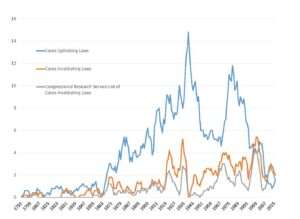
I have now posted to my personal website an updated and expanded version of the Judicial Review of Congress Database. You may find here the database itself, a description of the variables, a description of how the cases were identified and selected, and a text list of the cases invalidating a provision of an act of Congress in whole or in part. (A comparable list of cases upholding acts of Congress against constitutional challenge is still in process, though the cases themselves are included in the JRC Database.)
The Judicial Review of Congress Database catalogs all the cases in which the U.S. Supreme Court has substantively reviewed the constitutionality of a provision or application of a federal law. The dataset aims to be the most comprehensive accounting of Supreme Court cases both upholding and invalidating provisions of federal statutes. It does not include cases decided in the lower courts that address the constitutional validity of federal statutory provisions, except to the extent that those cases eventually found their way to the U.S. Supreme Court. The database currently includes 1323 cases decided by the Court from its founding through its October 2021 term and related pieces of information about those cases.