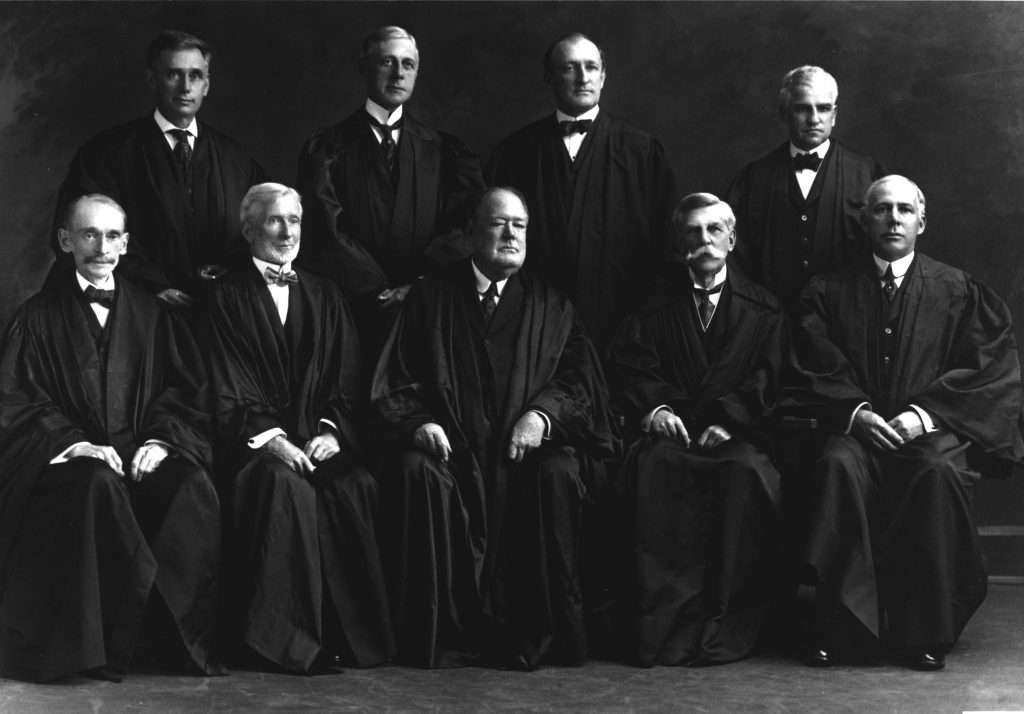
11/5/1917: Buchanan v. Warley decided.

Mostly law professors | Sometimes contrarian | Often libertarian | Always independent | Est. 2002

11/5/1917: Buchanan v. Warley decided.
Wanted posters, vague and threatening letters, and dragging a 75-pound dummy.
Please enjoy the latest edition of Short Circuit, a weekly feature written by a bunch of people at the Institute for Justice.
Last summer Alexandria, La. police pulled over Mario Rosales for failing to use his turn signal and detained him for 20 minutes, probing for evidence of other, more serious lawbreaking, cutting him loose when they didn't find any. But wait! The officers' dashcam shows that Mario did signal. Those sneaky dogs! Click here to learn more about IJ's latest case, a challenge to pretextual, picayune harassment that passes for police work.
Over at Intelligence Squared, IJ Attorney Anya Bidwell debates the Heritage Foundation's John Malcom on the merits of qualified immunity, explaining why it is really and truly okay if officers who make good-faith mistakes in life-and-death situations are not shielded from suit. With an appearance by The New York Times's Adam Liptak.
After she was laid off from her full-time job, Sally Ladd turned her side hustle—renting out her vacation home in the Pocono Mountains—into a full-time gig, managing six other vacation rentals for nearby property owners. But that all came to an abrupt halt in 2017, when Pennsylvania officials demanded that she obtain a real estate license, which requires 315 hours of coursework and a 3-year apprenticeship, among other things. This week, however, we're happy to say that—after a 2020 trip to the state's high court—Sally has prevailed at trial! Says the court: The requirements "are unreasonable, unduly oppressive, and patently beyond the necessities of the case." Nor do they "bear a real and substantial relation to protecting the public from harm." Hear, hear for state courts, judicial engagement, and the right to earn an honest living. Click here to learn more.
From Doe v. Mid-American Apartment Communities, Inc., decided Wednesday by Magistrate Judge Christopher Ray (S.D. Ga.):
The Court's prior Order explained that "[a]nonymous pleading is the exception to Federal Rule of Civil Procedure 10(a), which requires every party to be named in the complaint." It also explained that "[t]he ultimate test for permitting a plaintiff to proceed anonymously is whether the plaintiff has a substantial privacy right which outweighs the customary and constitutionally-embedded presumption of openness in judicial proceedings."
Doe's Motion to Proceed Anonymously states that he should be permitted to pursue this case anonymously because his "defamation of character lawsuit warrants anonymous filing." He contends, without any citation to legal authority, that "[c]ourts in the Eleventh Circuit and elsewhere have routinely recognized defamation of character lawsuit as one of the rare situations justifying anonymous suits." He also alleges, in wholly conclusory fashion, that anonymous proceeding is justified by the possible application of an arbitration clause, apparently in his lease. Finally, he expresses concern that pursuing this case in his own name "may incite [d]iscrimination[, and] … expose [him] to [d]iscrimination, [r]etaliation, [f]urther risk of illegal entry, [p]rivate [p]roperty, personal health, and life dangers."
From Civil Beat (Hawaii) (Stewart Yerton):
Based on what they believed was evidence that Gallagher had advised pregnant women on how to make money selling erotic photos, many of the doulas ostracized him as a sexual predator seeking to infiltrate their community….
Gallagher's attorney, Megan Kau, acknowledged in an interview that her client advised women about selling nude photos on the creative artist platform Patreon…. But Kau said Gallagher never coerced anyone. And it was wrong to accuse Gallagher of being a "pimp" and a "predator" who groomed vulnerable women to produce and distribute pornography.
Courthouse News (Candace Cheung) has more:
The first in a series of very miscellaneous ideas and excerpts
For the last 30 years or so, I've kept a kind of "Commonplace Book"** - a collection of writings, anything from a sentence or two to a couple of paragraphs, that I had come across and found particularly well-constructed, or expressing some particularly interesting or profound idea in a special way, which I copied out and stored in a series of notebooks.
** The term "Commonplace Book" is quite ancient, and comes from the Latin locus communis, or "common knowledge." Aristotle and Cicero both discussed the practice of collecting and organizing sententiae, or "wise sayings" or quotations from philosophers, poets, dramatists, and the like, and the list of great writers and thinkers over the years who have assiduously kept their own Commonplace books is impressive, including e.g. John Milton, John Locke (who went as far as publishing a guide to the practice, entitled "A New Method of Making Common-Place-Books), Thomas Jefferson, Erasmus and Charles Darwin, Emerson, Thoreau, Mark Twain, Virginia Woolf, Thomas Hardy, . . .
Somewhat to my surprise, it turned out to be very helpful for my own writing; the practice of simply copying out well-written passages, like the practice of memorizing texts, forces one to dig a little deeper into, and to think a little bit harder about, exactly what the author is doing and why the passage works as well as it does.
I have well over 500 entries in my book, and, skimming them over recently, I found a great deal of interesting stuff in there that I think would be fun to share. So over the next few months I'll pull something out and post it every few days, perhaps with a (brief) commentary on context, or on what I found particularly alluring about the excerpt. I think - or at least I hope - that some of you will find it interesting and illuminating.
**********
This seems like a good place to start:
The wonderful Polish poet Wislawa Szymborska, winner of the Nobel Prize for Literature in 1996, was, from 1968 to 1981, the (anonymous author) of the Literary Mailbox column in the Polish journal Literary Life. It was a kind of "Dear Abby" advice column for aspiring poets and novelists, in which she would answer readers' questions about writing or, more frequently, comment on excerpts that they had submitted. A bunch of her more trenchant (and often hilarious) responses are collected in How to Start Writing (and When to Stop). I think this is my favorite:
To the Author of 'The Pianist's World':
We advise you—for a few months at least—to read only the great humorists. You won't be wasting time: such activity provides rest and recreation for a mind worn down by its own lyricism. It also demonstrates, incidentally, the folly of excessive self-importance. After this course of treatment, you will see your poems differently. The mood of 'The Pianist's World' will strike you as contrived, and the metaphor "life licks us with a tongue of contrasts" will no longer fill you with writerly pride.
Best regards.
What's on your mind?
We sit down with California Western School of Law's Prof. Erin Sheley
The eleventh episode (Apple Podcasts link here and Spotify link here) of Strangers on the Internet with co-host and psychologist Michelle Lange has us chatting with Prof. Erin Sheley who brings her personal and professional wisdom to the world of online dating.
Erin found love (and indeed, a fiance) on Bumble after dating app adventures across North America. While last time we had Catgate, this week's episode brings us Fishgate: this vegetarian scholar and her avid fisherman date from the apps did NOT see eye to eye when it comes to how many fish it's okay to kill in a year. Erin also tells the tale of how a man tried to throw her on the train tracks in Calgary and how an intrepid cowboy intervened just in time to save her life!
We will discuss the difficulties in settling down romantically as an itinerant academic, so come join us on this journey from DC to Canada, Oklahoma, Dallas, and finally San Diego.
Also, what exactly was that guy planning to do on their car ride if Erin hadn't sent his info to her friends in advance? Can even a criminal law professor stay safe from crime by strangers on the Internet? We've got the tea - grab a cup and have a listen!
From Krasno v. Mnookin, decided yesterday by Magistrate Judge Stephen Crocker (W.D. Wisc.):
Although there is no requirement of narrow tailoring in a nonpublic forum, the government's restrictions still must be viewpoint neutral and must be "reasonable in light of the purpose served by the forum." In order to show that a speech restriction is "reasonable," the government must show that its restraint: (1) furthers a "permissible objective;" and (2) contains "objective, workable standards" that are "capable of reasoned application."
{[C]ourts often describe a forum opened by the government that is limited to certain speakers or subjects as a "limited public forum." Although most of these cases use the term interchangeably with "nonpublic," meaning that regulations in both are subject to a lower level of scrutiny, at times the term "limited public forum" has been used to describe a subcategory of "designated public" fora subject to the strict scrutiny test. In the instant case, when the University argues that the comment threads to its social media posts are "limited public" fora, I understand it to mean a forum governed by the reasonableness and viewpoint neutrality requirements applied to "nonpublic" fora. To avoid confusion, I will use the term "nonpublic" in this opinion to designate such a forum.}
[T]he University has a legitimate, viewpoint-neutral interest in limiting the comment threads to discussion of or reaction to the specific topic of the University's post. The University uses its Facebook page and Instagram account as channels to communicate official University announcements, events and policies to the public, including its student body, and as a means of promoting the UW-Madison "brand." With respect to the interactive comment threads, the University monitors what other social media users are saying in response to the University's posts, to see how its content is generally being received and to see the reactions its posts are generating. The University also wants to see if anyone has questions, and it may engage in its own speech in the comment threads to answer them. Allowing off-topic comments to proliferate makes it more difficult for the University to engage with its followers and to see comments to which it may wish to respond.
It also is legitimate for the University to consider the distraction that off-topic comments may present to other users seeking to engage in and to discuss the topic of the University's post. It is reasonable for the University to conclude that these other users may be less inclined to leave a comment, to ask a question, or to engage in on-topic discussion with other users if the University's pages are fraught with off-topic comments…. "[F]ailure to effectively moderate a public discussion may be as deleterious to dialogue in such a forum as censorship." There is nothing unreasonable about the University preferring that the interactive comment threads have the look and feel of a brown bag lunch discussion rather than its open-air Library Mall at the foot of State Street.
The Arizona law, which appears to be quite unusual among the states, provides:
The defendant, the defendant's attorney or an agent of the defendant shall only initiate contact with the victim through the prosecutor's office. The prosecutor's office shall promptly inform the victim of the defendant's request for an interview and shall advise the victim of the victim's right to refuse the interview.
Judge Steven Logan (in yesterday's Arizona Attorneys for Criminal Justice v. Ducey) concluded that this was a speaker-based restriction on speech that appears to be justified by the expected content of the speech, and thus had to be judged under strict scrutiny, which the law failed. The court stressed that witnesses have every right to refuse to talk to the defense team, but the law "is not 'actually necessary'" to protect that, since "victims receive ample notice of their right to refuse a defense interview under several other provisions of state law." As to protecting witnesses from "intimidation, harassment, or abuse,"
The Foundation for Individual Rights and Expression reports (for more, read Judge Amos Mazzant's August 25 decision denying the college's motion to summary judgment, Jones v. Collin College):
Today, administrators at Collin College agreed to a settlement that includes reinstating education professor Suzanne Jones, fired by the institution last year for her protected speech. The Foundation for Individual Rights and Expression represented Jones in her lawsuit….
As part of the settlement, the college agreed to a two-year, $230,000 teaching contract with Jones and to pay $145,000 in attorneys' fees. …
Under President H. Neil Matkin, Collin College — the epicenter of censorship in Texas — fired Jones on Jan. 28, 2021. The college cited three incidents that led to her firing:
- In 2017, Jones signed her name and college affiliation on a published open letter supporting the removal of Confederate monuments in Dallas.
- In 2020, Jones used the name of Collin College on a website associated with the Texas Faculty Association, a statewide faculty union Jones helped organize at Collin College.
- Jones, who sat on the Collin College Faculty Council, publicly supported the council's proposed plan regarding campus reopening amidst the pandemic.
In the oral argument from SFFS v. UNC, Justice Alito raised the question, highlighted in my amicus brief and book, of whether the racial and ethnic classifications used by UNC and other universities are so arbitrary as to be unconstitutional. I have posted the colloquy below.
Two comments:
(1) Justice Alito asks why a student of Afghani heritage should be put in the same classification as a Chinese American. In fact, while this is far from clear from the Common Application itself, officially the Asian American classification ends at the Western border of Pakistan, and Afghan-Americans are white. This just goes to show how arbitrary and confusing the classifications are.
(2) Mr. Park for UNC struggles to explain that UNC both considers each student's ethnicity on an individualized basis, but also relies on box-checking because racial heritage is relevant to one's life experiences: "[Plaintiffs' argue] that race says nothing about who you are. And we just don't think that is true when you look at American society as it exists." But that just gets us back to Justice Alito's question: what common "racial" experiences do, say a Filipino, a Vietnamese, and Bangladeshi American have in common, such that they should be considered members of the same classification? "Asian" seems like a rather arbitrary dividing line, especially given that "racially" Asians may be Caucasian, East Asian, Austronesian, or "other" (like indigenous Malaysians.)
JUSTICE ALITO: I'd like your response to the argument that these racial categories are so broad that any use of them is arbitrary and, therefore, unconstitutional. So what would you say to, for example, a student whose family came from Afghanistan and doesn't get in because the student doesn't get the plus factor that the student would get if the student's family had come from someplace else? So you would say to the student: Well, we don't -- we don't need you to contribute to a diversity of views at our school because we already have enough Asians. We have a lot of students whose families came from China or other Asian countries. And the student says: Well, you don't have anybody like me, I'm from Afghanistan. What -- what similarity does a family background to the person from Afghanistan have with somebody whose family's background is in, let's say, Japan?
MR. PARK: So, respectfully, what you're describing is the exact opposite of how our process actually works on -- on an individualized basis. This is -- we discuss this on page 11 of our brief. There was a Vietnamese student. The admissions office –the admissions officer testified about a Vietnamese student who immigrated to a remote part of North Carolina and thrived in that setting, and she testified, undisputed, that that was a favorable aspect of her application.
JUSTICE ALITO: Well, that's -- that's-- that's an individual aspect of the application and something that has to do with her experience. But what is the justification for lumping together students whose families came from China with someone -- with students whose families came from Afghanistan? What do they have in common?
MR. PARK: So I agree that that would be a strange rule. And that is not the rule that this Court has established. It would require --
JUSTICE ALITO: Well, then why do you have them check a box that I'm Asian? What do you learn from the mere checking of the box?
MR. PARK: So we think that it depends on the individual circumstances of that person, but I am telling --
JUSTICE ALITO: So you don't need the -- you don't need the boxes at all?
MR. PARK: So I think that that is not necessarily true on an individualized basis. So another example, so we -- again, as I discussed, we attempt very vigorously to recruit and enroll rural students, and we don't ask them to write an essay about how being from a rural background affects their, you know, sense of self and their experiences, but what we say is that person comes with something that we value, and –
JUSTICE ALITO: Well, they may choose to write about it, but what's the answer to my question? Why do you have these boxes? Why – why do you give a student the opportunity to say this one thing about me, I'm Hispanic, I'm African American, I'm Asian? What does that in itself tell you?
MR. PARK: We think that it can in context, on a individualized basis, perhaps not in every case but in some cases, give important information about where that person is coming from and what their experiences have been. And, really, this goes to the heart of the dispute that we have between the parties. So they say on page 53 of their brief that race says nothing about who you are. And we just don't think that is true when you look at American society as it exists.
Harvey Silverglate, a noted civil rights and criminal defense lawyer, is running for the Harvard Board of Overseers, on a platform of free speech and encouraging debate and viewpoint diversity. Harvey is the co-founder of the Foundation for Individual Rights in Education (which was recently broadened to be the Foundation for Individual Rights and Expression), as well as a member of the ACLU of Massachusetts Board of Directors for 30 years (two as the Board president).
As Jeff Jacoby (Boston Globe) reports,
Ordinarily, overseers are chosen from a slate of insider candidates selected by a committee of the Harvard Alumni Association. But there is an outside route: Candidates can get on the ballot if [3,188] Harvard graduates sign a petition nominating them.
If you're a Harvard alum and would like to see Silverglate as a member of the board, you can sign his petition at https://www.harvey4harvard.com/petition. I would have, had I gone to Harvard. Rumors that Harvard grads who went to Yale for graduate school have their Harvard alumni status automatically revoked are entirely unfounded.
UPDATE: A friend of mine reports:
It's actually really hard to submit a valid petition for him. You have to use your "HarvardKey" credentials to get through the alumni association portal and verify your own identity a few times. Plus you also have to know the exact spelling of his name (Silverglate, not Silvergate) and that he was Harvard Law School class of 1967 for the submission to be valid.
One originalist argument in favor of allowing the government to engage in "race-conscious" policies is that the post-Civil War Freedmen's Bureau was established to assist freedmen and refugees, the vast majority of whom were black, as Congress was well aware.
During oral argument on Monday, the plaintiff's attorney replied, "The Freedmen's Bureau for the most part did not draw any racial classifications. It was classifications on the basis of being a former slave or a refugee." A law professor tweeted in response, "It's one of the most ridiculous things I've heard in legal argument."
And yet the distinction drawn by the attorney is not ridiculous at all. Imagine an Allied policy in 1946 to help former inmates of Nazi camps, 95% of whom were Jews. This is, on the one hand, "about" race (the Nazis having considered Jews an inferior race), i.e., race conscious. On the other hand, the policy does not single out Jews for assistance based on them being Jews, as such.
Such would be a clear precedent for the notion that you can give assistance to a group that suffered horrific discrimination, knowing that the group is overwhelmingly composed of Jews. It's a much weaker precedent for the notion that the government can in the future, especially 160 years in the future, single out Jews specifically for special treatment, regardless of whether their ancestors were ever persecuted by the Nazis.
It would be an even weaker precedent that one could single out ANY ethnic or religious minority for differential treatment. In the affirmative action context, state universities give preferences to all black applicants, even if they were born in the Caribbean or Africa--and note that African immigrants may be descendants of slavers rather than slaves. They also give preferences to Hispanics, even if they are "white" (of European ancestry). The connection between these policies and the Freedmen's Bureau precedent is far from obvious.
This raises an important point. Lawyers often refer to the question of whether the government can use racial preferences as a question of whether the government may engage in "race-conscious" policies. But this is a misnomer (and one I am guilty of using myself). Affirmative action policies involve not simply consciousness of how a policy affects putative racial groups, but classifying individuals by race.
Imagine two scenarios. The first scenario involves a local government with three high schools. One high school is 60% Hispanic, 20% Black, and 20% White. The second is 60%Black, 20% Hispanic, and 20% White. And the third is 60% White, 20% Black, and 20% Hispanic. The government decides that sound social policy dictates that each school should be 1/3 each group. It therefore proceeds to classify each student by race/ethnicity, and buses them around town to achieve racial balance.
In the second scenario, a town is deciding where to place two new high schools. If it places the high schools in locations A, one school will be 90% White and 10% Black, and the other school will be the reverse. Under plan B, each school will be 50-50. Even though other factors (cost, convenience, etc) slightly favor plan A, the town considers de facto integration to be a value, and therefore decides to go with plan B.
Both scenarios depicted above involve "race consciousness." But scenario A involves different considerations than scenario B. Scenario A involves classifying individuals by racial and ethnic categories, and changing many of their school assignments based on which group they are classified into. Scenario B involves simply placing a school in one location or another, without anyone's assignment specifically being based on his or her racial classification. If demographics naturally shift over time such that the schools move away from the 50-50 preferred balance, no one is going to be forced to switch schools based on race.
Some might argue that both scenarios involve unconstitutional "race consciousness." But it strikes me that the better view is that the classifications involved in school assignment in scenario A are far more troubling under the Equal Protection Clause. Indeed, my inclination would be to say that scenario A is unconstitutional while scenario B is permissible. Being conscious of how government policy may or may not affect social policy seeking integration or relieving the isolation of specific minority groups is just not the same as dictating an individual's rights and remedies based on a government classification of his or her racial status. The latter is both a much greater intrusion on individual rights, and a much more dangerous power to give the government.
Supreme Court protesters may get their moment of fame, but they may make it less likely the justices will allow live video broadcast of oral arguments.
The Supreme Court has continued its Covid-era practice of live-streaming oral argument audio. This allows people to listen and comment on the arguments in real time. It also creates an incentive to disrupt the proceedings as a way of generating media attention.
Yesterday, during oral argument in Bittner v. United States, several protestors interrupted the oral argument to scream their objections to the Supreme Court's Dobbs decision and subsequent state laws limiting or prohibiting abortions. Each of the protestors was swiftly apprehended and removed from the courtroom. SCOTUSBlog reports on the details here,
While the protestors received a decent amount of media attention (which was no doubt their aim), it does not appear they were ultiamtely able to hijack the audio stream. SCOTUSBlog reports "some of Wednesday's protest was apparently redacted from the stream in real time on Wednesday: The stream started late, after the argument had already begun, and the audio briefly went silent during the protest in the first several minutes."
Television broadcasters routinely delay live broadcasts for a few seconds so as to allow real time editing or censoring of inappropriate conduct. (This development was one of the factors that precipitated a tightening of the FCC's rules on the broadcast of "fleeting expletives" noted in the Court's first FCC v. Fox decision upholding the policy.) If the Supreme Court is using a similar technology, that would certainly help protect against efforts to hijack livestreamed arguments for political purposes.
One likely consequence of yesterday's protests is that live video streaming of oral arguments is ever-more unlikely. The justices have long been wary of how live broadcast could alter the incentives of advocates and judges at oral argument in ways that encourage style over substance. (Are we already seeing this? Perhaps.) The risk of additional protests is only likely to stiffen their resolve.
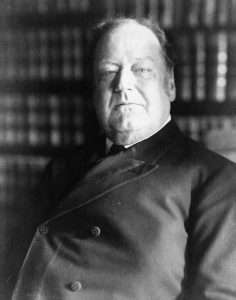
11/3/1845: Chief Justice Edward Douglass White's birthday.
The federal appellate judge suggests judges should focus less on social media attention, and more on ensuring their opinions are clear, succinct and correct.
In recent remarks before the Harvard Law School chapter of the Federalist Society, Judge Stephanos Bibas of the U.S. Court of Appeals for the Third Circuit lamented the tendency of some judges to be more concerned with authoring quote-worthy and attention-grabbing opinions than in writing clear and succinct opinions that properly apply the law to the case at hand.
A federal appeals court judge on Wednesday argued his judicial peers too often succumb to a "judges gone wild" mentality of writing "show off" opinions that may trend on Twitter but risk alienating the public instead of being persuasive. . . .
[Bibas said] judges should focus more on writing "in way that ordinary citizens can understand,". . . "Citizens don't read many opinions, but when they do, accessibility is crucial," he said. . . .
"For the show off, it seems to be all about the judge's musings, even the judge's ambitions to be noticed," Bibas said. "'Look at me, look at me, I'm so cool.' That is not authoritative. It is even disrespectful."
Judge Bibas also suggested that judges should spend less time on Twitter and other forms of social media.
Asked by a student how judges feel when a big ruling like his election decisions garners them "newfound fame," Bibas said "the kind of cheerleading you get from Twitter is really dangerous," yet some judges seem to seek that attention.
"Try to be on Twitter less than you otherwise would," he said. "Try not to be searching for the feedback or the plaudits or anything else. Just focus on the craft and find as much internal satisfaction in the craft of judging and writing as you can."
I suspect much of this advice could well apply to legal academics too.
So holds the Ninth Circuit; Hamilton plays a major role.
From Green v. Miss United States of America LLC, decided today by the Ninth Circuit (Judge Lawrence VanDyke, joined by Judge Carlos Bea, with Judge Susan Graber dissenting):
Anita Green, who self-identifies as "an openly transgender female," sued the Miss United States of America pageant, alleging that the Pageant's "natural born female" eligibility requirement violates the Oregon Public Accommodations Act ("OPAA"). The district court granted the Pageant's motion for summary judgment, holding that the First Amendment protects the Pageant's expressive association rights to exclude a person who would impact the group's ability to express its views.
We conclude that the district court was correct to grant the Pageant's motion for summary judgment, but reach this conclusion not under the First Amendment's protection of freedom of association but rather under the First Amendment's protection against compelled speech….
As with theater, cinema, or the Super Bowl halftime show, beauty pageants combine speech with live performances such as music and dancing to express a message. And while the content of that message varies from pageant to pageant, it is commonly understood that beauty pageants are generally designed to express the "ideal vision of American womanhood." In doing so, pageants "provide communities with the opportunity to articulate the norms of appropriate femininity both for themselves and for spectators alike."
Celebrate your independence with a subscription to Reason magazine, your most trusted source of honest, insightful news and analysis.