If the government exercises a power it lacks for a long time, it can keep exercising that power. But if a government does not exercise a power it has, it loses that power.
From an originalist perspective, NLRB v. Noel Canningwas one of the worst separation of powers decisions in recent memory. The text of the Recess Appointments Clause clearly refers to "the recess of the Senate"--a single break between sessions. But Justice Breyer's majority opinion found that text "ambiguous," and then relied on historical practice--what we might now call "tradition"--to find that intrasession recess appointments were permissible. In short, many Presidents had made these types of appointments, and Congress had not meaningfully object to this practice, therefore the practice is constitutional.
Justice Scalia wrote a concurrence, which really read more like a dissent. He accused Justice Breyer of misreading the historical record, as intrasession recess appointments were the subject "of a long simmering interbranch conflict." But Scalia further criticized Breyer's methodology as akin to "adverse possession." That is, if the executive branch continuously exercises some power that it lacks, it can keep exercising that power.
As someone who teaches both Property and ConLaw, Scalia's argument about adverse possession has always resonated with me: if the government acts unlawfully for a long time, why should it be rewarded by being able to keep acting unlawfully? We tolerate squatter rights in the land use context, in part, to conclusively settle disputes and put property to the highest use. But the Constitution is not an abandoned lot or a fallow farm.
There is a flip-side to the "adverse possession" theory of the separation of powers. Justice Barrett articulated it in her Rahimi concurrence. She rejected a theory of originalism that "assumes that founding-era legislatures maximally exercised their power to regulate, thereby adopting a 'use it or lose it' view of legislative authority." Such a theory assumes that if some government did not exercise a power, that is evidence that the government lacks such a power, and future courts can prevent the government from exercising that power. It could also be that the government simply exercised discretion, and chose not to use that power. Barrett limited her point here to founding-era legislatures, but I think that dynamic would extend to post-enactment tradition.
Let's use an easy, and familiar example. In the 1860s, some states regulated abortions. (There were tiresome debates about how to count those states, which I'll table for now). Dobbs found that the fact that some states regulated abortion is proof that abortion was not considered a fundamental right when the 14th Amendment was ratified. I think that argument is correct as far as it goes. But imagine a counterfactual. Let's say states did not regulate abortion at the time. Perhaps they did not have much evidence that there was a problem with abortion, or perhaps the legislature chose to focus on other items. Would that lack of regulation suggest that states in fact did not have the power to prohibit abortions? Is this some sort of use-it-or-lose-it power? Would the lack of regulation in fact suggestion that abortion was a fundamental right? Wouldn't the better answer simply look to whether "abortion" was considered "liberty," or discussed as a right, when the Fourteenth Amendment was ratified? Why work backwards from laws that were, or were not passed?
I realize Glucksberg asks for a tradition of regulation to define rights. That is not an originalist framework. But I think it is also not originalist to look to a tradition to non-regulation to define government power. So much turns on gleaning unstated intentions from unenacted legislation by long-dead legislators. How is any of this originalism?
I see the "adverse possession" and "use it or lose it" theories as two edges of traditionalism. If the government exercises a power it lacks for a long time, it can keep exercising that power. But if a government does not exercise a power it has, it loses that power.
I still need to chew this through. Again, Justice Barrett's short concurrence raised a lot of food for thought.
I received a message last night that I did not know how to answer. Has there ever been a Supreme Court decision with a lopsided majority who insisted that it was simply reaffirming precedent, when in fact it was rewriting precedent. Sure, this happens all the time in 5-4 or (now) 6-3 cases, where the Roberts Court pretends to follow some decision when in fact it narrows or broadens it. But has there been such an 8-1 decision? I could not think of a case. [Update: A colleague flagged Groff v. DeJoy, which pretended to uphold TWA v. Hardison, when it in fact rewrote five decades of precedent.[
I think everyone realizes that the Court reinterpreted Bruen. Look no further than Linda Greenhouse's new column:
This was a misunderstanding of Bruen, Chief Justice Roberts insisted. The court had not meant to suggest "a law trapped in amber" but simply whether "the challenged regulation is consistent with the principles that underpin our regulatory tradition."
This was news to Justice Thomas, who objected that "not a single historical regulation justifies the statute at issue."
Chief Justice Roberts, for his part, found two, both imported into the United States from English common law. One required those found likely to "break the peace" by abusing a spouse or misusing firearms to post a bond or face jail. The other could disarm those who used weapons to "terrify the good people of the land."
"Since the founding," the chief justice said, "our nation's firearm laws have included provisions preventing individuals who threaten physical harm to others from misusing firearms." The law at issue in the case, he concluded, "fits comfortably within this tradition" and was "what common sense suggests."
There is quite a difference between a principle that "fits comfortably" on the one hand and an analogous regulation that has to be a near-perfect match on the other. Which requirement describes the real Bruen, a decision that the chief justice and four members of his 2024 majority had signed only two years ago? It's tempting to conclude that these justices wanted to reinterpret Bruen while not expressly disavowing it.
I agree fully with Greenhouse--not a sentence I write often. I welcome others to prove me wrong, but I doubt anyone will bother. The Court reached the "right" result so they'll let things sit. I regret all the scholarship on Bruen that was published in the last two years that has since been rendered obsolete.
Greenhouse also suggests that Justice Gorsuch "seemed particularly uneasy" and that Justice Barrett vigorously disagree with Kavanaugh's exposition on tradition.
I also found myself in agreement with parts of a post from Mike Dorf on the Kavanaugh concurrence:
I confess that before writing my post Friday or proofreading Prof Segall's post for Monday, I hadn't read Justice Kavanaugh's concurrence in full. I skimmed it and concluded it was a little law review article defending originalism against straw man arguments.
Reading the whole concurrence, as I had to in order to edit Rahimi down for the annual supplement to my casebook, confirmed my initial impression. For example, Justice Kavanaugh writes: "Some say that courts should determine exceptions to broadly worded individual rights . . . by looking to policy. Uphold a law if it is a good idea; strike it down if it is not." That's ridiculous. Nobody says uphold a law if it is a good idea or strike it down if it's a bad idea. Thus, my impression was correct. Justice Kavanaugh takes aim at a straw man. . . .
The entirety of Justice Kavanaugh's concurrence is a self-indulgent exercise the point of which appears to be to get himself quoted in books and articles about constitutional interpretation.
Dorf also suggests that Kavanaugh misread some caselaw concerning scrutiny.
T-minus six minutes to go till new opinions. Stay tuned.
Update: Braidwood Management v. EEOC was actually decided on June 21, 2023, not last week. I'm not sure why that case popped up on my radar this week. There was no cert petition on that case. I'm going to leave this post up for the sake of completeness, but you can skip over it.
I have spent some time thinking about how the three Trump appointees differ. In Rahimi, Justices Gorsuch, Kavanaugh, and Barrett each wrote concurring opinions. And they are not on the same page. I'm not even sure they're reading from the same book. Rahimi provides another opportunity to consider how the troika approaches originalism.
Justice Gorsuch
I'm still uncertain what to make of Justice Gorsuch's dissent. I see some pangs of guilt for not joining Justice Thomas's dissent. He writes:
I appreciate that one of our colleagues sees things differently. Post, at 6–7 (THOMAS, J., dissenting). But if reasonable minds can disagree whether § 922(g)(8) is analogous to past practices originally understood to fall outside the Second Amendment''s scope, we at least agree that is the only proper question a court may ask.
Even if Gorsuch is not persuaded by Roberts's historical examples in all regards, Gorsuch seems convinced that this particular facial challenge cannot succeed.
And, at least in some cases, the statute before us works in the same way and does so for the same reasons [as the surety laws]: It permits a court to disarm a person only if, after notice and hearing, it finds that he "represents a credible threat to the physical safety" of others.
The facial challenge analysis is key to Gorsuch's vote. The opening paragraph of the Gorsuch's concurrence focuses on United States v. Salerno:
Mr. Rahimi pursues the "most difficult challenge to mount successfully": a facial challenge. United States v. Salerno, 481 U. S. 739, 745 (1987). He contends that 18 U.S.C. § 922(g)(8) violates the Second Amendment "in all its applications." Bucklew v. Precythe, 587 U. S. 119, 138 (2019). To prevail, he must show "no set of circumstances" exists in which that law can be applied without violating the Second Amendment. Salerno, 481 U. S., at 745. I agree with the Court that he has failed to make that showing. Ante, at 8.
Salerno is the case that judges cite when they do not want to declare a law unconstitutional. See Judge Sutton's opinion in the Obamacare litigation. Rahimi's merits brief didn't even cite Salerno. And the SG cited it once in her reply brief. During oral argument, Rahimi's lawyer said Salerno was not relevant. Instead, this case mirrored the facial challenge in United States v. Lopez. I think the Salerno dodge helped Roberts button up the eight-member majority. He is very good at what he does.
Justice Gorsuch tries to mediate some synergy between the three concurrences:
If changes are to be made to the Constitution's directions, they must be made by the American people. Nor is there anything remotely unusual about any of this. Routinely, litigants and courts alike must consult history when seeking to discern the meaning and scope of a constitutional provision. See post, at 6–16 (KAVANAUGH, J., concurring) (offering examples). And when doing so, litigants and courts "must exercise care." See post, at 3, n. (BARRETT, J., concurring)
But I think that Justices Gorsuch, Kavanaugh, and Barrett are quite far apart.
Gorsuch concludes:
Among all the opinions issued in this case, its central messages should not be lost. The Court reinforces the focus on text, history, and tradition, following exactly the path we described in Bruen.
Far from it. The Court rewrites Bruen, which apparently had a two-year expiration date.
I was glad to see that the California Court of Appeal published its opinion in Luo v. Volokh, following a request by the First Amendment Coalition. (In California, any person or organization may ask a court to publish an opinion that was initially released as nonpublished.) The opinion thus becomes precedent in California, and might prove helpful in cases such as Adams v. Gulley, the case discussed in the "California Judge Orders Removal of Reddit Criticism of Scientist/Consultant Who Publicly Criticized English Lucy Letby Murder Trial" post.
Here again is the key reasoning in the newly published opinion:
Appellant Xingfei Luo, also known as Olivia Luo, twice sought a restraining order against respondent Professor Eugene Volokh pursuant to Code of Civil Procedure section 527.6. Luo sought to prevent Volokh from identifying her in his writings….
[Cal. Code Civ. Proc.] Section 527.6 provides an expedited procedure to prevent harassment. By definition, harassment must have "'no legitimate purpose.'" "Legitimacy of purpose negates harassment." Constitutionally protected activity also is excluded from the definition of harassment….
Section 527.6 defines harassment as "unlawful violence, a credible threat of violence, or a knowing and willful course of conduct directed at a specific person that seriously alarms, annoys, or harasses the person, and that serves no legitimate purpose. The course of conduct must be that which would cause a reasonable person to suffer substantial emotional distress, and must actually cause substantial emotional distress to the petitioner." A course of conduct is defined as "a pattern of conduct composed of a series of acts over a period of time, however short, evidencing a continuity of purpose, including following or stalking an individual, making harassing telephone calls to an individual, or sending harassing correspondence to an individual by any means, including, but not limited to, the use of public or private mails, interoffice mail, facsimile, or email."
{Luo described the parties' relationship as follows: "Volokh has learned my info through litigation." Luo stated, "Volokh has published my info online and invited ha[t]ers to stalk, harass, threaten and commit violence against me. I continue to receive threatening and harassing phone calls and voice mails calling me cunt, slut, lying on men and indicating they will rape and kill me. At the end of July, I was forced to move out of my prior residence for safety concern."
Luo requested the trial court order Volokh to "[1] Remove any remarks, comments, or references from any publicly available documents or articles authored by [Volokh] that connect [her] real name with rape or sexual assault; [2] Remove any remarks, comments, or references from any publicly available documents or articles authored by [Volokh] that connect [her] with the cases in which she has received a protective order to proceed under a pseudonym; [3] Cease publishing any remarks, comments, or references that connect [her] with rape or sexual assault; [4] Cease drawing public attention to [her] name [when] associated with rape or sexual[ ] assault."
One problem with pseudonymous litigation is the proliferation of Doe v. cases against the same institutional defendant; the cases, and the precedents they set, can easily be confused with each other because they have the same name. In If Pseudonyms, Then What Kind?, published last year in Judicature (an academic law journal aimed at judges), I discussed various possible solutions, but I've just come across a new twist, from Doe WHBE 3 v. Uber Technologies, Inc.:
As plaintiffs' opening brief explains: "Because so many Jane Doe plaintiffs filed actions against Uber, they assumed additional pseudonyms utilizing the initials of the law firms representing them." Jane Doe WHBE 3 was "the third [case] in which the plaintiff was represented by Williams, Hart, Boundas and Easterby, LLP (now Williams, Hart & Boundas, LLP) (SF Super Ct. No. CGC-20-584649)."
I'm not wild about that: I tend to agree with courts that have concluded that the use of initials can be subtly "depersonalizing" or "dehumanizing," see the cases cited in nn.23 & 24, and this seems even more so with regard to these sorts of alphanumeric combinations.
Indeed, identifying a person through the initials of their lawyer seems especially awkward, though maybe that's just my own idiosyncratic reaction. (As the article notes, there have been other such alphanumeric pseudonyms before, though not quite with the same pattern.) My recommendation in the article is to follow the EEOC model of using an arbitrary first name followed by an arbitrary initial, e.g., "Angela M." Still, I thought I'd flag this alternative that is apparently being heavily used in this particular large batch of pseudonymous cases.
I first watched Jurassic Park when I was a few months shy of my ninth birthday. It was a formative experience for my youth. Three decades later, the blockbuster still holds up. I recently watched it with a performance by the Houston Symphony. Still brings the house down.
The premise of the movie is that scientists extracted dinosaur DNA from mosquitos who were trapped in amber. But the DNA found in the mosquitos was incomplete. There would be "massive sequence gaps," as Dr. Ian Malcolm told us. Instead, the scientists had to complete the genetic code with DNA from frogs. While all the dinosaurs in Jurassic Park were bred to be female, frogs had the power to change their sex. As a result, the dinosaurs were able to breed. And the rest is history.
I thought of Jurassic Park when I read what will likely be the most quoted sentence in Chief Justice Roberts's Rahimi majority opinion:
Nevertheless, some courts have misunderstood the methodology of our recent Second Amendment cases. These precedents were not meant to suggest a law trapped in amber.
Roberts no doubt made this line up, but may have been thinking of Jurassic Park.
Justice Sotomayor quotes the line in her concurrence:
Thankfully, the Court rejects that rigid approach to the historical inquiry. As the Court puts it today, Bruen was "not meant to suggest a law trapped in amber."
As does Justice Jackson:
The Court today expounds on the history-and-tradition inquiry that Bruen requires. . . . Ante, at 7–8. We emphasize that the Second Amendment is "not … a law trapped in amber."
Justice Barrett also embraces the line:
To be consistent with historical limits, a challenged regulation need not be an updated model of a historical counterpart. Besides, imposing a test that demands overly specific analogues has serious problems. To name two: It forces 21st-century regulations to follow late-18th-century policy choices, giving us "a law trapped in amber."
Justice Gorsuch's concurrence seems content to be bound by amber, but doesn't think there is amber here:
We have no authority to question that judgment. As judges charged with respecting the people's directions in the Constitution—directions that are "trapped in amber," see ante, at 7—our only lawful role is to apply them in the cases that come before us. Developments in the world may change, facts on the ground may evolve, and new laws may invite new challenges, but the Constitution the people adopted remains our enduring guide.
"Trapped in amber" is sort of like "judges are umpires." A quotable platitude that masks difficult jurisprudential decisions. This line will be used to give countless judges cover to break free from history.
In a way, what Chief Justice Roberts did in Rahimi is akin to what the scientists did in Jurassic Park. He extracted an incomplete historical record from long ago, merged it with some modern-day know-how to fill the gaps, and created some new creation that people want to see. Mosquitos are not trapped in amber anymore than surety laws are stuck in amber. What the Court did here is not originalism. It is recreationism. We're left with the Second Amendment merged with some frog DNA. Welcome to Jurassic Park.
Chief Justice Roberts's greatest gift is to make a complicated case look simple--so simple, that the answer he reaches seems like the only plausible outcome. In less than 18 pages, Roberts purports to reaffirm Bruen while actually diluting the precedent. Now, the lower courts can uphold any gun control law that is "is consistent with the principles that underpin our regulatory tradition." If you read it quickly, you won't even realize what he's done. But this majority opinion in Rahimi is yet another masterclass in misdirection.
What is the leading "principle" that underpins the tradition for 922(g)(8)? Surety laws. As I was reading through the Chief's opinion, I could not stop thinking about the Obamacare cases. My NFIB PTSD was recently triggered by Moore, and Rahimi dragged me back in.
What is the connection, you may ask? Society has long determined that certain conduct is bad. There are several ways to deal with misconduct. First, after the person engages in misconduct, he can be punished. This is the criminal justice system. Second, if the person is likely to engage in misconduct, he can be subjected to some sort of prospective injunction to bar him from engaging in that misconduct. Think of the domestic violence restraining order at issue in Rahimi. Third, a person can choose to prospectively pay some sort money that will allow them to engage in that misconduct.
Wait a minute, you might ask. Number three is not an option! Yes, it is. Look no further than the Affordable Care Act. Congress determined that going uninsured was a bad thing. To address that problem, Congress mandated that people purchase health insurance. But Congress allowed people to go uninsured by paying a penalty--or is it a tax? Doesn't really matter for present purposes. In some cases, the government may determine that the money generated by the fee can be used to address the underlying problem. Better that uninsured people pay a penalty than to throw them in jail, right? If you want another example, think of Jacobson v. Massachusetts. People who were unvaccinated could choose to pay a nominal fine. Once they paid that fine, they were free to mingle in society, without being vaccinated.
There is also a fourth way to deal with misconduct: the surety system. Long before there were law enforcement agencies, society developed a system to ensure bad conduct does not occur. In short, people who were at risk of engaging in misconduct could submit a payment to the court--known as a surety. If they behaved for a prescribed period of time, they would get their surety back. If they engaged in that misconduct, they would surrender the surrety. Thus, there was a financial incentive to behave.
Chief Justice Roberts explained that surety laws were invoked to prevent domestic violence. For example, a wife could demand a surety against an abusive husband. From this practice, Roberts finds support for Section 922(g)(8). But does it?
After posting a surety, a suspect domestic abuser can freely possess a firearm. But under 922(g)(8), a suspected domestic abuser cannot possess a firearm. Justice Thomas's dissent explains why this historical precedent provides no support at all for 922(g)(8). And this analogue brings us back to NFIB. Is the surety closer to a mandate, coupled with a penalty? Or is a surety closer to a tax on going uninsured? I think the answer is the latter.
A better analogue would be a system where a person who may pose a risk to others posts some sort of financial bond; the failure to post that bond would result in incarceration; and engaging in misconduct would also result in posting that bond. I think all would agree that Mr. Rahimi belongs behind bars, but if he is left on the street, there is no historical analogue that supports disarming him. Perhaps there is a "principle," but that exception will soon swallow the entire rule.
We will see what the Court does. The SG asked the Court to grant plenary review in Range and other pending Second Amendment cases. Or the Court may GVR everything to let the lower courts wallow in confusion for a few more years.
Yesterday the Supreme Court granted certiorari in United States v. Skrmetti, a challenge to Tennessee's SB1, a law prohibiting puberty blockers, cross-sex hormones, and sex-transition surgeries for minors suffering from gender dysphoria. SB1 is one of several state laws recently adopted imposing such limitations on such care for minors, and Skrmetti is one of several cases involving challenges to such laws.
Tennessee's law was initially challenged on both Equal Protection and Due Process grounds. A divided panel of the U.S. Court of Appeals for the Sixth Circuit initially stayed and then reversed a preliminary injunction against the law. In opinions by Chief Judge Sutton, the court concluded that the challengers were unlikely to succeed on either their Equal Protection or Due Process claims.
Both the federal government and individual plaintiffs filed petitions for certiorari in Skrmetti. Yesterday the Court only granted the federal government's petition. One reason might be that the brief filed by the Solicitor General only submitted one issue -- Equal Protection -- to the justices. The SG did not ask the justices to consider the substantive dur process claim that Tennessee's SB1 infringed upon fundamental liberties, such as the right of parents to control the upbringing of and make medical decisions for their children.
The question presented in the SG's brief that was accepted for certiorari reads as follows:
Whether Tennessee Senate Bill 1 (SB1), which prohibits all medical treatments intended to allow "a minor to identify with, or live as, a purported identity inconsistent with the minor's sex" or to treat "purported discomfort or distress from a discordance between the minor's sex and asserted identity," Tenn. Code Ann. § 68-33-103(a)(1), violates the Equal Protection Clause of the Fourteenth Amendment.
The second question presented that was addressed by the Sixth Circuit and included in the petition for certiorari that was not accepted by the Supreme Court reads as follows:
Whether Tennessee's SB1 likely violates the fundamental right of parents to make decisions concerning the medical care of their children guaranteed by the Fourteenth Amendment's Due Process Clause.
While the Supreme Court is not ready to consider whether the Due Process Clause protects parental rights in this case, it will likely have additional opportunities to consider such questions in due course, and potentially in cases that have a different ideological valence.
While some states have imposed limits on various treatments for gender dysphoria for minors, other states have placed limits on conversion therapy. While such laws do not raise the same Equal Protection issues as Tennessee's SB1, they arguably place equivalent limits on parental rights. There are also brewing disputes over whether a parent's willingness to affirm a child's gender identity should be considered in custody disputes, as would have been required under a California bill vetoed by Gavin Newsom last year.
Whether or not the Court is willing to add a parental rights case to the docket anytime soon, Skrmetti is currently the highest profile case on tap for October Term 2024.
[Note, however, that should Donald Trump win the election, this is a case in which the federal government could change sides, so it will be worth paying attention to the briefing schedule and when this case is scheduled for argument. On this point, see Josh Blackman's post.]
UPDATE: While the Tennessee law in question prohibits both chemical and surgical treatments, it is important to note that the Solicitor General's brief limits its challenge to the prohibition on the use of hormones and puberty blockers. According to page 9 of the Solicitor General's brief: "The law also prohibits surgical procedures provided for the same purposes, but that prohibition is not at issue here."
The reason the SG claims the case is so proscribed is that the lower courts concluded that the private plaintiffs lacked standing to challenge the prohibition on gender-transition surgeries because none had plans to obtain or provide such surgeries in violation of the law.
Of course, if the SG is correct that the law imposes a sex-based classification that triggers heightened scrutiny, this conclusion would apply across the board. The question then would be whether, if the SG is correct that the prohibition on the use of hormones and puberty blockers fails heightened scrutiny, whether that would necessarily doom the prohibition on surgeries as well. Does the state have a stronger interest in limiting such surgeries for minors than it does for limiting puberty blockers? And is the prohibition on surgeries most closely related to the state's interests? And while this question may not be part of the case at it reaches the Court for review, I would not be at all surprised were the SG asked these questions at oral argument.
From Dever v. Dugan, decided by a panel of the Vermont Supreme Court (Harold E. Eaton, Jr., Karen R. Carroll & Nancy J. Waples) on June 12:
Plaintiff was performing work at Amy's Bakery in Brattleboro…. Dugan owned the property where the business was located.
Plaintiff alleged in his complaint that Dugan stated "that, as owner of [the] property, he had the right to approve or refuse, anyone doing work in or on his building," and "he would not allow [plaintiff] to work in his building" because "[plaintiff] had sued people for whom he had worked in the past," and "there was a good chance" that plaintiff would sue them and "he didn't want to take that chance." According to plaintiff, Dugan told Comerchero [who owned Amy's Bakery] that if she did not terminate plaintiff immediately, he would evict her.
Plaintiff also alleged that Dugan gave Comerchero a list of cases that plaintiff had been involved in for use in a breach-of-contract case that plaintiff brought against her. While plaintiff referred to this list of cases as "malicious defamation," there was no allegation that plaintiff was not in fact involved in these suits.
In November, I wrote that the Fifth Circuit's Rahimi decision "was a faithful application of Bruen." Seven months later, now having read the Supreme Court's Rahimi decision, I stand by what I wrote. After Justice Thomas's dissent, the most intellectually honest opinion in Rahimi was Justice Jackson's concurrence. Jackson explained that "Today's effort to clear up 'misunderst[andings],' is a tacit admission that lower courts are struggling" with Bruen. The struggle is this: Justice Thomas meant what he wrote, but the other five members of the Rahimi majority did not. And they've now all run for the hills.
June 2022 was a strange time. The Court was on the verge of overruling Roe and the Lemon test. According to recent reporting by the New York Times, Chief Justice Roberts and Justice Kavanaugh did not sign onto Bruen until fairly late in the process, and only with a narrowing concurrence. And Justice Barrett was quite vocal about her own reservations. Had Bruen been decided in a different term without Dobbs and Kennedy, perhaps we would have gotten a different opinion. Had Chief Justice Roberts assigned the case to anyone but Justice Thomas, we would have never had Rahimi. The New York law would have been declared unconstitutional, but there would have been nothing about analogical reasoning. So many things had to go right--or wrong, depending on your vantage point--for June 2022 to happen the way it did. And so it did.
But only two years later, and the Court's originalists are fracturing. Vidal was the canary in the coal mine.
I still do not understand Justice Gorsuch's Rahimi concurrence. I think he would have been better off saying nothing than trying to explain his position. There is a small irony to Gorsuch's reliance on Salerno. That is the exact test that Judge Sutton used to avoid declaring the Affordable Care Act unconstitutional. More NFIB PTSD. Salerno may also make a cameo in the NetChoice case, with regard to facial challenges.
I'll give Justice Kavanaugh credit. He is really trying to make "tradition" a doctrine. He put a lot of work into that concurrence. It is long. Probably too long. And the string cites to everything Justice Scalia wrote comes off a tad desperate--look at me, I'm just like Justice Scalia! The genius of Scalia is that he didn't look like he was trying. Kavanaugh is trying way too hard. Still, having read all of Kavanaugh's concurrence, I'm not sure I learned anything new that wasn't already in some of the articles he cited. It was at most a synthesis. And Mike Rappaport has already started to point out Kavanaugh's mistakes.
Then there is Justice Barrett. She is such an effortless writer. In only a few pages, she conveys far more novel insights than can be found in Kavanaugh's treatise. Still, I worry about her. She talks the originalist talk, but she is hesitant to walk the originalist walk. The level of historical support she demands is probably more than can be established in most cases. And when lawyers don't meet her burden, she will revert to some sort of common law judging approach. By the way, my prediction for Barrett based on her Vidal concurrence was right on point. Justice Jackson kept citing Garcia, and I worry that Barrett, perhaps like Roberts, may have a Harry Blackmun moment soon enough.
I'll have much more to say about the case in some future writings. Don't worry. I haven't forgotten about the Chief Justice.
The Supreme Court's opinion in United States v. Rahimi stretched more than 100 pages. I finally finished reading it, and editing it down for the Barnett/Blackman supplement. The edited version now totals about 33 pages.
I suspect that most professors will not assign all of the opinions. For a basic 1L ConLaw class, it is probably enough to read Chief Justice Roberts's majority opinion, Justice Jackson's concurrence, and Justice Thomas's dissent. Students interested in originalist theory should read Justice Barrett's concurrence and Justice Kavanaugh's concurrence, in that order. I'm still not sure what to make of Justice Gorsuch's concurrence. And Justice Sotomayor's concurrence can be skipped without sacrificing much.
I will have much more to say about this case in due time.
Illustration: Lex Villena; Stephen Coburn | Dreamstime.com
President Biden's new large-scale student loan forgiveness plan had a terrible, horrible, no good, very bad day. That's because two separate federal district courts ruled against its legality, in lawsuits brought by different coalitions of GOP-led states. Moreover, both of the judges who issued the rulings were Democratic Barack Obama appointees. That makes it hard to argue the decisions were a result of ideological or partisan bias, and is a very bad sign for the Administration's chances of prevailing on appeal.
The new loan forgiveness plan - known as the SAVE Plan - which would discharge at least $156 billion in federally backed student loan debt, is a successor to the one the Supreme Court invalidated in Biden v. Nebraska, last year, on the grounds that the Administration's actions were not authorized by Congress (that plan would have discharged some $430 billion in student debt).
While the administration claimed last year's plan was authorized by the 2003 HEROES Act, they have defended the new plan as an exercise of authority delegated by the Higher Education Act of 1965. But both plans use vague statutory language to justify a massive expenditure of funds and both are vulnerable to attack under the "major questions" doctrine, which requires Congress to "speak clearly" when authorizing an executive branch agency to make "decisions of vast economic and political significance." It was therefore foreseeable (and in fact foreseen) that the new plan might well suffer the same fate as the old, if challenged in court, and that is what happened today.
In Missouri v. Biden, federal district Judge John A. Ross issued a preliminary injunction blocking parts of the plan that forgive debt, as opposed to merely restructure it. He first had to address the issue of "standing" - whether Missouri and the other plaintiff states were likely to suffer an "injury" caused by the plan. Standing was a major issue in Biden v. Nebraska, one the Supreme Court resolved by ruling that the state of Missouri had standing because it has a state agency - the Higher Education Loan Authority of the State of Missouri (MOHELA) - that services federally backed student loans, and MOHELA's income would be reduced if some of those loans were forgiven. In a previous post, I noted that Missouri could use the exact same reasoning to get standing to challenge the new plan. Judge Ross agrees:
Here, Plaintiffs have established standing through the alleged injuries to MOHELA and thus to Missouri. The allegations in the Complaint are substantially similar to, if not identical to, those the Supreme Court held were sufficient to establish Missouri's standing just last year in Biden v. Nebraska. The Court finds no reason to reach a different result here.
The Final Rule calls for accelerated loan forgiveness for a set of borrowers with low initial principal balances who elect repayment through the SAVE plan and make a set number of qualifying payments. To the extent MOHELA services accounts subject to this early forgiveness—and there is no dispute that MOHELA does service such accounts—MOHELA will lose revenues from administrative servicing fee when those accounts are forgiven.
If Missouri has standing, the court concludes that it need not issue standing rulings for the other plaintiff states (again following the precedent set in Biden v. Nebraska).
On the merits, Judge Ross finds that the SAVE plan goes beyond what the statute authorizes:
According to Defendants, Congress intended to grant the Secretary [of Education] authority under the HEA to forgive balances on loans in the ICR [income contingent repayment] program by creating a maximum repayment period of 25 years or "an extended period of time prescribed by the Secretary." 20 U.S.C. § 1087e(d)(1)(D)…… Under this alleged authority, the Secretary has been providing loan cancellation for loans in the ICR plan since the first ICR regulations became effective in 1995.
Despite this history, the plain text of the statute does not support Defendants' position. The Court is not free to replace the language of the statute with unenacted legislative intent…. It is true that offering forgiveness of loan balances after 25, or even 10, years of repayments to borrowers under the SAVE plan will ensure that fewer borrowers will default or become delinquent. These loan forgiveness provisions thus comport with the Secretary's expressed purpose for creating the Final Rule. But because the statute is silent on loan forgiveness under the ICR program, it is at least equally as likely that the HEA's time limitations in the ICR program refer to the maximum period that borrowers can be in repayment before the entire loan amount must be repaid or borrowers must default….
Plaintiffs' alternative reading—that § 1087e(d)(1)(D)'s language does not permit loan forgiveness under the ICR program—finds support in other portions of the HEA that explicitly permit loan forgiveness. Congress has made it clear under what circumstances loan forgiveness is permitted, and the ICR plan is not one of those circumstances.
Later in the opinion, Judge Ross concludes that such a massive loan forgiveness plan clearly qualifies as a "major question," but also indicates that the plan is illegal even aside from the major questions doctrine. That doctrine merely further reinforces the plaintiff states' arguments:
Here, there is no real dispute that the Secretary's Final Rule touches on issues of vast economic and political significance and therefore may implicate the major questions doctrine. But to the extent it is necessary to invoke the major questions doctrine here at this stage of litigation, it merely confirms what the Court has found using the typical tools of statutory interpretation.
The court did reject some of the plaintiff states other arguments, and also would preserve parts of the SAVE plan that do not actually forgive debt, but merely alter payment schedules and the like. Nonetheless, Judge Ross's reasoning indicates that the most important provision of the plan (the one that would forgive vast amounts of student loan debt) is illegal, because not authorized by Congress.
In Alaska v. Department of Education (formerly known as Kansas v. Biden) Judge Daniel Crabtree of the District of Kansas reached a similar decision. The standing issue in this case was addressed in a previous ruling, where Judge Crabtree concluded only 3 of 11 plaintiff states have standing. Unlike Judge Ross, he held that giving one state standing does not resolve the standing issues for the rest. The state of Kansas, which initially led the litigation, was one of those that did not get standing, which to the case being renamed.
On the merits, Judge Crabtree's reasoning is very similar to Judge Ross's, except that he relies much more on the major questions doctrine:
To resolve plaintiffs' motion, the court must answer three questions.
First: does defendants' SAVE Plan present a "major question"—one of such economic and political significance that defendants must show that Congress clearly authorized the SAVE Plan? In Biden v. Nebraska, 143 S. Ct. 2355 (2023), the Supreme Court answered this question. This recent, binding Supreme Court decision holds "that the basic and consequential tradeoffs inherent in a mass debt cancellation program are ones that Congress would likely have intended for itself." Id. at 2375 (quotation cleaned up). So, this is an easy yes.
Second, given that the case presents a major question, have defendants shown that the Higher Education Act clearly authorizes their SAVE Plan? Biden v. Nebraska doesn't answer this question because that case addressed a different statute with a different regulatory history. While it's a close and difficult question, the court answers this second question no. Defendants have offered colorable, plausible interpretations of the Higher Education Act that could authorize the SAVE Plan, but those interpretations fall short of clear congressional authorization.
Last, the court must decide whether the preliminary injunction should apply nationwide. Scope aside, part of plaintiffs' requested injunction is unworkable, and so the court denies it. But, for the workable part of plaintiffs' injunction, the court reluctantly answers yes—it should apply nationwide.
I think Judge Ross's analysis is a bit better than Judge Crabtree's, and the case can be resolved even without applying the major questions doctrine. But if the statute is indeed unclear, both judges are right to conclude that MQD requires a ruling in favor of the plaintiffs.
Despite some differences, both courts have issued nationwide preliminary injunctions that block the Administration from engaging in most further loan forgiveness. Nationwide injunctions are the subject of extensive controversy. I think the two courts are right to issue nationwide injunctions here, because, as Judge Crabtree puts it, "[a] broad rule, like the SAVE Plan, requires a broad injunction, given the compelling need for nationwide uniformity in the Department's administration of student loan programs."
Both of today's decisions only address preliminary injunctions. They are not yet final decisions on the merits. However, both judges made clear they believe the plaintiffs are likely to prevail on key issues in any such final decision (such a likelihood of success is one of the criteria for getting a preliminary injunction).
The Biden Administration will surely appeal both rulings. But the fact they lost at the trial court level in both cases, despite litigating them before liberal Democratic appointees, is a strong indication they will face an uphill struggle. I am now even more confident than I was before that the most likely outcome of this litigation is that the SAVE Plan will suffer the same fate as its HEROES Act predecessor.
In A Republic, Justice Gorsuch recounts a story told by his former boss, Justice White:
THESE DAYS I SOMETIMES find myself thinking back a quarter century to a day when, as a law clerk, I was walking with my boss, Justice Byron White, along the ground-floor hallway of the Supreme Court. As we passed portrait after portrait of former justices, he asked me how many of them I could name. As much as I wanted to impress the boss, I admitted the answer was about half. The justice surprised me when he said, "Me too. We'll all be forgotten soon enough."
Justice White was quite right.
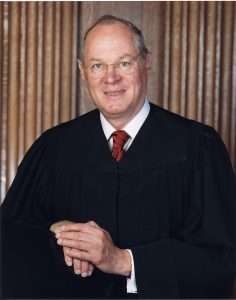
During a recent event, Justice Kavanaugh referred to Justice Robert Jackson, and added, "or as we like to refer to him, the first Justice Jackson." Eek.
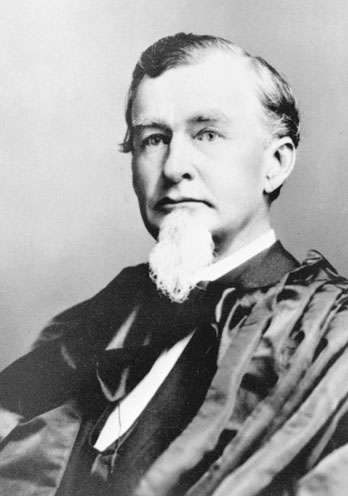
Justice Howell Edmund Jackson
Everyone knows Justice Robert Houghwout Jackson, who served from 1941 through 1954. But most people do not know Justice Howell Edmunds Jackson. He was appointed by President Benjamin Harrison, and served from 1893 through 1895. Forgotten. KBJ is the third Justice Jackson.
Shortly before KBJ was appointed, I listed the other Justices who shared a last name:
Chief Justice John Marshall (1801-1835) and Justice Thurgood Marshall (1967-1991)
Justice John Rutledge (1790-1791) and Justice Wiley Rutledge (1943-1949)
Justice Thomas Johnson (1792-1793) and Justice William Johnson (1804-1834)
Justice Samuel Chase (1796-1811) and Chief Justice Salmon Chase (1864-1873)
Justice John Marshall Harlan I (1877-1911) and Justice John Marshall Harlan II (1955-1971)
Justice Lucius Quintus Cincinnatus Lamar (1888-1893) and Justice Joseph Rucker Lamar (1911-1916)—(they were cousins)
Justice Edward Douglas White (1894-1910) and Justice Byron White (1962-1993)
Justice John Hessin Clarke (1916-1922) and Justice Tom C. Clark (1945-1967)—(close enough on the spelling)
Justice Owen Josephus Roberts (1930-1945) and Chief Justice John C. Roberts (2005-any day now)
Eugene Volokh likes to post about cases that can go forward because they survive some kind of summary judgement. Mostly it just seems to rile up the usual commenters as either a biased miscarriage of justice (if they don't like the claims upheld when viewed in the light most favorable to one side) or as an absolute legal victory (if they like the claims so upheld). How often do such cases get a followup when finally resolved? What benefit* is there to report on such preliminary activity? Why not cases like these but that don't hinge on elements likely to be characterized as "lathering the rubes"?
(*That cases like this may be privately settled before further proceedings would be one argument, that this could be the one chance to discuss such a case. Since I'm not a lawyer, I have no idea whether this case presents anything legally interesting that a case that wouldn't mostly prompt comments on charter schools and vaccines and vaccine mandates and so on. So I could be off base here.)
I thought some other non-lawyer readers might have the same question, so here's the answer: I like to report on court opinions, because the court opinions
become precedent (even if only persuasive precedent, as with trial court decisions);
illustrate how courts apply the legal rules (if the facts are X, then under legal rule Y the result would be Z);
are likely to come to my attention (since I have daily Westlaw searches finding new cases that mention the First Amendment); and
offer publicly available details.
Indeed, I suspect that's why most legal academics mostly write about court opinions.
On the other hand, the final resolution of a case is usually a settlement. A settlement isn't precedent. It doesn't directly illustrate how courts apply the legal rules. It usually won't come to my attention. And it generally isn't public as to its terms (including whether plaintiff got any money or other benefit at all). Moreover, even if the final resolution is a jury verdict—which happens only in a fraction of the cases—it won't come up on my Westlaw queries, so I generally won't learn about it.
Occasionally, the court opinion reflects a resolution of the case, for instance when it denies or grants a motion for judgment notwithstanding a verdict, when it's an appellate opinion affirming a verdict. And of course sometimes court opinions themselves resolve the case, for instance when they grant summary judgment or a motion to dismiss. When any of that happens, I'm definitely open to blogging that (though mostly for the same reasons 1 to 4 above). But I'm also open, for the reasons given above, to writing about opinions that simply allow the case to go forward.
Justice Amy Coney Barrett's majority opinion includes significant errors, and violates some of her own precepts against excessive reliance on questionable history.
Justice Amy Coney Barrett. (Eric Lee/Pool via CNP/Polaris/Newscom)
In its important recent immigration decision in Department of State v. Munoz, the Supreme Court ruled there are virtually no constitutional limits on the federal government's power to bar non-citizen spouses of American citizens from entering the country. In the process, Justice Amy Coney Barrett's majority opinion (written on behalf of herself and four other conservative justices) commits serious errors in historical analysis, and violates Justice Barrett's own well-taken strictures about the appropriate use of history in constitutional analysis.
Sandra Munoz is a US citizen whose husband, Luis Asencio-Cordero (a citizen of El Salvador) was barred from entering the US to come live with her, because US consular officials claimed he had ties to the MS-13 criminal drug gang (which connection Ascencio-Cordero denies). Munoz filed suit, claiming that, given that the constitutional right to marriage was implicated, the State Department was at the very least required to reveal the evidence that supposedly proved her husband's connection to the gang.
In arguing that there is no originalist or historical justification for US citizens to claim a right to entry for their non-citizen spouses, Justice Barrett cites historical evidence from the 1790s:
From the beginning, the admission of noncitizens into the country was characterized as "of favor [and] not of right." J. Madison, Report of 1800 (Jan. 7, 1800)…. (emphasis added); see also 2 Records of the Federal Convention of 1787, p. 238 (M. Farrand ed. 1911) (recounting Gouverneur Morris's observation that "every Society from a great nation down to a club ha[s] the right of declaring the conditions on which new members should be admitted"); Debate on Virginia Resolutions, in The Virginia Report of 1799–1800, p. 31 (1850) ("[B]y the law of nations, it is left in the power of all states to take such measures about the admission of strangers as they think convenient"). Consistent with this view, the 1798 Act Concerning Aliens gave the President complete discretion to remove "all such aliens as he shall judge dangerous to the peace and safety of the United States." 1 Stat. 571 (emphasis deleted). The Act made no exception for spouses—or, for that matter, other family members.
Almost everything in this passage is either false or misleading. The quote from James Madison's Report of 1800, does not, in fact, indicate that Madison believed the federal government has blanket authority to exclude immigrants for whatever reason it wants. Far from it. Madison was arguing that the Alien Friends Act of 1798 (part of the notorious Alien and Sedition Acts) was unconstitutional because the federal government lacks such power. Here is the passage where the quote occurs:
One argument offered in justification of this power exercised over aliens, is, that the admission of them into the country being of favor not of right, the favor is at all times revokable.
To this argument it might be answered, that allowing the truth of the inference, it would be no proof of what is required. A question would still occur, whether the constitution had vested the discretionary power of admitting aliens in the federal government or in the state governments.
Note that Madison does not even admit that admission of immigrants is "a favor." He just assumes it is for the sake of argument, then goes on to argue that the Alien Act is unconstitutional regardless, because the relevant power isn't given to the federal government (this is what he argues in the rest of the Alien Act section of his Report). The 1798 Act Concerning Aliens, also quoted by Justice Barrett, is the very same Alien Friends Act denounced as unconstitutional by Madison, Thomas Jefferson, and many others. Opposition to the Act was so widespread that no one was ever actually deported under it, before Thomas Jefferson allowed it to expire upon becoming president in 1801.
I think Jefferson and Madison were right to argue the Alien Friends Act was unconstitutional. But, at the very least, legislation whose constitutionality was so widely questioned at the time cannot be relied on as strong evidence of the original scope of federal power in this area.
The quote by Gouverneur Morris at the Constitutional Convention is not about immigration restrictions at all. It is part of a speech defending his proposal that people must be required to have been citizens for at least fourteen years before being eligible to become US senators. The proposal was rejected by the Convention (which eventually decided on a nine-year requirement). It was denounced by several other prominent members of the Convention, including James Madison and Benjamin Franklin. Madison argued it was "unnecessary, and improper" and would "give a tincture of illiberality to the Constitution" (see Records of the Federal Convention of 1787, Vol. 2, pp. 235-37 (Max Farrand, ed., 1911)).
Morris's speech in favor of this failed proposal is not a reliable guide to the sentiments of the Convention. Still less is it indicative of the original meaning understood by the general public at the time of ratification (which is the relevant criterion for most originalists, including Justice Barrett, who has said the original meaning of a constitutional provision is "the meaning that it had at the time people ratified it").
Finally, the Debate on the Virginia Resolutions in the Virginia Report of 1799-1800, also quoted by Justice Barrett, was a record of debates in the Virginia state legislature over the Virginia Resolution (drafted by Madison) a statement asserting that the Alien Friends Act is unconstitutional. The passage Barrett quotes is from a speech by a dissenting member of the Virginia state legislature opposing the Resolution. The majority, however, sided with Madison.
Given this history, the debate over the Resolution cannot be relied on to justify virtually unlimited federal power over immigration by spouses of citizens, or any other migrants. And because Madison and the majority in the state legislature argued that the entire Alien Friends Act was unconstitutional, they understandably did not bother to argue that there was a separate issue regarding exclusion of non-citizen spouses of citizens. To my knowledge, no such case involving spouses came up during the short time the Act was in force.
Justice Barrett also relies on dubious 19th century history:
The United States had relatively open borders until the late 19th century. But once Congress began to restrict immigration, "it enacted a complicated web of regulations that erected serious impediments to a person's ability to bring a spouse into the United States." Din, 576 U. S., at 96 (plurality opinion). One of the first federal immigration statutes, the Immigration Act of 1882, required executive officials to "examine" noncitizens and deny "permi[ssion] to land" to "any convict, lunatic, idiot, or any person unable to take care of himself or herself without becoming a public charge." 22 Stat. 214. The Act provided no exception for citizens' spouses. And when Congress drafted a successor statute that expanded the grounds of inadmissibility, it again gave no special treatment to the marital relationship….
In her recent concurring opinion in United States v. Rahimi, an important Second Amendment case, Justice Barrett warned about careless reliance on post-ratification history in constitutional interpretation:
[F]or an originalist, the history that matters most is the history surrounding the ratification of the text; that backdrop illuminates the meaning of the enacted law. History (or tradition) that long postdates ratification does not serve that function. To be sure, postenactment history can be an important tool. For example, it can "reinforce our understanding of the Constitution's original meaning"; "liquidate ambiguous constitutional provisions"; provide persuasive evidence of the original meaning; and, if stare decisis applies, control the outcome…. But generally speaking, the use of postenactment history requires some justification other than originalism simpliciter….
As I have explained elsewhere, evidence of "tradition" unmoored from original meaning is not binding law… And scattered cases or regulations pulled from history may have little bearing on the meaning of the text.
Here, Barrett relies heavily on "evidence of 'tradition' unmoored from original meaning" and "scattered… regulations" enacted more than a century after ratification. In fairness, the nineteenth century laws in question were enacted closer in time to the ratification of the Fourteenth Amendment in 1868, which is where the Supreme Court has said the right to marry arises from (albeit, when it comes to the federal government, the right is read back into the Fifth Amendment). But the 1880s was still a long time after ratification. Moreover, the laws in question were enacted at a time when racial and ethnic bigotry undermined enforcement of much of the original meaning of the Fourteenth Amendment, and such bigotry heavily influenced immigration legislation and jurisprudence.
Barrett also relies on the history in part because the Supreme Court's test for whether the Due Process Clauses of the Fifth and Fourteenth Amendment protect an unenumerated right (like the right to marry) require the right to be "deeply rooted in this Nation's history and tradition." But a combination of badly misinterpreted 1790s history and 19th century history heavily tinged by racial and ethnic bigotry are poor means for applying that test.
As Justice Barrett recognizes later in her opinion, in later years Congress did in fact enact legislation giving spouses of US citizens a presumptive right to enter the United States, though there are exceptions, such as the one for "unlawful activities" at issue in this case. That suggests there may in fact be a historically rooted right to spousal migration, even if not an absolute one (most other constitutional rights aren't completely absolute, either).
Overall, I think Amy Coney Barrett has been a pretty good justice since her controversial appointment just before the 2020 election. But Munoz is far from her finest hour.
The Court's badly flawed handling of history doesn't necessarily mean the bottom-line decision was wrong. Even the dissenting liberal justices agreed the government was justified in denying Asencio-Cordero a visa, reasoning that the possible ties to MS-13 were a sufficient justification to outweigh the right to marry in an immigration case (and, as Justice Gorsuch notes in a concurring opinion, the government did eventually reveal the evidence in question; he argues the Court should have resolved the case on that basis, without reaching the constitutional issues). Alternatively, one can argue the right to marriage doesn't necessarily include a broad right to have your spouse present in the same jurisdiction. There may be other possible justifications for the outcome, as well.
But the Supreme Court should not have relied on a badly flawed interpretation of post-enactment history to justify a sweeping power to run roughshod over marriage rights in immigration cases, even in situations where the right to marry might otherwise impose a constraint. That's especially true given that similar reasoning could potentially be used to apply to other constitutional rights. If the Alien Friends Act of 1798 and 1880s immigration legislation qualify as relevant evidence, they could be used to justify almost any immigration restriction.
Obviously, Munoz is far from the first Supreme Court decision where the justices effectively exempted immigration restrictions from constitutional constraints that apply to other federal laws. Trump v. Hawaii, the 2018 travel ban decision is another recent example, and there are other such cases going back to the 19th century. But Munoz is still notable for its particularly slipshod historical analysis.
UPDATE: I have edited this post to note Justice Gorsuch did not join the majority opinion. He concurred in judgment only.
Sign up here to receive all of the new Volokh Conspiracy posts in a daily e-mail.
The All-Argentina Issue is Here
New from Reason: a look into what Javier Milei
has accomplished and what it will take to make the most of Argentina’s window for real change. Out now
for subscribers.