

3/1/1880: Strauder v. West Virginia decided.
The Volokh Conspiracy
Mostly law professors | Sometimes contrarian | Often libertarian | Always independent | Est. 2002

Friday Open Thread
What's on your mind?
How Trump Imperils Free Markets and Personal Liberties
Washington Post columnist Dana Milbank provides a helpful summary, with a little help from me.
Jeff Bezos, owner of the Washington Post, recently said the Post opinion page should be "writing every day in support and defense of two pillars: personal liberties and free markets." This inspired Post columnist Dana Milbank to write a helpful piece outlining some of the many ways in which the new Trump administration threatens those values:
Personal liberties and free markets are part of the American creed. But many readers I've heard from suspect the words are cover for a plan to turn this into a MAGA-friendly outlet.
I don't yet know for sure. But this much is clear: If we as a newspaper, and we as a country, are to defend his twin pillars, then we must redouble our fight against the single greatest threat to "personal liberties and free markets" in the United States today: President Donald Trump…..
Claiming monarchical powers, attacking the free press, starting trade wars, cutting off legal immigration, siding with despots over free countries, politicizing law enforcement and the military, assaulting the judicial system and injecting crony capitalism at the highest levels of government: These are all the very antithesis of "personal liberties and free markets."
Milbank also interviewed me about this issue, and quoted a few things I said:
"I think, and many of us (libertarians) think, that the Trump administration is very bad on these metrics of both economic and personal liberty," [Somin] told me. "The massive trade wars that he's starting right and left go against Econ 101 as well as any libertarian principle. There's the mass deportation and immigration restrictions, which restrict both economic and personal liberty on a massive scale. There's his attacks on the freedom of the press, which are also troubling," as is Trump's "kissing the rear end of dictators like Vladimir Putin."
Somin likes some of Trump's efforts to cut regulations and taxes, but "if you look at the cumulative impact … the horrible things Trump is doing massively outweigh many times over the good that he might do in a few areas."
D.C. Circuit Stays Mandate in Marin Audubon Society v. FAA
After refusing to order remand without vacatur, the D.C. Circuit pauses the effect of its decision.
Last fall, in Marin Audubon Society v. Federal Aviation Administration, a divided panel of the U.S. Court of Appeals for the D.C. Circuit concluded that the Council on Environmental Quality lacks statutory authority to issue binding regulations implementing and interpreting the National Environmental Policy Act.
Last month, the full court denied a petition for en banc review in the case, while a majority of judges on the court joined an opinion suggesting the above holding was merely dicta.
Today, the original panel granted a stay of the judgment in the case (having previously denied the petitioners request for remand without vacatur). Writing for the panel, Judge Randolph explained that in cases like this, in which the party challenging a government regulation for being too lax as opposed to too stringent, a stay may be justified so as not to leave the petitioner in worse condition than before filing suit. In such cases, Judge Randolph explained, equitable considerations may justify a stay without compromising the effect of the court's conclusion that the agency action was unlawful.
Judge Srinivasan concurred separately "in the disposition" on the grounds that he would have granted remand without vacatur as an initial matter.
For myself, I prefer Judge Randolph's approach. One reason for this is I do not understand how remand without vacatur is consistent with the instruction for courts to "set aside" unlawful agency actions. Whether or not one believes universal relief is appropriate, once a court concludes that an agency action is unlawful, the court should not be willing to enforce that action, either in the instant case or going forward.
In addition, remand without vacatur does not put much pressure on an agency to fix the problem. As a consequence, agencies often drag their feet to comply with such orders. While staying the mandate produces much the same outcome--a court judgment that the agency action was unlawful that does not take effect--a stay that can be lifted at the court's discretion or that expires at a date certain does more to incentivize the agency to fix the problem. Indeed, if the primary justification for remand without vacatur is that courts should not enter judgements that are disruptive to the prevailing party, this is actually a stronger argument for Judge Randolph's position than Judge Srinivasan's.
Short Circuit: A Roundup of Recent Federal Court Decisions
Private islands, signal fires, and a salmagundi of sadness.
Please enjoy the latest edition of Short Circuit, a weekly feature written by a bunch of people at the Institute for Justice.
New on the Short Circuit podcast: Our long-time friend Robert Thomas stops by to proclaim his support for "old property."
Divided Fourth Circuit Denies Partial Stay of Preliminary Injunction Against Executive Order Curtailing Birthright Citizenship
If nationwide injunctions were okay against other administrations, the Fourth Circuit see no reason they are not okay now.
Today a divided panel of the U.S. Court of Appeals for the Fourth Circuit denied the Trump Administration's application for a partial stay of a nationwide preliminary injunction granted by a district court against the implementation of the Administration's Executive Order curtailing birthright citizenship. The denial was largely based upon the question of whether it was appropriate for the district court to grant universal relief and not the merits of the case. The U.S. Court of Appeals for the Ninth Circuit previously denied an application for emergency relief in parallel litigation challenging the same E.O.
The Fourth Circuit order was entered on behalf of Judge Harris, joined by Judge Gregory. Judge Niemeyer dissented, also focusing on the question of nationwide relief. He would have narrowed the injunction to the parties in the case. Assuming the Trump Administration seeks Supreme Court review, this case would present a clear opportunity for the Supreme Court to (finally) provide guidance on when universal relief is appropriate (and the answer should be "only in special circumstances").
Hamas, Israel, and the Death of International Humanitarian Law
Taken over by the far left, the IHL community discredited the field by going easy on Hamas and libeling Israel.
[Cross-posted at my Times of Israel blog]
International humanitarian law is dead. Ideologically motivated hostility to Israel since the Hamas massacre of Israelis on October 7 killed it.
IHL was invented after World War II. The war saw tens of millions of civilians were killed, some intentionally as in the Shoah, and some because their lives were not valued when military decisions were being made.
The underlying idea was that regardless of which side was right or wrong in any given international conflicts, armed forces on both sides have obligations to protect civilians to the extent possible while engaged in war.
If the IHL community had taken this seriously, imagine what would have happened immediately after October 7.
IHL scholars, activists, and organizations would have been unified in their intense denunciation of the massive violation of all precepts of international law by Hamas in their massacre, torture, rape and kidnapping of Israeli civilians.
They would have demanded that Hamas immediately release its hostages, and insisted that the world pressure not just Hamas but its allies and enablers in Egypt, Qatar, and Iran, to ensure the safe and unconditional release of the hostages. They would have insisted, publicly and consistently, that Hamas surrender.
And when Hamas would have then, inevitably, refused to give in, the IHL community would have denounced Hamas's failure to wear uniforms to allow Israel to distinguish enemy fighters from civilians, its intentional placing civilians at risk, its obstruction and theft of humanitarian aid, and, not least, its continuing to hold, torture, and rape hostages.
An IHL community actually devoted to IHL would also of course have had concerns about Israeli actions. They would have reviewed Israeli military responses in Gaza to see if they met the proportionality standard. That standard is quite vague, but surely IHL scholars, activists, and organizations could have contributed measured analyses and occasional criticism of Israeli actions. They also could properly have insisted that to the extent Israel took control of territory that ensured that the civilian population was properly fed and sheltered, consistent with international law.
None of this happened, of course. The IHL community, writ large, had been taken over by the far left, and for a variety of interrelated ideological reasons IHL activists are hostile to Israel's very existence, and do not believe that Israel has any right to defend itself, including from Hamas terrorism. Therefore any civilian casualties caused by Israeli military action were unacceptable.
As a result of these ideological biases, the first reaction of the IHL community to 10/7 ranged from rather tepid criticism of Hamas to exculpatory language suggesting that Hamas's actions on October 7 were understandable as an effort at so-called de-colonization. Either way, IHL people and organizations called for an immediate cease-fire and more general Israeli restraint, even though legally speaking Israel and every right to go after Hamas.
Things just spiraled downward from there. False accusations of genocide, intentional targeting of civilians, intentional starvation of Gazans, and more have been the coin of the realm the IHL world. Meanwhile, Hamas has largely been given a pass, despite the fact that its terrorist forces violate IHL every single time they take military action.
Two particularly absurd manifestations of the IHL world's anti-Israel bias stick out in my mind. First, there was the condemnation of Israel's pager operation against Hezbollah. For months, IHL activists had been alleging that at best Israel was not narrowly targeting Hamas terrorists and at worst was engaging in genocidal indiscriminate bombing. So you think these groups would rejoice and praise Israel when it managed to kill or wound three thousand enemy terrorists with almost no civilian casualties. Instead, various IHL organizations and prominent individuals accused Israel of terrorism.
After that, we may have reached the reductio ad absurdum a few months ago, when Amnesty International came out with a report accusing Israel of genocide. The report acknowledged that Israel's actions didn't really seem to meet what it called the prevailing "overly cramped interpretation of international jurisprudence" that would "effectively preclude" finding that Israel committed genocide. Amnesty's solution to that quandary, since it really, really wanted to accuse Israel of genocide, was to make up a new definition of genocide that would encompass Israel's actions.
There were a lot of failures on before 10/7, on 10/7 and thereafter. But as a law professor no failure hits home like the willingness of people around the world who claim to be devoted to international humanitarian law to ignore, distort, and pervert the law, lest it be used to protect Jews and condemn their enemies.
[Author's note: This post is based on a speech I gave at a memorial for the Bibas children, Shiri Bibas, and Oded Lipfshitz on February 26, 2025, at George Mason University's Antonin Scalia Law School. The event was sponsored by the Jewish Law Students Association.]
Expressive Discrimination: Universities' First Amendment Right to Affirmative Action — Part 1
Maybe some universities can continue to do race-based affirmative action, even after SFFA v. Harvard.
My article Expressive Discrimination: Universities' First Amendment Right to Affirmative Action has finally been published by the Florida Law Review. In these days of federal attacks on private DEI, maybe some private universities might find this useful as a strategy for fighting back against the Trump Administration! I'll reproduce the Abstract and Introduction today, and continue to post the rest of the article next week. In the meantime (and especially if you want all the juicy footnotes), read the whole thing.
A note before starting: One of the earliest contributions to this literature was my co-blogger David Bernstein's 2001 article in the William & Mary Bill of Rights Journal. Another was David Geary's 2004 student note in The University of Chicago Law Review. Aside from that, there hasn't been much. A couple of articles were written more or less simultaneously with (and independently from) my article: Kent Greenfield's 2024 article in the American Journal of Law & Equality, and Part III of Taylor Barker's 2024 essay in the Stanford Law Review.
Abstract
In the wake of Students for Fair Admissions, Inc. v. President & Fellows of Harvard College, affirmative action proponents should pursue a First Amendment approach. Private universities, which are speaking associations that express themselves through the collective speech of faculty and students, may be able to assert an expressive association right, based on Boy Scouts of America v. Dale, to choose their faculty and students. This theory has been recently strengthened by 303 Creative LLC v. Elenis.
I discuss various complexities and counterarguments: (1) Race is not different from sex or sexual orientation for purposes of the doctrine. (2) The market context may not matter, especially after 303 Creative. (3) The conditional-federal-funding context does give the government more power than a simple regulatory context; the government will still be able to induce race-neutrality by the threat of withdrawing federal funds, but the unconstitutional conditions doctrine precludes draconian penalties such as withdrawing all funds from the entire institution based only on affirmative action in some units. (4) This theory doesn't apply to public institutions.
I also explore the potential flexibilities of this theory, based on recent litigation. The scope of the Boy Scouts exception might vary based on (1) what counts as substantial interference with expressive organizations, (2) what counts as a compelling governmental interest, and, most importantly, (3) what it takes for activity to be expressive.
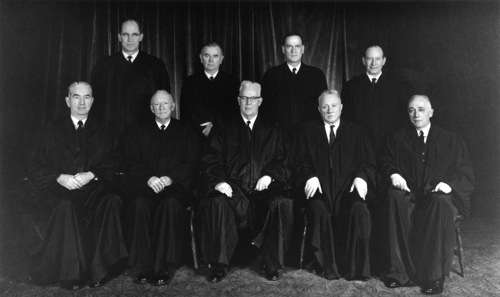
Today in Supreme Court History: February 28, 1966
Fifth Circuit Panel Issues 24-Page Unpublished Opinion In Favor Of Planned Parenthood and Reverses Judge Kacsmaryk
Is this opinion a "one and done" decision to evade en banc review?
There is a long-running debate in FedCourts circles about unpublished opinions. These decisions, by their terms, are not precedential. Yet, lawyers, and some courts, will cite unpublished opinions as precedents. The line between published and unpublished is fuzzy at best. And, as I understand things, if one judge on a panel requests it, an opinion will be published.
There is another element of unpublished opinions that is less understood: because unpublished opinions are not precedent, there is less of a need to review them en banc. To be clear, the en banc court can review en unpublished opinion, but because the decision is not precedential, it may not be considered a good use of the court's resources.
In 2022, this issue arose on the Fifth Circuit. A panel of the Fifth Circuit (Smith, Elrod, Oldham) ruled in favor of the plaintiff in Sambrano v. United Airlines. The panel issued an unpublished opinion. Judge Smith dissented on the merits. But he also objected to the majority's decision to issue an unpublished opinion:
I call this the "one and done" method of decisionmaking. Two judges randomly selected for a panel decide that—for whatever reason—a particular result is correct but can be achieved only by divorcing the opinion from the common-law tradition, by evading precedent, and by obscuring the path in the shroud of an unpublished per curiam opinion. The obvious result is to foster whatever happens to be the "Blue Plate Special" cause on a given day.
Judge Smith hints that the decision to use an en banc opinion was designed to evade en banc scrutiny.
The fact that an opinion is unpublished furnishes just another reason to vote to deny en banc scrutiny. But by today's ruling, the Good Ship Fifth Circuit is afire. We need all hands on deck.
At the time, I wrote "Judge Smith shot up a flare over the Gulf of Mexico." I will need to amend that post to the "Gulf of America."
Any member of the panel could request that opinion should be published. Judge Smith could have made that request, but he (apparently) didn't. There is a bit of game theory behind this move. By Smith not voting to publish the opinion, he ensures that a decision he thinks is erroneous will not be a circuit precedent. Had he voted to publish the opinion, and made the decision a precedent, that would have made en banc review more likely. But this latter option creates the risk that en banc review is denied, and there is now an entrenched precedent.
With the benefit of hindsight, en banc review was denied in Sambrano by a 13-4 vote. Judge Smith dissented from the denial of rehearing en banc. He lamented a 1996 rule change that made it easier to designate opinions as non-published. And he doubled down on his criticism of the majority:
Our concern was prescient. As I say in my panel dissent, the "obvious result" of the majority's decision is to foster today's "'Blue Plate Special' cause" without committing to sweeping legal changes that may not always produce the same outcomes.21 This "'one and done' method of decision-making"22 is made possible only by abusing the availability of unpublished opinions―a device that the full court has now fully validated by denying re-hearing.
Judge Smith worried that other rogue panels can avoid en banc review by marking the opinion as unpublished:
And by a lopsided vote, the en banc court declines to lift a finger. After today, a future panel that wishes to use the "one and done" method of decisionmaking can feel more secure in thinking there will be no consequences.
I think we have found just such a panel.
Yesterday, a Fifth Circuit panel issued a twenty-four page unpublished decision. The panel reversed a judgment by Judge Matt K, which found that Planned Parenthood was liable for $2 billion in damages. This issue was complex, and of great significance. There was every reason to publish it. But it wasn't. Judges Barksdale, Southwick, and Graves were on the panel. Though, on paper, this panel has two Republican-appointed judges, Barksdale and Southwick consistently vote with the liberal bloc on the en banc court. When I read this decision, my immediate thought was a "one and done" move designed to shield the opinion from en banc review.
I would expect activity before the en banc court soon.
Update: Is it possible for the en banc court to vacate the panel's decision to issue an unpublished decision, and then vacate that precedential opinion. This approach would send a clear signal about "one and done" panel opinions. Even judges who agree with the panel on the merits should disfavor this evasion principle.
Should the Charges Against Mayor Adams Now Be Dismissed With Prejudice … Because of Prosecutorial Misconduct?
That's the powerful argument that Mayor Adams's lawyers are making, citing (among other grounds) the leaking of a resignation letter containing "the wildly inflammatory and false accusation that Mayor Adams and his counsel had, in essence, offered a quid to the Department of Justice in exchange for the quo of dismissal."
I've been following the Justice Department's pending motion to dismiss corruption charges against Mayor Adams, focusing on the question of whether the dismissal involves some sort of illegal quid pro quo. The motion seeks to dismiss the charges without prejudice. Yesterday, the Mayor's skilled defense attorneys filed a new motion to dismiss the charges—with prejudice—based on alleged prosecutorial misconduct in leaking internal Justice Department correspondence critical of the dismissal. The Mayor's new motion raises important issues and highlights why, in my view, the existing motion to dismiss has become even more easily defensible.
To set the stage: On this blog, we've had a debate about the dismissal motion that I think (to some degree) tracks the national debate in New York and elsewhere about the dismissal motion. To simplify, initially there was a wave of outrage about an alleged quid pro quo in the dismissal motion (as suggested in the resignation letter by Acting U.S. Attorney Danielle Sassoon). But faced with sworn denials from lawyers on both sides of the case, that outrage seems to have morphed into concern about whether the dismissal should be with or without prejudice.
Illustrating that transition from the debate here on this blog, VC readers will recall two initial posts by David Post asserting that there was an improper quid pro quo in the dismissal, the first one linking to a full copy of the Sassoon letter and the second one developing her allegation. Josh Blackman responded, and then David Post replied, reasserting his quid pro quo position. I then supported Josh Blackman's view by arguing that motion to dismiss was easily defensible and, in a second post, that there was no quid pro quo. David Post then rejoined with a post entitled: "No Quid Pro Quo. So?" My reading of this post (as suggested by its title) is that David has retreated to the position that whether there was, in fact, a negotiated quid pro quo is unimportant because things will implicitly shake out in way that resembles quid pro quo. I've seen similar arguments elsewhere. And another recent post (relating views of Professor Ryan Snyder) notes the debate over the quid pro quo and then proceeds on the assumption that there was a quid pro quo—without attempting to defend that characterization.
Yesterday's motion by Mayor Adams highlights an overlooked feature of the trajectory of this debate: the mere fact that government prosecutors have leaked an internal allegation of an improper "quid pro quo" has been highly and unfairly damaging to Mayor Adams. I was going to try and summarize the motion's allegations. But it seems best to begin by simply quoting from the motion's powerful introductory paragraph:
Following the Department of Justice's long-overdue decision to dismiss the case against Mayor Adams, someone within the government leaked a February 12, 2025 letter from the former interim U.S. Attorney for the Southern District of New York to the Attorney General. The leaked letter disclosed, among other things, the former interim U.S. Attorney's self-proclaimed confidence in Mayor Adams's guilt; the fact that Southern District prosecutors were planning to re-indict Mayor Adams, including on a new and equally baseless obstruction charge; and the wildly inflammatory and false accusation that Mayor Adams and his counsel had, in essence, offered a quid to the Department of Justice in exchange for the quo of dismissal. The disclosure of this letter to the press was part of an extraordinary flurry of leaked internal Justice Department correspondence that included memoranda from the Acting Deputy Attorney General to the Southern District and an unhinged resignation letter by one of the former line prosecutors on this case. In addition to violating Mayor Adams's fundamental constitutional rights and ability to receive a fair trial, the government's leaks violated numerous statutory and court rules, including the Justice Department's own longstanding policies aimed at curbing prosecutorial misconduct.
The Mayor's new motion goes on to support these allegations with detailed argumentation. I am not endorsing the motion but want to focus here on the quid pro quo issue. Read More
Protesters Disrupt Stanford Class
Stanford reports:
On Tuesday afternoon, Feb. 25, several individuals disrupted the Democracy and Disagreement course in Cemex Auditorium to protest a guest speaker, former Secretary of the Treasury Larry Summers, who was there to debate with the economist Emmanuel Saez on the idea of a wealth tax.
The protestors were not Stanford students.
This behavior violates university policy and will not be tolerated. The Department of Public Safety collected information from the disruptors and is referring the information to the Santa Clara County District Attorney's Office. We are taking steps to ban these individuals from our campus, which is private property. We extend the university's apologies both to the speakers and to the students who were in attendance.
More on Free Speech on Campus, Title VI, and Anti-Israel Speech
"[I]n seeking to hold Cooper Union liable for [students'] expression, [plaintiff] cannot help but say the quiet part loud: sweeping otherwise-protected political expression into the hostility analysis will create pressure on institutions 'to suppress speech to ensure compliance with Title VI,' causing 'regulated entities to adopt restrictive policies in an effort to avoid liability' for a hostile environment."
Judge John Cronan Feb. 5 decision in Gartenberg v. Cooper Union declined to dismiss plaintiffs' claims alleging a hostile educational environment for Jewish students at Cooper Union (a college in New York), but held that those claims could not be based on certain political speech that the college had tolerated. Plaintiffs moved to reconsider, and in a new decision Tuesday, Judge Cronan stood by his earlier position; an excerpt:
[Gartenberg asks the Court to] revise its Opinion and Order to hold Cooper Union potentially liable under Title VI for "all incidents of harassment alleged in the Complaint, including those where the harassment was accomplished through political speech."
Gartenberg does not specify which additional allegations of "harassment" she believes the Court misclassified as protected speech on matters of public concern. The Court therefore assumes that her Motion seeks to have the Court recast some or all of the following incidents as actionable harassment under Title VI and the First Amendment: (1) a demonstration by pro-Palestinian students on a public sidewalk adjacent to the Foundation Building concerning the Israeli-Palestinian conflict; (2) the distribution of fliers supporting the Palestinian cause; (3) a controversial "art display" advocating violent resistance to "colonialism"; (4) a speech by Dr. Omer Bartov titled, "The Never Again Syndrome: Uses and Misuses of Holocaust Memory and the Weaponization of Language"; (5) an on-campus "vigil" organized by a pro-Palestinian student organization to "Honor Palestinian Martyrs"; (6) a flier inviting members of Cooper Union's community to "come grieve and honor all those killed by decades of Israeli occupation and imperial violence"; (7) a statement published in Cooper Union's student newspaper by the school's Muslim Student Association that characterized "the account of the Jewish students being trapped in the library as 'a false narrative'"; (8) a statement published in same issue of the school newspaper by Cooper Union's Black Student Union, which "declared solidarity with 'the Palestinian struggle against colonialism and genocide' and claimed that 'the conflation of Zionism and Judaism' is 'manipulative, exploitive and racist'"; and (9) an "alumni letter" signed by Cooper Union students, faculty members, and administrators that expressed support for the Palestinian cause and, among other things, stated that "[i]t is historical malfeasance for the administration to issue a statement of condemnation of Hamas's October 7th attacks without acknowledging the context in which these attacks took place."
The Court declines to amend its First Amendment analysis to expose Cooper Union to possible civil liability based on these incidents…. Gartenberg argues that under Healy v. James (1972), a lesser degree of First Amendment protection for political speech is warranted in the higher-education context due to the "'special characteristics' of schools."
But Healy said exactly the opposite: "[T]he precedents of [the Supreme Court] leave no room for the view that, because of the acknowledged need for order, First Amendment protections should apply with less force on college campuses than in the community at large. Quite to the contrary, '[t]he vigilant protection of constitutional freedoms is nowhere more vital than in the community of American schools.'"The Supreme Court in Healy, therefore, made clear that "[t]he college classroom with its surrounding environs is peculiarly the 'marketplace of ideas,'" and stressed its decision was "break[ing] no new constitutional ground in reaffirming this Nation's dedication to safeguarding academic freedom" on college campuses.
Today in Supreme Court History
Today in Supreme Court History: February 27, 1901
2/27/1901: Champion v. Ames argued.
Cert Petition in Georgia Adult-Entertainment Tax Case: Part 2
The rest of the cert petition in Georgia Ass'n of Club Executives v. Georgia
Yesterday, I blogged about the cert petition that I filed a couple of weeks ago in Georgia Ass'n of Club Executives v. Georgia and Georgia Ass'n of Club Executives v. O'Connell. That post reprinted the introductory part of the cert petition; here's the main body of the brief. Again, if you want to write an amicus brief, you have until March 20 to file one—let me know by personal message if you're interested! If you want to read the whole thing in its beautiful formatted form (thanks to Counsel Press), you can click here.
As I said yesterday, this case should be of interest even if you're not interested in adult entertainment (indeed, even if you're hostile to adult entertainment). The big question here is whether a facially content-discriminatory enactment (that would otherwise be evaluated under strict scrutiny) should be considered content-neutral (and thus evaluated under intermediate scrutiny) if it has a content-neutral justification. This means this case is closely related to the abortion-clinic buffer-zone cases that rely on Hill v. Colorado—and, as you may have read on this blog (here or here), the Supreme Court has recently denied cert in a case that presented the issue of whether to overruled Hill.
* * *
Reasons for Granting the Petition
This Court should grant certiorari because the boundary between the Reed and City of Renton doctrines is unclear; lower courts, including the Georgia Supreme Court in this case, have been wrongly extending the City of Renton reasoning to areas where it does not apply.
Reed correctly reaffirmed the general rule that content-discriminatory governmental enactments are evaluated under strict scrutiny. But City of Renton stated that certain enactments, even if facially content discriminatory, can be evaluated under intermediate scrutiny if the government seeks to justify them by the need to combat secondary effects. Because the proper scope of the City of Renton exception has never been clarified, lower courts have disagreed on what previous case law survives Reed, and some lower courts have extended City of Renton into areas far afield from its original grounding in judicial deference to zoning and land-use regulation. This Court should resolve this important question of First Amendment law, either by overruling the City of Renton/Hill line of cases or by cabining the scope of the content-neutral justification rule, for instance by holding that this reasoning is limited to zoning and land-use regulation, or by holding that this reasoning does not apply to facially content-discriminatory taxes.
If The Courts Want Their Orders To Be Followed, The Courts Must Issue Orders That Can Be Followed
Federal judges are walking on thin ice by issuing unappealable TROs and failing to stay their rulings.
Last weekend, I spoke on a panel about executive power. The other panelists ranged in positions from "We are in a constitutional crisis" to "We are almost in a constitutional crisis." My position, perhaps unsurprisingly, was that everyone needed to take a deep breath. I've seen no evidence, at all, that the executive branch is attempting to flagrantly violate any federal court order. To the contrary, the Trump Administration has taken every possible step to appeal adverse rulings, and avoid violating orders.
But the government can only do so much when judges go too far. Case in point is the litigation over USAID funding. On Tuesday, a district court judge ordered the Trump Administration to pay nearly $2 billion by 11:59 p.m. on Wednesday evening. The government insisted that it would be impossible to pay all of those amounts. It was not as simple as turning as light switch on. Yet, the District Court refused to stay its TRO.
The government sought an emergency stay from the D.C. Circuit by 1:00 p.m. on Wednesday. But the D.C. Circuit did not rule on the motion by that time. So the Solicitor General filed an emergency application for an administrative stay with Circuit Justice Roberts. Roberts granted that motion on his own before the midnight deadline. At least for the near future, the government will not be obligated to disburse the full amount.
After the SG filed the application, the D.C. Circuit denied the request for an administrative stay. (I am not certain what time the order was issued.) The court stated, yet again, that it will not entertain jurisdiction of an appeal from a TRO. Obviously, the Chief Justice disagreed.
Also on Wednesday, confirmation hearings were held for several nominees to the Trump Administration, including Solicitor General Nominee John Sauer. They were asked whether they would always follow a court order. I tell my students to never answer an "always" question. It is impossible to predict all of the circumstances that may arise. What if a federal judge ordered the President to immediately reinstate the chairman of the Joint Chief of Staffs, and refused to stay the ruling? Would that order have to be immediately complied with? It is better to hedge. And I think the nominees at the hearing hedged appropriately.
In the unlikely event that I were ever to appear before the Senate, I would answer the question a bit more directly: if the Courts want their orders to be followed, the Courts must issue orders that can be followed. District Court judges cannot issue global, unappealable administrative stays and TROs against the executive branch, forcing it to spend money on foreign policy, and then refuse to stay the ruling to permit a timely appeal.
Every action has an equal and opposite reaction. Thankfully, Chief Justice Roberts stepped in with the solo administrative stay. But in some other case, perhaps coming from the First, Second, or Ninth Circuits, the Circuit Justices may not be as expeditious.
Federal judges are walking on thin ice by issuing unappealable TROs and failing to stay their rulings.
Second Amendment Roundup: Supreme Court Should Hold its Decision in VanDerStok
The new Administration should notify the Court of its change in position on ATF regulations.
As of now, of the nine cases argued in the Supreme Court's October calendar, five have been decided. Still pending is Garland v. VanDerStok, which was argued on October 8. Before rendering a decision, the Court should give the Trump Administration an opportunity to express its views of the case with the Court. It's a challenge to the Final Rule of the Bureau of Alcohol, Tobacco, Firearms and Explosives (ATF) redefining and expanding the definitions of "firearm" and "firearm frame or receiver" that criminalizes conduct not made unlawful by Congress, with Second Amendment implications.
The new Administration is sure to hold views adverse to those presented by the Biden Administration. Indeed, the Plaintiffs' arguments in the case are similar to those made by DOJ in defense of the previous, longstanding regulatory definition of "firearm" before the Biden Administration upended that definition in the Rule.
On February 7, the President issued the Executive Order Protecting Second Amendment Rights directing the Attorney General to examine all regulations and other actions of executive departments to assess any ongoing infringements on Second Amendment rights and to propose a plan of action to the President to protect those rights. That includes rules promulgated by ATF and the positions taken by the United States in ongoing litigation that could affect the ability of Americans to exercise their Second Amendment rights.
Prompted by the Executive Order, Senator John Cornyn (R-Texas) and 29 other U.S. Senators wrote to ATF Deputy Director Marvin Richardson requesting that ATF immediately rescind several regulations promulgated by the Biden Administration, including the "so-called 'ghost gun' rule, which cracks down on law-abiding hobbyists who are exercising their Second Amendment rights to privately build firearms—a longstanding tradition that traces back to the Colonial Era." That's the rule at issue here.
If the Supreme Court is on the verge of issuing an opinion in VanDerStok, it should delay to give Acting Solicitor General Sarah Harris an opportunity to review the matter and advise the Court of the new Administration's position. That office must be overwhelmed by the deluge of cases in which the district courts are enjoining actions of the President, such as the DOGE efforts to weed out fraud and abuse from the executive branch and the effort to exclude birth-right citizenship to unlawful aliens and temporary visitors.
The SG's Office should act quickly to ensure that the Court is advised of the Administration's views on VanDerStock. If it doesn't make this a top priority, it risks a decision that is uninformed by the Executive Branch's position on a constitutional right exercised by millions of Americans.
The Department of Justice has already taken steps to ask courts to put cases on hold to give counsel an opportunity to advise the courts on the government's position consistent with the Executive Order. In Colon v. BATFE (11th Cir.), a challenge to ATF's pistol brace regulation, DOJ filed a motion to postpone the oral argument scheduled for March 5 and to hold the appeal in abeyance. Similarly, in Kansas v. U.S. Attorney General (D. Kansas), involving ATF's "engaged in the business rule," the DOJ submitted a brief requesting that the Court stay the case, including all deadlines on pending motions, in light of the Executive Order.
In VanDerStok, the Department of Justice should promptly file a letter to notify the Court that the position of the United States has been reconsidered and that the government's previously stated views no longer represent the United States' position. It recently filed such a letter in United States v. Skrmetti, advising the Court that the new Administration would not have intervened to challenge Tennessee's ban on gender-altering medical "experimentation" on minors. The letter did not seek further "likely duplicative briefing from the same parties about the same court of appeals judgment in the underlying suit."
Here, it is unlikely that the Court would accept any further briefing from the United States, which in any event would likely duplicate the excellent briefing from the respondents and their amici. I commented on two of such amici briefs here and here (which I coauthored). Whatever alternative the Acting Solicitor General chooses, she should notify the Court quickly of the government's change in position.
For a comprehensive review of the issue on the merits, see my article "The Meaning of 'Firearm' and 'Frame or Receiver' in the Federal Gun Control Act: ATF's 2022 Final Rule in Light of Text, Precedent, and History."
Upcoming Event on "Solving the Nation's Housing Crisis"
Economist Bryan Caplan and I will speak at event sponsored by the Schar School of Policy and Government at George Mason University.
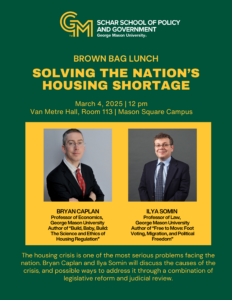
On March 4, 12-1 PM, the Schar School of Policy and Government at George Mason University will hold an event on "Solving the Nation's Housing Shortage." The event is open to the public, and you can get details about time and location, and sign up here.
I will be speaking along with economist Bryan Caplan (George Mason University), author of Build, Baby, Build: The Science and Ethics of Housing. Bryan will discuss his book, which addresses the causes of the housing crisis, and potential solutions. I will speak about how exclusionary zoning - the most significant cause of our housing shortage - violates the Takings Clause of the Fifth Amendment, and how judicial review can help address the problem. These issues are covered in greater detail in my recent Texas Law Review article on exclusionary zoning (coauthored with Josh Braver).




