
The Volokh Conspiracy

Mostly law professors | Sometimes contrarian | Often libertarian | Always independent | Est. 2002

The Volokh Conspiracy

Immigration

An "Ugly Tax" in Trump's "Big Beautiful Bill"

Boston Globe columnist Jeff Jacoby rightly decries the GOP's inclusion of a tax on remittances immigrant workers send to their families, in the "Big Beautiful Bill."

|

NA

Conservative Boston Globe columnist Jeff Jacoby rightly decries a pernicious provision in Trump's "Big Beautiful Bill":

Buried near the end of the ludicrously named "One Big Beautiful Bill Act" approved by the House Budget Committee over the weekend is a new 5 percent tax on remittances [now reduced to 3.5%], the gifts of money that tens of millions of foreign-born US workers regularly send to family members abroad.

As a rule, Republicans promote themselves as the party of lower taxes. Indeed, a key goal of the "big, beautiful" legislative package is to permanently extend the tax cuts passed by Congress in 2017 and signed by President Trump during his first term….

But it's a different story for immigrants sending some of their hard-earned wages to loved ones in their homelands.

Tax cuts may be important to the GOP brand, but these days so is ill will toward migrants. A new tax on remittances would generate some revenue for the federal government, but as with so many of the administration's actions, its primary purpose is to make life more difficult for immigrants….

I would add that the GOP is also supposed to be the party of "family values." Yet this tax targets people sending funds to their families, many of whom suffer from severe poverty in their countries of origin. Remittances are a valuable lifeline for millions of poor people, and targeting them for discriminatory taxation is cruel and unjust. Immigrant workers should pay the same taxes as everyone else, and should not be subject to additional taxation when they use some of their hard-earned pay to send remittances to their families.

Jacoby rightly points out that the remittance tax may well incentivize rather than deter illegal migration. I would add that the vast majority of remittances are actually sent by legal migrants. Even if you think it's just to punish illegal migrants in this way (I generally do not because the moral import of the legal-illegal distinction is vastly overblown), that's no reason to harm legal ones.

Jacoby also highlights the flaws in the argument that remittances somehow drain money from the US economy:

Nativists also argue that remittances drain money from the United States — that dollars earned here should stay here. "Remittance-Senders (Mostly Illegals) Ship $25 Billion a Year Out of the U.S.," the Center for Immigration Studies argued in 2010…

As most economists will confirm, dollars sent abroad — as remittances, to pay for imports, or to buy foreign currency — are not "lost" to the US economy. In almost every case, they make their way back. Foreign entities generally cannot use dollars domestically within their own countries. So when businesses or banks abroad accumulate US currency, they can only use it to buy American goods and services or to invest in American assets. The bottom line: No matter how many billions of dollars Americans send abroad, virtually all those dollars must ultimately return to the United States.

This is just basic Economics 101 of dollar-denominated remittances. Assume, however, that some family members receiving remittances just stuff the money in their mattresses or wallow in it, like Scrooge McDuck. Americans still benefit! By taking this money out of circulation in the US, the family members would cause a small amount of deflation at the margin, thereby marginally increasing the value of dollars held by everyone else - and most such dollars are held by Americans. This point also largely applies to the use of remittance dollars in countries like El Salvador, which has adopted the US dollar as its own currency.

 

Conditional Spending

Mitchell Berman on Conditional Federal Grants and the Constitution

While there is no constitutional right to receive grants, the Constitution does bar grant conditions that undermine constitutional rights.

|

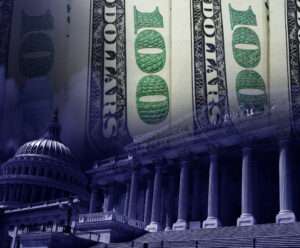
The U.S. Capitol is seen underneath $100 bills
Photo 181642336 © Zimmytws | Dreamstime.com

The Trump Administration has been trying to leverage federal grants in ways that force various people and organizations to give up their constitutional rights or submit to constraints that go beyond the constitutional authority of the federal government. A standard response to criticisms of such policies is that people have no right to these grants in the first place. Receiving federal grants and other government benefits, it is said, is a "privilege, not a right." Thus, the federal government can impose whatever conditions it wants on recipients. In an excellent recent Washington Post article, University of Pennsylvania law Prof. Mitchell Berman has a great explanation of why such reasoning is badly wrong:

Universities refuse to fully dismantle their DEI programs? The Trump administration withdraws billions of dollars in federal funding, and cancels visas for their foreign students. Law firms won't donate their services to causes that President Donald Trump favors? Trump cancels their lawyers' security clearances and refuses to deal with their clients. Journalists still call the Gulf of Mexico "the Gulf of Mexico"? Trump pulls their credentials for press briefings. The state of Maine allows some transgender athletes to compete on some girls' and women's sports teams? Trump threatens to cut off federal funding for its public schools.

Different targets, but one common tool: leverage. Trump uses federal funds and other government benefits to pressure individuals and institutions into exercising their constitutional rights as he prefers. This is extortionate. And therefore unconstitutional….

If Trump can use threats over tariffs to pressure nations into opening their markets or strengthening their currencies or ordering more U.S. arms, why can't he do the same with American institutions?

Because foreign nations have no constitutional rights, but American universities, lawyers, journalists and states do — rights protected by the First, Fifth, Sixth and Tenth Amendments. Trump's efforts to leverage government benefits against them violate those rights by penalizing their exercise.

When [Trump Council of Economic Advisers Chair Stephen] Miran defended high tariffs to gain concessions from trading partners, he noted that "access to the U.S. consumer market is a privilege that must be earned, not a right." The same applies to federal funding for education, research and other governmental benefits. They, too, are privileges, not rights. But it's impermissible to withhold benefits for the purpose of shaping or punishing American institutions for exercising the rights they do have — including free speech.

This is a well-established legal principle. More than 50 years ago, in Perry v. Sindermann, the Supreme Court thought it already well-established that "even though a person has no 'right' to a valuable governmental benefit … there are some reasons upon which the government may not rely" in denying that benefit. In particular, government may not deny a benefit to punish someone for exercising their constitutional rights or to pressure them into exercising their rights in the way the government dictates.

The reason is simple: "if the government could deny a benefit to a person because of his constitutionally protected speech or associations," his rights would thus be "penalized and inhibited." Because the Constitution doesn't "allow the government to 'produce a result which [it] could not command directly,'" the government cannot make the exercise of a right costly to force compliance with its agenda….

Yet that's precisely what Trump is doing. He threatens to withdraw funding from research to cure Parkinson's or Alzheimer's to punish universities for exercising their First Amendment rights to express views on American history and racial justice. He would pull school lunch funding for underprivileged kindergartners to pressure states into accepting his edicts on gender. But the Constitution prohibits this.

This is exactly right, and I have made similar points myself (albeit less eloquently), in the context of speech-based deportations of foreign students, sanctuary cities, and other issues.

I would add that Trump's use of tariffs as leverage is also unconstitutional, because he is usurping a power the Constitution granted to Congress, not the president. American businesses and consumers have a right to be free of unconstitutional taxation imposed by executive.

Berman goes on to point out that conservative judges, no less than liberal, have sought to prevent this kind of unconstitutional coercion:

Conservatives have historically been at least as vigilant as liberals in guarding against the selective granting and withholding of government benefits as a tool to pressure right-holders into exercising their rights the government's preferred way. Take the Affordable Care Act decision from more than a decade ago. The Supreme Court invalidated a portion of the act that conditioned all Medicaid funding on states' agreement to partner with the feds to provide health care to a new beneficiary class. Chief Justice John G. Roberts Jr. rightly reasoned that it was unconstitutional for Congress "to penalize States that choose not to participate in that new program by taking away their existing Medicaid funding" — even though, unquestionably, Medicaid funding is a privilege, not a right.

A quarter-century earlier, the court held that a state zoning authority could not leverage its control over land-use variances (also a privilege, not a right) to pressure a family into conveying a public easement across its private beach. To threaten to withhold permits because of how landowners exercise their property rights, Justice Antonin Scalia reasoned, was "an out-and-out plan of extortion."

He's right on this point, too! And it's great to see a prominent left-liberal legal scholar praise the much-vilified Medicaid ruling in NFIB v. Sebelius and Justice Scalia's takings jurisprudence (also oft-maligned by left-of-center academics). Neither of these precedents is a model of clarity, and I have some reservations about both myself (see here and here). But both are much better than simply letting the government do whatever it wants, thereby severely compromising constitutional rights and structural limits on federal power. More generally, people across the political spectrum have a strong interest in maintaining constitutional constraints on the use of federal benefits and grants as leverage. Even if you trust Trump to use such leverage responsibly, I bet you wouldn't trust a Democratic president to do so (and vice versa).

Circuit Justice Kagan Never Bothered Calling For A Reply In Trump v. AFGE

The District Court succeeded its TRO with a PI, rendering the government's application moot.

|

The Circuit Justices do not apply uniform rules when it comes to emergency applications. Justice Jackson, for example, refused to promptly call for a response in Libby v. Fectau, a case where the majority ultimately granted emergency docket relief.

I have also been keeping my eye on Trump v. AFGE. On May 9, A federal district court issued a TRO against the Trump Administration to block the removal of certain employees. On May 16, the Solicitor General applied for an emergency stay with Circuit Justice Kagan. And Kagan did absolutely nothing. She didn't even call for a reply.

On May 22, the District Court entered a preliminary injunction, which the government promptly appealed. On May 23, the Solicitor General filed a letter with the Supreme Court, withdrawing the stay application. The short letter states:

On May 16, 2025, we filed in the above-captioned case an application for a stay of an order issued on May 9, 2025, by the United States District Court for the Northern District of California. Labeled as a temporary restraining order, that order barred numerous executive-branch agencies from taking various actions related to an executive order and guidance memorandum concerning federal agencies' reductions in force. The order also directed the disclosure of certain deliberative executive-branch planning documents. Yesterday, May 22, the district court issued a preliminary injunction succeeding its temporary restraining order. Today, the United States filed a motion in the United States Court of Appeals for the Ninth Circuit to stay that new order pending appeal. In light of those developments, the United States withdraws its May 16 stay application in this Court.

I think I figured out what happened here. Justice Kagan realized that the District Court would almost certainly replace the unappealable TRO with an appealable PI. So she didn't lift a finger. She would rather wait for the normal appellate process to play out in the Ninth Circuit. Apparently, Justice Kagan did not think much of the government's urgent desire for a ruling.

As a practical matter, Kagan's delay extends by at least a month how long the government would be subject to an injunction. There isn't even the chance for an administrative stay. This case illustrates how much power and discretion the Circuit Justice has.

One of my proposals for bilateral judicial reform is to rotate the circuit justices annually. How is it fair that Justice Kagan always has authority over the Ninth Circuit while Justice Alito always has authority over the Fifth Circuit? Neither Justice has any geographic ties to the area. These should shift every year. And while I'm on the topic, the Court should consider a standard timeline for responses with emergency applications. It seems unfair that individual Circuit Justices can game the system.

Climate Change

The Trump EPA's Plan to End Greenhouse Gas Emission Regulation from Stationary Sources

Instead of making a headlong rush at the endangerment finding, the Administration is adopting a more targeted deregulatory strategy.

|

A draft of the Environmental Protection Agency's proposed regulation to undo the Biden Administration's regulations governing greenhouse gas emissions from power plants is undergoing White House review. If finalized, this rule would end EPA regulation of greenhouse gases from power plants, and put on ice greenhouse gas regulation of other stationary sources under the Clean Air Act.

The EPA is not seeking to undo the Biden power plant rules by challenging the EPA's 2009 endangerment finding. Though urged by some, this would have been foolhardy. Rather, according to this New York Times report, the EPA appears to be taking a more strategic approach along the lines of what I suggested in this post last week.

From the NYT story:

In its proposed regulation, the agency argued that carbon dioxide and other greenhouse gases from power plants that burn fossil fuels "do not contribute significantly to dangerous pollution" or to climate change because they are a small and declining share of global emissions. Eliminating those emissions would have no meaningful effect on public health and welfare, the agency said.

The key word in the statutory language is "significantly." The EPA is not claiming that climate change does not pose a threat, nor is the EPA claiming that greenhouse gases do not contribute to climate change. Rather, the EPA is saying that fossil fuel-fired power plants in the United States to not contribute "significantly" to global greenhouse gas concentrations in the atmosphere.

In proposing to lift regulations on power plants, the E.P.A. points to the fact that the U.S. share of global power sector emissions represented about 3 percent of worldwide greenhouse gases in 2022, down from 5.5 percent in 2005. So, it argued, even if American power plants erased all their greenhouse gases from the power sector, the risk to public health would not be "meaningfully" improved.

As global climate change is a global concern--and is driven by global concentrations of greenhouse gases in the atmosphere, it does not matter that power plants are a large share of domestic emissions. And, as U.S. emissions decline as a share of global emissions, the significance of domestic power plants will decline over time.

If the EPA goes ahead with this approach, the final rule will certainly be challenged. A key question in such litigation will be whether reviewing courts accept the EPA's definition of what it means for a category of sources to contribute "significantly" to a type of air pollution. Absent Chevron deference the EPA's interpretation of the the statutory language will not carry much wait, but courts may be convinced that this is nonetheless a question upon which courts should respect agency expertise and accommodate the EPA Administrator's exercise of discretion. But as noted above (and as I told the Times), if the EPA is successful with such a rule, it will effectively end the regulation of greenhouse gases from stationary sources under Section 111 of the Clean Air Act.

Donald Trump

Thoughts on the Oral Argument in the Oregon Case Against Trump's IEEPA Tariffs

Like that in the similar case filed by Liberty Justice Center and myself, this one indicated judicial skepticism of Trump's claims to virtually unlimited power to impose tariffs.

|

NA

On May 21, The US Court of International Trade (CIT) held oral arguments in Oregon v. Trump, a case challenging Trump's massive IEEPA tariffs filed by twelve states led by the state of Oregon. The Oregon case is similar to that filed by the Liberty Justice Center and myself on behalf of five US businesses harmed by the tariffs, though there are some distinctions (see here for a more detailed discussion).

I won't try to go over the entire two hour argument here. Interested readers can listen to the audio available at the CIT website. And, as always, it is difficult to predict judicial decisions based purely on oral arguments. But I will say that, as in the argument in our case on May 13, the judges seemed highly skeptical of the government's claim that the International Emergency Economic Powers Act of 1977  (IEEPA) gives the president virtually unlimited power to impose tariffs.  Judge Restani repeatedly noted that the government's position would allow the president to declare an "emergency" for any "crazy" reason, and then impose whatever tariffs he wanted. In response to the government lawyer's assertion that the delegation of nearly boundless tariff authority was clear enough to satisfy the requirements of the major questions doctrine (a key issue in the case for reasons I describe here), Judge Restani said "[w]e're having a lot of argument for something that's clear" and that "It's not clear to everybody." Amen.

Unlike the argument in our case, this one included some discussion of the scope of the remedy should the plaintiffs prevail. Should there be a nationwide injunction against the tariffs, or one limited to the plaintiffs? I could easily be wrong about this. But it seemed to me the judges were leaning towards s broader remedy. The judges also asked about the standing of the states, especially those who do not directly import goods subject to the tariffs.  This issue did not come up in our case, as all our clients are businesses that directly import.

In my view, if even one state is entitled to standing (as Oregon likely is, based on their direct importation), the same goes for the rest, based on the "standing for is standing for all" rule recently applied by the Supreme Court in Biden v. Nebraska (the red state lawsuit challenging Biden's student loan forgiveness program). The Court ruled Missouri had standing, and therefore there was no need to consider whether the other state plaintiffs did.

At one point, the government's lawyer complained that an injunction against the tariffs would "kneecap the president" in his efforts to use the tariffs as leverage against our trading partners. I say the kneecapping would be a feature, not a bug. The Constitution requires a trade system based on the rule of law, not the whims of one man able to impose tariffs whenever he feels like it, in hopes that they might be useful leverage. Otherwise, consumers, investors, and businesses like our clients won't have the stable legal regime they need to make plans and function effectively. I develop these and related points in more detail in my Lawfare article, "The Constitutional Case Against Trump's Trade War," and my post on why Trump's tariffs threaten the rule of law.

While there is no set schedule for the court to issue its decisions in either our case or Oregon's, I would not be surprised if they come relatively quickly. I would also expect them to be issued at the same time, or in close succession.

Free Speech

Judge James Ho's Concurrence in the Fifth Circuit Library Decision: Positive Rights vs. Negative Rights

|

An excerpt from Judge Ho's concurrence in the Little v. Llano County en banc decision (he also joined the majority opinion as to listener interests and the seven-judge decision as to library curation decisions being government speech):

The Constitution protects "the freedom of speech." That freedom ensures that citizens are free to speak—not that we may force others to respond. It's the First Amendment, not FOIA.

So "[t]here is … no basis for the claim that the First Amendment compels others—private persons or government—to supply information." The Supreme Court "has never intimated a First Amendment guarantee of a right of access to all sources of information within government control." "The First and Fourteenth Amendments do not guarantee the public a right of access to information generated or controlled by government."

Our Founders enacted a charter of negative liberties. "[L]iberty in the eighteenth century was thought of much more in relation to 'negative liberty'; that is, freedom from, not freedom to." …

The fundamental distinction between negative and positive rights is essential to a proper understanding of the First Amendment.

Consider how the law treats public museums. It's well understood that you have no First Amendment claim just because a public museum won't feature the art or exhibit you wish to view. That's because, as today's en banc majority opinion explains, when a government funds and operates a museum, it necessarily acts as a curator for the public's benefit—and there is no First Amendment claim when the government is curating, not regulating.

Read More

Free Speech

Seven Fifth Circuit Judges on Public Library Selection and Curation Decisions as Government Speech

|

As I noted yesterday, a ten-judge Fifth Circuit majority held that the Free Speech Clause doesn't secure a right of readers to access material in a public library, and thus generally doesn't constrain public library selection and removal decisions. But seven of the ten judges in the Fifth Circuit (led by Judge Kyle Duncan) also argued that the government speech doctrine provides a separate basis for this decision; the seven judges in the dissent disagreed. This government speech reasoning thus isn't a binding precedent on the question, but it will doubtless come up in other circuits, and in the Supreme Court if the Court agrees to hear the case (perhaps because of the circuit split between the Fifth and Eighth circuits):

"[T]he Free Speech Clause … does not regulate government speech." … [W]hen Llano County shapes its library collection, choosing some books but not others, is the county itself speaking or is the county regulating private speech?

The judges began by citing cases in which the Court recognized that private entities—social media platforms curating their news feeds (see last Term's Moody v. Netchoice), parade organizers choosing floats, newspapers choosing what submissions to publish, and so on—often speak by "present[ing] a curated collection of third-party speech." "Deciding on the third-party speech that will be included in or excluded from a compilation—and then organizing and presenting the included items—is expressive activity of its own." Moody. And, they reasoned,

Like a private person, a government may express itself by crafting and presenting a collection of third-party speech. See, e.g., Ark. Educ. Television Comm'n v. Forbes (1998) ("When a public broadcaster exercises editorial discretion in the selection and presentation of its programming, it engages in speech activity."). A key precedent illustrating this point is City of Pleasant Grove v. Summum (2009), [where] … the City created displays in a public park by accepting privately donated monuments …. The City's selecting some monuments over others[, the Court held,] "constitute[s] government speech." It did not matter that the monuments were works by private sculptors. The relevant expression was the City's choosing the ones it wanted. The City could "express its views," [and thus could pick and choose which monuments to accept -EV,] the Court explained, even "when it receives assistance from private sources for the purpose of delivering a government-controlled message."

Summum maps neatly onto our case. Just as the City of Pleasant Grove selected private speech (monuments) and displayed that speech in a park, the Llano County library selects private speech (books) and features them in the library. The relevant expression lies not in the monuments or the books themselves, but in the government's selecting and presenting the ones it wants. And in both cases the government sends a message. Pleasant Grove said, "These monuments project the image we want." Llano County says, "These books are worth reading."

Read More

Constitutional Interpretation

Video of National Constitution Center Panel on "The War Over the Constitution's Meaning"

The participants were Amanda Shanor (Univ. of Pennsylvania), Alan Trammell (Washington and Lee), Wilfred Codrington, III (Cardozo), and myself.

|

NCC

I took part in a recent National Constitution Center panel on "The War Over Constitutional Meaning." The other participants were Prof.  Amanda Shanor (Univ. of Pennsylvania), Prof. Alan Trammell (Washington and Lee), and Prof. Wilfred Codrington, III (Cardozo School of Law, Yeshiva University, serving as moderator). Here is the video:

We covered a lot of ground, ranging from the pros and cons of originalism, to whether the Reconstruction amendments are "underrated" to whether we need fundamental constitutional reform. On the latter issue, I made the case that many of our current problems stem not from inherent flaws in the Constitution but from failure to enforce it more fully.

The panel was part of a larger conference on "Constitutional Meaning in the Shadow of the Articles of Confederation." Video of the full conference and the full list of participants (including many prominent legal scholars and Rep. Jamin Raskin, himself a former legal scholar) are available here.

Executive Power

District Court Declines to Stay Order Reinstating Fired U.S. Institute of Peace Board Members, Holds Trump v. Wilcox Doesn't Apply

|

From today's order by Judge Beryl Howell (D.D.C.) in U.S. Institute for Peace v. Jackson:

[On Monday, t]his Court declared that President Trump's termination of USIP Board members violated the statutory removal protections in 22 U.S.C. § 4605(f), and because those protections posed no constitutional problem, the terminations were null and void. This Court also declared null and void actions taken as a result of those improper removals, including the removal and replacement of USIP President Ambassador Moose, as well as the transfer of property and other actions taken by those illegitimately installed replacements. This Court then ordered that plaintiff Board members and Ambassador Moose remain in their leadership positions for USIP and may not be treated as having been removed, among other concomitant relief.

Defendants sought a stay of this order while it's being appealed, but the court said no:

Whether a stay is appropriate depends on four factors: "(1) whether the stay applicant has made a strong showing that he is likely to succeed on the merits; (2) whether the applicant will be irreparably injured absent a stay; (3) whether issuance of the stay will substantially injure the other parties interested in the proceeding; and (4) where the public interest lies." "The first two factors of the traditional standard are the most critical," and the showing of likelihood of success must be "substantial."

For all of the reasons explained in this Court's Memorandum Opinion, defendants have not made the requisite showing that they are likely to succeed on the merits. President Trump removed the USIP Board members without complying with the statutory requirements in 22 U.S.C. § 4605(f). Defendants did not argue that the President met those requirements but rather challenged the constitutionality of the statutory removal restrictions, arguing that USIP is part of the Executive branch and its Board members are subject to at-will presidential removal under Article II of the Constitution.

As the Court explained, however, while USIP may be considered part of the federal government, USIP does not exercise executive power and thus is not part of the Executive branch, so the President does not have absolute constitutional removal authority over USIP Board members but must comply with the statute in exercising his removal power. Further, even if USIP were part of the Executive branch, Congress's restrictions on the President's exercise of constitutional removal authority in 22 U.S.C. § 4605(f) would be permissible under Humphrey's Executor v. United States (1935), and its progeny, given USIP's Board's multimember structure and de minimis, if any, exercise of executive power. Thus, whether USIP is or is not part of the Executive branch, the President must comply with the various mechanisms at his disposal, as provided in the statute to remove members of USIP's Board.

Read More

Administrative Law

Baude on Trump v. Wilcox: "Predictable and Reasonable"

A defense of the Supreme Court's decision to let President Trump remove members of the NLRB and MSPB.

|

Yesterday, by a vote of 6-3, the Supreme Court stayed district court orders blocking President Trump from removing members of the Gwynne Wilcox from the National Labor Relations Board and Cathy Harris from the Merit Systems Protection Board. As I noted before, this case targeted Humphrey's Executor and had the potential to effectively eliminate independent regulatory agencies as a category.

In today' New York Times, Will Baude has an op-ed largely defending the Court's order as both "predictable and reasonable" that largely captures my views on the subject (thus freeing me from writing a longer blog post on the case). He writes:

We have plenty of things to worry about in constitutional law today. But those worried about how the court will confront the unprecedented and sometimes unlawful actions of the Trump administration should save their outrage for other cases.

In the two cases here, the court held that the president was likely to prevail in his unitary executive claim, that the administration was unduly harmed by allowing the officials to keep their offices while the case was pending, and that this reasoning would not imperil the independence of the Federal Reserve. It did all of this in an emergency order, rather than waiting for the issues to arrive on the court's regular docket.

All four of these things are noteworthy and provoked a powerful dissent by Justice Elena Kagan. But in this particular case, all four can be justified.

It was reasonable for the Court to conclude that the NLRB and MSPB are more like the Consumer Financial Protection Board than they are like the 1930s Federal Trade Commission, and thus limitations on presidential removal of board members conflicted with Seila Law and should not be saved by Humphrey's Executor. Indeed, it is not clear the current FTC would qualify. The "quasi-legislative" functions of the FTC the Court considered important in Humphrey's were the FTC's responsibilities for assisting and informing Congress, not promulgating regulations.

But what about the Federal Reserve? Baude writes:

The court's declaration that the Federal Reserve is different also has a plausible basis. In the decades after the nation's founding, practice and precedent firmly established the constitutionality of the Bank of the United States, which operated as a corporation with some independence from the president. This suggests that monetary policy is not necessarily executive power. While the Federal Reserve today does many things beyond its core mission of monetary policy, the court would have several options for preserving at least some independent functions for the Federal Reserve.

I would go a little further and note that all the Court said in its order is that allowing the removal of NLRB and MSPB members does not "necessarily" mean that members of the Federal Reserve Board are also removable. It is simply a separate question, and it may well be the case that the Fed's primary responsibilities (monetary policy) can be insulated from executive control, whereas some of its regulatory functions cannot. Those are all questions courts can sort out another day.

More Baude:

Officially, the court was careful not to completely prejudge the legal issues, nor to state definitively that previous precedents about independent agencies would be narrowed or overruled. It made an honest judgment about the likelihood of success on the merits, as the law calls for.

Even if it had gone further and made such definitive statements, this is not the kind of case where that should especially concern us. It is bad when the emergency docket forces the justices to quickly take positions on tough issues that they have not had time to consider carefully. But the unitary executive question has been before the court multiple times in recent cases, with extensive briefing and argument. All of the justices have thought carefully about the legal issues and made up their minds about most of them.

The president's ruinous tariffs, purported cancellation of birthright citizenship, renditions to foreign prisons and retaliations against his political opponents all raise far graver constitutional problems than the court's ultimately unsurprising order in these cases. We should focus our concern there.

That seems right to me.

Judiciary

Does the Big, Beautiful Bill Contain a Threat to Judicial Independence? (Updated)

Is it a problem if a provision requires judges to comply with the Federal Rules of Civil Procedure?

|

The New York Times reports on an ominous provision in the House passed "Big Beautiful Bill" through which Republicans are trying to "weaken federal judges." From the story:

The sprawling domestic policy bill Republicans pushed through the House on Thursday would limit the power of federal judges to hold people in contempt, potentially shielding President Trump and members of his administration from the consequences of violating court orders. . . .

The language in the House-passed bill would block federal judges from enforcing their contempt citations if they had not previously ordered a bond, a provision that Republicans said was intended to discourage frivolous lawsuits by requiring a financial stake from those suing. . . .

Democrats have argued that House Republicans' measure would rob courts of their power by stripping away any consequences for officials who ignore judges' rulings. They also noted that the measure would effectively shield the Trump administration from constitutional challenges by making it prohibitively expensive to sue.

"We've never said to American citizens and constituents that in order to vindicate their rights in federal court, they're going to be required to provide a security when their constitutional rights have been violated by their government," Representative Joe Neguse, Democrat of Colorado, said.

Curious, I looked up the relevant provision in the House-passed bill. It reads:

No court of the United States may use appropriated funds to enforce a contempt citation for failure to comply with an injunction or temporary restraining order if no security was given when the injunction or order was issued pursuant to Federal Rule of Civil Procedure 65(c), whether issued prior to, on, or subsequent to the date of enactment of this section.

So the issue, then, is what is required by FRCP Rule 65(c). It provides:

The court may issue a preliminary injunction or a temporary restraining order only if the movant gives security in an amount that the court considers proper to pay the costs and damages sustained by any party found to have been wrongfully enjoined or restrained. The United States, its officers, and its agencies are not required to give security.

So it would seem that Rule 65(c) already requires security to be given before such orders issue, subject to the judge's discretion as to what constitutes a "proper" amount.

This has become an issue because many judges use this discretion to set the security amount at zero. From the story:

The amount is supposed to be set at what "the court considers proper" to cover any costs that might be suffered if that injunction is later found to have been incorrectly issued. But federal judges have wide discretion to set their bonds, and often refrain from doing so.

Samuel L. Bray, a Notre Dame law professor, said many judges do not order injunction bonds in cases where people are seeking to stop government actions that they claim are unconstitutional.

"It doesn't wind up getting used as much as it's supposed to," he said, "and it especially doesn't wind up getting used when people sue the federal government."

I'll defer to Prof. Bray on this point, but it seems to me that the common practice of waiving any security is contrary to the rule as written. After all, if the rule were intended to give judges the discretion to set the security amount at zero, might it have been drafted to make requiring security at all a matter of judicial discretion? That is, giving judges discretion to set an amount is not the same thing as giving judges the discretion as to whether to require security at all.

In any event, this may all be moot as it is not clear that this provision will survive the Senate. Among other things, it is not clear how this provision is sufficiently budget-related for a reconciliation bill, but we will see.

UPDATE: It's a good thing I said I'd defer to Prof. Bray, as he was ahead of me in flagging this provision, and notes that it does more than I suggest. Indeed, in a post at Divided Argument he suggests the provision is "underinclusive, overinclusive, and likely unconstitutional." Going forward, judges could effectively evade its requirements by setting the security required at $1. But since the provision is also retroactive, it could blow up all sorts of federal court injunctions on the books (as in school desegregation orders or antitrust remedies). And, most significantly, he suggests the provision "is probably unconstitutional as an attempt to interfere with the inherent power of a court of equity to enforce its decrees with contempt." Duly noted.

Politics

Short Circuit: An inexhaustive weekly compendium of rulings from the federal courts of appeal

Helicopter accidents, nasty feuds, and serial lies.

|

Please enjoy the latest edition of Short Circuit, a weekly feature written by a bunch of people at the Institute for Justice.

Not in my backyard! In which IJ goes full NIMBY: IJ client Dalton Boley used to enjoy camping with his three little boys in the 10-acre woods immediately behind his house. That is, until he learned that Alabama game wardens have been spying on them without warrants. On multiple occasions, these armed agents have trespassed onto the property, tampering with Dalton's trail cameras, while ignoring No Trespassing signs. So this week, IJ filed suit on Dalton's (and others') behalf, seeking to vindicate the Alabama Constitution's protections against unreasonable searches and the state's common-law right against trespasses. Click here to learn more. And click here for a special podcast episode explaining why this isn't a Fourth Amendment case.

This week on the Short Circuit podcast: Dirt biking around the nondelegation doctrine and unmooting free speech.

  1. We wish we could tell you if, in 2017, two FBI officials unlawfully leaked info from a classified FISA warrant to the press in order to besmirch the reputation of a Trump adviser. But the D.C. Circuit (over a dissent) says the suit claiming as much is time-barred.
  2. North Carolina helicopter pilot dies when his crop-dusting chopper collides with a steel wire strung between a tall pole and a distant tree. Negligence on the part of the farm's owners and the pesticide company that hired the crop-duster? District court: No. The risk posed by the wire wasn't reasonably foreseeable to the defendants, since they're farmers, not pilots. Fourth Circuit: Under North Carolina law, which governs here, summary judgment is basically never appropriate in negligence cases. To trial the case must go! (Your summarist must confess to not being entirely sure the court faithfully applied the Erie doctrine in placing such weight on North Carolina's fondness for jury trials, but … who knows? Not us!) Read More

Free Speech

The Fifth Circuit on Library Selection and Removal Decisions and First Amendment Rights of Listeners

|

The primary argument supporting a claimed First Amendment prohibition on public libraries' excluding books based on viewpoint was the First Amendment right of listeners. The majority in today's Little v. Llano County en banc decision held that this right doesn't give people an entitlement to have the government provide the materials in the library:

We hold that plaintiffs cannot invoke the right to receive information to challenge the library's removal of the challenged books.

First, plaintiffs would stretch the right far beyond its roots. As discussed, the [Supreme Court's right-to-receive-information precedents] teach that people have some right to receive information from others without government interference.

It is one thing to tell the government it cannot stop you from receiving a book. The First Amendment protects your right to do that. It is another thing for you to tell the government which books it must keep in the library. The First Amendment does not give you the right to demand that.

Second, if people can challenge which books libraries remove, they can challenge which books libraries buy. "[A] library just as surely denies a patron's right to 'receive information' by not purchasing a book in the first place as it does by pulling an existing book off the shelves." For good reason, no one in this litigation has ever defended that position.

Read More

Free Speech

Judge Temporarily Blocks DHS's Revocation of Harvard's Ability to Allow Foreign Students and Exchange Visitors to Get Visas

|

This is the matter I wrote about yesterday; the judge issued a temporary restraining order "to preserve the status quo pending a hearing" on Harvard's preliminary injunction motion. The hearing is set for next Thursday morning (May 29). You can read Harvard's arguments for the TRO here; I expect its arguments for a preliminary injunction will be similar. From the Introduction:

For more than 70 years, Harvard University … has been certified by the federal government to enroll international students under the F-1 visa program, and it has long been designated as an exchange visitor program sponsor to host J-1 nonimmigrants. Harvard has, over this time, developed programs and degrees tailored to its international students and invested millions to recruit the most talented such students and integrate them into all aspects of the Harvard community. Yesterday, the government abruptly revoked Harvard's certification to host F-1 and J-1 students without process or cause, to devastating effect for Harvard and more than 7,000 Harvard students and affiliates on F-1 and J-1 visas.

The government's revocation of Harvard's certification was not a product of the ordinary review process set out in detailed regulations that define the limited circumstances under which a school's certification may be revoked and put a premium on the due process rights of institutions and students. On its face, the revocation is part of the government's broader effort to retaliate against Harvard for its refusal to surrender its academic independence.

In response to the government's disagreement with the perceived viewpoints of Harvard, its faculty, and its students, the government issued a series of demands requiring Harvard to submit to government oversight of the faculty it hires, the students it admits, and the courses it teaches. When Harvard declined, the Administration unleashed the full power of the federal government, freezing billions in federal grants, proposing to eliminate Harvard's tax-exempt status, opening multiple federal investigations, and—most relevant here—threatening to terminate Harvard's participation in the F-1 and J-1 visa programs.

Yesterday, the government made good on that threat—and it did so via a letter that makes plain that DHS is not even pretending to follow its own regulations, either as to process or as to substance. Instead, DHS all but announced that the revocation is blatantly in retaliation for Harvard's exercise of its academic freedom.

Revoking Harvard's certification is unlawful many times over. It is a pillar of our constitutional system that the government cannot "invok[e] legal sanctions and other means of coercion" to police private speech, especially when the government's treatment is animated by viewpoint discrimination. NRA v. Vullo (2024) (quoting Bantam Books, Inc. v. Sullivan (1963)). Prohibitions on viewpoint discrimination and on retaliation for protected speech are at the core of the First Amendment's protections. And especially so here, because "academic freedom" is "a special concern of the First Amendment." Keyishian v. Bd. of Regents (1967). The government's effort to punish the University for its refusal to surrender its academic independence and for its perceived viewpoint is a patent violation of the First Amendment.

Read More

More