


The Volokh Conspiracy

Mostly law professors | Sometimes contrarian | Often libertarian | Always independent | Est. 2002

The Volokh Conspiracy

Free Speech

N.C. Trial Court Rejects Sealing of Parts of State's Complaint Against TikTok

|

From Judge Adam Conrad's opinion Tuesday:

[T]he State has sued the owners and operators of TikTok, a popular app for sharing and viewing user-created videos. According to the State, the makers of TikTok designed the app to be highly addictive to minors and then undertook a deceptive publicity campaign to convince parents and children that the app is safe. On that basis, the State asserts a claim for unfair or deceptive trade practices under N.C.G.S. § 75-1.1…. Defendants and Apple maintain that the complaint should be sealed….

The presumption is that court filings are public records. They must be "open to the inspection of the public," except as prohibited by law. N.C.G.S. § 7A-109(a). For that reason, the burden is on the designating party to overcome that presumption. To meet its burden, the designating party must clearly articulate "the circumstances that warrant sealing the document" in a motion to seal or supporting brief…. The designating party must explain how public "disclosure would cause serious harm" that outweighs the public's interest in open courts….

Defendants … ask to seal Exhibit A to the complaint, which is a video compilation of statements from their employees, ostensibly to protect the employees' personal information. By personal information, Defendants apparently mean the employees' names and job titles. There is no compelling reason to seal that information. The employees' association with the case may entail some embarrassment, but that alone does not outweigh the public's right of access. See Doe v. Doe (N.C. App. 2018) (stating that "an interest in protecting third parties from 'trauma and embarrassment' or 'economic damage' has not been recognized as a compelling state interest outweighing the constitutional right of public access to the records of our courts").

The balance of Defendants' argument concerns allegations about its internal and external approaches to compulsive TikTok use by minors. In broad strokes, these allegations describe measures urged by Defendants' employees to mitigate TikTok's addictiveness, resistance to those measures by senior officials, metrics showing that the app's safety features did not work or could be easily evaded, and staff cuts that inhibited Defendants' ability to moderate content in keeping with TikTok's Community Guidelines. These allegations are undoubtedly disputed, and they might be embarrassing, but they are not competitively sensitive. See, e.g., Fleming v. Horner (N.C. Super. Ct. 2020) ("[S]ealing is not warranted merely because allegations are potentially embarrassing or injurious to the reputation of a party."); Bradshaw v. Maiden (N.C. Super. Ct. 2020) (denying motion to seal potentially embarrassing information).

Read More

Free Speech

N.C. Trial Court Rejects First Amendment Defense to "Addictive Design" Claim Against Tiktok

|

From State ex rel. Jackson v. TikTok Inc., decided Tuesday by Judge Adam Conrad; I'm skeptical about the analysis, for reasons I hope to blog about later (I'm writing a journal article on the subject right now), but I thought I'd pass it along:

The following background assumes that the allegations in the complaint are true [because that's what courts do when deciding on a defendant's motion to dismiss -EV].

TikTok features an array of elements allegedly designed to exploit minors' developmental immaturity and induce compulsive use. TikTok's home page (coined the "For You Page") feeds each end user videos that are algorithmically selected to maximize engagement. The algorithm, or recommendation system, performs this task by recording the user's interactions with the app (such as sharing or skipping a video), identifying behavioral patterns, comparing the user's behavior with others', and ranking videos as more or less likely to be engaging based on that comparison. This individualized feed is, in the words of ByteDance employees, "addictive."

Other design elements enhance TikTok's addictive quality. When a user opens TikTok, a video plays automatically. The user can then cycle through videos endlessly just by swiping a finger. These features—"autoplay" and "infinite scroll"—generate an immersive, seamless experience without the occasional pause that the user might regard as a natural stopping point. Of course, scrolling isn't all that the app has to offer. Filters allow users to touch up photos and videos in myriad ways; one filter called "Beauty Mode" makes facial features and hairstyles look more attractive. Various buttons and widgets also allow users to like and share videos, post comments, and follow specific content creators. The desire to amass likes and similar social rewards begets more frequent and protracted app usage.

In addition, the app sends push notifications to coax users to return to the app when they are away. Notifications arrive on a schedule most likely to get users' attention, such as late in the evening. They may highlight algorithmically selected videos and sometimes promote content that is available to view only for a short period or at a specific time, playing on users' fear of missing out to create a sense of urgency. There are also badges, which appear as a number above the app's icon and tempt the user to return by quantifying, perhaps falsely, all that they've missed while not using the app.

These design choices allegedly make TikTok addictive to minors in much the same way that, say, roulette is addictive to gamblers. One reason that roulette is so alluring is that it offers unpredictable, variable rewards. As the wheel spins, gamblers "anticipate[ ] a reward that they know could come but is tantalisingly just out of reach," and they "experience a dopamine rush" in the process.

Read More

Religion and the Law

"Oyster Bay Caves, Agrees to Pay $3.95M and Approve Mosque's Plans After 'Fake Grandma' Scandal"

|

N.Y. Post (Brandon Cruz) reports:

Under the agreement, the town will green-light the Masjid Al-Baqi mosque's submitted plan to demolish two one-story buildings and build a larger house of worship, repeal a 2022 parking law that more than doubled space requirements for houses of worship, and pay nearly $4 million in damages and attorneys' fees….

From an earlier article (also by Brandon Cruz):

Town Planning Board Chairman Angelo Stanco admitted in a deposition that Oyster Bay "departed from its normal practice" to "invent the fake witness" — something he said had never been done before. He said the grandma is "partially an amalgam of testimony and written submissions," the records show….

Typically, the approval process to get the permit that the mosque is seeking only takes roughly six months to a year. But the mosque, which has existed in the town since the 1990s, said they have been fighting for their approval for over six years at this point.

And from the Justice Department's April 2025 statement of interest expressing support for the mosque, filed before the fake grandma revelations:

Read More

N.Y. Intermediate Appellate Court Rejects Civil Fraud Judgment Against Trump

|

ABC News (Aaron Katersky, Peter Charalambous & Steven Portnoy) reports on the 323 pages of opinions by a five-judge panel:

Two of the judges said Trump was properly held liable for business fraud, but the fine was excessive.

Two of the judges said the trial court was wrong to decide Trump committed fraud and the case should be retried—nonetheless, those two judges said they joined the decision "with great reluctance" to allow the case to proceed on appeal to the state's highest court.

A fifth judge said New York Attorney General Letitia James should not have brought the case in the first place.

You can read the opinions here …. Oh, whom am I kidding? I'm surely not going to slog through the 323 pages; I can't imagine many of our readers would, either.

Criminal Law

"After a Ten-Minute Bench Trial Held in Her Absence" …

defendant "was found guilty of criminal mischief and domestic violence"—yet the prosecution "presented no evidence that [she] damaged or destroyed the property of another—an essential element of criminal mischief, which was also the predicate offense for the domestic violence charge."

|

From Cedar City v. McCraw, decided last week by the Utah Court of Appeals (Judge Michele M. Christiansen Forster, joined by Judges Gregory K. Orme and David N. Mortensen):

In October 2021, McCraw and her girlfriend, Victoria [a pseudonym], argued inside their shared residence located in Cedar City, Utah. The dispute escalated to the point that McCraw threw and shattered plates on the floor in front of Victoria's young child. The City charged McCraw in the Iron County Justice Court with criminal mischief and domestic violence in the presence of a child; the case was later transferred to the Fifth District Court.

The bench trial was continued once and reset. When the trial was finally convened, McCraw did not appear. Counsel briefly left the courtroom to try to contact her client, returned, and reported that McCraw was unavailable. Counsel explained that McCraw was experiencing homelessness and had relocated out of state to find shelter. Counsel did not argue that McCraw's absence was involuntary or seek to continue the trial, and the trial proceeded without her.

Before any witnesses were called, Counsel agreed the City could proceed entirely by proffer and indicated that she did not intend to cross-examine any of the City's witnesses, even though the witnesses were present. {"When evidence is going to be received substantively by proffer, the proffering party states what the witness would testify to if called …, and if the opposing party consents, a court can accept the proffer."} The prosecutor proffered the testimony of Victoria and two police officers. The City's proffers established that McCraw broke and damaged plates during an argument, that Victoria's minor child witnessed this altercation, and that McCraw confessed to arguing with Victoria and breaking the plates.

No proffer established to whom the plates belonged. After the City rested, the trial court asked Counsel, "[D]o you have anything to offer"? She replied, "No, Judge." Counsel called no witnesses and made no closing argument. The court found McCraw guilty on both counts, and McCraw timely appealed….

Read More

Politics

Natural Property Rights: A VC Preview

Rights of use: nuisance and servitudes.

|

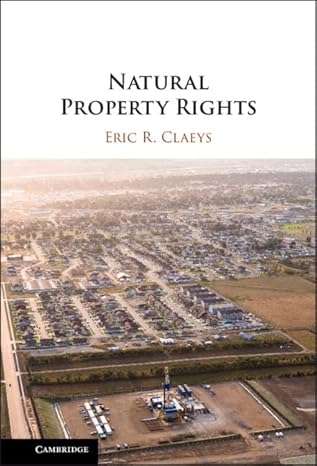
I'm blogging this week about my new book Natural Property Rights, published with Cambridge University Press.

Today, I'll cover the right to use property. I'll illustrate with servitudes, and the common law use rights owners rely on when they create servitudes and assign them away. Since many professors associate nuisance law with law and economic analysis, I'll contrast rights-based and economic analyses of nuisance here.

Imagine that three neighbors own adjacent lots on a street in an unzoned residential neighborhood. Al's lot comes first, then Becky's, then Cassie's. Becky owns and lives in a residential house. Al's lot is vacant at first, but he builds a dry cleaning operation on the lot and starts running the store. Cassie lives in her own residential house, but she then lets the local electric utility (Daring) install solar-energy-collecting arrays in her backyard.

Imagine that Becky dislikes Al's dry cleaning and the solar arrays on Cassie's lot. Can Becky stop either of those land uses? To do so, she'd have to show that the dry cleaning and the solar arrays are nuisances. A defendant commits a nuisance when: he performs an act that interferes with the plaintiff's use or enjoyment of land she owns or occupies; the interference causes her harm; and the interference is unreasonable.

Read More

Call for Papers: Rocky Mountain Junior Scholars Forum

An opportunity out west for junior legal scholars.

|

I am pleased to be able to share this call for papers.

The Rocky Mountain Junior Scholars Forum is issuing a call for papers. The Forum welcomes participants from across the United States in an academic position without tenure status as well as those who have not yet held an academic position. Fellows, Visiting Assistant Professors, and those in similar positions are welcome. Papers may be at any stage of development at the time of the Forum, including complete drafts, first drafts, partial drafts, and running outlines. Submissions on any legal topic are due by September 15, 2025 and can be submitted at https://rmjsf.byu.edu/2025-home/. Submissions may be in the form of an abstract or draft at any stage. Authors of selected papers will be notified by the end of September.

The Forum will be hosted this year by BYU Law School on October 16-17, 2025. The Forum will begin at lunch on Thursday, October 16, and end in the afternoon on Friday, October 17. The Forum will host dinner and an activity near the law school on Thursday evening. All meals will be covered by the Forum, but participants must provide for their own lodging and travel to and from the Forum. A block of rooms at a discounted price will be made available at a local hotel.

If you have any questions or concerns, please contact Tyler Lindley at lindleyt@law.byu.edu.

Free Speech

Judge Denies Government's Request to Unseal Epstein Grand Jury Transcripts

|

Today's decision by Judge Richard Berman (S.D.N.Y.), in U.S. v. Epstein, is here; here's the summary from the docket entry:

The principal ruling in this case is that Federal Rule of Criminal Procedure 6(e) governs and that there is clear precedent and sound purpose for grand jury sealing.The Government concedes that no Rule 6(e)(3) "exceptions" to grand jury secrecy apply in this case. At the same time, the Government fails to demonstrate any "special circumstance[]" which might justify unsealing….

And a brief excerpt from the opinion:

The Government is the party seeking disclosure-however unusual it is for the Government to seek to unseal grand jury material…. A significant and compelling reason to reject the Government's position in this litigation is that the Government has already undertaken a comprehensive investigation into the Epstein case and, not surprisingly, has assembled a "trove" of Epstein documents, interviews, and exhibits. And, the Government committed that it would share its Epstein investigation materials with the public. The Government's 100,000 pages of Epstein files and materials dwarf the 70 odd pages of Epstein grand jury materials….

The Government is the logical party to make comprehensive disclosure to the public of the Epstein Files. By comparison, the instant grand jury motion appears to be a "diversion" from the breadth and scope of the Epstein files in the Government's possession. The grand jury testimony is merely a hearsay snippet of Jeffrey Epstein's
alleged conduct.

Mail-In Ballots

Another day, another unconstitutional Executive Order on the way?

|

Today's Con Law I exam question:

The President issues* an "Executive Order" prohibiting the use of mail-in ballots and automatic voting machines in all federal elections, nationwide.  Discuss the possible constitutional problems that such a move may entail.  10 points.

*  The President has not, actually, issued such an Executive Order; he has indicated, however, that he intends to do so, and the White House has indicated that the E.O. is in the process of being drafted. [see here or here]

Let's do a little exam issue-spotting on this one, shall we? If I'm grading your answers, I expect you to raise two pretty obvious constitutional problems here.

You should start with the relevant Constitutional text (Art. I, Sec. 4):

"The Times, Places and Manner of holding Elections for Senators and Representatives, shall be prescribed in each State by the Legislature thereof; but the Congress may at any time by Law make or alter such Regulations, except as to the Places of chusing Senators."

From that, two issues sort of jump right out at you, no?

  1. The State legislatures are expressly given the power, in the first instance, to "prescribe" the "time, place, [or] manner of holding [federal] elections." This E.O. appears to be an attempt to do that; it would certainly affect the "manner" in which elections for federal officers are held, and probably the "time" and "place" of those elections as well (to the extent that millions of people rely on mail-in ballots in order to vote early (time) and when they are out-of-state (place)).  As such, it violates Art I Sec. 4..
  2. The federal government is given the power to "make or alter" the States' time/place/manner regulations, but that power is expressly granted to Congress - not to the President.  The President, acting unilaterally via an Executive Order, has no power to compel the States regarding their rules about the time/place/manner of those elections.

I'm only awarding 10 points for this question because it is too damn easy. This EO is close to being laughably unconstitutional. Any first-year law student who doesn't see that is really asleep at the switch. It's the sort of thing that only a law professor would dream up, too ridiculous to contemplate in the real world.  It's a gimme, just setting you up for the more complex interpretive questions to come later in the exam.

What does this say about our President, and about his legal advisers? It says - once again - that they don't give a damn about whether or not what they're doing is, or is not, constitutional. Unless they all flunked Con Law I, which I doubt, anyone the President might conceivably consult for a legal opinion on the constitutionality of what he wants to do -- from the Attorney General, the Solicitor General, the White House Counsel, and the Director of the Office of Legal Counsel, to the lowliest legal intern at the DOJ -- would surely know that he doesn't have the power to do what he wants to do, and that at some point a court, quite possibly the Supreme Court, will issue a final judgment to that effect and the Order will be of no further force and effect.

But in the meantime, . . . In the meantime, he does whatever he wants to do and accomplishes whatever he wants to accomplish. It's very much an "in the meantime" strategy, and it's working very well thus far.  He'll issue the Order, and then he will have his Executive agencies issue regulations designed to scare States into complying with it - cutting off their highway funds, or their Medicaid reimbursements, or their FEMA grants, if they don't comply with the Order. The matter will of course be litigated immediately. But given all of the ways that the government can slow things down - the jurisdictional and standing challenges, the challenges to class certification, the motions to disqualify or dismiss, the requests for stays, the appeals of adverse rulings in any or all of the foregoing - it will be, at a minimum, a year or so before the Supreme Court says, finally, "Of course you're not allowed to do this; there is no other remotely plausible way to read Art. I Sec. 4."

And by that time, if he and his advisers get their timing right, the midterm elections will have come and gone, and millions of people will have had their election rights abridged by unconstitutional executive action. Which is, of course, the intended result.

So that's what it says about Trump and his legal team.

And what does it say about the country? That we now have a President who - I know I'm being repetitive, but if anything bears repetition, it's this - doesn't care whether his actions comply with the Constitution, and it barely merits a mention for a few days in the infosphere and then disappears, a rock dropped in the ocean. I get it: There's no point to keep talking about it, over and over again. But this is a blog about the important legal issues of the day, and failing to talk about this feels a little too close to complicity for my taste.

Property Rights

Natural Property Rights: A VC Preview

|

I'm blogging this week about my new book Natural Property Rights, published with Cambridge University Press and available for purchase now digitally and in hardbound version, at a variety of bookstores. On Monday,, I summarized the book's normative theory. Yesterday, I explained how the theory applies to acquisition law and policy, and what happens when a community chooses to ignore the moral constraints associated with natural law.

Today, I'll explain how the theory applies to ownership, leases, … and the arcane estates and future interests used in American and "Anglo-sphere" legal systems. Along the way, I'll also consider some familiar critiques of property, by scholars who think that property threatens social and political equality.

Let me start with ownership. Ownership constitutes a relatively specialized form of property. Ownership supplies the model for property in land. Land owners are entitled to sue trespassers for trespassing whether or not they damage the premises and whether or not the owners are actually using the land. But ownership does not supply the model for property in water rights (rights to the use of river water and its flow). Water-rights holders cannot complain that others are interfering tortiously with their rights unless those others interfere with ongoing water uses. The rights to alienate or assign property come automatically with ownership; they don't attach automatically to usufructs.

But even though ownership is only one form of property, it is probably the most familiar form. Most people associate "property" with their personal possessions, their real estate, and their wealth. All of those resources can be owned.

And ownership makes property controversial. How is it just for one person to exclude everyone else from resources everyone could use? As I've explained in my earlier posts, a natural property right is qualified by a sufficiency proviso. How is it fair for an owner to exclude others who have rights corresponding to the sufficiency proviso? Questions like these have been  asked by many writers and scholars— Pierre-Joseph Proudhon 200 years ago, and Joe Singer and Jeremy Waldron relatively recently.

Read More

Did the Texas Tribune Hallucinate About Judge Ho's Dissent?

The article misattributed two quotations to Judge Ho. And variants of those quotes appeared in the majority, but there were inexplicable alterations.

|

On August 18, a divided Fifth Circuit panel decided the case of Spectrum WT v. Wendler. This case presented a challenge to West Texas A&M University's decision to cancel a drag show on campus. The majority opinion by Judge Southwick, joined by Judge Dennis, found that the cancellation of the drag show violated the First Amendment. Specifically, the panel found the drag show was expressive. And, the majority ruled, "a message in support of LGBT+ rights was intended, which is a far clearer message than some of the examples of art identified in Hurley as protected by the First Amendment." The majority found that Christian Legal Society v. Martinez was not relevant because "expressive association" was not at issue in that case.

Judge Ho dissented. In short, Judge Ho found that if U.C. Hastings was able to exclude the Christian Legal Society, then West Texas A&M could exclude the drag show. His dissent begins:

Spectrum WT claims that it has a First Amendment right to put on a drag show in a public facility at West Texas A&M University. But university officials have determined that drag shows are sexist, for the same reason that blackface performances are racist. And Supreme Court precedent demands that we respect university officials when it comes to regulating student activities to ensure an inclusive educational environment for all. See Christian Legal Society v. Martinez, 561 U.S. 661 (2010). I disagree with the Supreme Court's decision in CLS. But I'm bound to follow it. And I will not apply a different legal standard in this case, just because drag shows enjoy greater favor among cultural elites than the religious activities at issue in CLS.

This is a common theme in Judge Ho's decisions. What is good for the goose is good for the gander. Whatever rules apply to one side must apply to the other side. There is a ruthless fairness to his cases, which I admire--especially when it involves a terrible precedent like CLS v. Martinez. If I could pick five decisions from the last two decades to reverse, Martinez would make the cut. Justice Ginsburg gerrymandered the facts of the case so gruesomely, for the reasons Justice Alito pointed out in dissent. I'm not even sure it is necessary to overrule CLS. That case could easily be confined to the facts about the "stipulations." Indeed, the West Texas A&M Case might be the perfect vehicle to do it. Imagine the headlines: Chief Justice Roberts writes majority opinion in favor of Texas drag show, with Justice Jackson in dissent. Heads will explode.

But that's not why I'm writing this post. I'm writing about the media.

The original version of the Texas Tribune (PDF link) included these three paragraphs about Judge Ho's dissent.

Judge James C. Ho dissented in the West Texas A&M case.

"Drag is not inherently expressive," wrote Ho, who was appointed to the 5th Circuit by Trump and is the former Solicitor General of Texas.

He argued that whether a particular performance conveys a protected message depends on the specific show, performers and audience. He said Spectrum WT had not shown it was entitled to such an "extraordinary remedy" as a court order blocking the drag show ban.

I read these sentences and was perplexed. Judge Ho did not say a word about whether drag is expressive. Seriously. The word "expressive" does not appear in the dissent. He didn't need to. He found this issue was decided by CLS v. Martinez, and under that precedent, the University receives deference. Full stop. Judge Ho said nothing at all about whether a "protected message depends on the specific show, performers and audience." He said nothing at all about whether an "extraordinary remedy" was justified. The word "remedy" does not appear in the dissent. Because again, he would have deferred under CLS v. Martinez.

I seriously wondered if the person who wrote this even bothered to read any of Judge Ho's dissent. Judge Ho didn't make any of these points.

Read More

NLRB

Fifth Circuit Upholds Injunction Against NLRB Proceedings, Distinguishing Humphrey's Executor

The Court concludes that limitations on the removal of NLRB Board members and NLRB administrative law judges are both unconstitutional.

|

Today, in Space Exploration Technologies Corp. v. NLRB, the U.S. Court of Appeals for the Fifth Circuit concluded that the structure of the National Labor Relations Board (NLRB) is unconstitutional in (at least) two ways. First, the NLRB's administrative law judges are insulated by a double-for-cause removal protection of the sort invalidated in Free Enterprise Fund v. PCAOB (and which the Fifth Circuit had previously declared unconstitutional in Jarkesy).  Second, the court concluded that for-cause removal protection for NLRB Board members is also unconstitutional because the NLRB exercises significant executive power and is not sufficiently like the Federal Trade Commission to be protected by Humphrey's Executor.

Judge Willett wrote for the court, joined by Judge Duncan. Judge Wiener concurred in part and dissented in part. Judge Wiener agreed with the majority on the merits, but disagreed on whether the companies challenging the NLRB were entitled to a preliminary injunction against being subject to Board proceedings. In Judge Wiener's view, the companies did not demonstrate that they would suffer irreparable harm.

Judge Willet summarized his opinion this way:

Congress created the National Labor Relations Board in 1935 to administer and enforce the National Labor Relations Act, the cornerstone of American labor law. Like many independent federal agencies, the NLRB relies heavily on "administrative adjudication." Its administrative law judges (ALJs) preside over claims of NLRA violations and issue initial decisions, which are subject to review by the agency's five-member Board—a quasi-judicial body of presidential appointees that sits atop the NLRB's hierarchy.

Board Members may be removed by the President only "for neglect of duty or malfeasance in office[.]"1 And ALJs may be removed only "for good cause," as determined by the Merit Systems Protection Board (MSPB)—itself an independent, quasi-judicial agency that adjudicates "[f]ederal employee appeals from agency personnel actions."

In this consolidated appeal, SpaceX, Energy Transfer, and Findhelp (together, the Employers) each faced unfair-labor-practice complaints. Before administrative proceedings began, each filed suit in a different federal district court, challenging the constitutionality of the NLRB's structure—specifically, the dual for-cause removal protections shielding both Board Members and ALJs. Each court granted a preliminary injunction, halting the agency's proceedings.

On appeal, the NLRB argues that the district courts (1) lacked jurisdiction to enjoin ongoing Board proceedings, and (2) abused their discretion in doing so, because the Employers are unlikely to prevail on the merits and have not shown irreparable harm.

We disagree on both counts. First, nothing in federal law strips federal courts of jurisdiction to hear these claims—or to enjoin unconstitutional agency proceedings. Second, the district courts acted well within their discretion in granting preliminary relief.

ALJs are inferior officers insulated by two layers of for-cause removal protection—an arrangement the Supreme Court and this circuit have both held unconstitutional. As for the Board Members, precedent is less definitive. But the Supreme Court and this court have both cautioned against extending Humphrey's Executor to agencies that are not a "mirror image" of the Federal Trade Commission.

The Employers have made their case and should not have to choose between compliance and constitutionality. When an agency's structure violates the separation of powers, the harm is immediate—and the remedy must be, too.

On how the NLRB is sufficiently different from the FTC to get around Humphrey's Executor, Judge Willett writes:

Read More

Sex Crimes

$2M Recommended Compensatory Damages + $7.5M Punitives for Inmate Raped by Guard

So a Magistrate Judge concludes in recommending a default judgment in favor of the inmate.

|

From today's Report and Recommendation by Magistrate Judge Ronald Griffin (W.D. Tex.) in Doe v. Serna-Venegas; the lawsuit is just against the guard (the County had been dismissed earlier, as had some other individual defendants), so it seems unlikely the plaintiff will recover much money from this particular award. Some extra appalling dollops in an already appalling case:

In her Complaint, Plaintiff alleges Defendant had a commercial web page on "OnlyFans.com," where he was paid to have sex with females, including inmates, and post it on his page. Investigators later reviewing videos on Defendant's phone found at least seven different videos of Defendant having sex with inmates at the Midland County Jail. Defendant was ultimately prosecuted and convicted of six felony counts of improper sexual activity with a person in custody.

Guns

7-Day "Cooling-Off" Period for Gun Purchases Struck Down by Tenth Circuit Panel

|

A short excerpt from today's long Ortega v. Grisham, by Tenth Circuit Judge Timothy Tymkovich, joined by Judge Allison Eid:

New Mexico enacted a law in 2024 that imposes a categorical seven-day "cooling-off" period for nearly all consumer purchases of a firearm. No matter how urgent the need, or how much physical danger a prospective buyer might be in, buyers must wait seven days before New Mexico deems them safe to carry arms. Even buyers with previous firearms background checks or security clearances are not eligible for waivers from the prohibition. In short, the law requires no individualized reason to conclude that a prospective consumer is a danger to himself or the community, nor can anyone be excused from the waiting period because of personal danger….

Cooling-off periods infringe on the Second Amendment by preventing the lawful acquisition of firearms. Cooling-off periods do not fit into any historically grounded exceptions to the right to keep and bear arms, and burden conduct within the Second Amendment's scope. In this preliminary posture, we conclude that New Mexico's Waiting Period Act is likely an unconstitutional burden on the Second Amendment rights of its citizens…. Plaintiffs are entitled to an injunction….

Read More

The ABA Disregards Law School Objections, Mandates 12 Credits of Experiential Learning

There is absolutely no evidence showing that the ABA's dictates are effective.

|

The American Bar Association's Council of the Section on Legal Education is moving forward with a new standard that would require twelve credits of experiential learning for graduation. An earlier version of this proposal was already widely opposed by law school deans. But the ABA only made small modifications to the program. There will now be a forty-five day comment period. But we can see the writing on the wall.

There are many problems with the ABA's approach to accreditation. But perhaps the biggest problem is that the Council adopts standards without any proof these standards will accomplish their stated goal. The ABA demands that law schools demonstrate that they are satisfying certain objectives, but the ABA never imposes such mandates internally.

Dan Rodriguez of Northwestern stated, correctly, that there is no evidence showing these reforms will be effective:

But Northwestern Pritzker School of Law professor Daniel Rodriguez said the revisions are unlikely to win over critics like himself who believe the ABA is going too far in dictating curriculum without providing adequate data to justify the proposed changes.

"There is a conspicuous lack of what we might call evidence-based analysis in the council's work," Rodriguez said.

Brian Leiter of Chicago makes the point more forcefully:

The latter gives law schools an opportunity to organize in opposition to these indefensible changes. Some possibilities: (1) a collective refusal by dozens of law schools to comply with these requirements that will disrupt their programs of legal education without any evidence of their benefit--let's dare the ABA to start stripping accreditation from elite law schools, state flagships, etc. (2) a collective effort to lobby the Education Department to recognize other accreditors of law schools, and perhaps to strip the ABA of its accreditation role entirely given its repeated bad behavior.

Even Gerard Magliocca, one of the most mild-mannered people I've ever met, is outraged:

The decision of the Council on Legal Education on new experiential learning requirements for law schools, summarized here, is just more evidence that the ABA's accreditation role should be curtailed or eliminated. I've been a legal educator for nearly 25 years. I can't think of any positive contribution by that organization in this field.

I couldn't agree more. I remain convinced the ABA's accreditation role is substantially modified, if not eliminated, within a decade. And that wound will be entirely self-inflicted.

I have written at length about the problems with the ABA's accreditation role. The Supreme Courts of Florida, Texas, and Ohio are now reconsidering whether to require ABA accreditation in their states. I think other states will follow. Moreover, the Trump Administration is closely scrutinizing the ABA's DEI mandates. The ABA is under siege.

You would think that the ABA would realize what time it is, and shore up their support from the political left. No. They did the exact opposite. They raised a large middle finger to elite law schools whose students have no need or interest in twelve hours of experiential learning.

Maybe there is a Baptist and Bootlegger coalition to be hand with the right and left. I'll let you decide who are the Baptists and who are the Bootleggers.

Legal Ethics

Sanctions Decision as to Rape Allegations Against Comedian Druski, in Case Also Involving Sean Combs (P. Diddy)

"After the lawsuit was filed, Desbordes' [Druski's] counsel sent Plaintiffs' counsel evidence, including debit card records and phone records, showing that it was virtually certain that Desbordes was in Georgia at the time of the alleged rape, and thus could not have participated in the assault." "Yet, at the hearing on the motion for sanctions, Plaintiffs' counsel expressly stated Plaintiffs 'have no desire to dismiss Mr. Desbordes' from the lawsuit."

|

From today's order by Judge Rita Lin (N.D. Cal.) in Parham v. Combs:

This lawsuit concerns the alleged gang rape of Plaintiff Ashley Parham that occurred on March 23, 2018, in Orinda, California. On March 13, 2025, Plaintiffs amended their complaint to add Defendant Drew Desbordes to the lawsuit, alleging that he participated in the rape.

Desbordes has moved for sanctions against Plaintiffs' counsel under Rule 11 of the Federal Rules of Civil Procedure, which requires attorneys to have a factual basis for allegations made in a complaint and to have conducted a reasonable investigation prior to filing suit. After the lawsuit was filed, Desbordes' counsel sent Plaintiffs' counsel evidence, including debit card records and phone records, showing that it was virtually certain that Desbordes was in Georgia at the time of the alleged rape, and thus could not have participated in the assault.

At the time that Plaintiffs' counsel filed the amended complaint, there did appear to be a reasonable factual basis for naming Desbordes, as further explained below. Therefore, the Court declines to sanction Plaintiffs' counsel for suing Desbordes in the first place and DENIES the motion.

However, even after receiving the new evidence about Desbordes, Plaintiffs' counsel continued to allege at the hearing on July 10, 2025, that the claims against Desbordes are viable and stated that Plaintiffs intend to pursue them. Those continued allegations appear to have no reasonable factual basis. Accordingly, the Court ORDERS Plaintiffs' counsel TO SHOW CAUSE why sanctions should not be issued for the statements made at the July 10, 2025 hearing….

Allegations of the Complaints

Read More

More


