The Volokh Conspiracy

Mostly law professors | Sometimes contrarian | Often libertarian | Always independent | Est. 2002

The Volokh Conspiracy

Kavanaugh's Paradox

|

For more than a month, protestors have demonstrated outside of Justice Kavanaugh's house. The purpose of these gatherings is clear: to pressure the Justice to change his vote in Dobbs. On Tuesday, Nicholas John Roske traveled to Justice Kavanaugh's house with the same purpose. But instead of wearing a pussy hat, he brought a bag filled with weapons. Even after this apparent assassination attempt, the protestors came back to Kavanaugh's house to demonstrate. And they will likely continue protesting outside of his house until Dobbs is decided.

Still, Kavanaugh faces a paradox. In February, he joined Justice Alito's majority opinion. And Politico suggested that in early May, Kavanaugh was still with the majority. But we were told that Roberts had not yet circulated his concurrence. No doubt the protestors hope that pressuring will deprive Alito of a majority to save Roe. Mr. Roske chose different means, but had the same ends. If in fact, Kavanaugh did change his vote after May, in response to the Chef's blue plate special, then perhaps the protests and death threats will stop. We would be blind to reality if we thought this prospect did not play some role in Kavanaugh's decision-making. But I think this calculus is backwards. If Kavanaugh does change his vote, we will learn about it. Jan Crawford, Joan Biskupic, and others will find out. And the protestors packing pussy hats and Glocks will know the playbook: the way to change Justice Kavanaugh's vote is through pressure on his family. If it worked once, it will work again.

Thus, the paradox: if Kavanaugh changes his vote to uphold Roe, the protests may stop in the short-term, but will continue in the long-term. Ruth Sent Us can buy a house on Kavanaugh's block to set up a 24-hour vigil. If Kavanaugh stands by his vote to reverse Roe, the protests in the short-term will continue, but will fade in the long-term. Standing firm will send a clear and unequivocal message that neither fear nor favor will affect the judicial power.

I do not envy Justice Kavanaugh's position. Indeed, I can't fathom why anyone would want to serve on the Supreme Court. To be more precise, I can't fathom why any conservative would want to serve on the Supreme Court. Liberal jurists are feted with honors at every juncture. But conservative jurists are excoriated and personally attacked. I wonder, in hindsight, if Kavanaugh still would have pursued a position on the Supreme Court, knowing what we know now: the first  confirmation hearing, baseball tickets, Spartacus, Christine Blasey Ford, Michael Avenatti, Ronan Farrow, the second confirmation hearing, yearbook, beer, Klobuchar, Saturday Night Live, Matt Damon, the Dobbs leak, and now an assassination attempt outside of his home. During this time, Kavanaugh and his family have been dragged through such painful experiences, one after the other. Was it all worth it? And to what end? To swallow the Chief's blue plate special?

The Court has announced opinions will be issued on Monday and Wednesday of next week.
Law & Government

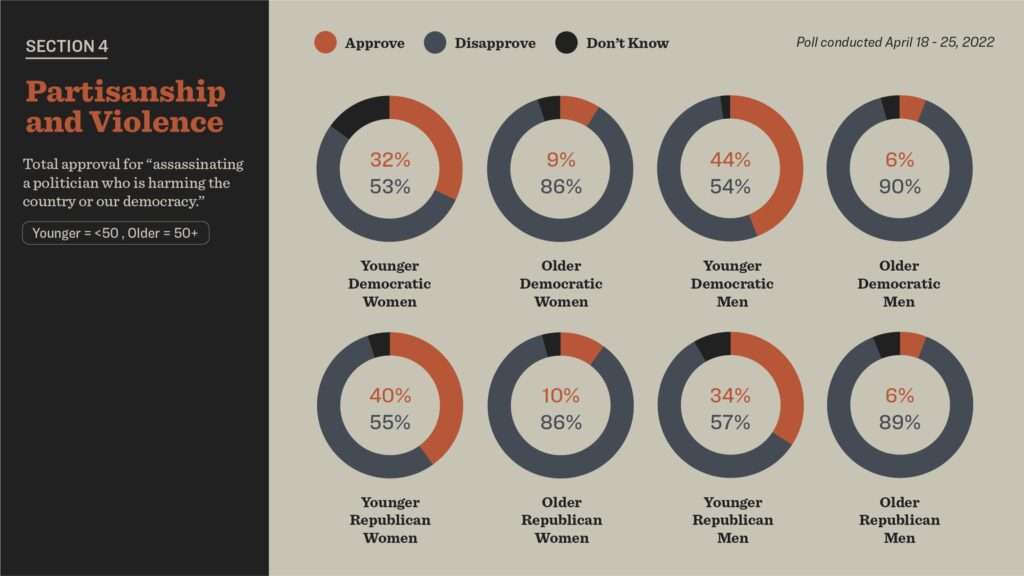
35-40% of Under-50 Respondents Endorse "Assassinating a Politician Who Is Harming the Country or Our Democracy"

|

This is according to a Southern Poverty Law Center poll, conducted by Tulchin Research (warning: FiveThirtyEight.com gives Tulchin mediocre marks, at least as to its campaign polls). The poll was "a nationwide survey of 1,500 adults ages 18+ which was conducted via online panel," so I expect there were likely only about 150 respondents in each of the demographic categories (such as "Younger Republican Men") which would mean a margin of error of about 8%, so I'd be hesitant to make much of (say) Younger Republican Women seeming to support assassination more than Younger Republican Men, Younger Republican Women more than Younger Democratic Women, or Younger Democratic Men more than Younger Republican Men.

But it does seem that among the under-50-year-olds, there is about 35-40% support, with no detectable aggregate difference between Democrats (averaging 38-54%) and Republicans (37%-56%).

Read More

Race Discrimination

Washington S. Ct.: Whether Someone Has Been "Seized" Turns in Part on His Race

|

My follow-up question: There are also likely highly "disproportionate police contacts, investigative seizures, and uses of force against" men—which doubtless stem in part from men actually committing more crimes than women, but are likely also influenced by "implicit, institutional, and unconscious biases" on the part of law enforcement (and everyone else). Wouldn't the court's logic likewise apply to let male defendants claim that their sex should be considered in their favor in the seizure analysis, and what wouldn't be a seizure to a woman would be one to them?

From today's decision in State v. Sum:

This case concerns the analysis that courts must apply to determine whether a person has been seized by law enforcement for purposes of article I, section 7 of the Washington Constitution. It is well established that an encounter with law enforcement rises to the level of a seizure if "considering all the circumstances, an individual's freedom of movement is restrained and the individual would not believe [they are] free to leave or decline a request due to an officer's use of force or display of authority." Today, we are asked whether "all the circumstances" of the encounter includes the race and ethnicity of the allegedly seized person.

As the parties correctly agree, the answer is yes. Our precedent has always required that the seizure inquiry be made in light of the totality of the circumstances, and we have never stated that race and ethnicity cannot be relevant circumstances. However, we have not explicitly held that in interactions with law enforcement, race and ethnicity matter. We do so today. Furthermore, to ensure that all the circumstances of a law enforcement encounter are properly considered, including race and ethnicity, we take this opportunity to clarify the seizure inquiry as a matter of independent state law, taking guidance from GR 37.

Read More

Conjunction Disjunction in the Dobbs Draft

Does the Glucksberg test require a right to be "fundamental" and "deeply rooted" or "fundamental" or "deeply rooted"?

|

In 2019, I published an article on Timbs v. Indiana with my itinerant co-author, Ilya Shapiro. We contended that Justice Ginsburg modified the Glucksberg test, as it was stated by Justice Alito in McDonald v. Chicago.

Justice Ginsburg wrote the majority opinion in Timbs, joined in full by Chief Justice Roberts and Justices Breyer, Alito, Sotomayor, Kagan, Gorsuch, and Kavanaugh.144 This octet relied on the substantive due process framework employed in McDonald—sort of. Justice Ginsburg cited McDonald for the proposition that "[a] Bill of Rights protection is incorporated . . . if it is 'fundamental to our scheme of ordered liberty,' or 'deeply rooted in this Nation's history and tradition.'" That is, a right can be incorporated if it is either (a) "fundamental" or (b) "deeply rooted." Justice Ginsburg's summary is a plausible reading of McDonald, but not the best reading. Consider Justice Alito's test, in full:

With this framework in mind, we now turn directly to the question [of] whether the Second Amendment right to keep and bear arms is incorporated in the concept of due process. In answering that question, . . . we must decide whether the right to keep and bear arms is fundamental to our scheme of ordered liberty, or as [the Court has] said in a related context, whether this right is "deeply rooted in this Nation's history and tradition."146

McDonald is better read to require both factors: that the right is (a) "fundamental" and (b) "deeply rooted." That is, asking if a right is "deeply rooted" is a way of determining whether that right is "fundamental." The inquiries overlap. Under the new Timbs test, however, a modern—or even postmodern—right could still be deemed fundamental. Indeed, this novel approach echoes the framework Justice Breyer advanced in his McDonald dissent: "I thus think it proper, above all where history provides no clear answer, to look to other factors in considering whether a right is sufficiently 'fundamental' to remove it from the political process in every State."147

Alas, because seven other Justices joined Justice Ginsburg in Timbs, the Court has now watered down the incorporation test.

In the Dobbs draft, Justice Alito seems to have reverted back to his understanding of the Glucksberg test in McDonald. Joseph Blass made the catch at Balkinization:

Compare Justice Ginsburg's statement of the test in Timbs with Justice Alito's citation to her statement (emphasis my own). Justice Ginsburg writes that a right is protected under the Constitution's Due Process Clause "if it is fundamental to our scheme of ordered liberty, or deeply rooted in this Nation's history and tradition" (internal quotations omitted). But Justice Alito now writes: "Justice Ginsburg's opinion for the Court in Timbs [concluded] that the Eighth Amendment's protection against excessive fines is 'fundamental to our scheme of ordered liberty' and 'deeply rooted in this Nation's history and tradition.'" See the difference? Justice Alito slices Justice Ginsburg's statement of the test in Timbs in half around the word "or," sandwiching her quoted statements of the branches around a new "and". The opinion states the test four separate times, each time using "and" to connect the two branches. But up until this draft opinion the test has been disjunctive: in McDonald, Justice Alito states the test much as Justice Ginsburg did in Timbs, using "or." And so does Chief Justice Rehnquist in Glucksberg, the case that originated the test by drawing together its branches from prior Due Process precedents.

Conjunction disjunction at the Supreme Court.

Foreign Law in American Courts

California Court Rejects Lebanese Bigamous Marriage

|

From In re Marriage of Elali & Marchoud, decided yesterday by the California Court of Appeal (written by Justice Carol Codrington and joined by Presiding Justice Manuel Ramirez and Justice Douglas Miller):

While Mr. Samir Elali was married to Ms. Angeles Elali and resided with her in California, Samir married Ms. Mayssa Marchoud in Lebanon. {Samir[ testified] that he married Angeles in 1987, and had remained married to her for almost 35 years, including when he married Mayssa in Lebanon in 2012.} After Samir attempted to terminate the Lebanese marriage, Mayssa filed a petition in California for spousal support without dissolution against Samir. The trial court ruled the Lebanese marriage was bigamous and therefore void under Family Code section 2201, subdivision (a)…. We … conclude the trial court did not err in ruling the bigamous Lebanese marriage was void under section 2201(a)[:]

[A subsequent marriage contracted by a person during the life of his or her former spouse, with a person other than the former spouse, is illegal and void, unless:

(1) The former marriage has been dissolved or adjudged a nullity before the date of the subsequent marriage.

(2) The former spouse (A) is absent, and not known to the person to be living for the period of five successive years immediately preceding the subsequent marriage, or (B) is generally reputed or believed by the person to be dead at the time the subsequent marriage was contracted.] …

Under [Family Code] section 308, "[a] marriage contracted outside this state that would be valid by laws of the jurisdiction in which the marriage was contracted is valid in California." … Mayssa argues that although Samir had two simultaneous marriages, the second marriage in Lebanon was valid because Lebanese law permits bigamy….

Read More

How Native Hawaiians and Pacific Islanders Became a Separate Classification from "Asian Americans"

Native Hawaiians had found that being lumped in with Asian Americans hurt their chances of admission to West Coast colleges.

|

When the Office of Management and Budget first created in the 1970s the racial and ethnic classifications that are used across the government and became standard throughout American society, Native Hawaiians were included in the "Asian and Pacific Islanders" classification.

As sociologist Michael Omi explained 2001 article, this wound up not sitting well with Native Hawaiians:

Senator Daniel K. Akaka (D-Hawaii) initiated a discussion and subsequent lobbying effort to move Native Hawaiians out of the Asian/Pacific Islander category beginning in the early 1990s. Senator Akaka's office had been receiving phone calls from students and alumni of Kamehameha High School complaining of the difficulty of convincing mainland colleges and universities to consider Native Hawaiian admissions and scholarship decisions separately from those of Asian Americans.

Senator Akaka proceeded to do the logical thing, which is to propose that OMB "create a new indigenous category of 'Native American,' that would group Native Hawaiians together with American Indians and Alaskan Natives." OMB did not like this suggestion, "fearing that the move would open up the contentious and unresolved issue of Native Hawaiian sovereignty." And while Omi does not say so, I have read elsewhere that Native American groups also opposed such a change, not wanting Native Hawaiians to become eligible for various programs geared to American Indians.

OMB's Sally Katzen therefore proposed a compromise: "Why not put Hawaiians and Pacific Islanders together into a separate category? The proposal became official on October 30, 1997, when the Asian or Pacific Islander category was disaggregated into two categories.

And author's note: If you find this sort of thing interesting, why not preorder Classified: The Untold Story of Racial Classifications in America? It's now available on Kindle for only $9.99.

Slippery Slope Arguments

Slippery Slope Arguments in History: Edmund Burke

|

From his speech on Conciliation with the Colonies, Mar. 22, 1775:

Permit me, Sir, to add another circumstance in our colonies, which contributes no mean part towards the growth and effect of this untractable spirit….

In no country perhaps in the world is the law so general a study…. General Gage marks out this disposition very particularly in a letter on your table. He states, that all the people in his government are lawyers, or smatterers in law; and that in Boston they have been enabled, by successful chicane, wholly to evade many parts of one of your capital penal constitutions….

This study renders men acute, inquisitive, dexterous, prompt in attack, ready in defence, full of resources. In other countries, the people, more simple, and of a less mercurial cast, judge of an ill principle in government only by an actual grievance; here they anticipate the evil, and judge of the pressure of the grievance by the badness of the principle. They augur misgovernment at a distance; and snuff the approach of tyranny in every tainted breeze.

Slippery Slope Arguments

Cost-Lowering Slippery Slopes as Multi-Peaked Preferences Slippery Slopes

|

[This month, I'm serializing my 2003 Harvard Law Review article, The Mechanisms of the Slippery Slope.]

Cost-lowering slippery slopes, it turns out, are a special case of a broader mechanism—the multi-peaked preferences slippery slope.

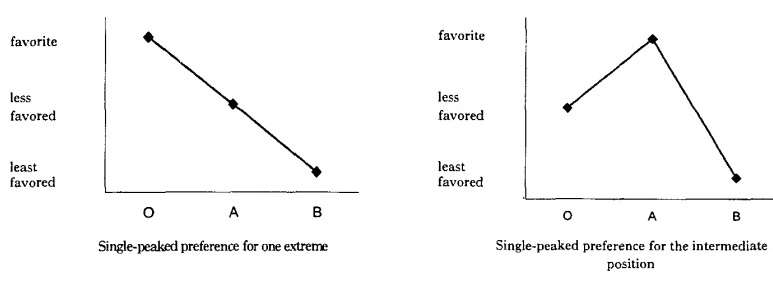
In many debates, one can roughly divide the public into three groups: traditionalists, who don't want to change the law (they like position 0); moderates, who want to shift a bit to position A; and radicals, who want to go all the way to position B. What's more, one can assume "single-peaked preferences": both traditionalists and radicals would rather have A than the extreme on the other side. We can represent the preferences as follows, which is why the preferences are called "single-peaked":

If neither the traditionalists nor the radicals are a majority, the moderates have the swing vote, and thus needn't worry much about the slippery slope. Say that 30% of voters want no street-corner cameras (0), 40% want cameras but no archiving and face recognition (A), and 30% want cameras with archiving and face recognition (B). The moderates can join the radicals to go from 0 to A; and then the moderates can join the traditionalists to stay at A instead of going to B. So long as people's attitudes stay fixed, there's no slippery slope risk: those who prefer A can vote for it with little danger that A will enable B. {I assume here that the enactment of A doesn't change people's preferences; in later posts, I will relax that assumption, and consider the possibility that enacting A might actually alter people's attitudes about B.}

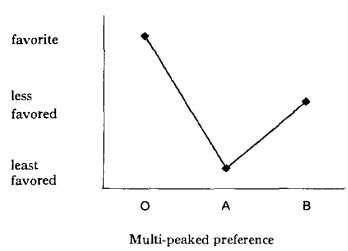
But say instead that some people prefer 0 best of all (they'd rather have no cameras, because they think installing cameras costs too much), but if cameras were installed they would think that position B (archiving and face recognition) is better than A (no archiving and no face recognition): "If we spend the money for the cameras," they reason, "we might as well get the most bang for the buck." This is a multi-peaked preference—these people like A least, preferring either extreme over the middle.

Read More

Press Coverage on the Assassination Attempt of Justice Kavanaugh

The New York Times lists sixteen news stories above the attempted murder of a Justice.

|

If you log onto NYTimes.com now, and check above the fold, you will see a lovely story about the Jurassic Park cast and Kelly Clarkson's performance. If you scroll down, down, down, down, down, you will find a story about the attempted assassination of a Justice. By my count, the Kavanaugh assassination attempt is perhaps the sixteenth most important news item of the day! Oh, and according to the Washington Post, Kavanaugh and his family were home last night.

I agree with Nate Silver.


Criminal Law

The "Abandonment" Defense to Criminal Attempt, and the Person Who Was Planning to Kill Justice Kavanaugh

|

The plan to kill Justice Kavanaugh is horrible for many obvious reasons. But the one nonobvious question that might arise, and that I thought I'd address, is this—it appears that the would-be killer likely changed his mind, which is why he was arrested:

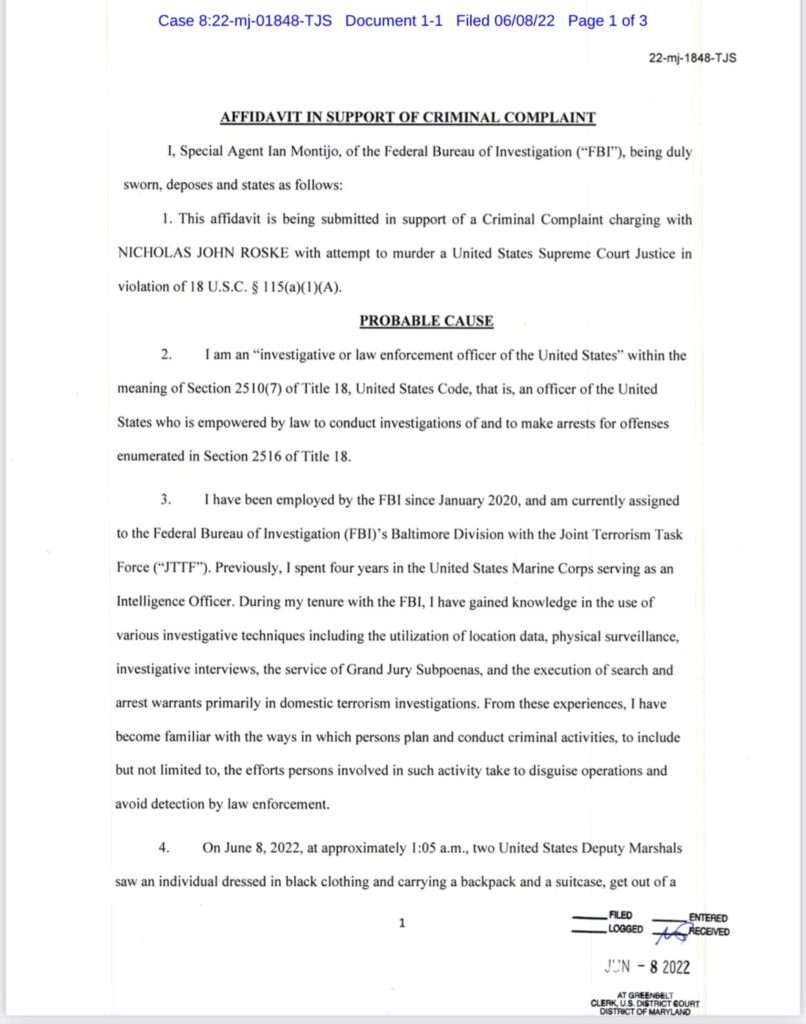
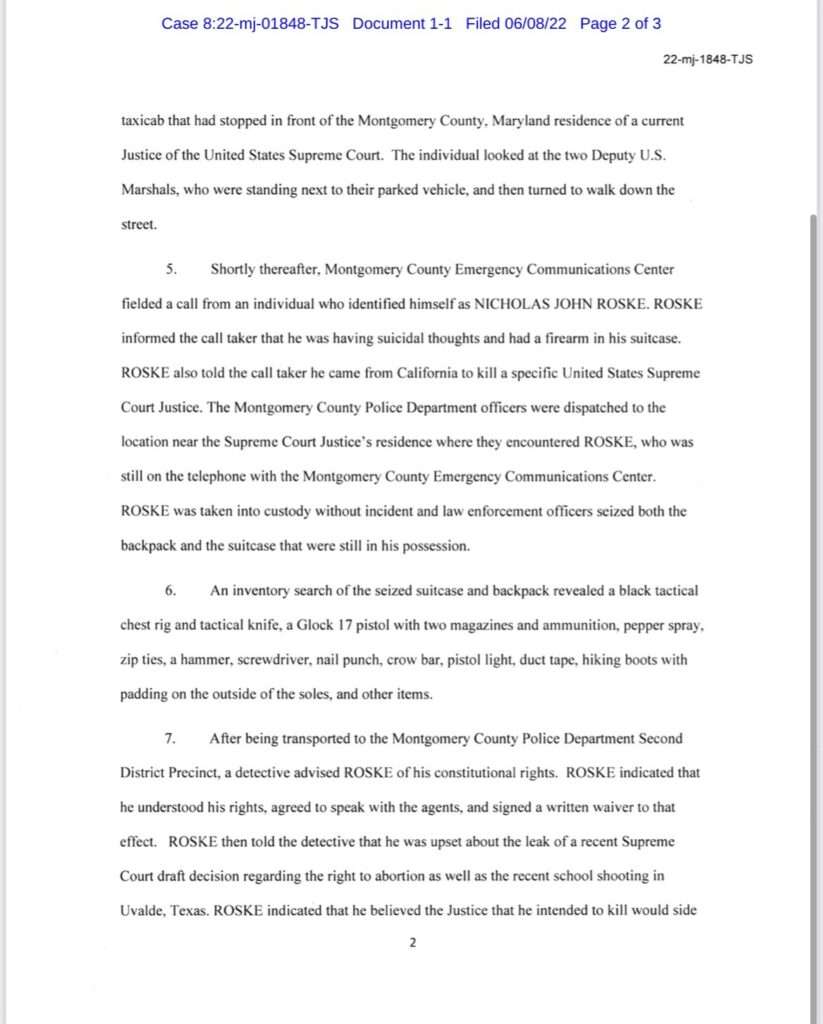
On June 8, 2022, at approximately 1:05 a.m., two United States Deputy Marshals saw an individual dressed in black clothing and carrying a backpack and a suitcase, get out of a taxicab that had stopped in front of the Montgomery County, Maryland residence of a current Justice of the United States Supreme Court. The individual looked at the two Deputy U.S. Marshals, who were standing next to their parked vehicle, and then turned to walk down the street.

Shortly thereafter, Montgomery County Emergency Communications Center fielded a call from an individual who identified himself as NICHOLAS JOHN ROSKE. ROSKE informed the call taker that he was having suicidal thoughts and had a firearm in his suitcase. ROSKE also told the call taker he came from California to kill a specific United States Supreme Court Justice. The Montgomery County Police Department officers were dispatched to the location near the Supreme Court Justice's residence where they encountered ROSKE, who was still on the telephone with the Montgomery County Emergency Communications Center. ROSKE was taken into custody without incident and law enforcement officers seized both the backpack and the suitcase that were still in his possession.

Assume, for purposes of this question, that Roske called 911 because had completely and voluntarily changed his mind (rather than because, say, he was worried about getting caught). Does that mean that he's not guilty of the crime of attempt (setting aside the separate question of whether he's guilty of threatening a Justice), under the "abandonment" or "renunciation" defense?

Read More

New Details On Attempted Assassination of Justice Kavanaugh

From this criminal complaint, it seems that the defendant wanted to kill Kavanaugh to prevent him from casting decisive votes in Dobbs and NYS Rifle & Pistol.

|

More details have been released about the attempted assassination of Justice Kavanaugh. From the Washington Post:

A man with a gun and a knife was detained by police early Wednesday morning near Brett M. Kavanaugh's Maryland home after making threats against the Supreme Court justice, according to federal officials.

According to a criminal complaint charging Nicholas John Roske with attempted murder of a federal judge, two U.S. Deputy Marshals spotted Roske get out of a cab in front of Kavanaugh's home at approximately 1:05 a.m. He looked at the marshals and then walked down the street. Not long after, Montgomery County got the call from Roske saying he was suicidal and came to kill Kavanaugh.
Montgomery County Police Department officers were dispatched and arrested Roske without incident while he was still on the phone with 911, according to the affidavit. In his suitcase and backpack were a Glock 17 with two magazines and ammunition, pepper spray, a tactical knife, a hammer, a screwdriver, a crow bar, zip ties and duct tape, along with other gear.

After his arrest, according to the affidavit, Roske told police he was upset over the leaked draft of an opinion that would overturn the constitutional right to abortion and also over the recent school shooting in Uvalde, Tex. He thought Kavanaugh would support looser gun laws. He decided to kill Kavanaugh and then himself, according to the police officer, thinking it would give his life purpose.

A reporter has also posted a copy of the criminal complaint:

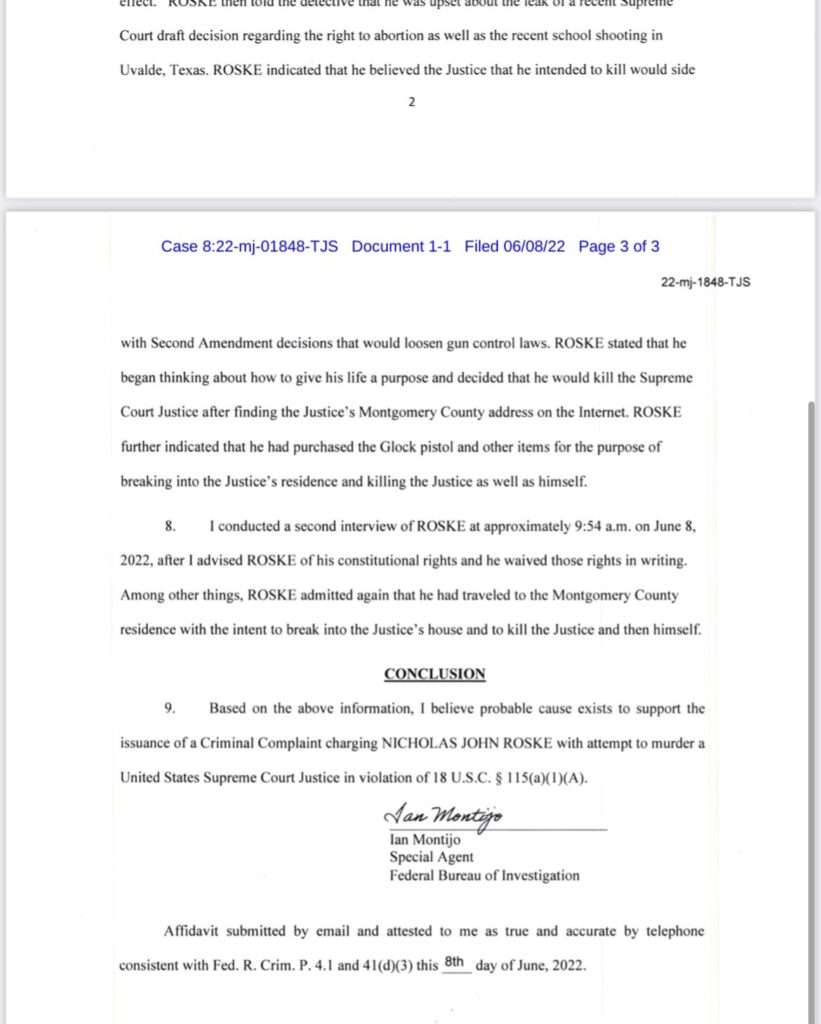
Here are screenshots:


From this complaint, it seems that the defendant wanted to kill Kavanaugh to prevent him from casting decisive votes in Dobbs and NYS Rifle & Pistol.

ROSKE then told the detective that he was upset about the Supreme Court draft decision regarding the right to abortion as well as the recent school shooting in Uvalde, Texas. ROSKE indicated that he believed the Justice that he intended to kill would side with Second Amendment decisions that would loosen gun control laws. Roske stated that he began thinking about how to give his life a purpose and decided that he would kill the Supreme Court Justice after finding the Justice's Montgomery County address on the internet. ROSKE further indicated that he had purchased the Glock pistol and other items for purpose of breaking into the Justice's residence and killing the Justice as well as himself.

Release both opinions, right away. Do not delay another day.

Justice Sotomayor Criticizes The "Restless and Newly Constituted Court"

This claim brings to mind Justice Stevens' dissent from Citizens United.

|

Today, the Supreme Court decided Egbert v. Boule. Justice Thomas's majority opinion reversed the Ninth Circuit's decision, which approved Bivens claims under the First and Fourth Amendments. The Court applied something of a rational-basis test to determine whether a new Bivens cause of action should be implied.

The Bivens inquiry does not invite federal courts to independently assess the costs and benefits of implying a cause of action. A court faces only one question: whether there is any rational reason (even one) to think that Congress is better suited to "weigh the costs and benefits of allowing a damages action to proceed." Ziglar, 582 U. S., at ___ (slip op., at 12).

Here, the Court expands on Ziglar v. Abbasi. This 2018 decision split 4-2. Justices Sotomayor, Kagan, and Gorsuch were recused. Still, Justice Kennedy's plurality opinion largely closed the door on Bivens claims. But now, Egbert, with six votes strong, slams that door shut. And Justice Gorsuch would shred the door in a wood chipper.

https://www.youtube.com/watch?v=Cs3kl3vfX0Q

Justice Sotomayor dissented in part, joined by Justices Breyer and Kagan. She criticized the Court for departing from Ziglar. And she does so in a very personal fashion:

If the legal standard the Court articulates to reject Boule's Fourth Amendment claim sounds unfamiliar, that is because it is. Just five years after circumscribing the standard for allowing Bivens claims to proceed, a restless and newly constituted Court sees fit to refashion the standard anew to foreclose remedies in yet more cases. "

There are two separate barbs there. First, she charges that the reason why the Ziglar standard was "refashioned" was because of the "newly constituted Court." That is, Justices Kennedy and Ginsburg were replaced by Justices Kavanaugh and Barrett. This claim brings to mind Justice Steven's dissent from Citizens United:

In the end, the Court's rejection of Austin and McConnell comes down to nothing more than its disagreement with their results. Virtually every one of its arguments was made and rejected in those cases, and the majority opinion is essentially an amalgamation of resuscitated dissents. The only relevant thing that has changed since Austin and McConnell is the composition of this Court.

Second, Sotomayor charged that her new colleagues are young and "restless." Still this personalized rhetoric from Justice Sotomayor, especially at this time, is misplaced. Bivens has been subject to withering criticisms for decades. And Hernandez sent a very, very clear message that Courts should be really, really cautious about Bivens claims. Yet the Ninth Circuit did not get the memo. Now, the Supreme Court was compelled to say, "We really, really mean it" in language that not even the ghost of Stephen Reinhardt could ignore. This Court is not "restless."

Ultimately, this decision was not terribly surprising. And Justice Thomas's opinion leaves open the question of whether Bivens will be overruled entirely in an appropriate case:

And, more recently, we have indicated that if we were called to decide Bivens today, we would decline to discover any implied causes of action in the Constitution. See Ziglar, 582 U. S., at ___ (slip op., at 11). But, to decide the case before us, we need not reconsider Bivens itself. Accordingly, we reverse the judgment of the Court ofAppeals.

I think the vehicle would have to present the same exact claim present in Bivens or a related case, rather than a question about extension.

So Long As Dobbs Remains Undecided, The Lives of the Justices Are At Risk

The Dobbs 5 should immediately issue an unsigned per curiam order, with an opinion to follow, even over the Chief Justice's objection.

|

At 1:50 am this morning, an armed man with burglary tools was arrested near Justice Kavanuagh's home in Maryland. He told the police that he wanted to murder the Justice. Fortunately, someone tipped off the police, and the man did not make it onto Kavanaugh's property. The police stopped him nearby. According to the Washington Post, the would-be-assassin was angry about the leaked opinion in Dobbs. We should all pray for the safety of Justice Kavanaugh, as well as the other Justices.

Every day that goes by, and Dobbs remains undecided, is a day that the lives of the Justices and their families are at risk. Immediately after the leak, I wrote that the Court should issue a one-sentence per curiam opinion, with a reasoned decision to follow--follow the path of Ex Parte Quirin. Lurking in the back of mind was the risk that a Justice could be assassinated. Now, that risk looks so much more real.

Why, then, has the Court not issued a decision in Dobbs yet? We know the majority opinion was finished in February. Yet, at least in May, the Chief Justice still had not circulated his much-vaunted concurrence. My cynical take was that "circulating the draft opinion at the latest possible juncture creates chaos, and makes it more likely that things can move around without sufficient deliberation."

Or maybe there is a less cynical, but equally dangerous explanation. Shortly after the leak of the Dobbs opinion, Chief Justice Roberts proclaimed, "The work of the Court will not be affected in any way." Perhaps Roberts thinks that by deviating from the normal course, the Court would be sending a signal that the leak did affect the Court's business. If so, Roberts continues to live in a different reality than the rest of us. Justice Kavanaugh nearly faced an assassination attempt. A group bearing the name of Ruth Bader Ginsburg advertises nightly protests outside of his home. Similar protests are scheduled outside of the homes of other Justices. Their lives have been turned upside down. All of the other Justices are at similar risk. The way to ensure that the Court "will not be affected in any way" is to decide a case as soon as it is ready, and remove the threat that someone will try to deprive the majority of the fifth vote.

Why is there a delay? So Roberts can take yet another ill-fated attempt to pick off one or two votes? A real leader would have put aside his quixotical quest for balance. Every day that passes, as the Chief haggles over votes, a target remains on the backs of his colleagues.

The Dobbs 5 should immediately issue an unsigned per curiam order, with an opinion to follow, even over the Chief Justice's objection. The Justices should send a clear and unequivocal message that they will not be intimidated by these acts of violence.

Slippery Slope Arguments

Slippery Slope Counterarguments in History: Abraham Lincoln

|

[In 1863, Clement Vallandigham—a prominent Democratic politician and former Congressman—was arrested for making an anti-Civil-War speech, and tried before a military court on the charge of: "Publicly expressing, in violation of General Orders No. 38 … sympathy for those in arms against the Government of the United States, and declaring disloyal sentiments and opinions, with the object and purpose of weakening the power of the Government in its efforts to suppress an unlawful rebellion." Lincoln defended the arrest in part on the grounds that such measures during wartime were so obviously unpleasant to the general public as to be self-limiting, and to resist slippage:]

Nor am I able to appreciate the danger … that the American people will by means of military arrests during the rebellion lose the right of public discussion, the liberty of speech and the press, the law of evidence, trial by jury, and habeas corpus throughout the indefinite peaceable future which I trust lies before them, any more than I am able to believe that a man could contract so strong an appetite for emetics during temporary illness as to persist in feeding upon them during the remainder of his healthful life.

Slippery Slope Arguments

Being Alert to the Slippery Slope Risk + Constitutions as Tools for Preventing Slippery Slope Inefficiency

|

[This month, I'm serializing my 2003 Harvard Law Review article, The Mechanisms of the Slippery Slope; in last week's posts, I laid out some examples, definitions, and general observations, and turned to a specific kind of slippery slope mechanism—cost-lowering slippery slopes. This week, I've been elaborating on that; tomorrow, I'll shift to some other related mechanisms.]

The analysis so far suggests that decisionmakers—legislators, voters, advocacy groups, or opinion leaders—should consider how proposed government actions would change the costs of implementing future actions, in particular:

  1. How would this government action provide more information to the government (for example, who owns the guns), and what other actions (for example, seizing the guns) would be made materially cheaper by the availability of this information?
  2. How would this government action provide more tools to the government (for example, video cameras), and what other actions (for example, automated face recognition or videotape archiving) would be made cheaper by the existence of these tools?
  3. How would this government action provide more experience to the government in doing certain things, and what other actions would this extra experience make less risky and thus more politically appealing?
  4. How would this government action provide more legal power to the government (for example, the power to search people's homes), and what other actions would this extra grant of power make possible or make easier?

Opponents of B thus can't simply console themselves with the possibility that a line between A and B can logically be drawn, dismiss the slippery slope concern as being that "we ought not make a sound decision today, for fear of having to draw a sound distinction tomorrow," or argue that

[s]omeone who trusts in the checks and balances of a democratic society in which he lives usually will also have confidence in the possibility to correct future developments. If we can stop now, we will be able to stop in the future as well, when necessary; therefore, we need not stop here yet.

There's a different "we" involved: those who support A but oppose B should fear that if they vote for A now, such a vote may lead others to vote for B later—and that though a logical line could be drawn between A and B (yes cameras, no archiving, no face recognition), most voters will decide to draw the line on the far side of B rather than on the near side. Even those who generally trust that their society is democratic can therefore rationally oppose a decision that they like on its own, for fear that it will lower the cost of another decision that they dislike and thus make that decision more likely.

Read More

Supreme Court

The Least Productive Supreme Court Ever?

The justices hear fewer cases and decide fewer questions than they used to.

|

The Supreme Court is on track to decide the fewest number of cases after oral argument in over 150 years. Despite the reduced workload, the justices are behind this term, having issued opinions in just over half of the 62 argued cases. We will get more opinions tomorrow (Wednesday) morning, but the justices will have to pick up the pace if they are to finish before the July 4 holiday, as is traditional.

There may be extenuating circumstances behind the Court's slow pace this term -- the pandemic, shadow docket filings, and (of course) the Dobbs leak, to name a few. But the Court's declining speed and productivity seems to be something of a trend. Idneed, as data Adam Feldman put together suggests, this may be the least productive Supreme Court ever. As Feldman notes, last year the Court "decided the fewest number of cases on oral argument since the Civil War," and they will decide even fewer this year.

From Feldman's post on EmpiricalSCOTUS:

Since the number of oral arguments has dropped since 2017, presumably the Roberts Court's average is even lower than that shown in the graph. The Court's lack of productivity is also evident in the following graph (based on cases orally argued derived from the Supreme Court Database) showing how it hit a modern day low last term when the Court decided the fewest number of cases on oral argument since the Civil War.

Based on the historical evolution of the Court's institutional power and legitimacy, the Court's diminished modern day merits docket implies that not only is the Court less productive now than it was before, but that it currently may be the least productive Court ever.  There was no expectation that the Court would decide a baseline number of cases each term in the mid-1800's. Once the Court began hearing 150 to 200 cases a term in the mid-20th century though, the expectation became that the Court would continue to do so. Obviously, the Court has not followed this course.

More from Feldman:

With 53% of cases undecided by the beginning of June 2022, the Court has had its least productive term through the second to last month of a term since the Court's calendar moved to October through June.

Other indicators similarly reflect the Roberts Court's lack of productivity.  Based on the preceding graphs it should not be surprising that the Court's current majority opinion output is the lowest it has been since the Civil War. The following graph shows the average annual number of majority opinions in orally argued cases released by Court Era. . . .

The Court has drastically changed its shape over time. The justices are deciding some of the most politically charged and publicly important cases ever this term, dealing with issues such as abortion, gun control, and border policies. On the other hand, the Court only heard 63 arguments this term which is below the average number of arguments even during the Roberts Court years. The graphs above convey that this Court's current productivity is the lowest that it has been since the 1800s and since the Court was only in a nascent stage at that point, the Roberts Court is arguably the least productive Court in history.   This trajectory is unlikely to change anytime soon.

The Court is deciding fewer cases, hearing oral argument in even fewer, and taking longer to decide them (such that we began this June with over half of this term's cases still undecided). This serves no one's interests.

It is possible that some justices think the Court should decide fewer questions so as to intrude less into the political sphere. I understand the impulse, but it is counter-productive. The Court continues to decide cases concerning political subjects, and (as the docket shrinks) those cases become a larger share of the Court's work. Thus, the Court with a smaller docket comes off as a more interventionist institution than it would were it taking the time to resolve more circuit splits and provide greater clarity in unsettled areas of law.  Whether or not this is the reason the Court is hearing fewer cases, the justices should seek to undo this trend.

More