The Volokh Conspiracy

Mostly law professors | Sometimes contrarian | Often libertarian | Always independent | Est. 2002

The Volokh Conspiracy

Free Speech

Pseudonymity Allowed to Relatives Suing Grindr Over Minor's Suicide

The court cites the relatives' privacy interests, and in particular the risk of "harassment by the adults alleged to have committed sexual crimes against the decedent" (and who aren't named as defendants in the case).

|

From R.V. v. Grindr, LLC, decided Wednesday by Magistrate Judge Patricia Barksdale (M.D. Fla.); the underlying lawsuit chiefly claims that Grindr should have done more to prevent minors from using its services:

The plaintiff sues on behalf of the estate of a minor who allegedly used the defendant's services marketed to gay, bi, trans, and queer people and, through that use, was exposed to, and engaged in, sexual activities and relationships with adult users, resulting in severe emotional distress and bodily injuries culminating in death from a self-inflicted gunshot wound….

The survivors are two people, including the plaintiff. Off the public docket, the plaintiff has or will disclose the full names to the defendant. The defendant has no opposition.

The court acknowledged that there's a strong presumption in favor of parties suing in their own names, but concluded that it was rebutted here:

Read More

The Secret Breast Connections of the Internet, Here of Mastodon

|

The word comes from "mastodont," which the Oxford English Dictionary tells us comes from

French mastodonte (Cuvier 1806, in Ann. du muséum d'hist. nat. de Paris8 270) < masto-masto- comb. form2 + -odonte-odont comb. form, with reference to the nipple-like tubercles present in pairs on the crowns of the molar teeth.

Perhaps those nipple-like objects came from Amazons,

< Latin Amazon, < Greek Ἀμαζών, -όνα; explained by the Greeks < ἀ priv. + μαζ-ός a breast (in connection with the fable that they destroyed the right breast so as not to interfere with the use of the bow), but probably pop. etym. of an unknown foreign word.

And of course they don't call it Go Ogle for nothing.

Guns

Second Amendment Challenge to University of Michigan Gun Ban

|

In today's Wade v Univ. of Michigan, the Michigan Supreme Court sent a challenge to the University of Michigan's gun ban back to the Court of Appeals, for consideration in light of N.Y. State Rifle & Pistol Ass'n v. Bruen. The Court didn't issue an opinion, but Justice David Viviano had an interesting concurrence:

The Court today remands to the Court of Appeals an important case concerning the constitutionality of the University of Michigan's prohibition of firearms on campus. The United States Supreme Court recently elucidated the structure of the required analysis in New York State Rifle & Pistol Ass'n, Inc v Bruen (2022). I write to offer a few thoughts about how that analysis might apply here.

Presently, the University of Michigan bans firearms on campus unless, among a few other exceptions, the University's Director of Public Safety waives the prohibition for an individual "based on extraordinary circumstances." Plaintiff has challenged that ban on firearms as a violation of his Second Amendment right to bear arms….

[I]t is not at all apparent that Heller's brief discussion of sensitive places was intended to establish a rule that all entities historically known as "schools" could permissibly ban firearms, meaning the only question that would remain for future cases is whether the entity at issue was considered a "school." Nor is it even clear that the Court meant to include universities and colleges in its reference to "schools," let alone to say that such locations can completely ban firearms. See Note, Guns on Campus: Continuing Controversy, 38 J C & U L 663, 667-668 (2012) (noting that Heller did not address guns on university campuses or define "schools" to include higher education)….

Read More

What's Next For FedSoc?

Politico writes about the future of the Federalist Society

|

As the National Lawyers Convention kicks off, Politico Magazine published a profile about the Federalist Society. It focuses on a question that has occupied my mind for some time: what is the future for the Society?

When the Federalist Society gathers on Thursday at the Mayflower Hotel for its first national lawyers convention since the Supreme Court's historic 2021-22 term, one word is likely to stir up a surprising amount of debate, reaction and perhaps even pain.

The word is Dobbs.

After all, skepticism about the right to abortion was part of the impetus for the founding of the society, back in 1982. Popular outrage on the right over Roe v. Wade was what gave the upstart group founded by law students the sustained political support that propelled it to national prominence, connecting high-minded legal theorists to religious voters who had never heard the term originalism. And within the society's ranks, a belief that Roe was wrongly decided was the glue that held two of the group's major factions together: It provided common ground between conservative activists hungering to see their views enshrined in law and people who believed simply that unelected judges should leave major decisions to politicians.

Now, though, the Dobbs decision and the newfound legal power that delivered that victory are exposing those internal divisions and testing the group's commitment to its founding principles.

The article quotes me in a few spots, where I muse on the topic:

The first clue that the defeat of Roe, while a universally hoped-for goal, might also prove a mixed blessing for the conservative legal movement came at the 2021 Federalist Society convention.

One of the society's most prolific members, South Texas College of Law professor Josh Blackman, noticed that of the dozens of panel discussions — on topics including cancel culture and "social activism and corporate leadership" — none addressed the elephant in the room: the pending challenge to abortion rights, and how that could reshape both society and the conservative legal movement.

"You get your white whale and what do you do? What's the next thing?" said Blackman in an interview a few weeks ago while on his way to Federalist Society talks at three Boston-area law schools. "The answer is: I don't know."

I will keep my eyes and ears open throughout the convention to see how this question shakes out.

Why the Indian Child Welfare Act is Unconstitutional

|

Well, you can't say that my new book, Classified: The Untold Story of Racial Classification in America, was not well-timed. Last week, the Supreme Court took up the issue of affirmative action in admissions, and directly addressed the question raised in my book as to whether the classifications are too incoherent to be a justified basis for an asserted compelling interest in diversity.

Yesterday, the Supreme Court held oral arguments in Brackeen v. Haaland on another issue discussed in my book, the question of "Indian" identity under federal law. The case involves a challenge to the constitutionality of the Indian Child Welfare Act. The plaintiffs argue that the Act is unconstitutional because it illegally commandeers state courts to enforce federal law, and because it imposes a racial classification that violates the equal protection component of the Fifth Amendment's Due Process clause.

My view is that the law is unconstitutional at least for the latter reason, as I explain below. I reviewed the transcript of the oral arguments from yesterday, and I think the plaintiffs' attorneys failed to get across one key point as to why the case is distinguishable from the leading precedent of Morton v. Mancari. In the latter case, the Court held that tribal membership is a political, not a racial, classification. This allowed the allowing individuals to assert tribal membership to gain a preference in employment with the Bureau of Inidan Affairs.

ICWA is intended to protect Indian families from having their children unjustly taken away from them by non-Indian courts. However, under ICWA, by contrast, the federal government can impose Indian identity on a child against the parents' wishes, even when the child is not a member of the tribe. And it can do for the benefit not of the child, but of either the tribe or even Native American demographics writ large. Surely there is a distinction between allowing a liberal definition of "Indian" to provide an employment benefit and imposing an even more liberal definition of "Indian child" to the child's detriment on a child who may have no cultural or other connection to any Indian tribe beyond that one parent is a member and the child is eligible for membership. Anyway, here is my analysis:

There are several things that distinguish ICWA from the situation in Mancari.

First, in Mancari and like-minded cases, the government was providing a benefit to an individual if he or she was a tribal member.

ICWA, by contrast, often requires special measures for tribal members that are to their disadvantage, but that are seen to be advantageous to their tribe or to the Indian community in general. For example, for non-Indian families, parental rights can be terminated for sufficiently abusive behavior proven by "clear and convincing" evidence. Indian children, by contrast, cannot be removed from their parents unless the government can prove "beyond a reasonable doubt," based on expert witness testimony, that the child is in critical danger. This may be beneficial to the Indian community at large by keeping more children connected to their Indian culture, but it's dangerous for the child.

Second, while Mancari involved an individual who chose to assert Indian status, under ICWA Indian status, and the legal ramifications of that status, are imposed on a child and the child's family. Even parents who are willing to relinquish their tribal membership cannot escape ICWA's jurisdiction over their children. In a 2016 case, the Oklahoma Supreme Court held that the Cherokee Nation's interest in moving a child from a non-Indian foster home to an ICWA-compliant one outweighed both birth parents' wishes. This was so even though one birth parent was not an Indian, and the Indian birth parent had filed paperwork to unenroll from the tribe. ICWA was intended to help Indian parents who did not want their children adopted outside their tribe. In practice, however, ICWA allows tribes to intervene in custody proceedings against the parents' explicit wishes, even when one parent is not Indian and the other does not wish to be considered one.

Third, and relatedly, ICWA requires courts, with limited exceptions, to override the normal best interests of the child standard in custody matters in favor of a blanket presumption that it is in the best interest of the Indian child to be placed with Indian adults. Again, it's one thing to allow someone to claim a benefit based on Indian tribal membership, it's another thing to impose a harm on a child because the government wants to help the Indian nations retain their members.

While placement with Indian adults can be overriden for "good cause," in practice there is still a different standard for children deemed Indian and other children. California and Texas courts have explicitly said that there are two different best interest standards: an individualized one for white, black, etc., kids, and an "Indian best interests" standard,

Read More

Politics

Automatic Feed to Mastodon

|

We're happy with our Twitter feed, so we have no plans to switch to Mastodon. At the same time, if some readers are moving there, we'd be happy to set up a Mastodon feed as well. The more ways people can read us, the better.

Our Twitter and Facebook feeds, however, are automatically delivered from our RSS (using dlvr.it)—if we had to manually post each item, we'd constantly forget or err. Do any of you know whether it's possible to easily set up an automatic feed to a Mastodon account? Thanks!

"Mistakes Were Made, It's Time to Move on—From Trump"

|

From Paul Mirengoff (Ringside at the Reckoning):

What would Donald Trump say about a party leader who led his party to two successive electoral defeats and, in a third election cycle, caused his party to suffer more disappointment?

We don't have to guess. Trump accused Mitt Romney of "choking" his bid for the presidency. Romney lost to a far more formidable opponent than Joe Biden.

Trump, by his own standards, is a choke artist.

Trump choked the 2018 elections by needlessly alienating suburbanites and swing voters with his over-the-top rhetoric. He choked the pandemic, which led to him losing the 2020 election. He choked the Georgia portions of that election, including the two winnable Senate races the GOP lost.

I'm old enough to remember when normal candidates, unencumbered by Trump, won Georgia statewide races. In fact, it happened yesterday….

Read the whole thing.

Communism

Data on Mass Murder by Government in the 20th Century

Communists killed the most, followed by fascists.

|

This post presents the data for the mass murders by the Nazi regime and its allies, by Communist regimes and their allies, and by other governments. This week is an especially appropriate time to reflect on mass murder by government. Kristallnacht was 84 years ago today, November 9, 1938. Two days ago, November 7, was the National Day for the Victims of Communism.

During the 20th century, governments murdered over 200 million people. This figure excludes battle deaths from wars. The tables below are from my just-published article Guns Kill People, and Tyrants With Gun Monopolies Kill the Most, 25 Gonzaga Journal of International Law 29 (2021). The data cover 1900 to 1987 and are mainly based on the scholarship of the late University of Hawaii political science professor Rudolph J. Rummel. The few instances in which different figures are used are explained in my article.

The tables below do not used the word "genocide," because that term, as defined in the Convention on the Prevention and Punishment of the Crime of Genocide, is too narrow. At the insistence of Josef Stalin, the Genocide Convention applies to some mass murders by government (e.g., targeting racial, ethnic, or religious groups) but not to others (e.g., targeting victims for class warfare or ideological reasons). Hence, prof. Rummel coined the term "democide" to describe noncombat mass murders for any reason.

As the tables indicate, mass murders are perpetrated by dictatorial regimes of various stripes. Communist regimes are far away the most murderous. The tables list 17 communist regimes that murdered at least 100,000 people. Overall, the communists murdered approximately 168,759,000 from 1900 to 1987.

On the whole, the most-murderous fascist regimes proved to be less durable than their communist counterparts, so their killing sprees did not last as long. The 1900-87 murder count by fascist regimes was 27,848,000.

Fascist regimes are those that were explicitly aligned with the political theories of Italian dictator Benito Mussolini. Mussolini had been a socialist, but he broke with the party because of its internationalist class perspective and its opposition to World War I. Mussolini recast the totalitarian side of (some) socialist ideology into a nationalist mold.

All these figures are rough midpoint estimates. They come from a scholar who dedicated his outstanding career to quantifying mass murder by government and examining it causes.

TABLE 1

Mega-Murders—Over 1 Million Victims

Regime Years    Democide (000,000s)      Summary

A. Dekamurders (over 10 million victims)

People's Republic of China. 1949-87. 87.6 million people murdered. Mao et al. communist regime. Does not include 3.5 million murders by Chinese communists during the 1927-49 civil war.

Union of Soviet Socialist Republics. 1917-87. 61.9 million people murdered. Communist regime. Includes 54.8 million within the Soviet Union, plus 6.9 million in areas conquered by the USSR. Josef Stalin's rule (1929-53) accounts for 43 million. On an annualized basis, the pre-Stalin regime founded by Lenin was more murderous than the post-Stalin one.

Germany. 1933-45. 20.9 million people murdered. National Socialist German Workers Party (Nazi). Includes Hitler regime's murders throughout occupied Europe. Does not include WWII battle deaths.

China, 1928-49. 10.1 million people murdered. Kuomintang party. Although the party was originally Leninist in orientation, I did not count them in the communist total.

Read More

Free Speech

If Parody Seems to Imply That the Parodied Person Is Responsible for Racist Actions, Can That Be Libelous?

|

From Corso Ventures, LLC v. Paye, decided Sept. 7, 2021 by Judge Karen Held Phipps (Ohio Ct. Com. Pl. Franklin County), but just posted several days ago on Westlaw; it's now on appeal.

{In January of 2020, Defendant Jordan saw a story on the local news that the Short North Food Hall had established a dress code banning certain articles of clothing and accessories [more on the details below -EV]. The various news identified Short North Food Hall's parent company as being Plaintiff Corso Ventures and/or stated the restaurant was owned by Plaintiff Christopher Corso.

Defendant Jordan, who is African-American, viewed the clothing prohibitions as being racially charged and discriminatory. Thus, he authored and published three articles or advertisements on his website intending to criticize Plaintiffs for creating the dress code: "Corso Ventures' Newest Bar, Nigghers, Coming to Short North This Fall," "Short North Food Hall Literally Just Googled, 'How to Keep Black People Out of Bars,'" and "White Wednesdays at Short North Food Hall." Defendant Jordan contends he intentionally wrote the articles in a way that would clearly signal to the reader that they were satire and not a depiction of true events. The articles were surrounded by other satirical articles that Defendant Jordan claims were obviously untrue and jokes or parodies. Some of the surrounding headlines were, "Socially Distanced July 4th Parade Will Be 86 Miles Long, Last 40 Hours"; "Raccoon Serial Killer Continues Senseless Violence"; and "Teaching My Grandpa How to Find Porn on His Phone."}

[Jordan's website is] DelawareOhioNews.com. Defendant Jordan regularly writes articles and other content published on the website. He characterizes DelawareOhioNews.com as a "satirical website" that publishes fictional stories to "poke fun" at issues of local or national interest. In its "ABOUT US" section, DelawareOhioNews states the following:

Read More

Book Signing of 100+ Cases at #FedSoc2022

We are launching the 2nd Edition of #IntroConLaw at the Federalist Society National Lawyers Convention

|

As I type, a shipment weighing 550 pounds is heading direct from the printing press to the Mayflower D.C. I haven't even seen copies of the Second Edition of An Introduction to Constitutional Law yet. But they will be on premises shortly.

On Friday at 2:00 p.m., Randy and I will signing copies of the paperback at the Federalist Society Convention. This will be your first opportunity to snag a copy. Amazon will not deliver for a few more weeks. We hope you can stop by. David Bernstein will also be signing his new book, Classified.

Alas, the illustrated hardcover edition, which will not be ready for sale. (Much to our consternation, "supply chain" problems delayed the publication of this glossy, hardcover book.) But, we will be signing adhesive book plates for those who pre-order the coffee table book. Place your order today.

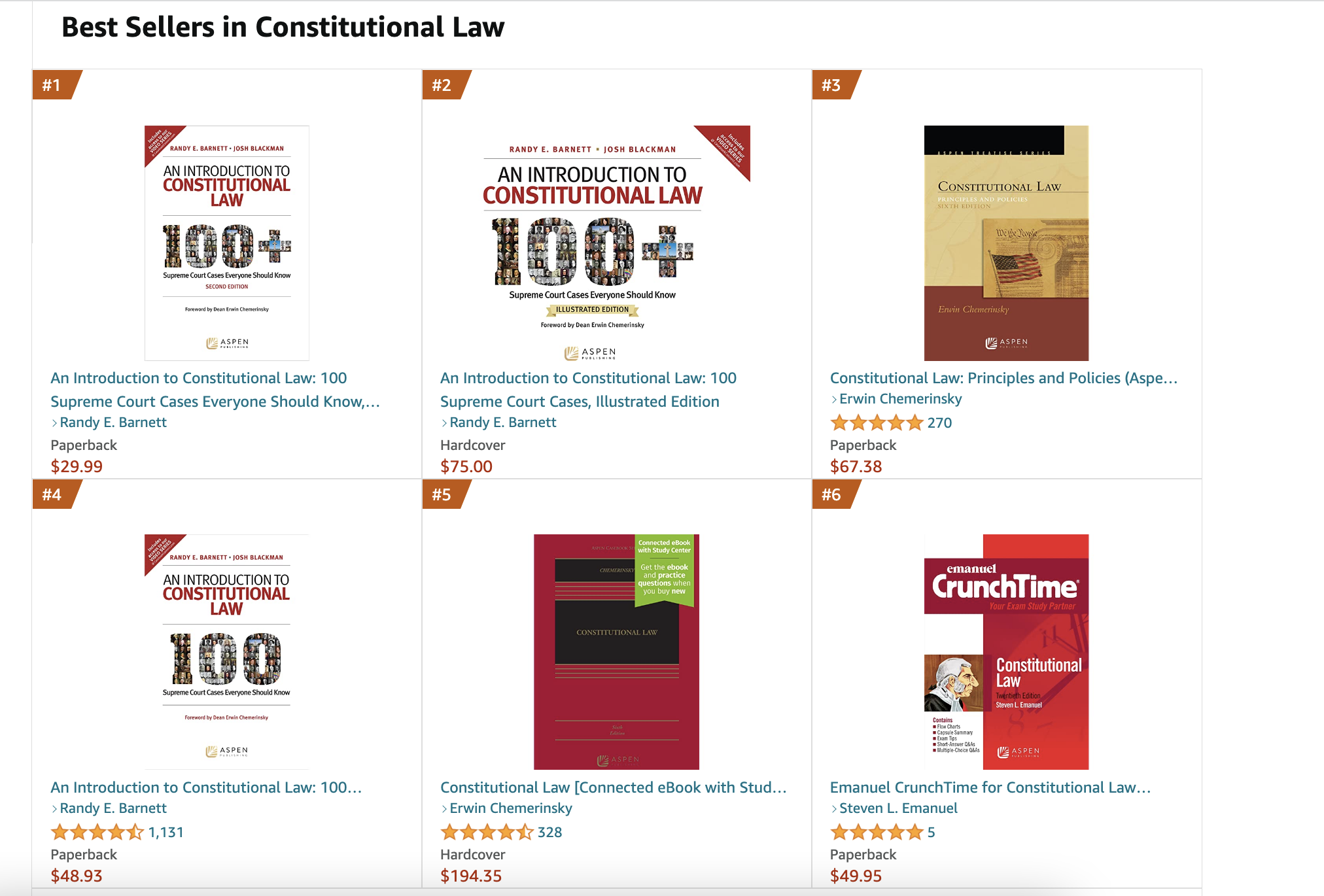
Our books have already shot to the top of Amazon's best-seller category for Constitutional Law books. We occupy three of the top four slots.

Abortion

Abortion in the States

|

Michigan voters voted 56.7% to 43.3% (with >95% of votes in, see N.Y. Times) to enact a state constitutional right to reproductive freedom, which would cover abortion rights; California and Vermont voters supported the same, but those states already broadly allow abortions.

Voters in Kentucky (where abortion is generally illegal) appear to have rejected (52.4% to 47.6%, with 91% in) a constitutional amendment that would keep the Kentucky courts from interpreting the Kentucky Constitution as securing a constitutional right to abortion. Recall that in August Kansas voters declined to reverse a Kansas Supreme Court decision that had recognized a state constitutional right to abortion.

Dobbs returned decisions about abortion to the states, and this is what state voters are saying, at least in these states.

Free Speech

Unconstitutional for Court to Threaten Suspending Custody Rights for "Any Further Unfounded Allegations" of Abuse

The order “could encompass speech ... that [the mother] believe[s] valid and substantiated even if CPS ultimately determines that [it is] not.”

|

In Chandler v. Chandler, decided yesterday by the Washington Court of Appeals (Judge Linda Lee, joined by Chief Judge Rebecca Glasgow and Judge Bernard Veljacic), Child Protective Services had found that a father had sexually abused two of his daughters, but a Superior Court judge reversed, stating, "the Court is not convinced on a more probable than not basis that actual sexual abuse occurred." (This was apparently largely based on the testimony of "a licensed mental health counselor and mediator" who had "served as a reunification counselor and saw all members of the Chandler family"; you can read the opinion for more details that may explain why the court so held.)

Based on this, the court left the mother with primary physical custody, but gave visitation to the father, and added:

Any further unfounded allegations filed with Child Protective Services by or at the instigation of [mother] will be grounds for suspension of her rights under this Order when those allegations are brought to the Court's attention by a motion.

The Court of Appeals, however, reversed that order, reasoning:

The First Amendment to the United States Constitution prohibits government interference with a person's "freedom of speech" or a person's "right … to petition the Government for a redress of grievances." "Although the right to free speech and the right to petition are separate guaranties, they are related and generally subject to the same constitutional analysis." Neither the right to free speech nor the right to petition the government protects harassing or libelous speech. In re Marriage of Meredith (Wash. App. 2009)….

Read More

Executive Power

Yale Journal on Regulation Symposium on Peter Shane's "Democracy's Chief Executive"

Participants include Daniel Farber, Keith Whittington, Cristina Rodriguez, Lisa Heinzerling, and myself, among others.

|

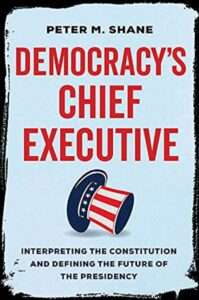
The Yale Journal on Regulation is hosting a symposium on Peter Shane's important new book, Democracy's Chief Executive: Interpreting the Constitution and Defining the Future of the Presidency. They have already posted contributions by VC co-blogger Keith Whittington (Princeton), Daniel Farber (UC Berkeley), Cristina Rodriguez (Yale), Gillian Metzger (Columbia), and several others, including myself.

Here's an excerpt from my contribution:

Peter Shane's Democracy's Chief Executive is a formidable challenge to much conventional wisdom about presidential power – particularly, but not exclusively, on the right. At the very least, it casts serious doubt on traditional originalist arguments in favor of an executive that is both "unitary" and endowed with broad substantive authority across a wide range of issue areas. He also explains how presidential power in many domains has exceeded constitutional bounds, and grown to dangerous levels…..

In this assessment, I advance two points, one an extension of his thesis, the other a critique. The former focuses on presidential efforts to usurp Congress' power of the purse, an issue largely ignored in Shane's book. The latter focuses on the tension between Shane's support of relatively tight limits on presidential power and his largely uncritical endorsement of broad views of the total scope of federal authority under the Constitution, particularly under the Commerce Clause. The same point applies to his rejection of constraints on Congress' power to delegate regulatory authority to the executive….

While Shane notes several other ways in which the Trump Administration pushed beyond previous limits on executive power, he overlooks its usurpation of the spending power. Using a variety of executive orders, lawsuits, and Justice Department policies, the administration repeatedly sought to impose conditions on federal grants to state governments that were not authorized by Congress….

Trump also famously tried to use a national emergency declaration to divert military funds to the construction of his border wall, despite Congress' repeated refusal to fund this project….

President Biden has used Trump-like exploitation of emergency powers to forgive hundreds of billions of dollars in student loan debt – an action with many parallels to Trump's border wall diversion, including the highly strained nature of administration claims that the policy has statutory authorization….

Executive usurpation of the spending power….. would give the president a powerful stick with which to reward allies and punish political adversaries, and bend recalcitrant state governments and private interest groups to his will…..

While the spending power issue can readily fit within Shane's thesis that presidency needs to be curbed, his embrace of extremely broad theories of federal power undercuts it…..

If the federal government can legislate on virtually anything that might be considered a "national problem" in some sense, we end up with the status quo, in which it can ban the distribution or possession of almost anything…. With such extensive regulation of almost every human activity, it is inevitable that much authority will be delegated to the executive, thus giving the president vast power….

This, in turn, undercuts the democratic accountability and deliberation Shane advocates. As he recognizes, most voters pay little attention to government and public policy, and often do not even know such basic things as the names of the three branches of government.  Most are "rationally ignorant" about politics; due to the very low likelihood that any one vote will change an electoral outcome, few voters devote more than minimal time and effort to learning about public policy.

The larger and more complex the federal government, the more likely that most of its functions -including those performed by the executive – will escape meaningful democratic accountability. Indeed, most of the electorate won't even know about most of them. And the more the president will wield dangerously unaccountable power.

There will be some additional contributions to the symposium over the next few days, and Prof. Shane will post a response to the participants.

One Year Later

The sky did not fall after the Supreme Court exited the abortion debate.

|

Exactly one year ago, the Federalist Society held its National Lawyers Convention. And exactly one year ago, the Supreme Court was enmeshed in the abortion debate on two fronts. First, Jonathan Mitchell, also known as "The Genius," foisted the impermeable fetal heartbeat law on the judiciary. Second, Mississippi's fifteen-week abortion ban was slated for oral argument. At the time, we were warned about the parade of horribles that would fall if the Supreme Court allowed either of these laws to go into effect.

One year later the story looks very different--especially after election day. In Kansas, voters rejected a ballot measure that would have reversed a state supreme court decision that protected abortion. And all the justices who joined that opinion, as well as several other justices appointed by the Democratic governor, were retained. Voters in several states also rejected efforts to scale back abortion rights. In Kentucky, 53% of voters rejected a referendum that would have stated there was no right to abortion under the state constitution. In Montana, 53% of voters rejected a "born alive" amendment to the state constitution. In Michigan, 56% of voters approved a referendum that protects a right to abortion, and wipes out a 1931 law that banned the procedure.

Justice Scalia's clarion call in Casey rings true three decades later:

Quite to the contrary, by foreclosing all democratic outlet for the deep passions this issue arouses, by banishing the issue from the political forum that gives all participants, even the losers, the satisfaction of a fair hearing and an honest fight, by continuing the imposition of a rigid national rule instead of allowing for regional differences, the Court merely prolongs and intensifies the anguish. We should get out of this area, where we have no right to be, and where we do neither ourselves nor the country any good by remaining.

Justice Breyer should be proud that Dobbs is making democracy work.

As a general matter, I no longer pay attention to predictions that the sky will fall after a conservative Supreme Court victory. The sky did not fall after Heller. The sky did not fall after Citizens United. The sky did not fall after Shelby County. The sky did not fall after Hobby Lobby. The sky did not fall after Rucho. And so on. The sky will not fall after Dobbs.

Some Thoughts on Last Week's Oral Argument in the Affirmative Action Cases

|

I was asked to give some brief remarks on the affirmative action cases at a panel discussion at the University of Baltimore today. I typed up some notes, and I thought they were worth sharing:

  • I think at least seven Justices, including Kagan on the left, converged on the notion that given the requirement of strict scrutiny for racial classifications, that use of such classifications for admissions must be narrowly tailored to serve a compelling interest—that universities must seriously consider and to a significant extent exhaust non-racial alternatives to achieve diversity before using racial preferences. If Kennedy and O'Connor were still the swing votes, I could imagine a narrow opinion along those lines, saying that Harvard's and UNC's admissions policies did not pass strict scrutiny because they did not properly explore and try race-neutral alternatives, such as eliminating alumni preferences.
  • But I don't expect such a narrow opinion. First, the Court has grown more conservative. Second, I think the conservatives gave the clear impression that they think the defendants and similarly situated schools have been openly cheating—the Court keeps telling them they need to use race is a narrowly tailored way, and they keep acting as if the Court told them they could do whatever they want so long as they don't use hard quotas. Unlike Justice O'Connor in Grutter and Justice Powell in Bakke before her, I don't think anyone in the current majority trusts universities to obey any rule that provides any wiggle room. It doesn't help that the conservative Justices are personas non grata at elite universities these days. Recall that Justice Kavanaugh was teaching at Harvard until totally unsubstantiated allegations of a decades-old sexual assault were leveled against him, at which point he lost that gig. The Justices' ties to the elite establishment are much weaker than they once were.
  • I thought it was a terrible strategy by UNC's lawyer, and Harvard's to a lesser extent, to deny that race can be a dispositive factor in admission. You can't with a straight face argue that race is never dispositive, but banning the university from considering race will lead to a plunge in diversity. That's mathematically impossible.
  • The Court was much more interested than it has been in previous cases as to whether the classifications used by the universities are coherent and really are diversity-enhancing. Justice Alito pressed UNC's lawyer on why it makes sense to use "Asian American" as a diversity classification when it encompasses everyone from Afghans to Filipinos (though in fact Afghans are officially white, but you could substitute Pakistanis). Justice Kavanaugh asked which box Middle Eastern Americans should check off, I think trying to raise the point that many people think of Middle Easterners as people of color who would add to diversity, but are classified by the Common App and by universities as white. Remarkably, the attorney claimed not to know the answer, even though the Common App specifically puts Middle Easterners into the white category.
  • More generally, there has been a real shift from the dynamics of Bakke in 1978 to the situation today. In Bakke, while most students admitted into the quota program in that case were Chicano or Asian American, the debate was almost entirely over whether affirmative action may be used to make up for discrimination against African Americans, with slots that would have otherwise gone to white applicants. In the last 44 years, the US has grown much more ethnically and racially diverse, such that 25% of the 18 year population is Hispanic compared to 15% African American, and Asian Americans, around 1% of the population in 1978, are now more like 7%, and draw from an incredible array of countries and cultures. This really complicates the debate, as the beneficiaries of affirmative action are no longer primarily black Americans, and at least in elite university admissions, those who may be subject to higher standards in admissions are often Asian rather than white, and Harvard in particular seems to make it more difficult for people classified as Asian to be admitted than whites.
  • Justice Kavanaugh, interestingly, suggested a possible compromise that brings us back the original impetus for affirmative action. He asked whether universities could implement a preference for descendants of American slaves, as a non-racial classification that would therefore not be subject to strict scrutiny.
More