The Volokh Conspiracy

Mostly law professors | Sometimes contrarian | Often libertarian | Always independent | Est. 2002

The Volokh Conspiracy

Free Speech

Eighth Circuit Upholds Iowa Law Increasing Trespass Penalties When Trespasser Uses Recording Device

|

From today's opinion in Animal Legal Defense Fund v. Reynolds by Judge Grasz, joined by Judges Colloton and Kobes:

Iowa enacted a trespass-surveillance law penalizing anyone who, while trespassing, "knowingly places or uses a camera or electronic surveillance device that transmits or records images or data while the device is on the trespassed property[.]" …

The Act applies only when there has first been a "trespass" as defined in Iowa Code § 716.7(2). When a general trespass does not involve injury to a person or property damage over $300, Iowa punishes the offense as a "simple misdemeanor," with a fine between $105 and $855 and up to thirty days of imprisonment. The Act, however, punishes a first offense of trespass-surveillance as an "aggravated misdemeanor," with a fine between $855 and $8,540 and up to two years of imprisonment. The State argues these steeper penalties are, in part, meant to deter would-be trespassers from placing or using recording devices, in addition to protecting the privacy interests of Iowans on their private property….

Because freedom of speech includes expression through the making and sharing of videos, we assume without deciding that the use of a camera while trespassing implicates the First Amendment as protected activity. We must then review the statute by applying the appropriate level of scrutiny. As the district court correctly assumed, Plaintiffs' facial challenge to the Act should be reviewed under intermediate scrutiny because the Act represents a content-neutral time, place, and manner restriction.

Read More

Upcoming Speaking Engagements [Updated]

Ilya Somin's speaking engagements for the Spring 2024 semester. Most are free and open to the public.

|

NA

This post is a list of my upcoming speaking engagements for the Spring 2024 semester. Unless otherwise noted, all events are free and open to the public—and in person.  The listed times are those in the time zone where the event is being held.

I may add additional events and information to this post, over time.

In the meantime if your university, think tank, research institute or other similar organization would like to invite me to speak (either virtually or in person) on any topic within my expertise, I am open for business! You can get an overview of the issues I write and speak about at my website.

Jan. 9, 12:00-1:15 PM, Brigham Young University Law School, Provo, UT: "The Case for Disqualifying Trump Under Section 3 of the 14th Amendment." Debate with Prof. Kurt Lash. Sponsored by the BYU Federalist Society.

Jan. 10, 2-3 PM, Competitive Enterprise Institute, Washington, DC: "The Case Against Nationalism." This event is by invitation only, I believe.

Feb. 1, noon-1 PM (tentative time), University of Dayton School of Law: "A Qualified Defense of the Major Questions Doctrine." Sponsored by the Dayton Federalist Society.

Feb. 8, 1:15-2:15 PM, University of Michigan, Ross School of Business,  Rm. 0420, 701 Tappan Street, Ann Arbor, MI: "Free to Move: Foot Voting, Migration, and Political Freedom." Sponsored by the Adam Smith Society.

Feb. 9, 12-1PM, University of Michigan Law School,  Hutchins Hall, Room 138, Ann Arbor, MI: "Sanctuary States of the Left and Right: A Defense of Liberal Immigration Sanctuaries and Conservative Gun Rights Sanctuaries." Sponsored by the Univ. of Michigan Federalist Society.

Feb. 15, noon-1:15 PM (tentative time), Case Western Reserve University Law School, Cleveland, OH: "The Free Market Case for Open Borders Immigration" (tentative title). Sponsored by the Case Western Federalist Society.

Feb. 22, noon- 1 PM, University of North Carolina Law School, Chapel Hill, NC: "Rights and Wrongs of State Preemption of Local Government Policy" (debate with Prof. Rick SU). Sponsored by the UNC Federalist Society.

Feb. 29, noon-1 PM, Scalia Law School, George Mason University, 3301 Fairfax Dr., Arlington, VA, Rm. 120: "Is Trump Disqualified From Office." Panel with Debra Perlin (Citizens for Responsibility and Ethics in Washington, the organization litigating Trump v. Anderson on behalf of the plaintiffs) and John Maier (CREW). Sponsored by the George Mason University American Constitution Society (ACS).

Mar. 6, 12:45-2:00 PM: Boston University School of Law, Boston MA, 765 Commonwealth Ave, Rm. 204: "The Constitutional Case Against Exclusionary Zoning." Sponsored by the BU Federalist Society.

Mar. 6, 4:20-5:40 PM, Law and Economics Workshop, Boston University School of Law, Boston MA: "The Constitutional Case Against Exclusionary Zoning." This event is likely limited to faculty and other invitees. It will focus on different aspects of the article than the Federalist Society event earlier the same day.

April 2, 12-1 PM, Scalia Law School, George Mason University, Arlington, VA, Hazel Hall, Rm. 120: "The Criminal Cases Against Trump." Sponsored by the George Mason Criminal Law Society.

April 5, 10:30-11:00 AM, University of Denver, Denver, CO: "Takings, the Police Power, and the Right to Use," Conference on "The Origins, Justification, and Implications of the Right to Property."

April 11, 11:40 AM-1 PM, MIT Sloan School of Management,  Rm. E62, 100 Main St,  Cambridge, MA: "Free to Move: Foot Voting, Migration, and Political Freedom." Sponsored by the MIT Adam Smith Society.

April 23, 12-1 PM, Schar School of Policy and Government, George Mason University, Van Metre Hall, Rm. 111, 3351 Fairfax Dr., Arlington, VA: "The Constitutional Case Against Exclusionary Zoning," Panel on "Solving the Nation's Housing Shortage." The other panelists will be Prof. Bryan Caplan, author of Build, Baby, Build: The Science and Ethics of Housing (George Mason University), and Jerry Howard (former Director of the National Association of Home Builders). UPDATE: This event has been postponed till September, for scheduling reasons. I will post the new date and time when it is set.

Supreme Court

Supreme Court Takes a Pass on Minnesota Climate Change Case

Only one justice indicated any interest in premature consideration of state-law climate change lawsuits.

|

Today the Supreme Court denied certiorari in American Petroleum Institute v. Minnesota, in which energy companies were seeking to remove state-law claims against energy companies from state to federal court. Thus climate change is not returning to the Supreme Court (at least not yet).

For reasons I explained last month (and reiterated here), the Supreme Court's denial of certiorari was totally warranted. The energy companies' arguments are largely based upon the claim that climate-change-based tort claims necessarily implicate federal law, and are ultimately preempted. As I have explained at length, and has been recognized by virtually every circuit court judge to hear such claims (most recently by a three-judge panel on the D.C. Circuit), that is just not so. And absent a circuit split, there was simply no reason to take this case (though other climate-related cases may find themselves on the Court's orders docket in due course).

As noted on the orders list, one justice -- Justice Kavanaugh -- would have granted the petition for certiorari. As I have noted before, Justice Kavanaugh has repeatedly indicated an interest in hearing cases that did not interest his colleagues.

Free Speech

No Sealing for Defendant After Pro Se Plaintiffs' Sex Trafficking Allegations Were Dismissed

A good illustration of the strong policy of openness in American court cases, even when defendants argue that unfounded allegations in court records are intruding on their privacy and damaging their reputations.

|

In Magistrate Judge Daphne Oberg's decision Thursday in Schur v. Berntsen, self-represented plaintiffs had sued, "generally alleging Defendants are involved in 'sex trafficking, … labor traf[f]icking, harass[ ]ment, [and] hate crimes.'"

In this case, Plaintiffs alleged Nathan Schur met Ms. Berntsen through a dating application and Ms. Berntsen later sexually assaulted him, filed a false police report about him, threatened him with guns registered to another person, and "continued harassing [him] and asking for sexual favors." They alleged both defendants filed a protective order against Mr. Schur, "making him fear for his safety in the state of Utah." They further alleged Ms. Berntsen "intimidated Mr. Schur and his family in their political asylum case." According to the complaint, Mr. Schur obtained his green card in 2015 but Ms. Berntsen then tried to interfere with his citizenship "with her attempts to turn [Mr.] Schur into a sexual slave." Plaintiffs also allege [plaintiffs] Ana Maria Ravines de Schur (Mr. Schur's mother) and Jessica Johannes were traumatized by Ms. Berntsen's threats against Mr. Schur and by viewing a video of the assault.

The case was dismissed in 2022, largely because plaintiffs had alleged violations of criminal statutes that didn't provide for civil enforcement in private lawsuits, and because the allegations didn't support any claim "under 18 U.S.C. § 1595, which provides a private right of action for victims of slavery and trafficking":

The complaint alleges Mr. Schur was sexually assaulted and harassed, but it does not allege the defendants held him in a condition of peonage, involuntary servitude, or forced labor. And a general allegation that Ms. Berntsen is attempting to make Mr. Schur a "sexual slave" is insufficient to allege the defendants are guilty of or benefitted from trafficking him into slavery. Additionally, the complaint does not allege that either Ms. Ravines de Schur or Ms. Johannes are victims of slavery or trafficking by the defendants—and 18 U.S.C. § 1595 only provides a private right of action for victims. For these reasons, the complaint fails to state a claim under 18 U.S.C. § 1595. And the court is unable to conceive of any other federal cause of action under which the complaint could state a claim.

(Presumably the plaintiffs could sue for ordinary torts, such as battery, but they didn't do so, presumably because such a claim would have had to be brought in state court.) A year later, defendant sought to have the case sealed, but the Magistrate Judge said no:

Ms. Berntsen alleges she and her son … have been victims of Mr. Schur's harassment and Ms. Berntsen is the repeated victim of domestic violence by Mr. Schur. She asserts she has a protective order against Mr. Schur, which he has violated….

Read More

Parental Rights

May Court Suspend Father's Supervised Parenting Time Until Father Gives Password to Thumb Drives That Might (or Might Not) Contain Child Pornography?

The father had an earlier history of sexually assaulting children.

|

From Dekarske v. Lopez, decided Dec. 28 by the Michigan Court of Appeals (Judges Redford, Shapiro, and Yates), which holds that the suspension of supervised parenting time on these grounds was improper:

In 2000, plaintiff was convicted, by a plea of no contest, of fourth-degree criminal sexual conduct (CSC-IV), for which he served five years of probation and completed a sexual rehabilitation program. The parties met in 2016 through an online dating site. Plaintiff disclosed his prior conviction to defendant on their first date, but misrepresented the underlying circumstances. Plaintiff told defendant that, when he was 17 years old, he had sexually abused an 11-year-old girl. In fact, plaintiff sexually abused his half-sister, who was three years old at the time, approximately 30 times.

The parties moved in together in 2017. At that time, defendant had a nine-year-old son, BL, who also resided with the parties. The parties have one child together, CAD, who was born in 2019.

In 2022, defendant discovered the "presentencing report documents" describing the true nature of plaintiff's CSC-IV conviction, and also sexual assaults that he committed on two other children before his conviction in 2000. Defendant, who was concerned that plaintiff had sexually abused CAD and BL, took pictures of those documents and three USB thumb drives to the police, and also contacted Children's Protective Services. The parties' cohabitation and relationship ended around that time.

Detective Kelly Ebersole testified that she was told the drives were encrypted or password-protected, and she contacted plaintiff to obtain the passwords to ensure there was nothing illegal on them before returning them. Plaintiff made approximately 60 attempts to communicate with Ebersole, and, when they finally communicated, plaintiff "became very irate" and refused to provide any passwords, telling Ebersole that she needed to contact his lawyer and to get a search warrant.

Read More

The January 6th Riot Was Not Like the Civil War

A Response to Ilya Somin

|

Ilya Somin has responded to my post yesterday by denying that Section Three of the Fourteenth Amendment only applies to Insurrections and Rebellions that are akin to the Civil War.  He suggests it would have applied to Shay's Rebellion or the Whiskey Rebellion had Section Three been in the Constitution when those rebellions occurred.

Yale Law Professor Jed Rubenfeld has written wisely that all constitutional clauses are written with a paradigmatic wrong that is meant to be righted.  The Fourth Amendment "right" to be from unreasonable searches and seizures was meant to right the "wrong" of the British colonial general warrants authorizing sweeping searches of colonial warehouses to look for smuggled goods.  The Free Exercise Clause was written to prevent the "wrongs" done to Quakers who were executed for heresy by the Massachusetts Bay Colony, and the exclusion from the franchise of Catholics and Jews by the British government.

The paradigmatic "wrong" underlying Section Three of the Fourteenth Amendment was an insurrection and rebellion during the U.S. Civil War that led to the deaths of between 620,000 and 850,000 Americans.  That was 2.5 percent of the population or the equivalent of 7 million people today.  Section Three does apply to future "insurrections or rebellions", but they have to be analogous in some way to the Civil War.  This is the sense in which the words "insurrection or rebellion" are used in the Fourteenth Amendment.

The January 6th riot let to the death of 5 people, two of whom died of heart attacks.  No rioter brought guns to the riot in a country, which is awash in privately owned guns.  I am sure many members of the Proud Boys and the Oath Keepers owned guns, but they did not bring them to the ellipse on January 6th.  The alleged "insurrection or rebellion" lasted two and one half hours, peacefully dispersed on Donald Trump's request, and occurred in one city in the third most populous country on earth after India and China.  The casualties were much smaller than in the many mad gun shooting episodes, which have occurred in schools and other public places like Sandy Hook where 26 people died.

Neither the so-called Shays Rebellion  nor the Whiskey Rebellion would have triggered Section Three of the Fourteenth Amendment had it been the Supreme Law of the Land when those popularly labeled rebellions occurred.  The "insurrections or rebellions" contemplated by Section Three must be threats to the government akin to that posed by the U.S. Civil War.  The January 6, 2001 riot does not even remotely come close to reaching that level.

Donald Trump

Insurrection, Rebellion, and January 6: Rejoinder to Steve Calabresi [updated with brief further rejoinder]

"Insurrection" and "rebellion" should not be conflated. But the events of January 6 readily meet the criteria for both.

|

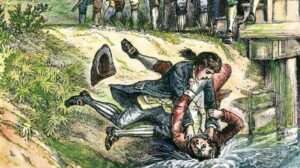
Shay's Rebellion (1786).


Steve Calabresi has posted an impressively swift response to my post explaining why the January 6, 2021 attack on the Capitol was an insurrection. But I remain unpersuaded. Steve's emphasis on the use of the word "rebellion" - in addition to "insurrection" - in Section 3 of the 14th Amendment only reinforces my point.

Steve relies on the legal rule of noscitur a sociis, which is the idea that words in a statute should be understood by reference to their "associates," in this case that "insurrection" should be understood as similar to "rebellion" because in Section 3 both occur in the same phrase ("insurrection or rebellion").  He then argues that "rebellion" is limited to uprisings on a scale comparable to the Civil War.

While it is reasonable to read the two words together, one can't be interpreted in such a way as to render the other redundant. That would violate another longstanding rule of legal interpretation: the canon against superfluity, which, as Justice Scalia and Bryan Garner explain in Reading Law, requires courts to give effect to "every word and every provision" in a law and to ensure that "none should be needlessly given an interpretation that duplicates another provision" (quoting US v. Butler (1936)). While "insurrection" and "rebellion" may overlap and be similar, it is perfectly plausible that one may include some uprisings too small to be included in the other. If they were completely identical, one term would be rendered superfluous.  Thus, my explanation of how the January 6 attack fits any plausible definition of "insurrection" (including Steve's own preferred definition from the 1828 Webster's dictionary) remains unrefuted.

In addition, the events of January 6 fit any plausible definition of "rebellion," as well - including, once again, Steve's own preferred definition. There is no reason to believe that a "rebellion" must be on a scale comparable to the Civil War, or anything like it. There is nothing incoherent or implausible about the idea of a small-scale rebellion that is quickly suppressed. Such rebellions are actually far more common than large and prolonged ones!

Consider the two most famous pre-Civil War events in American history generally labeled rebellions: Shay's Rebellion (1786-87), and the Whiskey Rebellion (1793). Both were on a scale similar to the January 6 attack. Each involved no more than a few thousand rebels (only about 600 in the case of the Whiskey Rebellion; many fewer than January 6). Each occurred in one part of just one state (western Massachusetts and western Pennsylvania, respectively). The number of combat fatalities (9 for Shay's Rebellion, 3-4 for the Whiskey Rebellion, 5 on January 6) is also similar.

The two 18th century uprisings did take longer to suppress than January 6 did. But that was in large part because a comparable number of rebels were spread over a larger area. Plus, the military response to the two revolts was slow to develop and eighteenth century transportation technology made it harder to move troops quickly than is the case today.

I would add that the objectives of Shays Rebellion (debt relief) and the Whiskey Rebellion (repealing the federal whiskey tax) were more limited than those of the January 6 rebels (seizing control of the most powerful office in the land and denying it to the rightfully elected candidate). In that respect, January 6 was actually more clearly a rebellion than either of the other two.

Relying again on the 1828 Webster's Dictionary, Steve defines "rebellion" as "An open and avowed renunciation of the government to which one owes allegiance; or the taking of arms traitorously to resist the authority of lawful government; revolt." The January 6 attack easily falls within this definition. The people who attacked the Capitol clearly took "up arms" and "resist[ed] the authority of the lawful government." Indeed, their purpose was to enable Trump to illegally continue to wield that authority.  The fact they believed it rightfully belonged to him does not change the nature of their actions, for reasons I outlined in a previous post. Notice also that Steve's preferred definition indicates no minimum scale that an uprising must reach before it can be considered a "rebellion." A small "revolt" qualifies no less than a big one.

Steve asks whether, under my approach, the 2020 "Black Lives Matter" riots also qualify as insurrections. In my view, the answer is probably not, because the rioters did not seek to take control of the powers of government. Unlike the participants in the Whiskey and Shays' rebellions, most didn't even seek the repeal of specific laws. But if some did seize government power (the case of the "CHOP" group, which took control of parts of the Seattle for several weeks may be an example), then their actions do qualify as "insurrection." I have no problem biting that bullet.

Of course, only those participants who previously held various types of public offices can be disqualified under Section 3. Some Seattle officials apparently helped CHOP. If Steve - or anyone else - wants to get these people disqualified from future office-holding under Section 3, I think they might have a good case.

In sum, January 6 was an insurrection - including under Steve's preferred definition of that term. And, to the extent it matters, it probably counts as a "rebellion" as well.

UPDATE: Steve Calabresi has posted an additional rejoinder responding to this post here. He argues that Section 3 applies only to "rebellions" or "insurrections" that are comparable in scale to the Civil War, which is the "paradigm" case the section was intended to address. But Section 3 speaks in general terms of insurrection and rebellion, and requires disqualifying all covered government officials who "engage" in them. That strongly suggests it was meant to apply to all insurrections and rebellions, not just some subset that may be seen as similar to the Civil War. Steve provides no textual or original meaning evidence to the contrary.

It would make little sense to exempt insurrectionists from the ban merely because their attempts to overthrow the government were ineffective and relatively easily crushed. The whole point of Section 3 is to prevent such people from getting a second chance to subvert the republic. People who try one insurrection that fails miserably may be more effective the next time around! They could even learn from their previous mistakes.

The Constitution has many provisions that were enacted in response to a "paradigm" case (or cases), but nonetheless apply more generally. The Fourteenth Amendment's restrictions on racial and ethnic discrimination was enacted in response to southern states' oppression of blacks, but nonetheless protects other groups, too, and ban state-sponsored racial discrimination that takes forms different from those of the Black Codes of the 1860s. The First Amendment was enacted in response to specific types of censorship and oppression of religious minorities practiced by eighteenth century Britain, but nonetheless protects freedom of speech and religion more broadly.

Finally, it is not true the mob attacking the Capitol "peacefully dispersed on Donald Trump's request." They fled because they were defeated after extensive fighting, and reinforcements arrived to assist the initially overwhelmed Capitol Police. Trump did not issue any request to disperse until after it was clear that the attack he inspired was on its way to defeat. Until that point, evidence indicates he was cheering on the mob (much of it summarized by the Colorado Supreme Court in its Section 3 decision), and trying to use the attack as leverage to pressure members of Congress into refusing to certify the election results.

At this point, we are probably in the realm of diminishing returns in this exchange. I will leave off, unless some significant new point is raised. Many thanks to Steve for his insights.


January 6, 2021 Was Not an Insurrection

Noscitur a sociis.

|

Justice Antonin Scalia, one of the leading originalists and textualists of the modern era ended his career by publishing with Bryan A. Garner a 2012 treatise Reading Law: The Interpretation of Legal Texts.  In his treatise, Scalia urges lawyers to go back to using the canons of interpretation, which the legal realists sarcastically scorned.  As it happens, there is a canon of interpretation, which is very relevant to what the word "insurrection" means in Section 3 of the Fourteenth Amendment, which Ilya Somin's post today conveniently overlooks:  noscitur a sociis -- The meaning of an unclear or ambiguous word in a legal text should be determine by considering the words with which it is associated in context.

The word "insurrection" in Section 3 appears as part of the phrase "insurrection or rebellion" in a text that had as a paradigmatic example the U.S. Civil War in which 620,000 Americans at a minimum died and possibly as many as 850,000 according to more modern estimates.  This amounts to about 2.5% of the population, which today would be 7 million people.

In contrast 5 people died in the January 6, 2021 riot at the Capitol.  This difference in scale is enormous!  More people died in the 1960's race riots and no-one called them an insurrection.  Thirty-four people, for example died in the Watts Los Angelos riot in 1965 and more than a thousand were injured.

If the January 6th riot was an insurrection are Black Lives Matters protests also insurrections with the result that those who participate in such protests cannot run for political office? Read More

Donald Trump

The January 6 Attack was an Insurrection

And it isn't a close case.

|

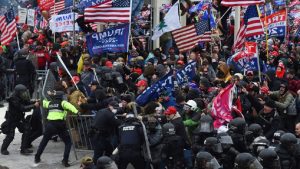
The attack on the Capitol. January 6, 2021. (NA)


Today is the third anniversary of the January 6, 2021 attack on the Capitol, intended to keep Donald Trump in power after he lost the 2020 election. One of the points at issue in the Supreme Court case considering whether Trump should be disqualified under Section 3 of the Fourteenth Amendment is whether the events of that day qualify as an "insurrection." It should be an easy call. The January 6 attack was an insurrection under any plausible definition of that term.

As legal scholar Mark Graber shows, contemporary definitions of "insurrection" prevalent at the time the Fourteenth Amendment was enacted were quite broad: possibly broad enough to encompass any violent resistance to the enforcement of a federal statute, when that resistance was motivated by a "public purpose." That surely includes the January 6 attack!

I'm not convinced courts should actually adopt such a broad definition. It could set a dangerous precedent. As Graber notes, on that theory people who violently resisted enforcement of the Fugitive Slave Act qualify as insurrectionists, too. But January 6 was an insurrection even under a narrow definition that covers only violent attempts to illegally seize control of the powers of government. After all, the attackers were using force to try to keep the loser of the 2020 election in power, blocking its transfer to the rightful winner. If that isn't a violent attempt to seize government power, it's hard to know what is.

It's true many of those who participated thought they were acting to support the rightful winner of the election, and thus believed they weren't doing anything illegal. But much the same could be said of the ex-Confederates who were the original target of Section 3. Most of them believed their states had a constitutional right to secede, and they had much better grounds for that belief than Trumpists ever had for the utterly indefensible claim that the election was stolen from him (one uniformly rejected in numerous court decisions, including by judges appointed by Trump himself).

It is sometimes claimed that the mob attacking the Capitol was unarmed or not violent enough to qualify as an insurrection. That would be news to the five people who were killed, and the over 140 police officers injured. There could easily have been many more fatalities had the attackers been more successful in carrying out their plans to "hang Mike Pence" and kill members of Congress (Pence and the members managed to escape). And it just isn't true that the mob was unarmed. After extensive consideration of evidence, Colorado courts found otherwise:

[C]ontrary to President Trump's assertion that no evidence in the record showed that the mob was armed with deadly weapons or that it attacked law enforcement officers in a manner consistent with a violent insurrection, the district court found—and millions of people saw on live television, recordings of which were introduced into evidence in this case—that the mob was armed with a wide array of weapons…. The court also found that many in the mob stole objects from the Capitol's premises or from law enforcement officers to use as weapons, including metal bars from the police barricades and officers' batons and riot shields and that throughout the day, the mob repeatedly and violently assaulted police officers who were trying to defend the Capitol…. The fact that actual and threatened force was used that day cannot reasonably be denied.

Co-blogger and prominent conservative law professor Steve Calabresi is nonetheless unconvinced January 6 was an insurrection. He relies on a definition of "insurrection" from the 1828 edition of Webster's Dictionary:'

A rising against civil or political authority; the open and active opposition of a number of persons to the execution of a law in a city or state. It is equivalent to sedition, except that sedition expresses a less extensive rising of citizens. It differs from rebellion, for the latter expresses a revolt, or an attempt to overthrow the government, to establish a different one or to place the country under another jurisdiction. It differs from mutiny, as it respects the civil or political government; whereas a mutiny is an open opposition to law in the army or navy. insurrection is however used with such latitude as to comprehend either sedition or rebellion.

The events of January 6 fit this definition to a T! The attack on the Capitol was obviously "A rising against civil or political authority" and even more clearly "the open and active opposition of a number of persons to the execution of a law in a city or state." The mob incited by Trump sought to prevent the "execution" of the laws requiring transfer of power to the winner of the election.

Calabresi suggests that the January 6 attack fits the definition of a "riot." Perhaps so. But "riot" and "insurrection" aren't mutually exclusive concepts. An event can be both at the same time. Indeed, that's a common occurrence in history.

Calabresi and others also argue that the attack wasn't large enough to qualify as an insurrection because, as he puts it, the attack "occurred for three-and-one-half hours in one city only in the United States, Washington D.C., and not as an overall insurgency in multiple cities across the United States." But the definition he himself cites indicates that an insurrection is "the open and active opposition of a number of persons to the execution of a law in a city or state" (emphasis added). That suggests one city is enough.

And there is no historical or modern evidence indicating that an insurrection has to last some minimum length of time. A revolt that is quickly put down can still be an insurrection. The same goes for one that is poorly planned and easily defeated.

If actions in multiple cities are required, a great many attempted coups and armed revolts would not count as "insurrections." It is common for attempts to seize power to focus on the capital city where the government is located. If the revolt is put down, it may not spread elsewhere. But that doesn't mean it was not an insurrection.

The Bolshevik seizure of power in Russia in 1917 initially involved just the capital city of St. Petersburg. If the Provisional Government had managed to swiftly crush it, thereby preventing it from spreading to other cities, would that mean it wasn't an insurrection?

Do Steve and others who advance similar reasoning believe Adolf Hitler's 1923 Beer Hall Putsch  was as an insurrection? Like the January 6 attack, it lasted only about one day (evening of Nov. 8, 1923 to the evening of the following day), and was limited to a single city (Munich, the capital of the German state of Bavaria). The number of participants (several thousand; 1265 people have been charged with offenses related to the attack on January 6, and many other participants likely got away without being identified or charged) and the number of people injured was also similar to that of January 6.

There were somewhat more fatalities (21) in the Beer Hall Putsch. But 16 of them were  participants in the coup (the others were four police officers and a civilian bystander). The Bavarian police and troops who put down the revolt were less restrained in their use of force than US law enforcement officers on January 6 (who only killed one of the attackers). That surely isn't a decisive difference between the two cases. More aggressive law enforcement action cannot by itself transform a mere "riot" into an insurrection.

It seems obvious that both the Beer Hall Putsch and the January 6 attack were insurrections, for the simple reason that both involved the use of force to illegally seize control of government power. It matters not how long they lasted, or that they were poorly planned and quickly put down. And it certainly doesn't matter that they both occurred in just one city.

There is an admittedly more difficult issue over the question of whether Trump "engaged" in the insurrection that occurred. I think the Colorado Supreme Court decision that the US Supreme Court will review dealt with that question persuasively. But Trump has a better argument on that point than on any other. His involvement, while substantial, was less clear and direct than, say, Hitler's in the Beer Hall Putsch or Lenin's in the Bolshevik revolt in Russia. But whatever might be said of Trump's level of involvement, there can be no serious doubt that an insurrection did occur.

UPDATE: I have made minor additions to this post.

UPDATE #2: Steve Calabresi responded to this post here. I have posted a rejoinder here.


Israel

Guest Post on Israeli Supreme Court Decision Striking Down Law Restricting Judicial "Reasonableness" Review of Government Policies

The post is by prominent Israeli legal scholar Ronit Levine-Schnur (University of Tel Aviv).

|

The Supreme Court of Israel recently invalidated a controversial law limiting judicial "reasonableness" review of government policies. I previously wrote about the law here. To analyze the decision, we are pleased to publish a guest post by prominent Israeli legal scholar Professor Ronit Levine-Schnur. She is a faculty member at the Law Faculty, and co-head of the Center for Applied Research of Risks to Democracy, at Tel Aviv University. We are grateful to Prof. Levine-Schnur for taking the time to share her insights on this important ruling, especially during this difficult period in Israel's history.

The remainder of this post is by Prof. Levine-Schnur, not me (Ilya Somin):

In the course of one year, Israel—an intense country on a regular basis—has been pushed to its foundational limits. As a Jewish and democratic state, Israel's internal and external conflicts have always been extensive. But 2023 was a year beyond the worst expectations. The October 7 sudden and repulsive attack, massacre, and kidnapping of civilians by Hamas, were horrific which targeted Israel as a Jewish state, and Israelis as Jewish (although not all the victims were). It brought back living memories of the Holocaust. One of many stories to mention is of that Dr. Hayim Katsman, who was shot dead while hiding in a closet at his home in Kibbutz Holit, exactly 80 years after his ancestors in Poland were deported and killed at the Treblinka extermination camp. Unfortunately, the horrendous events of October 7 (and its aftermath) came after 9 demanding months of a wholly different kind of attack on Israel's democracy.

On January 4, 2023, Israel's newly sworn-in government, presented its plan for a "governmentality reform." This plan, for both its supporters and opposers, targeted the democratic nature of the Israeli state. The supporters, primarily represented by the Justice Minister, Yariv Levin, and the Head of the Parliamentary Constitution Committee, MK Simcha Rothman, argued that Israel's democratic character is undermined by the Supreme Court, the Attorney General, and other gatekeepers, who prevent the government from executing the "people's will" by putting restraints on its power. To fix this, and to strengthen Israel's democracy, so they claimed, they advanced 5 central amendments, all of which aim to weaken the grip and independence of the judiciary and the gatekeepers as a means that balance the power of executive.

In the eyes of many, the proposed changes were not democracy-enhancing at all. If approved, they argued, Israel would no longer be considered a democracy, as their adaptation would lead to an unrestrained government. Even before all these changes were to be enacted, the executive branch in Israel already possessed extraordinarily powers compared to most democracies. It effectively controls the parliament and its lawmaking agenda (including the enactment of basic laws, as will be explained below), and it lacks all the constraints and checks and balances that exist in the U.S. and many other constitutional democracies (such as an entrenched constitution, bicameralism, presidential veto, federalism, etc.).

The government's plan for reform was supposed to be implemented as statutory amendments to Israel's Basic Laws. The term "Basic Law" has no formal meaning under Israeli legislation. Israel has no written  constitution, and in particular, there is currently no law that sets the rules for legislating and amending constitutional norms. There is no formal norm that differentiate the legislative procedure of ordinary laws and constitutional ones. This lack of formality is the result of a 75 year-long tradition of legislating portions of the emerging constitution as basic law, without this tradition itself being  properly legislated. While for many years basic laws were enacted on broad consensus and were rarely amended, in the past decade there has been an ongoing deterioration of this practice, where the pace of amendments lost control and the custom of broad consensus was abandoned. Basic laws were now often used to solve concrete political issues.

As an illustration, the average rate of amendments between 2014 and 2022 stood at 4.75 changes a year, compare with less than 0.15 changes a year on average in the USA (since 1789). Moreover, basic laws were now enacted or amended based solely on the vote of ruling coalition members, hence, without a consensus which crosses the coalition-opposition lines. As Justice Amit commented: "the Israeli constitution is extremely flexible, almost spineless, in a way that allows it to win the floor gymnastics world championship for constitutions." Thus, if a presiding government utilizes its legislative powers it can, almost overnight, enact any basic law it aims, ostensibly, even if it leads to a severe harm to Israel's nature as a Jewish and Democratic state.

The five components of the government's plan included: 1. Granting the government an absolute control over the appointment of judges and justices to all courts. 2. Preventing judicial review of basic laws. 3. Preventing or severely limiting judicial review of  regular Knesset legislation, and allowing the ruling coalition to "override" the effect of judicial review with its guaranteed majority in the Knesset. 4. Significantly diminishing the role of the Attorney General and government legal advisors as gatekeepers. 5. Preventing judicial review of the executive power of the government and its ministers based on unreasonableness grounds.

During the first 9 months of 2023, the government—who under the Israeli system controls the unicameral legislature (the Knesset)—pushed as hard as it could to legislate its reform. It faced, however, an unprecedented resistance, were for over 39 weeks, Israelis protested and disrupted as much as they could to the government's plan.

On July 24, despite the mass public protests, the objection of many legal, economic, military and other experts and former senior officials, and the decision of reservists in the air force and other units not to continue their voluntary military service if the law is amended, the "Unreasonableness Amendment" passed the second and third readings in the Knesset and became law. The law takes the form of an amendment to Section 15 of the Basic Law: The Judiciary. This section defines the jurisdiction of the Supreme Court sitting as a High Court of Justice to review governmental acts and decisions. According to the Amendment, no court of law, including the High Court of Justice, may consider and/or pass judgment on the reasonableness of any "decision" of the Cabinet, the prime minister, or any other minister; nor may a court give an order on the said matter based on its purported unreasonableness. The Amendment defines a "decision" as "any decision – including in matters relating to appointments, or a decision to avoid exercising any authority."

As the Israeli Law Professors' Forum for Democracy analyzed, the immediate danger of the Amendment is in the field of corruption, both in the use (or rather misuse) of public funds and in the field of government appointments and removal of officials from office. The principal immediate threat could be a government decision to dismiss the Attorney General who heads the state public prosecution, and to replace her with a lawyer who will be favourable to halting the prosecution of PM Netanyahu on charges of corruption. Another fear is that the Court will not be able to intervene in the refusal of the Minister of Justice to convene the Committee for the Selection of Judges. The more general danger, moreover, is that obliterating reasonableness as a legal standard would be seen by the government and its ministers as a general license to act unreasonably. The Amendment will weaken the power of legal advisers at all government levels to curb illegal, corrupt, and politically-motivated decisions. A principal tool for curbing such decisions and acts at the departmental level are legal advisors' warnings that such acts would likely be struck down by administrative courts on grounds of manifest unreasonableness. This crucial process of nipping institutional (as well as personal) corruption at the bud has now been eliminated, with no alternative mitigating measure instated in its place.

Indeed, the constitutionality of the Amendment was immediately put to test, and as the new year begun, the Supreme Court delivered its monumental decision, a first of its kind en banc case decided by all its 15 justices.

The Supreme Court faced the following questions:

  • Is the Knesset, as a constituent authority, limited in its powers to enact basic laws.
  • Assuming that the answer to the above question is affirmative, the following question is whether the court is authorized to conduct judicial review on basic laws, and whether it can determine that the Knesset exceeded its authority in enacting a basic law.
  • Assuming that the answer to the previous question is positive, the third question arises - did the Knesset deviate from its authority as a constituent authority in amending the "Unreasonableness Amendment," in a way that requires a declaration of the invalidity of the amendment. This question requires first to determine the correct interpretation of the amendment.

Of 15 justices, a majority of 13 ruled in the affirmative on the first two questions. Two other justices denied both the existence of limitations on the constituent power and the court's authority to review basic laws. Among the majority, there is some variation between the justices concerning the kind of limitations imposed on the constituent power, but they all agree that they are essentially concerned with Israel's nature as a Jewish and Democratic state. There is also some variation concerning the source of legitimacy for the court's power to conduct judicial review, but it essentially rests on either the "constitutional existentialist facts" or the Declaration of Independence, or on existing basic laws. Of the 13 justices, a few were more cautious  than others in crafting the scope of review.

This caution is reflected in that of the 13 justices mentioned, eight found the Amendment unconstitutional and void, in that it cannot be reconciled with the principles of separation of powers and the rule of law, "which are two of the most important characteristics of our democratic system. Such an infringement to the very heart of our founding narrative cannot stand" (Ret. Chief Justice Hayut). Justice Amit clarified that the Amendment should be assessed given "the democratic deficit in which the country is, which lacks 'engines of democracy' that exist in many countries in the world and which contribute to the strengthening of the democratic foundation." Thus, the Amendment "steps in the opposite direction and further strengthens the power of the executive authority… such a blanket denial of unreasonableness as a ground for judicial review has a much higher specific gravity than in other countries."

Three other justices found that the Amendment could be interpreted in such a way that makes its effect on Israel's democratic character below the unconstitutionality threshold. Here the interpretation adopted by the justices—which limits the unreasonableness doctrine denied by the Amendment to a strictly limited component of it (the balancing test)— is tricky. Both during the legislative process and in  oral testimony before the Court, MK Rothman clearly explained  that the subjective intention of the legislator is to deny the doctrine all together. For the three justices, who are usually considered as conservative ones, it was extremely important to avoid the more drastic step of annulling a basic law. Adopting the narrow interpretation, contra to the explicit intention of the legislator, seems to contradict their (especially one of them – Justice Alex Stein) commitment to a more originalist mode of interpretation.

To conclude, in its decision, the Israeli Supreme Court declared the first component of the judicial reform as an unconstitutional constitutional amendment. More importantly, in this landslide decision, the Supreme Court not only announced the limits of the Knesset as a constituent assembly, but also effectuated these limits by clearly positing it can announce basic laws as unconstitutional and void. The decision raises, of course, many questions and dilemmas. It will inspire endless accounts and analyses. The only hope is that instead of leading to a further divide among Israelis it would do the opposite. After this annus horribilis, many conceptions should be rethought. A good starting point in strengthening Israel's democracy, is in creating a joint mechanism involving members of both coalition and opposition, that would prepare a basic law which determines how constitutional norms are to be enacted. This would allow us to put the current Court's decision in proper perspective: it was the unavoidable outcome of a longstanding failure to properly establish the institutions that hold Israel's democracy intact.


Canada

Canadian Immigration Officials Block Citizenship Grant for Russian Immigrant Because She Was Convicted of the "Crime" of Speaking Out Against Russia's War of Aggression Against Ukraine

If the absurd decision stands, she could potentially be deported back to Russia, where she faces an 8-year prison sentence.

|

NA

Maria Kartasheva, a Russian migrant in Canada may be denied citizenship and potentially be deported because she was convicted of a "crime" back in Russia. What was her heinous offense? She wrote blog posts condemning Putin's invasion of Ukraine and war crimes committed by Russian troops there:

Federal officials are blocking a pro-democracy activist from Canadian citizenship because a Russian court convicted her for blog posts opposing Moscow's invasion of Ukraine.

Maria Kartasheva is appealing the decision by Immigration, Refugees and Citizenship Canada, and says she fears being deported to a Russian prison.

Kartasheva left Russia in 2019 because of rising authoritarianism, and is now a tech worker in Ottawa who co-founded a grassroots activist group for democracy in Russia….

Kartasheva, 30, learned via her family that in late 2022 she was charged by Russian authorities with a wartime offence of disseminating "deliberately false information" about Russia forces. The charges related to two blog posts she wrote while living in Canada.

Kartasheva notified Immigration, Refugees and Citizenship Canada about the charges and uploaded translated court documents last May. Days later the department gave her an invitation to her citizenship ceremony.

On June 7, 2023, she logged into the ceremony alongside her husband. In the pre-interview that takes place before someone is allowed into the ceremony room, they were asked if anyone had been criminally charged, as part of a list of standard questions.

When she explained what had happened, an official pulled her out of the ceremony, though her husband went ahead and was given his citizenship…..

Last month, the department sent her a letter, saying that her conviction in Russia aligns with a Criminal Code offence in Canada relating to false information.

Kartasheva's blog posts condemning the invasion of Ukraine and atrocities committed by Russian forces ran afoul of new draconian Russian laws criminalizing dissent on the war. A Russian court convicted her in absentia, and sentenced her to an eight-year prison sentence. Ironically, Elena Lenskaya - the judge who sentenced Kartasheva - is under sanctions by Canada, for her role in perpetrating human rights violations. Yet Canadian immigration authorities are relying on her decision in this case as a reason to deny citizenship.

There is much stupidity and downright evil in US immigration law and policy. But if Canadian authorities don't reverse this decision, it would be up there with some of the worst of ours.

If anything, Kartasheva's conviction for speaking out against the war should help her cause, not hurt it. Like the US, Canada has a law granting refugee or asylum status to people who have a "well-founded fear of persecution" for their political views. If anyone has such a "well-founded fear," it's a person who faces a lengthy prison sentence for speaking out against her government's war of aggression and atrocities.

Last year, Canada granted refugee status to a young Russian fleeing conscription into Putin's war. Kartasheva's case is at least equally worthy. And the idea that her conviction is a crime meriting denial of citizenship in a liberal democratic society is absurd.

Since the start of the conflict, I have been making the case that Western nations should open their doors to Russians fleeing Putin's regime, on both moral and strategic grounds. For some of my writings on this topic, see here, here, here, and here. But even those unwilling to go as far in this direction as I advocate should at least be open to accepting Russians who face persecution and imprisonment for speaking out against the war.

Assessing the GOP Presidential Candidates Ten Days Before the Iowa Caucuses

Nikki Haley is libertarianism's best bet.

|

I consider myself to be a libertarian conservative with a Reaganite view of foreign policy. The Iowa Caucuses are now only ten days away, and it is appropriate to evaluate the merits of some of the Republican presidential primary contenders at this time given my viewpoints. I will comment on what I think are the strengths and weaknesses of each candidate given my own political philosophical perspective.

Donald Trump. Donald Trump was in many ways a very successful President, but the economic boom experienced during his presidency was significantly fueled by massive deficit spending and over-borrowing. Trump has a history as a businessman of driving his companies into bankruptcy and of being rescued by loans from the Deutsche-Bank that may well have come from his good buddy Vladimir Putin. A re-elected President Trump might very well drive the federal government into bankruptcy and that is something all voters should worry about. Vladimir Putin will not, and cannot afford to, bail out a bankrupt U.S. federal government.

I happen to think that Donald Trump should not be barred from 2024 election ballots. I also think the Jack Smith prosecution of Trump is unconstitutional. But, I do not think Trump should be re-elected President because of the way he behaved between Election Day 2020 and January 6, 2021.

The President has the high duty to take care that the laws be faithfully executed, and Trump failed to do this after he lost the 2020 presidential election. Trump badgered his own loyal Vice President Mike Pence to violate federal election law by denying the validity of electoral votes cast for Joe Biden in Pennsylvania, Wisconsin, Nevada, Arizona, and Georgia. Instead of taking care that the federal election laws be faithfully executed, Trump tried to bludgeon his own Vice President into violating them. When that did not work, Trump assembled a mob in front of the Ellipse at the White House and urged them to march on Capitol Hill and to "fight" to take our country back. As a direct result of the riot, which Donald Trump incited, five people died and more than one hundred were injured. For the first time in 234 years of American history, there was not a peaceful transfer of power following a presidential election.

Read More

Donald Trump

Supreme Court Will Consider Trump Section 3 Disqualification Case

The justices will hear the case on an expedited schedule, and could potentially consider all the issues it raises.

|

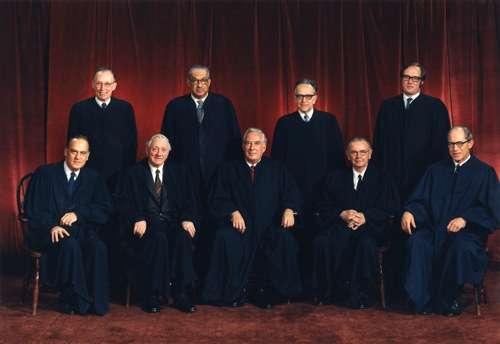
The Supreme Court. (Wikimedia)


This afternoon the Supreme Court agreed to review the Colorado Supreme Court decision disqualifying Trump from appearing on the state's ballot in the 2024 presidential election, under Section 3 of the Fourteenth Amendment. The case will be heard on an expedited schedule, with oral arguments scheduled for February 8, a little over one month from now. The justices likely chose to hear the case quickly so as to make sure it gets resolved before we go too much further into the 2024 election cycle.

Significantly, the Court has not limited the questions presented. That means the justices could potentially consider the full range of issues raised by the case, including whether the January 6 attack on the Capitol qualifies as an "insurrection," whether Trump's actions amount to "engaging" in insurrection, whether the president is an "officer of the United States" covered by Section 3, whether Section 3 is "self-executing," whether it is a "political question," and whether Trump got adequate due process in the state court. There may be some additional procedural questions, as well. But perhaps the Court will issue narrowing questions presented before briefs are due.

Most observers expect the Court to overturn the Colorado decision. That might well happen; it may even be the most likely outcome. But I think many are underrating the likelihood that the justices will affirm the Colorado ruling. The latter is based on strong reasoning, including from an originalist point of view. And to the extent the justices may be motivated by reputational considerations, disqualifying Trump is the perfect opportunity for them to show once and for all that they are not adjuncts of the GOP and especially not the "MAGA Court." In my view, much of the left-wing criticism of the Court is wrong or over overblown; but my opinion is not what's decisive for the Court's public and elite standing.

Of course, I'm far from a perfect prognosticator of what the justices will do. We'll likely get a better sense of where they stand during the oral argument.

I assessed the Colorado decision (which I think is largely correct) here. I went over the issues at stake in the Section 3 litigation in more detail in this article (written before the Colorado decision). In a September Lawfare article, I addressed various pragmatic and moral concerns raised by disqualification, such as claims that it would be anti-democratic and might create a dangerous slippery slope.

U.S. Supreme Court Will Hear Trump Disqualification Case on February 8

|

From today's order in Trump v. Anderson:

The petition for a writ of certiorari is granted. The case is set for oral argument on Thursday, February 8, 2024. Petitioner's brief on the merits, and any amicus curiae briefs in support or in support of neither party, are to be filed on or before Thursday, January 18, 2024. Respondents' briefs on the merits, and any amicus curiae briefs in support, are to be filed on or before Wednesday, January 31, 2024. The reply brief, if any, is to be filed on or before 5 p.m., Monday, February 5, 2024.

More