The Volokh Conspiracy

Mostly law professors | Sometimes contrarian | Often libertarian | Always independent | Est. 2002

The Volokh Conspiracy

Marijuana

Can a Criminal Enterprise Commit an Unfair Labor Practice?

Does the National Labor Relations Board have jurisdiction over a medical marijuana dispensary's treatment of its employees?

|

Today the U.S. Court of Appeals for the D.C. Circuit decided a case concerning the allegation of unfair labor practices at Curaleaf Arizona, a medical marijuana dispensary. In Absolute Healthcare v. NLRB, the court granted Curaleaf's petition challenging some NLRB findings that the company had committed unfair labor practices under the National Labor Relations Act.

The fact that Curaleaf is a medical marijuana dispensary makes this an interesting case. While Curaleaf's activities are legal under Arizona law, they are criminal under federal law, so Curaleaf is engaged in a criminal enterprise. This makes it interesting, to say the least, for a federal agency (the NLRB) to police Curaleaf's treatment of its employees. (For an exploration of other curiosities caused by the state-level legalization of the distribution and sale of marijuana, see my book, Marijuana Federalism: Uncle Sam and Mary Jane.)

Judge Millett wrote the panel opinion, granting Curaleaf's petition insofar as it challenged the NLRB's findings. (Some of the NLRB's findings were uncontested.) Senior Judge Ginsburg and Judge Walker joined the opinion. Judge Walker also wrote a separate opinion raising questions about whether the NLRA reaches allegedly unfair labor practices by employers engaged in businesses that remain illegal under federal law.

Congress empowered the National Labor Relations Board to protect the labor rights of certain employees of certain employers that affect interstate commerce. It is an undeniably broad grant of jurisdiction. But it may not be quite as broad as the NLRB assumes.

Consider the facts of this case. The NLRB ordered a criminal enterprise called Curaleaf Gilbert to pay a drug dealer to sell illegal drugs. That is a curious order from the branch of government tasked with faithfully executing federal law.

I can imagine three arguments in favor of the NLRB's jurisdiction over marijuana dispensaries like Curaleaf, but each has flaws.

First, many people believe marijuana should be legal. There are thoughtful people on both sides of that policy debate, and momentum may well be toward legalization. But for now, marijuana remains illegal at the federal level, notwithstanding the Department of Justice's nonenforcement.

Second, Arizona law allows Curaleaf to sell marijuana. But federal criminal prohibitions preempt conflicting state law. And those prohibitions cannot be displaced by an agency advisory memo.

Third, the NLRB usually retains jurisdiction even after an employer breaks a law. Indeed, Congress tasked the NLRB with holding employers accountable when they violate federal labor law. But that's when the enterprise is otherwise legitimate — not necessarily when its sole aim is to sell an illegal product or provide an illegal service.

That distinction may be more significant than the NLRB appreciates. After all, rings of bookies and counterfeiters affect interstate commerce, but the NLRB does not seem eager to adjudicate their labor disputes. Ditto for street gangs.

Why does that change when a corner boy calls himself a "budtender" and his crew incorporates under state law?

To me, at least, the answer is hazy.

NRA v. Vullo and Trump v. Hawaii

Citing Governor Cuomo's tweets harkens back to, and perhaps foreshadows, litigation against President Trump.

|

The Supreme Court's unanimous decision in NRA v. Vullo was not surprising. It is also not surprising that Chief Justice Roberts assigned the case to Justice Sotomayor. The Chief loves optics, and nothing screams bipartisanship more than an Obama nominee ruling in favor of the NRA against her former home state. Indeed, if I had to guess, this was not Justice Sotomayor's preferred assignment--she probably would have rather written an ERISA opinion. But there was one feature of the majority decision that likely gave Justice Sotomayor some delayed satisfaction.

Flash back to Trump v. Hawaii. One of the main issues in that case was to what extent should the courts consider tweets from candidate- and President-Trump that related to the travel ban. Justice Sotomayor's dissent, which I heard her read in Court, focused at great length on those social media postings. She could not understand how the majority could turn a blind eye to those tweets. Chief Justice Roberts, as he often does, simply made up a test that allowed him to acknowledge the tweets, but find they were not dispositive. But he overruled Korematsu, so just look the other way!

Fast forward to NRA v. Vullo, another First Amendment case with allegations of improper motivation. Maria Vullo, the only defendant left standing, was the former superintendent of the New York Department of Financial Services (DFS). Former-Governor Andrew Cuomo was also sued, and was later dismissed from the case. But you wouldn't know it from Justice Sotomayor's opinion. She references Cuomo over and over again, including his social media postings.

On February 27, Vullo met with senior executives at Lloyd's. There, speaking on behalf of DFS and then-Governor Andrew Cuomo, Vullo "presented [their] views on gun control and their desire to leverage their powers to combat the availability of firearms, including specifically by weakening the NRA." ….

The same day that DFS issued the Guidance Letters, Vullo and Governor Cuomo issued a joint press release that echoed many of the letters' statements. The press release included a quote from Vullo "'urg[ing] all insurance companies and banks doing business in New York'" to join those"'that have already discontinued their arrangements with the NRA.'" ….

The press release cited Chubb's decision to stop underwriting Carry Guard as an example to emulate. The next day, Cuomo tweeted: "'The NRA is an extremist organization. I urge companies in New York State to revisit any ties they have to the NRA and consider their reputations, and responsibility to the public.'" ….

A follow-on tweet from Cuomo reaffirmed the message: Businesses in New York should "'consider their reputations'" and "'revisit any ties they have to the NRA,'" which he called "'an extremist organization.'" ….

Vullo's boss, Governor Cuomo, also urged businesses to disassociate with the NRA to put the organization "into financial jeopardy" and "shut them down." App. 21 (Aug. 3, 2018, tweet). …

Why talk so much about Cuomo when he wasn't even a party? Weren't Vullo's actions sufficient to clear the Iqbal bar? I had this sinking feeling that Justice Sotomayor was laying the groundwork for some future Trump litigation, where the chief executive's social media posts can be used to taint the action taken by some cabinet member. Again, it is almost a given that people would allege that President Trump and his administration will engage in some sort of retaliatory or coercive actions against protected speech. Now, there is a clear precedent on point. The Vullo decision was unanimous, so I'm sure the Fourth, Ninth, and D.C. Circuits will cite it with glee. (Remember, if Trump wins, everyone switches sides for forum shopping.)

I, for one, was on the receiving end of such a phone call from Governor Cuomo. To Justice Jackson's dissent, I experienced first-hand the subtle "line from persuasion to coercion."

Free Speech

My Identifying Would-Be Jane Doe Litigant in Law Review Article Wasn't "Harassment,"

notwithstanding the claim that it “invites worldwide haters to threaten, stalk, and commit violence against” her.

|

From Luo v. Volokh, decided today by the California Court of Appeal, in an opinion by Justice Helen Bendix, joined by Justices Frances Rothschild and Victoria Gerrard Chaney:

Appellant Xingfei Luo, also known as Olivia Luo, twice sought a restraining order against respondent Professor Eugene Volokh pursuant to Code of Civil Procedure section 527.6. Luo sought to prevent Volokh from identifying her in his writings….

[Cal. Code Civ. Proc.] Section 527.6 provides an expedited procedure to prevent harassment. By definition, harassment must have "'no legitimate purpose.'" "Legitimacy of purpose negates harassment." Constitutionally protected activity also is excluded from the definition of harassment. A court must find harassment by clear and convincing evidence before issuing an order prohibiting the harassment.

Section 527.6 defines harassment as "unlawful violence, a credible threat of violence, or a knowing and willful course of conduct directed at a specific person that seriously alarms, annoys, or harasses the person, and that serves no legitimate purpose. The course of conduct must be that which would cause a reasonable person to suffer substantial emotional distress, and must actually cause substantial emotional distress to the petitioner." A course of conduct is defined as "a pattern of conduct composed of a series of acts over a period of time, however short, evidencing a continuity of purpose, including following or stalking an individual, making harassing telephone calls to an individual, or sending harassing correspondence to an individual by any means, including, but not limited to, the use of public or private mails, interoffice mail, facsimile, or email."

{Luo described the parties' relationship as follows: "Volokh has learned my info through litigation." Luo stated, "Volokh has published my info online and invited ha[t]ers to stalk, harass, threaten and commit violence against me. I continue to receive threatening and harassing phone calls and voice mails calling me cunt, slut, lying on men and indicating they will rape and kill me. At the end of July, I was forced to move out of my prior residence for safety concern."

Luo requested the trial court order Volokh to "[1] Remove any remarks, comments, or references from any publicly available documents or articles authored by [Volokh] that connect [her] real name with rape or sexual assault; [¶ 2] Remove any remarks, comments, or references from any publicly available documents or articles authored by [Volokh] that connect [her] with the cases in which she has received a protective order to proceed under a pseudonym; [¶ 3] Cease publishing any remarks, comments, or references that connect [her] with rape or sexual assault; [¶ 4] Cease drawing public attention to [her] name [when] associated with rape or sexual[ ] assault."

Read More

Free Speech

Unanimous First Amendment Victory for the NRA (Represented by the ACLU)

|

From Justice Sotomayor's opinion today in NRA v. Vullo (the NRA was represented by the ACLU, with David Cole arguing before the Court; by William Brewer, Sarah Rogers & Noah Peters of Brewer Attorneys & Counselors; and by me):

[A.] Six decades ago, this Court held that a government entity's "threat of invoking legal sanctions and other means of coercion" against a third party "to achieve the suppression" of disfavored speech violates the First Amendment. Bantam Books, Inc. v. Sullivan (1963). Today, the Court reaffirms what it said then: Government officials cannot attempt to coerce private parties in order to punish or suppress views that the government disfavors.

Petitioner National Rifle Association (NRA) plausibly alleges that respondent Maria Vullo did just that. As superintendent of the New York Department of Financial Services [DFS], Vullo allegedly pressured regulated entities to help her stifle the NRA's pro-gun advocacy by threatening enforcement actions against those entities that refused to disassociate from the NRA and other gun-promotion advocacy groups. [More factual details below. -EV] Those allegations, if true, state a First Amendment claim….

A government official can share her views freely and criticize particular beliefs, and she can do so forcefully in the hopes of persuading others to follow her lead. In doing so, she can rely on the merits and force of her ideas, the strength of her convictions, and her ability to inspire others. What she cannot do, however, is use the power of the State to punish or suppress disfavored expression….

Read More

Supreme Court

Supreme Court OT2023 at the End of May

The justices have been slow and quite agreeable -- so far.

|

Today the Supreme Court issued three more opinions, bringing the total number of decisions to 29 so far this term (out of 61 argued cases). This is a slower pace than usual for the Court, despite the smaller docket, but on par with what we saw last term.

Here is the number of opinions issued by the end of May this year as compared with the total in each of the prior five terms:

  • OT2023 - 29
  • OT2022 - 29
  • OT2021 - 33
  • OT2020 - 39
  • OT2019 - 36
  • OT2018 - 44

The relative slowdown is noticeable. What's the cause? One possibility is that whatever processes the Court adopted in the wake of the Dobbs leak have slowed down the Court's work. Another possibility is that the remaining cases are sufficiently difficult or divisive that they are taking more time to complete. Whatever the cause, the Court will have to average a decision a day to finish its work by the end of June.

While the Court has been relatively slow to issue opinions, it is showing a surprising degree of unanimity. The justices have been unanimous in the judgment in 20 of the 29 cases decided thus far, including today's unanimous decision by Justice Sotomayor in NRA v. Vullo, siding with the National Rifle Association against New York financial regulators. Of the remaining nine cases, two were decided 7-2 and seven were decided 6-3. Of potential interest, only three of the 6-3 decisions issued thus far split the Court along traditional conservative-liberal lines. In two of those three cases the majority was written by Justice Alito (Thornell, Alexander). Justice Kavanaugh wrote the opinion in the third (Culley).

There are good reasons to think that the Court's will be less unanimous -- and perhaps more conservative -- than what we have seen so far this term, and not just because the Court tends to issue the most controversial and politically divisive decisions at the end of the term. So far this term, the liberal justices have authored a disproportionate share of the Court's opinions (thirteen of twenty-seven signed opinions), despite representing only one third of the Court. Based on what we have seen thus far, the Court's liberals are likely to have relatively few of the remaining majority opinions.

In terms of individual opinion authorship, here is where we stand.

  • Sotomayor: 6
  • Kagan: 4
  • Alito: 3
  • Kavanaugh: 3
  • Barrett: 3
  • Jackson: 3
  • Thomas: 2
  • Gorsuch: 2
  • CJ Roberts: 1

There have also been two per curiam opinions, and some cases are likely to be merged into a single opinion (e.g. the two Chevron cases, Relentless and Loper-Bright will almost certainly be decided in a single opinion).

Given that the Court heard argument in 61 cases, each justice will only have six or seven decisions, so Justice Sotomayor may be done with writing majority opinions this term, and Kagan and Jackson may only a few each left. Of the thirty-ish opinions to come, I think we can expect over two-thirds of them to be written by one of the Court's conservatives. The Chief Justice in particular has been holding his powder dry, having only taken one decision for himself thus far. Do not be surprised if he writes for the Court in both the Trump immunity case and the Chevron cases.

Free Speech

80 Years After S. Ct. Held Pledge of Allegiance Couldn't Be Mandated in Public School, Public School Seems to Try to Mandate It

|

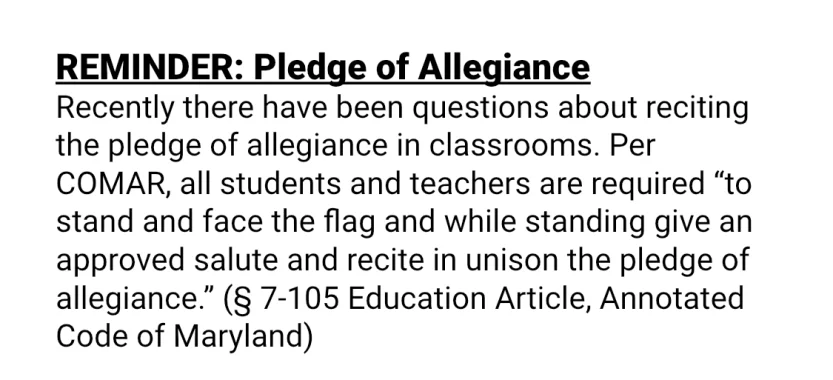
Email from the school, as reported by FIRE.


From the Foundation for Individual Rights and Expression letter sent today to the Twin Ridge Elementary School (Maryland):

Our concerns arise out of an April 26 email TRES sent to school staff to address confusion regarding what conduct is required during the Pledge of Allegiance. The email  represented that per Maryland Education Code § 7-105(c)(3), "all students and teachers are required 'to stand and face the flag and while standing give an approved salute and recite in unison the pledge of allegiance.'" But the email failed to mention the opt-out provision of subsection (d), which states: "Any student or teacher who wishes to be excused from the requirements of subsection (c)(3) of this section shall be excused."

Not only does the TRES directive misrepresent Maryland law by suggesting it requires participation without allowing abstention, that misdescription of the law is one the First Amendment prohibits…. Over 80 years ago, in West Virginia State Board of Education v. Barnette, the Supreme Court invalidated a requirement that schoolchildren salute the U.S. flag and recite the Pledge of Allegiance. Even in the dark days of World War II, the Court recognized that requiring students to pledge allegiance to a national symbol is contrary to our national commitment to freedom of conscience. As the Court explained, "if there is any fixed star in our constitutional constellation, it is that no official, high or petty, can prescribe what shall be orthodox in politics, nationalism, religion, or other matters of opinion or force citizens to confess by word or act their faith therein." …

I called the school's main number to ask whether it had a statement, and the person answering the phones said she had no idea, and hung up on me. If any readers know of any errors in FIRE's account of the matter, please let me know; I have generally found FIRE's factual accounts quite trustworthy.

Election 2024

If Neither One Is Acceptable, Then Neither Is Acceptable

Matthew Franck on "Choosing Not to Choose" in November

|

In The Dispatch Matthew J. Franck explains why he will not be voting for Donald Trump or Joseph Biden in November, just as he refused to vote for either Trump or Hillary Clinton in 2016.

Eight years ago, I published an essay for Public Discourse about why I could not vote for either Hillary Clinton or Donald Trump. "Vote as if your ballot determines nothing whatsoever—except the shape of your own character," the piece concluded. "Vote as if the public consequences of your action weigh nothing next to the private consequences. The country will go whither it will go, when all the votes are counted. What should matter the most to you is whither you will go, on and after this November's election day."

There is nothing in what I said then that I would now retract. I rejected the idea that I, as one individual, must treat my choice as confined to the binary of Clinton versus Trump, as though the weight of the outcome were on me alone. It is frequently the case that we vote for one major-party presidential candidate principally because we are against the other one—usually because we find "our guy" a less than optimal choice but "the other guy" strongly repellent. But when we conclude that both of them are wholly unfit for office, our habitual partisan commitments, and our fond hope that the one representing "our side" will be normal, or guided by normal people, do not compel us to cast a vote in that direction. What we must consider, I argued, is not our role in the outcome of the election (which is negligible, and unknown to us when voting), but the effect on our conscience and character of joining our will to a bad cause. . . .

And here we are in 2024, with the same choice again. Only this time the overwhelming majority of voters have already voted at least once—successfully!—for these feckless men. That means the emotional investment of many voters in both Trump and Biden is very high, since each has a term as president to be defended—which ain't easy to do in either case. Trump's signature qualities were incompetence and recklessness, constrained to positive effect only by Congress, the courts, and many of his own appointees. Then he did his utmost, up until the evening of January 6, to steal the election from Joe Biden. A second term for Trump would be a four-year master class in indecency and mendacity, strongly inflected by an urge to authoritarianism that may sorely test our civic institutions. . . .

A vote for Biden would be contrary to an adult lifetime of conservatism. But I could write that sentence again almost verbatim, only substituting "Trump" for "Biden." For a conservative like me, who has refused twice to vote for Trump, it is not that hard to refuse a third time. (What's disappointing is the number of people I know who will vote for him a third time, despite everything.)

If you think you might be a "double hater" (in Ramesh Ponnuru's phrase), the whole thing is worth a read.

Politics

Judge Suggests Courts Should Consider Using "AI-Powered Large Language Models" in Interpreting "Ordinary Meaning"

|

That's from Judge Kevin Newsom's concurrence yesterday in Snell v. United Specialty Ins. Co.; the opinion is quite detailed and thoughtful, so people interested in the subject should read the whole thing. Here, though, is the introduction and the conclusion:

I concur in the Court's judgment and join its opinion in full. I write separately … simply to pull back the curtain on the process by which I thought through one of the issues in this case—and using my own experience here as backdrop, to make a modest proposal regarding courts' interpretations of the words and phrases used in legal instruments.

Here's the proposal, which I suspect many will reflexively condemn as heresy, but which I promise to unpack if given the chance: Those, like me, who believe that "ordinary meaning" is the foundational rule for the evaluation of legal texts should consider—consider—whether and how AI-powered large language models like OpenAI's ChatGPT, Google's Gemini, and Anthropic's Claude might—might—inform the interpretive analysis. There, having thought the unthinkable, I've said the unsayable.

Now let me explain myself….

I think that LLMs have promise. At the very least, it no longer strikes me as ridiculous to think that an LLM like ChatGPT might have something useful to say about the common, everyday meaning of the words and phrases used in legal texts….

Thanks to Howard Bashman (How Appealing) for the pointer.

Don't Judge A Book By Its Cover, But….

|

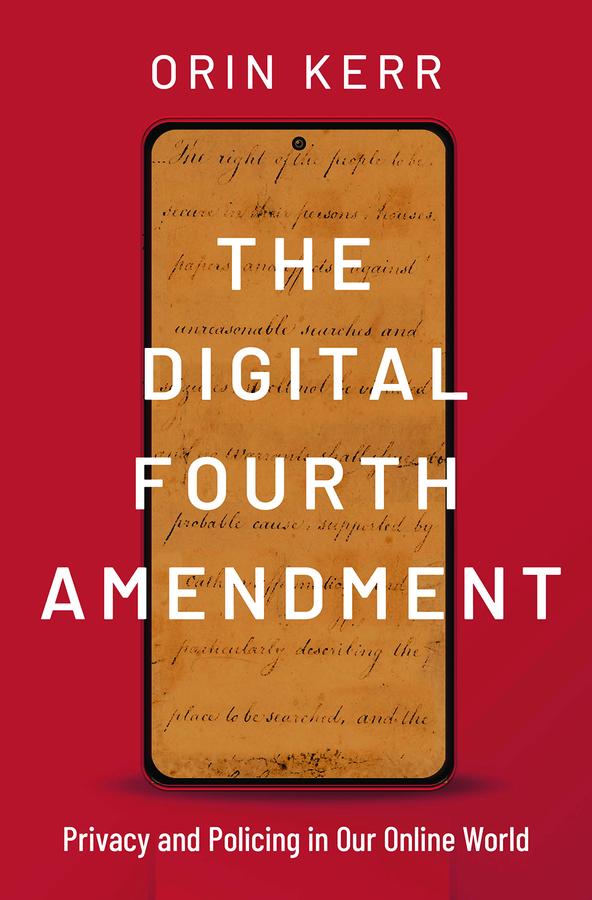
I'm pleased to be able to post the cover of my forthcoming book, The Digital Fourth Amendment, which will be published this fall (or thereabouts) by Oxford University Press.  Although you shouldn't judge a book by its cover, I'll happily grant an exception if you like this:

(UPDATE: When I first posted this, I had it as "it's cover" instead of "its cover," but the spirit of my 6th grade English teacher Mrs. Bailey fortunately rushed in to correct it soon afterward. Eeks!)

Justice Alito's Letter About The Flag Flap

He will not recuse, so everyone should move on.

|

Justice Alito wrote a letter to Senators Durbin and Whitehouse in response to their calls for recusal. He was under no obligation to respond, and I have no doubt that his response will not placate critics. But his letter makes several important points, and also provides insights into his thinking about the flag flap.

First, the Supreme Court's Code of Conduct provides that a Justice should recuse "where an unbiased and reasonable person who is aware of all relevant circumstances would doubt that the Justice could fairly discharge his or her duties." What does "unbiased and reasonable mean"? Justice Alito provides his own gloss on that phrase.  Here, Justice Alito was "confident that a reasonable person who is not motivated by political or ideological considerations or a desire to affect the outcome of Supreme Court cases would conclude that the events recounted above do not meet the applicable standard for recusal." In Alito's view, "unbiased and reasonable" does not include a person who is "motivated by political or ideological considerations or a desire to affect the outcome of Supreme Court cases." The people who are calling for Justice Alito to recuse fall squarely in this category. The primary driver behind the "Stop the Steal" narrative is to force Justice Alito to recuse in all Trump-related cases. These voices were silent about Justice Ginsburg's comments about President Trump, and her dissent collar after election day. (Apologies do not undo an appearance of partiality). These voices, Alito implies, are not "unbiased and reasonable."

Second, Justice Alito and Mrs. Alito had no idea that either flag was associated with the "Stop the Steal" movement.

My wife's reasons for flying the flag are not relevant for present purposes, but I note that she was greatly distressed at the time due, in large part, to a very nasty neighborhood dispute in which I had no involvement.

…

I was not familiar with the "Appeal to Heaven" flag when my wife flew it. She may have mentioned that it dates back to the American Revolution, and I assumed she was flying it to express a religious and patriotic message. I was not aware of any connection between this historic flag and the "Stop the Steal Movement," and neither was my wife. She did not fly it to associate herself with that or any other group, and the use of an old historic flag by a new group does not necessarily drain that flag of all other meanings.

I don't care how many tweets Jodi Kantor finds, this narrative--the core of the entire story--will never stick.

Third, Justice Alito explains that his wife retains the full panoply of free speech rights:

My wife is a private citizen, and she possesses the same First Amendment rights as every other American. She makes her own decisions, and I have always respected her right to do so. . . .

As I said in reference to the other flag event, my wife is an independently minded private citizen. She makes her own decisions, and I honor her right to do so.

The mere fact that Mrs. Alito says something does not impute any improper motivations to her husband. Thankfully, coverture has been abolished, and spouses are allowed to have their own legal identities.

Fourth, we learn that Justice Alito had nothing to do with either flag. Indeed, Justice Alito asked Mrs. Alito to take down the upside-down flag, and she refused:

As I have stated publicly, I had nothing whatsoever to do with the flying of that flag. I was not even aware of the upsidedown flag until it was called to my attention. As soon as I saw it, I asked my wife to take it down, but for several days, she refused.

I'm sure some readers would respond, "You could divorce your wife." Indeed, Nancy Gartner, a former federal judge, said as much to the Washington Post.

If her husband had tried to put up a sign or flag at their house in response to something a neighbor displayed on their block that was inconsistent with or critical of his civil liberties work, Gertner added: "One of two things would have happened: A) a divorce and B) surely recusal."

I think this statement says far more of how Gertner views the institution of marriage than how she views the code of ethics. Mrs. Alito's neighborly spat with her neighbors was her own business. Justice Alito asked her to taken down the flags. She refused. Even if Mrs. Alito was trying to convey some sort of political message about the election, Justice Alito distanced himself from it. Knowing these facts now, a reasonable person should see no justification for recusal--of course, they may insist that Justice Alito is lying, and that he personally was aware of the symbol's meaning and endorsed it. But these views are not reasonable, and not unbiased.

Fifth, Justice Alito spoke to the sacrifices that his wife has had to make.

She has made many sacrifices to accommodate my service on the Supreme Court, including the insult of having to endure numerous, loud, obscene, and personally insulting protests in front of our home that continue to this day and now threaten to escalate.

The protests will continue. These Justices and their families cannot know peace and quiet. Indeed, their refuge on the Jersey Shore has also been ruined.

Our vacation home was purchased with money she inherited from her parents and is titled in her name. It is a place, away from Washington, where she should be able to relax.

Regrettably, the spouses of all conservative Justices have to make these sacrifices. I can't fathom why anyone would want to accept this job--why put your family through this hell. And to be clear, spouses of liberal Justices will be toasted on the town. Patrick Jackson has nothing to worry about. There were never any call for RBG's recusal based on Marty Ginsburg's practice at Fried Frank, which appeared before the Supreme Court.

Justice Alito will not recuse, so everyone should move on. But they won't.

Free Speech

No Pseudonymity in Case Challenging Denial of Gun Rights Based on Alleged Mental Health Problems

|

From P.D. v. Sullivan, decided last month by Judge Nelson Román (S.D.N.Y.):

Plaintiff seeks to proceed anonymously because the action involves "matters of a highly sensitive and personal nature, to wit, medical and mental health records and information." … There is little question that the instant case involves matters that are highly sensitive and of a personal nature—medical and mental health information are undoubtedly so. Moreover, Plaintiff is suing the Commissioner of the New York State Office of Mental Health in her official capacity, and therefore sues the government rather than a private entity. Furthermore, there is little to no prejudice to Defendant as she has not opposed Plaintiff's request and Plaintiff indicated he would provide his name to Defendant. Finally, Plaintiff's name and identity have been kept confidential from the public to date.

[On the other hand, though] Plaintiff argues that his identification "poses a risk of retaliatory physical and mental harm to Plaintiff, and even more critically, to innocent non-parties including his family members" … this risk of harm is vague and speculative. Plaintiff points to the combined "stigma" of mental health and Second Amendment rights but fails to elaborate on or provide any evidence of this supposed stigma. Nor does Plaintiff specify the nature of these potential harms. Plaintiff claims this is particularly true "within New York State's hostile anti-Second Amendment environment," and the Court is not entirely sure what Plaintiff means….

"… [T]here is a general presumption that parties' identities are public information." As implied by Plaintiff, the Second Amendment has fostered continued debate and discussion among the public in recent years. Accordingly, there will likely be widespread interest in Plaintiff's suit that challenges provisions of the New York State Mental Hygiene Law ("NY MHL") as unconstitutional under the Second and Fourteenth Amendments.

Read More

Judiciary

Judge David Tatel on the Roberts Court, the Voting Rights Act, and the Notorious RBG

In a forthcoming book. retired Judge David Tatel offers candid thoughts and spills the tea.

|

CNN's Joan Biskupic offers a preview of some of what's contained in retired Judge David Tatel's forthcoming book, Vision: A Memoir of Blindness and Justice. Judge Tatel was appointed to the U.S. Court of Appeals for the D.C. Circuit by President Bill Clinton, and was a highly regarded member of that court for nearly three decades. Had Al Gore been elected President in 2000, some believe he would have nominated Judge Tatel to the Supreme Court if given the opportunity.

According to Biskupic, Tatel echoes the common (and incorrect) complaint that the Roberts Court has been less respectful of precedent than prior courts. She reports that Tatel charges that the Roberts Court "has 'kicked precedent to the curb' and become 'a tragedy' for civil rights and the rule of law." Assuming that Biskupic's report is accurate (as the book has not yet been released) it is a shame to see Judge Tatel repeat this claim about the Roberts Court and precedent because, as I have shown, the Roberts Court has actually been less prone to overturn precedent than prior courts.  It is one thing to criticize the substance of the Roberts Court's decisions. It is quite different to make demonstrably false claims about the nature of the Court's decisions.

Biskupic's story also confirms what many have long suspected about the Supreme Court's decision in NAMUDNO v. Holder, concerning the Voting Rights Act.

In his book, Tatel wrote that Ginsburg told him about the behind-the-scenes dealings in a 2009 case, known as Northwest Austin v. Holder, that was the forerunner to Shelby County. The 2009 case left the VRA's Section 5 intact, although its reasoning laid the groundwork for future obliteration. (Tatel had authored the lower court opinions in both Northwest Austin and Shelby County.)

When the Supreme Court ruled in 2009, Tatel said, "What I couldn't figure out was why the four liberal justices had joined the Chief's majority opinion. … (T)he unnecessary and irrelevant jabs at Section 5's constitutionality? Why had they gone along with that part of the Chief 's opinion? I suspected I knew the answer, and Justice Ginsburg herself later confirmed my suspicions."

"The justices had initially voted 5–4 to declare Section 5 unconstitutional, but they later worked out a compromise: The majority agreed to sidestep the big question about Section 5's constitutionality, and the would-be dissenters agreed … to sign on to the critique of Section 5," the judge wrote. "With that compromise, the liberal justices had bought Congress time to salvage the keystone of the Civil Rights Movement."

Congress never acted, and Tatel contends the 2009 compromise cost the liberals: "They sure paid a high price: an unrebutted opinion that criticized the VRA and, worse, endorsed a new 'equal sovereignty' doctrine with potentially profound implications," Tatel wrote of the principle that restricted Congress' ability to single out certain states, in this situation because of past discriminatory practices. "The Court's opinion in Northwest Austin thus planted the seeds for Section 5's destruction."

It is certainly true that the NAMUDNO decision "planted the seeds" for the Shelby County holding, in that it flagged the constitutional concerns that underlay the Shelby County decision. But according to this account, there would have been five votes to invalidate Section 5 either way. Thus what NAMUDNO actually accomplished (as some of us have pointed out before) was to give Congress the opportunity to revise Section 5 (and, specifically, to update the statute's obsolete coverage formula) so as to preserve its constitutionality. In other words, a majority of the Court was willing to stay its hand, and refrain from invalidating a federal statute, in the interest of deferring to Congress. That Congress did not avail itself of the opportunity, is not the fault of the Court.

The Biskupic story notes other tidbits from the book, such as how Justice Ginsburg resented the pressure to retire under a Democratic president, and suggests that RBG's death during the Trump Administration likely encouraged Judge Tatel to retire soon after Joseph Biden took office. This Adam Liptak interview with Tatel suggests much the same:

Judge Tatel said his retirement was linked to a lesson he drew from Justice Ruth Bader Ginsburg's decision to remain on the bench despite calls for her to step down in time to let President Barack Obama name her successor.

"We had dinner here at this table several times," he said. In the book, he described "her annoyance with commentators who were calling for her retirement."

Justice Ginsburg's contributions to the law will endure, he said. "But there's no denying," he wrote, "that her death in office ultimately contributed to Roe's downfall," with Justice Amy Coney Barrett — rushed onto the court by President Donald J. Trump and Senate Republicans — casting the decisive vote to eliminate the constitutional right to abortion.

Judge Tatel, now 82, wrote that he had stepped down because he "didn't want to take the chance that my seat might be filled by a president who'd campaigned on picking judges who would fulfill his campaign promises."

But there was more. "I was also tired," he wrote, "of having my work reviewed by a Supreme Court that seemed to hold in such low regard the principles to which I've dedicated my life."

I look forward to reading the book when it is released.

Free Speech

$1.1M Libel Award to Drag Performer Who Had Been Accused of Exposing Himself

|

From the Couer D'Alene/Post Falls Press (Kaye Thornbrugh) yesterday:

The jury found that blogger Summer Bushnell defamed Post Falls resident Eric Posey when she accused him of exposing himself to the crowd while he performed in drag at the Coeur d'Alene City Park bandshell in June 2022….

The day of Posey's performance, June 11, 2022, Bushnell posted a video of herself discussing the mass arrest of Patriot Front members near City Park, as well as footage from Posey's performance.

"Why did no one arrest the man in a dress who flashed his genitalia to minors and people in the crowd?" she said in the video. "No one said anything about it and there's video. I'm going to put up a blurred video to prove it."

Read More

The Alito Flag Flap, Snyder v. Phelps, and Chaplinsky v. New Hampshire

The latest reporting from the New York Times intersections with Free Speech cases.

|

Jodi Kantor of the New York Times has a new report that dives deeper into the Alito flag flap. This work probably should have been done before her initial story ran. Now, we have a lot more context. From my vantage point, I'm not sure much changes. There was a spat between Mrs. Alito and her neighbors, in which she flew the flag upside down as a symbol of distress. I still see nothing to connect Mrs. Alito's decision with some sort of stop-the-steal imagery. But I'm sure "objective observers" will continue to see the "appearance of impropriety" they want to see.

What did interest me is how facets of this neighborly spat intersected with two landmark free speech cases. Sometimes reality is stranger than fiction.

After January 6, the neighbors put up a sign across the street from the Alitos saying "You Are Complicit."

Then came Jan. 6. Rocked by the violence and threat to democracy, the couple soon put up new signs in their yard, saying "Trump Is a Fascist" and "You Are Complicit." Emily Baden said in interviews that the second sign was not directed at the Alitos, but at Republicans generally, especially those who weren't condemning the Capitol attack. . . . .

It's not clear whether Mrs. Alito saw those signs, but the day after the Capitol riot, as the couple parked in front of their home, she pulled up in her car, they said. She lingered there, glaring, for a long moment, recalled the couple, who texted their friends about the encounter.

Who is You? Justice Alito? Or Republicans in general?

This exact argument was at issue in Snyder v. Phelps. Recall that the Westboro Baptists held up a signs saying "God hates you" and "You're going to Hell." Who was the sign referring to? Matthew Snyder? Or society at large? Chief Justice Roberts, per the majority, did not think the sign referred exclusively to the slain Marine, but could have referred to society more broadly. Justice Alito, in his solo dissent, thought the sign clearly referred to Matthew Snyder. Here is the summary of the dispute from 100 Cases:

Justice Alito wrote a solo dissent. He countered that some of the signs were directed at Matthew Snyder. For example, "You're going to Hell" referred to Matthew. In addition to carrying signs at the funeral, Westboro also published a blog post — known as an "epic" — that addressed the Snyder family directly. During oral argument, Justice Alito stated, "The epic specifically referenced Matthew Snyder by name, [and] specifically referenced Matthew's parents by name." He then asked, "Do you think that the epic is relevant as an explanation of some of these arguably ambiguous signs that were displayed at the funeral? For example, 'You are going to hell,' 'God hates you.' Who is 'you'? If you read the epic, perhaps that sheds light on who 'you' is." . . . .

Chief Justice Roberts only considered the signs at the demonstration. He observed that "even if a few of the signs — such as 'You're Going to Hell' and 'God Hates You' — were viewed as containing messages related to Matthew Snyder or the Snyders specifically, that would not change the fact that the overall thrust and dominant theme of Westboro's demonstration spoke to broader public issues." By limiting the facts in this way, Chief Justice Roberts made the case easier to decide than perhaps it was.

I suspect the Alitos thought the "complicit" sign was directed them--in particular at Justice Alito. Trump is a fascist and Justice Alito is complicit. It is rare that we have a Justice's opinion on how to interpret pronouns on protest signs, but we have Snyder v. Phelps.

There is more. It turns out that the neighbor-at-issue never actually saw the upside-down flag!

On Jan. 17, the upside-down flag hung at the Alito household, according to a photograph obtained by The Times. Neighbors say it was up for a few days. If the flag was intended as a message for the Badens, whose home does not have a direct view of the Alito residence, they missed it, they said.

One of the greatest ironies of Snyder v. Phelps is that the family of Matthew Snyder never actually saw the protest signs, which were outside the cemetery. The claim for intentional infliction of emotional distress was premised solely on media reporters of the protest. Here too, Mrs. Alito flew the flag as a symbol of distress, but it never reached its intended recipient.

As is often the case with free expression and symbolism, messages are often missed and misinterpreted--another reason why we should all be cautious and not view the flags in the worst possible light.

There is one more SCOTUS intersection, this time to Chaplinsky v. New Hampshire. In this case, Chaplinsky called a police officer a "damned fascist." The Supreme Court held that these words were "fighting words," and were not protected by the First Amendment. As all know, the fighting words doctrine is basically a dead letter. It plays almost no role in modern First Amendment law. I sometimes joke with my students that in today's coarsened society, no words would justify punching someone in the face. Then again, Justice Alito favorably cited Chaplinksy in Snyder:

This Court has recognized that words may "by their very utterance inflict injury" and that the First Amendment does not shield utterances that form "no essential part of any exposition of ideas, and are of such slight social value as a step to truth that any benefit that may be derived from them is clearly outweighed by the social interest in order and morality." Chaplinsky v. New Hampshire, 315 U. S. 568, 572 (1942); see also Cantwell v. Connecticut, 310 U. S. 296, 310 (1940) ("[P]ersonal abuse is not in any proper sense communication of information or opinion safeguarded by the Constitution"). When grave injury is intentionally inflicted by means of an attack like the one at issue here, the First Amendment should not interfere with recovery.

Back to the cul-de-sac. According to the neighbors, Mrs. Alito used similar words as Mr. Chaplinsky:

The conflict then seemed to quiet down. But on Feb. 15, the couple were pulling in trash bins when the Alitos, who seemed to be on a stroll, appeared. Mrs. Alito addressed the pair by name, used an expletive and called them "fascists," the couple told The Times and said in texts at the time. Justice Alito remained silent, they added. The Alitos began to walk away.

In response, the neighbor called Mrs. Alito a word that begins with c- and rhymes with punt.

That was when Emily Baden snapped, she said. She does not remember her precise words, but recalls something like this: How dare you behave this way. You've been harassing us, over signs. You represent the highest court in the land. Shame on you.

Ms. Baden said that she — not her partner, as Justice Alito recalled — used the lewd expression. "I will fully cop to that," she said. A neighbor standing in the street, who asked not to be identified because of the friction on the block, said he heard her say the word too.

Is calling someone an expletive-fascist a fighting word? Does it justify a c-bomb in response? Is calling someone a c-word a fighting word? I can't fathom what was going through Justice Alito's mind when he witnessed all of this unfolding. Pick at random any other graduate from Steinert High School in Trenton, Class of 1968, and call their wife the c-word. See what would happen. Judicial restraint would not be the order of the day. (By chance, the District Court judge I clerked for graduated from Steinert a few years before Justice Alito.)

Anyway, I think this story will have a life so long as it allows people to call for Justice Alito's recusal. I think what we have here is what we had from the outset: an ugly neighborly spat that did not signal the Justice's sympathy with "stop the steal."


More