Please enjoy the latest edition of Short Circuit, a weekly feature written by a bunch of people at the Institute for Justice.
New cert petition! In 2013, a Clovis, Calif. officer disclosed to a fellow officer that his girlfriend had filed a confidential domestic violence complaint against him—knowing full well that she was trapped in a room with him at that very moment. He then brutally attacked her. And though the Ninth Circuit ruled earlier this year that it was "obvious" that disclosing the report put her in grave danger, it granted the first officer qualified immunity anyway, finding that no factually identical prior case gave the officer fair notice the disclosure was unconstitutional. The decision reinforces a circuit split and also conflicts with Supreme Court precedent that says a factually identical case is not necessary in situations where an official has time and opportunity to deliberate (as opposed to a split-second decision on the use of force). Today, IJ asked the Supreme Court to weigh in.
Is school choice racist? Did it originate with post-Brown v. Board opposition to public school integration? Shameful mistruths! IJ Senior Attorney Michael Bindas takes to the Syracuse Law Review and sets the record straight.
Over at the Advisory Opinions podcast, IJ's Anthony Sanders indicts Justice Oliver Wendell Holmes Jr., who turns out to have been a bit of a bad egg Constitution-wise.
P.P.S. My favorite version of "Both Sides, Now" is the original Judy Collins recording, but also check out the version from the recent movie CODA (album version here, partial movie clip here). My song uses the CODA arrangement at 1.5x speed.
Given Donald Trump's recent remarks about Kamala Harris' racial/ethnic identity, it's an unfortunate coincidence that I posted something earlier this week noting that Harris once emphasized her Indian heritage more.
So just to formally disassociate myself from Trump's views, no, I do NOT think that Harris is faking a black identity, and the fact that she once gave more public attention to the Indian part of her heritage as part of her political persona does NOT mean that she is insincere in also having a black identity.
And it's quite silly and offensive to say she can't identify with *both* her black and Indian heritages. And she has! From what I can tell, from the earliest point in her public career she was quite forthright in stating that her (largely absent) father was black, her mother was Indian, and that her mother took pains to raise her with exposure to both cultures and identities.
Not surprisingly, she emphasizes one or the other publicly depending on the context--doing an Indian cooking segment with Mindy Kaling vs. speaking to a gathering of her historically black college sorority, for example. And of course sometimes there is political salience to emphasizing one identity or another. But she's is, after all, a politician, so she should be expected to act like one!
As the author of a book about modern racial classification in the US, one thing I've noted is that she rarely if ever refers to herself as "multiracial." That's also quite understandable. A 'multiracial' movement gained steam in the US in the early 1990s, powered primary by young activists with one black and one non-black parent. One thing that particularly irked them was that not only could you not check "multiracial" on the Census and other federal forms (you still can't), but you had to choose only one racial box to check, you could not check "Asian American" and "Black," for example (now you can, since 1997). But when Harris came of age a bit before this was a "thing," so it's not surprising that she doesn't use the multiracial nomenclature.
UPDATE: Here is Trump's statement, made during an interview at a conference of black journalists: "I didn't know she was Black until a number of years ago when she happened to turn Black and now, she wants to be known as Black. So, I don't know, is she Indian or is she Black?… she was Indian all the way, and then all of a sudden she made a turn, and she went -- she became a Black person." I suppose Trump is also a product of his times, when you had to "choose" one identity, at least officially, but I suspect that it more comes down to him trying to turn a segment of black voters against her by falsely suggesting that she's exploiting a black heritage that she previously neglected.
Today a panel of the U.S. Court of Appeals for the Sixth Circuit granted broadband providers' request for a stay of the Federal Communications Commission's rule that would classify broadband internet providers as common carriers under the Communications Act, often referred to as "net neutrality." According to the panel, the broadband providers were likely to succeed on the merits--in part due to the major questions doctrine--and this justified staying the rule pending review of their petitions. The panel consisted of Chief Judge Sutton and Judges Clay and Davis.
Broadband internet refers to the set of platforms that permit users to access the internet at speeds faster than dial-up services. . . . Over three-quarters of Americans have access to high-speed broadband service. . . . In addition to renting or constructing the physical network connecting computers, broadband internet providers offer other services that enable subscribers to access content from "edge providers"--namely websites, such as Google, Netflix, and Amazon, that host content on their own networks. . . . These services include DNS, short for Domain Name Services, a "phonebook" that matches web addresses (e.g., http://www.ca6.uscourts.gov) with their IP (internet protocol) addresses. And they include "caching" services that speed up data access by storing copies of edge provider content closer to the user's home system. . . .
The Communications Act of 1934 covers broadband providers, and it gives the Federal Communications Commission authority to promulgate rules and regulations under the Act. The extent of that regulatory authority turns on whether the providers count as common carriers under the Act. If a business counts as a common carrier, it must comply with Title II of the Act, which includes rate-review regulations and non-discrimination obligations. . . . For other businesses, the Commission may impose only the ancillary regulations authorized under Title I, which generally preserve the ability of companies to respond to market conditions. . . .
The development of the internet presented the Commission with a classification challenge. When Congress first enacted this law in 1934, it defined common carriers to include anyone involved in "wire communications." . . . Think telephone companies and the monopolies that went with them. But by the 1970s, telephone companies and others had begun competing to offer data processing services through telephone wires. . . . Common carrier rules designed for telephone-wire monopolies, the Commission realized, could inhibit the development of "data information services." . . . The Commission responded by distinguishing the "basic transmission service" that transferred data between two points from the "enhanced service" that allowed subscribers to interact with data stored elsewhere.
Responding to these developments, Congress enacted the Telecommunications Act of 1996. It established a new category of "telecommunications service," which offers "the transmission, between or among points specified by the user, of information of the user's choosing, without change in the form or content of the information as sent and received." . . . The Commission must treat telecommunications service providers as common carriers. . . . The 1996 Act also created a new category of "information service," which applies to a company that offers "a capability for generating, acquiring, storing, transforming, processing, retrieving, utilizing, or making available information via telecommunications." The Commission may not treat information service providers as common carriers. . . .
After passage of the 1996 Act, the Commission for many years took the view that broadband internet access services were information services, not telecommunication services. That left them free of Title II's common carrier requirements. . . .
Reviewing a decision from the Ninth Circuit, the Supreme Court upheld this classification under Chevron. [See Brand X]. . . Specifically, the Supreme Court found that the classification of broadband internet access offered through cable modems as an information service was a permissible interpretation of the Communications Act. . . .
In 2010, the Commission continued to treat broadband internet services as something covered by Title I but opted to alter its rules based on a debate over the risk that broadband providers could favor some edge providers' content over others. . . . The Commission tried to use its Title I authority to impose "open internet" rules on broadband providers that banned them from blocking or unreasonably discriminating between lawful content. . . . A federal court invalidated this rule on the ground that the Commission could impose such requirements only under Title II.
The next chapter unfolded in 2015. That year, the Commission promulgated a rule that categorized broadband providers as common carriers and required net neutrality under Title II. . . .
In 2018, the Commission returned to its prior view. It issued a new rule that broadband providers fall under Title I and do not qualify as common carriers. . . . The D.C. Circuit again upheld the classification and again did so under Chevron. . . .
On May 22, 2024, the Commission switched positions again. Under its current rule, the Commission has classified broadband providers as common carriers under Title II. . . . The rule requires broadband providers to disclose "accurate information regarding the network management practices" and forbids them from engaging in blocking, throttling, paid prioritization, and "unreasonable interference" with users and edge providers. . . . The rule at this point forbears other Title II regulations, including rate regulation and tariffing. . . .
The petitioners are likely to succeed on the merits because the final rule implicates a major question, and the Commission has failed to satisfy the high bar for imposing such regulations. Although the petitioners have raised other arguments in support of their position that the FCC exceeded its authority in promulgating the rule at issue, such as whether broadband can be classified as a telecommunications service under the Communications Act and the stare decisis effect of the Brand X decision, we decline to reach those arguments at this preliminary stage.
An agency may issue regulations only to the extent that Congress permits it. . . . When Congress delegates its legislative authority to an agency, it presumably resolves "major questions" of policy itself while authorizing the agency to decide only those "interstitial matters" that arise in day-to-day practice. . . .When Congress upsets that presumption and delegates its power to alter the fundamental details of a regulatory scheme to an agency, it must speak clearly, without "hid[ing] elephants in mouseholes." The more an agency asks of a statute, in short, the more it must show in the statute to support its rule.
Net neutrality is likely a major question requiring clear congressional authorization. As the Commission's rule itself explains, broadband services "are absolutely essential to modern day life, facilitating employment, education, healthcare, commerce, community-building, communication, and free expression," to say nothing of broadband's importance to national security and public safety.
Congress and state legislatures have engaged in decades of debates over whether and how to require net neutrality. Because the rule decides a question of "vast economic and political significance," it is a major question. . . . The Communications Act likely does not plainly authorize the Commission to resolve this signal question. Nowhere does Congress clearly grant the Commission the discretion to classify broadband providers as common carriers. To the contrary, Congress specifically empowered the Commission to define certain categories of communications services--and never did so with respect to broadband providers specifically or the internet more generally. . . . Absent a clear mandate to treat broadband as a common carrier, we cannot assume
that Congress granted the Commission this sweeping power, and Petitioners have accordingly shown that they are likely to succeed on the merits. . . .
Chief Judge Sutton also wrote a separate concurrence, emphasizing that even without the major questions doctrine, the FCC would likely lose. As Sutton notes, "The best reading of the statute, and the one in place for all but three of the last twenty-eight years, shows that Congress likely did not view broadband providers as common carriers under Title II of the Telecommunications Act."
Very little actually surprises me anymore. Even something unexpected is generally within some range of possibility that I anticipated. The "No Kings Act," which was introduced today by Senate Majority Leader, surprised me. No, just not surprised. It stunned me. I was actually speechless.
At a high level, the statute purports to reverse Trump v. United States, eliminate criminal presidential immunity (but not civil), and divests the Supreme Court of appellate jurisdiction over any prosecution of a former President, or even a challenge to the statute itself.
Let's walk through the bill. Section 2 explains that the "purpose" of the law is to "clarify that a President or Vice President is not entitled to any form of immunity from criminal prosecution for violations of the criminal laws of the United States unless specified by Congress." Clarify? That statement expressly conflicts with the holding of Trump. And Section 3 provides, "A President, former President, Vice President, or former Vice President shall not be entitled to any form of immunity (whether absolute, presumptive, or otherwise) from criminal laws of the United States unless specified by Congress." This statement flatly contradicts how a majority of the Supreme Court interpreted Article II.
Curiously, the statute says nothing at all about civil immunity under Nixon v. Fitzgerald. Apparently that made-up immunity, which was the basis of Chief Justice Roberts's decision, is A-Okay. Also, nothing in Trump even hinted that the Vice President has immunity. This provision could have some unintended consequences for the Vice President acting as President of the Senate, who (under modern law) receives some protections under the Speech or Debate Clause.
It gets worse, The law provides that federal courts "may not consider whether an alleged violation of any criminal laws of the United States committed by a President or Vice President was within the conclusive or preclusive constitutional authority of a President or Vice President or was related to the official duties of a President or Vice President unless directed by Congress." If taken literally, this statute directs lower courts to not follow binding Supreme Court precedent--they cannot consider the exact thing that the Supreme Court said must be considered. If only Republicans responded this way to Planned Parenthood v. Casey: federal courts "may not consider' whether a law imposes a substantial burden on access to abortion. That would have been so simple!
Congress is certainly free to make such statements. It is a coordinate department of government that is entitled to interpret the Constitution. But unless we are willing to cross the rubicon of judicial supremacy, lower courts would be required to ignore Congress and follow SCOTUS. Now don't get me wrong. I despise Cooper v. Aaron. If it takes Trump Derangement Syndrome to blow up judicial supremacy, then that may have been worth it. I think of Heath Ledger as the Joker walking away from the exploding hospital. But Schumer doesn't quite have the chutzpah to go that far. Instead, he proposes a ham-handed way of playing keep-away from John Roberts.
Section 4 of the law modifies judicial review of "any criminal proceeding commenced by the United States" against a President or former President. Actions can be brought in the applicable district court. But here comes the kicker: the judgment of the court of appeals with regard to immunity is final!
"The Supreme Court of the United States shall have no appellate jurisdiction, on the basis that an alleged criminal act was within the conclusive or preclusive constitutional authority of a President or Vice President or on the basis that an alleged criminal act was related to the official duties of a President or Vice President."
A conviction of the President of the United States would stop with the inferior courts, and most likely, the D.C. Circuit, which by the way, will have a Democratic-appointed majority for at least the next two decades or so. If only President Reagan had thought of this idea when he had appointed the majority of judges on that court!
This morning I did something I have not done in some time. I loaded CNN.com. I wanted to see the latest in Biskupic's series of "Exclusive" reports on the Supreme Court. There was nothing. I checked again, and again, and again. No Part IV. It is just past noon eastern now, and still nothing. Is this series over? If so, we learned very little. The primary new insight was about Barrett's flip in Moyle from the emergency docket to the oral argument. Everything else was pretty apparent from the published decisions.
I have a love-hate-yawn relationship with Biskupic's reporting. I am always eager to see the scintillating details, even though I deeply regret that people are still leaking to the press after Dobbs. These sorts of stories do irreparable damage to the collegiality and openness of the Justices. And to what purpose? Does anyone, other than a few nerds, really care about how the sausage is made? In the end, I yawn because not much is learned. Really, the cost to the judiciary of these leaks far exceeds whatever trivial value we gain from these "Exclusive" stories. We went a few years without any Biskupic scoops, and everything was just fine.
I encourage everyone to watch Nick Gillespie's cool interview with Randy Barnett. They touch on Randy's role in developing originalism, the challenge to Obamacare, and the future of the libertarian movement. I would also commend Randy's recent essay, fittingly titled "Libertarianism Updated." And if you haven't bought Randy's new book yet, you should. I'm sure he would be happy to sign it next time you see him.
My motion for the victims' families asks the district court to reject the proposed plea agreement because of its deceptive factual premises, its inaccurate Sentencing Guidelines foundation, and its inadequate accounting for the deaths Boeing caused.
Earlier today, I filed a motion for the Boeing 737 MAX crashes victims' families, asking the district judge to reject the plea deal that the Justice Department and Boeing have negotiated. I argue that the proposed plea agreement is a "sweetheart" deal that is an inadequate response to the deadliest corporate crime in U.S. history. Because the motion raises interesting issues of crime victims' rights and corporate accountability, I wanted to post the motion here and highlight the arguments it contains.
As noted in earlier posts here, here, here, and here, I have been working with other lawyers (pro bono) for about two-and-half years now, representing some of the families who lost loved ones in the crashes of the two Boeing 737 MAX aircraft. To quickly recap where things stand, after two deadly crashes in 2018 and 2019, in January 2021, Boeing admitted that it concealed safety issues with the 737 MAX from the FAA. Boeing swiftly and secretly negotiated a deferred prosecution agreement (DPA) with the Department, apparently resolving its criminal liability for its deadly conspiracy to defraud the FAA.
But since then, in October 2022, the district judge handling the case (Judge Reed O'Connor in the Northern District of Texas) concluded that the 346 families who lost family members in the crashes represent "crime victims" and that their Crime Victims' Rights Act (CVRA) rights were violated by the Department covertly negotiating the DPA. And then, while issues of how to remedy that rights violations were being debated, in May of this year, the Justice Department concluded that Boeing had breached its DPA commitment to improve safety at the company. Following that breach determination, Boeing was subject to prosecution for the charge of conspiring to defraud the FAA that had been filed against it. And last week, the Department and Boeing announced the specific terms of the plea agreement they had reached to resolve the prosecution.
It is often assumed that once the parties in a criminal case (the prosecutors and defense) reach a plea, that's the end of things. But under the federal rules, a district judge must approve the plea agreement under what is essentially a public interest standard. And my brief for the victims' families argues strenuously that this plea deal is not in the public interest. From the introduction (some citations omitted):
Boeing's lies to the FAA directly and proximately killed 346 people, as this Court has previously found. And yet, when the Government's and Boeing's skilled legal teams sat down behind closed doors to negotiate a plea deal, that tragic fact somehow escaped mention. Instead, what emerged from the negotiations was a plea agreement treating Boeing's deadly crime as another run-of-the-mill corporate compliance problem. The plea agreement rests on the premise that the appropriate outcome here is a modest fine and a corporate monitor focused on the "effectiveness of the Company's compliance program and internal controls, record-keeping, policies, and procedures …." And as a justification for such lenient treatment, the plea agreement relies on an incomplete and deceptive statement of facts that obscures Boeing's true culpability.
The families object, as the Crime Victims' Rights Act gives them the right to do. The families respectfully ask the Court not to lend its imprimatur to such an inappropriate outcome. Indeed, the families' first objection is that the Court would not be allowed to make its own determination about the appropriate sentence for Boeing but merely to rubber stamp what the parties propose through a "binding" plea deal under Fed. R. Crim. P. 11(c)(1)(C).
In the pages that follow, the families provide eight substantial objections to the proposed plea, including its deceptive factual premises, its inaccurate Sentencing Guidelines foundation, and its inadequate accounting for the deaths Boeing caused. This Court has previously stated that when it has authority "to ensure that justice is done," then "it would not hesitate." This proposed agreement is not justice. The Court should not hesitate to reject it.
My motion advances eight different and independent arguments about why the district judge should reject the plea, specifically:
The proposed Rule 11(c)(1)(C) binding plea agreement destroys the judge's ability to craft a Fair and Just Sentence;
The Parties have "swallowed the gun" by hiding relevant facts About Boeing's true culpability;
The proposed plea agreement unfairly allows Boeing to escape accountability for directly and proximately causing 346 deaths;
The proposed plea agreement surreptitiously and unfairly exonerates Boeing's then-senior leadership for their involvment in the conspiracy;
The proposed $243 million fine to be imposed is inadequate under recognized general principles of sentencing;
The proposed compliance monitor provision is inadequate because it creates unenforcable obligations;
The plea agreements provisions requiring Boeing to make new investments in compliance, quality, and safety programs is also essentially unenforcable; and
The agreement's restitution provision is misleading and unfairly allows Boeing to tie Up restitution awards through extensive litigation and appeals.
You can read the entire motion and incorporated memorandum here. And, in connection with the families' argument that the parties have deceptively concealed the facts surrounding the conspiracy, the families have prepared a more complete and expansive statement of facts--found here.
The Justice Department and Boeing now get two weeks to respond, and I get five days to reply. After that, the issue of whether to approve the plea will be in the hands of Judge O'Connor.
Yesterday, in United States v. Abbott, the en banc US Court of Appeals for the Fifth Circuit ruled in favor of Texas in a case where the federal government is suing the state for installing floating buoy barriers in the Rio Grande River to block migration and drug smuggling, thereby creating safety hazards and possibly impeding navigation. The Biden Administration claimed this violates the Rivers and Harbors Act of 1899.
Texas argues the federal government incorrectly interpreted the statute, but also asserts that one of the "invasion" clauses of the Constitution gives it the power to install the buoys even if federal law forbids it. Article I, Section 10, Clause 3 of the Constitution states that "[n]o state shall, without the Consent of Congress, . . . engage in war, unless actually invaded, or in such imminent Danger as will not admit of delay." Texas claims illegal migration and drug smuggling qualify as "invasion," and therefore the Constitution gives the state the power to take military action in defiance of federal statues, and even in the absence of congressional authorization for war.
In an 11-7 decision largely divided along ideological lines (with more conservative judges in the majority), the en banc Fifth Circuit overturned appellate panel and trial court decisions that had ruled in favor of the federal government.
The majority decision is based on statutory arguments, concluding that the relevant stretch of the Rio Grande is not covered by the Rivers and Harbors Act because it isn't "navigable." On that issue, I think both sides have some good arguments, and I will leave it to analysts with greater interest and expertise. Significantly, the majority does not address Texas's "invasion" argument, thereby not overturning the panel and trial court rulings against Texas on that issue.
Texas has also advanced the "invasion" argument in another case, one dealing with the legality of the states SB 4 law, giving law enforcement broad powers to detain and expel undocumented migrants. So far, both the district court and a Fifth Circuit panel have ruled against the state on that point.
In a recent Lawfare article and an amicus brief in this case, I have explained why illegal migration and drug smuggling do not qualify as "invasion" under the text and original meaning of the Constitution. An "invasion" is an organized armed attack. In addition, I outline the dangerous implications of Texas's argument. If accepted by courts, it would give states nearly unlimited power to start wars without congressional authorization, and give the federal government a similar blank check to suspend the writ of habeas corpus (thereby allowing it to detain people, including US citizens, without charges).
In a concurring opinion in the en banc court, prominent conservative Judge James Ho argues that the court should have addressed the invasion argument. He contends that the meaning of "invasion" is a "political question" that the judiciary is not permitted to address. Other courts that have ruled that invasion is a political question have simultaneously concluded that the matter is left up to the federal government (while, in several cases, also simultaneously concluding that illegal migration does not qualify as invasion). Judge Ho, however, argues that courts must defer to the Texas governor's assertion that there is an invasion, at least so long as the governor is acting in "good faith."
This theory has breathtakingly awful implications. It implies a state governor can declare the existence of an "invasion" virtually any time he or she wants, and then "engage in war" in response - even without authorization from Congress. Moreover, Ho argues the governor can continue military action indefinitely, even if the federal government has had time to consider the situation, and opposes the state's actions.
The "good faith" restriction is not much of a constraint. Political partisans can persuade themselves that almost any interaction with foreigners they find threatening qualifies as an "invasion." If illegal migration and drug smuggling qualify, why not economic competition (many "national conservatives" view imports as a national security threat)? Why not supposedly harmful cross-border cultural influences (dangerous foreign ideas and art forms are "invading" our people's minds!)? And that list can easily be extended.
If this conclusion were required by the text and original meaning of the Constitution, perhaps there would be no way around it. But that isn't so. As explained in my article and amicus brief, historical and textual evidence overwhelming demonstrate that only an organized armed attack qualifies as an "invasion." As James Madison put it, invasion is "an operation of war." Nor is there any original meaning evidence indicating that courts must defer to state governments on this issue.
The "political questions" doctrine is a judicial invention, not something embedded in text and original meaning itself. I am skeptical that the doctrine makes much sense at all. Even if it should be used in some contexts, there is no reason to think the meaning of "invasion" is the kind of issue that courts cannot or should not resolve. The meaning of that term is at least as clear as that of many other words in the Constitution that courts routinely interpret. At the very least, the political question doctrine should not be interpreted to mandate the absurd consequence that a single state can start a war virtually anytime it wants - since there is virtually always some substantial amount of illegal migration and cross-border smuggling, at least so long as we have drug prohibition and severe migration restrictions.
Judge Ho also argues that actions by nongovernmental groups can qualify as "invasion." This may be true in some situations, as in the case of attacks by insurgents or terrorist groups. It does not follow that illegal migration, drug smuggling, or other ordinary criminal activity qualify.
Moreover, most of the evidence he cites relates to a situation in the 1870s where the governor of Texas used state militia to combat large-scale cross-border banditry from Mexico. This episode - occurring almost a century after the enactment of the Invasion Clause - sheds little light on the text and original meaning. In a recent opinion, Supreme Court Justice Amy Coney Barrett rightly cautions against reliance on "[h]istory (or tradition) that long postdates ratification." This is the kind of thing she had in mind.
In addition, the 1870s history doesn't really support Judge Ho's position. In an 1874 letter to the Attorney General (which Judge Ho helpfully reprints in an appendix to his opinion), Texas Governor Richard Coke argued that the Mexican bandits had gone beyond ordinary criminality, and "were making war on the people of Texas and their property." He also stressed that Texas state forces were "not authorized to cross the river for purposes of retaliation, nor to make war on the territory or any of the people of Mexico, but only to pursue marauders going out of Texas, and take from them and bring back property found in their possession belonging in Texas." This stops short of claiming a right to "engage in war." Perhaps most important, the Governor acknowledged that "the officers of the United States Government… have the power to prevent… enforcement" of his order to the Texas troops, and that he will withdraw the order if the federal government requests it. That's a far cry from the claim of virtually unlimited power to declare an "invasion" and engage in war in response claimed by Governor Abbott today.
The dissenting opinion by Judge Dana Douglas has additional criticisms of Ho's opinion on the "invasion" issue. I don't agree with all of her arguments. But she's right to point out that Texas's position "would enable Governor Abbott to engage in acts of war in perpetuity."
In a concurring opinion, Judge Andrew Oldham (another prominent conservative jurist), contends that Judge Ho is wrong to argue the majority was required to address the invasion issue. I think Judge Oldham is probably right about that question, but will leave it to commentators with greater expertise on civil procedure.
Yesterday's ruling is not a final resolution of the buoy case. Technically, it only lifts the preliminary injunction against the buoys issued by the district court. However, the majority's analysis makes clear that the trial court will have to resolve the case in favor of Texas on the issue of "navigability." If so, the invasion question need not be addressed, since the en banc majority signaled it does not have to be.
However, the invasion argument is still in play in the SB 4 case, and Texas - and perhaps other states - are likely to continue making it in the future. So long as they persist in doing so, I will keep on explaining why that argument is dangerously wrong.
UPDATE: In the original version of this post, I indicated that the vote in the en banc Fifth Circuit was 11-6, rather than the correct figure of 11-7. I apologize for the mistake, which has now been corrected.
On July 1, the Court decided Moody v. NetChoice. Later that day, I speculated that Justice Alito was assigned, and lost, the majority opinion. I had no inside information. I do not have any leaks. Rather, I was able to track the Court's assignments in each sitting, observe that Alito was short an assignment, and realize that Alito's separate opinion read very much like a majority opinion. Indeed, Alito signaled as much with this fourth-wall-breaking jab:
For these reasons, I am therefore compelled to provide a more complete discussion of those matters than is customary in an opinion that concurs only in the judgment.
Two weeks earlier, I speculated that Justice Alito lost the majority opinion in Gonzales v. Trevino. The per curiam majority was unusual. I wrote:
Why is this a per curiam opinion? It is possible that Justice Alito was assigned the majority opinion, but lost it, and the Chief came in to salvage the majority with a narrow per curiam. At present, Alito does not have any assignments from the March sitting.
Again, I had no inside information. I only need to read and to count.
Now, Joan Biskupic's exclusive third installment confirms what we already knew: Justice Alito lost the majority opinions in NetChoice and Trevino.
Here is Biskupic's lede.
The hardline approach Supreme Court Justice Samuel Alito takes usually gets him what he wants.
This year it backfired.
Behind the scenes, the conservative justice sought to put a thumb on the scale for states trying to restrict how social media companies filter content. His tactics could have led to a major change in how platforms operate.
CNN has learned, however, that Alito went too far for two justices – Amy Coney Barrett and Ketanji Brown Jackson – who abandoned the precarious 5-4 majority and left Alito on the losing side.
It is rare that a justice tapped to write the majority opinion loses it in ensuing weeks, but sources tell CNN that it happened twice this year to Alito. He also lost the majority as he was writing the decision in the case of a Texas councilwoman who said she was arrested in retaliation for criticizing the city manager.
And to be clear that Alito was not a source, Biskupic includes this disclaimer:
Alito declined CNN requests for an interview.
At conference, it seems that Justices Barrett and Jackson were more amenable to Judge Oldham's analysis in the Fifth Circuit. Remember, Justice Jackson has signaled that she will be the most hostile member of the Court to free speech claims.
A few days later, as the justices met in private on the dispute, they all agreed that NetChoice's sweeping claims of unconstitutionality had fallen short and that the two cases should be sent back to the lower courts for further hearings.
The justices, however, split over which lower court largely had the better approach to the First Amendment and what guidance should be offered for lower courts' further proceedings.
Alito, while receptive to the 5th Circuit's opinion minimizing the companies' speech interests, emphasized the incompleteness of the record and the need to remand the cases. Joining him were fellow conservatives Clarence Thomas and Neil Gorsuch and, to some extent, Barrett and Jackson.
This is the key insight that Biskupic provides here: that Barrett and Jackson formed the majority at conference. I speculated as much, but Biskupic states it with some degree of confidence.
New from me in The Dispatch is a breakdown of the administration's newly announced "reforms" for the U.S. Supreme Court. The announcement is remarkably light on details, and there are better and worse directions that the Democrats could go with this. So far the Biden/Harris team has declined to endorse the progressives' most favored proposal of expanding the size of the Supreme Court, but even this is a big shift to the left by the White House as we head into the 2024 elections and a clear signal that radical attacks on the Court will be on the agenda if the Democrats manage to claim both Congress and the White House.
Yet another reminder that for those who care about constitutional government, there are no good choices on the ballot this year.
As a matter of constitutional norms, a statutory term of service under current circumstances would in fact be a serious challenge to judicial independence. The current White House is not shying away from saying that it wants to shuffle justices off the court because it is unhappy with the substance of its decisions. Perhaps there could be a neutral rationale for setting a mandatory retirement age to avoid the problem of infirm judges—but there is nothing politically neutral about current proposals. They recall how a leader of the Jeffersonian senators once told John Quincy Adams that Federalist judges needed to be impeached because, "we want your offices, for the purposes of giving them to men who will fill them better."
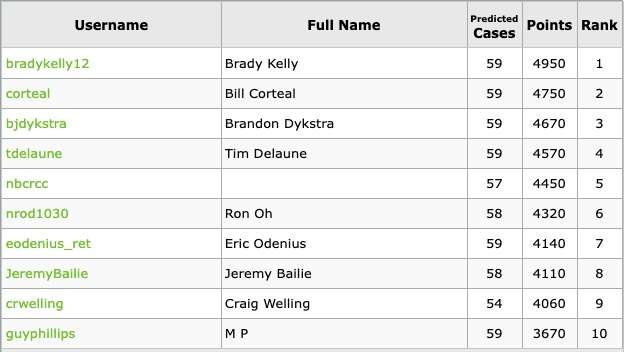
The October 2023 Term of FantasySCOTUS finally came to a close. This term, Chief Justice Roberts cemented himself as the Court's center, as Justice Barrett continues to separate herself from the other Trump appointees. On the whole, this term was more predictable than some recent years. And the FantasySCOTUS prediction market did quite well. In the aggregate, our crowd predicted 83.05% of the cases accurately, up from 75% last term, and 81% the term before.
I am happy to announce that the Chief Justice is Brady Kelly. Brady has now won the competition two years in a row. Players receive ten points for each correct prediction of a Justice's vote. We recorded 59 merits cases (DIGs do not count). A perfect score would have been 5,900 points. Brady scored 4,950 points. Bill Corteal, who was the champion in OT 2021, was the runner-up with 4,750 points.
Here is the Top 10:
Brady Kelly
I profiled Brady last year in this post. This year, I asked him to provide some more detail on how he makes predictions. Here are his comments:
This term, I changed approaches and put in a prediction for every case prior to oral arguments. I changed as needed after oral arguments, but I appreciated A) being able to form an opinion prior to seeing potentially misleading headlines, and B) the ability to (separately) hold myself accountable to predictions without the benefit of oral arguments. Interestingly, Justice Gorsuch had my least accurate predictions pre-oral arguments and my most accurate ones post-oral arguments. In terms of the most difficult cases, I found FBI v. Fikre challenging, and found Moore v. U.S. the hardest to wrap my head around. But honestly, I'm just glad there wasn't another habeas corpus case. There were a few cases where I guessed the outcome about right but guessed incorrectly how it would be counted (e.g. Devillier v. Texas), and then others where I didn't think it was terribly difficult but nonetheless got it very very wrong (e.g. Snyder v. U.S.). I felt the easiest three to predict were NRA v. Vullo, LePage Bakeries, and Sheetz (at least the QP itself). It seems like there are some really difficult questions waiting to come up in a future Sheetz-type case.
Congratulations to Brady, and everyone else who participated. The 16th season of FantasySCOTUS will launch on the first Monday in October.
FDA v. Alliance for Hippocratic Medicine is one of several cases in recent years brought by conservative plaintiffs advancing conservative causes to the Court, only to founder on the shoals of standing. Also this term, in Murthy v. Missouri, the Court concluded that social-media users lacked standing to seek an injunction barring federal officials from pressuring social-media platforms to suppress or deplatform unpopular speech as "disinformation." Whatever improper conduct officials had engaged in to suppress speech in the past, Justice Amy Coney Barrett explained, no plaintiff could show the imminent threat of government action necessary to justify an injunction.
AHM and Murthy are not aberrations. In recent years the Court has turned away conservative challenges to the Indian Child Welfare Act, the Affordable Care Act, and Biden-administration immigration policies as well, all on standing grounds. If some hoped (or feared) that a conservative Supreme Court would loosen the standing barrier against policy-oriented litigation, they were sorely mistaken.
That a conservative Supreme Court insists on enforcing traditional rules of standing should be no surprise. Stringent standing rules have been a core element of conservative jurisprudence for decades. Current doctrine was shaped by the late justice Antonin Scalia as much as by anyone else, and it has also been a priority of Chief Justice Roberts, who sees it as a way of preventing political activists from using the courts to fight policy battles that belong in Congress or at the ballot box.
The idea of standing is grounded in Article III of the Constitution, which limits federal-court jurisdiction to "cases" and "controversies." The idea is that an individual litigant should have a sufficient stake in the outcome of a legal dispute to justify the exercise of federal jurisdiction over his claim. "In more pedestrian terms," as then-judge Antonin Scalia explained in a 1983 law-review article, "it is an answer to the very first question that is sometimes rudely asked when one person complains of another's actions: 'What's it to you?'" It is not enough to care deeply about a particular question. One has to have a sufficiently tangible stake if one wants one's arguments heard in a federal court.
The complaints about standing from the Right, combined with continuing concerns about third-party standing, associational standing, and state standing, make standing doctrine poised for revision, and potentially in ways that do not easily conform to ideological priors or even to linear characterization (e.g. "easier"/"harder"). I suspect standing could become easier in some contexts, but more difficult in others. The question then will be whether standing's current critics will be happy with the end result. I have my doubts.
It looks like Joan Biskupic will have a multi-part series. Maybe five parts, like in the bad 'ol days when the Supreme Court had more leaks than the Titanic. Part I was on Moyle. Part II turns to Trump immunity.
Frankly, there is not much insight here. Almost everything she wrote could have been deduced from simply reading the opinions. Again, I wonder how much of what Joan comes from sources with actual inside info, versus people who have informed speculation. Let's break things down chronologically.
First, a note on sourcing. Biskupic expressly states that Roberts "declined to comment."
Roberts declined to respond to CNN's questions about the recent term and this case.
I don't remember seeing a similar denial in past Biskupic pieces. I think Roberts wanted to make painfully clear that he was not a source for Biskupic. I understand this was an issue with Biskupic's book on Roberts, where certain things were said on background that were attributed to the Chief Justice. There are no doubts here.
Second, we learn there was broad consensus to reject Jack Smith's petition for certiorari before judgment:
The immunity case first arrived at the justices' door in December. Seeking to move the prosecution along, Smith had tried to persuade the court to take early review of the case, before US appellate court action. After the US appellate court ruled, Smith urged them to let the decision – which had spurned the Trump claim of immunity – stand.
Both efforts by the special counsel were in vain. Sources told CNN that there was broad understanding among the justices that they would need to decide the matter themselves, and only after the usual appellate court hearing.
No one dissented from the Court's order. That suggests there was consensus. But if sources confirm it, then it must be true! With the benefit of hindsight, would the Justices have had such a consensus if they knew how long the D.C. Circuit panel decision would take? I doubt it.
Relatedly, Smith has not yet moved to expedited his Eleventh Circuit appeal--something Seth Barrett Tillman wrote should not be granted. Smith may simply be willing to let this case litigate in the normal process, and hope no broad precedent is set on the special counsel regulations.
Third, after oral argument, the Chief Justice assigned the opinion to himself, and made no efforts to forge any compromise with the Court's left wing: