
10/2/1967: Justice Thurgood Marshall takes the oath.

Mostly law professors | Sometimes contrarian | Often libertarian | Always independent | Est. 2002

10/2/1967: Justice Thurgood Marshall takes the oath.
Post your recommendations in the comments; other weeks, there'll be other posts for other genres and other formats.
UPDATE: I had originally said "general literature," and many readers interpreted that as including nonfiction. I've updated this to "general fiction"; I'll have a query for nonfiction next week.
In VanDerStok, the Supreme Court will decide if policy trumps statutory text.
ATF declares that its Final Rule at issue before the Supreme Court in Garland v. VanDerStok "will enhance public safety by helping to ensure that more firearms may be traced by law enforcement to solve crime and arrest the perpetrators." Radically expanding the definition of "firearm" from what Congress enacted is allegedly justified by the policy argument that the agency will be able to "trace" more firearms. Whether that will solve more crimes is a big "if."
We're all familiar with the spiel. A criminal leaves his gun at a "crime scene" (how often does that happen?) but gets away, unidentified. Police find the gun and ask ATF to trace it. The gun is engraved with the manufacturer's name and serial number. ATF starts with the manufacturer and, using the records kept by federal licensees, traces the gun to its retail purchaser. And voilà, the criminal is identified and arrested.
But now the sky is falling. ATF insists that its Final Rule is the Ghost Buster for "ghost guns," a propaganda term used to describe privately-made firearms. Unless the kits from which hobbyists make their own guns are declared to be "firearms," their homemade guns won't be traceable. Criminals who lose their guns at "crime scenes" won't be caught.
After years of ATF exaggerating the usefulness of tracing, Congress enacted a law in 2013 requiring ATF to "make clear that trace data cannot be used to draw broad conclusions about firearms-related crime" by including in its releases of information the following language: "Law enforcement agencies may request firearms traces for any reason, and those reasons are not necessarily reported to the Federal Government. Not all firearms used in crime are traced and not all firearms traced are used in crime."
Consider the disconnect. ATF traces all firearms it encounters. A person is subject to a domestic violence restraining order and ATF learns that he has a very large gun collection. They raid his house, seize all 200 of his guns, and then trace them. That goes down as 200 "crime guns" seized at a "crime scene" that have nothing to do with his offense of mere possession while subject to the order.
As explained in my two previous posts (here and here), Congress defines a "firearm" as a weapon "which will or is designed to or may readily be converted to expel a projectile by the action of an explosive" or "the frame or receiver of any such weapon." ATF's Final Rule expands that definition to include partially-machined raw material, information, jigs, and tools that sufficiently-skilled persons may fabricate into a firearm. Whether ATF has such authority is the issue before the Court in VanDerStok.
One of the superior amici briefs filed in the case is that of the Citizens Committee for the Right to Keep and Bear Arms, authored by Dan Peterson and C. D. Michel. I'll cover some of the highlights in that brief and offer some additional material in the following remarks.
Only licensed manufacturers and importers who are "engaged in the business" are required by the Gun Control Act (GCA) to identify and serialize firearms. 18 U.S.C. § 923(i). Hobbyists are free lawfully to craft their own guns without these requirements. ATF claims that the resultant "ghost guns" cannot be traced, thus requiring the non-gun materials that hobbyists use to make guns be redefined as guns.
But the GCA, as amended by the Firearm Owners' Protection Act, sharply delineates licensees from private individuals. While ATF may inspect licensed dealer records "in the course of a bona fide criminal investigation," it is prohibited from establishing "any system of registration of firearms, firearms owners, or firearms transactions." 18 U.S.C. §§ 923(g) & 926(a).
Nevertheless, ATF has been on a crusade to trace all firearms that law enforcement encounters, and its attack on privately-made firearms is only the latest stage in this endeavor. The Final Rule, ATF urges, is necessary to address an "urgent public safety and law enforcement crisis posed by the exponential rise of untraceable firearms commonly called 'ghost guns.'"
Let's test this claim with reality. New Jersey is one of the states that traces every firearm it encounters, to include the .22 rifle a widow abandons at a police station. Not exactly a crime scene.
In 2022, New Jersey criminalized the purchase of a parts kit not made by a licensed manufacturer with a serial number. ATF trace data for New Jersey that same year shows 5,248 firearm traces, of which 3,824 – 73% – were for "possession of weapon" and "found firearm." Keep in mind that the Garden State makes possession per se without the right papers a crime. How many of these were privately-made firearms? Only 67 traces were for "homicide" and 132 for "aggravated assault." As to firearms seized from the possessor, how did tracing solve any crime?
The Citizens Committee brief goes on point by point in explaining why tracing isn't what it's cut out to be and how meaningless is the supposed data on "ghost guns." First, a trace only leads to the first retail purchaser, if that person can be located. Without evidence, no reason exists to consider that person a "suspect" in whatever the crime is. And after that first purchase, the gun may have been inherited, given as a gift, sold, lost, or stolen.
Second, criminals don't typically buy guns from a licensed dealer, and thus their acquisitions cannot be traced. Where do criminals get their guns? Out of 24,848 prison inmates surveyed, a Bureau of Justice Statistics study Source and Use of Firearms Involved in Crimes (2019) reported:
Off the street/underground market: 43.2%
Obtained from individual: 25.3%
Theft: 6.4%
Purchased/traded at retail source: 10.1% [only 6.9% under one's real name]
Other sources: 17.4%
The study made no mention of any of the firearms being made from kits. Multiple studies of the sources from which criminals get their guns, going back to the 1980s, report similar results.
Third, evidence does not support the government's argument of an "urgent public safety and law enforcement crisis posed by the exponential rise of untraceable firearms…." Let's compare some numbers. There are an estimated 500 million firearms in private hands in the United States. The types of kits that hobbyists most often make into firearms are for AR-15 rifle types and handguns similar to Glocks. ATF data shows that about two and a half million Glocks were introduced into commerce between 2016 and 2022. According to the National Shooting Sports Association, there were 24 million+ modern sporting rifles (mostly AR-types) in American civilian circulation as of 2020.
Compare those numbers with the 19,000 privately-made firearms alleged to have been traced in 2021. That's hardly a drop in the bucket. And consider this further finding by Congress in the 2013 law cited above: "Firearms selected for tracing are not chosen for purposes of determining which types, makes, or models of firearms are used for illicit purposes. The firearms selected do not constitute a random sample and should not be considered representative of the larger universe of all firearms used by criminals, or any subset of that universe."
Other than the numbers of privately-made firearms traced, no information exists as to why they were traced. ATF has raided companies that market kits and presumably seized their inventory, which could jack-up the statistics dramatically. Eleven states and the District of Columbia restrict privately-made firearms, so traces generated in those places may reflect mere possessory offenses.
Based on unverified media accounts, Everytown for Gun Safety Foundation lists 187 alleged "shootings" with "ghost guns" between 2013 and 2024, for an average of about 15 per year. But the data include accidents and suicides, not just assaults. In any event, 15 shootings per year are a miniscule fraction of the tens of thousands of traces of "ghost guns" now being reported by ATF annually.
This is not the first time ATF has manipulated trace data for political ends. In the 1990s, in order to justify a ban on "assault weapons," it was charged with creating the impression that criminals prefer them. Its Forward Tracing Program entailed getting information from manufacturers on the subject firearms and "tracing" them to the retail dealers. Then they told the public that the designated firearms were disproportionately used in crime based on them being traced so much. I document this cooking of the books in America's Rifle, chapter 14.
It goes without saying that the issue before the Supreme Court in VanDerStok is purely legal: does ATF have authority to expand the definition of "firearm" enacted by Congress and thereby to criminalize activity that Congress did not make unlawful? Contrary to government claims, there is no "urgent public safety and law enforcement crisis posed by the exponential rise of untraceable firearms…." But even if there is, it's a matter for Congress, not the agency, to address.
"The District Court correctly dismissed the indictment. Amici advance four rationales to support the judgment below."
Today our team submitted an amicus brief in United States v. Trump before the Eleventh Circuit. This case is an appeal from Judge Cannon's decision declaring the appointment of the Special Counsel to be unlawful. Our brief was filed on behalf of Robert Ray, Professor Seth Barrett Tillman, and the Landmark Legal Foundation. We are grateful to Michael A. Sasso for serving as local counsel.
Tillman and Landmark joined our District Court brief. We are honored that Ray joined our effort on appeal. Ray served as one of the last Independent Counsels, replacing Kenneth W. Starr in October 1999, and was in charge of the Whitewater and Monica Lewinsky investigations. He concluded the investigations by March 2002 with the decision not to prosecute President Clinton once he left office.
Our brief makes four primary arguments:
The District Court correctly dismissed the indictment. Amici advance four rationales to support the judgment below.
First, from the 1850s through the 1950s, during six presidential administrations, Attorneys General retained outside lawyers as Special Counsels either: to assist a U.S. Attorney with prosecutions, or to assist the Attorney General with an investigation. Josh Blackman, A Historical Record of Special Counsels Before Watergate (2024), https://papers.ssrn.com/abstract=4970972 (hereinafter"A Historical Record"). And the Watergate Special Prosecutor is a thin reed to stand on. United States v. Nixon expressly and repeatedly recognized that the Watergate Special Prosecutor had "unique authority and tenure." 418 U.S. 683, 694 (1974). Further, in 1973, the Acting Attorney General, with the acquiescence of the President, granted the Special Prosecutor unsurpassed insulation against removal. Apart from those compromises, this insulation would be inconsistent with Bowsher v. Synar. 478 U.S. 714 (1986). Whether the Nixon analysis is holding or dicta, it is not controlling, and it should not be extended to today's context under today's statutory and regulatory framework.
Second, Special Counsel Jack Smith ("Smith") cannot rely on the permanent indefinite appropriation found in a "note" to 28 U.S.C. §591. In 2004, the Government Accountability Office determined that this appropriation can be used for "investigat[ing] and prosecut[ing] high ranking government officials." GAO, Special Counsel and Permanent Indefinite Appropriation, B-302582, 2004 WL 2213560, at *4 (Comp. Gen. Sept. 30, 2004). But Trump was not a "high ranking" official when he was indicted, and all the alleged conduct took place after he was out of office. In these circumstances, the funding mechanism in Section 591's note cannot be used to pay Smith.
Third, Supreme Court precedent distinguishes between officers and employees. An "Officer of the United States" position must have a duration that is continuous. Though Smith's prosecution has already continued for several years, and his duties are regular, his position is not continuous, because his extant position would not continue to a successor. Morrison v. Olson, 487 U.S. 654, 672 (1988). At most, Smith is a mere "employee" who cannot exercise the sweeping powers of a Senate-confirmed U.S. Attorney.
Finally, Amici have properly preserved for review by the Supreme Court the question of whether Morrison v. Olson should be overruled.
The Special Counsel, like the Independent Counsel, still comes as a wolf. Id. at 699 (Scalia, J., dissenting).
We look forward to this litigation proceeding.
"This Article presents a corpus of primary sources that were written by Presidents, Attorneys General, United States Attorneys, Special Counsels, and others between the 1850s and the 1950s."
I have posted to SSRN a new article titled, A Historical Record of Special Counsels Before Watergate. This Article is based on some extensive research into more than a dozen different archives. This Article is also relevant to the ongoing litigation over the Special Counsel, which I will address shortly.
Here is the abstract:
This Article presents a corpus of primary sources that were written by Presidents, Attorneys General, United States Attorneys, Special Counsels, and others between the 1850s and the 1950s. This corpus reproduces primary sources from more than a dozen archives to present a better legal account showing how Special Counsels were retained by Attorneys General under Presidents Buchanan, Andrew Johnson, Grant, Garfield, Theodore Roosevelt, and Truman.
During these six presidential administrations, Attorneys General retained outside lawyers as Special Counsels either: (1) to assist a U.S. Attorney with prosecutions, or (2) to assist the Attorney General with an investigation. In none of these matters did the Attorney General appoint an outside lawyer as a Special Counsel, and then delegate to him the powers now claimed by modern special counsels: all of the powers of a Senate-confirmed U.S. Attorney.
There was one outlier. In 1924, during the Coolidge Administration, Congress enacted legislation establishing Senate-confirmed special counsels to prosecute Teapot Dome Scandal defendants. These Special Counsels were afforded "total independence." It is doubtful that these positions would be consistent with the Supreme Court's modern separation of powers jurisprudence.
This practice shows that the positions of special counsels in the post-Watergate era are not analogous to the positions of special counsels in the pre-Watergate era. Thus pre-Watergate history does not provide support for the modern, post-Watergate special counsel and the vast powers that they are purportedly vested with.
I welcome comments and feedback!
The education chapter is written by Williamson Evers, and the corporate law chapter by Robert T. Miller.
I previously posted about my draft chapter on "Land-Use Regulation" for the forthcoming forthcoming Routledge Handbook on Classical Liberalism (edited by Richard Epstein, Liya Palagashvili, and Mario Rizzo). It is now available on SSRN. Two other draft chapters for this book are also now up on SSRN: "Education," by Williamson Evers (Director of the Center on Educational Excellence at the Independent Institute), and "Classical Liberalism and Corporate Law," by Robert T. Miller (University of Iowa).
Here's the abstract for the education chapter:
This chapter contends that classical liberal reform of K–12 and higher education would restore liberty and efficacy to all participants. It discusses the pros and cons of public and private provision of K–12 education. It describes the movement from highly local control to increased centralization. The article discusses how the organizational format of K–12 education came about historically, with particular emphasis on the influence of millennialism and its secular successor Progressivism. It shows that Progressivism in educational policy was also influenced by the example of Prussia. The chapter describes teacher-union power and discusses in particular the cases of African American education and Catholic schools. It examines the classical liberal K–12 reforms of pluralism, demonopolization, and parental choice.
Section 3 lays out higher education's array of subsidies and its poor incentive structure. The government is quite often inserted between colleges and students. As with K–12 education, the chapter discusses how the institutional organization of higher education came about historically. It relates what classical liberals have said about professorial tenure. It portrays the increasingly illiberal milieu in institutions of higher learning. The section proposes removing direct subsidies and relying mainly on student tuition payments.
The chapter offers a great overview of both libertarian/classical liberal critiques of conventional government-controlled education, and internal disagreements among libertarians over education policy (e.g. - between those who advocate total privatization and those who support state-subsidized school vouchers). If you want a relatively short but thorough summary of libertarian perspectives on education, this is the place to go.
If I have a reservation, it's that I wish the author had paid more attention to the argument that government control and/or funding of education is needed to increase voters' political knowledge. Voter knowledge of government and public policy is a public good that the market is likely to underprovide. This is an important standard rationale for state intervention in education. I offer some reservations about it in Chapter 7 of my book Democracy and Political Ignorance, and in a more recent book chapter. But the topic is, I think, due for a more extensive reconsideration.
I cannot say much about the corporate law chapter, because it is too far removed my areas of expertise. But it seems a valuable overview of its topic, as well.
I wanted to specially note this Digitalist Papers essay by my Hoover colleague, economist (indeed, Grumpy Economist) John Cochrane; I'm somewhat more worried than he is, but I thought his perspective was interesting and worth noting. Here's the Conclusion:
As a concrete example of the kind of thinking I argue against, Daron Acemoglu writes,
We must remember that existing social and economic relations are exceedingly complex. When they are disrupted, all kinds of unforeseen consequences can follow…
We urgently need to pay greater attention to how the next wave of disruptive innovation could affect our social, democratic, and civic institutions. Getting the most out of creative destruction requires a proper balance between pro-innovation public policies and democratic input. If we leave it to tech entrepreneurs to safeguard our institutions, we risk more destruction than we bargained for….
The first paragraph is correct. But the logical implication is the converse—if relations are "complex" and consequences "unforeseen," the machinery of our political and regulatory state is incapable of doing anything about it. The second paragraph epitomizes the fuzzy thinking of passive voice. Who is this "we"? How much more "attention" can AI get than the mass of speculation in which we (this time I mean literally we) are engaged? Who does this "getting"?
The defendant had also posted (in 2019), "I'm gonna go to the [expletive] pro-Israel march and I'm going to shoot everybody" and other such statements.
From a Justice Department statement yesterday (all redactions in original)
A Somerset County, New Jersey, man was sentenced today to time served—64 months—for concealing his attempts to provide material support to Hamas …. Jonathan Xie, 25, of Basking Ridge, New Jersey, previously pleaded guilty ….
According to documents filed in this case and statements made in court:
Xie knowingly concealed and disguised the nature, location, source, ownership and control of his attempt to provide material support and resources to Harakat alMuqawamah al-Islamiyya and the Islamic Resistance Movement, an organization that is commonly referred to as Hamas. Xie admitted that he knew Hamas was a designated foreign terrorist organization and has engaged in terrorist activities. He said he attempted to conceal his attempted support believing it would be used to commit or assist in the commission of a violent act.
In December 2018, Xie sent $100 via Moneygram to an individual in Gaza who Xie believed to be a member of the Al-Qassam Brigades—a faction of Hamas that has conducted attacks, to include suicide bombings against civilian targets inside Israel. At approximately the same time that Xie sent the money, he posted on his Instagram account "Just donated $100 to Hamas. Pretty sure it was illegal but I don't give a damn."
In April 2019, Xie appeared in an Instagram Live video wearing a black ski mask and stated that he was against Zionism and the neo-liberal establishment. When asked by another participant in the video if he would go to Gaza and join Hamas, Xie stated "yes, If I could find a way." Later in the video, Xie displayed a Hamas flag and retrieved a handgun. He then stated "I'm gonna go to the [expletive] pro-Israel march and I'm going to shoot everybody."
Glossip alleges that his prosecutors withheld evidence at his murder trial—and the Oklahoma A.G. curiously supports his claim. But the prosecutors didn't withhold anything. And the victim's family remains enmeshed in decades of frivolous capital litigation that has now reached the Supreme Court.
Next week the Supreme Court will hear oral argument in Glossip v. Oklahoma. Death row inmate Glossip claims that the prosecutors at his murder trial withheld evidence from him. In a curious twist, the State of Oklahoma has reversed its long-held position supporting Glossip's conviction and now joins Glossip. I have filed an amicus brief for the murder victim's family, presenting important facts about the case the parties have concealed from the Court. In this three-part series, I review the true facts of the case. Working together, Glossip and Oklahoma have concocted a phantom denial of evidence. In fact, the prosecutors never withheld any evidence from the defense. The Supreme Court should rapidly affirm the lower court's decision upholding Glossip's conviction and death sentence—and help bring the victim's family closer to closure after more than two decades of litigation.
In this first post, I demonstrate that the alleged violation of Brady v. Maryland (requiring the State to provide exculpatory evidence to a defendant) simply never happened. The evidence that Glossip alleges prosecutors withheld was, in fact, fully known to the defense, as my amicus brief explains. Tomorrow, in the second post, I will review Glossip's and Oklahoma's (non)responses to this decisive point. Their silence in briefing before the Court is powerful support for my position. Finally, in the last post, I draw some broader conclusions about non-adversarial litigation such as this one. This case presents a cautionary tale about the dangers of courts simply accepting an elected prosecutor's confession of "error," which may be politically motivated.
The story begins on January 7, 1997, when authorities found the slain body of Barry Van Treese in a motel located in Oklahoma City that he owned. Van Treese had been missing for several hours that day. The subsequent search for Van Treese consumed everyone associated with the motel … everyone, that is, except Richard Glossip.
Glossip managed the motel and had allowed it to fall into disrepair in the latter months of 1996. Additionally, Van Treese and his wife, Donna, suspected that Glossip was embezzling money. Van Treese had planned on confronting Glossip about these issues on January 6, 1997. But Glossip said that encounter never happened. Instead, Glossip maintained that Van Treese was his normal self on that day.
As police were searching for Van Treese the next day, suspicion quickly fell on Glossip, who provided conflicting statements and sent investigators on false leads. Later, a friend of Glossip's—Justin Sneed—would confess that he (Sneed) had murdered Van Treese and that Glossip had commissioned him to commit the murder. In 1998, a jury convicted Glossip and he was sentenced to death. After reversal of that conviction for ineffective assistance of counsel, in 2004 a jury again found Glossip guilty and he was sentenced to death based on testimony from Sneed and other witnesses. The judge who presided over the trial found Sneed "to be a credible witness on the stand," as quoted at p. 46 of the 2022 State's Submission to Parole Board. At sentencing, another judge echoed this conclusion, saying to Glossip: "I would say that after observing the witnesses and hearing the testimony I have absolute confidence in the decision the jury reached, both to convict you, to find the aggravators and to impose the sentence of death," as quoted at p. 48 of the same 2022 submission.
In 2007, the Oklahoma Court of Criminal Appeals ("OCCA") affirmed Glossip's conviction and sentence, rejecting Glossip's claim that the evidence only proved his was an accessory after the fact. In the years since, courts have rejected multiple challenges by Glossip to his conviction and death sentence.
Nearly two decades later, Oklahoma was preparing to execute Glossip when a new Attorney General, Gentner Drummond, was elected. Shortly after assuming office in January 2023, and apparently sensing political opportunity, the new Attorney General hastily commissioned an "independent" review of Glossip's conviction. Conveniently, General Drummond hired Rex Duncan, his lifelong friend and a political supporter who possessed limited experience in capital litigation. Duncan suddenly discovered "new" evidence the prosecution had purportedly concealed from the defense.
As the tale is told in Glossip's and Oklahoma's briefs before the Supreme Court, the trial prosecutors withheld from Glossip's defense team information about Sneed's lithium usage and related psychiatric care. This story rests on an interpretation of notes the prosecutors took during a pretrial interview of Sneed. Specifically, General Drummond asserts that the handwritten notes indicated that Sneed told the prosecutors "that he was 'on lithium' not by mistake, but in connection with a 'Dr. Trumpet.'"
Before the Oklahoma Court of Criminal Appeals (the "OCCA"), Oklahoma's highest court on criminal issues, five judges considered General Drummond's confession of error and were unimpressed. In April 2023, in a detailed opinion, the OCCA unanimously concluded that the Attorney General's concession was "not based in law or fact."
In May 2023, Glossip sought certiorari, supported by Attorney General Drummond. The Court re-listed Glossip's petition twelve times through the end of 2023.
In January 2024, the Supreme Court granted certiorari to review questions relating to the Court's jurisdiction and the implications of "the State's suppression" of Sneed's "admission he was under the care of a psychiatrist …." Because no one was defending the OCCA's judgment below, the Court appointed Chris Michel, a very capable appellate lawyer in Washington, D.C., to defend it as Court-appointed amicus.
The Supreme Court lacks jurisdiction in this case, for the reasons explained in briefs by the Court-appointed amicus, Utah and six other states, and the Criminal Justice Legal Foundation. But more important, Glossip's conviction should be affirmed because the prosecutors never suppressed anything.
Here's what really happened during the prosecutors' interview of Sneed two decades ago: On October 22, 2003, before Glossip's retrial, prosecutors Connie Smothermon and Gary Ackley interviewed Sneed, with Sneed's counsel present. Smothermon and Ackley both took notes. Read in context, the notes show that Sneed told the group that members of Glossip's defense team had previously visited him (Sneed) and questioned him about being "on lithium?" and a "Dr[.] Trumpet?" Smothermon and Ackley simply took notes recording what Sneed recounted about questions from Glossip's own defense team!
Turning first to Smothermon's notes, General Drummond argues that the prosecutor had "taken handwritten notes confirming her knowledge of Sneed's diagnosis and treatment"—e.g., treatment for a psychiatric condition by lithium by a Dr. Trumpet. But General Drummond fails to quote Smothermon's notes accurately, much less discuss their context or meaning in any detail. Smothermon's note regarding lithium contains a question mark—e.g., her note reads, "on lithium?" And her related note about "Dr[.] Trumpet" likewise contains a question mark. You can see the notes in question in the image below—with "on lithium?" and "Dr[.] Trumpet?" flagged with black arrows:
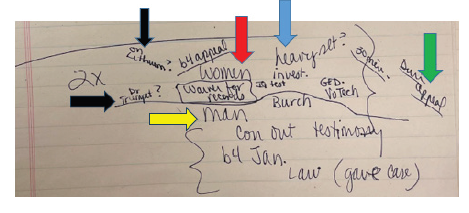
Stepping back to examine the surrounding context of these two notes reveals that Smothermon was simply recording Sneed recounting what Glossip's defense team was questioning him (Sneed) about—hence, the two question marks reflecting questions being asked. Smothermon's adjoining notes reflect two visits ("2X") by defense representatives—with notes about the two visits separated by a curving line. Read More
Plaintiff (Stefan Passantino, Cassidy Hutchinson's former lawyer) may thus eventually prevail, if the claim is shown to be false, and if the defendant is shown to have spoken with "actual malice" (if plaintiff is a public figure) or negligently (if plaintiff is a private figure).
From Judge Loren L. AliKhan's decision yesterday in Passantino v. Weissmann (D.D.C.):
The following factual allegations drawn from Mr. Passantino's complaint, are accepted as true for the purpose of evaluating the motion before the court. Mr. Passantino has been a lawyer for more than thirty years. In 2017 and 2018, he served as a senior lawyer in the Trump administration. Since then, he has been in private practice.
Following the attack on the U.S. Capitol on January 6, 2021, the House of Representatives established a Select Committee to investigate what had happened. As part of its investigation, the Select Committee interviewed numerous witnesses, including Cassidy Hutchinson, a former special assistant to President Trump who had been serving under the direction of White House Chief of Staff Mark Meadows on January 6, 2021.
Mr. Passantino represented Ms. Hutchinson at her first three closed-door Select Committee depositions on February 23, March 7, and May 17, 2022. While the complaint does not specify exactly when this occurred, Ms. Hutchinson sent text messages to a friend expressing that she "d[idn]'t want to comply" with the Committee's requests. In the same conversation, however, she noted that "Stefan [Passantino] want[ed] [her] to comply."
Following the second deposition, Ms. Hutchinson felt that she had "withheld things" from the Select Committee and wanted to "go in and … elaborate … and kind of expand" on some topics. Unbeknownst to Mr. Passantino, Ms. Hutchinson asked a friend to "back channel to the committee and say that there [were] a few things that [she] want[ed] to talk about." While Ms. Hutchinson deliberately kept this from Mr. Passantino, she explained at a future deposition that, at that time, she "wasn't at a place where [she] wanted to terminate [her] attorney-client relationship with [Mr. Passantino]."
10/1/1924: Chief Justice Rehnquist's birthday.
What's on your mind?
The statutory history of the Gun Control Act cuts in favor of the VanDerStok respondents.
This is my second installment preceding the upcoming October 8 argument in Garland v. VanDerStok, a challenge to the regulatory redefinition of the term "firearm" in the Gun Control Act. By expanding the statutory definition, the Bureau of Alcohol, Tobacco, Firearms & Explosives (ATF) in its 2022 Final Rule purports to criminalize numerous innocent acts that Congress never made illegal.
Until the new rule, a kit with partially-machined raw material that can be fabricated into a firearm was not considered to have reached a stage that it is a "firearm." To prevent Americans from making their own firearms from such material, which has always been and remains lawful, the bugbear term "ghost guns" was recently coined. In its VanDerStok brief, the government argues that "anyone with basic tools and rudimentary skills" can "assemble a fully functional firearm" from such kits "in as little as twenty minutes."
As explained in my last post, that is refuted by none other than the former Acting Chief of ATF's Firearm Technology Branch, Rick Vasquez, who reviewed and approved hundreds of classifications about whether certain items are "firearms." As he explained in his amicus brief, fabrication of a firearm from these kits is a complex process requiring skill and special tools beyond the capacity of the average person.
In this post I'll trace the statutory history of the term "firearm" to gain insight into its meaning. The Gun Control Act defines "firearm" as "(A) any weapon (including a starter gun) which will or is designed to or may readily be converted to expel a projectile by the action of an explosive; (B) the frame or receiver of any such weapon…." 18 U.S.C. § 921(a)(3). An ATF regulation on the books from 1968 to 2022 defined a "frame or receiver" as "that part of a firearm which provides housing for the hammer, bolt or breechblock and firing mechanism," i.e., the main part of a firearm to which the barrel and stock attach.
ATF's Final Rule stretches these terms to mean parts, material, jigs, tools, and instructions that constitute neither an actual "firearm" nor a "frame or receiver," but may be used by a skilled person with proper tools to fabricate these items.
This new regulatory definition of "firearm" obviously conflicts with the definition enacted by Congress. Two cases decided by the Supreme Court this year directly apply. Per Dep't. of Agriculture Rural Dev. Rural Housing Service v. Kirtz: "When Congress takes the trouble to define the terms it uses, a court must respect its definitions as virtually conclusive." Congress defined "firearm." And while Congress did not explicitly define "frame or receiver," Snyder v. United States teaches that, after analyzing the statutory text, a court may look at "the statutory history, which reinforces that textual analysis."
Statutory history is a prime focus of the Amicus Curiae Brief of the National Shooting Sports Foundation, which I coauthored with Schaerr Jaffe LLP and NSSF counsel. As the brief details, the statutory history reinforces the textual analysis. I have covered the subject further in "Textualism, the Gun Control Act, and ATF's Redefinition of 'Firearm,'" Harvard Journal of Law & Public Policy: Per Curiam, Aug. 27, 2024.
We begin with the Federal Firearms Act of 1938 ("FFA"), 52 Stat. 1250, which defined a firearm as "any weapon, by whatever name known, which is designed to expel a projectile or projectiles by the action of an explosive … or any part or parts of such weapon." It provided that any person who violated "any of the provisions of this Act or any rules and regulations promulgated hereunder" was subject to fines and imprisonment. It empowered the Secretary of the Treasury to "prescribe such rules and regulations as he deems necessary to carry out the provisions of this Act."
FFA regulations required licensed manufacturers to record firearms disposed of, including "the serial numbers if such weapons are numbered." Dealers were required to record acquisitions and dispositions. Required records included "firearms in an unassembled condition, but not including parts of firearms." That an "unassembled" firearm constituted a firearm in no way implied that raw material and unfinished parts were considered a firearm.
Revenue Ruling 55-175 (1955) held that "a barrel[ed] action comprised of the barrel …; front and rear stock bands; receiver with complete bolt, trigger action, magazine, etc., is a weapon, complete except for the stock, which is capable of expelling a projectile or projectiles by the action of an explosive." One can see here the understanding of a "receiver" as the housing that holds the internal parts that would be reflected in the 1968 regulatory definition of "frame or receiver."
Apparently, the only judicial decision on the meaning of "part or parts" in the FFA was United States v. Lauchli (7th Cir. 1966), which mostly concerned dealing in unregistered machine guns.
The court held that "Browning automatic rifle magazines" were "parts" under the FFA because "such weapons could not be fired automatically without the magazines." These finished parts contained in the machine guns were "serviceable parts, thus bringing them within the scope of the [FFA]." This statement confirmed that items that were not "serviceable parts" were not considered "parts."
In sum, under the FFA, a "firearm" was a "weapon" designed to expel a projectile, whether assembled or unassembled. To be a "part or parts," the items had to be serviceable. A "receiver" housed the bolt, trigger action, and magazine. This background demonstrates that partially completed material that had not become an actual weapon or useable parts was not considered a "firearm."
Despite recent political jargon about so-called "ghost guns," from the ratification of the Second Amendment in 1791 until 1958, no federal legislation required that anyone—even a firearm manufacturer—mark a firearm with a serial number. Then in 1958, a regulation required manufacturers and importers to identify each firearm "by stamping … the name of the manufacturer or importer, and the serial number, caliber, and model of the firearm…. However, individual serial numbers and model designation shall not be required on any shotgun or .22 caliber rifle…."
Beginning in 1963, bills were introduced to revise the FFA that would eventually find their way into the Gun Control Act ("GCA") of 1968, the major federal law regulating firearms today. As reflected in Senate Report No. 90-1097 (1968): "It has been found that it is impractical to have controls over each small part of a firearm. Thus, the revised definition substitutes only the major parts of the firearm; that is, frame or receiver for the words 'any part or parts.'"
Initially, the GCA bills continued the FFA provision making violation not just of the Act, but also of any rule or regulation, a criminal offense. In floor debate, Senator Robert Griffin objected that lawmakers "should not delegate our legislative power … in the area of criminal law," and that due process required that "we should spell out in the law what is a crime." Likewise, Senator Howard Baker rejected "plac[ing] in the hands of an executive branch administrative official the authority to fashion and shape a criminal offense to his own personal liking." 114 Cong. Rec. 14,792 (May 23, 1968). Making it a crime to violate a regulation was then removed from the bill.
As enacted, the GCA defined "firearm" exactly as it is defined by that statute now. It required licensed manufacturers and importers to engrave a serial number on each frame or receiver.
Also in 1968, the Treasury Department adopted the same regulatory definition of "frame or receiver" that was retained until 2022: "That part of a firearm which provides housing for the hammer, bolt or breechblock and firing mechanism, and which is usually threaded at its forward portion to receive the barrel." That reflected the common understanding of the meaning of those terms. In fact, each of the terms in the definition was defined that same year in Chester Mueller & John Olson, Small Arms Lexicon and Concise Encyclopedia (1968).
Just before adopting its proposed GCA regulations in 1968, Treasury held a public hearing, the only one ever held before or since. Not a single witness objected to the definition of a frame or receiver. To the contrary, an industry witness praised the "very clear definition of a … receiver, something we didn't have before[.]"
If the 1968 regulation could talk, it would say: "read my lips – the frame or receiver is the 'part' that 'provides housing' for the internal parts in the present tense, not partially-machined raw material that 'could provide housing' in the future should one perform the required fabrication operations."
In deep-sixing the Chevron deference doctrine in Loper Bright Enters. v. Raimondo, the Supreme Court said that historically "respect was thought especially warranted when an Executive Branch interpretation was issued roughly contemporaneously with enactment of the statute and remained consistent over time." That applies perfectly to the 1968 regulation, which expressed the common understanding of "frame or receiver" when Congress enacted the GCA, and remained in force for the next fifty-four years until ATF abruptly scrapped it.
In enacting the Firearm Owners' Protection Act ("FOPA") of 1986, Congress found "additional legislation" necessary "to correct existing firearm statutes and enforcement policies." But it left intact the GCA's definition of "firearm" and expressed no dissatisfaction with ATF's definition of "frame or receiver." It was the same result in the three subsequent times in which Congress defined certain types of firearms – the Crime Control Act of 1990, defining "semiautomatic rifle"; the Brady Act of 1993, defining "handgun"; and the Public Safety & Recreational Firearms Use Protection Act of 1994, defining "semiautomatic assault weapon" (repealed in 2004).
As the Supreme Court opined in U.S. v. Rutherford (1979), "once an agency's statutory construction has been 'fully brought to the attention of the public and the Congress,' and the latter has not sought to alter that interpretation although it has amended the statute in other respects, then presumably the legislative intent has been correctly discerned."
However, FOPA mandated that the Secretary (now the Attorney General) may prescribe "only such rules and regulations as are necessary to carry out the provisions of this chapter," deleting the prior language that "the Secretary may prescribe such rules and regulations as he deems reasonably necessary." And yet today, ATF's Final Rule purports to expand the meaning of terms in conflict with the GCA's plain text and thereby to criminalize previously legal conduct through regulations.
In sum, the statutory history reinforces the textual analysis that the term "firearm" is limited to the exact definition that Congress enacted, and does not extend to an open-ended, undefined "parts kit" that flunks that definition. Further, a "frame or receiver" is the main part of a firearm that provides housing for the internal parts, an understanding that has persisted over a half century. It does not include partially-machined raw material that has not been fabricated into a functional housing.
For much more on the statutory history beginning with the Federal Firearms Act of 1938 and going forward, please see my article "The Meaning of 'Firearm' and 'Frame or Receiver' in the Federal Gun Control Act: ATF's 2022 Final Rule in Light of Text, Precedent, and History."
Democrats will live to regret doing this if they have the votes to do it.
Vice President Kamala Harris has called for eliminating the filibuster to pass a national bill codifying abortion rights. Other top Democrats have called for abolishing the filibuster to pass a Supreme Court packing bill or voting rights legislation. Suspending the filibuster for your highest policy priorities, like guaranteeing abortion rights nationwide, is a very bad idea for four reasons.
First, if Kamala Harris and the Democrats abolish the filibuster on an issue as big as abortion rights for women, or to pack the Supreme Court, the Republicans will abolish the filibuster when they are next in power to ban public sector unions nationwide, to require school choice nationwide, to require tort reform nationwide, and to repack the Supreme Court. Democrats eliminated the filibuster of executive and judicial officers on the lower federal courts in 2013. As a direct result, when Republicans came to power and had a Senate majority in 2017, they eliminated the filibuster on Supreme Court nominees. This allowed the confirmations of Neil Gorsuch, by a vote of 54 to 45, of Brett Kavanaugh by a vote of 50 to 48, and of Amy Coney Barrett in October of a presidential election year by a vote of 52 to 48. What goes around comes around. Kamala Harris and the Democratic Party will rue the day they eliminated the filibuster to pass national abortion rights legislation or a Supreme Court packing bill.
This leads me to my second point, which is this: the one thing that we know for sure about the upcoming election on November 5th is that the presidential race and the races for control of both Houses of Congress are going to be incredibly close. If Democrats elect Harris by a small margin and win control of the two Houses of Congress by a small margin, they will not have a mandate to make a sweeping constitutional change in our system of government. Suspending the filibuster in the Senate would be a sweeping and probably permanent constitutional change in our system of government.
How would Democrats feel if a slim Republican majority in Congress and a Republican President elected by a slim margin required that voters in every state produce a driver's license or a passport in order to be eligible to vote in an election, or if a slim Republican trifecta banned mail in voting in every state because the secret ballot is compromised when people vote outside of polling booths, which it surely is?
To understand why keeping the filibuster is so important, consider my third point, which is this: One of the most important ways in which our Constitution and its system of checks and balances, which has traditionally included the filibuster, protects liberty and promotes economic growth is by creating certainty and predictability, which reduces the risk factor for investors. Few will want to start a business or try to invent a better mousetrap to make money in a country whose legal system might allow for the confiscation of that business or mousetrap income twenty years from now. Many authors will not write a controversial book or article or op-ed or give a speech if their country's legal system might allow them to be prosecuted for what they say twenty years from new.
From Mason v. American Prospect, Inc., decided yesterday by Judge Loren L. AliKhan (D.D.C.):
Plaintiff Chataquoa Nicole Mason brings this action against Defendants The American Prospect ("TAP") and Julianne McShane. Dr. Mason alleges that TAP and Ms. McShane defamed her and tortiously interfered with her business relations when they published an article (written and reported by Ms. McShane) covering her tenure as President and Chief Executive Officer of the Institute for Women's Policy Research….
IWPR is a "national think tank" that "build[s] evidence to shape policies that grow women's power and influence, close inequality gaps, and improve the economic well-being of families." The organization was founded by Dr. Heidi Hartmann, who served as its long-time President and Chief Executive Officer. In 2019, IWPR's Board of Directors removed Dr. Hartmann from these roles because she was "abusing staff and otherwise creating a toxic work environment, engaging in racist behavior … and failing to adequately fundraise."
IWPR searched for a new President and Chief Executive Officer and hired Dr. Mason in fall 2019. Dr. Mason is an African American woman who holds a Ph.D. in Political Science, boasts "more than twenty years of research and advocacy experience focused on women's economic security," and has a "long track record of success in leadership positions." She entered her new role in a time of tumult, facing budget shortfalls, staff discontentment, and racism. Nevertheless, "she worked tirelessly to achieve major goals," like "dealing with the toxic work environment," raising sorely needed funds (including closing a budget shortfall of more than one million dollars), and increasing the public profile of the organization. Dr. Mason "participate[d] in public forums and networking events," "spearhead[ed] two major conferences," won an industry award, and "was named one of the World's Greatest Leaders by Fortune Magazine." …
At some point, Ms. McShane, a freelance reporter, began investigating Dr. Mason's leadership of IWPR…. In November 2022, TAP published the article, titled "A Women's Policy Giant Struggles Amid New Leadership," https://perma.cc/P9CY-3V3V. The article highlighted several of Dr. Mason's and IWPR's key accomplishments, including her recognition by Fortune magazine and IWPR's successful fundraising efforts. The article also includes the following statements relevant to Dr. Mason's claims:
The narrower version put forward by her campaign is still bad, but much less so than the much broader one floated earlier.

Several weeks ago, in an article in The Hill, I outlined how both Donald Trump and Kamala Harris have put forward harmful economic policies that exploit widespread voter ignorance. One of the Harris policies I highlighted was a proposal for price controls on groceries. It's therefore only fair that I acknowledge she has since scaled back that proposal.
As originally described, Harris' proposal seemed to be a plan for broad, nationwide controls on grocery prices. The new version put out by her policy team, is still bad, but much less so than before. Michael Strain of the conservative National Review (which is not generally sympathetic to Harris) has the details:
There has been a great deal of confusion around Vice President Harris's plans to combat "price gouging." Last month, her campaign announced that, if elected, the vice president would push for "the first-ever federal ban on price gouging on food and groceries — setting clear rules of the road to make clear that big corporations can't unfairly exploit consumers to run up excessive corporate profits on food and groceries…."
This vague language — along with mixed messages from her advisers and surrogates — led many analysts and commentators to conclude that Harris would use a recent bill from Elizabeth Warren as a template for her policy. Senator Warren's bill is extremely broad and would give enormous power to the Federal Trade Commission to regulate prices.
If enacted, Warren's bill would, of course, be a disaster for the economy. If federal bureaucrats took charge of grocery prices, shortages would occur….
Does Harris support Warren-style price controls? For weeks, we've been left to speculate.
Yesterday [Sept. 24], the vice president released a policy book that answers this question: She does not support Warren-style price controls.
From Harris's book:
"Vice President Harris and Governor Walz's proposal—like many of the laws already on the books in 37 states—will go after nefarious price gouging on essential goods during emergencies or times of crisis. When an emergency strikes, the American people deserve to know the government can take on bad actors that take advantage of a crisis to excessively jack up prices."
The book makes two things clear: Harris would model her plan on existing state laws, not on Warren's bill. And her regulation would kick in only during emergencies….
To be clear, I don't think a federal price-gouging law is a good idea. Such laws at the state level are more defensible, but still questionable. Yes, cases of water became much more expensive in Texas following Hurricane Harvey. But if you were, say, a Colorado-based business that sold water, those higher prices for water in Texas meant that you wanted to stop selling water to folks in Colorado and to start selling it to folks in Texas. That $99-per-case price sent a signal to water sellers all across America that they should be sending more water to Texans than they normally do. The result: More water went to Texans, which was exactly what was needed following the hurricane.
But even though a federal price-gouging law isn't a good idea, it's not a terrible idea. It will likely have no real impact on consumers, producers, or economic activity.
I am less sanguine about Harris's scaled-down proposal than Strain is. What qualifies as an "emergency" or a "time of crisis" is far from clear. In recent years, presidents of both parties have abused "emergency" declarations to circumvent constraints on executive power in order to push through harmful policies, as with Trump's border wall funding diversion and Biden's student loan forgiveness program (eventually invalidated by the Supreme Court). When and if Harris tries to turn her new proposal into an actual bill, it will be important to keep an eye on whether and how the proposed law defines what counts as an "emergency."
In addition, as Strain points out, price controls are harmful even when there is an actual emergency. They tend to produce shortages of vital supplies precisely when those goods are most needed.
Nonetheless, it's worth noting that Harris's current price-control proposal is substantially narrower - and thus much less harmful - than the one originally floated in August. By contrast, Trump hasn't scaled back his even more harmful plans on immigration and tariffs.
It's also worth reiterating that either the narrow or the broad version of Harris's price controls would have to be enacted by Congress. By contrast, Trump could enact most of his most harmful ideas by unilateral executive action. As Trump himself recently put it, "I don't need Congress [to impose tariffs]…. I'll have the right to impose them myself, if they don't." That is one of a number of factors making his agenda more dangerous than Harris's, even though the latter also has serious flaws.
A new law bars both public and private universities from privileging children of alumni in college admissions.
In debates over whether universities should (or should be allowed to) consider race in admissions, it is often pointed out that many universities give preferences to the children of alumni and university donors. It is also fairly noted that such preferences may have racially disparate effects (particularly at institutions that were formerly segregated).
As a legal matter, however, race-based preferences more suspect than other admissions preferences. Under current 14th Amendment's Equal Protection Clause doctrine, the consideration of race by state institutions is inherently suspect (and this standard has been applied to private universities through federal law). Not so many other characteristics that may be used in university admissions processes -- including relationships to alumni and benefactors.
Earlier today, California Governor Gavin Newsom signed a measure to prohibit legacy and donor preferences in college admissions throughout the state. Of note, the law will apply to both public and private universities, but does not impose meaningful penalties.
From a Politico report:
California's law, which will take effect Sept. 1, 2025, is the nation's fifth legacy admissions ban, but only the second that will apply to private colleges. . . .
Like other states, California won't financially penalize violators, but it will post the names of violators on the state Department of Justice's website.
California will also add to data reporting requirements that it implemented in 2022, when private colleges had to start sharing the percentage of admitted students who were related to donors and alumni. Schools that run afoul of the new law will also have to report more granular demographic information about their incoming classes to the state, including the race and income of enrolled students as well as their participation in athletics. . . .
Public universities in California won't be affected by the change. California State University does not consider legacy or donor ties, and the University of California system stopped doing so in 1998, two years after California voters banned race-conscious admissions through a statewide ballot measure.
displayed on defendant's car and on her fence facing neighbors who have a transgender child; an appellate court reverses the conviction on procedural grounds, without resolving the First Amendment issue.
Last Wednesday's decision of a Pennsylvania appellate court in Commonwealth v. Balcom (by Judge Alice Beck Dubow, joined by Judges Deborah Kunselman & Carolyn Nichols) involved a dispute between neighbors. O'Donnell and Collier, a gay couple, lived with their sons "and their daughter, K.H., who is transgender"; Balcom lived next door, "and she and Victim's [O'Donnell's] family have had an acrimonious relationship for several years. Appellant's backyard abuts Victim's backyard, with a fence along the shared property line."
Mr. Collier was parking his car on the street near their home after picking up their sons when Appellant [Balcom], who was in her car, displayed a sign in the rear window of her car that said, "only women can be mothers." The next evening, Victim and his family returned home to find that Appellant had placed a large sign on the fence facing their back yard, and K.H.'s bedroom window, that said "'transing' kids is abuse and homophobia[.]" The sign was only visible from Victim's house or yard and to anyone walking their dogs in the adjacent alley if they "crane[d] their necks."
Victim filed a private criminal complaint against Appellant, in which he referenced the backyard sign and stated that Appellant had been "harassing [his family] for 2 years." Accordingly, the Commonwealth charged Appellant with Harassment, a summary offense.
The Magisterial District Court convicted Appellant and sentenced her to pay a fine of $200. Appellant appealed and proceeded pro se to a de novo bench trial in the Court of Common Pleas ….
Celebrate your independence with a subscription to Reason magazine, your most trusted source of honest, insightful news and analysis.




