The Volokh Conspiracy

Mostly law professors | Sometimes contrarian | Often libertarian | Always independent | Est. 2002

The Volokh Conspiracy

Donald Trump

Free Press Symposium on "Is Donald Trump Breaking the Law?"

The degree of agreement among participants with major ideological diferences is striking.

|

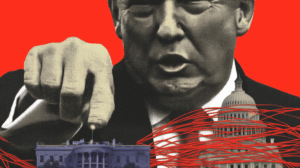
trump tariff
Lex Villena; Midjourney

Today, the Free Press published a symposium on "Is Donald Trump Breaking the Law?"

Participants include (in addition to myself), several prominent constitutional law scholars and legal commentators : Jonathan Adler (Case Western/Volokh Conspiracy co-blogger), Aziz Huq (University of Chicago), Larry Lessig (Harvard), Andrew McCarthy (National Review), Michael McConnell (Stanford), Ed Whelan (Ethics and Public Policy Center), and yours truly.

The editors of FP summarize the contributions, as follows:

The consensus is striking—and perhaps surprising, given the ideological diversity of these contributors. All agreed that the president's legal tactics reflect a dangerous willingness to ignore statutory and constitutional constraints—and that he must be reined in quickly.

Speaking for myself alone, I think I have never before been part of an ideologically diverse symposium on a  contentious topic where I agreed with over 90% of what the other participants said. But I do here, despite major ideological differences with all the others (except, probably, Adler). If I have a disagreement, it may be with Larry Lessig's argument that the best analogy to Trump's behavior is that of Mafia bosses. I think that comparison is a bit unfair to the Mafiosi, and the better analogy is to various nationalist authoritarians and wannabe authoritarians. But I do agree that what Lessig says is illegal is in fact so.

It's perhaps notable that two of the contributors (Huq and Lessig) are far to the left of me, and two others (McCarthy and Whelan) are far to the right. McConnell is also substantially more conservative than I am, but probably to a lesser degree than McCarthy and Whelan.

Skeptics can argue that FP cherry-picked the participants. But it's worth noting that Free Press is generally viewed as a right-leaning "anti-woke" publication. They've even been criticized for being excessively friendly to the MAGA movement and overly tolerant of its excesses.

Here's an excerpt from my own contribution:

The second Trump administration is trying to undermine the Constitution on so many fronts that it's hard to keep track. But three are particularly dangerous: the usurpation of Congress's spending power; unconstitutional measures against immigration justified by bogus claims that the U.S. is under "invasion"; and assertions of virtually limitless presidential power to impose tariffs….

Trump has claimed the power to "impound" federal funds expended by Congress, and to impose conditions on federal grants to state governments and private entities that Congress never authorized. The Constitution gives the power of the purse to Congress, not the president….

On immigration, Trump has issued an executive order claiming illegal migration amounts to an "invasion," thereby authorizing him to suspend most legal migration. The order is at odds with overwhelming evidence indicating that, under the Constitution, "invasion" means an "operation of war" (as James Madison put it), not mere illegal border crossing or drug smuggling. The invasion order threatens not only immigrants, but U.S. citizens….

Similar bogus invocations of "invasion" have been cited by Trump to justify invoking the Alien Enemies Act of 1798—legislation that can only be used in the event of war, "invasion," or "predatory incursion"—to deport Venezuelan migrants without due process to imprisonment in El Salvador….

The administration's claims that courts are powerless to order the return of illegally deported and imprisoned people menace not only immigrants, but American citizens. Under Trump's logic, they, too, could be deported and imprisoned abroad, and courts could not order their return.

Finally, Trump has usurped congressional authority over international commerce to impose his massive "Liberation Day" tariffs, thereby starting the biggest trade war since the Great Depression, and gravely damaging the U.S. economy….


Justice Alito Dissents: "Both the Executive and the Judiciary have an obligation to follow the law."

Justice Alito also questions whether the Court even had jurisdiction to act.

|

Saturday evening, I published three posts on A.A.R.P. v. Trump. Around midnight eastern time, Justice Alito issued his dissent, which was joined only by Justice Thomas. The dissent begins: "Shortly after midnight yesterday, the Court hastily and prematurely granted unprecedented emergency relief." He is correct.

Justice Alito lists seven bullets which demonstrates why this order was problematic. The first bullet argues that it is unclear the Court had jurisdiction:

It is not clear that the Court had jurisdiction. The All Writs Act does not provide an independent grant of jurisdiction. See 28 U. S. C. §1651(a) (permitting writs "necessary or appropriate in aid of " a court's jurisdiction); Clinton v. Goldsmith, 526 U. S. 529, 534–535 (1999) ("the express terms" of the All Writs Act "confine the power of [a court] to issuing process' in aid of ' its existing statutory jurisdiction; the Act does not enlarge that jurisdiction" (quoting §1651(a)). Therefore, this Court had jurisdiction only if the Court of Appeals had jurisdiction of the applicants' appeal, see §1254 (granting this Court jurisdiction to review "[c]ases in the courts of appeals"), and the Court of Appeals had jurisdiction only if the supposed order that the applicants appealed amounted to the denial of a preliminary injunction. See §1292(a)(1).

I've received a number of emails about my Marbury post. I'll offer a few points in response. The All Writs Act permits the Court to take actions in aid of its jurisdiction, and even in aid of its future jurisdiction. But, as Justice Alito notes, the All Writs Act does not, by itself, grant the Court new statutory jurisdiction. The Court still must have statutory jurisdiction from some other basis. The usual basis is where there is a judgment that is appealable under Section 1292. In some cases, the Court have construed a TRO as, in effect, a preliminary injunction, thus permitting the Court to intervene. But in A.A.R.P., the District Court did not rule at all, one way or the other. There is a doctrine where the "constructive" denial of a TRO is considered a ruling. But as Judge Ramirez pointed out, the district court was given about 42 minutes to rule. There is no sense this was a "constructive" denial.

Perhaps the ACLU might argue that the question of whether there is a "constructive" denial is a merits question. But I think it has to be jurisdictional, and that is what the Fifth Circuit concluded. If the Supreme Court wanted to issue any relief, it would have to satisfy itself there was a constructive denial, which would afford it some sort of statutory jurisdiction. I doubt any such finding was made. The Court fell for the ACLU's petition hook, line, and sinker.

It's not at all clear to me that the Supreme Court had any appellate statutory jurisdiction in this case. And if it was not exercising an appellate statutory jurisdiction, then how did the Court issue an order to the "government" (however defined)? If in fact the All Writs Act permits the Supreme Court to assume statutory jurisdiction over a future appeal, and issue an injunction, when in fact the District Court was never even given a chance to rule, then the All Writs Act may have some Marbury problems.

Has the Supreme Court ever issued an injunction or mandamus in a case where there is no ruling from any lower court? (I am not talking about cases of constructive denial.) I would wager the answer is no, but maybe someone knows of these cases. I am happy to post an update.

Justice Alito's second and third bullets focus on whether the ACLU complied with the Federal Rules of Appellate Procedure Rule 8(a)(1)(A) and Supreme Court Rule 23.3 about emergency relief. They didn't. These sorts of procedural rules only seem to matter when the Court wants to deny relief.

Alito does include a piece of information that hasn't been made public:

When this Court rushed to enter its order, the Court of Appeals was considering the issue of emergency relief, and we were informed that a decision would be forthcoming.

Based on my calculations, the Fifth Circuit ruled within a few minutes of the Supreme Court. The Fifth Circuit's order was dated April 18. It was issued around midnight central time, which would be around 1:00 a.m. ET. The Supreme Court's order was issued around 1:00 a.m. ET. It isn't clear which happened first. I asked the Clerk of the Fifth Circuit for clarification, which should be a matter of public record. But now we learn that Chief Justice Roberts knew the Fifth Circuit was going to rule, but just didn't give a damn to wait. Maybe he thought it was easier to try to rule first, and avoid having to make any ruling on anything?

Justice Alito's fourth bullet explains the problems with granting ex parte relief, where there are only briefs from one side.

Justice Alito's fifth bullet attacks another ruling issued late at night: South Bay:

The papers before us, while alleging that the applicants were in imminent danger of removal, provided little concrete support for that allegation. Members of this Court have repeatedly insisted that an All Writs Act injunction pending appeal may only be granted when, among other things, "the legal rights at issue are indisputably clear and, even then, sparingly and only in the most critical and exigent circumstances." South Bay United Pentecostal Church v. Newsom, 590 U. S. ___, ___ (2020) (ROBERTS, C. J., concurring in denial of application for injunctive relief ) (slip op., at 2) (internal quotation marks omitted) (quoting S. Shapiro, K. Geller, T. Bishop, E.Hartnett, D. Himmelfarb, Supreme Court Practice§17.4, p. 17–9 (11th ed. 2019));

In my earlier post, I speculated:

Can you imagine if the Supreme Court had bypassed all lower courts, and enjoined an emergency COVID regulation twenty-four hours after a district court TRO was filed?

Does everyone remember the South Bay "super precedent"? During the pandemic, there were actual imminent injuries by American citizens who sought to pray on holidays. But Chief Justice Roberts took his time, and ruled against people of faith for months at a time. It wasn't until Justice Barrett's confirmation that this tide turned. (I am convinced she regrets that early vote.) By contrast, the Court issues unprecedented orders to ensure that alleged gang members, who are in this country illegally, cannot be deported. I'm glad that the Chief has his priorities straight. This is what Trump would call an 80/20 issue.

Justice Alito's sixth bullet references a hearing before Judge Boasberg on a Saturday.

Although this Court did not hear directly from the Government regarding any planned deportations under the Alien Enemies Act in this matter, an attorney representing the Government in a different matter, J. G. G. v. Trump, No. 1:25–cv–766 (DC), informed the District Court in that case during a hearing yesterday evening that no such deportations were then planned to occur either yesterday, April18, or today, April 19.

Judges in the Beltway apparently are always on call to hold emergency hearings whenever the ACLU asks for one. It is unclear why Judge Boasberg is doing anything with these cases. The Supreme Court found he lacks venue and the D.C. Circuit stayed his special prosecutor frolick. Still, even if Boasberg denied relief, he is still demanding concessions from government lawyers.

The seventh bullet points out an obvious argument: the Court has never held that habeas can be used to certify a class, and the District Court never certified a class. The Supreme Court cannot exercise Rule 23 powers on the fly.

Although the Court provided class-wide relief, the District Court never certified a class, and this Court has never held that class relief may be sought in a habeas proceeding.

Justice Alito issues a challenge to his fellow members: I couldn't join this opinion, so why did you?

In sum, literally in the middle of the night, the Court issued unprecedented and legally questionable relief without giving the lower courts a chance to rule, without hearing from the opposing party, within eight hours of receiving the application, with dubious factual support for its order, and without providing any explanation for its order. I refused to join the Court's order because we had no good reason to think that, under the circumstances, issuing an order at midnight was necessary or appropriate.

The conclusion is a shot at J. Harvie Wilkinson:

Both the Executive and the Judiciary have an obligation to follow the law. The Executive must proceed under the terms of our order in Trump v. J. G. G., 604 U. S. ___ (2025) (per curiam), and this Court should follow established procedures.

Amen. The obligation cannot only be on Trump; the Court must obey the law as well. The more Chief Justice Roberts issues decisions like this, the more his precious "legitimacy" withers. I made a similar point here:

In a stress test, the Justices of the Supreme Court failed. In the same breath that Judges like J. Harvie Wilkinson wax poetic about the executive branch behaving lawlessly, the highest court in the land does no better.

Samuel Alito and Clarence Thomas are national treasures.

Justices Gorsuch and Kavanaugh did not join this dissent. I see a redux of the tax return cases, where the clearly agreed with the dissenters but could not be seen ruling for Trump. As for Justice Barrett, I think we can finally bury the "process formalism" defense. There are so many procedural reasons why she should have dissented here. But she did not, without any explanation. We can't read an opinion that does not exist; much like the Supreme Court cannot review a decision that does not exist.

Process Formalism In Texas But Not At SCOTUS

Kudos to Judge Ramirez who understands how the rules of civil and appellate procedure operate.

|

For much of the last five years, the fine federal judges of Texas were slandered and maligned. They were called rogue, partisan hacks. Egged on by pundits on social media, these judges were targeted for non-stop attacks. Their chambers were blitzed with calls. They received countless misconduct complaints. Billboards were plastered with their faces. They were subject to repeated death threats, which led to criminal indictments. This conduct was far worse than any pizzas delivered to judges. How did the federal judiciary respond to these actions? By trying to ram down an illegal rule to take away their cases. And the threats were met with silence.

The reality is very different. For sure, plaintiffs forum shopped, but the Biden Administration never argued that venue was improper. And when these judges issued national injunctions or vacaturs, they stayed their rulings to permit the government to take a timely appeal. The Fifth Circuit moved promptly, and decided cases on its emergency docket to permit a timely appeal to the Supreme Court. It is fair to criticize these rulings on their substance, but over the four years of the Biden Administration, I think Texas judges largely followed fair procedures.

The second Trump administration has brought on a different wave of problems. District judges have permitted suits against the federal government for damages that should clearly have been brought in the Court of Federal Claims. Habeas actions brought on the east coast should have clearly been brought in Texas where the prisoners were confined. Actions seeking reinstatement of federal employees should have clearly been brought in the MSPB and other civil service forums. Judges have certified class actions during ex parte TRO hearings without any regard for Rule 23. And so on.

At every instance, judges in these cases abandoned any pretense of process formalism. Even as they denied Trump the presumption of substantive regularity, courts themselves abandoned any preseumption of procedural regularity. Judge Boasberg is perhaps the most egregious repeat offender. On a Saturday afternoon hearing, he told the ACLU lawyers to restyle their habeas case as an APA case to avoid venue problems, and immediately certified a class, and ordered the executive branch to turn around planes. Even after the Supreme Court gave him an easy out by finding he lacked venue, he is still going down the road to appoint a truly independent special prosecutor who can assert absolute authority over the executive branch. Again, Boasberg may be right or wrong about the substance, but procedurally, he is way out of his lane. The D.C. Circuit administratively stayed Boasberg's order by a 2-1 vote (Katsas and Rao, with Pillard dissenting). Let's see if that holds up.

By any procedural measure, the judges of Texas have behaved far better than the judges on the Amtrak Corridor. This background brings me to the latest installment of the emergency docket, A.A.R.P. v. Trump.

Read More

The Procedural Posture of A.A.R.P. v. Trump

The Fifth Circuit and SCOTUS ruled at approximately the same time.

|

I wrote a short post about A.A.R.P. v. Trump. Here, I will walk through the complex procedural posture of this case. I will do my best to lay out it clearly, and offer commentary at the end.

In the wake of J.G.G. v. Trump, district courts in Texas have asserted jurisdiction over alleged gang members who are slated for removal to El Salvador. Some of these aliens are currently being held in Abilene, Texas. Judge James Wesley Hendrix keeps his chambers in Lubbock, but draws cases from the Abilene Division of the Northern District of Texas.

On April 16, 2025 the ACLU filed suit on behalf of A.A.R.P and W.M. in the Abilene Division. They sought an ex parte TRO, alleging that the federal government planned to imminently remove the aliens. The government filed a reply later that day. On April 17, 2025, Judge Hendrix denied the TRO on the grounds that the removal was not imminent. That evening, counsel for the ACLU left a voicemail with the court about the case. Later that evening, the court ruled that any emergency relief must be sought on the docket. On April 18, at 12:34 a.m., the ACLU sought a second emergency TRO. Under a prior order, the government had twenty-four hours to respond. The Court noted the case "raised a series of complicated questions" and "believed that 24 hours was an appropriate time" to respond. Moreover, Friday was (for those who may not have known) Good Friday, and many people simply were not available to work that day. (We will see if the ACLU brings an Establishment Clause claim against the judge for citing a religious holiday to justify a delay.) Judge Hendrix said he would rule by Saturday, April 19. But he would never be given the chance to rule.

The ACLU filed another motion for an emergency immediate status conference at 12:48 p.m. CT. The motion stated that if the government did rule by 1:30 p.m.--forty-two minutes later--the ACLU would seek emergency relief from the Fifth Circuit. Judge Hendricks did not rule on the motion within forty-two minutes. The ACLU sought an appeal. But by filing an appeal, the ACLU divested Judge Hendricks of jurisdiction to proceed, and the chance to rule.

At this point, the timeline gets fuzzy, as ECF does not track the precise times when motions are docketed. But, as best as I can tell, several hours after the 1:30 p.m. deadline the case arrived at the Fifth Circuit. The ACLU requested an immediate ruling from the Fifth Circuit. Under the usual practice, when an emergency case arrives to the Fifth Circuit, the clerk assigns it a docket number, and it is assigned to a randomly drawn emergency panel. There is no reason to think the judges on this panel were tracking the case, let alone familiar with the complex procedural posture. Indeed, it is reasonable to assume that on Good Friday, judges would have already left the office and their clerks have gone home.

At some point on April 18 before midnight central time, the Fifth Circuit issued a per curiam order with a concurrence by Judge Ramirez. The unanimous panel (Ho, Wilson, Ramirez) found that the court lacked appellate jurisdiction. (I'll describe that opinion in another post.) I know the opinion came before midnight central time, because the opinion is stamped by the clerk with the date of April 18. Midnight central time is 1:00 a.m. ET. According to SCOTUSBlog, the Court's decision was released to the reporters around 1:00 a.m. ET. I can't pin down which order was issued first: the Fifth Circuit order or the Supreme Court order. It's possible the Fifth Circuit acted first. It's possible the Supreme Court acted first. There is something of a Schrodinger's Box problem. The case was both decided and it was not decided.

In the abstract, the ordering does matter. Had the Fifth Circuit issued some decision, the Supreme Court would arguably have some lower court ruling to review. This posture would avoid the Marbury problem. But if the Fifth Circuit had not yet ruled, there would be nothing for the Supreme Court to review. This temporal debate is irrelevant because the Supreme Court's order itself states that the Fifth Circuit had not yet ruled, and that was the basis for the Justices' vote. It is a curious question whether the Fifth Circuit's ruling after the Supreme Court's ruling retroactively provided some form of appellate jurisdiction nunc pro tunc. I am skeptical this could work. The general rule is that jurisdiction must be present at all times, and if jurisdiction is absent when the Court ruled, it cannot be restored after the fact. This academic question is ultimately irrelevant. At least five members of the Supreme Court issued an injunction against the executive branch without even having any lower court ruling. The Court basically granted an "Administrative Stay" of an executive action. This nomenclature is a perversion of federal court jurisdiction. If this is the Chief Justice's way of avoiding a constitutional crisis, he should promptly sign up for the benefits from A.A.R.P.

SCOTUS Violates Marbury v. Madison By Granting Ex Parte Injunction Against Executive Branch In Its Original Jurisdiction

When the Justices voted, there was no actual lower court decision to review.

|

It is black letter law that the Supreme Court's original jurisdiction is fixed by the Constitution. By contrast, Congress can regulate the Supreme Court's appellate jurisdiction. As a result, a litigant cannot simply file an action in the Supreme Court to demand relief. Poor William Marbury learned this lesson the hard way more than two centuries ago.

I thought this much was clear, but apparently not. The Supreme Court's statement in A.A.R.P. v. Trump violated Marbury v. Madison. (I cannot call the statement an order or decision, because the Court was without jurisdiction.) When the Justices voted, the District Court had not issued a ruling and the Fifth Circuit ruled it had nothing to review. There was no credible allegation that the lower courts were dragging their feet. Indeed, both lower courts were moving with remarkable dispatch. Judge Ramirez's concurrence explains why there was no "effective denial of injunctive relief based on the district court's failure to issue the requested ruling within 42 minutes." As a result, there was no actual lower court decision for the Fifth Circuit to review, and no lower court decision for the Supreme Court to review. The proper order, if any, was to deny the application on the expectation that the lower courts would move promptly. The Court has done that from time to time. But I cannot recall the Supreme Court issuing a global injunction against the executive branch while the lower court was in the midst of deciding the issue.

The short per curiam order cited the All Writs Act. To be sure, courts can take actions to protect their jurisdiction. But they have to have some jurisdiction in the first place. The Supreme Court had no appellate jurisdiction. The Supreme Court can only exercise appellate jurisdiction when there is some ruling of the lower court. Here, the Supreme Court directly reviewed the government's actions. Cutter v. Wilkinson (2005) explains that SCOTUS is a "court of review, not of first view." No judge had ruled on the merits when the Supreme Court enjoined the government. This case threw Cutter to the wind. Can you imagine if the Supreme Court had bypassed all lower courts, and enjoined an emergency COVID regulation twenty-four hours after a district court TRO was filed? Worse still, the Court did not actually grant the ACLU's emergency application. This is part of a disturbing pattern of playing games with nomenclature. The Court simply issued an ex parte order against the executive branch in its original jurisdiction. 

This is not the first time the Supreme Court ran afoul of Marbury on the emergency docket. Last month, in the USAID case, the Court denied the federal government's application but still issued an order to the district court to clarify which funds were enjoined. This was an advisory opinion of the worst sort: telling a lower court what to do without actually ruling on the requested relief.

What in the world is going on here? Does anyone think the Justices gave this issue more than a moment's thought in the middle of the night on Good Friday? The Supreme Court has clearly abandoned any pretense of procedural regularity at the same time they are denying the Trump Administration the presumption of substantive regularity. If Chief Justice Roberts doesn't want his rulings to be ignored, then this decision is a terrible way to proceed. Justice Barrett, a former federal courts professor, should, in the words of Justice Scalia, hide her head in a bag. There is more law in Obergefell than in this fly-by-night operation.

With a case name like A.A.R.P v. Trump, the retirement jokes write themselves!

D.C. Circuit Stays Judge Boasberg's Criminal Contempt Proceedings

A panel of the D.C. Circuit is encouraging Judge Boasberg to adopt a more deliberate approach.

|

Late yesterday, the motions panel of the U.S. Court of Appeals for the D.C. Circuit issued an administrative stay delaying the criminal contempt proceedings against the Trump Administration initiated by Judge Boasberg. The stay was imposed by a majority of the panel (Judges Katsas and Rao). Judge Pillard disagreed with the decision to impose a stay.  The order gives the panel more time to consider the Trump Administration's emergency order to say the proceedings.

The order reads:

Upon consideration of the emergency motion for a stay pending appeal or, in the alternative, a writ of mandamus, it is

ORDERED, on the court's own motion, that the district court's contempt-related order entered on April 16, 2025, be administratively stayed pending further order of the court. The purpose of this administrative stay is to give the court sufficient opportunity to consider the emergency motion for a stay pending appeal or a writ of mandamus and should not be construed in any way as a ruling on the merits of that motion. See D.C. Circuit Handbook of Practice and Internal Procedures 33 (2024). It is

FURTHER ORDERED that appellees file a response to the emergency motion by 5:00 p.m. on Wednesday, April 23, 2025. Any reply is due by noon on Friday, April 25, 2025.

A footnote provides:

Judge Pillard would not administratively stay the challenged order. In the absence of an appealable order or any clear and indisputable right to relief that would support mandamus, there is no ground for an administrative stay.

Is Trump Administration Confrontation with Harvard Due to a Mistake?

An interesting report that suggests some internal disagreement over how to handle higher education.

|

Last week, the Trump Administration sent a letter to Harvard University threatening serious consequences were the University not to adopt a broad series of reforms including (but not limited to) changes in hiring and admissions. Unlike some other universities, Harvard stood its ground and announced it would not comply. Now it appears someone in the Trump Administration may have acted prematurely in sending the letter in the midst of negotiations between the two sides.

According to a New York Times report the letter may have been sent in error.

The April 11 letter from the White House's task force on antisemitism, this official told Harvard, should not have been sent and was "unauthorized," two people familiar with the matter said.

The letter was sent by the acting general counsel of the Department of Health and Human Services, Sean Keveney, according to three other people, who were briefed on the matter. Mr. Keveney is a member of the antisemitism task force.

It is unclear what prompted the letter to be sent last Friday. Its content was authentic, the three people said, but there were differing accounts inside the administration of how it had been mishandled. Some people at the White House believed it had been sent prematurely, according to the three people, who requested anonymity because they were not authorized to speak publicly about internal discussions. Others in the administration thought it had been meant to be circulated among the task force members rather than sent to Harvard.

But its timing was consequential. The letter arrived when Harvard officials believed they could still avert a confrontation with President Trump. Over the previous two weeks, Harvard and the task force had engaged in a dialogue. But the letter's demands were so extreme that Harvard concluded that a deal would ultimately be impossible.

Once the letter was sent, however, Harvard felt the need to respond to the official demands, leading to the current confrontation in which the Trump Administration is threatening to cut off all federal money to the university and to reconsider its tax-exempt status (a legally questionable move, as Eugene discusses here).

Immigration

Supreme Court Issues Unusual Order in Alien Enemies Act Deportation Case

The order temporarily blocks AEA deportations. It likely also reflects the Court's growing frustration with the Trump Administration.

|

The Supreme Court. (NA)


Last night, the Supreme Court issued a very unusual order in an Alien Enemies Act deportation case. Here it is in its entirety:

There is before the Court an application on behalf of a putative class of detainees seeking an injunction against their removal under the Alien Enemies Act. The matter is currently pending before the Fifth Circuit. Upon action by the Fifth Circuit, the Solicitor General is invited to file a response to the application before this Court as soon as possible. The Government is directed not to remove any member of the putative class of detainees from the United States until further order of this Court. See 28 U. S. C. §1651(a). Justice Thomas and Justice Alito dissent from the Court's order. Statement from Justice Alito to follow.

As I write these words (Saturday morning), we do not yet have Justice Alito's statement, and therefore do not yet know why he and Thomas dissented.

What do we make of this? I largely agree with the analysis of Georgetown Prof. Steve Vladeck. After providing a helpful overview of the AEA litigation to date, he writes:

Obviously, there's still a lot we don't know. But at least initially, this strikes me as a massively important—and revealing—intervention by the Supreme Court, for at least three reasons:

First, the full Court didn't wait for the Fifth Circuit—or act through the individual Circuit Justice (Justice Alito).2 Even in other fast-moving emergency applications, the Court has often made a show out of at least appearing to wait for the lower courts to rule before intervening—even if that ruling might not have influenced the outcome. Here, though, the Court didn't wait at all; indeed, the order specifically invites the government to respond once the Fifth Circuit weighed in—acknowledging that the Fifth Circuit hadn't ruled (and, indeed, that the government hadn't responded to the application in the Supreme Court) yet. This may seem like a technical point, but it underscores how seriously the Court, or at least a majority of it, took the urgency of the matter….

Second, the Court didn't hide behind any procedural technicalities. One of the real themes of the Court's interventions in Trump-related emergency applications to date has been using procedural technicalities to justify siding with the federal government—including in J.G.G. itself (the first AEA ruling). One could've imagined similar procedural objections to such a speedy intervention, on a class-wide basis, in last night's ruling. (Indeed, I suspect some of those objections are forthcoming in Justice Alito's impending dissenting opinion.) Here, though, the Court jumped right to the substantive relief the applicants sought—again, reinforcing not just the urgency of the issue, but its gravity.

Third, and perhaps most significantly, the Court seemed to not be content with relying upon representations by the government's lawyers. In the hearing before Chief Judge Boasberg, Drew Ensign had specifically stated, on behalf of the government, that "no planes" would be leaving either Friday or Saturday. True, the government hasn't formally responded in the Supreme Court, but the justices (or at least their clerks) would have been well aware of the exchange—indeed, some of the clerks were likely listening to the hearing as it happened. In a world in which a majority of the justices were willing to take these kinds of representations at face value, there might've been no need to intervene overnight Friday evening; the justices could've taken at least all day Saturday to try to sort things out before handing down their decision.

But this case arose only because of the Trump administration's attempt to play Calvinball with detainees it's seeking to remove under the Alien Enemy Act. The Court appears to be finally getting the message—and, in turn, handing down rulings with none of the wiggle room we saw in the J.G.G. and Abrego Garcia decisions last week. That's a massively significant development unto itself—especially if it turns out to be more than a one-off.

Whether it turns out to be more than "one-off" remains to be seen. But, for the moment, I think Vladeck is right to highlight the Court's growing frustration with the Trump Administration.

I do differ with Vladeck on one point: It is not entirely true that "no court has yet to rule on whether the government even has the power to use the Alien Enem[ies] Act this way in the first place." The AEA can can only be used to detain and deport immigrants in the event of a declared war, or an "invasion" or "predatory incursion" perpetrated by a "foreign nation or government." In the DC Circuit ruling previously vacated by the Supreme Court on procedural grounds, Judge Karen LeCraft Henderson' opinion clearly indicates there is no war, invasion, or predatory incursion occurring, though without providing a completely definitive ruling. While technically, this was the opinion of only one judge on the three-person panel, Judge Millett appeared to agree, in her own concurring opinion, noting that the AEA is only supposed to be used during a "shooting war."

I agree with Henderson and Millett. In earlier writings, I have emphasized that the meaning of "invasion" in the AEA tracks the meaning of the same term in the Constitution. If courts were to accept the Trump argument that illegal migration and drug smuggling qualify as "invasion," that would have dire  implications, such as enabling states to "engage in war" in response and the federal government to suspend the writ habeas corpus (including for US citizens) virtually anytime it wants, thereby enabling it to detain people without due process.

The Supreme Court's own previous decision also resolved an important substantive question, by unanimously rejecting the Trump Administration's position that a presidential invocation of the AEA is immune from judicial review.

While we do not yet have a complete and definitive judicial ruling on the applicability of the AEA to Trump's efforts to detain Venezuelan migrants, the DC Circuit and earlier Supreme Court ruling indicate widespread (and well-justified) judicial skepticism of the Trump position.

Last night's Supreme Court decision suggests we may get a more definitive ruling on the merits sooner rather than later.

UPDATE: I have made minor additions and revisions to this post.

Politics

Can Harvard Lose Tax Exemption for "Pushing Political, Ideological, and Terrorist Inspired/Supporting 'Sickness'"?

Just as the government can't generally deny tax exemptions to groups that engage in supposed "hate speech," so it may not deny tax exemptions to universities that promote or tolerate ideological agendas that the government disapproves of.

|

President Trump suggested on April 15 that:

Perhaps Harvard should lose its Tax Exempt Status and be Taxed as a Political Entity if it keeps pushing political, ideological, and terrorist inspired/supporting "Sickness?" Remember, Tax Exempt Status is totally contingent on acting in the PUBLIC INTEREST!

The IRS is apparently planning something along those lines, though the details are unclear. But, if Harvard was indeed stripped of its tax exemption because of the "political, ideological, and terrorist inspired" views that it "push[es]," would that be consistent with the First Amendment? (I set aside here the separate question whether there may be federal statutory or administrative law constraints applicable here.)

The answer is "no," as I argued to a Democrat-controlled House subcommittee in 2019, and before that in 2016 (and as Dale Carpenter elaborated on in 2019). Like other such programs that protect a wide range of private speech in order to serve the "public interest," the government can't define the scope of the program or the term "public interest" in a way that turns on the viewpoint that the speaker expresses. My testimony focused on calls for stripping tax exemptions from groups that allegedly engaged in "hate speech," but the same analysis applies to other viewpoint-based denials as well.

(Note that, as I explain below, the government may provide that tax exemptions are unavailable to groups that engage in certain kinds of nonspeech conduct. Likewise, the government provides that tax exemptions are unavailable to groups that engage in electioneering or substantial lobbying, regardless of viewpoint. But here President Trump's stated rationale is all about the viewpoints that Harvard expresses, perpetuates, or protects.)

* * *

Dear Chairman Lewis, Ranking Member Kelly, and Members of the Committee:

Many thanks for inviting me to testify about "How the Tax Code Subsidizes Hate." The Tax Code indeed subsidizes hate, just as it subsidizes Socialism, Satanism, and a wide variety of dangerous and offensive ideas. Under the First Amendment, tax exemptions have to be distributed without discrimination based on viewpoint; that means that evil views have to be treated the same way as good views.

1. The Supreme Court has repeatedly made clear that tax exemptions can't be denied based on the viewpoint that a group communicates. This was first made clear in Justice Brennan's opinion in Speiser v. Randall (1958), which struck down a denial of a property tax exemption to people and organizations that "advocate[] the overthrow of the Government of the United States … by … violence … or who advocate[] the support of a foreign government against the United States in the event of hostilities":

Read More

Judge Wilkinson's Opinion is Worth a Close Look

Judge Wilkinson's plea for mutual respect between the Executive Branch and the Judiciary.

|

One problem, these days, is that there is so much "shit" that is "flooding the zone" - Steve Bannon's metaphor, I believe - that it is very difficult to know, from day to day, which amazing and unprecedented events matter, and which don't.

Judge J. Harvie Wilkinson's opinion for the 4th Circuit Court of Appeals in the Abrego Garcia case matters. Eugene has already excerpted much of the opinion here, and the full text is available here.

Though it was issued yesterday (!), it already feels like old news, superseded by Trump's attacks on Fed Chairman Jerome Powell, Senator van Hollen's visit to the El Salvador mega-prison where Abrego Garcia is being held, A U.S. threat to pull out of the negotiations to end the Ukraine war, etc. etc.

But I urge you, if you have not done so already, to spend a little of your time and attention on it.  It is a very powerful piece of legal prose, and it might well represent an important moment in the legal history of the United States.

As most (or all) readers of the Volokh Conspiracy surely know, Judge Wilkinson is a true conservative icon, one of the most highly respected conservative jurists in the country for the past 40 years. It gives added resonance to his plea to the Executive Branch:

"The basic differences between the branches mandate a serious effort at mutual respect. The respect that courts must accord the Executive must be reciprocated by the Executive's respect for the courts. Too often today this has not been the case, as calls for impeachment of judges for decisions the Executive disfavors and exhortations to disregard court orders sadly illustrate.

Now the branches come too close to grinding irrevocably against one another in a conflict that promises to diminish both. This is a losing proposition all around. The Judiciary will lose much from the constant intimations of its illegitimacy, to which by dent of custom and detachment we can only sparingly reply. The Executive will lose much from a public perception of its lawlessness and all of its attendant contagions. The Executive may succeed for a time in weakening the courts, but over time history will script the tragic gap between what was and all that might have been, and law in time will sign its epitaph. It is, as we have noted, all too possible to see in this case an incipient crisis, but it may present an opportunity as well. We yet cling to the hope that it is not naïve to believe our good brethren in the Executive Branch perceive the rule of law as vital to the American ethos. This case presents their unique chance to vindicate that value and to summon the best that is within us while there is still time.

Emphasis added.

Tariffs

Motion for Preliminary Injunction, Temporary Restraining Order, and Summary Judgement in Our Case Against Trump's "Liberation Day" Tariffs

The motion was filed today, and sets out our case in detail.

|

President Donald Trump signs two executive orders on April 2 instituting tariffs
President Donald Trump signed two executive orders on April 2 instituting tariffs on a wide range of countries. ( Andrew Leyden/ZUMAPRESS/Newscom)


Today, the Liberty Justice Center and I filed a motion for a preliminary injunction, temporary restraining order, and summary judgment in our case challenging Donald Trump's massive "Liberation Day" tariffs. The motion sets out our arguments in greater detail than the complaint filed on Monday.  For a shorter and more accessible overview of the reasons why these tariffs are illegal, see my just-published Lawfare article "The Constitutional Case Against Trump's Trade War." The case is entitled VOS Selections, Inc. v. Trump.

We are litigating the case (pro bono) on behalf of five US businesses that import goods from many of the countries targeted by the tariffs. As explained in today's motion, the new tariffs are inflicting grave harm on them, and in at least some cases threaten their viability.

In earlier posts,  previewed our key arguments and explained why Trump's partial pause of the tariffs does not end the madness or obviate the need to challenge this usurpation of legislative power in court.

To briefly summarize our position, we argue that the International Emergency Economic Powers Act of 1977 (IEEPA) doesn't authorize tariffs at all, that even if it does the trade deficits targeted by the "Liberation Day" tariffs do not qualify as an "emergency" or as an  "unusual and extraordinary threat" (both prerequsites to invoking IEEPA), that Trump's use of IEEPA to impose massive tariffs runs afoul of the "major questions" doctrine, and that - if these tariffs are somehow authorized by IEEPA - it would violate constitutional limits on delegation of legislative power to the executive. If we prevail on any one of these points, we win the case.

The new motion also explains why we are entitled to a preliminary injunction and temporary restraining order. If we get either or both, implementation of the tariffs will be blocked while the case is litigated, thereby protecting our clients and the US and world economy from grave and irreparable harm.

The court has ordered the government to file a response to our motion by close of business on Monday. This tight schedule may be a positive sign for us, as it suggests the court recognizes the importance of the case, and the potential need for a quick injunction to prevent further harm to our clients and others.

Crime Victims Rights Act

The Victims' Families Seek a Plea Deadline in the Boeing Criminal Case

I argue that the Crime Victims' Rights Act entitles the victims' families to know whether Boeing is really planning to go to trial ... or whether it will stick with its guilty plea.

|

This afternoon, I filed a motion for the Boeing 737 MAX crashes victims' families whom I represent in the criminal case against Boeing. As readers of the blog will recall from my earlier posts (e.g., here, here, and here), Boeing previously agreed to plead guilty to the charge of conspiring to defraud the FAA in connection with the safety of its 737 MAX aircraft. Boeing's criminal conspiracy caused two plane crashes, killing 346 passengers and crew in what the federal district court judge handling the case (O'Connor, J.) has described as the "deadliest corporate crime in U.S. history." According to recent media reports, Boeing is now trying to walk back from its earlier plan to plead guilty. Judge O'Connor has set a trial date of June 23.

In today's motion, I argue that the Crime Victims' Rights Act (CVRA) entitles the victims' families to know in advance whether Boeing truly intends to go to trial.  Here's the introduction to my motion:

Naoise Connolly Ryan et al. (the "victims' families" or "families") … respectfully file this motion for the Court to set a deadline for any proposed plea agreement or other pre-trial resolution—e.g., an Ellis deadline. See United States v. Ellis, 547 F.2d 863, 864 (5th Cir. 1977) ("The [district] court [has] the prerogative to make and strictly enforce a deadline on plea bargaining.")). The families respectfully request an Ellis deadline of May 5, 2025. On the unique facts of this case, such a deadline is required to protect the victims' families' rights under the Crime Victim's Rights Act (CVRA) to be treated with fairness, to be free from unreasonably delayed proceedings, and to not be excluded from any trial. See 18 U.S.C. § 3771(a)(3), (7), (8). Grieving families need advance notice of whether this case is really going to trial so that they can begin the process of preparing to exercise their right to attend the trial. Also, an Ellis deadline will permit the Court to properly discharge its duty to review—and accept or reject—any proposed pre-trial resolution.

The motion raises an important issue about the treatment of crime victims (and, in death cases, their families) in the plea bargaining process. All too often, the parties in criminal cases drag out negotiations, with little regard for the consequences of the delays on the victims. In an effort to address this concern, Congress added a provision to the CVRA giving crime victims in federal cases the right to "proceedings free from unreasonable delay." As recounted in the motion, the CVRA's Senate sponsors explained that "too often … delays in criminal proceedings occur for the mere convenience of the parties and those delays reach beyond the time needed for defendant's due process or the Government's need to prepare. The result of such delays is that victims cannot begin to put the crime behind them and they continue to be victimized. It is not right to hold crime victims under the stress and pressure of future court proceedings merely because it is convenient for the parties …." 150 CONG. REC. S4260-01l) (April 22, 2024) (colloquy between Senators Kyl and Feinstein).

As I argue in today's motion, Boeing has had ample time—literally years—to resolve the conspiracy charge against it. Boeing first began negotiations over contemplated criminal charges in 2020, producing the illegally negotiated deferred plea agreement (DPA) that kicked off the case in early January 2021. After years of litigation about the effect of the victims' rights violation (including a published decision in the Fifth Circuit), Boeing violated its DPA obligations. Boeing's intransigence produced another round of plea negotiations, and the company finally presented to the district court a proposed plea agreement on July 24, 2024. The district court rejected Boeing's proposed plea on December 5, 2024. Since then, Boeing has requested multiple extensions of time for its legions of lawyers to do more wheeling and dealing.

As noted in the motion, in January of this year, new leaders took office in the Justice Department. But from what the victims' families can glean from media reports, the current delays stem not from inaction by the Justice Department but rather from Boeing contriving to "withdraw [from] an earlier agreement to plead guilty …." Dave Michaels & Emily Glazer, Boeing Is Pushing to Withdraw Guilty Plea Agreement, WALL ST. J., Mar. 24, 2025. Of course, Boeing possesses a constitutional right to force the Justice Department to prove its guilt at a trial—even though it has previously confessed to all of the elements of its deadly crime and even though, in other public settings, Boeing has professed sorrow for causing the deaths of hundreds of passengers and crew. But Boeing should not be free to extend the years-long proceedings any further than necessary. Boeing has yet to offer any real reason for additional delay. As of May 5, Boeing will have had a full five months to determine how it wants to proceed—after having already agreed to plead guilty in another proposed plea agreement.

As my motion concludes: "Today, 346 victims' families are left wondering whether they should plan to travel to Fort Worth to represent their lost loved ones at a trial to determine Boeing's guilt. They deserve to know whether Boeing really intends to go to trial—and they deserve that answer by May 5."

This issue now goes to Judge O'Connor for his decision.

The Major Separation of Powers Problems with J.E.B. v. Trump

Judge Boasberg is about to unleash a truly independent counsel on the Trump Administration, and the President himself, subject to none of the strictures that Alexia Morrison faced.

|

On Wednesday, I briefly wrote about Judge Boasberg's proposed criminal prosecution briefly. Here, I would like to highlight several of the significant separation of powers problems, many of which were raised in DOJ's latest mandamus petition to the D.C. Circuit. Specifically, this special prosecutor would truly be untethered, and would be burdened by none of the modest restrictions that Alexia Morrison confronted.

Let's recap how the Ethics in Government Act (EIGA) operated. First, the Attorney General had to determine if there was "reasonable grounds to believe that further investigation or prosecution is warranted." Second, when such a finding is made, the EIGA called for a special three-judge panel of the Court of Appeals for the D.C. Circuit to "appoint an appropriate independent counsel" and "define that independent counsel's 'prosecutorial jurisdiction.'" Third, the special division was authorized to expand the independent counsel's "prosecutorial jurisdiction." Fourth, the independent counsel could be removed by the Attorney General for "good cause." That removal would be subject to review by the Special Division.

After Congress let the Independent Counsel statute lapse, Attorney General Reno issued a series of regulations that created the new "special counsel" regime. This was the authority that Robert Mueller and Jack Smith invoked to investigate and prosecute President Trump. I've argued at some length why I think those regulations are unconstitutional, but I'll table those issues for now. At least under those regulations, the special counsel was subject to some supervision by the Attorney General, and could be removed for cause. Moreover, Mueller adhered to DOJ policy, and did not indict the President.

Now, let's consider the path that Judge Boasberg is going down.

First, it is not the Attorney General, or some politically accountable figure, deciding whether the investigation and prosecution of the executive branch should begin. It is an inferior court judge. Now, you might reply that Attorney General Bondi is in fact a possible party to the case, since she signed pleadings in Judge Boasberg's court. I think that argument presumes that there was a crime committed, but I take the point. The bigger problem is that Judge Boasberg is also a party to the case. His oral and written orders are the basis of the contempt proceedings. Is he a disinterested party to determine how others should have construed his orders? I think not. When I tell my kids to do something, and they  largely ignore me, I am not a neutral party to decide whether my instructions were clear enough. I continue to think that all judges who initiate contempt proceedings should immediately ask to have the case reassigned to avoid any possible conflict of interest. Really, Judge Boasberg should be a witness in such a proceeding, rather than the deciding authority.

Second, under the EIGA, the three-judge panel decided who the independent counsel should be. And under the special counsel regulations, the Attorney General made that decision. The decision of who to appoint is foundational. Why did Merrick Garland appoint a war crimes prosecutor like Jack Smith to go after Trump, but appointed a mild-mannered former U.S. Attorney like Robert Hur to investigate Biden? Both cases involved alleged purloining of government documents. Why didn't Garland appoint the same official to investigate Biden and Trump? I think the question answers itself.

And in any event, it doesn't much matter who is appointed. Many men of integrity have been sullied by serving as independent counsels or special counsels. Justice Scalia was right in Morrison: when a prosecutor has only a single target, with no restrictions or accountability, he will stop at nothing to get his guy. Remember, Ken Starr, a well-regarded former federal judge, embarked on a modest investigation into President Clinton's business dealings. That case exploded to an inquisition about President Clinton's sex life, ultimately leading to an impeachment and a near-indictment. Robert Mueller, a well regarded former FBI director, started to investigate Trump's removal of Comey, but the investigation spiraled into a never-ending drip-drip-drip about obstruction and corruption. Trump was nearly impeached and indicted over Muellergate.

We all know how these sorts of special prosecutions wind up. Does anyone doubt that the special prosecutor will want to interview President Trump himself? If Trump refuses, would the District Court hold him in criminal contempt? Even if there is no violation found of Judge Boasberg's order, there will be a never-ending series of allegations based on "obstruction," the most malleable crime in federal law. I doubt all of these proceedings will uncover much useful information that we don't already know. But the collateral costs will be massive.

Third, there is a benefit to having judges unconnected with the controversy decide who the special prosecutor ought to be. The three-judge panel, appointed by the Chief Justice, were neutral, and had no role in adjudicating the actual matter. By contrast, Judge Boasberg cannot separate himself from this conflict. Yet, he can still decide who will be the next Inspector Javert.  Relatedly,  there is some value in having a three-judge panel make these decisions, rather than a unilateral judge. As Judge Ho's concurrence from yesterday explains, there is a big difference between a single-member court and a multi-member court.

Every level of the judiciary risks losing its credibility if judges fail to live up to these principles. But appellate courts have at least one built-in check: No appellate judge can act alone. Appellate courts act only through multi-member panels. So appellate judges must convince their colleagues before they can exercise the judicial power of the United States. District court decisions, by contrast, are (with rare exception) made by just one judge. District judges are the only members of the judiciary who can exercise the judicial power of the United States without anyone's consent but their own. With unilateral power, there's unique danger that some district courts may get off track. So it's vital that district judges exercise their powers carefully and with integrity—and critical that appellate judges be ready to intervene when district courts refuse to stay in their lane.

District Court judges have almost unlimited authority over their docket. Circuit judges have to persuade their colleagues.

Fourth, the EIGA and Reno regulations at least provided some mechanism for removal. Chief Justice Rehnquist cited the possibility of removal as a basis to uphold the EIGA. But is there any way to remove Judge Boasberg's special prosecutor? I don't think so. Short of mandamus by the D.C. Circuit or the Supreme Court, the special prosecutor can follow Trump to the ends of the earth.

Fifth, Judge Boasberg would sub silentio resurrect the EIGA. The history of the independent counsel statute is well known.  Republicans and Democrats agreed that the Independent Counsel statute was a mistake, and let it lapse. But who knew, all along, that Rule 42 permits a single district court judge to unilaterally install a truly independent counsel, subject to none of the restrictions under the EIGA? I realize the Supreme Court ducked the Rule 42 issue in the Donzinger case. Justice Gorsuch, and Judge Menashi (2nd Circuit) in dissent, were clearly right. That prosecution involved a private citizen. This was not a case where a special prosecutor is opening an investigation into the executive branch itself.

Sixth, at least in the Donziger case, the special prosecutor could ostensibly assert the authority of the United States in parallel to DOJ. But in the Boasberg case, the special prosecution would be asserting the sovereign authority of the United States in conflict with the Department of Justice. I see an analogy to United States v. Nixon. I remain convinced that Nixon was not justiciable because it was an intra-executive branch dispute. There was a conflict between the special prosecutor and the President. The courts had no business resolving that conflict. Here, Judge Boasberg is about do something far more problematic. He will be seizing the prosecutorial authority of the executive branch, delegating it to a private citizen, who will then prosecute the executive branch, all in the absence of clear statutory authorization. This sort of move makes anything Judges Reed O'Connor or Matthew Kacsmaryk did look like child's play.

The government's brief states the issue well:

The Executive Branch must itself prosecute, or face a court-appointed private prosecutor who would apparently exercise core executive powers of prosecution. And that private prosecutor would exercise those powers outside the President's or the Attorney General's control, all in service of a prosecution that the Executive Branch opposes. District courts cannot outsource prosecutorial power to private citizens, insulate them from Executive Branch control, and then unleash them against the Executive Branch.

Seventh, where will the budget come from for this special prosecutor? DOJ certainly will not give a penny. The lawyer cannot keep an office at Main Justice. Does the court have the budget to pay for this crusade? Or will the court order the government to divert funds for the lawyer and his team? Then again, there may be a line of attorneys who will gladly work pro bono to nail Trump.

Update: Judge Menashi's dissent discusses the funding issue. In Donzinger, the special prosecutor was paid from the judiciary's budget. He observed, "Providing judiciary-funded prosecutors to the executive branch creates tension with Congress's power of the purse."

Eighth, please do not forget about "officer stuff." In the Florida special counsel litigation, Seth Barrett Tillman and I argued that the special counsel was not an officer, but was at most an employee, and as an employee lacked the "significant authority," per Buckley, to bring a criminal indictment. (Our 11th Circuit brief in the since-mooted case is a good place to start.) In the past, DOJ has argued that court-appointed special prosecutors were employees. Thus, in our view, the special prosecutors could not exercise the "significant authority" to investigate and prosecute the executive branch, and perhaps the President himself. Remember, a court-appointed prosecutor would not be subject to the DOJ opinion on whether the President could be indicted. Alternatively, the special prosecutor position would be appointed for only a single purpose. This position would lack duration because it is not continuous. Therefore, it cannot be an "officer" of any type. The current qui tam case before the Eleventh Circuit just became far more important. I will probably write about that case soon.

Even assuming Morrison v. Olson is valid, what Judge Boasberg is doing is unconstitutional. Indeed, he is taking all of these steps after the Supreme Court ruled he lacks jurisdiction! Putting aside the venue issue, the absence of a cause of action is a jurisdictional defect. (Seth and I addressed this issue in our Emoluments Clause briefing at p. 8-9.) The Chief Justice gave Judge Boasberg an easy jurisdictional out: issue a grumbling opinion, but dismiss the contempt proceedings. Instead, the court seeks to push forward.

Going forward, the airplane case should no longer be known as J.G.G. v. Trump. It is better captioned as J.E.B. v. Trump, as Judge James E. Boasberg ("Jeb" for short) is going down a personal path against the Trump Administration. He will be the judge, jury, and executioner about the fate of the executive branch. Hell hath no fury like a scorned inferior court judge.

We are treading down a very dangerous path. I fear the judiciary will suffer the same fate of Ken Starr, Robert Mueller, and Jack Smith. None of this bodes well for the separation of powers.

The D.C. Circuit must intervene here. I know it was fashionable to dunk on the Fifth Circuit as this rogue right-wing court, but in candor, that court was never quite that conservative. There are many moderate members who can tip the en banc vote. The D.C. Circuit, by contrast, has an over-whelming liberal majority, and will have that majority for a generation. If the D.C. Circuit upholds this action, I will see it as no different than the new liberal majority on the Wisconsin Supreme Court that upheld a 400-year line item veto. A special prosecutor is not the way to deal with Trump.


Tariffs

My New Lawfare Article on "The Constitutional Case Against Trump's Trade War"

It explains why the IEEPA "Liberation Day" tariffs are illegal and how our case against them relates to the other three cases challenging Trup's tariffs.

|

Today, Lawfare published my article "The Constitutional Case Against Trump's Trade War." Here is an excerpt:

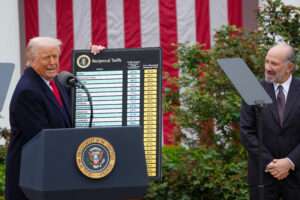
President Trump's massive "Liberation Day" tariffs, imposed April 2, on goods imported from almost every country in the world are likely to do grave damage to the U.S. and world economies, impose an enormous tax increase on Americans (an average of some $1,300 per household per year), and poison relations with America's allies. They are based in part on a completely nonsensical "reciprocity" formula, compounded by mathematical errors.

The tariffs are also a blatantly illegal usurpation of legislative power. That is why, on Monday, the Liberty Justice Center and I filed a lawsuit challenging the tariffs in court on behalf of five American import businesses severely harmed by them. We have a strong case.

Article I of the Constitution clearly gives Congress, not the president, the power to regulate "commerce with foreign nations" and to "lay and collect Taxes, Duties, Imposts and Excises." The administration claims the tariffs are authorized by the International Emergency Economic Powers Act of 1977 (IEEPA). IEEPA gives the president authority to impose various types of sanctions in situations when there is "any unusual and extraordinary threat, which has its source in whole or substantial part outside the United States, to the national security, foreign policy, or economy of the United States, if the President declares a national emergency with respect to such threat." But, as Peter Harrell points out, it doesn't mention tariffs, and no previous president has used IEEPA to impose them.

Even if tariffs are permitted, they can be used only to address an "emergency" that amounts to an "unusual and extraordinary threat." The supposed "emergency" here is the existence of trade deficits with various countries. An "emergency" is a sudden crisis. As a House of Representatives report leading to the enactment of IEEPA put it, the legislation is based on "a recognition that emergencies are by their nature rare and brief, and are not to be equated with normal ongoing problems." The report adds that "[a] national emergency should be declared and emergency authorities employed only with respect to a specific set of circumstances which constitute a real emergency, and for no other purpose…. A national emergency should not be a normal state of affairs."

There is nothing new about bilateral trade deficits. They have existed for decades and are in fact a "normal state of affairs." Economists across the political spectrum recognize they are not actually a danger at all. America's bilateral trade deficit with Canada or the European Union is no more a threat than is my trade deficit with my local supermarket: I buy a lot from them; they virtually never buy anything from me….

Even if courts defer to the president's claim that trade deficits are an "emergency," they still aren't an "unusual and extraordinary threat." There is nothing unusual and extraordinary about them (again, they have existed for many years), nor do they pose any genuine danger….

If there is any ambiguity over the meaning of IEEPA, courts should resolve it against the government by applying the major questions doctrine. Since 2021, the Supreme Court has invalidated several presidential initiatives under that rule, which requires Congress to "speak clearly" when authorizing the executive to make "decisions of vast economic and political significance." If the law isn't clear, courts must reject the executive's assertion of power…

If Trump's sweeping use of IEEPA to start the biggest trade war in a century is not a major question, it is hard to say what is. The magnitude of the Liberation Day tariffs exceeds that of most of the other measures declared major questions by the Supreme Court….

Trump's IEEPA tariffs also violate constitutional limits on delegation of congressional power to the executive. While there is much disagreement on where to draw the line, there must be at least some limit to Congress's ability to give away its lawmaking powers. Congress cannot just simply pass a law giving the president the power to establish any tariffs he wants, without limitation…

The enormous scale of Trump's power grab runs afoul of even the most modest nondelegation constraints. If long-standing and perfectly normal bilateral trade deficits qualify as an "emergency" and an "unusual and extraordinary threat," the same can be said of virtually anything. The president would have the power to impose tariffs of any magnitude on any country for any reason, any time he wants. If that does not violate constitutional constraints on delegation, nothing does. That might be acceptable to those who believe there are no limits on delegation whatsoever. But both liberal and conservative Supreme Court justices have rejected that extreme view.

The article also explains how our case relates to the other three lawsuits challenging Trump's IEEPA tariffs, filed by the state of California, the New Civil Liberties Alliance, and members of the Blackfeet Nation Native American tribe.

More