
9/5/1922: Justice George Sutherland takes the oath.


Mostly law professors | Sometimes contrarian | Often libertarian | Always independent | Est. 2002
9/5/1922: Justice George Sutherland takes the oath.
What's on your mind?
The American people don't know what a "ConLaw" professor is, don't know what "doctrine" means, and don't realize that ACB changed the "doctrine" in Dobbs.
CBS News posted a short excerpt of a TV interview with Norah O'Donnell and Justice Barrett. I do not think it went well. Consider this brief snippett:
O'Donnell: You wrote in the book that the Court has held that the rights to marry, engage in sexual intimacy, use birth control, and raise children are fundamental. But the rights to do business, committ suicide, and obtain abortion are not.
Barrett: Right, I'm describing the doctrine. I was a ConLaw professor for many years. Yes, I've described the doctrine in the book. And yes that is the state of the law. . . .
O'Donnell: But you also say in the book that the rights to marry and engage in sexual intimacy and use birth control are fundamental.
Barrett: Yes. And again I'm describing what our doctrine is and that is what we've said.
What are the problems here?
First, regular people do not know what a "ConLaw" professor is. ConLaw, CivPro, CrimPro, FedCourts, and other abbreviations are known to lawyers. But not to non-lawyers. When I say that Justice Barrett is still at her heart a law professor, I mean it. This is a vocation one cannot shake.
Second, regular people do not know what "doctrine" means in this context. Of course, Barrett is trying to explain that her book merely restates what the Court has held, and that she is not articulating her private views on marriage, abortion, and birth control. But people watching this clue will have no idea what "doctrine" is, a word she said three times in the span of about a minute.
Third, Barrett is using the word "fundamental" in the legal sense--a right that triggers strict scrutiny. Roe held that abortion was a fundamental right. Casey held that abortion was not a fundamental right, and abortion laws should be reviewed under the heightened "undue burden" standard. I think this is the test that Professor Barrett would have taught for years. O'Donnell, and most Americans, do not know how Barrett used the word "fundamental." Moreover, I think this explanation is incomplete. Dobbs held that abortion rights receive only deferential rational basis review. Justice Barrett cast the deciding fifth for that opinion. She is not merely describing doctrine. She changed the "doctrine." The right to contract was once deemed fundamental, but the Court changed course? And what would stop the Court from holding that other rights are not fundamental.
Years ago, I wrote that Barrett could benefit from media training. I can see how Barrett went through extensive media training. She kept referring back to the book, and repeating that the Court is trying to see what the American people decided, and stating that the Court should not impose its own values on the American people. These are the talking points. But she got tripped up by a fairly predictable question.
This was Justice Barrett's first TV interview. She cancelled an interview with the New York Times "The Daily" podcast. Her session at Lincoln Center with Bari Weiss does not seem to have been livestreamed. Hopefully future interview go better. Then again, ACB said that her husband and assistant screens the stuff she reads:
"To be in this job, you have to not care," she said, referring to the criticism. "You have to have a thick skin."
She added that she doesn't have social media and that her husband and one of her assistants screen material for her and determine whether to share it with her on a "need-to-know arrangement."
Sounds like an episode of South Park.
The revolution started with the Boston TRO Party. Who can end it?
With each new day, the revolt in the lower courts grows. What started with the Boston TRO Party has now spread across the nation. Now, more than a dozen judges talked to Lawrence Hurley of NBC News. The message is loud and clear. The inferior court judges are frustrated with the cursory orders from the emergency docket. Moreover, they blame Chief Justice Roberts for not standing up for the judiciary--and indeed fault Roberts's own rulings as legitimating Trump's criticisms. Here are the key excerpt from the article:
Federal judges are frustrated with the Supreme Court for increasingly overturning lower court rulings involving the Trump administration with little or no explanation, with some worried the practice is undermining the judiciary at a sensitive time.
Some judges believe the Supreme Court, and in particular Chief Justice John Roberts, could be doing more to defend the integrity of their work as President Donald Trump and his allies harshly criticize those who rule against him and as violent threats against judges are on the rise.…
Ten of the 12 judges who spoke to NBC News said the Supreme Court should better explain those rulings, noting that the terse decisions leave lower court judges with little guidance for how to proceed. But they also have a new and concerning effect, the judges said, validating the Trump administration's criticisms. A short rebuttal from the Supreme Court, they argue, makes it seem like they did shoddy work and are biased against Trump.
"It is inexcusable," a judge said of the Supreme Court justices. "They don't have our backs." ….
With tensions so high, four of the judges said they believe the Supreme Court and specifically Roberts, the head of the judiciary, should do more to defend the courts.
The Supreme Court, a second judge said, is effectively assisting the Trump administration in "undermining the lower courts," leaving district and appeals court judges "thrown under the bus." ….
The Supreme Court, that judge said, is effectively endorsing Miller's claims that the judiciary is trying to subvert the presidency.
"It's almost like the Supreme Court is saying it is a 'judicial coup,'" the judge said.…
"Judges in the trenches need, and deserve, well-reasoned, bright-line guidance," a judge said. "Too often today, sweeping rulings arrive with breathtaking speed but minimal explanation, stripped of the rigor that full briefing and argument provide."
Ten of the judges, both Republican and Democratic appointees, agreed the court's lack of explanation is a problem. Judges must follow Supreme Court precedent, but they can find it difficult to assess what the justices are asking them to do.…
A judge who spoke to NBC News expressed frustration that judges' role in the judicial system is being undermined by the Supreme Court's frequent interventions, before there has been extensive litigation and, potentially, a trial.
"It's very discouraging," the judge said. "We are operating in a bit of a vacuum."….
Roberts, who generally does not seek public attention, has long been known as an institutionalist who looks out for the interests of the Supreme Court, but several judges wondered whether that instinct extends to lower courts.
"He should be doing everything he can internally to insist on ordinary process," the judge who has received threats said in reference to the emergency cases. Roberts' end-of-year report was "not enough," the judge added.
Another judge said: "He hasn't been completely absent, and he's trying to do the best he can. I wish he would be a little bit more assertive and aggressive."
"If the entire foundation falls out from under your house, it does no good to have a really well-insulated attic," the judge said. "It sure would be nice if someone had our backs."
Kudos to Judge Burroughs in Boston for calling out Justice Gorsuch publicly and by name. All of these other judges, who have life tenure, feel the need to hide behind the cloak of anonymity. Same for the judges who anonymously tell the press they will not take senior status, even they were eligible long before Emil Bove.
One more quote stuck out:
Killing suspected drug traffickers is both unjust and illegal. And it could be the start of an effort to turn the already awful War on Drugs into something more like a real war, thereby making it even worse.

On September 2, at President Trump's order, US military forces used a drone strike to kill 11 Venezuelans on a small boat in the Caribbean Sea. The claimed justification for this action is that the people on the boat were drug traffickers. Even if that claim is true, the killings were unjust and illegal.
In my view, the entire War on Drugs is fundamentally unjust. It kills and imprisons many thousands of people every year, for no good reason, and in the process stimulates the growth of organized crime and associated violence. It has also severely undermined the Constitution. Under the principle of "my body, my choice," the government should not be in the business of deciding what drugs adults, at least, are allowed to consume. And the way to get rid of drug gangs like Venezuela's Tren de Aragua (TdA) is to end it, just as ending the similarly unjust Prohibition regime was what largely put paid to the organized crime involved in the alcohol trade then. But even if we assume the War on Drugs has some justification, it is a matter of ordinary law enforcement and doesn't justify gratuitously killing people without due process.
US officials admit they could have interdicted the boat and detained the people on board. They did not pose any imminent threat of violence, and they were not combatants in any war against the US. Calling them "narco-terrorists" does not change these obvious facts.
In addition, it is not even clear these people were drug traffickers at all (they might have been migrants fleeing Venezuela's horrible socialist dictatorship). If they were shipping drugs, it is not clear they were going to the US, as opposed to Trinidad and Tobago (which was much closer to their location) or somewhere else. It is not illegal for people on a ship in international waters to transport drugs that are banned in the United States. US law only applies, if at all, if they were planning bring their cargo into US territorial waters.
As GOP Senator Rand Paul put it, "The reason we have trials and we don't automatically assume guilt is what if we make a mistake and they happen to be people fleeing the Venezuelan dictator? … off our coast it isn't our policy just to blow people up … even the worst people in our country, they still get a trial." He's right.
I won't go through the legal issues in detail here, because national security law expert Brian Finucane has already done so in a thorough Just Security article. The bottom line is that these were illegal, extrajudicial killings.
I would call it a war crime, except that there is no war here, despite Trump's (also illegal) efforts to use TdA's activities to invoke the Alien Enemies Act against Venezuelan migrants. So really it's just an old-fashioned regular crime. Perhaps the president has immunity for his part in it under the Supreme Court's dubious immunity ruling in Trump v. United States (which is far from a model of clarity). But if so that just means he can't be prosecuted. It does not not make his actions either legal or right.
I have previously warned against Republicans' dangerous plans to try to turn the War on Drugs into a real war, thereby making an already awful policy much worse (though at that time they seemed more focused on Mexico than Venezuela). We shall have to see if this strike is just the first of a series of similarly terrible actions; administration officials say it may be.
Back in 2013, I testified before a Senate subcommittee on President Obama's use of targeted drone strikes in the War on Terror. Ironically (in light of recent events), I was called as a witness by Republicans who worried that Obama was going too far; some Democrats on the committee also had concerns. I argued that targeted killing of Al Qaeda terrorist leaders was legal and justified (citing precedents like the targeted killing of Admiral Yamamoto and SS General Reinhard Heydrich during World War II) but also that there should be somewhat greater due process to prevent inadvertent targeting of the innocent. See my testimony here.
I have not kept up with this issue in detail since then, instead focusing my writings on other matters). But the concerns I and others expressed at that time apply with much greater force to targeting alleged drug smugglers. And unlike Heydrich, Yamamoto, and Al Qaeda leaders, suspected drug traffickers are simply not proper military targets, except perhaps in rare situations where they are themselves about to launch an attack.
Perhaps, though I am skeptical, evidence will emerge to prove that the people killed in the strike were planning a dangerous terrorist attack, or the like. Otherwise, the president committed an utterly indefensible and criminal act here.
Yes, but only if they intend to relinquish it (or, if they are naturalized citizens and committed fraud during the naturalization process).
[Originally posted in July, reposted today, with slight changes, in light of President Trump's renewed talk of stripping Rosie O'Donnell of her citizenship: "As previously mentioned, we are giving serious thought to taking away Rosie O'Donnell's Citizenship. She is not a Great American and is, in my opinion, incapable of being so!"]
Let's begin with the constitutional text, here from section 1 of the 14th Amendment:
All persons born or naturalized in the United States, and subject to the jurisdiction thereof, are citizens of the United States and of the State wherein they reside.
Once you have American citizenship, you have a constitutional entitlement to it. If you like your American citizenship, you can keep your American citizenship—and that's with the Supreme Court's guarantee, see Afroyim v. Rusk (1967):
There is no indication in these words of a fleeting citizenship, good at the moment it is acquired but subject to destruction by the Government at any time. Rather the Amendment can most reasonably be read as defining a citizenship which a citizen keeps unless he voluntarily relinquishes it. Once acquired, this Fourteenth Amendment citizenship was not to be shifted, canceled, or diluted at the will of the Federal Government, the States, or any other governmental unit.
(Special bonus in Afroyim: a cameo appearance by a Representative Van Trump in 1868, who said, among other things, "To enforce expatriation or exile against a citizen without his consent is not a power anywhere belonging to this Government. No conservative-minded statesman, no intelligent legislator, no sound lawyer has ever maintained any such power in any branch of the Government.") In Vance v. Terrazas (1980), all the justices agreed with this principle. Your U.S. citizenship doesn't turn on whether the President is of the opinion that you are a Great American.
Now, as with almost all things in law—and in life—there are some twists. Naturalized citizens can lose their citizenship if they procured their citizenship by lying on their citizenship applications; the premise there is that legal rights have traditionally been voided by fraud in procuring those rights. And citizens can voluntarily surrender their citizenship, just as people can generally waive many of their legal rights. This surrender can sometimes be inferred from conduct (such as voluntary service in an enemy nation's army), if the government can show that the conduct was engaged in with the intent to surrender citizenship. The relevant federal statute, 8 U.S. Code § 1481, provides (emphasis added):
A post from Ed Driscoll (at InstaPundit), pointing to a PetaPixel (Matt Growcoot) article:
Ever since the Ray-Ban Meta smart glasses arrived on the market, the elephant in the room has always been: what if someone uses them for clandestine recording?
And it struck one New York woman who was attending a Brazilian wax appointment at the [European] Wax Center and noticed midway through proceedings that the beautician was wearing a pair of the glasses that are capable of recording video and still images….
The European Wax Center … tells the Washington Post that the waxer's glasses were "powered off at the time of service." …
I was quite amused by Ed's summary (the "Putting …" part), and thought I'd pass it along.
The ruling would apply, I think, to anyone gathering information about the sideshow for publication, whether or not he's a professional journalist.
From today's Ninth Circuit decision in Garcia v. County of Alameda, by Judge Holly Thomas, joined by Judges John Owens and Mark Bennett; Alameda County contains Berkeley and Oakland:
Driven by concerns over unmanageable crowds, property damage, noise pollution, garbage, firearms use, and reckless driving under the influence of drugs and alcohol, … the County of Alameda … adopted an ordinance prohibiting any person from knowingly spectating a sideshow event conducted on a public street or highway from within 200 feet of that event. Possible penalties include both imprisonment and a monetary fine.
In this pre-enforcement suit, Jose Antonio Garcia, a reporter who writes about sideshows for The Oaklandside under the pen name Jose Fermoso, raises a First Amendment challenge to the County's prohibition as applied to his reporting activities….
The First Amendment protects Garcia's newsgathering and reporting activities. And the County's prohibition on knowingly spectating a sideshow is content based and fails strict scrutiny. Garcia has clearly demonstrated that he is likely to succeed on the merits of his as-applied challenge, that he is likely to suffer irreparable harm in the absence of preliminary relief, that the balance of equities tips in his favor, and that the issuance of an injunction is in the public interest….
"The Supreme Court has recognized that newsgathering is an activity protected by the First Amendment." And we have determined both that the First Amendment protects recording and photographing "matters of public interest," and that an organization's "recording of conversations in connection with its newsgathering activities is protected speech within the meaning of the First Amendment." These holdings compel the conclusion that Garcia's newsgathering activities—the "quintessential function of a reporter"—are protected by the First Amendment.
Washington's highest court properly recognizes that crime victims can have interests at stake in appellate proceedings in criminal cases.
Last week, a divided Washington Supreme Court properly recognized that crime victims can, in appropriate cases, intervene in a criminal appeal brought by a criminal defendant. The Court joins other courts in recognizing that limited-purpose party standing is appropriate for victims when they have interests directly at stake in the appeal.
The case involved a defendant appealing his criminal conviction for second-degree murder, with a finding that it was a crime of domestic violence. In the trial court, the defendant moved to subpoena the medical records of the decedent victim. The mother of the victim (representing the victim's interests) intervened and objected. The defendant did not object to the mother's intervention at the trial court and, in fact, agreed that she had the right to oppose his motions. The trial court denied the defendant's motions to obtain the records, and he was convicted. His challenge to the conviction reached Washington's appellate courts, and the Washington Court of Appeals allowed the mother to intervene to oppose access to her daughter's medical records.
The Washington Supreme Court affirmed the decision allowing the intervention:
[Defendant] argues that on appeal he now faces two respondents and, in effect, "'two prosecutors.'" However, this is no different from the situation at the trial court level. Moreover, it is incorrect to characterize [the mother] as a second prosecutor. Instead, [the mother's] role in the appeal is limited in the same manner as it was in the trial court: the only issue she may address is whether [defendant] should be allowed access to her daughter's health care records. Justice Gordon McCloud makes a similar argument in the dissent, pointing out that it is the prosecutor who decides whether to bring an action and, if so, how that action is pursued. That is correct. The prosecutor's ability to decide strategy is not affected by our holding. Instead, our holding provides the Court of Appeals with the discretion to allow a person to continue seeking to protect health care records on appeal when they were allowed to do so at the trial level.
The dissent acknowledges that [the mother] could have brought a separate civil lawsuit to quash any attempt by [the defendant] to subpoena her daughter's health care records and that she had the right to appeal any adverse ruling. The dissent fails to explain the functional difference to [defendant] if [the mother] had brought a civil action that quashed any subpoenas issued by the court in the criminal action. Justice Gordon McCloud suggests that the civil action would only determine whether the health care records are confidential, which she concedes is not a debatable question—they are. Justice Gordon McCloud likewise assumes that the court in the civil action would not consider the reasons Mr. Thompson is seeking those records. On the contrary, a court faced with a motion to quash must consider all the arguments as to why the subpoena should be issued, together with all arguments against the issuance of the subpoena.
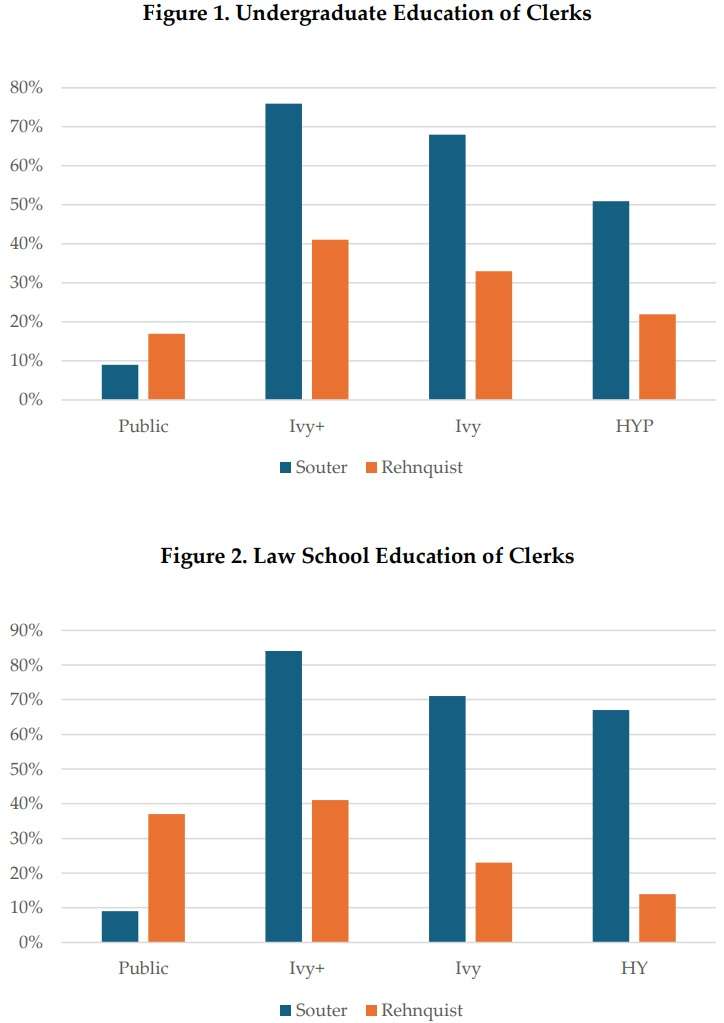
From a new law review article with that name, by Andy Smarick (Manhattan Institute):
During congressional testimony in 1999, the late Justice David Souter explained that only those who graduated from one of the nation's most elite law schools would be qualified for a precious Supreme Court clerkship. He considered it risky to hire from "outside the well-trodden paths." Earlier in the same hearing, he referred to Chief Justice Rehnquist's well-known and different view: that the top performers at a wide array of law schools are "fungible." That is, the most elite schools might have more of the highest-ability students, but extraordinary talent can be found far and wide.
These competing visions of legal potential are reified by Justice Souter's and Chief Justice Rehnquist's actual histories of clerk hiring. Since 1980, no justice pulled from a narrower sliver of schools than Justice Souter; Chief Justice Rehnquist hired from one of the largest pools. This finding, however, is not limited to these two justices or even to justices on the United States Supreme Court. On the contrary, the legal profession appears split between the elitist Souterian vision and the egalitarian Rehnquistian vision.
The consequence is two distinct prestigious legal circles. One has graduates of a vast array of undergraduate and law schools, including flagship public schools, regional public schools, small liberal arts schools, larger selective private schools, and more. The other is dominated by graduates of a strikingly slender set of private institutions, namely Ivy and "Ivy+" schools. {My studies follow the recent convention of adding four highly selective private schools (Chicago, Duke, MIT, and Stanford) to the eight Ivies to form an "Ivy+" category.}
Over the past two decades, scores of business owners across the nation have sought to refuse services for same-sex weddings, an SMU Law School study finds
Of course you know about the website designer who didn't want to create sites for gay weddings. You probably remember the Colorado baker who declined to make a custom wedding cake for a gay couple. Perhaps you even recall the New Mexico photographers who refused to take pictures of a lesbian commitment ceremony.
But did you know about the stylist in Tennessee who refused to cut hair or apply makeup to the women in a wedding party for two men? Or the instructor in Missouri who spurned two grooms seeking dance lessons for their ceremony because it "would make everyone else in the room uncomfortable"? It's unlikely you've heard about the North Carolina trolley company that turned down, on religious grounds, a request to transport a gay couple to their wedding ceremony in a remote mountainous location.
For the past five years, with the invaluable help of my research assistants at SMU Dedman School of Law, I've been collecting all publicly known stories of same-sex couples who were denied wedding goods or services by private business owners that object to gay marriage. The compendium of cases is collected in a new website called, Documenting Denial: A Record of Wedding Services Denied to Same-Sex Couples Since 2004. As best I can tell, this is the first published attempt to compile such a record.
I. What is the Project?
On the website, the project is described as follows:
In 2023, the Supreme Court of the United States held in 303 Creative v. Elenis that Colorado could not compel a website designer to create wedding websites for same-sex couples. The 6-3 majority reasoned that forcing a designer to create messages with which she disagrees would violate her First Amendment right to freedom of speech. The decision marked the first time the Court ruled that a for-profit business in the public marketplace could be exempt from the requirement to serve customers protected from discrimination by state law.
Twenty years earlier, in Goodridge v. Department of Public Health (2003), the Massachusetts state supreme court became the first in the country to declare laws against same-sex marriage unconstitutional. By 2004, the first official marriage licenses in the United States were being issued to gay and lesbian couples. Other states followed, although most states resisted. In Obergefell v. Hodges (2015), the Supreme Court recognized a federal constitutional right of same-sex couples to wed. Today, the number of same-sex marriages in the U.S. approaches one million.
Some of these couples have faced rejection from vendors when seeking goods and services related to their weddings or commitment ceremonies. Vendors have declined flowers, photography, wedding cakes, venues, tailoring, and more based on their personal and religious beliefs that marriage should not include same-sex couples.
The scope of the project
Our project is an attempt to document all publicly known examples of these denials. By "publicly known," we mean those denials accessible to the public through online media sources and public records of litigation. Our list also includes preemptive lawsuits filed by business owners seeking to establish or to clarify their right to refuse goods and services. In almost every instance we've listed, it is undisputed that a wedding-related service or good was actually denied. The claimed basis for the denial, the vendor's objection to same-sex marriage, is also almost always undisputed.
The record covers the period since 2004, the year that the first legal same-sex marriages began in the United States. It includes only denials by vendors in the business of providing such goods or services, not denials by judges or religious leaders refusing to officiate or by state officials refusing to issue marriage licenses. The record compiled here includes both denials that resulted in litigation and those that did not.
As part of the record, we want readers to know the who, what, where, when, and why of these denials. Accordingly, we offer a factual summary of the denial, the names of the parties involved on both sides, the locations and dates of each controversy, the particular product or service involved, whether litigation ensued, and the outcome. Links to relevant public records, like newspaper accounts and court opinions, are provided.
For a more visual experience of the scope and extent of the record, we have prepared a map showing the spread of denials across the nation and across the decades.
Finally, we invite readers to send us corrections and additions.
In essence, there are two ways to view the compilation of denial cases. One is by going to a chart (which we call the "Record") that gives detailed information about each case: a synopsis of the facts, the location and date of the denial or initial lawsuit filing, the type of wedding service or good involved, the names of the parties (both customers and business owners), the reason for the denial (religious, personal, or other), information about subsequent litigation (if any), and links to news articles or court opinions about the case. A color-coding scheme allows you to see quickly which of the listed denials resulted in litigation (pink), which of the denials resulted in no litigation (green), and which involved pre-enforcement actions by businesses where no actual denial occurred (blue).
The other way to view the compilation of cases is to peruse an interactive Map that allows you to click on the various locations in the country or to scroll through the cases chronologically. The Map is a good way to get an overview of the cases. You can then go the Record to find more detailed information about each case.
II. What We Found
In all, since Massachusetts became the first state to issue marriage licenses to same-sex couples in 2004, we found 64 cases of private businesses declining, or seeking to decline, goods or services for gay weddings or similar events (e.g., a commitment ceremony or a renewal of vows). Ten of those 64 cases involved businesses filing preemptive lawsuits to clarify or establish their legal right to refuse such services, although no actual denial had yet occurred.
Thus, we found 54 denials that have actually occurred since 2004 ("actual denial cases"). In 52 of the 54 cases, there was apparently no dispute between the customers and the business about whether there was a denial or about whether the basis for the denial was an objection to same-sex marriage.
As you'll see from the Map, the cases are spread out geographically. They stretch from east to west, north to south, and everywhere in between. They appear in big cities, small towns, and rural areas. The first case we could find in the public record--the New Mexico photographers who refused to take pictures of a lesbian couple's commitment ceremony--arose in 2006. The most recent came in November 2024. There are no significant trends in the frequency of denials over time. Four cases have arisen since the Supreme Court's decision in 303 Creative v. Elenis (2023). Only one of those is being litigated.
Of the 54 actual denial cases, 39 (72%) involved no lawsuit. In most of these 39 unlitigated cases, there was no relevant legal protection for same-sex couples available in the particular jurisdiction. Fifteen actual denial cases (28%) resulted in litigation.
What types of good or services have been the subject of these denials? By far the most common site for disputes has been the wedding venues themselves: 26 of the 64 overall cases (41%) have involved business owners refusing to rent their spaces for same-sex weddings. This is followed by disputes with wedding cake bakers (10), photographers (7), videographers (4), dressmakers and tuxedo makers (4), florists (2), caterers (2), wedding planners (2), and one each for a newspaper refusing same-sex wedding announcements, a calligrapher, a hairstylist, a dance instructor, a trolley operator, and the celebrated website designer who was the subject of 303 Creative.
What was the stated basis for denying wedding services to same-sex couples? The vast majority of business owners, 54 out of 64 overall cases (84%), cited religious beliefs as their primary objection to same-sex marriage. Most of these religious objectors were self-described Christians. The remaining ten business owners characterized their opposition as personal or legal, or did not specify a reason.
III. Why the Record Matters
Here's what we said on this topic at the Documenting Denials website:
Marriage is an important milestone in a person's life. It helps cement relationships, meets needs, and reflects religious and personal values. Its meaning matters to almost everyone—the couple, their children, their families, their friends, their faiths, and their societies. Participating in and supporting the wedding itself is an act loaded with significance for everyone.
It's no wonder that people on both sides have claimed strong interests for their respective positions. Same-sex couples want equal access to wedding services in the open marketplace and equal treatment from the vendors they select. They also do not want to be insulted at this uniquely sensitive and anxiety-laden time. Wedding vendors with religious or other objections to same-sex marriage want to run their businesses without violating their consciences and want to preserve their freedoms of speech and religion.
Knowing the number, locations, dates, and outcomes of actual denials helps to inform the debate about the significance and extent of the claims on each side. The record will help inform the public, attorneys, judges, and scholars about the kinds of services that are most often denied.
From the exchange of rings to the tossing of the bouquet, symbolism pervades almost every aspect of a wedding. But these are usually thought of as the expressions of the couple, not of the ringmaker or the florist. The Supreme Court declared in 303 Creative that, at least in some cases, providing the good or service amounts to expression by the business, which cannot be compelled by state law. Recounting the circumstances and context of actual cases may help sharpen the questions and settle the answers of what services or goods are sufficiently part of the wedding vendor's own expression to merit constitutional protection.
We shouldn't lose sight of the real people involved in these cases. The stakes were high for the couples who were denied services. Even if they obtained the services elsewhere--and it appears that in all or almost all cases they did--they bore the anxiety, time, and expense of having to do so. And they were figuratively slapped in the face at what should have been a joyous time in their lives.
The stakes were also high in these cases for the objecting business owners. They had the choice of either serving the weddings and foregoing their convictions or denying the services and dealing with the fallout. Public pressure forced some of them out of business. Others had to defend themselves in court, and some of these ended up losing. Even if they prevailed, courts dragged out their cases. One Oregon baker who declined a wedding cake for a lesbian couple in January 2013 (when Barack Obama was beginning his second term) is still awaiting final word from the Oregon courts more than 12 years later. Even then the case will probably go back to the U.S. Supreme Court for possible review a second time. It's now zombie litigation: the bakery closed in 2016.
At the same time, it's important to keep the record in perspective. We found 54 actual denial cases over a 20-year time span, fewer than three per year on average. That may seem like a lot compared to the mere handful of cases most people have heard about. But consider that, at the upper range, Gallup estimated there were 930,000 same-sex marriages in the U.S. as of June 2025. At the lower end of the range, the Williams Institute at UCLA estimated there were 823,000 married same-sex couples in the United States as of June 2025.
Given those numbers, it's a safe bet that there have been close to one million same-sex marriages performed in the United States since 2004. Of course, not all of these married couples held weddings at which commercial services or goods were needed or desired.
By any reasonable reckoning, the 54 publicly known cases of actual service denials that we found are likely a tiny fraction of the total number of weddings at which gay couples called on service providers for venues, cakes, photographs, flowers, and other products from the innumerable professionals who make weddings their business. Many of these couples self-selected their providers, opting for those they knew to be open to gay couples. But the logical inference from these numbers is that the vast majority of gay couples and wedding businesses have had no difficulty engaging in these particular commercial exchanges. Markets tend to value profit over identity or moral judgment.
IV. Limitations and ongoing efforts
With that perspective in mind, it's also important to highlight some limitations of this study. We aim to catalogue only publicly known instances of wedding-service denials. Again, by "publicly known," we mean those denials accessible to the public through online media sources (like newspapers and social-media sites) and public records of litigation.
There are doubtless many cases of actual denial where the rejection never surfaced publicly. It's possible the cases we've collected are the tip of an iceberg. Short of conducting broad surveys or doing other research, our review could not capture these private acts of denial. It also cannot capture the full impact of discrimination in the wedding-service industry, which would include cases where gay couples altogether avoid a provider because they fear rejection or cases where providers hide the true reason for denials.
This project is ongoing. We will update Documenting Denial as needed. To that end, we invite readers to send corrections and additions to: documentingdenial@smu.edu. If making suggestions for additional cases that should be added, please send links or other documentation supporting the additions.
Finally, I want to thank the following SMU Law students who gave countless hours and boundless devotion to this project over the past five years: Jaishal Dhimar, Sarah Fisher, Emily Fletcher, Ryan Fulghum, Lauren Jasiak, Kaci Jones, and Sarah Starr. Their excellent work will continue to inform this controversy long past their law school graduations.
Armenia, Azerbaijan, and the New U.S. Role in the South Caucasus
Last month, Armenia and Azerbaijan initialed a draft peace framework at the White House—brokered with quiet but significant involvement by the Trump team and some U.S.-based Christian advocates. The agreement, though not yet signed, reflects an unusual blend of foreign policy realism and faith-based diplomacy, a convergence we don't often see in contemporary international affairs.
On the one hand, the draft reflects the logic of strategic interest. Armenia, reeling from the loss of Artsakh (Nagorno-Karabakh) and facing the very real threat of renewed Azerbaijani aggression, accepted significant concessions—formally abandoning its claim to Artsakh and allowing the development of a U.S.-secured transit route through its southern territory. In exchange, Azerbaijan appears to have dropped its demand for an extraterritorial corridor in Armenia—one of the thorniest obstacles in past negotiations—and agreed to a framework of reciprocal transit rights. The U.S., for its part, gains a foothold on an increasingly critical East–West trade route, without committing troops or giving long-term security guarantees.
But the agreement wasn't just the result of geopolitical calculation. It was also shaped, in part, by religiously motivated advocacy, especially from Christian organizations concerned about the treatment of Armenian Christians ethnically cleansed from Artsakh and the fate of Christian prisoners still held in Azerbaijani custody. Groups like Save Armenia worked to highlight these humanitarian concerns in Washington, and their efforts helped keep the issue on the radar of policymakers—particularly in the Republican orbit, where appeals to religious freedom and Christian persecution carry significant weight.
This raises broader questions about the evolving relationship between faith and foreign policy in the American context. Can religious advocacy effectively influence diplomacy in a way that's consistent with strategic interests? Are faith-based groups entering a new phase of international engagement—one that's less utopian and more aligned with traditional realist priorities, such as regional balance and access to trade routes?
In the latest episode of Legal Spirits, I speak with Dan Harre, Deputy Director of Save Armenia, about the draft deal and what it represents. We discuss how Christian groups became involved, why Armenia accepted such difficult terms, and why Azerbaijan may have chosen to delay finalizing the agreement. We also explore the historical echoes of this moment—including America's fateful decision not to accept a League of Nations mandate for Armenia a century ago, a choice that shaped the region's trajectory in profound ways.
You can listen to the episode here.
Whatever your view of this draft agreement, it's a powerful case study in how legal, religious, and geopolitical considerations can overlap on the global stage.
9/4/1851: Justice Levi Woodbury dies.
The 2-1 ruling is in line with most previous court decisions on Trump's invocation of the AEA. Judge Oldham wrote an extremely long, but significantly flawed, dissent.
Yesterday, in W.M.M. v. Trump, the US Court of Appeals for the Fifth Circuit ruled that President Trump's invocation of the Alien Enemies Act of 1798 as a tool to deport Venezuelans is illegal. While multiple federal district courts have issued similar rulings, as have individual concurring opinions by judges on two other circuit courts, this is the first full-blown appellate court decision on the subject. It is therefore an important precedent. There is a lengthy 130 page dissenting opinion by Judge Andrew Oldham. But it's serious flaws merely confirm the weaknesses of the government's position.
The AEA allows detention and deportation of foreign citizens of relevant states (including legal immigrants, as well as illegal ones) "[w]henever there is a declared war between the United States and any foreign nation or government, or any invasion or predatory incursion is perpetrated, attempted, or threatened against the territory of the United States by any foreign nation or government." Trump has tried to use the AEA to deport Venezuelan migrants the administration claims are members of the Tren de Aragua drug gang.
The Fifth Circuit majority opinion by Judge Leslie Southwick (a Republican George W. Bush appointee) holds that TdA's activities - drug smuggling, illegal migration, and related crimes - don't qualify as an "invasion" or a "predatory" incursion and therefore the AEA cannot be used here. Everyone agrees there is no declared war.
On the definition of "invasion," Judge Southwick concludes, after a review of the evidence:
Congress's use of the word in the AEA is consistent with the use in the Constitution, that "invasion" is a term about war in the traditional sense and requires military action by a foreign nation. Petitioners have the sense of the distinctions in saying that responding to another country's invasion is defensive; declaring war is an offensive, assertive action by Congress; and predatory incursion is for lesser conflicts. Of course, after this country has been attacked by an enemy with invading forces, Congress might then declare a war. That occurred in World War II after the attack on Pearl Harbor. Still, when the invasion precedes a declaration, the AEA applies when the invasion occurs or is attempted. Therefore, we define an invasion for purposes of the AEA as an act of war involving the entry into this country by a military force of or at least directed by another country or nation, with a hostile intent.
Every other court to have ruled on the definition of "invasion" has reached similar conclusions, and I argue for that conclusion in the amicus brief I coauthored in W.M.M. on behalf of the Brennan Center, the Cato Institute, and others.
Here is the Fifth Circuit on the definition of "predatory incursion":
These different sources of contemporary meaning that we have identified from dictionaries, the writings of those from the time period of the enactment, and from the different requirements of the Alien Enemies Act and the Alien Friends Act, convince us that a "predatory incursion" described armed forces of some size and cohesion, engaged in something less than an invasion, whose objectives could vary widely, and are directed by a foreign government or nation. The success of an incursion could transform it into an invasion. In fact, it would be hard to distinguish some attempted invasions from a predatory incursion.
This too is similar to previous court decisions, and to the approach outlined in our amicus brief, which explains that a "predatory incursion" is a smaller-scale act of war. The one exception is a district court opinion that adopted an extremely broad definition of "predatory incursion," which I critiqued here.
The majority also persuasively argues that the definitions of "invasion," "predatory incursion" and other statutory terms are not unreviewable issues simply left to executive discretion.
The majority does, however, rule that courts must, to a degree, defer to presidential fact-finding regarding whether an "invasion" or a "predatory incursion" is occurring. It concludes, here, that the facts alleged in the President's Proclamation do not meet the requirements of the correct definition of that term. This may leave open the possibility that the president could simply legalize the AEA by claiming the existence of different (more egregious) "facts," even if the claims are patently false. I have criticized excessive deference on such factual issues in this recent article, and in the amicus brief. Deference on factual questions should not allow the president to invoke extraordinary emergency powers merely by mouthing some words and making bogus, unsubstantiated claims.
That said, the majority does suggest that factual deference must be limited:
The Supreme Court's recent J.G.G. opinion shows Ludecke is to be understood as requiring courts to interpret the AEA after the President has invoked it…. Interpretation cannot be just an academic exercise, i.e., a court makes the effort to define a term like "invasion" but then cannot evaluate the facts before it for their fit with the interpretation. Thus, interpretation of the AEA allows a court to determine whether a declaration of war by Congress remains in effect, or whether an invasion or a predatory incursion has occurred. In other words, those questions are justiciable, and the executive's determination that certain facts constitute one or more of those events is not conclusive. The Supreme Court informs us that we are to interpret, and we do not create special rules for the AEA but simply use traditional statutory interpretive tools.
If courts must "use traditional… interpretive tools" and "determine… whether an invasion or a predatory incursion has occurred," they cannot simply blindly acquiesce to whatever factual claims the government might make, no matter how specious. Otherwise, interpretation will indeed become "just an academic exercise."
Prominent conservative Judge Andrew Oldham wrote a lengthy 130 page dissent. He's undoubtedly a highly capable jurist. But his herculean efforts here just underscore the radical and dangerous nature of the government's position.
Surprisingly, Judge Oldham doesn't seriously dispute the definitions of "invasion" and "predatory incursion." He just argues that these issues are left to the completely unreviewable discretion of the executive. If that's true, the president could use the AEA to detain or deport virtually any noncitizens he wants, at any time, for any reason, so long as he proclaims there is an "invasion" or "predatory incursion," regardless of whether anything even remotely resembling these things is actually happening. A power that is supposed to be used only in the event of a dire threat to national security would become a routine tool that can be deployed at the president's whim.
And, under Judge Oldham's analysis, the president also could deport and detain these people with little, if any, due process. He contends the government has no obligation to prove that the people detained are actually TdA members. And in fact there is no evidence that most of those deported under the AEA are members of the gang or have committed any crimes at all. Thus, Judge Oldham is essentially claiming the AEA gives the president unlimited, unreviewable power to detain and deport non-citizens - including legal migrants - whenever he wants (again, so long as he proclaims the right words).
Nothing in the text or history of the AEA even approaches this. Instead the text says that the AEA can only be used when a war, invasion, predatory incursion or threat thereof, exists, not merely when the president says so.
Oldham argues in detail that various precedents require the latter outcome. But, as the majority notes, those precedents - including the Supreme Court's recent decision in J.G.G. specifically indicate that there is room for judicial review. Moreover, if the AEA really did grant the president such unlimited power, one would have expected contemporaries in 1798 to point that out and object on constitutional grounds, as they did in the case of the contemporaneous Alien Friends Act, which really did give the president sweeping deportation and detention powers, even in peacetime, and which was duly denounced as unconstitutional by James Madison and Thomas Jefferson, among others. The Alien Enemies Act, by contrast, was far less controversial, precisely because it was understood to be limited to genuine wartime situations, not anything the president might speciously label as such.
Moreover, under Suspension Clause of the Constitution, in the event of an "invasion," the federal government can suspend the writ of habeas corpus, and thereby detain people - including US citizens - without any due process. There is no way the Founders understood themselves to have given the president unreviewable authority to trigger that power anytime he wants.
I won't try to go through all of Judge Oldham's analysis of precedent here. But I will give one example of how problematic it is. The judge argues that Supreme Court's 1862 decision in The Prize Cases gives the president unreviewable authority to determine there is a war going on, and exercise war powers accordingly. The majority opinion in that case does no such thing. Rather, it emphasized the fact that then-ongoing Civil War was a conflict "which all the world acknowledges to be the greatest civil war known in the history of the human race." Thus, President Lincoln's power to establish a blockade in response could not be negated by "by subtle definitions and ingenious sophisms."
The Court then went on to make the point cited by Oldham:
Whether the President, in fulfilling his duties as Commander-in-chief in suppressing an insurrection, has met with such armed hostile resistance and a civil war of such alarming proportions as will compel him to accord to them the character of belligerents is a question to be decided by him, and this Court must be governed by the decisions and acts of the political department of the Government to which this power was entrusted. "He must determine what degree of force the crisis demands." The proclamation of blockade is itself official and conclusive evidence to the Court that a state of war existed which demanded and authorized a recourse to such a measure under the circumstances peculiar to the case.
But notice the president only gets deference on the question of whether the "insurrection" he is "fulfilling his duties" by combatting is one of "such alarming proportions" as to justify a wartime blockade. He does not get deference on the question of whether an insurrection exists in the first place (in that case, as the Court noted, it obviously did). Had Lincoln instead imposed a blockade to prevent, say, illegal smuggling of contraband goods and then claimed smuggling qualifies as war, he would not get the same deference.
Judge Oldham's reliance on other precedents has similar flaws. Nearly all of them also arose from genuinely massive wars, not attempts to pass off drug smuggling or other similar activity as an "invasion." Oldham complains that "[f]or over 200 years, courts have recognized that the AEA vests sweeping discretionary powers in the Executive," and that "until President Trump took office a second time, courts had never countermanded the President's determination that an invasion, or other similar hostile activity, was threatened or ongoing." But the AEA has previously only been invoked in connection with three indisputable international conflicts: the War of 1812, World War I, and World War II. You don't have to be an expert to see the difference between these conflicts and the activities of a drug gang.
The majority, the concurring opinion by Judge Ramirez, and the dissent also address a number of other issues, particularly various procedural questions. I will pass over them for now, as this post is already long.
The Trump administration may well appeal this case to the Supreme Court. If the Court takes it, I hope they, too, will recognize that the AEA doesn't give the president a blank check to wield sweeping extraordinary power whenever he wants.
In the meantime, litigation over this issue continues in various federal courts around the country.
The Lower Court Revolt Continues.
Remember Massachusetts District Court Judge Allison Burroughs? She wrote the opinion finding that Harvard engaged in no discrimination against Asian students and minimized the effect of some damning Admission Office emails. The Supreme Court roundly rejected her findings of facts in Students for Fair Admissions. As Justice Sotomayor pointed out in dissent, Chief Justice Roberts failed to "review the District Court's careful fact-finding with the deference it owes to the trial court." With good reason.
Fast forward to the Trump Administration. By luck of the draw, Judge Burroughs was assigned Harvard's funding case against the executive branch. Judge Burroughs issued an ex parte TRO in the funding case so quickly, that she could not have possibly even read the briefs. Judge Burroughs was also assigned the Harvard student visa case. How random? And she issued another immediate ex parte TRO. Not to be outdone, Boston Judge Talwani issued an immediate ex parte TRO in favor of Planned Parenthood, blocking the funding provisions of the One Big Beautiful Bill.
What is going on with Boston? Is there something in the Charles River?
Maybe there should be a rule that a TRO cannot be granted until at least enough time has elapsed so a reasonable person could actually read all the filings. They can even hang out at an all-night Denny's to finish their review. Sometimes when I receive a long email that I don't want to read, but I don't want the person to think I skipped it, I schedule a response for the following morning thanking the reader for the message. That approach at least creates the appearance that I took the matter seriously.
Today, Judge Burroughs issued a decision finding that in fact the Trump Administration threatened funding cuts would violate Harvard's rights under the First Amendment and Title VI. Critically, the court ruled that the case belongs in Boston, and not in the Court of Federal Claims. Where have I heard this before? Oh yeah, in DHS v. D.V.D. and in NIH v. APHA. Just yesterday, another Boston federal judge apologized for not knowing that emergency docket orders were precedential.
What did Judge Burroughs do? She took Justices Gorsuch and Kavanaugh to task for calling out lower judges in NIH v. APHA. Consider this remarkable passage in a footnote:
. . . This Court understands, of course, that the Supreme Court, like the district courts, is trying to resolve these issues quickly, often on an emergency basis, and that the issues are complex and evolving. See Trump v. CASA, Inc., 145 S. Ct. 2540, 2567 (2025) (Kavanaugh, J., concurring) ("In justiciable cases, this Court, not the district courts or courts of appeals, will often still be the ultimate decisionmaker as to the interim legal status of major new federal statutes and executive actions."). Given this, however, the Court respectfully submits that it is unhelpful and unnecessary to criticize district courts for "defy[ing]" the Supreme Court when they are working to find the right answer in a rapidly evolving doctrinal landscape, where they must grapple with both existing precedent and interim guidance from the Supreme Court that appears to set that precedent aside without much explanation or consensus.
"Unhelpful" and "Unnecessary." I don't recall ever seeing a federal judge push back against a Supreme Court justice in an opinion. I think after years of rantings about the "shadow docket," even federal judges have decided that their superior body is a fair target. Judge Burroughs may as well have painted a bullseye in Red Sox red on the imminent stay application. At least Judge Reinhardt tried to keep things on the down-low so SCOTUS couldn't catch them all.
The lower court revolt continues. I'll repeat my conclusion from my Civitas column: John Roberts faces a far greater threat from a lower court revolt, than from President Trump, who has pledged allegiance to SCOTUS.
I attended Professor Mascott's confirmation hearing this morning. Several senators brought up Justice Gorsuch's concurrence. He struck a nerve. This issue is not going away.
What's on your mind?
Here's looking at you, Chief.
The Free Press published an extended excerpt from Justice Barrett's new book. Justice Barrett develops at some length the theme of King Solomon. She reminds readers that Solomon never actually cut the baby in half. Rather, his wisdom was putting forward a test that would identify the real mother, without having to murder the child. And that test has endured for milennia. Barrett writes:
"Doing justice" doesn't call to mind a judge parsing statutory language; it sounds more like King Solomon, who famously mediated the dispute between two women claiming the same baby. In a brilliant (if high risk) strategy, Solomon proposed to divide the baby in half, betting that the true mother would relinquish the child rather than see him die.
Fortunately, Solomon was right. And because he achieved the just result, the Old Testament memorializes this story to illustrate Solomon's wisdom. In fact, Solomon is also honored on a frieze in the courtroom of the Supreme Court, where he appears as one of the "great lawgivers of history."
Barrett goes on to say that King Solomon is not the right model for a federal judge. Federal judges do not decide cases based on internal wisdom, but they decide cases based on external law.
It's notable to me that Solomon's wisdom came from within. He didn't resolve the case by turning to sources like laws passed by a legislature or precedents set by other judges. Nor was there any limit to the kind of solution he could impose—after all, his proposed remedy was to literally split the baby. Solomon's authority was bounded by nothing more than his own judgment. But that wasn't cause for concern, because the man and wise rule were one and the same.
If you'd asked me before law school, I may well have identified Solomon as the ideal judge. And in a certain respect, he is—it's appealing to entrust a dispute to someone who resolves it with reference solely to principles of justice. Solomon, however, stands out for a reason: His wisdom was flawless. Those who framed and ratified the Constitution didn't expect the same to be true of federal judges.
Barrett is exactly right here. Indeed, I have difficulty with the fact that the slogan chiseled into stone atop the Supreme Court is "Equal Justice Under Law." That phrase has no home in any legal authority. It was proposed by the architects of the Supreme Court. I suppose it is technically correct that the justice must be done under some type of written law, but that phrase conveys all the wrong message to litigants. The job of a judge is not to dispense justice, as she sees it.
Justice Barrett's point brings to mind a rather infamous statement made repeatedly by then-Judge Sonia Sotomayor. She would often say that a "wise Latina woman with the richness of her experience would more often than not reach a better conclusion than a white male who hasn't lived that life." King Solomon could perhaps draw on his wisdom, but federal judges should not. Then again, Justice Ketanji Brown Jackson recently described "equal justice under law" as "this Court's guiding light nearly a century after those words were first engraved there." Not quite.
Barrett continues to develop the Solomon theme with regard to the death penalty. She restates her longstanding moral opposition to capital punishment. Yet, she still voted to affirm the death sentence for the Boston Marathon bomber. Barrett peels back the curtain a bit and explains how she could have issued a Solomonic vote, in which her legal judgment was (quietly) informed by her moral beliefs. Barrett writes that no one would have ever known if she had done this--not even her colleagues. (Does Barrett think that some judges do this?) But Barrett saw such an action as a dereliction of her duty, and violation of her oath. Read these passages carefully:
From today's decision by Judge Allison Burroughs (D. Mass.) in President & Fellows of Harvard College v. U.S. Dep't of Health & Human Servs.:
Harvard asserts that the Defendants' actions in this case "violated Harvard's First Amendment rights in at least two ways: 1) by retaliating against Harvard based on the exercise of its First Amendment rights, and 2) by imposing content- and viewpoint-based burdens on those rights through the imposition of funding conditions that are unrelated to any legitimate government interest in combating antisemitic harassment or otherwise." Because of this, Harvard contends that "[t]he Freeze Orders and Termination Letters should be vacated and set aside, and any further similar action against Harvard should be permanently enjoined." …
The court concluded that the government's actions were unconstitutional retaliation for Harvard's exercise of First Amendment rights:
Harvard engaged in constitutionally protected conduct 1) when it refused the terms set forth in the April 11 Letter, which sought to control viewpoints at Harvard, and 2) when it filed this lawsuit. Defendants do not dispute that the latter constitutes protected conduct. As to the April 11 Letter rejection, there is "a zone of First Amendment protection for the educational process itself," that encompasses not only "the independent and uninhibited exchange of ideas among teachers and students," but also Harvard's "autonomous decisionmaking." The rights protected by the First Amendment include the right to "manage an academic community and evaluate teaching and scholarship free from [governmental] interference," as well as Harvard's "prerogative 'to determine for itself on academic grounds who may teach'" and what is taught in the "college classroom."
Defendants' April 11 Letter, on its face, was directed at these core freedoms, and Harvard's April 14 rejection, on its face, was aimed at preserving them. The April 11 Letter stated, in no uncertain terms, that the letter would constitute an "agreement in principle that w[ould] maintain Harvard's financial relationship with the federal government" but only if Harvard agreed to "audit the student body, faculty, and leadership for viewpoint diversity," report that audit to the government, and "hir[e] a critical mass of new faculty" and "admit[] a critical mass of students … who will provide viewpoint diversity."
It further required Harvard to "abolish all criteria, preferences, and practices, whether mandatory or optional, throughout its admissions and hiring practices, that function as ideological litmus tests;" to audit "programs and departments that … reflect ideological capture;" to "immediately shuttter all diversity, equity, and inclusion (DEI) programs, committees, positions, and initiatives … including DEI-based … speech control policies," and to demonstrate that it had done so "to the satisfaction of the federal government." In brief, the April 11 Letter purported to require Harvard to overhaul its governance, hiring, and academic programs to comport with the government's ideology and prescribed viewpoint….
Celebrate your independence with a subscription to Reason magazine, your most trusted source of honest, insightful news and analysis.




