
10/6/2010: Snyder v. Phelps is argued.
Today in Supreme Court History

Mostly law professors | Sometimes contrarian | Often libertarian | Always independent | Est. 2002

Today in Supreme Court History
10/6/2010: Snyder v. Phelps is argued.
Hawaii law bans firearms on private property open to the public without explicit permission.
On October 3, the Supreme Court granted cert in Wolford v. Lopez on the following issue: "Whether the Ninth Circuit erred in holding, in direct conflict with the Second Circuit, that Hawaii may presumptively prohibit the carry of handguns by licensed concealed carry permit holders on private property open to the public unless the property owner affirmatively gives express permission to the handgun carrier?"
In response to Bruen's holding that citizens may not be denied permits to carry firearm without a special need, several states enacted sweeping bans on where firearms may be carried. One such provision enacted by Hawaii prohibits the carrying of firearms by a permit holder onto private property open to the public unless the owner affirmatively gives permission by "unambiguous written or verbal authorization" or by the "posting of clear and conspicuous signage." The Ninth Circuit upheld this prohibition in Wolford v. Lopez (2024).
That conflicts with the Second Circuit's decision in Antonyuk v. James (2024), which found violative of the Second Amendment New York's ban on firearm possession by a permitee onto private property open to the public unless the owner or lessee of the property posts clear and conspicuous signage or otherwise gives express consent to bring the firearm onto the property. That created an unprecedented default presumption that carriage is banned, instead of the historical presumption that it is banned only if explicitly done so.
To show that Hawaii's reverse default presumption satisfied Bruen's requirement that a restriction find analogues in American historical tradition, Wolford pointed to a 1771 New Jersey law focusing on hunting that prohibited going on the lands of another armed without consent, and an 1865 Louisiana law that prohibited carrying firearms on the premises or plantation of another without consent. But as Judge Lawrence VanDyke pointed out, dissenting from denial of en banc rehearing, the 1771 New Jersey law was "an antipoaching and antitrespassing ordinance," while the 1865 Louisiana law was one of the "notorious Black Codes that sought to deprive African Americans of their rights, including the right to keep and bear arms otherwise protected by state law."
As I noted in a previous post, the United States filed an amicus curiae brief in support of the cert petition in Wolford, explaining that "after Bruen, five States, including Hawaii, inverted the longstanding presumption and enacted a novel default rule under which individuals may carry firearms on private property only if the owner provides express authorization, such as by posting a conspicuous sign allowing guns." As the brief explained, the Court's consideration of the issue "would help lower courts seeking to interpret the Second Amendment, legislatures seeking to comply with the Constitution, and (most important) ordinary Americans seeking to exercise their fundamental right to possess and carry arms for lawful purposes such as self-defense."
The Wolford cert petition also proposed that the Court resolve a second issue: "Whether the Ninth Circuit erred in solely relying on post-Reconstruction Era and later laws in applying Bruen's text, history and tradition test in direct conflict with the holdings of the Third, Fifth, Eighth and Eleventh Circuits?" While the Court did not grant cert on that issue, it is sure to covered in the briefing, and the Court may well expand on its prior rulings that focused on Founding-era history and allowed later history only if consistent with Founding-era history. On that topic, see Mark W. Smith's article "Attention Originalists: The Second Amendment was adopted in 1791, not 1868."
Another state that tried to nullify Bruen was New Jersey, which prohibited carrying a firearm on "private property, including but not limited to residential, commercial, industrial, agricultural, institutional or undeveloped property, unless the owner has provided express consent or has posted a sign indicating that it is permissible to carry on the premises a concealed handgun." After the briefing in Wolford was complete, on September 10 the Third Circuit decided Koons v. Attorney General New Jersey, which held this ban likely to be violative of the Second Amendment as applied to carriage on private property open to the public, further buttressing the challengers in Wolford.
The Supreme Court has now decided to resolve an outlier law without precedent in American history until a handful of states sought to push back on the Court's ruling in Bruen. Most of the other of the Court's prior Second Amendment precedents invalidated outlier laws – the handgun bans in the District of Columbia (Heller) and Chicago (McDonald), and the discretionary licensing law in New York (Bruen). However it decides Wolford is sure to give major guidance as applied to the avalanche of other Second Amendment cases being litigated mostly in the same restrictive states.
Judge Immergut's opinion is worth a look, not least because she was a Trump appointee with strong Republican credentials
The court's opinion, available here, has some powerful language regarding the President's deployment of national guard troops to protect "War-ravaged Portland," as Trump called it on Truth Social. Worth a look.
This case involves the intersection of three of the most fundamental principles in our constitutional democracy. The first concerns the relationship between the federal government and the states. The second concerns the relationship between the United States armed forces and domestic law enforcement. The third concerns the proper role of the judicial branch in ensuring that the executive branch complies with the laws and limitations imposed by the legislative branch. Whether we choose to follow what the Constitution mandates with respect to these three relationships goes to the heart of what it means to live under the rule of law in the United States. . . .
Plaintiffs bring claims alleging that Defendants' actions violate (1) the statutory authority granted the President in 10 U.S.C. § 12406, (2) Oregon's sovereign rights as protected in the Tenth Amendment, (3) the Posse Comitatus Act, (4) the Administrative Procedures Act, and (5) the separation of powers, as well as the Militia and Take Care Clauses of the U.S. Constitution. . . .
For the reasons discussed below, this Court finds that Plaintiffs are likely to succeed on their claim that the President's federalization of the Oregon National Guard exceeded his statutory authority under 10 U.S.C. § 12406 and was ultra vires. In addition, because Section 12406 defines the scope of Congress's constitutional delegation to the President to federalize the National Guard, Plaintiffs are likely to succeed on their claim that the President exceeded his constitutional authority and violated the Tenth Amendment. . . .
Under 10 U.S.C. § 12406, the President may federalize National Guard service members if: (1) the United States, or any of the Commonwealths or possessions, is invaded or is in danger of invasion by a foreign nation; (2) there is a rebellion or danger of a rebellion against the authority of the Government of the United States; or (3) the President is unable with the regular forces to execute the laws of the United States.
In Newsom II, the Ninth Circuit held that 10 U.S.C. § 12406 does not "preclude[] judicial review of the President's determination that a statutory precondition exists." However, a reviewing court must give "a great level of deference to the President's determination that a predicate condition exists." A court "review[s] the President's determination to ensure that it reflects a colorable assessment of the facts and law within a 'range of honest judgment.'" At the same time, the Executive's "exercise of his authority to maintain peace" must be "conceived in good faith, in the face of the emergency and directly related to the quelling of the disorder or the prevention of its continuance."
In this case, and unlike in Newsom II, Plaintiffs provide substantial evidence that the protests at the Portland ICE facility were not significantly violent or disruptive in the days—or even weeks—leading up to the President's directive on September 27, 2025. The record evidence establishes that while disruption outside the Portland ICE facility peaked in June of 2025, federal and local law enforcement officers were able to "quell[] . . . the disorder." As of September 27, 2025, it had been months since there was any sustained level of violent or disruptive protest activity in Portland. During this time frame, there were sporadic events requiring either PPB monitoring or federal law enforcement intervention, but overall, the protests were small and uneventful.
This deployment of additional federal law enforcement officers reduced the level of disorder between June and September to the point that in the immediate days leading up to the federalization order, around twenty or fewer protesters gathered outside the ICE Facility and "FPS indicated no issues or criminal reports." On September 26, the eve of the President's directive, law enforcement "observed approximately 8–15 people at any given time out front of ICE. Mostly sitting in lawn chairs and walking around. Energy was low, minimal activity." It is clear that "the regular forces," i.e. FPS and additional federal law enforcement, were able to execute the laws of the United States. . . .
"[A] great level of deference" is not equivalent to ignoring the facts on the ground. As the Ninth Circuit articulated, courts must "review the President's determination to ensure that it reflects a colorable assessment of the facts and law within a 'range of honest judgment.'" Here, this Court concludes that the President did not have a "colorable basis" to invoke § 12406(3) to federalize the National Guard because the situation on the ground belied an inability of federal law enforcement officers to execute federal law. The President's determination was simply untethered to the facts. . . .
[T]he following "key characteristics" provide the boundaries for what constitutes a "rebellion": First, a rebellion must not only be violent but also be armed. Second, a rebellion must be organized. Third, a rebellion must be open and avowed. Fourth, a rebellion must be against the government as a whole—often with an aim of overthrowing the government—rather than in opposition to a single law or issue. Here, the protests in Portland were not "a rebellion" and did not pose a "danger of a rebellion," especially in the days leading up to the federalization. As discussed above, Defendants presented evidence of sporadic violence against federal officers and property damage to a federal building. Defendants have not, however, proffered any evidence demonstrating that those episodes of violence were part of an organized attempt to overthrow the government as a whole, and therefore, Defendants have failed to show that the President had a colorable basis to conclude that Section 12406(2) was satisfied.
Furthermore, this country has a longstanding and foundational tradition of resistance to government overreach, especially in the form of military intrusion into civil affairs. "That tradition has deep roots in our history and found early expression, for example, in . . . the constitutional provisions for civilian control of the military." Laird v. Tatum, 408 U.S. 1, 15 (1972); see also James Madison, Address to the Constitutional Convention (1787), reprinted in 1 Records of the Federal Convention of 1787, at 465 ("A standing military force, with an overgrown Executive will not long be safe companions to liberty. The means of defence [against] foreign danger, have been always the instruments of tyranny at home."). This historical tradition boils down to a simple proposition: this is a nation of Constitutional law, not martial law. Defendants have made a range of arguments that, if accepted, risk blurring the line between civil and military federal power—to the detriment of this nation.
Praise from Wood for what I think is the best new book this year.
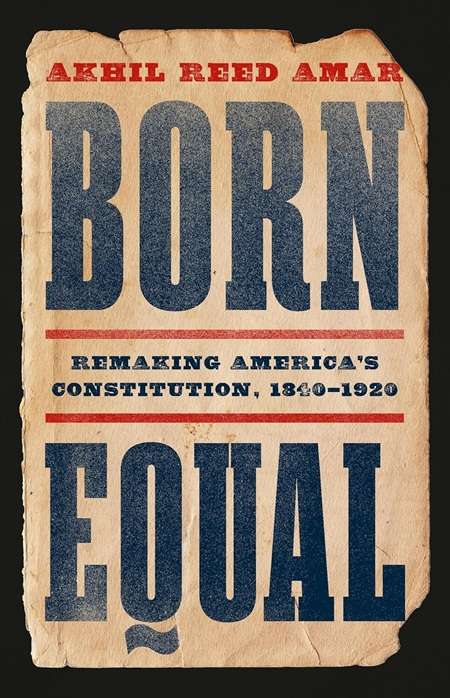
On September 16, Yale Law professor Akhil Reed Amar published Born Equal: Remaking America's Constitution, 1840-1920, the second volume of an in-progress three-volume history of America's constitutional project from 1760 to the present day. The first volume, The Words That Made Us: America's Constitutional Conversation, 1760-1840, was published in 2021. I much liked both volumes (more on that below), and I'm delighted to report that America's greatest historian of the Founding era, Gordon S. Wood, has recently publicly praised them as well.
Wood wrote a detailed review of Born Equal that he read aloud at a September 19 Yale Law School conference on originalism that I organized; Wood labeled Born Equal "wonderful" and went on to say that,
[I]t is the most extraordinary kind of history that I have read…. [Akhil] has paid tribute to the power of equality in our political and constitutional lives as no other historian ever has.
The complete transcript of Wood's glowing remarks may be found here, and may well be published in more polished form in the months ahead.
Kirkus Reviews awarded Born Equal a rare and much-coveted Kirkus Star and The Wall Street Journal ran a rave review by Adam J. White. The New York Times review by Jeff Shesol was generally favorable, but criticized Akhil's staunch defense of originalism. Read Born Equal and decide for yourself!
As I mentioned, I liked both volumes very much. Back in 2021 I described The Words That Made Us as:
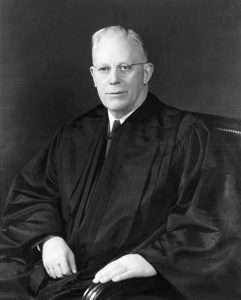
10/5/1953: Chief Justice Earl Warren takes the oath.
What's on your mind?
[1.] There's a lot going on in the Trump Administration's proposed "Compact," and there's a lot that we might want to ask about it. Some questions would have to do with whether particular demands (such as a tuition freeze or a 15% cap on foreign students or mandatory U.S. civics classes for foreign students) are a good idea. Some might be and some might not be. Some might have to do with the way that the Compact would rebalance power between universities and the federal government.
Some might have to do with whether particular demands (for instance, the requirement that universities require all applicants to take standardized admission tests) should be implemented top-down on a one-size-fits-all basis. The federal government may have the power to impose certain conditions on the recipients of government funds, but that doesn't mean that it necessarily should do so. This question of when conditions become excessive micromanagement perennially arises when it comes to government contracts and grants.
Some questions have to do with whether the Executive Branch can impose these conditions through just an announcement, whether this would require notice-and-comment regulatory rulemaking, or whether it would require express Congressional authorization. Similar questions have arisen in the past with regard to whether, for instance, Title IX should be understood to mandate university investigation of alleged sexual assault by students; whether it should be understood as mandating a preponderance-of-the-evidence standard in such situations rather than a clear-and-convincing-evidence; and other matters. In particular, the Compact seems to contemplate conditions on universities' "preferential treatment under the tax code," which I expect would likely require revisions to the tax code. But there too there have been controversies about where the Executive Branch has power to read provisions into tax exemption requirements that hadn't been expressly authorized by Congress (see, e.g., Bob Jones Univ. v. U.S. (1983)).
Still, I can at most note such matters—important as they are—since they aren't within my core area of expertise. So let me turn instead to the First Amendment problems posed by the Compact, which I am more knowledgeable about. I don't want to suggest that these are the most important issues, but that's where the light is best for me, so maybe I can find some keys there.
[2.] As a general matter, when the government is providing funding or other benefits for private parties' speech, it may not discriminate based on viewpoint. Thus, for instance, Rosenberger v. Rector (1995), held that when a public university funds student newspapers, it can't exclude ones that convey religious viewpoints. The Court there expressly "reaffirmed the requirement of viewpoint neutrality in the Government's provision of financial benefits." Many other precedents say the same.
To be sure, the government may create programs for conveying its own preferred viewpoints. As Rust v. Sullivan (1991) noted, Congress can set up a National Endowment for Democracy without setting up a National Endowment for Communism. But the Court has distinguished such government speech, which the government can select based on viewpoint, from government programs that subsidize a diverse range of private speech, as in Rosenberger. To quote Rosenberger again,
This is the second appellate court ruling against the order. So far, every court that has addressed this issue has ruled the same way.

Yesterday, the US Court of Appeals for the First Circuit issued a decision that Donald Trump's executive order denying birthright citizenship to children of undocumented immigrants and non-citizens present on temporary visas is unconstitutional. It also ruled that it violates a 1952 law granting naturalization to children born in the United States, and upheld a nationwide injunction against implementation of the order. This is the second appellate court decision ruling against Trump's order, following an earlier Ninth Circuit decision. Multiple district court judges (including both Democratic and Republican appointees) have also ruled that the order is illegal, and so far not a single judge has voted to uphold it.
Judge David Barron's opinion for the First Circuit runs to 100 pages. But he emphasizes that this length is the product of the large number of issues (including several procedural ones) that had to be considered, and does not mean the case is a close one:
The analysis that follows is necessarily lengthy, as we must address the parties' numerous arguments in each of the cases involved. But the length of our analysis should not be mistaken for a sign that the fundamental question that these cases raise about the scope of birthright citizenship is a difficult one. It is not, which may explain why it has been more than a century since a branch of our government has made as concerted an effort as the Executive Branch now makes to deny Americans their birthright.
I won't try go to through all the points in the decision in detail. But I think Judge Barron's reasoning is compelling and persuasive, particularly when it comes to explaining why this result is required under the Supreme Court's ruling in the 1898 Wong Kim Ark case, and why the 1952 naturalization statute provides an independent ground for rejecting Trump's order.
I would add, as I have noted previously (e.g. here and here), that virtually all the government's arguments for denying birthright citizenship to children of undocumented immigrants and those on temporary visas would also have denied it to numerous slaves freed as a result of the Civil War and the Thirteenth Amendment. For example, if children of people who entered the US illegally are ineligible, that would exclude the children of many thousands of slaves who were brought into the US illegally after Congress banned the slave trade in 1808. And granting citizenship to freed slaves and their children was, of course, the main purpose of the Citizenship Clause of the Fourteenth Amendment.
I also think the ruling is sound in concluding that the state government plaintiffs in the case have standing to sue (though, admittedly, the Supreme Court's precedents on state standing are far from a model of clarity), and in suggesting that "complete relief" for their injuries requires a nationwide injunction (though it ultimately remanded this issue to the district court for further consideration). State lawsuits are one of several possible exceptions to the Supreme Court's general presumption against nationwide injunctions in Trump v. CASA, Inc. Both this exception and that for class actions have been used in lower court decisions against the birthright citizenship order, since Trump v. CASA came down in June. These exceptions are among the reasons why CASA has so far not had anywhere near as devastating an impact as some feared (though I continue to believe it was a bad decision).
Both the substantive birthright citizenship issue and the procedural issue of the proper scope of injunctions are likely to return to the Supreme Court. Hopefully, the justices will affirm the lower court rulings on these issues. We shall see.
The case was filed yesterday by a broad coalition of different groups, including a health care provider, education groups, religious organizations, and labor unions.
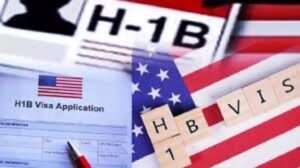
Yesterday, a broad coalition of groups filed the first lawsuit challenging President Trump's imposition of a $100,000 fee on applications for H-1B visas, which are used by tech firms, research institutions, and other organizations to hire immigrant workers and researchers with various specialized skills. If allowed to stand, the fee would effectively end most H-1B visas, by making them prohibitively expensive, thereby inflicting serious harm on the US economy.
The case is called Global Nurse Force v. Trump. The plaintiffs are a broad coalition including the Global Nurse Force (which supplies nurses to health care providers), education groups (e.g. - the American Association of University Professors), religious organizations, and labor unions. I am a little surprised that multiple labor unions joined this lawsuit, as one might think they would want to keep out potential competitors to their members. However, I would guess they have H-1B visa holders among those members. In addition, studies show that H-1B workers actually increase wages for many US-citizen workers by increasing productivity and innovation.
The complaint argues the H-1B visa is illegal for a number of different reasons. Here's a brief excerpt that summarizes some of them:
Defendants' abrupt imposition of the $100,000 Requirement is unlawful. The
President has no authority to unilaterally alter the comprehensive statutory scheme created by Congress. Most fundamentally, the President has no authority to unilaterally impose fees, taxes or other mechanisms to generate revenue for the United States, nor to dictate how those funds are spent. The Constitution assigns the "power of the purse" to Congress, as one of its most fundamental premises. Here, the President disregarded those limitations, asserted power he does not have, and displaced a complex, Congressionally specified system for evaluating petitions and granting H-1B visas. The Proclamation transforms the H-1B program into one where employers must either "pay to play" or seek a "national interest" exemption, which will be doled out at the discretion of the Secretary of Homeland Security, a system that opens the door to selective enforcement and corruption.
The plaintiffs also argue that the government's assertion of virtually unlimited power to impose visa fees goes against the major questions doctrine (which requires Congress to speak clearly when it delegates broad powers to the executive over issues of vast economic and political significance), and the constitutional nondelegation doctrine, which limits delegation of legislative power to the executive branch.
I made similar points in an earlier post about the H-1B visa fee policy, where I explained why it goes against the statutory scheme enacted by Congress, and why it would violate the nondelegation doctrine if Congress had delegated this power.
As the Global Nurse Force complaint notes, enforcing nondelegation is particularly crucial when it comes to the power to raise revenue, which is a specifically enumerated congressional power. The $100,000 fee goes far beyond anything that could plausibly be described as defraying administrative expenses, and is essentially a form of taxation. The Framers of the Constitution were careful to ensure that only the legislative branch could impose taxes, in order to avoid the abusive executive taxation pursued by 17th century British monarchs. This is one of several areas where Trump is attempting to usurp this legislative power. Others include his unilateral imposition of massive tariffs, and his unconstitutional export taxes (which even Congress lacks the power to impose under the Constitution).
I hope the plaintiffs prevail here. I expect there may also be other lawsuits challenging the H-1B fee.
From California Court of Appeal Justice Judith McConnell, writing for the court Thursday in People v. Alvarez; the lawyer involved has been licensed in California for 54 years:
[A filing in this case] included a quotation attributed to In re Benoit (1973) 10 Cal.3d 72, 87–88, but the purported quote did not exist in the case. Attorney Siddell later clarified that it was not a direct quotation because he modified it "to incorporate broader principles."
The opposition also included a citation to a case that does not exist: People v. Robinson (2009) 172 Cal.App.4th 452. Counsel additionally cited two cases that do not address the issues for which they were cited: People v. Jones (2001) 25 Cal.4th 98 and People v. Williams (1999) 77 Cal.App.4th 436….
At [a] hearing [after the matter was discovered], Attorney Siddell apologized for failing to verify the legal citations and sources included in his motion and explained that this failure resulted from feeling rushed. He reported he had taken courses regarding artificial intelligence (AI) and was aware that AI could hallucinate cases, but he did not verify the accuracy of any citations. He explained he relies on staff to help draft motions and briefs, but he recognized it is his responsibility to check the caselaw before submitting documents to the court. He said in the future he would "trust but verify" research provided through the use of AI….
The Second Appellate District recently published Noland v. Land of the Free, L.P., discussing the impact of the improper use of AI. We agree with our colleagues that "there is nothing inherently wrong with an attorney appropriately using AI in a law practice," but attorneys must check every citation to make sure the case exists and the citations are correct….
The conduct here is not as egregious as what occurred in Noland. But it is particularly disturbing because it involves the rights of a criminal defendant, who is entitled to due process and representation by competent counsel. Courts are obligated to ensure these rights are protected.
This one addresses the issue of whether the owner of a home foreclosed for nonpayment of debt is entitled to "fair market value" compensation, or only whatever the government gets from auctioning off the property, minus the debt owed.

In Tyler v. Hennepin County (2023), a unanimous Supreme Court ruled that "home equity theft" is unconstitutional. If the government forecloses on a property for nonpayment of taxes or other debts, it can only keep as much of the value of the land as is necessary to repay the debt in question. The rest belongs to the property owner. Otherwise, the Court ruled, there would be a violation of the Takings Clause of the Fifth Amendment, which bars taking of private property without payment of "just compensation" (see my analysis of the ruling here).
After Tyler, I did not think the home equity theft issue would return to the Supreme Court anytime soon. But, yesterday, the Court decided to hear Pung v. Isabella County. In this case, Isabella County, Michigan seized the late Timothy Pung's house because he supposedly failed to pay some $2200 in taxes and fees (his estate claims he didn't actually owe this money). They then sold the property at auction for about $76,000; the County kept the $2200 it thought it was owed and transferred the remaining funds (about $73,800) to Pung's estate.
But the usual standard for takings compensation, according to longstanding Supreme Court precedent, is "fair market value" - the price a property would fetch if sold on the open market. And Pung's estate argues the fair market value here is actually $194,400 (the value at which the county itself assessed that value for property tax purposes).
If a seizure of home equity after foreclosure is a taking - as Tyler v. Hennepin County rightly held - then I think the estate is obviously right. The property taken is the residual value of the home (after delinquent taxes and other debts are repaid). And that may be more than the government got from the highest bidder at the auction.
To be sure, the highest bid at the auction is relevant evidence of fair market value. But it is not always the only evidence that must be considered. The government could potentially do a poor job of marketing the property, and end up accepting a below-market value price. That's especially likely if, as is usually the case, they have no incentive to maximize value, so long as they secure enough to repay the debt that supposedly justified the foreclosure in the first place.
Here, it seems clear the auction price was indeed subpar. We know that because the winning bidder quickly resold the property for $195,000 (very close to the Pung estate's $194,400 estimate of the fair market value). That suggests the County was either incompetent at marketing the property or just didn't care to make a serious effort.
The lower court ruling by the US Court of Appeals for the Sixth Circuit held there is no taking here. But it is largely based on previous circuit precedent, which offers little in the way of analysis on this point. Tyler makes clear that a property owner subject to tax foreclosure "must render unto Caesar what is Caesar's, but no more." Here, Caesar pretty obviously did take a lot more, even if he wasn't able to appropriate its full value for himself.
In addition to considering the Takings Clause issue, the Supreme Court will also weigh the question of whether this kind of home equity theft violates the Excessive Fines Clause of the Eighth Amendment. The Court need not decide that issue if they rule in favor of Pung on the Takings Clause question. In Tyler, the Supreme Court similarly chose to rely on the Takings Clause, and did not to decide the Excessive Fines Clause issue. In a concurring opinion, Justice Neil Gorsuch (joined by Justice Ketanji Brown Jackson), argued that home equity theft does indeed violate the Excessive Fines Clause, as well as the Takings Clause.
I hope - and tentatively expect - that the Supreme Court will reverse the Sixth Circuit and rule that the Pung estate is entitled to fair market value compensation. I doubt the Court would have chosen to hear this case just to affirm the lower court decision. There is no split between circuits here of a kind that might lead the justices to take a case to resolve it.
Pung is somewhat unusual, in recent years, in being a major Takings Clause case that reached the Supreme Court, but was litigated by conventional private counsel, rather than by one of the major property rights public interest firms, such as the Institute for Justice and the Pacific Legal Foundation (which litigated Tyler). Philip L. Ellison, the Michigan attorney representing the Pung estate, wrote a strong cert petition that must have persuaded the justices to take the case.
Regardless of how the case got to the Court, the property rights community will surely support the victimized owner here. I myself intend to file an amicus brief, and I suspect I will not be alone in that.
From Southerland v. Bragg, decided Friday by Magistrate Judge Gabriel Gorenstein (S.D.N.Y.):
The complaint in this case seeks to obtain judicial records (and possibly other records) relating to Jordan Neely, who as a child was a witness at the New Jersey trial that resulted in plaintiff's conviction for murder. Over a decade later, Neely was the victim in a prosecution brought in New York against Daniel Penny, which resulted in an acquittal. Under a New York State statute, Criminal Procedure Law § 160.50, that acquittal in turn resulted in the sealing of the records in the criminal case against Penny (and thus of any documents therein that relate to Neely). Plaintiff's complaint seeks to have this Court unseal the New York state court records in the Penny case to obtain any records relating to Neely….
Plaintiff has filed "motion to unseal" the records in the Penny case, to which defendants have responded. This Court of course has power to seal and unseal its own records in accordance with applicable legal standards. But in this motion to unseal, plaintiff is not asking the Court to unseal a document that was filed on the docket in the case before it.
Instead, the motion asks this Court to unseal the New York state court records in the Penny case: that is, plaintiff seeks the unsealing of the very records that he seeks to obtain through the filing of the complaint. Whether the Court has power to order production of those records will be decided in due course as part of its consideration of the merits of this case. In the meantime, there is no basis for the Court to unseal those same records in response to a "motion to unseal."
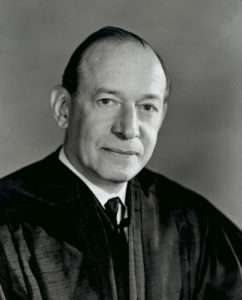
10/4/1965: Justice Abe Fortas takes the oath.
From the Atlantic in 1935, by Edwin Embree (see also yesterday's Atlantic Time-Travel Thursdays (Jake Lundberg) item yesterday discussing this):
How does one go about appraising the scholarly eminence of universities? In the first place, one may take the lists of the most distinguished scientists as published in American Men of Science and in somewhat similar records for the other branches of learning and tabulate the centres of concentration of these most eminent scholars. Second, since creative scholarship finds expression ultimately in publication, it is possible through the scientific journals to appraise the scholarly output of the several university faculties. The third and probably the soundest method is to rely on appraisals of the relative eminence of the several departments of universities made by competent scholars in each field. [More details omitted. -EV] …
While I have based my ratings on authoritative findings, most of which are matters of published record, I must in the end assume personal responsibility for the judgments. With all these considerations and reservations in mind, here is my rating of American universities in the order of their scholarly eminence: —
1. Harvard
2. Chicago
3. Columbia
4. California
5. Yale
6. Michigan
7. Cornell
8. Princeton
9. Johns Hopkins
10. Wisconsin
11. Minnesota
Once again, a district judge is reversed by the Supreme Court twice in the same case.
I noted in my recent Civitas column that it is rare for a single judge to be reversed by the Supreme Court twice in the same case. Yet, it has happened again. The latest installment is Noem v. TPA Alliance, Part II. The Court states the issue plainly:
In March of this year, the United States District Courtfor the Northern District of California entered a preliminary order postponing the effective date of the Secretary of Homeland Security's decision to remove "temporary protected status" (TPS) from Venezuelan nationals living in the United States. See 8 U. S. C. §1254a; 5 U. S. C. §705. In May, this Court stayed that order while the Governmentappealed. The United States Court of Appeals for the Ninth Circuit ultimately affirmed the District Court's preliminary order. Last month, the District Court entered final judgment in respondents' favor, holding unlawful and settingaside the Secretary's actions effectuating her decision—namely, her vacatur of a pending extension of TPS for Venezuelan nationals, and her termination of that status itself. See 5 U. S. C. §706(2). (The District Court also concluded that the Secretary unlawfully vacated a TPS extension for Haitian nationals. The Government now seeks to stay theportions of the District Court's judgment pertaining to Venezuela, but not Haiti. See Application 7, n. 6.) The application for stay presented to JUSTICE KAGAN and by her referred to the Court is granted. Although the posture of the case has changed, the parties' legal arguments and relative harms generally have not. The same result that we reached in May is appropriate here.
Justice Jackson, in dissent, laments how the Court did not use its "opinion-writing capacity." Given that this case took less than ten days to resolve, from start to finish, I don't think the Court found the matter particularly difficult. Justices Kagan and Sotomayor did not join Jackson's dissent.
At some point, lower courts will get the memo of how the emergency docket works.
Over $300 billion in Russian state assets are frozen in the West. It's long past time they were used to help Ukraine resist Vladimir Putin's war of aggression.

European Union nations are once again considering ways to use the $300 billion Russian state assets frozen in Western nations (mostly in Europe) to help Ukraine:
European Union leaders on Wednesday weighed a new scheme to provide longer-term financial and military support to Ukraine using hundreds of billions of dollars in frozen Russian assets held in Europe.
The plan — which Moscow has described as "theft" — is a fresh sign of the EU's determination to push ahead alone with support for Ukraine without the United States. Under President Donald Trump the U.S. no longer sends financial aid to Ukraine, and little so far in the way of weapons.
Ukraine's budget and military needs for 2026 and 2027 are estimated to total around 130 billion euros ($153 billion). The EU has already poured in 174 billion euros since the war started in February 2022.
The biggest pot of ready funds available is through frozen Russian assets. Most of it is held in Belgium – around 194 billion euros as of June – and outside the EU in Japan, with around $50 billion, and the U.S., U.K. and Canada with lesser amounts.
The plan currently under consideration would use the funds to back a loan that Ukraine would only have to repay if Russia pays an equivalent amount in war reparations. I have long advocated just simply confiscating the Russian state assets and giving them to Ukraine (e.g. here, here, and here). But the EU loan plan is almost as good, inasmuch as the practical effects are likely to be very similar. Unless Russia pays reparations (which seems unlikely), the confiscated state assets will ultimately be used to repay the loan, and Ukraine will not be held liable for it.
Last year, Congress enacted the REPO Act, which authorized the president to confiscate the approximately $6 billion in Russian state assets frozen in the US and transfer them to Ukraine. But neither Biden nor Trump has acted on it. In recent weeks, Trump has been rhetorically tougher on Russia than before, but I am not optimistic that these words will be backed by deeds. He can start to prove me wrong by using the REPO Act authority.
In a November 2023 post, I addressed a range of different objections to confiscating Russian state assets, including 1) claims that it would violate property rights protections in the US and various European constitutions, 2) sovereign immunity arguments, 3) arguments that it would be unfair to the Russian people, 4) slippery slope concerns, and 5) the danger of Russian retaliation. Every point made there remains relevant today. Stephen Rademaker, former chief counsel to the House Committee on Foreign Affairs, has a helpful recent Washington Post article further addressing the retaliation point.
Qualified privileges, unequal conspiracies, and a file in hand.
Please enjoy the latest edition of Short Circuit, a weekly feature written by a bunch of people at the Institute for Justice.
New case! Armed, masked ICE agents in Alabama have twice arrested Florida-born U.S. citizen Leo Venegas at work, each time barging onto active construction sites and violently detaining Latinos (while leaving everyone else alone) and each time continuing to detain Leo after he showed them his REAL ID. This week, we filed a class action on behalf of Leo and thousands of others similarly situated, challenging the warrantless entries, preemptive detentions, and continued detentions. Click here to learn more.
New on the Unpublished Opinions podcast: The panel ruminates over favorite features of the U.S. Constitution, proposes amendments, and discusses the dangers of viewing rights through a partisan lens.
The Justice discusses originalism, common good constitutionalism, and King v. Burwell in a recent interview.
National Review has posted the first half of Dan McLaughlin's interview with Justice Amy Coney Barrett about her new book and other matters. The interview covers a range of topics, including originalism and the interim orders docket, among other things. This bit on originalism and "common good constitutionalism" seemed to be of particular interest.
NR: . . . We have now four Gen X justices, [the others being] Justices Gorsuch, Kavanaugh, and Jackson. Our generation is actually the first generation to have come of age as lawyers with Scalia opinions, the Federalist Society, and originalism and textualism as serious arguments in the law schools. I had Justice Scalia come to one of my classes once, and debate one of our professors. So, we came of age with that — do you see any difference in the perspective of the four younger justices?
JUSTICE BARRETT: Well, I can only speak for myself, but I think, I guess the difference between when I was in law school and now, in the law just generally, is that originalism has gone from the kind of theory that was often in dissent to now it is a theory held by a majority of justices on the Court. And so, I think when I was a law student and when I was a young lawyer, and frankly, even when I was first a law professor, and I was thinking about originalism, it was a way of critiquing a lot of decisions. But if you're building up, you know, if you're employing it from a position of, hey, this isn't in the dissent, and this isn't a critique, I think it's just a little bit of a different thing. And so I think that now we're at a point where it's probably third-generation originalism.
If you think of first generation as Bork and original intent, and then second generation as Scalia and original public meaning. And I think now it's third generation originalism. I guess I would say, I'm using that to describe debates about, what do you do when the original meaning is evident but not determinative of the meaning? This is, I think, the history and tradition debate that's going on.
I guess I will add one other thing. I think that when originalism in its early iterations, certainly in the first generation and somewhat in the second generation, was very focused on judicial restraint. And that was in part because it was criticizing a method of interpretation that felt a little bit more like the Wild West or more results-oriented. And I think that — this was evident in Justice Scalia's work, as he went on — it's really not a theory of restraint, even though it's a side benefit that if you consider yourself bound by the text, you have an external constraint operating on you. But it's really a theory of law. And I think that's how Justice Scalia regarded it.
But I do think that language of "you should be an originalist, because otherwise you might be a runaway judge," has never really kind of fully gone out of dialogue around originalism.
NR: We're now in a position where there are critics of originalism from the right — people who say: It's too legally positivist. It doesn't consider enough of the common good to achieve everything that the right wants to do. How do you think about or respond to those kind of critiques?
JUSTICE BARRETT: I don't like this common good constitutionalism movement.
It feels to me like it's just results-oriented, and I think that it has all of the defects that originalists critiqued when originalism first became a self-conscious theory in the 1980s. I resist the idea that originalism wasn't around until Scalia, that originalism wasn't around until the '80s, because if you go back and look even at [John] Marshall opinions, and go back to the Founding they were looking at, you know, what did the Framers intend? They might not have always used the language of meaning rather than intent, but originalism, Keith Whittington talks about this. I mean, originalism was always a part of the Court's jurisprudence. But just like that little caveat, I just think that common good constitutionalism is just kind of results-oriented jurisprudence from the right.
I was also interested in this little bit about King v. Burwell.
NR: . . . In the book you talk, you actually get into some reasonably recent cases, hot button cases. . . .You have some, I could say, careful criticism, or at least reference to prior criticism of the King v. Burwell case, which I would note, is a case that the Court seems to have gone out of its way not to cite as a precedent since then.
JUSTICE BARRETT: [Laughs]
NR: It's a little unusual for a sitting justice to be talking about things that are fairly recent and hot. Is that something that you made a conscious choice, that you wanted to get people to understand how the Court thinks, even about recent cases?
JUSTICE BARRETT: So, I was very careful to only discuss — the only reason why I discussed King v. Burwell in a critical way is because I was already on the record as a law professor having criticized it. So, I didn't criticize any other precedent. I took all the Court's precedents as I found it. So I didn't criticize, for example, when I described substantive due process doctrine, I wasn't talking about it like I might have from scratch: "Should this be privileges or immunities clause, you know, etc." So, the only areas that I did criticize existing precedent were things where I was already on the record.
The whole interview is interesting. Part two will be posted over the weekend.
UPDATE: Part two of the interview is here.
Adrian Vermeule has responded to Justice Barrett's critique of common good constitutionalism.
Celebrate your independence with a subscription to Reason magazine, your most trusted source of honest, insightful news and analysis.




