

The Volokh Conspiracy
Mostly law professors | Sometimes contrarian | Often libertarian | Always independent
Chief Justice Rehnquist and Chief Justice Roberts Did Not See Eye-to-Eye About Dames & Moore v. Regan
In the South Texas Law Review, Rehnquist described his opinion in Dames & Moore as "similarly important" to Gibbons v. Ogden. His law clerk, and future Chief Justice, would disagree.
I've always been fascinating by Dames & Moore v. Regan. Justice Rehnquist, the future Chief Justice, writes a landmark separation of powers ruling. And at the time his law clerk was John Roberts, also the future Chief Justice. I've explored before how Roberts contributed little or nothing to that written opinion. Back then, the Justices handled emergency docket cases on their own.
In the tariffs case, Roberts basically implored counsel to not even cite the case.
CHIEF JUSTICE ROBERTS: Counsel, you --you've already mentioned Dames & Moore three --three times, which surprises me a little because the Court in Dames & Moore went out of its way to say that it was issuing a very narrow decision it pretty much expected to apply only in this case.
But how did Rehnquist see the case? I recently stumbled upon something on point.
In 1984, then-Associate Justice Rehnquist visited my law school, the South Texas College of Law. He presided over the ribbon-cutting for the dedication of the new tower (where my office is located).
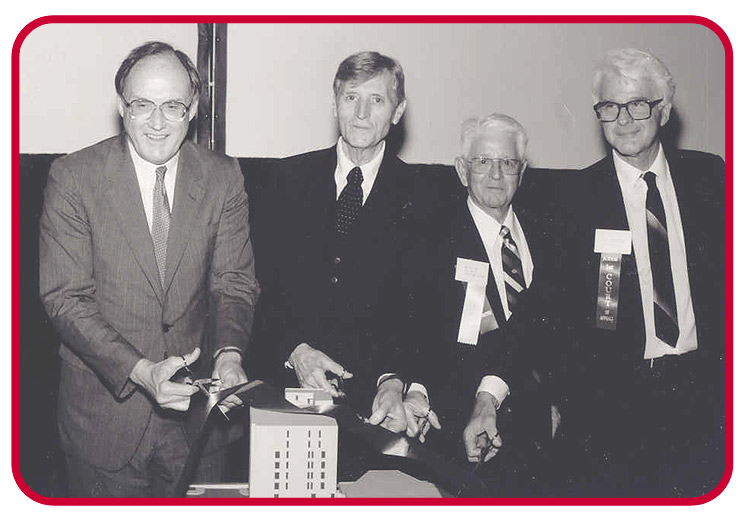
Rehnquist then delivered a speech on oral advocacy, that was published in the South Texas Law Review. Rehnquist also walks through the importance of oral arguments. There are many citations to Robert Jackson, for whom Rehnquist clerked--and had a somewhat complicated relationship. Rehnquist also contrasts the modern practice of short argument with the glory days of Daniel Webster where cases would be argued for days.
I was especially struck about this comparison Rehnquist drew between the oral argument in Gibbons v. Ogden and the recent case of Dames & Moore v. Regan.
The oral argument in the case was opened by Daniel Webster, who began at eleven o'clock in the morning of February 4, 1824. Webster argued for two-and-one-half hours in an "excessively crowded" courtroom. 9 Thomas J. Oakley, counsel for Ogden, followed and spoke for an hour on February 4th, and for the entire Court day of February 5th. Thomas Emmet spent the whole of the third day, February 6th, and two hours of February 7th, delivering his argument. The case was finally closed on the 9th by William Wirt for the appellant Gibbons. Five full Court days-twenty hours at four hours each day-were devoted to the argument of this important case.
By contrast, in Dames & Moore v. Regan,"a similarly important commercial case in which our Court granted certiorari before judgment a few Terms ago, two hours were allotted for oral argument. Without implying that one practice was good and the other bad, let us simply note for the moment that, in two cases of comparable importance, the time for oral argument was reduced from twenty hours to two.
It is striking that Rehnquist thought Gibbons and Dames & Moore were "similarly important" and of "comparable importance." I'm not sure that anyone at the time would have agreed with him. Surely no one today would draw that comparison. Gibbons remains the leading Commerce Clause case two centuries later. Chief Justice Marshall's decision was canonical. Dames & Moore was certainly important at the time, and resolved a serious conflict with Iran. But it but never pulled ahead of Justice Jackson's Youngstown concurrence. Indeed, Randy and I decided to remove Dames & Moore from the Fifth Edition of our casebook.
Still, this little vignette from my home institution reflects how perceptions often change over time.
I think the Justices often have a favorite decision. I recall Justice Scalia describing Crawford v. Washington, the Confrontation Clause opinion, as his most important ruling. Later, I think he moved District of Columbia v. Heller to the top of that list.
By contrast, Justice Thomas does not pick out a single opinion. I am making my way through Ted Cruz's excellent new book about Justice Thomas. Thomas relates that he doesn't much think about his opinions after he writes them:
During our final interview in December of 2025, I asked Justice Thomas whether he ever thinks about future generations when writing his opinions. Once again, he insisted that he doesn't. He simply looks at the facts in front of him, reviews the relevant law, and writes his conclusions in a way that the average American can understand. Then he moves on. His opinions, he insists, are not written in the way essays, speeches, and books are written.
I'll have more to say about Cruz's insightful book soon.




