The Volokh Conspiracy

Mostly law professors | Sometimes contrarian | Often libertarian | Always independent | Est. 2002

The Volokh Conspiracy

A "Bombshell" Or a Dud?

Once again, originalism is only elevated when a scholar with conservative credentials opposes conservative jurisprudence.

|

Yesterday, the New York Times published an article, titled Originalist 'Bombshell' Complicates Case on Trump's Power to Fire Officials. Adam Liptak highlights a new essay by UVA Law Professor Caleb Nelson that casts doubt on the claim that the Article II Vesting Clause includes a removal power.

Nelson did not say anything particularly novel in this 3,000 word essay. Indeed, he cites the work of scholars like Jed Shugerman and Julian Davis Mortenson who have written hundreds of pages on this issue in recent years.

So why did Nelson warrant a glowing profile in the newspaper of record? Simple: a law professor with conservative credentials opposed conservative jurisprudence. Here, a Thomas clerk published a short essay that bucks the conventional wisdom on the right. Will Baude hailed the essay on BlueSky as a "bombshell." I think it is fitting that the Times quoted Baude's announcement, as he was the subject of a similarly positive NYT piece by Adam Liptak in 2023.

Barely two years ago, Will and his co-author, Michael Stokes Paulsen wrote a 150-page article arguing that Donald Trump was unquestionably disqualified by the presidency under Section 3. (Seth Barrett Tillman and I were on the other side of that debate.) In the wake of January 6, there were many scholars who had written that Trump was disqualified. But what made the Baude/Paulsen article stand out was their conservative credentials. Baude, in particular, had clerked for Chief Justice Roberts.

I think there is something of a pattern. The mainstream media will elevate originalism when it bucks conservative orthodoxies. But when originalism unquestionably supports a conservative position, it is described as fringe and radical.

Ultimately, I'm not sure that Nelson's article moves the needle, at all. I don't need to remind everyone that the Baude and Paulsen position received zero votes at the Supreme Court. Justice Thomas made up his mind about Humphrey's Executor a long time ago. He stated the issue plainly in Seila Law.

I don't think Justice Thomas will wake up and say, "my goodness, because of a 3,000 word essay by a law professor I hired three decades ago, I have to radically alter everything I think about the separation of powers." A former Thomas clerk once told me a story of how he tried to persuade the boss that he was wrong about some case. Thomas sat patiently and listened as the clerk presented his argument. After the clerk was done, Thomas said he felt even more convinced that his initial position was correct.

I think it far more likely that Thomas cites, and continues to cite, another former clerk who is also on the University of Virginia faculty: Sai Prakash. Indeed, Thomas cited Prakash in Seila Law:

1 For a comprehensive review of the Decision of 1789, see Prakash, New Light on the Decision of 1789, 91 Cornell L. Rev. 1021 (2006).

Why is it that Prakash, whose credentials are very close to those of Nelson, doesn't even merit a mention by the Times? Prakash has been engaging in a lengthy debate with Mortensen and Shugerman on this issue. Indeed, Prakash co-authored an article with another member of the UVA faculty, Aditya Bamzai, in the Harvard Law Review.

Still, all the focus now is on Nelson, who wrote a short essay. If you read down to the last paragraph of Nelsons piece, you will see how tentative the claim is:

I am an originalist, and if the original meaning of the Constitution compelled this outcome, I would be inclined to agree that the Supreme Court should respect it until the Constitution is amended through the proper processes.  But both the text and the history of Article II are far more equivocal than the current Court has been suggesting.  In the face of such ambiguities, I hope that the Justices will not act as if their hands are tied and they cannot consider any consequences of the interpretations that they choose.

This is not exactly lion-hearted originalism. It isn't even faint-hearted originalism. Call it "inclined-to-be" originalism?

Ultimately, I think this new entry to the field will not be a bombshell, but will be a dud.
Free Speech

"Viewpoint Diversity" Requirements as a New Fairness Doctrine: Viewpoint Diversity Rules as to Students

|

I have an article titled "Viewpoint Diversity" Requirements as a New Fairness Doctrine forthcoming in several months in the George Mason Law Review, and I wanted to serialize a draft of it here. There is still time to edit it, so I'd love to hear people's feedback. The material below omits the footnotes (except a few that I've moved into text, marked with {}s, as I normally do when I move text within quotes); if you want to see the footnotes—or read the whole draft at once—you can read this PDF. You can see my argument about why viewpoint diversity requirements are likely to chill controversial faculty speech here; here is a brief follow-up section as to the problems with imposing such requirements as to students:

[E.] Viewpoint Diversity Rules as to Students

The Administration's letter to Harvard also calls on "audit[ing] the student body" and not just the faculty. But the problem of people being encouraged to misreport their political beliefs is likely to be even more severe with regard to the auditing of students. For college students, any such audit is likely to be based entirely on self-reporting, since most students will have little history of party registration, even less history of political donation, no formal publication record of the sort that academics have, and (again, for most students) little politically minded social media commentary.

Read More

Free Speech

My New Paper on "How Speech-Based Immigration Restrictions Threaten Academic Freedom"

It is forthcoming in Academic Freedom in the Era of Trump, (Lee Bollinger and Geoffrey Stone, eds., Oxford University Press).

|

NA

I recently posted to SSRN a draft of my new paper on "How Speech-Based Immigration Restrictions Threaten Academic Freedom." It is forthcoming in Lee Bollinger and Geoffrey Stone, eds., Academic Freedom in the Era of Trump (Oxford University Press). I will likely make revisions before publication, and welcome comments, suggestions, and criticisms. Here is the abstract:

Since he returned to office in January 2025, President Donald Trump's administration has engaged in a systematic effort to deport non-citizen university students and academics who express views inimical to those of the US government on a number of issues. Litigation over these attempted deportations has focused on First Amendment free speech issues. But speech-based deportations of students and academic university employees also threaten academic freedom. This chapter explains how and why.

Part I briefly summarizes the Trump Administration's campaign of speech-based deportation of non-citizen students and academics. That campaign focuses primarily on students with anti-Israel and pro-Palestinian views regarding the ongoing war in Gaza. But its logic could just as easily justify targeting a wide range of other viewpoints.

Part II presents an overview of the idea of academic freedom. That principle is related to, but distinct from freedom of speech. In some respects, it is narrower than the latter. But academic freedom does nonetheless require faculty and researchers to be able to consider and express a wide range of viewpoints on the issues they work on, and to be free of sanctions for viewpoints they express outside of the context of their academic work. The same goes for students. Part III explains how speech-based deportations undermine the academic freedom of both non-citizens subject to deportation, and US-citizen scholars and students. The former effect is obvious. The latter is more indirect, but nonetheless large. Speech-based deportations of foreign students and academics chills the speech of their US-citizen colleagues and also deprives the latter of the opportunity for valuable interactions that could enhance their research, teaching, and learning. What is true of speech-based deportations is also true of speech-based exclusions of potential migrants even before they are allowed to set foot in the United States.

Finally, Part IV considers multiple possible rationales for speech-based deportations and exclusions. Ironically, some of these rationales—currently advanced by a right-wing administration—turn out to be similar to traditional left-wing rationales for restrictions on "hate speech." Whether deployed by the right or the left, the rationales are badly flawed. If correct, they cannot logically be limited to suppressing speech by non-citizens. Bigoted or otherwise reprehensible speech by US citizens creates comparable or greater dangers.

Donald Trump

Deference Due? Trump, the National Guard, and the Misuse of Martin v. Mott

A guest post by Joshua Braver and John Dehn.

|

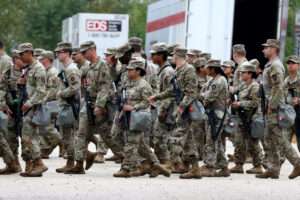
Members of the Texas National Guard assemble in Elwood, Illinois, at the Army Reserve Training Center in the southwest suburb of Chicago.
Members of the Texas National Guard assemble in Elwood, Illinois, at the Army Reserve Training Center in the southwest suburb of Chicago. ( Brian Cassella/TNS/Newscom)


President Donald Trump's attempts to federalize the National Guard and use it for domestic law enforcement are the subject of ongoing litigation in California, Oregon, and Illinois. What follows is a guest post on this important issue by legal scholars Joshua Braver and John Dehn, two leading experts on legal issues surrounding domestic use of the military. Prof. Dehn is also a former US Army officer, who spent fifteen years serving as a military judge advocate. In the post Braver and Dehn explain why courts should generally not defer to the president in addressing the issue of whether his invocation of extraordinary emergency powers to use the National Guard domestically, is legal, and why such deference is not required by the Supreme Court's 1827 decision in Martin v. Mott.

I myself have written about the California litigation here and here, and about the more general issue of judicial review of emergency powers here. What follows below was written by Joshua Braver and John Dehn, not by me (Ilya Somin), though I agree with virtually all their points:

The Trump administration's efforts to federalize and deploy the National Guard in Los Angeles, Portland, and Chicago has become mired in litigation. But it's not simply the courts versus Trump—the courts themselves are divided over how much deference to afford the President's determination that the conditions necessary for federalizing and deploying the guard have been met. Must courts take the Trump administration at its word, or may they independently determine whether the facts on the ground justify a deployment? No precedent figures more prominently in this debate than the Supreme Court's 1827 decision in Martin v. Mott, which has been cited by scholars as supporting broad judicial deference to presidential determinations that statutory preconditions to both federalization and deployment have been met. This post argues that this conventional reading of Mott as well as its application to these deployments is mistaken: no such broad deference is due as Judge April Perry correctly concluded in her opinion supporting the Chicago TRO.

The cases center on two provisions of 10 U.S.C. § 12406, which authorize the President to federalize the National Guard if (1) "there is a rebellion or danger of a rebellion against the authority of the Government of the United States," or (2) the President "is unable with the regular forces to execute the laws of the United States." Citing both triggers, the President issued a memorandum on June 7 directing that "members and units of the National Guard of any State [be called] into Federal service in such numbers as he considers necessary" to protect Immigration and Customs Enforcement (ICE) operations, agents, and facilities.

Federal district courts adjudicating the Chicago and Los Angeles cases refused to grant deference to the President's determinations and issued temporary restraining orders (TROs) halting both the federalization and deployment of National Guard units. The Seventh Circuit issued a partial administrative stay of the Chicago TRO, permitting the federalization of Guard units to continue but not their deployments. In the Los Angeles litigation, the Ninth Circuit stayed the Los Angeles TRO, reasoning that the district court had failed to grant sufficient deference. Citing Martin v. Mott and "the settled understanding of the Supreme Court and among legal scholars," the Ninth Circuit quoted Mott: "the authority to decide whether the exigency has arisen, belongs exclusively to the President, and his decision is conclusive upon all other persons." The panel stated that, consistent with Mott and later precedent, courts have only a limited role—to ensure that the President made a "colorable assessment of the facts and law within a 'range of honest judgment'" that was "conceived in good faith."

Read More

Free Speech

Colorado Child Porn Law Didn't Ban Deepfake Porn Until Recent Amendments, Court Holds

|

From In the Interest of Juvenile: S.G.H., decided yesterday by the Colorado Supreme Court, written by Justice Carlos A. Samour, Jr.:

S.G.H., a young teenager, … is accused of using a generative-AI tool to blend authentic images of three classmates' actual faces and clothed bodies with computer-generated images portraying naked intimate body parts to make it appear as though the classmates are nude….

Every state has laws prohibiting the nonconsensual distribution of authentic intimate images, and the federal government recently enacted a similar measure. But "few laws in the United States" specifically protect minors from exploitation through the use of generative AI tools, and many current statutes do not cover computer-generated explicit images that use real people's faces. [The court doesn't mention the federal TAKE IT DOWN Act, enacted in May 2025, which broadly bans nonconsensual deepfake porn. -EV] …

Colorado is among those states that have been slow off the mark to address the use of explicit images created with generative AI. To our legislature's credit, it recently stepped up and bridged the generative-AI gap that existed in the relevant statutes. But that was after S.G.H. had been charged in this case with six counts of sexual exploitation of a child (two counts for each victim), so any recent legislative amendments cannot serve as a lifeline for the People here.

The People nevertheless contend that they need no rescuing by the recent amendments because the law in effect on the dates of the charged offenses prohibited S.G.H.'s alleged conduct. According to the People, the amendments merely clarified that such conduct is prohibited. We disagree….

Read More

Free Speech

"Viewpoint Diversity" Requirements as a New Fairness Doctrine: Why Countervailing Pressures to Protect Controversial Views Are Likely to Be Inadequate

|

I have an article titled "Viewpoint Diversity" Requirements as a New Fairness Doctrine forthcoming in several months in the George Mason Law Review, and I wanted to serialize a draft of it here. There is still time to edit it, so I'd love to hear people's feedback. The material below omits the footnotes (except a few that I've moved into text, marked with {}s, as I normally do when I move text within quotes); if you want to see the footnotes—or read the whole draft at once—you can read this PDF. You can see my argument about why viewpoint diversity requirements are likely to chill controversial faculty speech here; here is a brief follow-up section to that:

[D.] Why Countervailing Pressures to Protect Controversial Views Are Likely to Be Inadequate

To be sure, despite the chilling effect described above, not all controversial faculty speech (or hiring of controversial faculty) will be chilled. University faculty may have their own reasons to speak out in controversial ways: perhaps personal ideological commitment, a felt obligation to express what they see as the truth even when it may draw ideological fire, a desire to win approval from people (inside and outside the academy) who share their ideological views, or a desire to make a name for themselves as interesting and important scholars. To the extent that universities maintain a strong system of tenure protection, even risk-averse administrators might not be able to constrain at least some such faculty members.

Likewise, if universities are committed to academic freedom, they might choose not to try to constrain faculty members even when the faculty's actions are causing political and financial problems for the university. And as noted above, the very mandate of "viewpoint diversity" could pressure universities to hire more faculty members who seek to express politically controversial viewpoints, rather than just faculty members who are seen by the public as apolitical.

This, of course, is also what the Court argued in Red Lion:

Read More

Civil Procedure

Justice Gorsuch Argues that the Seventh Amendment Should Apply to the States

|

From today's opinion by Justice Gorsuch respecting the denial of certiorari in Thomas v. Humboldt County:

In Minneapolis & St. Louis R. Co. v. Bombolis (1916), this Court held that the Seventh Amendment's civil jury trial right is not enforceable against the States. Petitioners ask us to reconsider that decision. But a number of "vehicle" problems make it unlikely that we could do so in this case. Accordingly, I agree with the Court's decision to deny review. At the same time, I do not doubt that Bombolis warrants a second look.

As petitioners observe, Bombolis is something of a relic. There, the Court dismissed as "strange" the notion that the Seventh Amendment—or, for that matter, any of the Bill of Rights—might be enforceable against the States. But what once might have seemed strange almost goes without saying today. In the years since Bombolis, this Court has "shed any reluctance" about the idea that the Fourteenth Amendment "incorporate[s]" against the States many of the liberties enshrined in the Bill of Rights.

Read More

Free Speech

"Viewpoint Diversity" Requirements as a New Fairness Doctrine: Chilling Effect on Controversial Faculty Speech

|

I have an article titled "Viewpoint Diversity" Requirements as a New Fairness Doctrine forthcoming in several months in the George Mason Law Review, and I wanted to serialize a draft of it here. There is still time to edit it, so I'd love to hear people's feedback. The material below omits the footnotes (except a few that I've moved into text, marked with {}s, as I normally do when I move text within quotes); if you want to see the footnotes—or read the whole draft at once—you can read this PDF. You can see the opening sections  drawing the Fairness Doctrine / viewpoint diversity requirements analogy here; here is a section that explains how one of the problems with the Fairness Doctrine is likely to also arise with viewpoint diversity requirements.

[V.] Chilling Effect on Controversial Faculty Speech and on the Hiring of Controversial Faculty

[A.] The Fairness Doctrine

Yet just as Red Lion offers some support for ideological diversity conditions on government funding, so the critiques of the Fairness Doctrine apply to ideological diversity conditions as well.

To begin with, the Fairness Doctrine tended to deter broadcasters from featuring controversial speakers, because having such speakers would require the broadcasters to provide free time to rivals. The Red Lion Court pooh-poohed that concern:

At this point, … that possibility is at best speculative. The communications industry, and in particular the networks, have taken pains to present controversial issues in the past, and even now they do not assert that they intend to abandon their efforts in this regard….

[And] if present licensees should suddenly prove timorous, the Commission is not powerless to insist that they give adequate and fair attention to public issues….

But just five years later, in Miami Herald Publishing Co. v. Tornillo, the Supreme Court rejected a Florida statute that provided a right of reply to political candidates who were criticized in a newspaper, and it did so partly on chilling effect grounds:

Faced with the penalties that would accrue to any newspaper that published news or commentary arguably within the reach of the right-of-access statute, editors might well conclude that the safe course is to avoid controversy. Therefore, under the operation of the Florida statute, political and electoral coverage would be blunted or reduced.

Read More

From October 7, 2023 to October 13, 2025

Blessed are You, L-rd our G‑d, King of the Universe, who has granted us life, sustained us and enabled us to reach this occasion.

|

On the evening of October 6, 2023, the Jewish holiday of Simchat Torah began. This is a joyous holiday, when it is a mitzvah (commandment) to be happy. Jews sing and dance with the Torah, and toast many L'Chaims. While many Jewish holidays can be a bit somber, Simchat Torah is a fun holiday. Hamas no doubt chose this day deliberately. In the early hours of the morning of October 7, people would be scattered, tired, and probably a bit hungover.

In 2024, Simchat Torah began on October 24. (The Jewish calendar follows the Lunar cycle, so dates shift around.) Around the world, Jews tried to be merry, but there was a sadness that those in captivity could not celebrate. We said we would "Dance for them," praying the hostages would soon be released.

On the evening of October 13, 2025, the Jewish holiday of Simchat Torah began again. Now, all of the living hostages have been returned to their families and friends. For the first time in nearly two years, we could celebrate without any restraints or reservations. Tonight's holiday was a joyous one for me, and I'm sure for Jews around the world.

In the summer of 2024, during a mission trip, I watched the surveillance footage of the atrocities of October 7. Many of those gruesome images will forever be burned in my mind. I wasn't sure there could ever be a video that could help reduce the sting.

This video of the hostages being reunited with his family will help. Try to watch this montage without tearing up.

Several of the grieving parents, upon seeing their sons, recited a very well-known Jewish prayer, the Shehecheyanu:

Blessed are You, L-rd our G‑d, King of the Universe, who has granted us life, sustained us and enabled us to reach this occasion.

These parents must have imagined this moment, over and over again, for two years. They no doubt planned what they would say and how they would act. And in the moment, the first words that left their mouths was the prayer to the Almighty, expressing thanks for letting them reach this momentous occasion. These moments should reinforce the faith in all of us.

A few related points.

First, President Trump deserves the eternal thanks of the Jewish people. He accomplished something that I didn't think was possible. In earlier days, I was quite critical of Trump, but over time, I've come to appreciate the singular and transformative talents he possesses. The Israel deal is perhaps his greatest move yet. No other President could have pulled it off.

Second, we can finally lay to rest this slander that Trump is an anti-semitic. Watch his speech before the Knesset (the Israeli Parliament). He gave thanks to the "Almighty G-d of Abraham, Isaac, and Jacob." He referred to the Abraham Accords as the Avraham Accords, the way you would pronounce it in Hebrew. He celebrates that his daughter converted to Judaism, and married a Jewish person.  Jews throughout Israeli, even those on the political left, celebrated President Trump. I've written before how being a Democrat is part of the American Jewish culture. Fine. I don't expect to change that norm, though I think that political homogeneity is fading.

Read More

Thoughts on Case v. Montana and the Standards for the Emergency Aid Exception

The Fourth Amendment returns.

|

It's been a long, long time since the Supreme Court heard argument in a real Fourth Amendment case.  This Wednesday, the Court will finally break the spell with argument in Case v. Montana.  I thought I would offer some thoughts on it. (Full disclosure: I have consulted with the lawyers for the petitioner in the case, although the thoughts here are my own.)

Here's the context. In Brigham City v. Stuart (2006), officers entered a home to break up a fight in which one person was being badly beaten in view of the officer from outside. The Court ruled that an "objectively reasonable basis for believing that an occupant is seriously injured or imminently threatened with such injury" allows a warrantless entry into the home. In such circumstances, the thinking runs, there is a strong and immediate government interest in saving the life and preventing further injury of the person being attacked.

On the other hand, in Caniglia v. Strom (2021), the Supreme Court held that the community caretaking exception to the warrant requirement does not allow entry into a person's home.  In Caniglia, officers had entered the home of a suicidal man and taken his guns.  Although the Court had recognized a community caretaking exception in an earlier case that allowed the entry into a car to prevent a gun from falling into the wrong hands,  Caniglia ruled that this exception did not apply to allow entry into a home.  Justice Thomas's short majority opinion in Caniglia was followed by concurrences from Justices Alito and Kavanaugh that speculated about circumstances in which entry into a home to aid might be allowed under other exceptions to the warrant requirement, such the emergency aid exception of Brigham City.

The Case case—confusing name, I know—picks up where Caniglia and Brigham City left off.  The facts here are somewhere in between those two precedents. William Case, who lived in a small town in Montana, called his ex-girlfriend and threatened suicide. The police in the small town all knew Case and his mental health problems, and they had reason to believe from past interactions that he was planning "suicide by cop"— a shoot out with the police when they checked on him. Officers eventually decided to enter his home with their guns drawn.

The question in Case is the legality of the officers' entry, and in particular, what's the specific standard for entry under the emergency aid exception. Case argues that entry under Brigham City's objectively reasonable evidence standard requires probable cause of an emergency.  The state argues that probable cause isn't needed, and that all the officers need is an objectively reasonable belief that they needed to enter to render emergency medical aid.

As I read the briefs, the dispute here is really a choice between a very general standard (was the belief about the need to enter to render emergency aid a reasonable belief) or a somewhat more rule-based approach (was there probable cause of an emergency).  Do you keep the standard more abstract, leaving it at case-by-case reasonableness, or do you provide more guidance and root that in the known standard of probable cause?

Here are the two things I will be listening for at Wednesday's argument:

(1) The role of common law history versus the role of pragmatism.

As I blogged last December, back at the cert stage, one of the things that makes Case unusual is that there's actually a lot of common law authority on the standards for emergency entry.  A key question to look out for is how much the Justices focus on that authority. As Justice Scalia emphasized in Kyllo v. United States, the Fourth Amendment must be interpreted to ensure "preservation of that degree of privacy against government that existed when the Fourth Amendment was adopted." And the common law standards of search and seizure have long provided the Fourth Amendment baseline of what is "reasonable," especially where there is "precise guidance from the founding era," as Riley put it.  Given the originalist turn at the Court in recent years, that history may matter a lot.

Read More

Hostages and "Hostages"

There is no moral equivalence between the hostages released by Hamas and the prisoners released by Israel.

|

From a post circulating yesterday:

Hamas will release Elkana Buchbut, a 32 yo party producer and musician, married and father of a 4 yo boy.

Israel will release Baher Badar, who in 2004 was responsible for a suicide terror attack which killed 11 Israelis.

Hamas will release Bar Kuperstein, a 23 yo security guard of the Nova festival, and the manager of his father's falafel restaurant.

Israel will release Faras Ganam, who was responsible for at least 5 terror attacks, and at least 4 dead Israelis.

Hamas will release Maxim Herkin, a 36 yo who got to Israel from Ukraine with his family, including his 4 yo daughter.

Israel will release Jihad Rom, who kidanpped 17 yo Yuri Goshchin in Jerusalem to Ramallah, abused him, murdered him and abused his corpse.

Hamas will release Segev Halfon, a 27 yo from Dimona who suffers from PTSD and worked in his family's bakery.

Israel will release Maher al-Hashlamun, who stabbed 3 people, killing one of them - Dalia Lemkus, who was a survivor of another terror attack 8 years prior to her murder.

Hamas will release Eitan Mor, a 25 yo who lived in Jerusalem and worked at a coffee shop.

Israel will release Hussein Sharrif Jauadra, who was 16 yo when stabbing 19 yo Eden Atias to death on a bus.

Hamas will release Alon Ahel, a 24 yo talented pianist and musician.

Israel will release Nabil Abu Hadir, who murdered his own sister for suspecting she was an Israeli agent.

Hamas will release Yosef Chaim Ohana, a 24 yo bartender, who helped others to escape from the party until he was kidnapped himself.

Israel will release Eiad Abu-Al-Rub, the head of The Islamic Jihad in Jenin, who's personally responsible for terror attacks, among them a suicide terror attack in Hedera, where 6 were murdered.

Read More

Judiciary

Forum Shopping in the First Circuit

An interesting Reuters report on the new locus of lawsuits challenging the Trump Administration.

|

Those seeking to file legal challenges against the Trump Administration's avalanche of executive actions have largely sought friendly fora in which to bring their claims. Increasingly, this appears to mean filing suit in New England, in district courts within the U.S. Court of Appeals for the First Circuit, the only federal appellate court in the nation without a single Republican appointee in active service (though there is one nominee pending).

Nate Raymond of Reuters has an interesting and informative exploration of how the First Circuit has become a forum of choice for anti-Trump Administration litigation, and includes some interesting data on how often such suits are now filed within the circuit.

A Reuters analysis found that at least 72 lawsuits challenging Trump's policies have been filed in federal courts in those four states by plaintiffs, including Democratic state attorneys general, advocacy groups and institutions targeted by the administration. Trial court judges have made at least an initial decision in 51 of those cases, ruling against Trump in 46 of them, the analysis showed.

These have included challenges to Trump's policies to restrict birthright citizenship, gut the U.S. Department of Education, revoke the legal status of thousands of migrants and fast-track deportations of migrants to countries other than their own - so-called "third countries" - including politically unstable South Sudan. . . .

The 1st Circuit, in handling Justice Department appeals of rulings by these trial judges against the president's policies, has issued 15 decisions, granting the administration's request to set aside judicial orders only three times.

The report goes on to explain why the First Circuit would be a popular circuit in which to file these suits.

While nationwide the U.S. judiciary is closely divided among judges appointed by Democratic and Republican presidents, in these four states 17 of the 20 active federal trial judges are Democratic appointees. These states fall under the umbrella of the Boston-based 1st U.S. Circuit Court of Appeals, whose five active judges all were appointed by Democratic presidents while a Trump nominee awaits Senate confirmation. . . .

The regional federal appellate court that has jurisdiction over the most challenges this year to Trump's policies is the one that covers Washington, D.C., as might be expected considering it is the seat of the U.S. government. But the courts under the 1st Circuit have attracted the second-most such lawsuits, according to data from Just Security, an online publication based at New York University School of Law.

The article also provides a useful explanation of forum shopping, why litigants engage in it, and how it's not new. Too often this sort of context is missing from news reports and analyses of litigation against the Trump Administration. Among other things, the report notes that the First Circuit is, in many respects, replacing the Ninth Circuit as the preferred circuit of anti-Trump litigants. As the story notes, President Trump made ten appointments to the Ninth Circuit during his first term, "reducing the likelihood that Democratic appointees would dominate its judicial panels that decide appeals."

President Trump has yet to make a single appointment to the First Circuit (which is also the smallest circuit court, with only six seats). As one might expect given its composition, anti-Trump suits have fared well within the First Circuit.

The 1st Circuit, in handling Justice Department appeals of rulings by these trial judges against the president's policies, has issued 15 decisions, granting the administration's request to set aside judicial orders only three times.

The Trump Administration has often sought Supreme Court review of the First Circuit's failure to stay or reverse district court orders entered against it.

The Supreme Court already this year on seven occasions fully or partially put on hold judicial orders against Trump policies arising out of the 1st Circuit's jurisdiction in cases concerning the Department of Educationlegal status of migrants and third-country deportations.

But, the story also notes, the Trump Administration has not always been quick to appeal adverse judgments from the First Circuit. Rather, as I have highlighted in prior posts, the Administration has been selective, only seeking Supreme Court review of cases in which its complaints about district court overreach are particularly strong.

While the Supreme Court has backed the administration in some important cases this year arising from the 1st Circuit, the Justice Department has not yet asked the justices to review some other adverse rulings from judges in the region.

That means, for example, that decisions by judges in Boston and Providence, Rhode Island, remain in place blocking the administration's efforts to make changes in federal elections including limits on counting mail-in ballots, cap federal research funding to universities and disfavor arts organizations seeking grant funding because they support "gender ideology."

Just as anti-Trump litigants are being selective in deciding where to bring which cases, the Trump Administration is being selective about which cases to bring to One First Street. The result is both that a disproportionate share of suits brought against the Trump Administration are successful, and a disproportionate share of Supreme Court orders vindicate the Trump Administration's position. But if you've been following my posts on this subject, you already knew that.

Free Speech

"Viewpoint Diversity" Requirements as a New Fairness Doctrine: Regulators' Motivations

|

I have an article titled "Viewpoint Diversity" Requirements as a New Fairness Doctrine forthcoming in several months in the George Mason Law Review, and I wanted to serialize a draft of it here. There is still time to edit it, so I'd love to hear people's feedback. The material below omits the footnotes (except a few that I've moved into text, marked with {}s, as I normally do when I move text within quotes); if you want to see the footnotes—or read the whole draft at once—you can read this PDF. You can see the opening sections  drawing the Fairness Doctrine / viewpoint diversity requirements analogy here; here is a brief section that dismisses one argument against viewpoint diversity requirements:

[IV.] Regulators' Motivations

[It does not matter for purposes of my analysis] that modern viewpoint diversity mandates come out of a desire to promote certain viewpoints (today, conservative ones) that their backers think are unfairly discriminated against.

Many regulations stem from perceived problems caused by particular groups that express particular views. The 36-foot bubble zone around abortion clinics in McCullen v. Coakley, for instance, was enacted in response to speech that expressed anti-abortion views. The bubble zone disproportionately affected anti-abortion speech. The legislators who voted for it were likely abortion rights supporters. But the Court treated the restriction as viewpoint-neutral and even content-neutral because the government's stated purposes were sufficiently neutral: protecting safety and preventing obstruction of passageways.

Read More

First Amendment

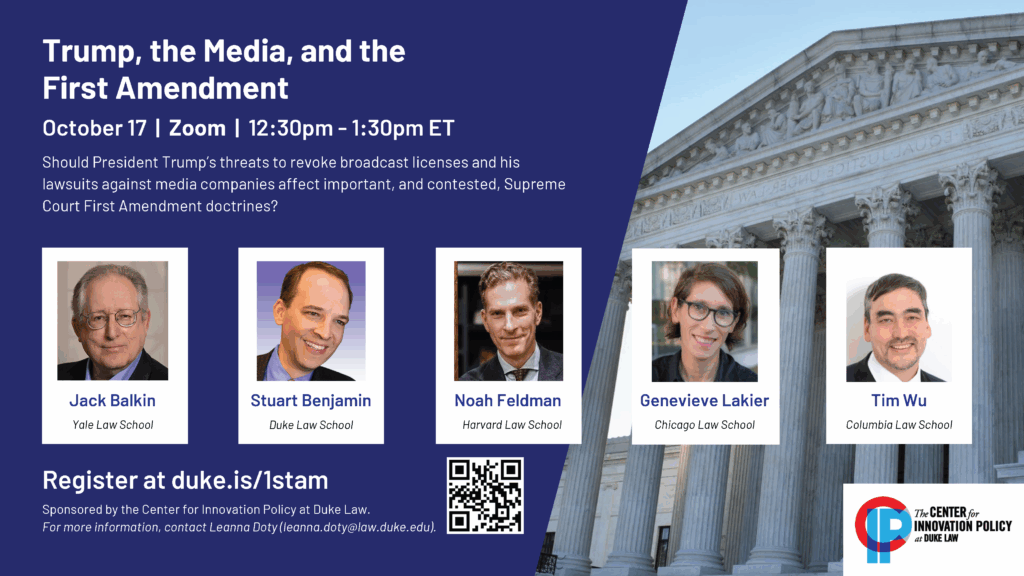
Friday Oct. 17 12:30pm-1:30pm Zoom event: Trump, the Media, and the First Amendment

The Trump Administration’s threats to revoke broadcasters’ licenses and President Trump’s lawsuits against media companies implicate important, and contested, Supreme Court First Amendment doctrines. Should these actions affect how courts and scholars analyze these doctrines?

|

This Friday at 12:30pm ET I will be hosting an online discussion about whether actions by President Trump and his administration should affect how courts and scholars analyze the First Amendment's application to the media.

The launching point is the Trump Administration threats to revoke broadcasters' licenses, and President Trump's lawsuits against media companies, which implicate important, and contested, First Amendment doctrines—particularly those developed in Red Lion v. FCC and FCC v. Pacifica Foundation (upholding FCC regulations of broadcasters' speech), NRA v. Vullo and Murthy v. Missouri (addressing government pressure and threats of legal sanctions), and New York Times v. Sullivan (holding that in defamation suits public officials must prove that the speaker knew a statement was false or was reckless about its falsity).

You can register here or scan the QR code below.

Supreme Court

DCCHS Oral History of Justice Ruth Bader Ginsburg

A set of interviews with the late justice is now available

|

The D.C. Circuit Historical Society has just released the Oral History of Justice Ruth Bader Ginsburg, who served on the U.S. Court of Appeals from 1980-1993. The oral history consists of eight interviews conducted by Dr. Maeva Marcus. By agreement, the interviews were not to be released until five years after Justice Ginsburg's death (or ten years after her judicial service ended).

I have not yet had the chance to go through all of the interviews, but did notice this tidbit in the last interview, from 2014.

Dr. Marcus: Is there much place for discussion other than in conference?

Justice Ginsburg: It's up to the Justices. There can be as much or as little as they want. The conference is concise. Let me explain the difference between when we get
together and when we don't. The dissenters had no time to get together in Bush v. Gore, so there were four separate dissents, vastly confusing to the press. In the Affordable Care Act case and the Voting Rights Act case, we had time to meet together and discuss what the dissenting opinion should include. After the discussion, I asked my colleagues on the dissent side if they had anything they particularly wanted me to cover, please send me a memo. It's not often that that will happen for the majority opinion, because people agree on the main lines of the opinion at conference. But
yes. Discussion continues after the conference. When a draft opinion is circulated, the Justices are more active than court of appeals judges in suggesting changes. Whoever circulates the first opinion in October knows that her colleagues will weigh in on it, sometimes heavily. But by April, people are so busy with the opinions they're writing themselves, they have less time to comment on a colleague's opinion. The chances of having your opinion released just as you wrote it are much better in April than in October.

Dr. Marcus: If you get to assign the opinion, you can override such a thing?

Justice Ginsburg: I have never assigned a majority opinion. Now I've succeeded to Justice Stevens' job in assigning dissenting opinions. He assigned most of them to himself. The other dissenters agreed that in the healthcare case and Hobby Lobby, as the senior of the four of us, I should write the dissent.

Former FCC Chair Ajit Pai highlights several other tidbits from the interviews in this Twitter thread.

Free Speech

"Viewpoint Diversity" Requirements as a New Fairness Doctrine

|

I have this article forthcoming in several months in the George Mason Law Review, and I wanted to serialize a draft of it here. There is still time to edit it, so I'd love to hear people's feedback. The material below omits the footnotes (except a few that I've moved into text, marked with {}s, as I normally do when I move text within quotes); if you want to see the footnotes—or read the whole draft at once—you can read this PDF. Here are the opening sections:

Introduction

The Trump Administration has been trying to attach "viewpoint diversity" mandates to federal funding, especially for universities. This Essay analyzes the parallels between these new proposals and a much older one: the Fairness Doctrine.

The arguments for both are similar, though of course not identical: The claim is that, when the government is

  1. distributing benefits—whether access to scarce spectrum, or scarce grants and other federal funds—
  2. it may attach viewpoint-neutral conditions that aim to
  3. make the benefits promote a wide range of opinion, rather than leaving it entirely to the beneficiary to choose which opinions it promotes.

"It is the purpose of the First Amendment," the theory goes, "to preserve an uninhibited market-place of ideas in which truth will ultimately prevail, rather than to countenance monopolization of that market, whether it be by the Government itself or a private licensee." Lawyers who want to argue in favor of the constitutionality of viewpoint diversity mandates may thus get some help from Red Lion Broadcasting v. FCC, which upheld the Fairness Doctrine against constitutional challenge.

But the arguments against the Fairness Doctrine—ultimately accepted by the Reagan Administration's FCC in 1987, when it rejected the Doctrine—are also powerful arguments against viewpoint diversity mandates. Both the Fairness Doctrine and viewpoint diversity mandates tend to deter the targeted institutions (whether broadcasters or universities) from allowing controversial speech, or hiring or admitting controversial speakers. And both, unlike nondiscrimination mandates, are inevitably viewpoint-discriminatory in application.

Read More

More