The Volokh Conspiracy

Mostly law professors | Sometimes contrarian | Often libertarian | Always independent | Est. 2002

The Volokh Conspiracy

corpus linguistics

Corpus Linguistics in the Supreme Court

|

I've long been interested in this subject, and was particularly pleased to have Justice Thomas Lee of the Utah Supreme Court and Stephen Mouritsen guest-blogging in 2017 about their groundbreaking work on the subject. The subject came up in yesterday's argument with regard to Prof. James Phillips' and Prof. Jesse Egbert's forthcoming article, A Corpus Linguistic Analysis of 'Foreign Tribunal', so I'm very glad to be able to pass along this item from Prof. Phillips:

Yesterday in oral argument in ZF Automotive US, Inc. v. Luxshare, LTD, the Supreme Court discussed a paper we recently wrote. In that paper we performed corpus linguistic analysis to see how the term "foreign tribunal" was used around the time it was inserted into the statutory provision at issue in the case. And a couple of the justices expressed uncertainty about relying on our findings.

Chief Justice Roberts conceded, "I don't quite know what to make of that. That's … something new. I mean, have we relied on that source before?" In response, counsel answered that the Court had engaged in this type of methodology in a case called Muscarello, where the majority opinion surveyed the use of the verb "carry" in New York Times articles. To which the majority the Chief Justice asked, "[H]ave I ever done that before?"

Counsel replied that the Chief Justice's opinion in AT&T likewise used this type of methodology. Justice Barrett then stated that "the Court has never used the Corpus Linguistics database before." She noted that two lower courts have—the Sixth Circuit and the Utah Supreme Court—but repeated that "this Court has not." And she described that what the Court did in Muscarello and the Chief Justice's opinion in AT&T were both "a more informal survey."

We have several responses to this colloquy (and we note petitioners' counsel did a good job describing and defending corpus linguistics).

Read More

Free Speech

Elected Body's Censure of Member for His Speech Doesn't Violate First Amendment, but

censure of government employees, students, professionals, and others might.

|

From today's opinion in Houston Community College System v. Wilson:

[A] plaintiff pursuing a First Amendment retaliation claim must show, among other things, that the government took an "adverse action" in response to his speech that "would not have been taken absent the retaliatory motive." Some adverse actions may be easy to identify—an arrest, a prosecution, or a dismissal from governmental employment. "[D]eprivations less harsh than dismissal" can sometimes qualify too. At the same time, no one would think that a mere frown from a supervisor constitutes a sufficiently adverse action to give rise to an actionable First Amendment claim.

To distinguish material from immaterial adverse actions, lower courts have taken various approaches. Some have asked whether the government's challenged conduct would "chill a person of ordinary firmness" in the plaintiff 's position from engaging in "future First Amendment activity." Others have inquired whether a retaliatory action "adversely affected the plaintiff's … protected speech," taking into account things like the relationship between speaker and retaliator and the nature of the government action in question. But whether viewed through these lenses or any other, it seems to us that any fair assessment of the materiality of the Board's conduct in this case must account for at least two things.

First, Mr. Wilson was an elected official. In this country, we expect elected representatives to shoulder a degree of criticism about their public service from their constituents and their peers—and to continue exercising their free speech rights when the criticism comes. As this Court has put it, "[w]hatever differences may exist about interpretations of the First Amendment, there is practically universal agreement" that it was adopted in part to "protect the free discussion of governmental affairs." When individuals "consent to be a candidate for a public office conferred by the election of the people," they necessarily "pu[t] [their] character in issue, so far as it may respect [their] fitness and qualifications for the office."

Read More

Free Speech

Crime to Send Certain "Crude, Vulgar, and Degrading" Sexual Jokes to 16-/17-Year-Olds in Indiana

But it's just fine to have sex with them.

|

From Judge Randall Shepard's majority opinion in Chapman v. State, decided today:

In this interlocutory appeal, Cory Chapman appeals the trial court's preliminary determination that the matter he allegedly disseminated to a former student via text messages is probably harmful to minors. We affirm.

Chapman was previously Student's band director. Following his resignation, Chapman allegedly sent her messages telling her he loved her and missed her. He also sent Student numerous memes via text message that involved sexual jokes, including [see the exhibits -EV]:

  • A picture of the clothed buttocks of three females with the words "Netflix adaptation," "Anime," and "Manga"
  • A picture of a woman's face and bare shoulder with the words "When I see someone displaying positivity" … "Oh f**k yeah spread it"
  • A picture of a straw hovering above the lid of a cup that has no hole and the words "When she likes you but only as a friend"

Read More

From Judge Jackson's Confirmation Hearing

There were no disruptions because only guests of Senators were allowed to attend.

|

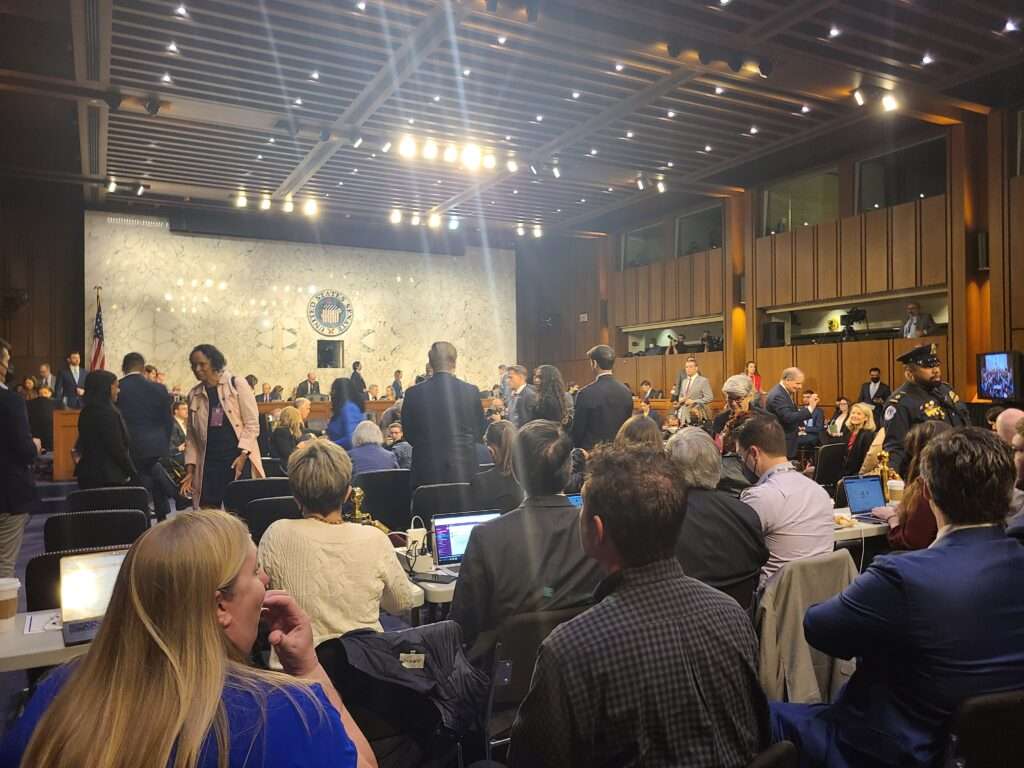
Today I attended Judge Jackson's confirmation hearing for about thirty minutes in the morning, and for about an hour in the afternoon. It was my first Supreme Court confirmation hearing. It's striking to think that in the span of a decade, between 1994 and 2005, we had zero Supreme Court confirmation hearings. And since 2016, we have had four Supreme Court confirmation hearings.

For those watching on TV, you may have noticed that the room was packed with spectators. What may not have been clear was that every attendee was either Senate staff, or a guest of a Senator. There was no general admission line. Tickets were handed out by Senate offices for thirty minute increments. And every thirty minutes, the attendees rotated out. The upshot of that policy is that every guest was screened, carefully. There was no potential for disruption like during the Kavanaugh hearings.

Under the Senate's COVID policy, members of the public can only enter the building if escorted by a Senate staffer. In the past, the public could enter a Senate building for any reason or no reason at all. I asked a Capitol Police Officer when that policy would be relaxed. He joked, and said never.

I was able to watch questioning from Senators Leahy, Cruz, Coons, Sasse, Blumenthal, Hawley, and Hirono. There were some fireworks during Cruz's time, which I'm not sure were fully captured on camera.

Photographs were prohibited during the hearing, but I was able to get a picture of Judge Jackson walking out during a break. She is in the blue dress.

Free Speech

"Cancel Culture … Is Inconsistent with the Philosophy of Open, Political Debate"

“[I]t undermines and stifles First Amendment privileges,” says a federal court, defining “cancel culture” as “the phenomenon of aggressively targeting individuals or groups, whose views aggressors deem unacceptable, in an effort to destroy them personally and/or professionally.”

|

In Wisconsin Family Action v. Federal Election Commission, decided yesterday by Judge William Griesbach (E.D. Wis.), the WFA—"a non-profit organization whose mission is to advance Judeo-Christian principles and values in Wisconsin by strengthening, preserving, and promoting marriage, family, life, and liberty"—sued to "enjoin the FEC from forcing WFA to disclose … any contributions other than those that are earmarked for specific independent expenditures expressly advocating the election or defeat of an identified candidate for Federal office." The Court began by generally discussing the First Amendment right of expressive association, which often includes anonymity:

Although the Court in Buckley v. Valeo (1976) held that the FECA disclosure requirements were facially valid and rejected a blanket exemption for minor parties and independents, it recognized that there could be cases in which forced disclosure of donor identities would violate the constitutional rights of supporters of unpopular causes. The Court acknowledged in its discussion of the burdens of disclosure on First Amendment rights that "it is undoubtedly true that public disclosure of contributions to candidates and political parties will deter some individuals who otherwise might contribute" and "[i]n some instances, disclosure may even expose contributors to harassment or retaliation." The Court explained that these burdens on individual rights are "not insignificant" and that "they must be weighed carefully against the interests which Congress has sought to promote." "Where it exists," the Court noted, "the type of chill and harassment identified in NAACP v. Alabama can be shown." The Court also noted its expectation that courts would be sensitive to similar showings in future cases.

WFA has offered, through the declaration of Julaine Appling, evidence of various instances of harassment of WFA's employees and its supporters. For example, for roughly two years after WFA supported a state constitutional amendment limiting the definition of marriage to a relationship between a man and a woman in 2006, Appling received a phone call at home every few months in the middle of the night that involved the use of "vulgar, foul language" and warned her that she was "not safe" because she was a "hateful, homophobic, Nazi bitch." In 2006, "serious death threats" were made against WFA's political advisor's family. In approximately 2013, Appling received a letter, postmarked from Wisconsin, that referenced issues supported by WFA and stated that the sender knew where Appling lived, that the sender lived close by, that later that month Appling would know they were there, and that Appling's life was in danger. Appling took the letter to the police, and the police considered the letter a "real threat" and ensured patrol cars were more visible and drove more frequently in her neighborhood for that month.

Read More

Supreme Court

Judge Ketanji Brown Jackson Says She Intends to Recuse from Harvard Admissions Case if Confirmed

While some legal ethics experts suggest recusal would not be necessary, the SCOTUS nominee suggested she thinks otherwise.

|

There has been some question as to whether Judge Ketanji Brown Jackson should recuse from Students for Fair Admissions v. Harvard College if confirmed to the Supreme Court. The case challenges Harvard University's use of race in admissions and will be heard by the Supreme Court next fall. I discussed the issue in a post earlier this month.

Earlier today, Judge Jackson told the Senate Judiciary Committee that she planned to recuse from the case if confirmed. When asked specifically whether she would recuse by Senator Ted Cruz, the nominee responded "That is my plan Senator."

As I noted in my prior post, Jackson's recusal may not affect the outcome of the case. Because Harvard prevailed below, the petitioners need five votes to prevail, and few expect a Justice Jackson would be inclined in their favor. Whether Jackson recuses or not, Harvard will need to attract the votes of at least two of the Court's six conservative justices to prevail.

Free Speech

Pseudonymity in Challenge to Denial of Religious Exemption from Military Vaccine Mandate?

|

I blogged yesterday about Chief Judge Beryl Howell (D.D.C.) saying "no" to this, but the issue is coming back with the same plaintiff to the District of Maryland (U.S. Army ROTC ECP Cadet Doe v. Biden, No. 1:22-cv-00691-RDB).

Plaintiff's lawyer tells me that he had tried to recall his D.D.C. filing (and filed in D. Md.) before receiving a decision on the pseudonymity question; "in the interim we decided we'd rather take it to the Fourth Circuit on appeal." (The Maryland connection is that plaintiff is a Maryland resident.) It will be interesting to see what Judge Richard Bennett (D. Md.) will decide here; I don't think he is bound by Chief Judge Howell's decision, but he certainly may consider it.

Privacy

Tennessee Statute Authorizing Wildlife Resource Agency Searches Facially Unconstitutional

So holds a Tennessee court.

|

From Rainwaters v. Tenn. Wildlife Resources Agency, decided yesterday by Chancellor Jerri Bryant, Judge Russell Parkes, and Chief Judge Donald Parish (Tenn. Cir. Ct.):

This matter concerns the constitutional challenge of Plaintiffs Terry Rainwaters and Hunter Hollingsworth to subsections 70-1-305(1) and (7) of the Tennessee Code Annotated and to the actions of Defendants Tennessee Wildlife Resources Agency ("TWRA") … taken pursuant to those statutory provisions.

Plaintiffs claim the challenged statute authorized the TWRA to establish a system whereby it sends its officers in unconstitutional, "roving patrols of private land" to enforce Tennessee hunting laws without regard for the property rights of individuals. Plaintiffs claim that under this system TWRA officers, as a matter of course, enter privately owned land to search for wildlife violations without a warrant or consent in violation of Article I, Section 7 of the Tennessee Constitution.

Plaintiffs claim TWRA officers hide and observe Plaintiffs and their guests on their own land, take pictures, and set up cameras to monitor Plaintiffs when the officers themselves are not present…. Defendants do not dispute the vast majority of these factual allegations, at least for purposes of these motions, but maintain their actions and the statutory provisions authorizing them are constitutional….

As written, the contested statute allows for the TWRA's executive director, a designated TWRA employee, or any "full-time wildlife enforcement personnel" employed by another state or the federal government to enter any property, except "buildings," in the performance of the executive director's duties. The protections of the Article I, Section 7, however, extend to all "property, real or personal, actually possessed or occupied" [but not including "wild or waste lands" -EV] …

Read More

Ukraine War Music

Bella Ciao / Ukrainian Fury (Furies)

|

A much less intimate song than the last one I posted, written for the war to the tune of the Italian "Bella Ciao" ("Beautiful, Goodbye"), which served in 1943-45 as an Italian song of resistance against the Nazis. It's sung and apparently written by prominent Ukrainian singer Khrystyna Soloviy in Ukrainian, but with English subtitles (somewhat loosely translated). Note that "Roosnia" ("Русня") appears be a derogatory term for Russians collectively, and Dnipro is the Ukrainian name for what is English usually called the Dnieper, which flows through the center of Ukraine (including Kiev):

And as a bookend, the Italian version with the original Italian words, but with Ukrainian army images, as you will see.

UPDATE: Commenter DonP writes, "Talented, attractive and good trigger discipline. What's not to like."

One Trade Secret to Rule Them All

|

From Physiotherapy Assocs., Inc. v. ATI Holdings, LLC, decided Friday by Judge Karon Owen Bowdre (M.D. Ala.):

"Keep it secret; keep it safe." The wizard Gandalf's brief command leaves little doubt as to the importance of the ring that he entrusts to the hobbit Frodo. Only determination and serious effort will keep an item of value secret. And over Frodo's hazardous journey, readers observe the bravery that he musters, the challenges he endures, and the feats that he achieves to keep the ring secret and keep it safe.

This lawsuit involves secrets of a corporate nature—client lists, financial data, and business expansion plans. But Alabama trade secrets law, like Gandalf's command, requires the holder of such information to keep it secret. Because Plaintiff Physiotherapy Associates did not safeguard its secrets, its trade secrets case now gets thrown into the volcano comes to its end.

A Cavalcade of Paranoia

It's episode 399 of the Cyberlaw Podcast

|

A special reminder for fans of the Cyberlaw Podcast that we will be doing episode 400 live in audio and video and with audience participation on March 28, 2022 at noon Eastern daylight time. So, mark your calendar and when the time comes, use this link to join the audience:

https://riverside.fm/studio/the-cyberlaw-podcast-400

See you there!

There's nothing like a serious shooting war to bring out the paranoia and mistrust, and the Russian invasion of Ukraine is generating mistrust on all sides.

Everyone expected a much more damaging cyberattack from the Russians, and no one knows why it hasn't happened yet. Dave Aitel walks us through some possibilities. Cyberattacks take planning, and Russia's planners may have believed they wouldn't need to use large-scale cyberattacks—apart from what appears to be a pretty impressive bricking of the Viasat terminals used extensively by Ukrainian forces. Now that the Russians could use some additional cyber weapons in Ukraine, the pace of the war may be making it hard to build and deploy them. None of that is much comfort to the Western countries that have imposed sanctions, since their infrastructure makes a nice fat sitting-duck target, and may draw fire soon if American intelligence warnings prove true.

Meanwhile, Matthew Heiman reports, the effort to shore up cyber defenses is leading to a cavalcade of paranoia. Has the UK defense ministry banned the use of WhatsApp due to fears that it's been compromised by Russia? Maybe. But WhatsApp has long had known security limitations that might justify downgrading its use on the battlefield. Speaking of ambiguity and mistrust, Telegram use is booming in Russia, Dave Aitel says, either because the Russians know how to control it or because they can't.  Take your pick.

Speaking of mistrust, the German security agency has suddenly discovered that it can't trust Kaspersky products.  Good luck finding them, Dave offers, since many have been white-labeled into other companies' software. He has limited sympathy for the agency, which resolutely ignored U.S. warnings about Kaspersky for years.

Even when governments aren't subverting software, the war is producing products that can't be trusted. One open-source maintainer of a popular open-source tool turned it into a data wiper for anyone whose computer looks Belarussian or Russian. What could possibly go wrong with that plan?

Meanwhile, people who've advocated tougher cybersecurity regulation are doing a victory lap in the press about how it will bolster our defenses.  It'll help, I argue, but only some, and at a cost of new failures. The best example is TSA's effort to regulate pipeline cybersecurity, which has long struggled to find its feet while being critiqued by an industry that has been hostile to the whole effort from the start.

The most interesting impact of the war is in China. Jordan Schneider explores how China and Chinese companies are responding to sanctions on Russia. Jordan argues that Chinese companies will follow their economic interests and adhere to sanctions – at least where it's clear they're being watched – despite online hostility to sanctions among Chinese digerati.

Matthew and I think more attention needs to be paid to Chinese government efforts to police and intimidate overseas Chinese, including Chinese Americans, in the United States. The Justice Department for one is paying attention; it has arrested several alleged Chinese government agents engaged in such efforts.

Jordan unpacks China's new guidance on AI algorithms. I offer grudging respect to the breadth and value of the  topics covered by China's AI regulatory endeavors.

Dave and I are disappointed by a surprise package in the FY 22 omnibus appropriations act. Buried on page 2334 is an entire smorgasbord of regulation for intelligence agency employees who go looking for jobs after leaving the intelligence community.  This version is better than the original draft, but mainly for the intelligence agencies; intelligence professionals seem to have been left out in the cold when revisions were proposed.

Matthew does an update on the peanut butter sandwich spies who tried to sell nuclear sub secrets to a foreign power that the Justice Department did not name at the time of their arrest. Now that country has been revealed. It's Brazil, apparently chosen because the spies couldn't bring themselves to help an actual enemy of their country.

And finally, I float my own proposal for the nerdiest possible sanctions on Putin. He's a big fan of the old Soviet empire, so it would be fitting to finally wipe out the last traces of the Soviet Union on the internet, where the .su country code has lingered for thirty years too long in the Internet domain system.  Check WIRED magazine for my upcoming op-ed on the topic.

Download the 399th Episode (mp3)

You can subscribe to The Cyberlaw Podcast using iTunes, Google Play, Spotify, Pocket Casts, or our RSS feed. As always, The Cyberlaw Podcast is open to feedback. Be sure to engage with @stewartbaker on Twitter. Send your questions, comments, and suggestions for topics or interviewees to CyberlawPodcast@steptoe.com. Remember: If your suggested guest appears on the show, we will send you a highly coveted Cyberlaw Podcast mug!

The views expressed in this podcast are those of the speakers and do not reflect the opinions of their institutions, clients, friends, families, or pets.


Free Speech

No Pseudonymity in Challenge to Denial of Religious Exemption from Military Vaccine Mandate

|

From U.S. Army ROTC ECP Cadet Doe v. Biden, decided yesterday by Chief Judge Beryl Howell (D.D.C.) (contrary to decisions in M.D. Fla., N.D. Ill. and D. Colo., but consistently with this nonprecedential Seventh Circuit order):

Plaintiff, "a nineteen-year-old male ROTC Early Commissioning Program (ECP) candidate" who is "currently a drilling member of the Army National Guard," has moved to proceed under pseudonym in the instant action challenging defendants' vaccination policies and their interference with his "fundamental right to the free exercise of religion." For the reasons set forth below, plaintiff's motion is denied, subject to any further consideration by the United States District Judge to whom this case is randomly assigned….

Despite the presumption in favor of disclosure [of party names], … [c]ourts …, in special [and rare] circumstances, may permit a party to proceed anonymously. A party seeking to do so, however, "bears the weighty burden of both demonstrating a concrete need for such secrecy, and identifying the consequences that would likely befall it if forced to proceed in its own name." Once that showing has been made, "the court must then 'balance the litigant's legitimate interest in anonymity against countervailing interests in full disclosure.'" …

At this early stage of the litigation, plaintiff has not persuasively met the burden of showing that the legitimate privacy interests he holds outweigh the public's presumptive interest in knowing the details of this litigation. Plaintiff has articulated no privacy interest sufficient to rebut the presumption in favor of open proceedings….

[1.] Plaintiff argues that pseudonymity is justified because his "sincere religious beliefs" and "medical decisions and past infections" are "personal intimate information justifying anonymity." Plaintiff asserts, in conclusory fashion, that "[d]ecisions regarding vaccinations, illness and treatment … are just like decisions regarding birth control," which other circuits have cited as grounds to allow a plaintiff to proceed under pseudonym.

Read More

Free Speech

Illinois Town "Issue[s] 62 Tickets to an Elderly Couple for Having Lawn Chairs in Their Front Yard"

Based on the allegations of the complaint, "[i]f this case were a Monell crime scene, [Melrose Park Village Mayor Ronald Serpico] left his fingerprints, footprints, and DNA all over the place.

|

From Cozzi v. Village of Melrose Park, decided yesterday by Judge Steven Seeger (N.D. Ill.):

The Village of Melrose Park decided that it would be a good idea to issue 62 tickets to an elderly couple for having lawn chairs in their front yard. The Village issued ticket after ticket, imposing fine after fine, to two eighty-year-old residents, Plaintiffs Vincent and Angeline Cozzi.

The fines were not small potatoes. Each ticket cost $500, so the Village tagged them with fines totaling about $30,000. And when it was all said and done, the Village slapped them with a lien on their house, for good measure.

The tickets faulted the Cozzis for creating a nuisance and for "unsanitary conditions." The tickets did not explain what was unsanitary about the plastic lawn chairs. But the Village claimed that they were receiving anonymous calls about "clutter" on their front lawn.

The Cozzis, for their part, didn't view their lawn furniture as wasteful clutter. In fact, they regularly used the furniture to sit outside, and visit with loved ones in a socially distanced manner during the pandemic. The fresh air and companionship apparently cost them $30,000.

A reader might be wondering how things could have gone so dramatically off the rails. The Village of Melrose Park, it seems, reacted poorly when Plaintiff Michael Cozzi (the adult son of Vincent and Angeline) complained about the first two tickets, and about the mistreatment of his parents more generally. Michael Cozzi attended public meetings in Melrose Park, and he expressed his concerns on social media about the Village harassing his elderly parents.

That free expression led to an avalanche of tickets. The Village issued the Cozzis a $500 ticket nearly every business day from December 3, 2020 to March 3, 2021. Christmas Eve was no exception. The tickets would financially cripple the Cozzis, an elderly couple on a fixed income.

Read More

Free Speech

"Project Veritas Says Feds Secretly Accessed Its Emails"

UPDATE 3/24/2022: Added link to government's response.

|

From Politico (Josh Gerstein):

In November, the FBI conducted predawn raids at the home of Project Veritas founder James O'Keefe and the homes of two other individuals who worked with the group. The agents acted with warrants that allowed them to seize phones and computers to search for evidence of trafficking in interstate property [apparently related to an investigation into the alleged theft of Ashley Biden's diary -EV].

The raids generated controversy in some circles because Project Veritas identifies itself as a news organization and the use of search warrants against journalists and news outlets is extremely rare due to Justice Department policies and a federal law passed in 1980 to limit such investigative steps.

After the raids, U.S. District Court Judge Analisa Torres agreed to a request by the group to put in place a special master to review the information on the seized devices to ensure that prosecutors did not get access to emails, text messages and other records that might be subject to attorney-client privilege or other legal protections.

However, in a letter Tuesday to a federal judge overseeing aspects of the probe, Project Veritas' attorneys said they recently learned that that for nearly a year before last November's raids prosecutors used gag orders to keep quiet other steps taken in the diary probe, including grand jury subpoenas and court-ordered seizures of all of the emails O'Keefe and several colleagues kept in particular accounts over a three-month span in 2020.

The ACLU, while saying it "deplore[s] Project Veritas' deceptions," and noting that the details of the government investigation aren't fully available, adds:

[W]e're concerned that the precedent set by this case could have serious consequences for press freedom. We're deeply troubled by reports that the Department of Justice obtained secret electronic surveillance orders requiring sweeping disclosure of "all content" of communications associated with Project Veritas email accounts, including attorney-client communications.

Compounding these concerns, the government suppressed information about the existence of the electronic surveillance orders even after the investigation became public knowledge and the district court appointed a special master to supervise prosecutors' access to Project Veritas' sensitive materials. The government must immediately suspend its review of the materials obtained pursuant to its electronic surveillance orders and fully disclose the extent of its actions, so that the court can consider appropriate relief.

You can see many of the filings in the case here.

UPDATE 3/24/2022: The government responds in this filing; an excerpt:

Despite the motion's bluster, the Movants cite no legal authority to justify the relief they seek, because there is none, and the accusations of Government misconduct are baseless. Put simply, the Government did not mislead the Court, and the subjects of a grand jury investigation are not entitled to information about that investigation or to dictate how the Government should conduct that investigation during its pendency. Instead, the Movants can raise these issues if there is an indictment filed charging them in connection with the investigation, or they can seek civil relief if they believe they have a claim of a constitutional or statutory violation that provides for individual rights of action against the Government. The Government does not respond to each and every accusation in the Movants' letter both because now is not the juncture to litigate these issues and because doing so would impair the integrity of the ongoing grand jury investigation. For the following reasons, the motion should be denied….

Free Speech

Sanctions for Libel Defendant's Obstructionism (Perhaps Connected to Continuing Libel)

|

From Judge William Session III in Ha v. Conn (D. Vt.):

[Defendant] Ms. Conn's attorney withdrew from the case several months ago {stating that his relationship with his client had "irrevocably broken down"}. The Court subsequently ordered Ms. Conn [on November 5, 2021] to appear with replacement counsel, or enter her own appearance pro se (representing herself), within 30 days. That deadline passed in December 2021, and Ms. Conn has failed to comply. Plaintiffs now contend that the litigation is stalled, and that Ms. Conn's ongoing tortious conduct continues to cause them harm. Plaintiffs therefore move for monetary sanctions to compel Ms. Conn's compliance with the Court's order….

Plaintiffs bring this action claiming that Ms. Conn has defamed them by publicly accusing them of "criminal offenses involving moral turpitude." Ms. Conn has also allegedly posted intimidating and harassing videos "motivated by ethnic, racial, religious and gender animosity." This conduct is reportedly ongoing. For relief, Plaintiffs seek compensatory damages, punitive damages, injunctive relief and attorney's fees….

The Court previously dismissed Ms. Conn's counterclaims as a sanction for [her] failure [to comply with the order to enter an appearance]. Plaintiffs now request daily monetary sanctions, payable to the Court, until Ms. Conn complies with [that] order. Plaintiffs also request attorney's fees incurred in connection with their motion….

Read More

Ukraine War Music

Songs of the War

|

I haven't generally been blogging the news of the war in Ukraine, nor any analysis: I have no real knowledge of the subject, and others can do much more, and much better. But I have been trying to blog about songs related to the war, mostly ones written in the last month but also some from the first war, in 2014 (Crimea/Donbass), plus some performances of older songs on occasion of this war. This is not because I think songs are more important than political, military, or economic analysis; it's just that this is one thing that I thought I could contribute.

Those who know me know I'm not a particularly aesthetically minded man, or one who cares much for the arts. But poetry, especially in the form of songwriting, has always spoken to me, and I have felt that reading a poem might give one a sense of people's feelings that prose does not. (Of course, prose has the same property with respect to poetry, and on most subjects to a much larger degree ….) To offer a non-war-related example I mentioned before, I think Sons of Martha conveys something to us about the soul of infrastructure engineers that a description or an interview or even a novel likely will not.

One problem, of course, is that rhymed and metered poetry derives so much of its impact from its rhyme and meter, which a translation generally cannot effectively reproduce (except in the hands of an extraordinarily talented translator, such as James Falen). Worse than that: The words in a translated poem will often come across not just as less effective but as outright inapt, precisely because what made the poet choose them for the original—their sound—is lost in translation. I don't know Ukrainian, but at least I can understand enough of the words that, armed with a translation (preferably a translation into Russian) I think I can experience the poem as an effective poem. I can't expect our English readers to get the same effect.

Still, at least I hope that some can appreciate them, and if one of you does happen to be a gifted translator, I'd love to see your interpretations. And if you have Russian-speaking friends who you think would appreciate the originals (or, in some instances, Ukrainian-speaking friends), please do pass them along.

(Note that, for many of the translations, I take the shortcut of adapting other translations I find online, of course giving credit where the translator is noted. But I do confirm them against my own sense of the words, and generally modify them where I think that's needed.)

In any event, you can find all the items (current and future) under the Ukraine-War-Music tag. Here is what I have so far; I particularly recommend, especially to Russian speakers, the top one below ("Will this letter some day arrive / To Kiev from Moscow? / Will the brother's letter reach his brother / Or at least his widow?"):

More