From today's opinion in Blattert v. State, decided by the Indiana Court of Appeals (Judge Derek Molter, joined by Judges Patricia Riley & Margret Robb):
The State of Indiana charged Scott A. Blattert, Jr. with aggravated battery (Level 3 felony), strangulation (Level 6 felony), five counts of domestic battery resulting in bodily injury to a person less than fourteen years of age (Level 5 felony), and three counts of domestic battery resulting in moderate bodily injury (Level 6 felony). The charges were based on the allegation that Blattert repeatedly punished his children by beating and strangling them. He claims a defense under Indiana's Religious Freedom Restoration Act ("RFRA"), which provides a defense to criminal prosecutions that substantially burden religious exercise unless the State shows the prosecutions are the least restrictive means of furthering a compelling governmental interest….
Blattert contends he satisfied his prima facie burden [under RFRA] by testifying he belongs to the Ellettsville Church of Christ; that his church relies on biblical teachings for religious instruction on how to live one's life; that he must follow God's commands as conveyed through the Bible; and that those commands include physically punishing his children as he sees fit. He argues the conduct the State alleges—punching his children in the face, striking their heads with his elbow, and choking them—all falls within the authority God commands him to exercise, and by prosecuting him the State is burdening his sincerely held religious beliefs. Because we can decide this case on other grounds, we assume, without deciding, that Blattert's testimony satisfies his prima facie burden to establish the State is substantially burdening his religious exercise….
The burden then shifts to the State to show this prosecution is the least restrictive means to further a compelling interest. Blattert contends these are questions for the jury to decide, but he is mistaken. Whether the State's interest is sufficiently compelling and whether the State has chosen the least restrictive means to further that interest are purely legal issues for the court to decide.…
From N.J. v. Sonnabend, decided today by the Seventh Circuit (Judge Diane Sykes, joined by Judges Kenneth Ripple and Amy St. Eve):
The plaintiffs are two teenagers who attend Wisconsin public schools. Both are gun enthusiasts and supporters of the Second Amendment. To express that support, they own and wear T-shirts that communicate their favorable opinion of the right to bear arms. When they wore those shirts to school, however, they got into trouble with school officials.
In February 2020 when plaintiff N.J. was in seventh grade at Shattuck Middle School in Neenah, he went to school wearing a T-shirt displaying a Smith & Wesson logo. The logo included an image of a revolver. Around the same time, A.L., a student at Kettle Moraine High School in Wales, went to school wearing a T-shirt bearing the logo of Wisconsin Carry, Inc., a gun-rights group. This logo too incorporated an image of a handgun.
Administrators at both schools barred the boys from wearing the shirts, explaining that any clothing depicting firearms is forbidden. Neither school's dress code expressly bans clothing with images of firearms. Rather, the dress codes prohibit "inappropriate" attire, which the administrators interpreted to bar any clothing with an image of a firearm regardless of whether it conveys support for or opposition to gun rights….
The students argued that their T-shirts weren't disruptive and thus couldn't be restricted, given Tinker v. Des Moines Indep. School. Dist. (1969), but the district court held that Tinker didn't apply to viewpoint-neutral speech restrictions, citing Muller v. Jefferson Lighthouse School (7th Cir. 1996). But on appeal the Seventh Circuit reversed, overruling Muller in relevant part:
A compendium of my writings defending the morality and legality of this program - but also warning that it remains imperiled unless and until Congress passes a law institutionalizing it.
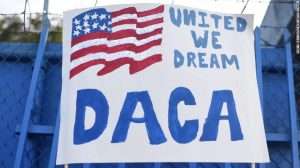
Today is the tenth anniversary of Deferred Action for Childhood Arrivals (DACA), a policy originally established by President Obama to protect children who were brought into the United States illegally. DACA allows such migrants (often referred to as "dreamers," after the Dream Act, which has so far failed to pass Congress) to stay and work in the U.S. as long as they arrived in the country when they were 15 years old or younger, were 30 or younger when the program began in 2012, have not been convicted of any crimes as of the time they apply for the program, and have either graduated from a U.S. high school, are currently enrolled in school, or have served in the armed forces. All told, the policy protects some 800,000 people from deportation.
I have been writing about this program from early on, and have consistently defended its morality and legality. But I have also warned that the "dreamers" won't be truly safe from deportation unless and until Congress passes a law institutionalizing the program. Until then, a hostile president can - if he tries hard enough - find a way to end DACA. The Supreme Court's 2020 decision invalidating the Trump administration's hamfisted efforts to abolish the policy made clear that a better-planned executive effort to get rid of it would likely succeed. It is also possible, though less likely, that lawsuit filed by GOP-controlled states will eventually lead the more conservative Supreme Court to rule that DACA is illegal. The 2020 decision didn't address the legality of the program itself, only whether Trump's attempts to end it violated the Administrative Procedure Act.
For those interested, here is a compendium of my writings on DACA and related issues. Unless otherwise indicated, all of these works are posts at the Volokh Conspiracy blog:
Even if the value of their property goes down, current homeowners still often have much to gain from breaking down barriers to new housing construction.
But zoning reform is often stymied by fears that it is inimical to the interests of current homeowners. They worry that allowing more housing construction in the area will diminish the value of their current homes, and also enable the construction of new buildings they object to on esthetic grounds. Thus, we get the classic conflict between "NIMBYs" (many of them current homeowners) opposed to new construction, and "YIMBYs" who favor it because it would benefit people who are currently shut out of various neighborhoods. This framing has some validity. But it overlooks key ways in which zoning deregulation can actually benefit existing homeowners.
Classic NIMBY concerns are not without some basis. If deregulation allows extensive new housing construction in a given area, that is likely to lower housing costs, and in the process also lower the price of existing houses. Such price reductions are actually a feature, not a bug! Making housing cheaper is one of the main reasons why advocates of zoning reform support it in the first place. There are some situations where deregulation can increase housing construction and lower prices, while simultaneously maintaining or even increasing the value of land occupied by already existing homes. But, if we YIMBYs get our way, there are likely to be many places where the price of existing homes does indeed go down.
Deregulation will also sometimes result in construction that current residents dislike for esthetic reasons. If you hate the sight of duplexes, eliminating single-family zoning in your area is likely to ensure you see more of them. The good people of Santa Fe might no longer be able to prevent George R.R. Martin from building a castle there, perhaps even one complete with "Jon Snow and a couple of dragons." Personally, I would love to have a castle in my neighborhood! But your tastes might well differ. Finally, some people object to an influx of new residents who differ from them on race, ethnicity, or socioeconomic class. Such preferences have declined over time. But they haven't completely disappeared.
But these possible downsides of YIMBYism for current homeowners are counterbalanced by enormous potential benefits, which are often ignored in public debates over the issue. There is widespread cross-ideological agreement among experts that zoning deregulation would greatly increase growth and economic productivity, because large numbers of people would move to places where they can be more productive. New evidence suggests that reducing zoning could increase US GDP by as much as 36% over time. That extra productivity would disproportionately benefit the poor and disadvantaged who get to move to areas from which they are now excluded. But such enormous increases in growth and production would also provide large benefits to current homeowners, as well.
The latter would get cheaper, higher quality, and more innovative goods and services in a wide range of areas. A rising tide this large may not quite lift all boats. But it would lift a great many, including large numbers of current homeowners.
The economic benefits here aren't limited merely to incremental improvements in the price and quality of currently available goods and services. They also involve increased innovations leading to entirely new products. People newly empowered to migrate to opportunity could engage in scientific and entrepreneurial innovation that would have been impossible in their previous locations.
I have previously highlighted this point when it comes to international migration. For example, the developers of the first two successful Covid vaccines were immigrants or children of immigrants from poor nations, who could not have made their vital contributions to these life-saving innovations, if they or their parents had been confined to their countries of origin.
The same point applies to domestic migration. A child born in a dysfunctional inner city neighborhood or a declining community in Appalachia is far more likely to grow up to be a great scientist or entrepreneur if his or her family is able to move to a place with greater opportunities. As with international migrants, only a very small percentage of internal foot voters will become great innovators. But that small percentage can still generate enormous progress, that benefits current homeowners, as well as everyone else. The kid whose family moves into the duplex next door - made possible by zoning reform - might grow up to cure a disease that would otherwise have put you in an early grave!
Housing deregulation can enable many millions of people to move to opportunity. Even if only a tiny fraction of them (say 1 in 50,000), go on to make major entrepreneurial or scientific innovations, that's still an enormous amount of innovation in the aggregate. And current homeowners will reap the benefits, along with everyone else.
Economist Bryan Caplan points out several other ways in which current homeowners can benefit from housing deregulation, even if the price of their current homes goes down:
1. Homeowners who own little or no equity could walk away from their small, expensive home in favor of a larger, cheaper home.
2. Homeowners who eventually planned to move to a larger, more expensive home could easily find that their losses on their old home are smaller than their savings on their new home. And they wouldn't have to wait as many years to upgrade.
3. The grown children of settled homeowners could much more easily afford to live near their parents – and wouldn't need so much help for a down payment.
4. Yes, higher local population means more congestion. Yet it also means better shopping, entertainment and employment opportunities. What's the net value of all the good effects of more people bundled with all the bad effects of more people? The very fact that prices are much higher in densely-population areas strongly suggests that the net value is highly positive. "New York would be great without all the people" is sadly naive, because without all the people, New York would no longer be great.
5. If you're willing to move, improve, or subdivide, deregulation allows even established owners with lots of equity to readily profit. If you suddenly gain the right to legally subdivide your lot into three homesites, a 50% fall in the value of the home you own is a fair price to pay. The same goes if you can now build up. Replace your home with a 10-story apartment and pocket the difference. Cha-ching.
The point about children is worth expanding on. Many homeowners have children, and care about their interests at least as much as they do their own. My wife and I live in expensive Arlington, Virginia, which we can afford to do because I am a law professor and she is a lawyer, thereby putting our household income in the top 5% of US the income distribution, or so. But we would like our kids (ages 6 and 4) to be able to live in a similar location even if they choose less lucrative professions.
My 6-year-old daughter says she wants to be "a lawyer like Mommy," because "that's the most important job in the world." Still, I want her to be able to live in a place like Arlington even if her career plans change. I suspect many other homeowning parents have similar aspirations.
Of course, we can potentially provide for our kids by leaving them a huge inheritance when we pass away. The more zoning restrictions inflate the value of our house, the bigger the inheritance will be! But I, for one, hope to live for many more years, and I don't want the kids to have to wait that long before they can afford to live in this area and others like it. We could instead sell the house when the kids grow up, move to a much smaller one, and give the kids the profit earned from the sale. But that option, too, has obvious downsides. Ditto for putting a second or third mortgage on your expensive house, and then letting the kids use the money.
All in all, I'd much rather that my kids benefit from a decline in housing costs, even if that means a reduction in the value of my own house. Not all parents will feel the same way. But I suspect a great many do.
None of the above proves that all current homeowners stand to benefit from zoning reform. If you're a homeowner who doesn't have kids (or doesn't care about their housing costs), doesn't care much about economic growth and scientific progress, and have a very strong desire to ensure that the "character" of your neighborhood never changes, the points made here are unlikely to wean you away from NIMBYism. But these considerations do show that a great many owners would be net beneficiaries of housing deregulation - even if the value of their property goes down, as a result.
That point is worth emphasizing. As Matt Yglesias points out, survey data suggests that the economic growth argument for zoning reform has broader appeal than traditional arguments emphasizing racial justice and gains for minority movers. YIMBY policies can create huge benefits even for the kinds of people most likely to be NIMBYs.
From the Institute's site, which includes the relevant details:
The Institute for Free Speech is hiring a Senior Attorney with a minimum of seven years of experience. The location for this position is either at our Washington, D.C. office or remotely anywhere in the United States.
Founded in 2005 by former Federal Election Commission Chairman Bradley A. Smith, the nonpartisan Institute for Free Speech promotes and defends First Amendment rights to freely speak, assemble, publish, and petition the government….
This is a rare opportunity to work with a growing team to litigate a long-term legal strategy directed toward the protection of Constitutional rights. We challenge laws, practices, and policies that infringe upon First Amendment freedoms, such as speech codes that censor parents at school board meetings, laws restricting people's ability to give and receive campaign contributions, and any intrusion into people's private political associations. You would work to hold censors accountable; and to secure legal precedents clearing away a thicket of laws, regulations, and practices that suppress speech about government and candidates for political office, threaten citizens' privacy if they speak or join groups, and impose heavy burdens on political activity….
Today, the Supreme Court decided American Health Association v. Becerra, unanimously rejecting reimbursement rates for certain prescription drugs set by the Department of Health and Human Services in 2018 and 2019 as contrary to statute. AHA was a closely watched case because some saw as it as an opportunity for the Court to revisit, and potentially narrow or even overturn, the Chevron doctrine, under which courts are to defer to agency interpretations of ambiguous statutory provisions. Yet the Court ultimately resolved the case without citing Chevron at all -- and this should send a message to lower courts about how Chevron should be applied.
In AHA the Court had accepted certiorari on two questions:
Whether Chevron deference permits HHS to set reimbursement rates based on acquisition cost and vary such rates by hospital group if it has not collected adequate hospital acquisition cost survey data.
Whether petitioners' suit challenging HHS's adjustments is precluded by 42 U. S. C. §1395l(t).
In an unanimous opinion by Justice Kavanaugh, the Court answered both questions in the negative -- the suit challenging the reimbursement rates was not precluded, and HHS may not vary reimbursement rates by hospital group without having first collected survey data -- but never once mentioned Chevron. What happened? The Court actually applied Chevron rigorously.
The Chevron doctrine has two steps. First, always, is to examine the relevant statutory text to see whether the statute is clear, and answers the question issue. If the statute is clear, the statute controls. If, however, the statute is ambiguous on the question at issue (here, whether HHS may vary reimbursement rates by hospital group in the absence of survey data), courts are to defer to a reasonable agency interpretation of the statutory language. As articulated by the Court, these are separate steps, and an agency's interpretation of the statue is only relevant if the Court first concludes that the statutory text is ambiguous on the question at hand. Further, as the Court has emphasized in recent opinions (and Justice Kennedy stressed in one of his final opinions on the Court), this initial inquiry should be a serious one, in which courts are to apply all the traditional tools of statutory interpretation to see whether Congress has answered the issue.
In AHA, the Court never had cause to consider whether HHS had offered a reasonable interpretation of the relevant statutory language because it resolved the case at step one, simply by interpreting the statutory text. As Justice Kavanaugh concluded his opinion:
after employing the traditional tools of statutory interpretation, we do not agree with HHS's interpretation of the statute. We conclude that, absent a survey of hospitals' acquisition costs, HHS may not vary the reimbursement rates for 340B hospitals. HHS's 2018 and 2019 reimbursement rates for 340B hospitals were therefore contrary to the statute and unlawful.
No deference was due to the agency because there was no ambiguity in the statute -- and because there was no ambiguity, there was no reason to even raise the question of Chevron deference. Rather, the Court could just apply the statute as written. In other words, what was styled as a Chevron case was really a straightforward statutory interpretation case.
Justice Kavanaugh's approach to Chevron in AHA stands in marked contrast to how the case was handled below. Chief Judge Srinivasan of the U.S. Court of Appeals for the D.C. Circuit wrote the majority opinion below. His approach to Chevron was quite different. Chief Judge Srinivasan wrote:
On that issue of statutory interpretation, HHS is entitled to Chevron deference, which it has invoked here . . .
Under Chevron, we first ask whether "Congress has directly spoken to the precise question at issue." Chevron, 467 U.S. at 842. Here, the "precise question at issue" is whether HHS's adjustment authority in subclause (II) encompasses a reduction to SCOD reimbursement rates aimed at bringing reimbursements to 340B hospitals into line with their actual costs to acquire the drugs. If the statute does not directly foreclose HHS's understanding, we defer to the agency's reasonable interpretation. See id. at 844. We conclude that HHS's interpretation of subclause (II) is not directly foreclosed and is reasonable.
Although repeating the canonical Chevron formulation, Chief Judge Srinivasan did not first focus on whether the statutory language provided a clear answer to the question of whether HHS could vary reimbursement rates. Rather, he asked whether the statute "directly forcelose[d] HHS's understanding," and finding no such direct prohibition on HHS's preferred approach, deferred to the agency.
The difference between how the D.C. Circuit and Supreme Court handled Chevron is subtle, but important. How the Chevron inquiry is framed -- and how one orders and conceives the steps -- can affect the outcome. Given the complexity of regulatory statutes, if a court adopts the view that any reasonable agency interpretation that is not "directly foreclosed" by the statute will be upheld, the dice are loaded in the agency's favor. If, on the other hand, the Court first looks directly at the statute, and utilizes all of the traditional tools of statutory interpretation to determine whether the statute answers the question, agencies will prevail less often, as they will never get the opportunity to present their position as a "reasonable" interpretation of the statute.
Another problem with the D.C. Circuit opinion, in my view, is it adopted an improper baseline for evaluating agency authority. Rather than looking to see whether the statute authorized HHS to vary reimbursement rates, it looked to see whether the statute expressly barred HHS opting to vary reimbursement rates by hospital group without the benefit of survey data.
Because litigation will often involve questions that may not have been anticipated by a statute's drafters, here again we see how where one starts the inquiry may determine the outcome. In the absence of any explicit language saying HHS may or may not vary reimbursement rates in the absence of survey data, whichever question is posed -- did Congress authorize or did Congress prohibit -- will be answered in the negative. So the question posed determines the answer.
Just as Justice Kavanaugh was correct to set HHS's interpretation aside and first interpret the relevant statutory text, Justice Kavanaugh was also correct to recognize that what he was looking for was statutory language authorizing HHS's approach (rather than language precluding HHS's approach). After all, federal administrative agencies only have that authority delegated to them by statutes, and the failure to delegate authority is just that: A failure to delegate authority. Accordingly, Justice Kavanaugh wrote:
Regardless of the scope of HHS's authority to "adjust" the average price up or down under the statute, the statute does not grant HHS authority to vary the reimbursement rates by hospital group unless HHS has conducted the required survey of hospitals' acquisition costs. Under the statute, varying a rate by hospital group is not a lesser included power of adjusting price. Otherwise stated, HHS's power to increase or decrease the price is distinct from its power to set different rates for different groups of hospitals.
Given that AHA never mentions Chevron, some may not think of it as a meaningful Chevron case. That interpretation is plausible, but for the reasons above I think that would be a mistake. Rather, AHA reinforces a message that the Court has been giving for several years now: The first task of a reviewing Court is to focus on the statutory language and follow Congress's instructions. If, after applying all the traditional tools of statutory interpretation, there is a residual ambiguity on the precise question at issue -- and only if there is such residual ambiguity -- then the Court may consider the reasonableness of the agency's views. Lower courts do not always do this. AHA is a reminder that they should.
Today the Supreme Court decided Viking River Cruises v. Moriana, yet another Federal Arbitration Act (FAA) case. The justices split 8-1 on the judgment, concluding that the FAA "preempts a rule of California law that invalidates contractual waivers of the right to assert representative claims under California's Labor Code Private Attorneys General Act of 2004."
Justice Alito wrote the opinion for the Court, but there was some splintering on the rationale. Justices Breyer, Sotomayor, Kagan, and Gorsuch joined Alito's opinion in full. The Chief Justice and Justices Kavanaugh and Barrett joined it in part. Justice Sotomayor wrote a concurring opinion, and Justice Barrett wrote an opinion concurring in part and concurring in the judgment. Justice Thomas dissented.
Justice Kavanaugh joined Justice Barrett's separate opinion in full. the Chief Justice joined the opinion in part. In fact, he joined all of Justice Barrett's opinion except for a short (seven word) footnote. What could be in that footnote to which the Chief objected? Well, below is Justice Barrett's one paragraph opinion and the offending footnote.
Today the Supreme Court dismissed as improvidently granted (a.k.a. DIGged) Arizona v. City and County of SanFrancisco. This case concerned challenges to the Trump Administration's "public charge" rule, which limited immigrant eligibility to certain social welfare programs.
The precise question presented was whether states (or others) could intervene to defend a rule from the prior Administration when the new Administration decides not to. This is an important question, but the Court apparently decided this case was not a good vehicle in which to decide it.
DIGs are not usually explained, but in this case, the Chief Justice authored a short concurrence, joined by Justices Thomas, Alito and Gorsuch. It's reproduced below.
In any sentence with multiple subjects, I avoid using pronouns. If two people are referenced, and I use "he," there is no way of know which person is being referenced. Even worse is the word "it" or "its." If a sentence has multiple nouns, there is no way to know which noun is being referenced.
In this case, Texas contends that Congress expressly ordained that all of its gaming laws should be treated as surrogate federal law enforceable on the Ysletadel Sur Pueblo Reservation. In the end, however, we find no evidence Congress endowed state law with anything like the power Texas claims.
Does "its" refer to the laws of Texas or the laws of Congress? Who knows? The next sentence does not answer that question. Rule of thumb: try very hard to avoid using the word "its" in sentences with multiple subjects.
The first Supreme Court opinion released this morning was George v. McDonough, a concerning the retroactive effect of decisions invalidating Department of Veterans' Affairs regulations. Writing for the Court, Justice Barrett concluded that the subsequent invalidation of such a regulation after a veteran's benefits decision becomes final cannot support a claim for collateral relief based on clear and unmistakable error. In other words, the fact that a regulation is subsequently invalidated does not enable a veteran to challenge a prior benefit decision based upon that regulation.
Justice Barrett's opinion was joined by the Chief Justice and Justices Thomas, ALito, Kagan and Kavanaugh. Justice Sotomayor dissented alone, and Justice Gorsuch dissented, joined by Justice Breyer in full and Justice Sotomayor in part.
With today's opinion, Justice Gorsuch has dissented from four of Justice Barrett's six majority opinions this term -- a full two-thirds of the opinions by the Court's newest justice! (Justice Jackson does not join the Court until this summer.)
As I noted in my prior post, Justice Barrett and Justice Gorsuch also crossed swords last term. In that case (HollyFrontier). Justice Gorsuch wrote the majority and Justice Barrett wrote the dissent. This term, however, it's Justice Barrett who has had the upper hand, and it's been Justice Gorsuch on the dissenting side.
Post-Script: Lest anyone think there is some sort of bad blood between Justices Gorsuch and Barrett, also today Justice Barrett joined Justice Gorsuch's opinion in Ysleta del Sur Pueblo v. Texas, a 5-4 decision in which Justice Gorsuch wrote for the Court, joined by Barrett, Breyer, Sotomayor and Kagan. Chief Justice Roberts dissented, joined by Justices Thomas, Alito and Kavanaugh.
This is the third in a series of posts on my forthcoming article The Fair Notice Rationale for Qualified Immunity. Yesterday I explained why liability that is unpredictable from a defendant's standpoint is unfair: just like retroactive law, it deprives the defendant of the ability to plan, and treats her as a means to an end. That theory helps evaluate the fairness of constitutional liability, and, therefore, the fair notice rationale for the defense of qualified immunity.
My paper argues next that three aspects of constitutional liability make it—in general—more likely to be unpredictable or otherwise unfair than most other forms of civil liability. My argument is not that constitutional liability is the only form of liability that has one or more of these features, but that altogether they make constitutional liability sufficiently unique, as a class, to justify the availability of a defense in at least some cases.
First, constitutional liability is often uniquely unpredictable. Most of the constitutional provisions that form the basis of that liability are vague. Jurists disagree about interpretive methodology. And to the extent a provision requires judicial construction, jurists disagree about what norms or principles should guide it. In short, constitutional doctrine is subject, at least in principle, to more unpredictable changes than most civil liability. Courts interpret provisions for the first time, they apply a doctrine to the states for the first time, they announce a previously unannounced right. They apply doctrinal principles to practices or customs that are longstanding. They tweak doctrine to apply it to new factual contexts. And so on.
[a] Simply Following Precedent: A Legal Effect Slippery Slope.—One of the most common "A will lead to B" arguments is the argument that judicial decision A would "set a precedent" for decision B. This generally means that (1) A would rest on some justification J and (2) justification J would also justify B.
{Sometimes this sort of argument is made not to illustrate the practical risk that A may lead to B, but to use situation B as an illustration that the underlying theory of rule R is unsound. My discussion here, though, focuses primarily on the practical argument.}
Consider, for instance, the debate about whether the government should be allowed to ban racial, sexual, and religious epithets (beyond those that fit within the existing fighting words and threat exceptions). To uphold such a ban (decision A), the courts would have to give some general justification for why these words should be punishable, essentially creating a new exception to First Amendment protection.
If this justification J were that "epithets add little to rational political discourse and are thus 'low-value speech,' which may be punished," then courts could likewise use this J to uphold bans on flag burning, profanity, and sexually themed (but not obscene) speech, all examples of speech that some argue is of "low value" (result B). In fact, a lower court might feel bound to reach result B because of precedent A's acceptance of justification J. We might call this process a legal effect slippery slope, because B follows from A as an application of an existing legal rule (the obligation to follow precedent).
From James v. McGuinness, decided today by the Indiana Court of Appeals, in an opinion by Judge Edward Najam, joined by Chief Judge Cale Bradford and Judge Mark Bailey:
James was married to McGuiness' daughter, Nicole Smith, until 2008. During the marriage, James and Smith had two children, Luca and [Shae], both of whom are now adults. For the past fourteen years, James has been in a same-sex relationship….
Scott assert[s] that McGuiness had sent Shae a text message with the following statements: "I will accept your father has turned you into a monster like himself"; "He hates us because we are educated, normal, and respectable"; "We may not have his money but what we have we earned"; and "He wanted to use you as a tool to move to Miami which has a large homosexual population." In addition, James claimed that McGuiness had stated to Luca and other individuals that James was "trying to 'turn' Shae gay," that he was "trying to lure Shae to Florida to entice her into the gay lifestyle," that James "was disgusting," and that "being gay is disgusting." …
The court held that McGuinness's statements didn't qualify as defamation:
Every year, I teach a seminar called Recent Books on the Constitution. I initially designed this course when I visited Georgetown in 2005. Because I tend to read what relates directly to my current projects, I felt that I was not keeping up with the literature. By assigning recent books on the Constitution to read as part of my teaching, I would actually read them. This has really worked for me.
The complete list of all the books I have assigned is below. Since 2005, I have assigned 85 books by 79 authors, with Sandy Levinson, Gerard Magliocca, Eric Segall, Dan Farber, Philip Hamburger, and David Bernstein each making 2 appearances. Four books were assigned in manuscript before publication. This fall, I am assigning a portion of my book with Evan Bernick: The Original Meaning of the 14th Amendment: Its Letter and Spirit, plus these 5 books:
I choose books I think I ought to read--either because of the subject or the author. I then hold off reading them myself so I can read them at the same time as the students. This enables me to react to the books along with them, and for me to remember their nuances for class discussion.
The seminar format is to read 6 books, taking 2 weeks on each book, with the author coming to the class during the second week to discuss the book. The first book is now always one of mine to use as a trial run and to give the students an idea of where I am coming from when we discuss the other books. When books are longer than 250 pages, I ask the author to tell me which 250 pages I should assign. If I assign much more than 125 pages per week, I fear the students won't read them, or won't read them carefully enough. To help assure that they do, students submit one-page summaries of each half of the book (graded pass-fail). On the day before the author's visit, they submit a 5500 character critique of the book, which I send to the author electronically the day before class. (They all read them.) When the class ends, there is no exam or paper for the students to write or for me to grade. We are done!
Students consistently tell me that the course is extremely enriching, and helps them develop their critical skills. It is also empowering for them to see how well they are able to find the holes in a professor's book-length presentation. I find that, collectively, the students are able to nail the weaknesses of every book (except mine, of course).
[Note to law professors: I have a budget to pay for the authors' travel expenses. But now that we all have access to Zoom teaching, this seminar format can be replicated anywhere at zero cost. Wouldn't it be great if there were a dozen or more such book seminars around the country? Try it. I promise you will love it.]
If you click on READ MORE you will see why teaching this class has been enormously rewarding for me. Offer my heartfelt thanks to all these authors for trekking to DC to discuss their books with my students.
The award was entered against entertainment executive Damon Anthony Dash, former business partner of Jay-Z; $650K in libel damages to another plaintiff, plus likely $25K of the $125K, remain.
From today's decision by Magistrate Judge Robert Lehrburger (S.D.N.Y.) in Webber v. Dash:
At the end of four-day trial, the jury unanimously found the defendants liable for copyright infringement and defamation. The jury awarded $30,000 in damages to Plaintiff Muddy Water Pictures LLC … for infringement of Muddy's copyright in the film "The List," later known as "Dear Frank" …; $400,000 in compensatory damages and $250,000 in punitive damages to Josh Webber … for defamation; and $125,000 in punitive damages, but zero compensatory damages, to Muddy for defamation. Defendants Damon Anthony Dash … and his production company Poppington LLC … have moved … for [reduction] of punitive damages, or, alternatively, a new trial on punitive damages….
Muddy financed and produced the Film. Webber directed it. Muddy retained Dash and his production company for their celebrity cache[t]. The initial dispute between the parties centered on the extent of Dash's contribution to the Film and who owned the copyright in the Film. As the evidence clearly showed, and as the jury found, Muddy is the sole owner of the Film copyright. Indeed, from the outset of the case, Dash was preliminarily enjoined from marketing and promoting the Film.
During trial, the Plaintiffs put on overwhelming evidence that the Defendants maliciously defamed both Webber and Muddy. {As the jury awarded punitive damages solely in connection with Plaintiffs' defamation claims, the Court does not address the copyright aspect of the case other than to the extent it provides context.} Plaintiffs' defamation claims arose from social media posts Defendants issued in response to the parties' dispute about who directed the Film and who owned the Film. For instance, in one post, Dash referred to Webber as a "culture vulture" falsely claiming credit for direction of the Film, and to Muddy as paying Webber to take credit for Dash's work. In another post, on which Dash tagged Variety, TMX, and other media outlets, Dash stated that Muddy "is pretending he owns" the Film, and Webber "(pure culture vulture) is pretending he directed" the Film. The most egregious post, however, came just over two weeks after Plaintiffs filed the initial complaint in this case.
On February 5, 2019, a post appeared on both Dash's personal Instagram page and Poppington's Instagram page… The post led with an image and embedded video of a child claiming that the child had not been paid for having acted in The Jump Out Boys, a film having no connection with either Webber or Muddy. Despite the absence of any such connection, and despite the fact that the video made no reference to either Webber or Muddy, the post authored by Dash read, in relevant part, as follows:
Now this is Disgusting … apparently @joshawebber […] and their crooked lawyer […] and I suspect @muddfilms robbed a 7 year old on another movie[.] this is crazy and it has to stop[.] there will be a class action suit…who ever got robbed by these clowns holla…lawsuit on me"
Dash never even reached out to Webber or Muddy to ask if they had anything to do with The Jump Out Boys or the child.
Dash's Instagram page has over one million followers, and when a screenshot of the page was taken, the specific post had already garnered over 26,000 views. The response to Dash's postings was particularly painful for Webber. In the wake of the postings, Webber's phone "blew up" with comments, including even death threats. And even though Webber notified Dash that Webber was receiving death threats, Dash "continued to do this very thing online over several weeks."
"[I]n this internet age, where jurors' names can trigger lightning-fast access to a wealth of biographical information, including addresses, any slightly positive role in divulging jurors' names to the public is outweighed by the risk to jury integrity."
So the Arizona Supreme Court held today (Morgan v. Dickerson), in an opinion by Vice Chief Justice Ann A. Scott Timmer:
The superior court in Cochise County uses "innominate juries" for all criminal jury trials. Under that procedure, prospective and impaneled jurors are referred to by numbers rather than by names throughout open-court proceedings, although the court and the parties know their identities. Consequently, although voir dire examinations and trials are open for public viewing, observers are not provided jurors' names absent order of the court….
[W]e are asked to decide whether the First Amendment provides the public a qualified right of access to jurors' names during voir dire, thereby creating presumptive access to those names that can be overcome only on a case-by-case basis by showing both a compelling state interest and that denying access is a remedy narrowly tailored to serve that interest. We hold the First Amendment does not prohibit the court's practice….
Arizona law provides that "[t]he list of juror names or other juror information shall not be released unless specifically required by law or ordered by the court." …
[T]he [Supreme] Court has held that the First Amendment guarantee of qualified public access attaches to criminal trials, voir dire examinations, and trial-like preliminary hearings… [But] the right to attend voir dire [and] a right to access juror names … are far from the same thing. Here, the public was not barred from attending any part of the criminal trials, including voir dire, so the most essential press and public right is not implicated…. [T]he Supreme Court has not addressed whether the First Amendment guarantee of qualified public access to voir dire examinations extends to learning jurors' names….
The court then applied the Supreme Court's "experience and logic" inquiry into whether a particular facet of the judicial process should be open; it agreed that, as to experience, "jurors' names were traditionally revealed during jury selection proceedings," but concludes that "logic" cuts in favor of upholding departures from that tradition:
Perhaps the real question is whether such a school is a state actor for purposes of Section 1983. The en banc Fourth Circuit says it is, so that a skirt requirement for girls is unlawful.
A state-funded charter school in North Carolina may not require female students to wear skirts because it counts as a state actor, the en banc U.S. Court of Appeals for the Fourth Circuit concluded today in Peltier v. Charter Day School. The en banc court split 10-6.
Senior Judge Keenan wrote the majority opinion, joined by Chief Judge Gregory and Judges Motz, King, Wynn, Diaz, Thacker, Harris, Heytens, and Senior Judge Floyd. Judge Wynn wrote a concurring opinion, joined by Judges Motz, Thacker, Harris, and Keenan. Keenan also wrote a separate concurring opinion, joined by Judge Thacker. Judge Quattlebaum wrote an opinion dissenting in part and concurring in part, joined by Judges Richardson and Rushing in full, and Judges Wilkinson, Niemeyer, and Agee in part. Judge Wilkinson wrote a dissenting opinion, joined by Judges Niemeyer and Agee.
According to Senior Judge Keenan's majority opinion, the Charter Day School (CDS), a public charter school in North Carolina, "requires female students to wear skirts to school based on the view that girls are 'fragile vessels' deserving of 'gentle' treatment by boys." Plaintiffs challenged this policy as an unlawful sex-based classification. According to the plaintiffs, the policy is based upon harmful gender stereotypes and violates both the Equal Protection Clause of the Fourteenth Amendment and Title IX. In Peltier, the Fourth Circuit affirmed the district court's entry of summary judgment for the plaintiffs on the Equal Protection claim, rejecting the school's claim that it is not a state actor, and vacated the district court's summary judgment for the defendants on the Title IX claim.
Key to the court's holding was the conclusion that CDS is a state actor. Here is Judge Keenan's summary of that portion of the opinion: