The Volokh Conspiracy

Mostly law professors | Sometimes contrarian | Often libertarian | Always independent | Est. 2002

The Volokh Conspiracy

Free Speech

When Are Slurs and Vulgarities Defamation?

The Mississippi Court of Appeals splits 5-4 on the subject.

|

From Fagan v. Faulkner, decided Tuesday by the Court of Appeals of Mississippi, in an opinion by Chief Justice Donna Barnes, joined by Judges Jim Greenlee, Anthony Lawrence, Joel Smith, and John Emfinger (expurgations in original):

Judy Faulkner sued Dr. Bryan Fagan for defamation of character and intentional infliction of emotional distress in the County Court of Lee County. At the time of the incident at issue, Faulkner was a surgical scheduler at the center where Dr. Fagan, an orthopaedic surgeon, worked in Tupelo, Mississippi. The suit arose from a one-time outburst Dr. Fagan had in the operating room where he called Faulkner a "f––king c-nt" ("FC") in front of approximately four other individuals after the parties had an argument over surgical scheduling.

After a bench trial, the county court entered a judgment in favor of Faulkner for $30,000 on the defamation claim of slander. Dr. Fagan appealed, and the Lee County Circuit Court affirmed the county court's judgment. Now, on appeal before this Court, we find the elements of slander were not met; therefore, we reverse and render the circuit court's judgment….

The trial court's ruling that the elements of falsity (unprivileged due to malice) and actionability were met was based on the finding that Dr. Fagan used the words as commentary on Faulkner's job performance. We do not find that to be the case.

"The common law has always differentiated sharply between genuinely defamatory communications as opposed to obscenities, vulgarities, insults, epithets, name-calling, and other verbal abuse." "Such statements may be hurtful to the listener and are to be discouraged, but … are not actionable" "no matter how obnoxious, insulting, or tasteless." … The Mississippi Supreme Court has recognized that "name calling and verbal abuse are to be taken as statements of opinion, not fact, and therefore will not give rise to an action for libel." …

No evidence showed that Dr. Fagan called Faulkner this expletive because he was disparaging her professional capabilities. Dr. Fagan testified that he did "[n]ot necessarily" use the words because he did not like how she performed her job; instead, he "was upset about the situation that happened, and that was just what I said." He testified that he "was not happy that the cases didn't get switched. That was the whole point of the argument." He later testified, "I don't think I was making a generalized statement at that point about how she overall does her job…. I think it was more … about that situation…. That I don't think it was handled correctly." He also testified that he was upset and embarrassed by what he said, that he should not have said it, and that he has not used that language since then….

Read More

Takings

Video of My Federalist Society "Seat at the Sitting" Talk on Tyler v. Hennepin County

My presentation covers an important takings case currently before the Supreme Court.

|

On April 13, I gave a virtual presentation on Tyler v. Hennepin County, as part of the Federalist Society's "Seat at the Sitting" program, which also included presentations by several other legal commentators on issues before the Supreme Court this month. Tyler is an important Takings Clause case addressing the issue of home equity theft. I previously summarized its significance here:

[T]he Supreme Court [has] decided to hear a case challenging the constitutionality of a Minnesota state law empowering local governments to seize the entire value of a property in order to pay off a much smaller delinquent property tax debt. The property owner in the case—94-year-old widow Geraldine Tyler—argues that this kind of uncompensated seizure of home equity violates the Takings Clause of the Fifth Amendment, which requires government to pay "just compensation" anytime it takes private property, and the Excessive Fines Clause of the Eighth Amendment.

The case has important implications beyond Minnesota. Eleven other states have laws that allow similar "home equity theft." In addition, the case might help resolve the longstanding debate over whether  property rights under the Takings Clause are purely a product of state law, and therefore subject to elimination by state legislation.

Here is the video of the "Seat at the Sitting" program. My presentation runs from roughly 42:00 to 53:00. In addition, the case attracted many audience questions, which I addressed  from about 1:04:30 to 1:12:40.

NOTE: Geraldine Tyler is represented by the Pacific Legal Foundation, which is also my wife's employer. She, however, is not involved in litigating the case.

FDA

The Good and Bad of the Fifth Circuit's Abortion Pill Ruling

The appeals court's unpublished order avoids some of the district court's errors, but still has some significant problems, especially with regard to standing.

|

Yesterday the U.S. Court of Appeals for the Fifth Circuit issued an unpublished order in Alliance for Hippocratic Medicine v. Food and Drug Administration, partially staying last week's district court order effectively suspending the FDA's approval of mifepristone, a widely used abortion medication. The 42-page order was considered and produced on an extremely tight schedule, and managed to correct some of the more egregious errors in the lower court's decision. But the Fifth Circuit panel's decision still has some problems, some of which I highlight below.

The stay requests were filed by the FDA and Danco Laboratories, a manufacturer of mifepristone. The panel considering the stay applications consisted of Judges Oldham, Engelhardt, and Haynes. The unsigned per curiam order granted a stay pending appeal covering parts of the district court's order. Basically, the panel stayed those portions of the order suspending the FDA's 2000 approval of mifepristone, but not those concerning actions taken by FDA concerning mifepristone in 2016 or later.  Judge Haynes concurred only in part, as she would have granted an administrative stay of the lower court ruling in its entirety, and deferred consideration of the stay pending appeal to the merits panel ultimately assigned the case. (Note that, contrary to some reports, this does not mean that Judge Haynes disagreed with her colleagues on any points. It could instead merely indicate that she did not want to resolve some of these questions on an expedited basis.)

As for the substance of the opinion, there are some good things about the Fifth Circuit's order, particularly when compared to the work of the district court. For starters, the Fifth Circuit recognized that AHM's challenges to the FDA's 2000 approval of mifepristone are barred by the applicable statute of limitations, even when one considers the reopening doctrine. The panel also did not buy the creative equitable tolling argument advanced by the district court. It further rejected AHM's too-clever argument that the FDA's appeal should be dismissed because the district court's stay was insufficient to grant the Fifth Circuit interlocutory appellate jurisdiction. This argument was quickly and correctly dispatched in a brief footnote.

While the Fifth Circuit's order was an improvement over that of the district court, it still had some problems, most notably with standing. The standing arguments adopted by the panel were more narrow and focused than those put forward by the district court, but they still misapplied precedent and would throw open the door to expansive standing arguments. I addressed my concerns about the plaintiffs' standing in my prior posts on this litigation. I will not reiterate those points. Adam Unikowsky has also surveyed some of the problems with the Fifth Circuit's standing analysis in a post highlighted by Orin below. If anything, he understates the case.

Article III standing requires, among other things, that plaintiffs have suffered an injury-in-fact that is both "concrete and particularized" and "actual or imminent." Speculative injuries or those based on a mere probability of future harm are insufficient. As the Supreme Court explained in Clapper v. Amnesty International USA, a "threatened injury must be certainly impending to constitute injury in fact, and that allegations of possible future injury are not sufficient."

Here the plaintiffs argue that some of their member doctors suffer an injury because they have to provide medical care to women who suffer complications from mifepristone. Assuming that this constitutes an injury (a contestable assumption), the plaintiffs have a problem of identifying that this injury is actually going to happen to them as a result of the government's action.

The Fifth Circuit panel seeks to overcome this hurdle by arguing that plaintiffs "are statistically certain" to suffer their alleged injury of having to provide emergency room care to women suffering complications from mifepristone. But to make this argument, the panel has to sidestep existing doctrine and play a bit of sleight of hand with the relevant allegations and claims.

For starters, the claim that an organization can claim standing because there is a strong statistical probability that some of its members will suffer an injury from a government action has been expressly considered and rejected by the Supreme Court in prior cases, most notably Summers v. Earth Island Institute in 2009. There the environmental plaintiffs had sought to argue that it was virtually certain that some among their hundreds of thousands of members would be harmed by the U.S. Forest Service's failure to allow for public comment on a salvage timber sale. Four justices found this to be sufficient for standing; five did not.

Writing for the Court in Summers, Justice Scalia explained that even accepting the probability that "some (unidentified) members have planned to visit some (unidentified) small parcels affected by the Forest Service's procedures and will suffer (unidentified) concrete harm as a result," that was not enough to satisfy the requirements of Article III. Such an approach to standing would, Justice Scalia explained, "make a mockery of our prior cases, which have required plaintiff-organizations to make specific allegations establishing that at least one identified member had suffered or would suffer harm."

The Fifth Circuit does not even mention Summers, but does try to suggest that there is standing here because the injuries are not merely probabilistic, but "statistically certain." Alas, this claim does not hold up to scrutiny, as it is based on a bit of sleight of hand.

The panel tries to argue that an injury to one of the plaintiffs is certain because there are so many women that have taken mifepristone, and complications are so common, that it is inconceivable that some of AHM's members will not be called upon to provide emergency room care. The panel stacks the deck though in the way it presents the numbers, however. For instance, it notes that five million women have taken the drug since 2000. Based on the FDA's acknowledgement that in two-to-seven percent of cases will involve potential complications from the drug not fully working, this means there have been between 100,000 to 350,000 cases in which women have needed additional treatment. But note that these numbers are for a twenty-plus-year period. On an annual basis, this represents 5,000 to 17,000 cases. Even making the demonstrably false assumption that all of these cases require a visit to one of the thousands of emergency rooms in the United States, it is far from a "statistical certainty" that one of the plaintiff doctors will handle one of these cases, as these cases represent a tiny fraction of the over 130 million emergency department visits each year.

There is an even deeper problem with the panel's analysis, however. It is well established that standing is not dispensed in gross. As the Supreme Court has repeatedly reaffirmed, a plaintiff "must demonstrate standing for each claim he seeks to press and for each form of relief that is sought." Standing to challenge one agency action does not necessarily establish standing to challenge another. More specifically, even if the plaintiffs can establish that they will suffer an actual or imminent injury from one FDA action (such as the 2000 approval of mifepristone) that does not mean that they will suffer an actual or imminent injury from another FDA action (such as the 2016 or later revisions to the rules governing mifepristone).

This aspect of standing matters in AHM v. FDA because, as the panel correctly concluded, the plaintiffs' claims against the FDA's 2000 approval of mifepristone are barred by the statute of limitations. All that's on the table are the later actions -- those in 2016 or later -- which merely altered the restrictions placed upon the distribution and administration of mifepristone. And in order to demonstrate standing, the plaintiffs needed to show that they will suffer an actual or imminent injury from these later actions. Yet this is not the analysis the Fifth Circuit panel conducted.

Rather than consider whether the plaintiffs could demonstrate even a reasonable likelihood that the FDA's changes to rules governing mifepristone would cause an injury-in-fact, the Fifth Circuit instead focuses on alleged injuries attributable to the approval of mifepristone. This is the wrong inquiry. In order to challenge the 2016 and later regulatory revisions, the plaintiffs need to show an actual or imminent injury that is fairly traceable to these specific actions -- the FDA's loosening of the restrictions on mifepristone -- which necessarily only represent a fraction of all the mifepristone-related complications requiring emergency care relied upon in the Fifth Circuit's opinion.

This is fatal to the Fifth Circuit's analysis, as there is nothing in the pleadings to support the claim that it is even reasonably likely, let alone "statistically certain," that one of the plaintiffs will be forced to provide care as a consequence of the FDA's 2016 and later modifications to the rules governing mifepristone. Put another way, even accepting that "emergency room care is statistically certain in hundreds of thousands of cases" resulting from the use of mifepristone (over a span of decades), this does nothing to establish the likelihood of such consequences from the FDA actions the plaintiffs are actually able to challenge.

The panel also concluded that the plaintiff associations "have also suffered independent injuries because FDA's actions have frustrated their organizational efforts to educate their members and the public on the effects of mifepristone." This conclusion, relying upon an expansive interpretation of the Supreme Court's decision in Havens Realty Corp. v. Coleman, effectively concludes that any time a government agency takes an action contrary to the mission of a public interest group, that group suffers an Article III injury. Such a conclusion is inconsistent with core principles of Article III standing, would blow open the doors for interest-group standing, and is not supported, let alone compelled, by Havens Realty.

This Havens-based standing theory is quite similar to that pushed by CREW in its emoulments clause litigation against Donald Trump, and suffers some of the same flaws. In Havens Realty, the Supreme Court held that a local non-profit, Housing Opportunities Made Equal (HOME), had standing to challenge violations of the Fair Housing Act because such violations frustrated HOME's purpose. Specifically, HOME operated counseling and referral services to help individuals find homes and advance the cause of increasing housing opportunity, and argued that unlawful housing discrimination made it more difficult and costly to perform those functions. This is distinguishable from the injuries alleged by AHM.

Whereas HOME had to spend more resources because unlawful discrimination made it more difficult to find homes for those it served, the Fifth Circuit panel claims AHM has standing because it has "expended time energy and resources" to collect information on mifepristone "to the detriment of other advocacy and educational efforts." Whereas HOME could allege "concrete and demonstrable" injuries to its core activities that were "far more than simply a setback to the organization's abstract social interests," AHM has not.

It is also worth noting that Havens Realty concerned a statute with provisions expressly authorizing private suits to enforce its requirements. With this provision, Congress made clear it wanted to do as much as possible to facilitate more stringent enforcement of the FHA's terms through private litigation, a point Justice Brennan stressed in his opinion for the court. AHM relies upon no comparable provision creating a cause of action under the Food, Drug and Cosmetic Act.

The standing analysis is not the only problem with the panel's opinion, but it strikes me as the most serious, as it is a threshold, jurisdictional issue. Without standing, there is no basis for the court to consider the remaining claims.

As for other issues reached by the panel, I am concerned it misapplied the arbitrary-and-capricious standard under the Administrative Procedure Act. Under MVMA v. State Farm, an agency action is arbitrary and capricious if an agency fails to consider the "relevant factors" or "an important aspect of the problem." The panel interprets this to mean that an agency cannot base a regulatory change on studies that examine the effects of the regulatory status quo, and must instead rely upon studies of the effects of changes that have not yet been made. That is simply not how the relevant analysis works.

Contrary to the panel's suggestion, there is nothing wrong with an agency basing a decision to modify or eliminate regulatory requirements upon studies of the status quo. What matters is whether the agency's analysis addresses and accounts for that aspect of the relevant studies (and this is precisely what State Farm holds). Put another way, the requirement of reasoned decisionmaking focuses more on the analyses and rationales offered by the agency, including how the agency assessed and evaluated available data and its implications for various policy options, than on what data was available. Indeed were it otherwise, agencies would be effectively precluded from relying upon empirical studies of actual conditions when making decisions to alter existing rules and might be precluded from making meaningful regulatory changes altogether.

This does not mean that the FDA's rationale for revising the rules governing mifepristone were adequate under the APA. On that question, I have no opinion. My point is rather that the standard the Fifth Circuit applied is not that which is required by current law, nor one that can be derived from general principles of agency decision-making.

It is certainly possible that the FDA made errors in judgment or failed to engage in reasoned decisionmaking when approving and setting policies concerning mifepristone in 2000, 2016 or later. It also may well be the case that distributing mifepristone through the mail is prohibited by the Comstock Act. But before a court can consider such claims, there needs to be a plaintiff who can satisfy the requirements of Article III standing.

The Department of Justice has announced it will seek further relief from the Supreme Court, so there is at least one more opportunity for the federal courts to get the jurisdictional questions in this case right.


Unikowsky on the Fifth Circuit's Mifespristone Decision

Another essential post.

|

Adam Unikowsky has another important post over at his Substack, this time taking on the Fifth Circuit's ruling on the stay in the mifepristone case: "Mifepristone and the rule of law, part III The Fifth Circuit's decision is wrong too."  He summarizes: "The Fifth Circuit's decision is less wrong than Judge Kacsmaryk's decision. However, it is still very, very wrong. In this post, I will attempt to explain why."

Just a short excerpt:

[In the most relevant precedent, the Supreme] Court then walked through several prior cases and explained: "This requirement of naming the affected members has never been dispensed with in light of statistical probabilities, but only where all the members of the organization are affected by the challenged activity."

Well, there you go. I don't think that even the Fifth Circuit could say with a straight face that all members of the plaintiff organizations face a concrete risk of harm based on hypothetical patients entering emergency rooms, especially given that only a small number of members submitted declarations regarding alleged harms in the past. The Fifth Circuit instead reasoned that some unspecified percentage of doctors are statistically likely to encounter patients in the emergency room who suffered complications of mifepristone, which is exactly the reasoning rejected in Summers. The rule of law requires that legal principles be applied neutrally. Article III does not apply differently depending on whether the plaintiffs support progressive causes or conservative causes.

Moreover, conceptually, the Fifth Circuit's approach would dramatically expand the law of standing. Any federal rule that could in some way be said to reduce "safety" could be challenged by a sufficiently motivated plaintiff organization. Suppose the National Highway Traffic Safety Administration relaxes some airbag requirement. Under the Fifth Circuit's theory, the American Association of Pro-Car Safety Doctors could sue, on the theory that an unspecified additional number of people will be injured in car accidents and go to the E.R., and some unspecified number of doctor-members will have to treat their injuries, stressing them out.

Read the whole thing.

Free Speech

Comparing Comparison of Vaccine Mandate and Nuremberg to Swastikas Isn't Libelous

|

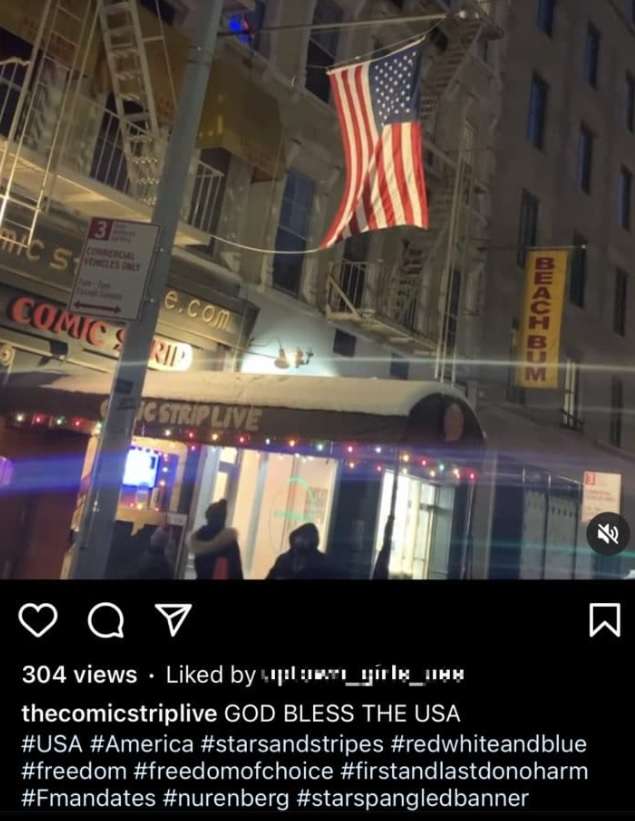
From Comic Strip Promotions, Inc. v. Envivo LLC, decided Tuesday by New York trial court judge Lisa Headley, in a controversy that apparently stemmed from this Instagram post:

From the opinion:

On or about January 9, 2022, Plaintiff … comedy club, published a social media post on Instagram, which contained hashtags related to the anti-vaccine mandate and Nuremberg. It has been alleged that Plaintiff's post offended a Jewish community member because it suggested an equivalency between the vaccine mandate and the persecution of Jews during the Holocaust. Thereafter, New York City Councilmember Julie Menin … wrote a letter to Plaintiff denouncing the post, and demanding the Plaintiff to make a public apology. On or about January 11, 2022, Defendant … Patch Media … published an article [apparently this one -EV]…, which discussed an investigation surrounding the Nazi Swastika symbols found on bills from an ATM. The Patch article discussed another occurrence of anti-Semitism in the area and the anti-vaccine social media post by the Plaintiff, which compared the city's vaccine mandate to Nazi Germany.

Read More

Free Speech

Brief Opposing Pseudonymity in #TheyLied Libel Case Alleging False Claims of Sexual Assault at College

|

I thought I'd pass along a long excerpt from this amicus brief, which my students Samantha Frazier, Katelyn Taira, and Jacob Haas and I wrote on behalf of the First Amendment Coalition and myself; for more on the decision below, which indeed rejected pseudonymity, see here.

[* * *]

Summary of Argument

John Doe is trying to punish Jane Doe … for accusing him of sexual assault. JA40. If he succeeds, she will likely be driven into bankruptcy based on her speech—speech that she claims is true and therefore constitutionally protected.

He is of course entitled to do this, so long as he is able to prevail on his libel claim. But he is not entitled to do this under the cloak of secrecy. Like other libel plaintiffs, and like most other civil plaintiffs and defendants, as well as criminal defendants, he must litigate this case in his own name.

"Pseudonymous litigation undermines the public's right of access to judicial proceedings. The public has an interest in knowing the names of the litigants, … and disclosing the parties' identities furthers openness of judicial proceedings …." Doe v. Public Citizen, 749 F.3d 246, 263 (4th Cir. 2014) (citations omitted). Public access, including the norm of litigating under parties' own names, "allows the citizenry to monitor the functioning of our courts, thereby [e]nsuring quality, honesty and respect for our legal system." Does 1-3 v. Mills, 39 F.4th 20, 25 (1st Cir. 2022) (citation omitted). Nowhere is this public right to monitor the judicial process—and the public confidence in the process that this right can bring—more important than when defendants are facing financial ruin for the content of their speech.

Argument

[I.] Risk to reputation does not suffice to justify pseudonymity

Appellant fears "potential irreparable harm" to his "reputation" and livelihood that would result from proceeding publicly. Appellant Br. 17, 25, 26. Such reputational harm, though, is potentially present in virtually all defamation litigation:

Read More

Free Speech

Can California "Safe at Home" Law Be Used to Retroactively Pseudonymize Past Federal Cases?

|

The California "Safe at Home Confidential Address Program" provides for special forwarding addresses for people who swear that they are "attempting to escape from actual or threatened domestic violence, sexual assault, stalking, human trafficking, or elder or dependent adult abuse," and need to "establish new names or addresses in order to prevent their assailants or probable assailants from finding them" (and possibly provide some corroborating evidence).

And Cal. Code Civ. Proc. § 367.3, enacted in 2019, adds to that:

A protected person who is a party in a civil proceeding may proceed using a pseudonym, either John Doe, Jane Doe, or Doe, for the true name of the protected person and may exclude or redact from all pleadings and documents filed in the action other identifying characteristics of the protected person.

Such litigants must confidentially inform the other parties and the court of their true identity, but the identity may not appear in the court records. No showing is required of any specific reason for pseudonymity, beyond the person's participation in the Safe at Home program.

Does this mean that a person, just by joining the Safe at Home program, may also retroactively reopen his past cases, and then get them sealed or pseudonymized? Several recent federal decisions, all apparently involving one litigant (a self-described "avid blogger on record sealing expungement, and First Amendment issues"), deal with the subject. Here's the latest judicial response, from Judge Kent Dawson's opinion Monday in Chaker-Delnero v. Butler & Hailey (D. Nev.), to that litigant, who had earlier had some (though mixed) success in his campaign:

Read More

Abortion

The Supreme Court on Life and Liberty

|

I participated last Fall on a Wisconsin Law Review symposium panel on "Is the Court out of Control?," and wrote up a short (12-page) article for that. I'm posting it in several pieces; I hope some of you find it interesting, and I also still have time to make any corrections, if need be. Here's the fourth part (you can also read the first part, the second part, and the third part):

All this brings me back to one of my favorite passages on constitutional law—not from a case, but from a speech by Abraham Lincoln at the peak of the Civil War:

The world has never had a good definition of the word liberty, and the American people, just now, are much in want of one. We all declare for liberty; but in using the same word we do not all mean the same thing. With some the word liberty may mean for each man to do as he pleases with himself, and the product of his labor; while with others the same word may mean for some men to do as they please with other men, and the product of other men's labor. Here are two, not only different, but incompatible things, called by the same name—liberty. And it follows that each of the things is, by the respective parties, called by two different and incompatible names—liberty and tyranny.

The shepherd drives the wolf from the sheep's throat, for which the sheep thanks the shepherd as a liberator, while the wolf denounces him for the same act as the destroyer of liberty, especially as the sheep was a black one. Plainly the sheep and the wolf are not agreed upon a definition of the word liberty; and precisely the same difference prevails today among us human creatures, even in the North, and all professing to love liberty. Hence we behold the processes by which thousands are daily passing from under the yoke of bondage, hailed by some as the advance of liberty, and bewailed by others as the destruction of all liberty.[1]

Now Lincoln certainly thought there was one definition that was right, and another that was wrong. Ultimately one definition was, thankfully, entrenched in American law by a political process (albeit backed by a military victory that was itself backed by a political process). Yet, the broader point still stands: claims of liberty presuppose controversial judgments about who is entitled to rights and to which ones.

If you change the words a bit, you see how this encapsulates the American debates about abortion. Both sides say they support liberty and life; they just have very different senses of what those mean, based in large part on a disagreement whether the rights of a particular group (the unborn) count. I doubt that framing abortion as a question of "necropolitics"[2] is helpful, but if it is, then surely those who view the unborn as persons can view the pro-abortion-rights position as being a particularly awful instance of necropolitics. Again, I generally take the pro-abortion-rights view. But it's unsurprising to me that others who disagree with me claim the mantle of individual rights as much as those who agree with me.

Read More

Academic Freedom

State "Higher Ed Reform" Roundup: Texas

Legislative showdown looming on tenure and academic freedom

|

Republican state legislatures across the country are debating significant reforms in state university systems. Some of the reform proposals are fairly modest, but others would substantially transform how higher education work in public universities. In several instances, those bills are now moving toward some resolution, and so a series of posts checking in on where things stand seems in order.

Next up is Texas. Last year the powerful Lieutenant Governor of Texas, former TV sportscaster Dan Patrick, declared that that the time had come to end tenure at public universities in the Lone Star State. The lieutenant governor is the presiding officer in the Texas state senate and exercises substantial formal and informal power in that chamber. Patrick has not forgotten about his vow, and it seems likely that some very dramatic reform bills will pass the Senate. The prospects that the proposals will be defeated in the House and in the governor's mansion are not at all clear. The Texas legislature is also set to pump additional funds into the state universities, but these structural reform bills work at cross-purposes with the governor's goal of creating more premier public universities in the state.

There are three bills of particular interest (though there are some other measures affecting higher education that have also been designated as legislative priorities). The Texas AAUP also have a convenient bill tracker.

Read More

Second Amendment Roundup: To Preserve Liberty, Not Slavery

Carl Bogus invented the fiction that the purpose of the Second Amendment was slave control.

|

Back in 1998—a decade before Heller—Prof. Carl Bogus claimed to have discovered a "hidden history" showing that the Second Amendment was adopted to ensure that militias could enforce slave control.  Since that theory crops up now and then, in 2021 I posted a comprehensive historical refutation in SSRN, which was subsequently published in Georgetown Journal of Law & Public Policy.

Bogus has now rehashed his 1998 theory in Madison's Militia: The Hidden History of the Second Amendment (Oxford University Press, 2023), which adds nothing new on point.  He states up front that he will not address how legal scholars or the courts have interpreted the Amendment, except to assert, without any support, that James Madison and his colleagues "would have been astonished" at the Supreme Court's holding that the Amendment "grants individuals a right to have guns…." ("Grants?"  No, confirms.)

Bogus failed to address or even mention my paper, which is the only comprehensive critique of his 1998 article, even though it was first published a year-and-a-half before his book.  Oxford University's readers who vetted his manuscript were either asleep at the wheel or biased in favor of his argument.  This is good example of why courts today, when searching for historical analogues under Bruen, should rely on original historical sources and not skewed declarations by "historians."

Bogus calls his tome "a mystery book" about "why James Madison decided to write the Second Amendment," because "there is no direct evidence about what the Founders intended."  But his agenda is clear: instead of "the Minuteman at Lexington, with a musket in his hands … the more accurate image [of the Second Amendment] is that of the musket in the hands of the militiaman on slave patrol in the South."

Denigrating America's patriots in order to infect the Second Amendment with racism makes it easier today to criminalize the right to keep and bear arms, and is consistent with other contemporary efforts, such as the 1619 Project, to demonize America and its founders.  Not surprisingly, Bogus served on the board of directors of Handgun Control Inc., the anti-gun lobby which morphed into the Brady Center.

Bogus focuses on the militia and ignores what he considers to be the non-existent individual right.  The mystery supposedly reveals itself in the Virginia ratification convention of 1788.  "Without spelling it out in so many words," Bogus writes, Patrick Henry objected to an exclusive federal power over the militia because it would "subvert the slave system indirectly."  George Mason's warning that the disarming of the militia could lead to tyranny was actually a ruse; such were "encoded discussions" about slave control, Bogus speculates, that could not be made "directly" because "public discussion of it was often frowned upon." Read More

ammunition

AR rifle ammunition is less powerful than most other rifle ammunition

Bullet speed matters, but so does bullet weight

|

According to "assault weapon" ban proponents, the AR rifle's lethality is all about how fast its bullets travel. The Washington Post recently claimed that "what makes [the AR] so deadly is the speed of [its] bullet." "The higher speed of a bullet from an AR-15 causes far more damage after it hits the body and drastically reduces a person's chances of survival." Scott Pelley at CBS News declared that "the AR-15's high velocity ammo is the fear of every American emergency room." In a March 2023 order denying a motion for a preliminary injunction in Delaware State Sportsmen's Ass'n v. Delaware Dep't of Safety and Homeland Security, Judge Richard Andrews described how "intermediate-caliber rounds fired at high velocity" cause "catastrophic" wounds with "multiple organs shattered, bones exploded, soft tissue absolutely destroyed, and exit wounds a foot wide."

President Joe Biden repeatedly has exaggerated the velocity of AR bullets, most recently asserting that they travel five times as fast as handgun bullets. To prove that AR's pose an "exceptional danger," Judge Virginia Kendall claimed in her February 2023 order denying a preliminary injunction in Bevis v. Naperville that "[t]he muzzle velocity of an assault weapon is four times higher than a high-powered semiautomatic firearm."

This post will discuss the comparative velocity and kinetic energy of AR bullets and how those factors affect bullet penetration and wound severity. It is co-authored by Campbell University law professor Gregory Wallace, who has published two articles on "assault weapons," most recently "Assault Weapon" Lethality, 88 Tenn. L. Rev. 1 (2020). Professor Wallace and I are among the co-authors of the law school textbook Firearms Law and the Second Amendment: Regulation, Rights, and Policy (3d ed. 2022, Aspen Pub.). In an earlier post, we examined false claims that the AR type rifles are exceptionally powerful.

While AR rifles can be chambered in various calibers, they most commonly fire the .223 Remington and 5.56 NATO rounds. The numbers .223 and 5.56 designate the caliber of the round based on a rough approximation of bullet diameter, which is expressed in decimals an inch (.223 caliber = 223 thousandths of an inch; .45 caliber = 45 hundredths of an inch ) or millimeters (5.56 caliber). The U.S. military uses the NATO designation, measured in millimeters. As detailed in our previous post, the .223 and 5.56 are mostly interchangeable.

  1. Understanding terms

"AR" is short for "ArmaLite Rifle," inventor of the firearm in the 1950s. "AR-15" is the name for a particular model by Colt; the AR-15 is a now shrinking minority among AR type rifles, since the patents have long expired.

Like the vast majority of modern rifles, the AR fires "high velocity" bullets, whereas most modern handguns fire "low velocity" bullets. Bullet velocity is measured at various distances, since velocity declines as a bullet travels downrange. The highest velocity is the instant the bullet leaves the barrel of the gun and exits the muzzle. The velocity at that point is called "muzzle velocity."

There is no scientific or industry definition of "high velocity." American researchers who assign numerical values to the term generally use "high velocity" to refer to bullets with a muzzle velocity of at least 2,500 feet per second (fps), and "low-velocity" for bullets with a velocity of 1,200 feet per second or less.

Other things being equal, greater velocity increases a bullet's striking power. So does increasing the mass of the bullet. The overall striking power is commonly known as "kinetic energy" and is measured in foot pounds (a force of one pound moving through a distance of one foot). The formula for kinetic energy is one-half times bullet mass times velocity squared (KE = 1/2mv2).

As we detailed in How powerful are AR rifles?, a bullet's impact on a human target is also influenced by the shape and composition of the bullet and where the bullet strikes. Our article refuted false claims from the early 1960s (which are still repeated by low-information journalists today) that the AR bullets have greater wounding effects than other rifle bullets.

In this post, we provide data about the velocity  kinetic energy of AR ammunition compared to other ammunition. We also address the false claim that AR ammunition has some supposedly unique ability to penetrate body armor or interior walls.

Read More

Academic Freedom

State "Higher Ed Reform" Roundup: North Dakota

North Dakota attack on tenure barely defeated

|

Republican state legislatures across the country are debating significant reforms in state university systems. Some of the reform proposals are fairly modest, but others would substantially transform how higher education work in public universities. In several instances, those bills are now moving toward some resolution, and so a series of posts checking in on where things stand seems in order.

First up is North Dakota. As I've noted before, North Dakota was considering very significant changes to the tenure system in the state universities. HB 1446 was sponsored by the House majority leader, and Republicans enjoy sizable majorities in both legislative chambers. Unsurprisingly, the bill sailed through the lower chamber. Amendments in the House cut some of the particularly egregious components of the original bill, but left in place the core commitment to gutting tenure. By the time the bill got the Senate it was being pitched as a pilot program that would only have an immediate effect on two campuses. I submitted testimony to the Senate critical of the bill, which left essentially unconstrained discretion in the hands of senior university officials to fire tenured members of the faculty. The bill was widely panned in submitted testimony to both the House and the Senate. The Senate Education Committee sent the bill to the Senate floor with the recommendation that it be passed into law, though it stripped the language about it being a pilot program in an apparent effort to reassure the other campuses that they would be spared from the reform.

HB 1446 failed to pass the Senate in a 21-23 vote on March 31. A motion to reconsider failed by a vote of 23-24. The"Tenure with Responsibilities Act" is dead for now, but there is clearly plenty of support in the legislature for severely weakening tenure and faculty governance.

"Strangers on the Internet" Podcast Episode 27: "Cripfished"

A director and two actors talk about dating with a disability

|

The twenty-seventh episode (Apple Podcasts link here and Spotify link here) of Strangers on the Internet has me talking to the makers of short film "Cripfished," an entrant in the 2023 Easterseals Disability Film Challenge.

Director Anna Pakman and actors Bree Klauser and Melissa Jennifer Gonzalez tell in their romantic comedy the fictional story of Logan (Melissa), who fakes being blind on a queer date with visually impaired Amy (Bree) because the latter only wants to go out with disabled people. On the podcast, we discuss not only the film but also dating with a disability in real life; come hear about Melissa's journey to love with autism, the questions Anna has to answer about her wheelchair use, and the way Bree has felt more accepted for being legally blind than neurodivergent.

Bree also talks about the COVID-caused challenges of adapting her career from acting alongside Jason Momoa in AppleTV+ show "See" to mastering a variety of recording skills, and Anna discusses what the pandemic has done to dating for vulnerable folks in NYC. Join us for some stereotype-shattering fun and learning!

"Cripfished" (Anna Pakman)

Free Speech

No Pseudonymity for Sorority Members Suing to Challenge Sorority's Admission of Transgender Student

|

In Doe v. Kappa Kappa Gamma Fraternity, decided last Thursday by Judge Alan Johnson (D. Wyo.), several members of the KKG sorority at the University of Wyoming (despite the corporate name, KKG is a sorority) sued the central KKG organization for breach of contract and related claims, arising out of KKG's decision to allow Terry Smith, a male-to-female transgender student, to become a member:

Plaintiffs ask this Court for declaratory judgments ordering: (1) that "men who identify as women" are ineligible for KKG membership, including voiding, ab initio, Smith's admission; (2) Defendants' violation of their obligations to the KKG organization; and (3) Defendants' violation of a campus housing contract. Plaintiffs also seek permanent injunctive relief invalidating Smith's membership and prohibiting men from admission to KKG, as well as monetary damages. {Plaintiffs do not allege claims against Defendant Smith, but [named Smith as a defendant because they] maintain that Smith is a required party under Fed. R. Civ. P. 19(a)(l)(B).}

At this stage, the preliminary question has been whether the Does could proceed pseudonymously, on the theory that "Plaintiffs argue that they have 'already faced threats, harassment, and safety concerns' from this litigation, including a 'social media maelstrom' often encircling matters of intense public scrutiny like transgender rights." No, said the court:

Proceeding anonymously is uncontemplated by the Federal Rules of Civil Procedure. See, e.g., Fed. R. Civ. P. 10(a) (requiring that a complaint's title "name all the parties"), 17(a)(l) (prescribing that "[a]n action must be prosecuted in the name of the real party in interest"). Nevertheless, the Tenth Circuit has recognized certain "exceptional cases" where parties may proceed anonymously. Exceptional circumstances exist: (1) in "'cases involving matters of a highly sensitive and personal nature;"' (2) in cases involving a "'real danger of physical harm;"' or (3) "'where the injury litigated against would be incurred as a result of the disclosure of the plaintiffs identity."' Femedeer v. Haun (10th Cir. 2000)….

I conclude that Plaintiffs do not meet the high pseudonymity bar reserved for exceptional cases. Two of Femedeer's "exceptional circumstances" warrant consideration, including whether this case involves "matters of a highly sensitive and personal nature" or a "real danger of physical harm."

Read More

More