
5/12/1790: Justice James Iredell takes the judicial oath.

Mostly law professors | Sometimes contrarian | Often libertarian | Always independent | Est. 2002

Download the edited version from the 2023 Barnett-Blackman supplement.
I have now finished reading the Court's very-fractured decision in National Pork Producers Council v. Ross. I have also edited the case for the Barnett-Blackman casebook supplement. (I find that distilling a case down to its essence is the quickest way to figure out what is important and what is unimportant). I have shared a link to the edited case here.
I will have much more to say about this case. What would Mr. Herbert Spencer think?
A brief comment on National Pork Producers v. Ross
It is a basic, intuitive, premise of our federal system that each state makes law for that states and not the other states. To steal an example from Professor Don Regan, even if the state of Michigan had a very strong anti-smoking policy, it could not ban the manufacture of cigarettes in North Carolina, only the importation of those cigarettes into Michigan.
And yet, it is not clear what actual part of our positive law enacts that premise. There is no Territoriality Clause in the Constitution, no Territoriality Statute, and arguments based on other more esoteric sources of law (general law?) raise deep questions of their own. Moreover, as every conflict of laws scholar knows, the basic premise of our federal system is frequently denied in practice -- states regularly apply their own law to conduct that took place in other states, with relatively little shame or theoretical explanation. And if there is no Territoriality Clause in the Constitution, maybe they are allowed to do that.
On occasion, the courts get so flummoxed with this that they temporarily press other constitutional clauses into temporary active serve as a Territoriality Clause. The Due Process Clause is occasionally asked to do this work, for instance (as it as asked to many constitutional odd jobs). More promisingly, several cases had asked the so-called dormant Commerce Clause to do this work as well. If states cannot discriminate against interstate commerce, the logic went, then they also cannot simply regulate out-of-state commerce either.
No more. In today's decision in National Pork Producers v. Ross, a majority opinion by Justice Gorsuch upholds California's prohibition on pork produced in inhumane conditions, even though that production generally occurs outside of California. In doing so, the Court pretty squarely rejects the idea of territoriality review under the dormant Commerce Clause, despite several cases that had generally been read this way (and excerpted in conflict of laws casebooks this way); and even the partly dissenting judges appear to agree with him on this point. The dormant Commerce Clause will no longer serve as a Territoriality Clause.
But at the same time, even Justice Gorsuch's opinion cannot give up on the idea that something in the Constitution must do the work of a Territoriality Clause. In distinguishing away yet another one of the Court's territoriality dormant Commerce Clause cases, the Court writes: Read More
What's on your mind?
The argument has some appeal, especially to libertarians. But it's actually a rationale for sweeping statist constraints on liberty.

One standard rationale for immigration restrictions is that governments have a right to exclude people much like the owner of a private house does. I have critiqued this argument here, and in greater detail in Chapter 5 of my book Free to Move: Foot, Voting, Migration, and Political Freedom. Among other things, this theory, if taken seriously, is a rationale for a quasi-totalitarian state that can suppress speech, religion, and other liberties, at will. It also ends up undermining actual private property rights, by blocking property owners from renting to immigrants, hiring them to work on their land, and so on.
But there is a different, less well-known, property rights rationale for immigration restrictions, one that focuses on public property specifically. I have not seen a serious academic defense of it. But it's increasingly common on social media, and elsewhere, and has particular appeal to libertarian-oriented immigration restrictionists.
The public property theory (at least implicitly) concedes that the government cannot justly prevent immigrants from accessing the property of willing private owners. But, so the argument goes, it can prevent them from using public property. After all, the state does own public property, and therefore can regulate it as sees fit. Or, alternatively, public property is collectively owned by the state's citizens, and they can use democratic political processes to restrict access as they wish.
Under current law, public property includes almost all major roads, most air space, and most significant waterways (including coastal waters). Therefore, if the government is entitled to restrict access to public property as it wishes, it can effectively bar nearly all immigration, or as much of it as it wants. And it can do so without directly restricting anyone's private property rights! One can readily see why this argument has appeal to people who consider themselves libertarians (and therefore advocate strong private property rights), but also support sweeping immigration restrictions.
Unfortunately, the public property rationale for migration restrictions turns out to have illiberal - and anti-libertarian - implications almost as dire as those of the house analogy. Libertarian political philosopher Christopher Freiman explains how:
Sometimes "bordertarians" argue that the state may restrict immigration because it may dictate how public property—specifically public roads—can be used. On this view, if the state decides that immigrants may not travel on public roads, then immigrants may not travel on public roads.
This is a bad view. I doubt that many of those who endorse it would grant that the state may prohibit citizens from traveling on public roads with books defending libertarianism in their car. States don't have carte blanche to violate people's liberties so long as they're located on public property. This is (one reason) why the "public property" objection to freedom of immigration fails—the state may not violate people's freedom of association or movement simply because they happen to make use of public roads.
If the government - or a political majority - can restrict access to public property however they wish, they can use that power to suppress a wide range of civil and economic liberties. For example, they could bar travel by critics of the government (or bar the distribution of their writings through public property). They could similarly bar adherents of religions they disapprove of (no more Jews on the roads; or no more Muslims!), and so on. Even if you think that real-world democratic governments would stop short of going this far, the public property theory suggests they would have no moral obligation to refrain from taking such measures (at least if they were backed by a majority of citizens).
The implications of the public property rationale for migration restrictions are particularly dire for libertarians. After all, we believe that people have a right to engage in a wide range of unpopular activities! On the public property theory, the state would be entirely justified in forbidding the use of public property to distribute any product it wishes to bar, whether it be drugs, alcohol, fatty foods, vaping products, or anything else. And, just as immigrants can be effectively barred from a nation if they cannot use public property, the same goes for virtually any good or service, so long as its distribution relies on the use of roads, aircraft, or public waterways.
Many of the libertarians sympathetic to the public property rationale for immigration restrictions also favor free trade. But the former can easily be used to destroy the latter. If the government can bar foreign people from roads and airways, the same goes for foreign-produced goods.
It isn't just libertarians who have strong reason to reject the public property theory, due to its dire implications. The same goes for liberals of any stripe who believe people have a right to engage in at least some unpopular activities that government might choose to suppress. After all, given the ubiquity of public property in modern society, almost any human interaction can be blocked by preventing people engaged in it from using roads, airways, and so on. For example, a homophobic society could use this power to bar gays and lesbians from the roads (thereby making it difficult or impossible for them to form relationships). If the house analogy is a direct path to a near-totalitarian state, the public property theory gets there by a back door - or perhaps by a back road!
It doesn't necessarily follow that libertarians (or anyone) must endorse the view that there should be no restrictions on access to public property. Freiman, I think, has a good approach for how to think about these issues:
So what's a better view of public property? Here's a first take: the state is justified in enforcing only those restrictions on the use of public property that are needed to ensure its functioning, assuming that the function of that property is, in itself, morally permissible. (Clearly the state is not justified in using public property in ways that directly violate rights, just as citizens are not justified in using private property in ways that directly violate rights.)
For instance, a public library may restrict your freedom to check out books by requiring that you have a library card because that restriction is needed to ensure that the lending system functions properly. But the library would not be justified in prohibiting those wearing [Dallas] Cowboys shirts from entering the library because that's not needed to ensure that the library is able to do its job.
Similarly, the state may restrict your freedom to drive on a public road when, for instance, it's being repaired. That's needed to ensure that the road functions properly. But the state would not be justified in prohibiting you from transporting particular books or people in your car.
No doubt this account will need some refinement, but I think it's at least the start of an answer to a hard question for libertarians.
As Freiman notes, the theory needs much more refinement. But it's at least a good start.
Immigration restrictionists can potentially argue, under Freiman's approach, that barring (at least some) immigrants from the roads is justified in order to ensure that they are not overused, or to prevent migrants from overburdening the welfare state, increasing crime, spreading harmful cultural values, and so on. But then the focus of the debate properly shifts to whether immigrants really do cause these harms, and - if so - whether that justifies restricting migration (including by perfectly innocent people), as opposed to imposing "keyhole" solutions. In that event, the public property argument will no longer be doing any meaningful work.
One can argue that the danger of overuse of public property is more closely linked to its functions than some of these other issues, and therefore provides a stronger rationale for limiting immigrant access to roads and the like. But even if overuse is a genuine risk, it should not be addressed by restricting access based on morally arbitrary criteria of ancestry and place of birth (as immigration restrictions do). We can instead impose nondiscriminatory numerical limits, assess tolls, and the like. Moreover, some of the vast additional wealth created by immigration can - if necessary - be tapped to build new infrastructure and finance the repair and upgrading of existing systems.
This entire issue might go away if you believe, as some libertarians do, that all or nearly all currently public property should be privatized. But if that's your view, you should also be opposed to the state using its current control over public property as leverage to impose sweeping restrictions on liberty - including those of immigrants and natives who wish to engage in interactions with them.
The Supreme Court issues five merits opinions, but there are still forty more waiting.
The Supreme Court issued opinions in five argued cases today, bringing the total number of merits decisions up to 18, with forty* more to go (unless some get mooted out).
The biggest decision of the day was National Pork Producers Council v. Ross, a Dormant Commerce Clause challenge to California's law barring in-state sale of animal products that fail to meet California's regulatory requirements. The pork producers argued this law unconstitutionally burdened interstate commerce and extraterritorialized California's regulatory preferences. A majority of the Supreme Court disagreed.
Justice Gorsuch wrote for the Court, but only one justice (Thomas) agreed with him in full. In fact, the Justices were quite splintered. See for yourself:
GORSUCH, J., announced the judgment of the Court, and delivered the opinion of the Court with respect to Parts I, II, III, IV–A, and V, in which THOMAS, SOTOMAYOR, KAGAN, and BARRETT, JJ., joined, an opinion with respect to Parts IV–B and IV–D, in which THOMAS and BARRETT, JJ., joined, and an opinion with respect to Part IV-C, in which THOMAS, SOTOMAYOR, and KAGAN, JJ., joined. SOTOMAYOR, J., filed an opinion concurring in part, in which KAGAN, J., joined. BARRETT, J., filed an opinion concurring in part. ROBERTS, C. J., filed an opinion concurring in part and dissenting in part, in which ALITO, KAVANAUGH, and JACKSON, JJ., joined. KAVANAUGH, J., filed an opinion concurring in part and dissenting in part.
There's quite a bit in there to unpack, but there are some important takeaways from the bottom-line result.
First, the opinion signals a narrowing of the Dormant Commerce Clause to an anti-discrimination rule, as opposed to a broader protection for the frictionless movement of goods and services across state lines.
Second, the opinion provides a bright green light for states to adopt environmental laws that regulate goods and services based upon how they are produced (e.g. their carbon intensity, etc.). California already leads the way with such laws, and this decision should make it more difficult for business groups to challenge such measures.
Third, the decision complicates the already questionable "Roberts Court is pro-business" narrative, by demonstrating (yet again) that when conservative jurisprudential commitments conflict with corporate interests, the former prevail. Combined with decisions such as Virginia Uranium v. Warren, National Pork Producers shows that business groups cannot depend on conservative justices to support their challenges to state regulations.
National Pork Producers was one of five total decisions issued today. The other four were:
It is worth noting that these last two opinions -- Percoco and Ciminelli -- continue the Court's recent trend of narrowing the applicability of federal laws used to prosecute political corruption.
With today's decisions, Justices Jackson, Kagan, and Gorsuch have tied Justice Kavanaugh's mark of three opinions for the Court this term. Justices Thomas and Alito each got out their first majorities of the term today, in addition to adding more to their counts of separate opinions. The only justice not to have authored an opinion for the Court in an argued case thus far is the Chief. Presumably this is because he is holding one or more big-ticket cases for himself.
Predictions are hard, especially about the future, but today's releases incline me to think that the Chief will have Sackett from the October sitting, and at least one of the affirmative action cases from November (unless his opinion does not command a majority). I am also inclined to think that Alito may have Brackeen. Of course, these predictions are worth no more than you paid for them.
*Note: The Court heard argument in sixty cases this term. The reason there will be no more than 58 opinions in argued cases is because one of those cases (In re Grand Jury) was DIGed (dismissed as improvidently granted), and SEC v. Cochran case was combined with Axon Enterprise v. FTC for decision.
[Note: I mistakenly wrote that Justice Barrett joined all of Justice Gorsuch's National Pork Producers opinion. She did not join Part IV-C, however. The error has been corrected.]
The willingness of Lina Khan's FTC to pursue untested -- and sometimes unlikely -- legal theories has been the subject of much sober commentary. But really, what fun is sober commentary? So here's the Cybertoonz take on the FTC's new litigation strategy. And, again, many thanks to Bing's Image Creator, which draws way better than I do.

5/11/1942: Gordon Hirabayashi "failed to report to the Civil Control Station within the designated area." The Supreme Court upheld the constitutionality of his conviction in Hirabayashi v. U.S. (1943).

On May 1, Justice Amy Coney Barrett directed the State of Illinois and the City of Naperville to respond to the emergency application for injunction pending appellate review filed by the National Association for Gun Rights (NAGR). As I explained in "An Opening Judicial Salvo in Defense of Illinois' New Rifle Ban," the U.S. district court (N.D. Ill.) denied a motion for preliminary injunction against the State's ban on semiautomatic rifles and standard-capacity magazines, greatly departing from Supreme Court precedent on the Second Amendment.
While that denial was being appealed to the 7th Circuit, Judge Stephen McGlynn (S.D. Ill.) found that plaintiffs in another challenge were likely to succeed on the merits that the law violates the Second Amendment, and he issued a preliminary injunction against enforcement. See my post. The 7th Circuit immediately granted the State's motion for a stay against the injunction in a one-sentence order without giving the plaintiffs an opportunity to respond.
So now the challengers have filed amicus briefs supporting NAGR in the Supreme Court, and we await a decision there.
While granting the emergency application in an interlocutory appeal of this type would be unusual, there are compelling reasons to do so here, as perhaps explained best in the amicus brief filed by Paul Clement and Erin Murphy on behalf of the National Shooting Sports Foundation (NSSF). As they note, there were only six states with bans last year when New York State Rifle & Pistol Ass'n v. Bruen was decided, and now there are ten. "Instead of treating Bruen as an occasion to reconsider existing restrictions on constitutional rights of law-abiding citizens, they have enacted new 'assault weapon' and/or 'large-capacity magazine' bans, with more still on the way." Quoting phrases from Bruen, they argue:
Rifles, pistols, and shotguns plainly "constitute bearable arms"—i.e., "instruments that facilitate armed self-defense," …—no matter what kind of grip, stock, ammunition feeding device, or other features they may have. The right to keep and bear them is thus "presumptively protect[ed]" by the Constitution. In breezily concluding that the firearms Illinois has banned are not even "Arms" covered by the plain text of the Second Amendment, the district court in this case inexplicably ignored the test that Bruen articulated, and instead simply declared that "[t]he text of the Second Amendment is limited to only certain arms."
This is a very simple, straightforward case. Going back to basics, the Court held in District of Columbia v. Heller (2008) that arms that are "in common use" or that are "typically possessed by law-abiding citizens for lawful purposes" are protected by the Second Amendment and may not be banned. As the record reflects, there are over 24 million rifles of the types that are banned in the hands of American citizens. Even the State's brief admits that there are millions of gun owners who possess semiautomatic firearms of the sort banned by Illinois.
Moreover, neither Naperville nor Illinois argue or present evidence that the banned firearms and magazines, which obviously help "facilitate armed self-defense" and which are essential components of modern semiautomatic firearms (both handguns and rifles), are not in common use by Americans for lawful purposes. Yet the district court invented a test that they may be banned because they are "unusually dangerous," perverting the rule that only arms that are both "dangerous and unusual" may be banned.
Turning the clock back to when the Court announced its decision in Heller, D.C. officials defiantly promised from the courthouse steps to do everything in their power to negate the decision, which they carried out by banning whole categories of rifles they called "assault weapons." It was my honor to challenge the ban in the case that became known as Heller II. It should have been a slam dunk.
In the 2-1 decision in the D.C. Circuit that followed, the majority readily conceded that the banned rifles and magazines were in common use. But that was only the beginning rather than the end of the matter. The legislative history featured antigun lobbyists who live in a fantasy world testifying that the only purpose of the subject guns and magazines was to kill lots of people. Apply means-ends scrutiny under intermediate scrutiny, forget about Heller's common-use test, and presto – the law is constitutional.
Then-circuit judge Brett Kavanaugh dissented. Semiautomatic rifles with detachable magazines began coming into common use over a century ago. Handguns, including semiautomatic pistols, are widely used in crime and yet are protected by the Second Amendment. Rifles of all kinds are rarely used in crime. The standard should be text, history, and tradition, not tiers of scrutiny.
Then began the great game of judicial leap-frogging. As I traced in my book America's Rifle, Heller II was cited by the next circuit to uphold a similar ban, then the circuit after that had two precedents to cite, and so on until five circuits upheld bans, mostly under intermediate scrutiny.
Finally, in Bruen, the Court put its foot down against this massive resistance to Heller. As the Court explained: "If the last decade of Second Amendment litigation has taught this Court anything, it is that federal courts tasked with making such difficult empirical judgments regarding firearm regulations under the banner of 'intermediate scrutiny' often defer to the determinations of legislatures." But "it is not deference that the Constitution demands here. The Second Amendment 'is the very product of an interest balancing by the people' and it 'surely elevates above all other interests the right of law-abiding, responsible citizens to use arms' for self-defense."
Following Bruen, several lower courts have been getting it right. Others, like the district court here, have retained an air of defiance to the Court's jurisprudence. That's why the Court should grant the emergency application for injunction pending appellate review. In outline, its order might recite the following:
First, the Illinois law is unconstitutional under Heller and Bruen, which hold that arms in common use are protected. Should the 7th Circuit uphold the law, that decision would warrant summary reversal.
Second, Plaintiffs should not be deprived of their rights to purchase, possess, and sell constitutionally-protected arms during the years-long process that will be necessary ultimately to resolve this case. The irreparable harm caused by this law is immediate and ongoing.
Third, a preliminary injunction is designed to protect the "status quo ante," that is, the situation that prevailed before there was a dispute between the parties. The status quo ante is that Illinois residents, like the residents of most states, could lawfully purchase, sell, and possess these arms. It is the recent act by the Illinois legislature that upset the status quo ante that had existed throughout the state's entire history. That previous state of affairs should continue while this litigation is ongoing.
Fourth, the disregard shown by some legislatures and lower courts to the Heller decision over the course of fourteen years, which is now continuing among some states and courts post-Bruen, is inconsistent with constitutional norms and must be ended instanter. In the words of McDonald v. Chicago (2010), the Second Amendment is not a "second class right, subject to an entirely different body of rules than the other Bill of Rights guarantees…."
Fifth, in Caetano v. Massachusetts (2016), the Court granted a cert petition and unanimously reversed, without briefing on the merits or oral argument, a state supreme court decision in conflict with Heller. Although this case is in a different procedural posture, granting the application would serve a similar beneficial purpose to ensure adherence to the Court's precedents.
The decision is at odds with Supreme Court precedent, and endangers the constitutional rights of millions of people. This brief urging the court to reverse it was filed by the Cato Institute and myself.
Back in March, I wrote about Devillier v. Texas, an egregious Fifth Circuit ruling that effectively makes it impossible for property owners to file takings claims against state governments. Earlier today, the Cato Institute and I filed an amicus brief urging the Supreme Court to hear this case and reverse the Fifth Circuit decision. Here's an excerpt that summarizes our arguments:
In its important decision in Knick v. Township of Scott, 139 S. Ct. 2162 (2019), this Court reversed Williamson County Regional Planning Commission v. Hamilton Bank, 473 U.S. 172 (1985)—a ruling that required takings plaintiffs with claims against state and local governments to first exhaust state-court remedies before seeking relief in federal court. The Court recognized that this state-litigation requirement created an impermissible "Catch-22" in which plaintiffs could not "go to federal court without going to state court first; but if [they went] to state court and los[t], [their] claim[s were] barred in federal court." Knick, 139 S. Ct. at 2167….
In reversing Williamson County's atextual exhaustion requirement, Knick established the important principle that takings plaintiffs are entitled to their day in federal court. Now, less than four years later, the Fifth Circuit has nullified that entitlement in a mere three-sentence per curiam decision that fails to even acknowledge Knick or any of this Court's Takings Clause precedents. By holding that Fifth Amendment takings claims against states are simultaneously removable to federal court under 28 U.S.C. § 1441 and nonjusticiable in federal court due to the purported lack of a federal cause of action, the Fifth Circuit resurrected the precise sort of Catch-22 eliminated by this Court in Knick and has effectively barred takings claims against states from both state and federal court.
The decision below demonstrates at best a massive oversight of this Court's precedents and at worst an egregious resistance to them. The result is that millions of Americans are now deprived of a fundamental constitutional protection against tyranny by state governments. These significant ramifications of the Fifth Circuit's ruling render the question presented extremely important.
Moreover, the Fifth Circuit's ruling deepened a preexisting split on the question presented: the First, Fourth, Seventh, and D.C. Circuits, along with the courts of last resort in New Mexico, South Dakota, and Nebraska, have recognized that the Takings Clause is self-executing and thus provides a direct cause of action for just-compensation claims; the Ninth and now Fifth Circuits have reached the opposite conclusion, holding that a statutory cause of action is required to vindicate the Fifth Amendment right to just compensation.
This Court should grant certiorari to resolve this split of authority, curtail the Fifth Circuit's defiance of Knick, and restore a fundamental constitutional protection to millions of Americans. Even if the Court declines plenary review, summary reversal is warranted to correct the patently erroneous decision below.
The brief is partly based on points I made in my March post about this case. Many thanks to Caroline Lindsay of Hilgers Graben PLLC, who is representing us pro bono, for her outstanding work in turning these ideas into a coherent brief, and adding several excellent additional points.
From Collins v. Waters, decided today by the California Court of Appeal, in an opinion by Justice John Wiley, joined by Justices Grimes and Viramontes:
In 2020, challenger Joe E. Collins III and incumbent Maxine Waters competed for a seat in Congress. During the campaign, Waters accused Collins of a dishonorable discharge from the Navy.
Collins shot back that he had not been dishonorably discharged. He showed Waters a document saying so. This document apparently was official. There was nothing suspicious about its appearance. The document, if genuine, would have established without doubt that Waters's charge was false.
Waters easily could have checked its authenticity, but did not. Her appellate briefing asserts that today, years later, she still does not know the truth about whether Collins's discharge was dishonorable.
This disinterest in a conclusive and easily-available fact could suggest willful blindness.
Collins sued Waters for defamation during the campaign, but Waters convinced the trial court to grant her special motion to strike his suit. We reverse that order. The preliminary posture of the case required the court to accept Collins's evidence as true. His evidence created a possible inference of Waters's willful blindness, which is probative of actual malice [i.e., reckless or knowing falsehood—ed.]. It was error to grant Waters's anti-SLAPP motion [a California state law motion that can be used to dismiss unfounded libel claims, but that doesn't block potentially viable claims—ed.]….
Free speech is vital in America, but truth has a place in the public square as well. Reckless disregard for the truth can create liability for defamation. When you face powerful documentary evidence your accusation is false, when checking is easy, and when you skip the checking but keep accusing, a jury could conclude you have crossed the line. It was error to end this suit at this early stage, for Collins established the minimal case needed to defeat Waters's special motion to strike.
I'm traveling this week, and don't have much to add on this case in any event, but I thought I'd point to two Reason pieces on the subject, Jury Finds Trump Liable for Sexual Abuse and Defamation of Writer E. Jean Carroll (Elizabeth Nolan Brown) and 8 Reasons Why E. Jean Carroll Won Her Sexual Abuse and Defamation Lawsuit Against Trump (Jacob Sullum).
Title 42 expulsions caused great harm for very little benefit. Biden plans to replace them with a combination of policies, some good and some very bad.
Tomorrow, the Biden Administration will finally end Title 42 "public health" expulsion of migrants on the southern border, after 3 years and some 2.7 million people expelled. The use of Title 42 caused great suffering for little or no benefit. It was also an egregious example of the abuse of "public health" emergency powers for unrelated policy goals. Biden plans to replace Title 42 with a combination of new policies, some of them good, but others very bad.
Though it is sometimes forgotten today, the ostensible rationale for the use of Title 42 was the need to curb the spread of the coronavirus pandemic. Indeed, the authorizing statute is a public health power granted to the Centers for Disease Control in order to prevent the "introduction" of diseases into the United States.
As a public health measure, Title 42 was a dismal failure. The original Covid variant and later ones such as Delta and Omicron all still quickly got into the US and swiftly spread throughout the country, despite Title 42 and other migration restrictions. Public health experts in both the Trump and Biden administrations knew early on that Title 42 had little if any effect on the spread of Covid. But first Trump and then Biden continued the policy for other reasons: Trump as part of his general anti-immigration agenda, and Biden because he hoped it would help curb politically damaging perceptions of disorder at the border.
In this way, the invocation of Title 42 over the last three years has been a particularly egregious case of the abuse of public health powers for the purpose of pursuing unrelated political goals. Conservatives and others who oppose such shenanigans in other contexts should object to it here, too. On top of that, the use of Title 42 under Trump and Biden was also illegal. The power to block "introduction" of a disease into the United States surely does not apply to a virus that has already established itself here on a large scale. Biden and Trump's broad interpretation of the statute would give the CDC nearly limitless authority over immigration, thereby violating the major questions doctrine, and constitutional nondelegation constraints.
Biden's imminent termination of Title 42 by ending the Covid-19 state of emergency is likely to moot out ongoing litigation over the policy. But these legal issues may well recur in the future, as the use of Title 42 in the Covid crisis may have set a dangerous precedent for its future invocation.
In the meantime, Biden plans to replace Title 42 with a set of new policies. Andrew Selee, president of the Migration Policy Institute, has a detailed overview here. As Selee notes, some of them involve expanding pathways to legal entry for would-be migrants, such as a new private sponsorship parole policy for migrants from four Latin American nations, which has already greatly reduced illegal border crossings by citizens of those nations.
But there is also a new set of restrictions on migrants seeking asylum that will make it far more difficult for them to try to obtain it by crossing into the US. I summarized and critiqued this policy in a February post (the actual rule is very similar to the preliminary draft proposal announced then):
The new rule would summarily expel most asylum seekers unless they have 1) been rejected for asylum in a third country they have passed through (usually Mexico), 2) they have used the CBP One cellphone app to make an appointment for an asylum interview with a Customs and Border Protection (CBP) official, or 3) they can prove that an "ongoing and serious obstacle" prevents them from doing one of the above (the burden of proof is on the asylum seeker).
Critics rightly point out that many asylum seekers don't have access to cellphones or cannot use the app for other reasons. Among other problems, it is notoriously prone to various glitches. Even if the app works as it is supposed to, migrants who use it may have to wait months to get an interview, during which time they are likely to be exposed to dangerous conditions in Mexico or Central America.
These and other flaws have led opponents to compare the new Biden policy to Trump-era initiatives designed to bar asylum seekers. In response, the administration points out they have given would-be migrants some alternative options, such as the app, and applying for private sponsorship …. The latter is open to would-be migrants from Cuba, Nicaragua, Venezuela and Haiti. Trump's proposals didn't include any such workarounds.
But even if Biden's new proposal isn't fully Trumpian, it is certainly Trump-lite. While it does not categorically bar all asylum seekers, it does effectively do so for the many who do not qualify for private sponsorship…. and cannot effectively use the app….
Sadly, the administration has not yet fully figured out that the best way to prevent border disorder is to make legal migration easy, even though its new policy of using the parole power to grant entry to migrants from four nations is a step in the right direction…. If implemented, the new Biden asylum policy will incentivize many asylum seekers to become illegal migrants, as that would be their only way to find relative safety and opportunity in the US.
The new asylum policy is certain to be challenged in court (the ACLU has already indicated it plans to sue), and it may well be struck down, as was a similar Trump policy invalidated in 2019. I won't try to address the legal issues here. But I believe there's a strong argument that Biden's policy, like Trump's before it, violates both statutory law and international treaty commitments blocking the US from expelling migrants who qualify under the legal definition of "refugee."
Like Title 42 before it, the new Biden asylum policy - if it survives legal challenges - is also likely to incentivize at least as much illegal migration as it deters. Just as Prohibition expanded the size of the illegal market in alcoholic beverages, so restrictions on legal migration increase the illegal kind. It's possible, however, that new Biden policies expanding legal pathways will offset this effect of the asylum policy.
Overall, Biden's immigration policies have been a significant improvement over Trump's and in some ways over previous Democratic presidents. But that should not excuse abuses such as his prolonged continuation of the Title 42 expulsions and the new asylum policy.
Finally, it's worth noting that the public debate over asylum policy ignores the fact that even the most generous possible version of current policy is constrained by very narrow criteria for eligibility that exclude many migrants fleeing horrific violence and oppression. That problem deserves much greater attention.
Geeky couple Jane-Ashe and Damon's love story defies the dating app paradigm
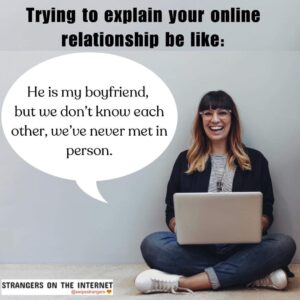
The thirtieth episode (Apple Podcasts link here and Spotify link here) of Strangers on the Internet with co-host and psychologist Michelle Lange features couple Jane-Ashe and Damon who met in a Facebook group tied to a nerdy fandom podcast (Binge Mode).
Damon hadn't had much luck with dating apps, while Jane-Ashe got tired enough of people wasting her time that she became a sugar baby to at least be paid for her efforts. In the Facebook group, Jane-Ashe attracted Damon's attention via her "high thoughts" upon first watching Star Wars. They started chatting privately and one visit by Damon--complete with a first date at Potterworld--was enough to convince them that he should move from Louisiana to Florida to live with her.
We explore how a lot of people, including neurodivergent folks, feel more comfortable meeting online and what might be the future for dating via online communities. Come meet a quirky couple that found love in the cyber-galaxy despite being far, far away from each other!
There are some parallels to late impeachment.
On Tuesday, the Texas House unanimously voted to expel Rep. Bryan Slaton. But on Monday, Slaton submitted his resignation. Wasn't the situation be moot? Well, according to Rep. Andrew Murr, who led the investigative committee, Slaton didn't actually resign. Murr announced on Facebook:
Though Representative Slaton has submitted his resignation from office, under Texas law he is considered to be an officer of this state until a successor is elected and takes the oath of office to represent Texas House District 2.
Perhaps this rule is correct under Texas law, but it would seem strange. Could it really be that a member who resigns, and does not wish to exercise the legislative power, would still continue holding that power? Would a different rule pertain if the member dies? Would a corpse continue holding the office until a successor is elected?
Let's assume that Murr is wrong, and that Slaton did actually resign. Can the House expel a member who no longer holds office? Here, there are some clear parallels to the late impeachment debates.
Article III, Section 11 of the Texas Constitution governs explusion:
Sec. 11. RULES OF PROCEDURE; PUNISHMENT OR EXPULSION OF MEMBER. Each House may determine the rules of its own proceedings, punish members for disorderly conduct, and, with the consent of two-thirds, expel a member, but not a second time for the same offence.
The text applies to "members," which seems to refer only to a person who currently is a member. A member who resigned his office would be a former member. I suppose the House could, pursuant to its own rules of proceedings, redefine "members" to include "former members." But that sort of rule would be ultra vires, and beyond the scope of the expulsion provision. I think it prudent for legislatures to narrowly construe the sole process by which a duly-elected member can be removed from office.
There is a pragmatic reason why late-expulsion would be problematic. Under the federal Constitution, with late impeachment, the Senate could disqualify the former-officeholder from holding some future office. But with expulsion, there is no similar disqualification. Indeed, an expelled member could be voted back into the exact same office.
Slaton's career is probably over, so this explusion will likely not be challenged in the courts.
A synthesis of our prior writings, and clarification on the meaning of “Officers of the United States.”
[This post is co-authored with Seth Barrett Tillman.]
The Constitution of 1788's original seven articles include twenty-two provisions that refer to "Offices" and "Officers." Since 2008, Tillman has been engaged in the continuing project: an analysis of the Constitution's "Office"- and "Officer"-language. Blackman joined this intellectual project about six years ago. Much of our research has already appeared in law review articles, amicus briefs, opinion editorials, and other writings. But we did not have a single compendium that systematically articulated our position. Initially, we considered writing a single law review article that touched on all aspects of our work, but we quickly realized that approach would far be too long for such a publication. In 2020, we adopted a new strategy: we would publish a ten-part series that would explain how we approach the offices and officers of the Constitution. And we are grateful to the editors of the South Texas Law Review, who committed to this multi-year endeavor.
We published Parts I and II in 2021. The first installment introduced the series. The second installment identified four approaches to understand the Constitution's divergent "Office"- and "Officer"-language. Parts III and IV will soon be sent to the printer. We have posted a near-final version of Part III to SSRN. (Part IV will be posted shortly). This third installment focuses on the four provisions of the Constitution of 1788 that use the phrase "Officers of the United States": the Appointments Clause, the Impeachment Clause, the Commissions Clause, and the Oath or Affirmation Clause.
The article is long—106 pages. We tried to be thorough and complete. Here is the abstract:
This Article is the third installment of a planned ten-part series that provides the first comprehensive examination of the offices and officers of the Constitution. The first installment introduced the series. The second installment identified four approaches to understand the Constitution's divergent "Office"- and "Officer"-language. This third installment will analyze the phrase "Officers of the United States," which is used in the Appointments Clause, the Impeachment Clause, the Commissions Clause, and the Oath or Affirmation Clause.
This Article proceeds in six sections. Section I describes our methodology, which includes textualism, original public meaning originalism, original methods originalism, and consideration of historical practices during the founding-era and later-in-time. Section II explains that the phrase "Officers of the United States" is defined by the Appointments Clause. This phrase refers to appointed positions in the Executive and Judicial Branches. Our position here is supported by the drafting history of the Appointments Clause, as well as Supreme Court precedent. Section III turns to the Impeachment Clause, which applies to "civil Officers of the United States." This latter category refers to non-military appointed positions in the Executive Branch and Judicial Branch. Members of Congress, as well as appointed positions in the Legislative Branch, are not "civil Officers of the United States," and therefore such positions cannot be impeached.
Section IV considers the Commissions Clause, which requires the President to commission "all the Officers of the United States." There is a longstanding practice of the President's commissioning appointed positions in the Executive Branch and Judicial Branch. But there is no evidence the President has ever commissioned an elected official, including himself. Section V analyzes the Oath or Affirmation Clause, which suggests that Senators and Representatives, as well as the President, are not "Officers of the United States." Finally, Section VI focuses on the Recess Appointments Clause. This provision does not use the phrase "Officers of the United States," and it is not clear whether recess appointees are "Officers of the United States."
These eight parts support our position: in the Anglo-American legal tradition, the phrase "Office under the . . ." was, and remains, a commonly-used drafting convention that refers to appointed officers. This phrase does not refer to elected officials.
Much of this article reproduces our prior writings and positions. Section II elaborates and clarifies our position on the meaning of: "Officers of the United States." Here is the overview of Section II:
In our view, the phrase "Officers of the United States" refers to appointed positions in the Executive and Judicial Branches. This language does not refer to appointed positions in the Legislative Branch, such as the Clerk of the House of Representatives or the Secretary of the Senate. The Appointments Clause defines the phrase "Officers of the United States" and, generally, how those officers are appointed: all such appointments are made to positions established by federal statute in the Executive and Judicial Branches. This category includes principal officers and inferior officers. Each of these positions must be created, authorized, or regularized "by law"; that is, by statute through bicameralism and presentment. And all of these positions are filled by appointment, not election. Positions created by the Constitution, including elected officials like the President and Members of Congress, are not created "by law." Therefore, they are not "Officers of the United States."
Our approach is consistent with the drafting history of the Appointments Clause: "Officers of the United States" can only be appointed, not elected. And our approach is also consistent with Supreme Court precedent. We acknowledge that some framers and ratifiers, on some occasions, argued that members of Congress were "Officers of the United States." However, we do not know how widespread this view was. And at the time, prominent framers and ratifiers opposed this view. On balance, the weight of evidence supports our position that "Officers of the United States" are appointed, not elected.
For those who want to see this material elaborating and clarifying our position, jump to page 377.
We welcome comments and feedback on our Article.
Our fourth installment will focus on the "Office . . . under the United States" drafting convention. That language is used in four provisions of the Constitution: the Elector Incompatibility Clause, the Impeachment Disqualification Clause, the Incompatibility Clause, and the Foreign Emoluments Clause. We will discuss those four provisions in detail in the fifth installment.
5/10/1886: Yick Wo v. Hopkins decided.
Baby Ninth Amendments, by Anthony Sanders
I thought readers might be interested in a new book published by Anthony Sanders of the Institute for Justice: Baby Ninth Amendments. Here is the description:
Listing every right that a constitution should protect is hard. American constitution drafters often list a few famous rights such as freedom of speech, protection against unreasonable searches and seizures, and free exercise of religion, plus a handful of others. But there are an infinite number of rights a constitution could protect. However many rights are put in a constitution, others are going to be left out. So what is a constitution drafter to do? Luckily, early in American history a few drafters found an easier way: an "etcetera clause." It states that there are other rights beyond those specifically listed. The most famous etcetera clause is the Ninth Amendment to the U.S. Constitution, which states: "The enumeration in the Constitution, of certain rights, shall not be construed to deny or disparage others retained by the people." Yet scholars are divided on whether the Ninth Amendment itself actually does protect unenumerated rights, and the Supreme Court has almost entirely ignored it. Regardless of what the Ninth Amendment means, however, things are much clearer when it comes to state constitutions. Two-thirds of state constitutions have equivalent provisions, or "Baby Ninth Amendments," worded similarly to the Ninth Amendment.
This book is the story of how the "Baby Ninths" came to be, what they mean, and what they tell us about unenumerated rights more generally. Unlike the controversy surrounding the Ninth Amendment, the meaning of the Baby Ninths is straightforward: they protect individual rights that are not otherwise enumerated. They are an "etcetera, etcetera" at the end of a bill of rights. This book argues that state judges should do their duty and live up to their own constitutions to protect the rights "retained by the people" that these "etcetera clauses" are designed to guarantee. The fact that Americans have adopted these provisions so many times in so many states demonstrates that unenumerated rights are not only protected by state constitutions, but that they are popular. Unenumerated rights are not a weird exception to American constitutional law. They are at the center of it. We should start treating constitutions accordingly.
There's much more, and a free copy of the first chapter, at this website. [UPDATE: In fact, you can download the entire book for free, as an e-book, here.]
My own tentative view of the Ninth Amendment to the federal Constitution is that it both serves as a rule of construction for the enumerated powers -- reminding us not to use the enumeration of rights to infer that the government would otherwise have had the power to abridge them -- and also serves to preserve the general law rights of citizens, a body of general law rights that turn out to be central to understanding the Fourteenth Amendment (as a new co-authored draft will argue).
Sanders argues that both of those views of the Ninth Amendment (which are not really original to me) are an awkward fit with the history and structure of "Baby Ninth Amendments." Maybe that awkwardness can ultimately be squared -- though Sanders doesn't think so -- but regardless that makes this an interesting and useful contribution in thinking about unenumerated rights more generally.
Celebrate your independence with a subscription to Reason magazine, your most trusted source of honest, insightful news and analysis.




