A Connecticut case raises the issue of whether a government agency violated the Fourth Amendment by attaching a camera to a bear known to frequent the plaintiffs' property. While the facts may seem silly, the case does raise some serious issues.
Bear No. 119 (the alleged perpetrator of a Fourth Amendment violation).
A case recently filed in a federal district court in Connecticut alleges that a state government agency violated the Fourth Amendment by attaching a camera to a bear they knew frequented the plaintiff property owners' land. Here is an excerpt from the complaint filed in Brault v. Connecticut Dept. of Energy and Environmental Protection:
6. During all times mentioned in this complaint, the defendant knew that bears, including a bear the defendant had tagged as Number 119, frequented the said property [belonging to the plaintiffs].
7. On an unknown date prior to May 20, 2023, but subsequent to January 1, 2023, the defendant affixed a collar to Bear Number 119 which contained a camera. The defendant thereupon released the camera-carrying bear in the vicinity of plaintiffs' property.
8. At approximately 9:30 a.m. on May 20, 2023, Bear Number 119 approached to within 200 yards of the plaintiffs' residence, which is located near the center of their property. It was wearing the aforesaid camera at the time and, upon information and belief, that camera was activated and taking and transmitting pictures or video of the interior of the plaintiffs' property to the defendant.
9. Upon information and belief, the defendant did not have a search warrant authorizing or permitting photographic surveillance of the interior of the property of the plaintiffs.
10. The aforesaid warrantless surveillance of the interior of plaintiffs' residential property is ongoing and inflicts irreparable injury on the plaintiffs in violation of the Fourth Amendment.
Accordingly, the Braults' ask the court to issue an injunction requiring the DEEP to stop attaching cameras to bears that wander on their land and to destroy all video evidence previously gathered by bear-camera surveillance on their land.
Like Nero the drug-sniffing dog, Bear No. 119 should have studied the relevant legal precedents more carefully! Had he done so, he might have been more careful, and this lawsuit could have been avoided. Or maybe he should have spent more time in hibernation.
At the Inverse Condemnation blog, property law specialist Robert Thomas notes that the case is relevant to the increasingly influential "property theory" of the Fourth Amendment, which holds that violations occur when the government engages in surveillance or searches that violate established property rights.
I'm no Fourth Amendment expert, so cannot say how this case should ultimately be resolved. But to the extent that property law is relevant, I think it pretty clear that the state Department of Energy and Environmental Protection intruded on the Braults' property rights.
If the agency had placed a camera on the Braults' land (without their consent) some other way (e.g. - by dropping it from a helicopter flying overhead), it would surely have been a trespass. Using a bear (or other wild animal) to get the camera onto the property instead of a helicopter doesn't change the relevant legal analysis. Or so, at least, it seems to me, as a longtime property law scholar.
Perhaps things would be different if DEEP didn't intend or have any reason to expect that the camera-bearing bear would go on the plaintiffs' land. But the Braults' complaint says the agency did in fact know that Bear No. 119 "frequented the said property."
Why are the Braults so adamant in seeking to end the bear-facilitated surveillance? In addition to the violation of their privacy, it may be because, as an attached affidavit by Mark Brault indicates, he is being sued by the Town of Hartland for allegedly feeding bears on his land illegally. While he denies this allegation, perhaps Bear No. 119 secured video footage of Mr. Brault illicitly feeding him (or some other bear).
The specific facts of this case may seem a bit silly - perhaps even unbearably so. But there is a broader issue here. Modern technology makes it possible for government agencies to attach surveillance devices to a wide range of wild animals, and then release the animal on or near the property of someone they want to collect evidence against, or perhaps even just harass. If courts rule that such activities don't violate the Fourth Amendment, it could open the door to abuses of power much more serious than the misadventures of Bear No. 119. Grr!
UPDATE: Reason's Jacob Sullum has a detailed discussion of this case and its implications here.
Current culture wars are just one more manifestation of the reality that public education routinely devolves into indoctrination and imposition of majoritarian ideology on dissenters. But school choice can help mitigate that problem.
Over the last several years, much of the US has been beset by culture wars over education in which right and left try to skew public school curricula in their favor, while banning materials they find offensive or distasteful. On the right, the state of Utah recently passed a ban on "indecent" books that is so sweeping that some school districts have banned the use of the Bible in elementary schools because it contains "vulgarity and violence." Florida recently enacted a sweeping ban on education about sexual identity, that goes far beyond its earlier "don't say gay" law, and applies all the way through high school. It should be obvious that books describing sexuality and violence often have educational value, especially in higher grades. And there is nothing wrong with telling students about different types of sexual identity, even if it is also desirable that this be done with due sensitivity.
Left-wing jurisdictions have enacted dubious restrictions of their own. For example, some have banned the teaching of such literary classics as Huckleberry Finn and To Kill a Mockingbird, on the grounds that they contain racist language. The ridiculous rationale for such bans overlooks the obvious fact that the books in question do not defend racism, but condemn it.
These examples are just the tip of a much larger iceberg of dubious, ideologically driven curricular decisions in both red and blue jurisdictions. Some of these policies can be traced back to the flaws of particular politicians and activists. But there is a more general structural problem underlying them. By its very nature, public education creates opportunities for the politically powerful to indoctrinate children in their preferred ideology, while locking out or severely restricting alternative viewpoints. Both red and blue states have a long history of doing exactly that. The problem dates back to the origins of modern public education in the 19th century, when in Europe it was often instituted for the purpose of indoctrinating students in nationalist ideology, and in the US often for the purpose of imposing Protestant views on new immigrants, many of whom were Catholics or Jews.
The danger of such indoctrination is the main reason why John Stuart Mill opposed state control of schools, even though he favored public subsidization of education for those unable to afford it. He warned that "[a] general State education is a mere contrivance for moulding people to be exactly like one another: and as the mould in which it casts them is that which pleases the predominant power in the government, whether this be a monarch, a priesthood, an aristocracy, or the majority of the existing generation."
In US states, the "predominant power in the government" is usually some combination of majority public opinion and organized activists and interest groups. The intensifying right-left culture war of the last few years has heightened their eagerness to use the public education system to impose their will.
Some hope that the censorial tendencies of public school officials might be curbed by litigation. I'm not an expert on the relevant First Amendment doctrine, so may be missing something. But, at least for the most part, I think such hopes are largely baseless. In a public school system, the government inevitably has extensive power over the curriculum. It has to be able to dictate what is taught, select teachers, and discipline those unwilling to follow the rules. Even if courts might strike down some of the more egregious book bans, officials can get around that by dictating course content in other ways. By requiring the inclusion of X and Y, they necessarily leave less time for Z.
Courts or legislatures could potentially limit the power of higher-level school officials and instead leave more discretion in the hands of individual teachers. This is how things often work in state universities (including my own). But that nonetheless still empowers government officials (albeit lower-level ones) to impose value choices on dissenting students and parents. If you're a conservative parent in an area where most of the relevant public school officials are liberal (or vice versa), those choices are likely to feel oppressive.
There is no perfect solution to this problem. But it can be mitigated by school choice policies under which parents are given vouchers or tax credits to choose from a wide range of schools. Many states have enacted new school choice laws over the last few years. While much of this is driven by conservatives and libertarians, parents and students with a wide range of views stand to benefit.
Liberal parents in conservative areas can choose schools that reflect their preferences, and the same goes for conservatives in liberal areas, and the many parents who would simply prefer to avoid culture war-oriented curricula of either side. To the extent that red states are more likely to enact school choice policies than blue ones, liberal parents and students in red jurisdictions are actually among the biggest beneficiaries of school choice. Otherwise, they might be forced to accept curricula dictated by the likes of Florida Gov. Ron DeSantis and his socially conservative allies.
To be sure, parents exercising choice may select schools with dubious curricular policies, whether of the right or the left. But that danger is less severe when parents can "vote with their feet" through school choice than when they make decisions about education (and other issues) in elections. Because of the very low odds that any one vote will make a difference, ballot box voters have little incentive to seek out information about policy issues, or to evaluate what they learn in a unbiased way. They are instead rationally ignorant, and often act as biased "political fans." That dynamic helps explain the incredible idiocy of many culture-war driven education policies. They aren't adopted through careful reasoning, but for the purpose of appealing to the raw emotions of political fans.
Foot voters, by contrast, have much better incentives to both seek out relevant information, and evaluate it objectively. That includes parents making choices about their children's education in a situation where their decisions will make a decisive difference about which schools their kids will actually attend, and with what kind of curriculum. Foot-voting parents are less likely to be seduced by stupid culture-war policies than ballot-box voters. They are more likely to try hard to seek out schools that maximize educational quality. Indeed, school choice often disproportionately benefits poor and minority students who are mostly likely to be shortchanged by conventional public schools, who are least able to effectively make use of political leverage. Even poor and disadvantaged families can often make good foot-voting decisions.
Empowering parents to choose can also help mitigate the education culture war. If parents with different views can have their needs met by different schools, they are likely to feel less need to impose their preferences on the unwilling. By contrast, such imposition is hard to avoid in the zero-sum game of public education, where there usually must be a single curriculum imposed on an entire region or state.
Choice can also reduce the danger that a single form of harmful indoctrination will be imposed across the board, on all the students in a given state or - even worse - throughout the country (should the federal government gain more control over education). Even if some parents opt for ideologically dubious curricula for their children, that is less dangerous than having the same set of bad ideas imposed on everyone.
To be sure, there is a danger that state or local governments might use voucher systems to impose ideologically driven curricula. Some minimal standards for voucher eligibility are unavoidable, and the state can potentially abuse that authority. For example, it can try to ensure that only schools with right-wing curricula (or only left-wing ones) are eligible for vouchers.
This problem is a genuine danger that school-choice proponents should take seriously. But it is mitigated by the fact that it's much harder for state authorities to impose tight curriculum controls on private schools where they do not control the hiring and firing of personnel and cannot easily supervise on a regular basis. Significantly, states that have adopted broad-ranging school choice programs have generally not attached tight curricular restrictions to them. That's even true of red states that have simultaneously imposed very dubious rules on public-school curricula. For example, Florida's recent major expansion of school choice does not impose on participating private schools any of the controversial "don't say gay" restrictions new state laws have forced on public ones. Those who (rightly, in my view) decry the latter laws, should welcome the former! They will enable more parents and students to escape dubious right-wing public school curricula.
Perhaps even more tellingly, the long history of federal subsidization of higher education has resulted in little in the way of federal control over the curricula of private and state universities (though such subsidies and their attached conditions have caused various other problems). In a long career of teaching politically controversial subjects at such schools (both private and state), I don't think I've ever heard of a curricular decision being influenced by ideological pressure from the federal Department of Education. I don't claim such things never happen. But they are rare - especially compared to the power state and local governments exert over the curricula of public schools.
There is, perhaps, something of a contradiction between many red states' eagerness to impose right-wing orthodoxy in public schools and their simultaneous willingness to give vouchers to students attending private schools, with few or no ideological constraints. But inconsistency is often preferable to being consistently wrong. At the very least, liberals who dislike these states' public-school curricular policies should be more open to school choice.
Choice is not a panacea for all the ills of our education system. Nor will it make the culture wars go away entirely. But it can help mitigate some of the worst aspects of both.
This post describes the speediest means of reloading firearms in the 19th century. The main focus is not the ammunition capacity of any particular type of arm, but rather how quickly various arms could be reloaded after the initial ammunition was spent.
As the post also explains, although the 19th century was, by far, the century of the greatest advances in firearms, many of those advances were not truly new. Rather, the advances were the results of improvements in manufacturing that greatly reduced the price of gun types that previously had been very expensive.
The post covers, in order:
Spencer lever-action rifles (fast reloads of 7-round tubular magazines);
Girardoni rifles (20-round tubular speedloaders);
bolt-action rifles (reloads via detachable box magazines or stripper clips);
double-barreled shotguns (over 30 shots per minute);
semiautomatic handguns (detachable box magazines or stripper clips);
cap-and-ball revolvers and pepperboxes (for revolvers, cylinder swaps starting with an 1858 Remington patent);
finally, and perhaps most surprisingly, the large progress in reloading speed of single-shot muskets and rifles, thanks to the replacement of muzzleloading with breechloading.
Spencer lever-action rifles
The first repeating long guns that became a major commercial success were lever-action rifles. They were introduced in the late 1850s. The first commercially successful lever action was the Henry Rifle of 1860; it held 15 rounds in a tubular magazine under the barrel, plus one round in the firing chamber.
Lever action rifles are fast shooters. Today, the champions of the Single Action Shooting Society can fire 10 shots in 2 seconds. The competition requires use of unimproved replicas of common 19th century arms. Once the user had fired all 16 shots from a Henry -- or all 18 shots from its successor, the Winchester Model 1866 -- reloading would take some time, as the user would have to drop cartridges one at a time into the magazine.
Much faster reloads were possible with the Spencer lever action repeating rifles and carbines), which was also introduced in 1860. During the Civil War, the Spencer Repeating Rifle Company, of Boston, made 144,500 rifles and carbines (short rifles), including 34,000 subcontracted to the Burnside Rifle Company of Providence, R.I. Burnside also made the Burnside Carbine, similar to the Spencer but with different rifling. The company's founder, Ambrose Burnside, was a Union general, strong advocate of using black volunteers in combat, future R.I. Senator and Governor, future first President of the National Rifle Association, and the namesake of "sideburns."
Of the Boston production, 107,372 were sold to the U.S. government, as were 30,052 of the Providence production. The disposition of the rest was presumably private sale, which would almost certainly include some Union soldiers buying arms for themselves. The Spencer was a preferred firearm for cavalrymen. Norm Flayderman, Flayderman's Guide to Antique American Firearms 633 (9th ed. 2007).
The Spencer held 7 rounds in a tubular magazine in the buttstock. After firing 7 rounds, the user could pour in 7 fresh rounds using the Blakeslee speedloader, patented in 1864. The Blakeslee cartridge box kit could hold up to 13 tubes, with 7 rounds each.
The principle of the detachable magazine had been put into use long before, albeit not on a scale as large as Spencer's. After the American Revolution, American inventor Joseph Belton moved to England, where starting in 1786 he created 7-shot breechloading repeaters with detachable metal magazines for the British East India Company. The 1786 gun had 7 separate firing pans, each of which needed to be reprimed after a magazine change.
In America, Belton is most famous for a prior 1777 invention. During the Revolution, in Philadelphia he demonstrated a gun that fired 16 shots at once. The observing committee --which including two American generals and scientist David Rittenhouse--wrote to the Continental Congress urging adoption of the gun. Letter from Joseph Belton to the Continental Congress (July 10, 1777), in 1 Papers of the Continental Congress, Compiled 1774–1789, Petitions Addressed to Congress 139 (1957). The Continental Congress ordered a hundred, but could not come to terms with Belton on the price. J. Cont. Cong., at 324, 361 (May 15, 1777). He insisted on £130 per gun, equivalent to £27,258 today, or $34,174--too much for a government that already couldn't make ends meet.
Another ancestor of Civil War Spencer was the lever-action Kalthoff repeater of 17th-century Europe. Some of them could fire 30 rounds without reloading. They "spread throughout Europe wherever there were gunsmiths with sufficient skill and knowledge to make them, and patrons wealthy enough to pay the cost. . . . [A]t least nineteen gunsmiths are known to have made such arms in an area stretching from London on the west to Moscow on the east, and from Copenhagen south to Salzburg. There may well have been even more." Harold L. Peterson, The Treasury of the Gun 230 (1962).
However, like all repeaters of the time, the Kalthoffs were much more expensive than standard infantry firearms. This is because repeaters, by their nature, have more intricate internal parts than single-shot guns, and the repeater's parts must fit together more precisely than in single-shots. If a Kalthoff part broke, the gun could only be repaired by a specialist gunsmith. The widespread adoption of lever action repeaters was impractical until the American industrial revolution, when, as described in a previous post, federal government industrial policy created a firearms industry that could mass produce high-quality intricate and interchangeable parts.
Although many Union soldiers provided their own firearms, as did Confederates, the majority of Union soldiers used firearms issued by War Department. When the Civil War ended, the U.S. government owned many more firearms than it would need for the soon-to-be much smaller post-war Army. Pursuant to General Order no. 101 (May 30, 1865), Union soldiers were allowed to buy their government-issued firearm for a deduction from their monthly pay. The most expensive was the Spencer, for $10. Muskets were $6, and revolvers or non-Spencer carbines $8. In 1865, the monthly pay for a Union private was $16. For sergeants it was $17 to $21, for lieutenants $105.50, and more for higher ranks.
In a new decision, United States v. Cerda, a New York City police sergeant submitted a warrant application in which he described what he saw on a video of the suspect carrying an item into his house as follows:
I further state that I viewed video surveillance from the above mentioned camera from outside the subject location from December 8, 2020 at approximately 3:53 PM which depicts the target exiting a vehicle, which is parked in the driveway at the subject location, and holding between the target's legs, what I recognize to be, based on my training and experience as a police officer, a long rifle. Said video then depicts the target zip up the target's jacket so as to conceal said rifle, then the target walks into the subject location.
What does this long rifle look like? Here's a screenshot from the video (a screenshot not included with the warrant application) with the item marked in red:
Held: Motion to suppress the fruits of the search granted, as the man was carrying a bouquet of flowers, not a gun. The officer was reckless in describing it as "a long rifle," based on his "training and experience," and suppression of that false assertion is therefore required under Franks v. Delaware.
Incidentally, this case is another possible example of the phenomenon I described back in December, how video cameras are changing Fourth Amendment law. As I wrote then, video evidence allows courts to scrutinize police conduct much more closely than before: "The available technology changes how the doctrine can be applied, and that, in a practical sense, helps to change what the doctrine is."
That's part of the dynamic here, I think. If the officer had personally observed the suspect enter the house, and he had obtained a warrant based on that, a reviewing judge would have been unable to second-guess the officer's claim that, based on his training and experience, he saw the man with a gun. (And indeed, a different illegal gun was found in the house when the search occurred.) The availability of video evidence changes that. The reviewing judge can watch the video himself, and he doesn't need to rely on the officer's claim of expertise.
This episode of the Cyberlaw Podcast kicks off with a spirited debate over AI regulation. Mark MacCarthy dismisses AI researchers' recent call for attention to the existential risks posed by AI; he thinks it's a sci-fi distraction from the real issues that need regulation – copyright, privacy, fraud, and competition. I'm utterly flummoxed by the determination on the left to insist that existential threats are not worth discussing, at least while other, more immediate regulatory proposals have not been addressed. Mark and I cross swords about whether anything on his list really needs new, AI-specific regulation when Big Content is already pursuing copyright claims in court, the FTC is already primed to look at AI-enabled fraud and monopolization, and privacy harms are still speculative. Paul Rosenzweig reminds us that we are apparently recapitulating a debate being held behind closed doors in the Biden administration. Paul also points to potentially promising research from OpenAI on reducing AI hallucination.
Gus Hurwitz breaks down the week in FTC news: Amazon has settled an FTC claim over children's privacy and another over security failings at Amazon's Ring doorbell operation. The bigger story is the FTC's effort to impose a commercial death sentence on Meta's line of children's advertising and services -- for a crime that looks to Gus and me like a misdemeanor. Meta thinks, with some justice, that the FTC is just looking for an excuse to rewrite the 2019 consent decree, something Meta says only a court can do.
Paul is surprised to find even the State Department rising to the defense of section 702 of Foreign Intelligence Surveillance Act ("FISA").
Finally, Gus asks whether automated tip suggestions should be condemned as "dark patterns" and whether the FTC needs to investigate the New York Times' stubborn refusal to let him cancel his subscription. He also previews California's impending Journalism Preservation Act.
You can subscribe to The Cyberlaw Podcast using iTunes, Google Play, Spotify, Pocket Casts, or our RSS feed. As always, The Cyberlaw Podcast is open to feedback. Be sure to engage with @stewartbaker on Twitter. Send your questions, comments, and suggestions for topics or interviewees to CyberlawPodcast@gmail.com. Remember: If your suggested guest appears on the show, we will send you a highly coveted Cyberlaw Podcast mug! The views expressed in this podcast are those of the speakers and do not reflect the opinions of their institutions, clients, friends, families, or pets.
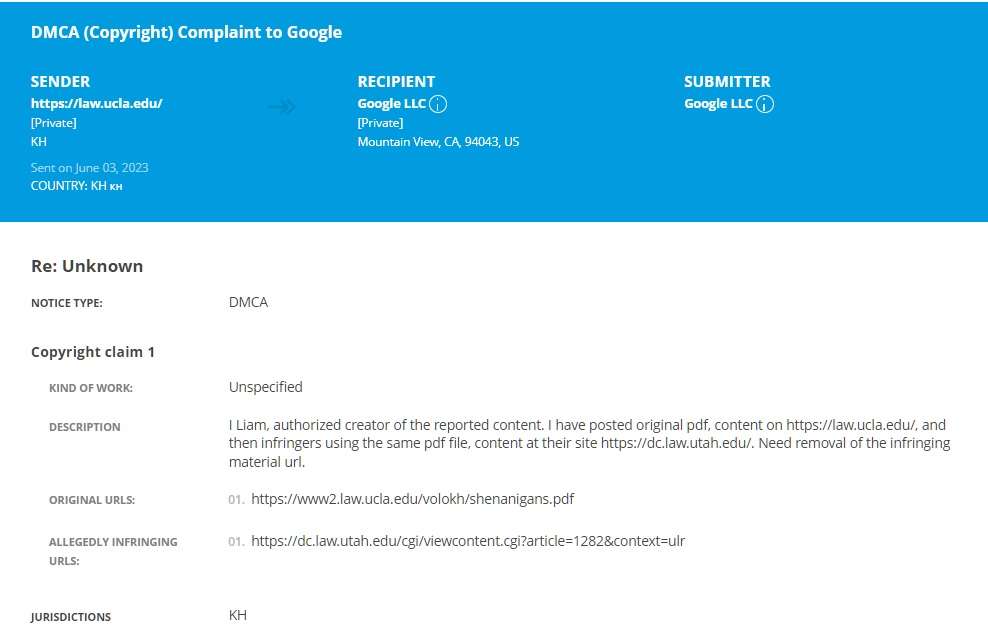
In 2021, I published Shenanigans (Internet Takedown Edition) in the Utah Law Review; the article is about people using various schemes—some of which included forgeries and frauds—to get material vanished from Internet search results. (You can read the Introduction below.)
Yesterday, I saw that someone tried to use a different scheme, which I briefly mentioned in the article (pp. 300-01), to try to deindex the Utah Law Review version of my article: They sent a Digital Millennium Copyright Act notice to Google claiming that they owned the copyright in my article, and that the Utah Law Review version was an unauthorized copy of the version that I had posted on my own site:
(That's a copy of the takedown demand that's archived at the Lumen Database.) Google has apparently recognized that this demand is unfounded, and hasn't blocked access to the "allegedly infringing URL[]." Too bad, Liam.
Here's the Introduction to my article, in case you're interested; you can also read the PDF here. Note that I have no reason to think that the DMCA notice stems from the particular case with which the Introduction begins; that's just one of the many fraudulent takedown requests that I discuss in my article.
That's the title of a new piece that Markus Funk,* Andrew S. Boutros,** and I*** have forthcoming in the Texas Law Review Online Edition. You can read it in PDF, or below; we still have plenty of time to edit it, so we'd love to see any corrections or suggestions. Here's the Abstract:
Adjunct professors are fixtures in law schools around the country. Yet they are among the least examined, least understood stakeholders in today's legal education industry. For example, few know that most law schools turn to adjuncts to teach more than 40% of their elective courses yet give them virtually no institutional voice; that adjuncts effectively pay for the privilege of teaching; and that a typical full-time professor makes roughly seven times more than an adjunct for teaching the very same course (while also costing the institution considerably more in overhead).
This thought piece, written by two long-term adjuncts and a tenured professor, conducts the first deeper-dive examination of the adjuncts' role in today's law schools. The article examines why adjuncts take on the responsibility of returning to school to teach, how laws schools and professors benefit from adjunct instructors, the professional and reputational risks facing today's adjuncts, and why—despite these challenges—adjunct teaching positions continue to be highly sought after.
In the final analysis, most U.S. law schools would be unable to continue operating as normal if this sea of legal temps suddenly decided to stop teaching. As such, it stands to reason that law schools each semester should be laser focused on ensuring that adjuncts are fully integrated into the institutional fabric and are otherwise made to feel welcomed and appreciated. But at present, too many law schools fall short on their efforts to foster a constructive community conducive to strengthening positive relationships between full-time faculty, administrators, staff, students, and adjuncts. We, therefore, wrap up this short excursion into the largely unseen economic, professional, and interpersonal realities facing today's law school adjunct instructors by suggesting practical steps these important institutions of higher learning can take to improve the relationship for the adjuncts, institutions, and students alike.
The question: Does the First Amendment allow content-based but viewpoint-neutral restrictions on which trademarks may be registered—here, a restriction on marks that "[c]onsist[] of or comprise[] a name ... identifying a particular living individual except by his written consent"?
Federal trademark law allows for the registration of trademarks, which provides certain benefits:
Registration on the principal register (1) "serves as 'constructive notice of the registrant's claim of ownership' of the mark"; (2) "is 'prima facie evidence of the validity of the registered mark and of the registration of the mark, of the owner's ownership of the mark, and of the owner's exclusive right to use the registered mark in commerce on or in connection with the goods or services specified in the certificate'"; and (3) can make a mark "'incontestable'" once a mark has been registered for five years." Registration also enables the trademark holder "to stop the importation into the United States of articles bearing an infringing mark."
Unregistered marks can still be used by their owner, and indeed can be protected from infringing uses—but trademark registration helps provide stronger protection.
In Matal v. Tam (the "SLANTS" case) and Iancu v. Brunetti (the "FUCT" case), the Court struck down certain limits on trademark registration that the Court viewed as viewpoint-based: the ban on marks that "disparage … persons, living or dead, institutions, beliefs, or national symbols" (Matal) and the ban on "immoral or scandalous" marks (Iancu). But the Court left open the question whether viewpoint-neutral but content-based limits on registration are constitutional.
Vidal v. Elster, which the Supreme Court agreed to hear today, deals with that very question. The federal trademark statute excludes from registration any marks
[c]onsists of or comprises a name, portrait, or signature identifying a particular living individual except by his written consent, or the name, signature, or portrait of a deceased President of the United States during the life of his widow, if any, except by the written consent of the widow.
As regular readers know, my book Classified: The Untold Story of Racial Classifications in America, was published in July. This is my first book since 2015, and the biggest difference in terms of publicizing this book has been the explosion of podcasts and webinars in the interim.
Some VC readers may have road trips or long plane rides coming up, and would be interested in listening to a podcast about it. I've done a lot of podcasts--just looking at the list below makes me tired--and I can't say I really have a favorite. So I'm just going to list the ones I have links to below, and let interested readers decide whether they expect to find one or another host especially interesting.
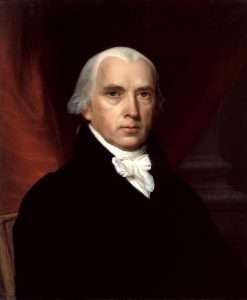
In a recent post at the Originalism Blog, legal scholar Rob Natelson criticizes me for relying on James Madison's Report of 1800 to support the conclusion that the original meaning of the Constitution does not give the federal government a general power to restrict immigration. Natelson contends that the Report has little relevance to the original meaning of the Constitution, and that it doesn't really address the issue of immigration restriction, in any event. In this post, I continue the discussion by respond to Natelson. I think he's wrong on both points.
Natelson's post is the latest contribution to an ongoing debate that began with my post critiquing conservative arguments claiming that illegal immigration qualifies as an "invasion" under under relevant provisions of the Constitution, and thereby empowers federal and state governments to use military force to prevent it. Andrew Hyman, one of those I criticized in that post, responded to me in a post I put up (with his permission) here at the VC blog. I posted a rejoinder in that same post. In both of my posts, I highlighted the passage in the Report of 1800 where Madison denies that immigration qualifies as "invasion" and therefore denies that the Alien Acts of 1798 (and federal immigration restrictions generally) were authorized by the invasion provisions of the Constitution.
While my exchange with Hyman was mostly focused on the "invasion" issue, Natelson broadens the focus by considering the more general relevance of the Report of 1800. He contends that the Report has little relevance for modern debates over federal power over immigration because "it was primarily directed at deportation, and a closer reading of this passage shows Madison was discussing only deportation, not immigration per se." I already addressed this point in some detail in my rejoinder to Hyman, where I pointed out that the Alien Friends Act of 1798 (which Madison, in the Report, argued was unconstitutional in its entirety) actually went far beyond mere deportation authority.
Much the same response applies to Natelson's claim that Madison's argument applies only to aliens who entered the United States legally. The whole point of Madison's position is that the federal government lacked the power to bar the entry of foreigners from countries not at war with the United States. Natelson may well be right to suggest that Madison's position would still allow the US to bar individuals engaged in armed hostilities against the US, even if they were citizens of countries whose governments were not at war with the US government. But merely crossing a border in contravention of a US law does not constitute such - especially if that law were a federal law that Madison denied to be constitutional in the first place. I covered these issues in some detail in my earlier posts addressing the "invasion" issue and Hyman's arguments.
Natelson also makes a more general argument against relying on the Report to shed light on the text and original meaning of the Constitution, based on the fact that it was written a decade after ratification:
There are all sorts of reasons why post-ratification statements are generally useless for showing ratification-era understanding. Here are some:
* Memories fade.
* Ratification-era participants who might have contradicted those statements often were not around to do so: When the 1800 Report was published, such leading participants in the constitutional debates as Benjamin Franklin, Patrick Henry, George Mason, Roger Sherman, Melancton Smith, and George Washington were all dead. John Rutledge was still alive, but suffering from mental illness. Rufus King was abroad. And so forth.
* Incentives change. The same person who, when presenting the Constitution to the public in 1788, had an incentive to characterize the federal government's powers one way, often had an incentive to characterize them differently later on. By way of illustration, the difference is great between Alexander Hamilton's constitutional arguments in Federalist No. 16 (prior to ratification) and in his Report on Manufactures (after ratification).
* Alliances change. In particular, they changed dramatically after the first session of the First Federal Congress, as the case of Madison illustrates: Prior to that time, he was allied with Hamilton. After that time, he was allied with Thomas Jefferson.
* Context and language change.
Using Madison's 1800 Report to show the understanding of the ratifiers a decade earlier is subject to all of those objections.
If this is correct, it invalidates not only the use of the Report of 1800 to shed light on constitutional meaning, but the use of any post-ratification material. Thus, judges, historians, legal scholars, and others are wrong to rely on 1790s debates over the Bank of the United States, the assumption of state debts, the use of foreign affairs powers in US relations with Britain, and France, and much else. The same goes for extensive judicial and scholarly reliance on Reconstruction-era evidence to shed light on the meaning of the Thirteenth, Fourteenth, and Fifteenth Amendment. A high percentage of what we know (or at least think we know) about the original meaning of the Constitution would have to be rejected.
Some of Natelson's concerns here are reasonable. For example, it is true that memories fade and that politicians might opportunistically shift positions in response to new political circumstances and alliances. But I don't think this counsels total or near-total rejection of post-ratification material. The latter is simply too valuable to reject entirely. In many situations - including this one - it gives extensive evidence of understanding of constitutional meaning by the very people who drafted and ratified the provisions in question, often even addressing issues similar to those that led the Constitution (or a given amendment) to be enacted in the first place.
James Madison's views on federal power over immigration are a dramatic example. He was clearly one of the most important drafters of the Constitution, as well as a key participant in the ratification process. And, while it is true that some framers and ratifiers had died by 1800, the audience he wrote the Report of 1800 for included large numbers of people who well remembered the framing and ratification and could be expected to object if they thought Madison got it wrong.
Instead of wholesale rejection, we should - on a case-by-case basis consider whether a given post-ratification statement, whether by Madison or anyone else, is likely to be a product of later political shifts or not. In this case, the answer is probably not. Madison's denial that the federal government had power to exclude "alien friends" is entirely consistent with positions he took during the ratification debates, such as his rejection, in Federalist 42, of claims that the the Migration or Importation Clause of the Constitution (which prevented Congress from barring the "migration or importation of such Persons as any of the States now existing shall think proper to admit" until 1808) implied that Congress otherwise had a general power to "prevent voluntary and beneficial emigrations" (as opposed to restricting the slave trade and the migration of indentured servants). Madison's position here would make little sense if, in fact, he believed that Congress had a general power to exclude migrants anytime it wanted, subject to limitations that would expire in 1808.
Natelson argues that Madison had shifted alliances from Hamilton to Jefferson between ratification and 1800. But, while Madison and Hamilton were allied in seeking ratification of the Constitution, Madison and Jefferson were also close political allies in the 1780s, and always had far more in common on both constitutional and political issues than either had with Hamilton. At any rate, Madison never endorsed the constitutionality of federal restrictions on the migration of "alien friends" and his position on this issue is a natural outgrowth of his generally narrow interpretation of federal power from the ratification debates onwards.
Much more can be said about these issues. Among other things, the "invasion" rationale for immigration restrictions is just one of several that has been advanced to justify federal power over immigration. I discussed many of the others here, and am in the process of working on a much more in-depth academic treatment of these issues. In the present exchange with Hyman and Natelson, I hope only to explain why the invasion theory is flawed, and why Madison's Report both supports that position, and is a relevant and valuable source of evidence.
I thank both Natelson and Hyman for their thoughtful contributions to this debate, and for pushing me to elaborate further on some of the issues involved.
From Peterson v. Harris, decided Friday by the California Court of Appeal, in an opinion by L.A. Superior Court Judge Audra Mori, joined by Justice Audrey Collins and L.A. Superior Court Judge Helen Zukin:
In January 2021, plaintiff Sabrina Peterson posted a video and messages to her Instagram account accusing defendants Clifford and Tameka Harris (entertainers who perform under the stage names "TI" and "Tiny") of various forms of sexual and physical abuse. Peterson also accused Clifford of previously threatening her with a handgun. Clifford, Tameka, and Tameka's friend, codefendant Shekinah Jones Anderson, responded to Peterson through their social media accounts.
Peterson sued for libel, false light, and intentional infliction of emotional distress (among other torts); the Harrises filed an anti-SLAPP motion, but the Court of Appeal concluded that Peterson's claim can go forward. First, Peterson's factual allegations:
Peterson is an award-winning business coach, entrepreneur, and founder of Glam University, a company designed to "coach women who are interested in entrepreneurship." The Harrises are well-known musicians, producers, and television personalities. Codefendant Anderson is a reality television personality who has appeared on a television show covering the Harrises.
In Stay You, LLC v. H&M Hennes & Mauritz, LP (S.D.N.Y.), plaintiff is claiming that defendant's use of the phrase "Stay True Stay You" infringes plaintiff's trademark "Stay You," and the defendant is arguing (among other things) that "the Urban Dictionary definition of 'Stay You" is strong evidence that the phrase is in common usage and therefore also diminishes the strength of Plaintiff's mark." But Judge Kimba Wood concluded Friday that the definition was inadmissible:
There is little Second Circuit case law regarding the admissibility of Urban Dictionary definitions. Where courts have referenced Urban Dictionary, they have typically done so only in passing to explain unfamiliar slang words or common phrases….
[T]he definitions should be excluded [in this case] under Rule 403 due to their lack of probative value. Urbandictionary.com is a crowdsourced online dictionary that allows users to anonymously publish their own definitions. The website provides few content guidelines for users. Content Guidelines, URBAN DICTIONARY (instructing users to "be creative [and] have fun"). When a user submits a definition, it goes through a perfunctory review process before it is published online. A single word can have hundreds of definitions submitted by various users over the years. Due to the constantly expanding nature of the website, Urban Dictionary explicitly states that it "does not and cannot review all Content published to the Website or created by users accessing the Website[.]"
For these reasons, the Urban Dictionary definitions upon which Plaintiff relies are unreliable. Their probative value is substantially outweighed by the danger of (1) confusing the issues (i.e., the jury may incorrectly assume the definitions of "Stay You" or "Stay True" are at issue), (2) misleading the jury about the strength of Plaintiff's mark or Defendant's fair use defense, or (3) wasting time….
During the COVID-19 pandemic, some states experimented with incentives to encourage people to get vaccinated. Ohio was one. Early indications were that such incentives helped, but subsequent studies cast doubt on that conclusion.
A new systematic review of studies looking at the effect of economic incentives on vaccine uptake published in Preventative Medicine concludes that they appear to encourage vaccination after all.
Here is the abstract:
Financial incentives are a controversial strategy for increasing vaccination. In this systematic review, we evaluated: 1) the effects of incentives on COVID-19 vaccinations; 2) whether effects differed based on study outcome, study design, incentive type and timing, or sample sociodemographic characteristics; and 3) the cost of incentives per additional vaccine administered. We searched PubMed, EMBASE, Scopus, and Econlit up to March 2022 for terms related to COVID, vaccines, and financial incentives, and identified 38 peer-reviewed, quantitative studies. Independent raters extracted study data and evaluated study quality. Studies examined the impact of financial incentives on COVID-19 vaccine uptake (k = 18), related psychological outcomes (e.g., vaccine intentions, k = 19), or both types of outcomes. For studies of vaccine uptake, none found that financial incentives had a negative effect on uptake, and most rigorous studies found that incentives had a positive effect on uptake. By contrast, studies of vaccine intentions were inconclusive. While three studies concluded that incentives may negatively impact vaccine intentions for some individuals, they had methodological limitations. Study outcomes (uptake versus intentions) and study design (experimental versus observational frameworks) appeared to influence results more than incentive type or timing. Additionally, income and political affiliation may moderate responses to incentives. Most studies evaluating cost per additional vaccine administered found that they ranged from $49–75. Overall, fears about financial incentives decreasing COVID-19 vaccine uptake are not supported by the evidence. Financial incentives likely increase COVID-19 vaccine uptake. While these increases appear to be small, they may be meaningful across populations.
The article is here; here are the Introduction and Part I:
This chapter addresses an underappreciated source of epistemic dysfunction in today's media environment: true-but-unrepresentative information. Because media organizations are under tremendous competitive pressure to craft news that is in harmony with their audience's preexisting beliefs, they have an incentive to accurately report on events and incidents that are selected, consciously or not, to support an impression that is exaggerated or ideologically convenient. Moreover, these organizations have to engage in this practice in order to survive in a hypercompetitive news environment.
To help correct the problem, this chapter outlines new forms of newsgathering tools that leverage digital information to provide a sense of how representative (or not) any particular event may be. This contextualizes the news and leads to more sober—that is, less hyperbolic and reactive—interpretations of it. Newsgathering institutions can also become much more interactive so that a participant has the ability to easily find facts that they are confident will not be tainted from the strategic selection or cherry-picking of a news authority or intermediary. These tools will make newsgathering more self-guided.
[I.] The Proliferation of True-but-Misleading News
Many beliefs circulating through American discourse at any given time are in some sense corrosive—to society, to personal health and safety, or to some other part of life. The path to these corrosive beliefs is tiled with true-but-misleading information. Although the American news landscape is marred by some wholly made-up stories (that the COVID vaccine includes trackers, for example), these falsities make up a relatively small set of corrosive beliefs. Most corrosive beliefs have some factual corroboration—some true anecdotes that undergird the beliefs. But the factually true anecdotes imply something larger that is not supported by more representative data.
Properly crafted restrictions on displays of pornographic material where minors can see it are constitutional; but the court rules, among other things, that this restriction (1) discriminatorily targets drag shows, (2) lacks an exemption for minors escorted by parents, (3) applies even to venues that try to card attendees but are duped by a fake ID.
… "Adult cabaret entertainment" … [m]eans adult-oriented performances that are harmful to minors, as that term is defined in § 39-17-901, and that feature topless dancers, go-go dancers, exotic dancers, strippers, male or female impersonators, or similar entertainers; …
"Entertainer" means a person who provides: (A) Entertainment within an adult-oriented establishment, … or (B) A performance of actual or simulated specified sexual activities, including removal of articles of clothing or appearing unclothed, [both] regardless of whether a fee is charged or accepted for the performance …;
It is an offense for a person to perform adult cabaret entertainment:
(A) On public property; or
(B) In a location where the adult cabaret entertainment could be viewed by a person who is not an adult ….
To understand this, one has to read § 39-17-901, which provides: