Yesterday, a jury in the District of Columbia ruled for climate scientist Michael Mann in his long-running defamation suit against writers Mark Steyn and Rand Simberg, for blog posts the two had written challenging the validity of his research and comparing Penn State's investigation into Mann's alleged misconduct with the University's whitewash of Jerry Sandusky. The suit was initially filed in 2012, and initially included National Review and the Competitive Enterprise Institute as defendants.
The jury awarded Mann nominal compensatory damages of $1 against each defendant, but then added punitive damage awards of $1 million against Steyn and $1,000 against Simberg. I would think that these damages--if not the verdict itself--are likely to be appealed.
The punitive damages would seem to be the most vulnerable part of the judgment. Under existing Supreme Court precedent, excessive punitive damages violate Due Process. So, for example, in BMW of North America v. Gore, the Court held that a punitive damage award of $2 million was excessive given that the plaintiff had only been awarded $2,000 in compensatory damages. This 1000-to-1 ratio, the Court held, could not be justified even considering the extent to which the defendant had engaged in egregious conduct.
There is some question whether BMW would continue to attract a majority of the Court today. That decision was 5-4. Justice Stevens wrote the majority, joined by Justices O'Connor, Kennedy, Souter, and Breyer. Justices Scalia, Thomas, Ginsburg and Rehnquist dissented. Nonetheless, the BMW holding is binding on lower courts.
This long-running litigation may not be over. Steyn's camp has indicated they intend to challenge the punitive damages award (if not other aspects of the decision). Mann's attorney also told the NYT they still plan to appeal the prior decisions that had removed CEI and National Review from the case: "Asked about Competitive Enterprise Institute and National Review, John Williams said, 'They're next.'"
DISCLOSURE: As I'venoted in priorposts on this case, I am a contributing editor at National Review Online, which means I have a fancier byline when I submit articles to the publication and occasionally contribute to The Corner and Bench Memos. It is not a salaried position. I also worked at the Competitive Enterprise Institute from 1991 to 2000 — many years before the events at issue in this litigation. If either of these facts makes you suspect bias on my part, so be it.
The oral argument in Trump v. Anderson was not the only activity at the Supreme Court yesterday. The Court also issued opinions in two argued cases -- the second and third decisions to be released this term.
In Department of Agriculture Rural Development Rural Housing Service v. Kirtz, a unanimous Court held that a consumer may sue the U.S. Department of Agriculture for money damages under the Fair Credit Reporting Act because the Act waived the federal government's sovereign immunity. Justice Gorsuch wrote for the Court.
In Murray v. UBS Securities, the Court held that under the whistleblower protection provisions of the Sarbanes-Oxley Act, a whistleblower challenging an employer's adverse employment action must prove that his protected whistleblowing activity was a contributing factor in the employer's unfavorable personnel action, but does not have to prove that the employer acted with "retaliatory intent." Justice Sotomayor wrote for the Court. Justice Alito filed a separate concurring opinion joined by Justice Barrett.
This seems like a a slow pace for the issuance of opinions, but not as slow as last year, when the Court had only issued one opinion in an argued case. In OT 2021, by contrast, the Court had issued ten opinions in argued cases, though several of those (WWH v. Jackson, US v. Texas, Biden v. Missouri, and NFIB v. OSHA) had been heard on an expedited basis. Pre-Covid, at the start of OT2019, the Court had also only issued three opinions in argued cases at this point (though it had also decided two cases summarily with per curiam opinions).
[Note: This is the tenth and hopefully the last – at least for now; we won't promise that we won't ever write more on this topic! – in a series of essays responding to objections that have been made to enforcing Section Three of the Constitution. The first nine essays can be found here, here, here, here, here, here, here, here, and here.]
Since last fall, when our article The Sweep and Force of Section Three was accepted for publication by the University of Pennsylvania Law Review and first posted on SSRN, we have received further comments and suggestions about the draft and taken them into consideration as we have gone through the editing process. As noted at the outset of this series, none of these comments has led us to reconsider and change our core substantive propositions in a major way. As the article goes to press in the next few weeks, it remains very close in substance to the versions from last fall. (We are grateful for all the comments and suggestions, and especially thank all who identified errors in the manuscript.)
We have made just one more meaningful substantive change since September, which we wish to note publicly before the article is published. Though the article is set to appear in print sometime this month, it might not beat the Supreme Court's decision in Trump v. Anderson to press. Indeed, it is a small irony that even though our article was written and posted before these lawsuits were filed (and with no contemplation of immediate litigation) the Supreme Court might nonetheless win the race to publication, leaving some aspects of our article potentially overtaken by events. (We would strongly resist, however, any notion that a law review article becomes "moot" in consequence of a Supreme Court decision! Our views remain our views, and remain correct, or not, whether the Supreme Court embraces them, or not.)
At all events, if we do not mention a substantive change in the content of the article now, nobody might ever notice it. (Or, equally troubling, people might notice and think we surreptitiously altered the manuscript, just before publication, to take account of the Court's decision.)
The change occurs beginning in the place of the draft that occupies pages 32-33 of the version now posted on SSRN. We are discussing the various situations in which different governmental actors might possess duties or powers that provide occasion for application of Section Three as a legal rule. In the course of considering certain "Special Situations" (p. 29), we consider who all might have authority to enforce Section Three with respect to the constitutional ineligibility of an individual for the office of President of the United States. We argue that state election officials, courts, and presidential electors all have the responsibility to faithfully apply Section Three's constitutional disqualification rule, each within the sphere of its respective powers and duties under state or federal law.
We then turn to this question: Does the Twelfth Amendment (and relevant federal law), by providing for a joint session of Congress in which the votes of electors for President and Vice President, transmitted sealed to the seat of government, are then opened and counted, implicitly confer upon Congress authority not to count votes cast for a candidate who is constitutionally ineligible by virtue of Section Three of the Fourteenth Amendment.
In the version of the article posted on SSRN, we stated categorically that the answer was No: Congress possesses no power to reject on substantive grounds votes actually cast by electors (as opposed to a power to determine the authenticity of the submitted votes; that is, whether the votes to be counted were actually the votes cast by the electors of the state).
While we have not changed our ultimate conclusion – we still believe that the better answer is that Congress currently lacks a substantive power to evaluate the propriety of votes cast by electors – we have changed the level of certainty with which we express this conclusion. And we have also set forth at greater length the competing arguments on both sides. We have become persuaded by many discussions that the argument for an implied power of the joint session of Congress to decline to count electoral votes cast for a constitutionally disqualified candidate is at least plausible, even though we ultimately disagree with it.
Here is how the text of our article now reads on this point, as scheduled for publication sometime very soon. (We have omitted the footnotes):
Section 3 of the Fourteenth Amendment and the Incompatibility Clause both apply to "officers under the United States" and must thus mean the same thing
The oral argument today in Trump v. Anderson strongly suggests a Trump victory on the grounds advanced heroically by Josh Blackman and Seth Barrett Tillman. Many kudos to them both for the long and successful campaign that they have waged. The Court will likely reverse the Colorado Supreme Court based on Griffin's Case, the absence of congressional legislation enforcing Section 3, and the prudential and pragmatic arguments made in Section 3 of the Brief signed by Attorneys General Edwin Meese III, Michael B. Mukasey, and William P. Barr, as well as by me and Gary Lawson.
Justices Ketanji Brown Jackson and Neil Gorsuch made a valiant but unsuccessful attempt to get Trump's attorney to address the other plausible off ramp for the Supreme Court in this case, which is the argument that Section 3 does not apply to the President of the United States. They offered definitions of the phrase "officer of the United States" and of the word "office" and of the word "officer", but they never forced Trump's awful lawyer to say anything about the meaning of the phrase "office *** under the United States", which language appears in exactly that formulation in both Section 3 of the Fourteenth Amendment and in the Incompatibility Clause.
If the presidency is an "office *** under the United States" that covers Donald Trump under Section 3, of the Fourteenth Amendment, then it has to also be an "Office under the United States" for the purposes of the Incompatibility Clause, which bars Members of Congress from holding any "Office under the United States." That would mean that the Presidential Succession Act of 1947 is unconstitutional because it allows either the Speaker of the House of Representatives or the President Pro Tempore of the Senate to serve simultaneously as a Member of either House and to hold the Presidency in the absence of both a President and a Vice President, which Presidency is wrongly said to be an "Office under the United States".
The Founding Fathers included legislative officers in the line of succession to the President, in 1792, in the Second Congress, in which many framers of the Constitution sat. President George Washington signed the 1792 Presidential Succession Act into law disregarding a complaint by Rep. James Madison that legislative officers could not be put in the line of succession to the Presidency because doing so would violate the Incompatibility Clause. President Washington and the Framers in the second Congress did not think that the Presidency was an "Office under the United States" for the purposes of the Incompatibility Clause. This is dispositive proof that the Presidency is also not an "office *** under the United States" for the purposes of Section 3 of the Fourteenth Amendment.
The justices might well overrule the Colorado Supreme Court on the grounds that only Congress has power to enforce Section 3 of the 14th Amendment. Such a ruling would be a serious mistake.
Today's Supreme Court oral argument in Trump v. Anderson overwhelmingly focused on the issue of whether Section 3 of the Fourteenth Amendment is "self-executing," that is whether states can enforce it in the absence of congressional legislation. Most of the other issues at stake in the case got little or no attention. For example, there was almost no discussion of the question of whether the January 6 attack on the Capitol was an "insurrection" and whether Trump "engaged" in it.
Both liberal and conservative justices repeatedly raised questions about whether letting states enforce Section 3 would lead to a lack of uniformity, and whether states could abuse their authority by trying to disqualify people for political reasons. Given the extensive focus on this issue and the relative neglect of others, there is a good chance that the Court will overrule the Colorado decision on that basis. Strikingly, the questioning focused much more on pragmatic concerns about chaos and abuse than on more traditional legal issues about the text, structure, and original meaning of Section 3. The self-execution question may also appeal to the justices because it is an "off ramp" that would allow them to dispose of this hot potato without having to pass judgment on the nature of the January 6 attack on the Capitol and Trump's egregious actions in inciting it and trying to use it as leverage to force Congress to keep him in power after losing the 2020 election.
But it would nonetheless be a mistake to decide the case in that way. Nothing in the text or original meaning of the Fourteenth Amendment require congressional legislation to enforce it. Indeed, multiple ex-Confederates were adjudged disqualified in the aftermath of the Civil War even without any such enforcement legislation, which suggests a broad understanding that disqualification does not depend on congressional action. Section 5 of the Fourteenth Amendment does give Congress the power to enact "appropriate" enforcement legislation. But there is no indication that this power is exclusive. And the Court has repeatedly allowed self-enforcement for other parts of the Fourteenth Amendment, even though Section 5 applies to them, as well.
Practical concerns about non-uniformity and abuse are understandable. But they are overblown. If state officials or state courts reach unsound or contradictory legal conclusions about the meaning of Section 3 (e.g. - by adopting overbroad definitions of what qualifies as an "insurrection"), their determinations could be reviewed in federal court, and the Supreme Court could impose a uniform definition of the terms in question. Indeed, it could do so in this very case! Non-uniform interpretations of provisions of the federal Constitution by state and lower federal courts can occur in many contexts. Settling such issues is one of the reasons why we have a Supreme Court that can be the final arbiter of federal constitutional questions.
In 2016, there was litigation in multiple states over claims brought by Trump supporters to the effect that Sen. Ted Cruz, his chief rival for the GOP presidential nomination, was not a "natural born" citizen (Cruz was born in Canada to US-citizen parents). Courts in different states could have reached divergent conclusions on the issue of whether a child born to US citizens while the latter resided abroad counts as "natural born" (it so happens they did not). Yet no one doubted state courts could decide this issue, subject - of course - to potential review by the federal Supreme Court.
Courts in different states could also potentially reach divergent conclusions about factual issues (e.g. - whether a particular person was involved in the insurrection or not). But that's a problem that can arise in any adjudication of candidate qualifications. Thus, no one doubts that state courts can adjudicate whether a candidate for president meets the requirements that he be 35 years old, and a "natural born" citizen of the United States. But if, for example, there is a factual dispute about the validity or accuracy of the candidate's birth certificate (recall "birtherist" claims that Barack Obama wasn't actually born in the United States), courts in different states could potentially reach divergent factual conclusions on that, as well.
Even on factual issues, serious abuses can be constrained by the power of the Supreme Court to review lower-court factual findings for "clear error." If lower courts or state officials make things up out of whole cloth or go against the clear weight of evidence, that can still be overturned.
While many of the justices seem to have overestimated the downside of allowing enforcement by states, they seemingly ignored the downside of ruling that the power belongs exclusively to Congress. As a practical matter, the latter turns Section 3 into a dead letter - not just for insurrectionist presidents, but for everyone else. It's highly unlikely Congress will enact new enforcement legislation at any time in the near future.
Before Trump's attempt to overturn the 2020 election and the resulting January 6 attack on the Capitol, it may have seemed that gutting Section 3 is no big deal, because there was little chance it would be needed. But we can no longer assume such complacency is justified. If future presidents and other officeholders do not face disqualification for insurrection, they might well conclude that imitating Trump's example is a worthwhile gamble. If you succeed, you get to stay in power despite losing an election! And if you fail, you can still seek office again in the future.
At one point, Justice Kavanaugh suggested that 18 U.S.C. Section 2383, the federal criminal insurrection law, qualifies as an exclusive enforcement statute. For reasons explained in Part I.B of my amicus brief, that simply isn't true. In addition, requiring a criminal conviction for insurrection will make enforcement impossible in situations where getting one is difficult or impossible, or where prosecutors choose to pursue other charges instead.
While the vast bulk of oral argument time was devoted to the self-execution issue, there was also some discussion of the issue of whether the presidency is covered by Section 3. Here, Trump lawyer Jonathan Mitchell made some striking concessions. For example, he conceded there is no good reason why an insurrectionist president should be excluded from coverage. Indeed, as he noted, the case for covering the president is actually stronger than that for covering other offices, given that the president is commander-in-chief of the armed forces, thereby making an insurrectionist president a far greater menace than an insurrectionist member of Congress or lower-level executive official. He also admitted that people at the time feared that a former Confederate such as Jefferson Davis could potentially become president.
Mitchell tried to suggest that the exclusion of the presidency was the result of a "compromise." But such a compromise could only occur if some people had a reason why they wanted to exclude the highest office in the land from Section 3's coverage. If, as Mitchell admitted, no such reason exists, there is no basis for believing that a compromise on this point was made.
Early on, a good chunk of time was also spent on Mitchell's creative argument that Section 3 cannot be enforced until an official has actually taken office, because until then Congress can also lift his disability by a 2/3 majority vote of each House. This is a badly flawed argument, and I don't think it got much traction with the Court. But Mitchell and Trump won't need to rely on this theory if they can win on self-enforcement, as now seems probable.
In sum, the most likely outcome is that the Court will rule in Trump's favor on the grounds that Section 3 is not self-enforcing. It's a bad argument that would set a dangerous precedent by effectively gutting Section 3. But it obviously appeals to the justices, for reasons that see more pragmatic in nature than legal.
As regular readers will know, Seth Barrett Tillman and I have spent untold hours over the past six months, and really past three years, on Section 3. But when I walked into the Supreme Court this morning, I felt a sense of closure. All of the arguments that had to be made were made--Seth and I were up till about 10:30 pm last night, working in person (for once) on a final post. Now, the only thing left to do was sit back, relax, and hear what the Justices had to say.
The arguments did not go exactly as I expected, but it was a very rewarding experience. And I suspect that Trump will win big league. Here are my immediate reactions, made based on my hand-scrawled notes. (I may write more when the transcript is released.)
Griffin's Case, which was barely mentioned in Petitioner's opening brief, occupied a lot of the argument. Our amicus brief and article led off with Griffin's Case. We've always seen this decision as a key ground of resolving the case. Justice Kavanaugh referred to the status of Griffin's Case as "liquidated" in light of Federalist 37. Tillman and I made that point expressly in our brief at p. 5.
Although not binding, courts at all levels have seen Griffin's Case as persuasive. Griffin's Case has settled the meaning of Section 3. See Federalist No. 37 (Madison) (discussing liquidation).
If the Court adopts Griffin's Case, the sword/shield dichotomy that Tillman and I advanced will be useful. The dichotomy helps to reconcile Griffin's Case with the Case of Jefferson Davis. Our brief stated at page 9:
Finally, it is these "two distinct senses of self-execution" which "reconciled in a principled manner" Griffin's Case and Chase's decision in the Case of Jefferson Davis. See Co.Sup.Ct.¶299 (Samour, J., dissenting) (citing Blackman & Tillman, supra, at 484–505).
Jonathan Mitchell acknowledged this tension between Griffin's Case and the Case of Jefferson Davis in response to Justice Sotomayor, but did not attempt to reconcile it. Moreover, that dichotomy helps to explain the direct appeal/collateral challenge question that Justice Barrett raised. The Constitution can always be raised as a defense on direct appeal. But the Constitution can only be used as a sword with a cause of action for a collateral challenge. (Our motion for leave to participate in oral argument identified the sword/shield distinction as one where we were not on the same page as the Petitioner).
Justice Ketanji Brown Jackson was the most interested questioner on whether the presidency was an "Office under the United States." She alluded to Kurt Lash's important research. Jonathan Mitchell pushed back against that argument, fearful of what it would mean for the Foreign Emoluments Clause. That must have been Mitchell's strategy going into the Court, but he could have pivoted when he heard Jackson's repeated entreaties. At times it seemed like Jackson was Trump's lawyer and Mitchell was Colorado's lawyer. (Our motion for leave to participate in oral argument identified this as another area where we were not on the same page as the Petitioner).
Justice Gorsuch was the most interested questioner on whether the President was an "Officer of the United States."He asked about the Commissions Clause in particular. He also inquired several times about our the Speaker and the Incompatibility Clause--a point Tillman and I have advanced. He suggested that the Blackman-Tillman position may be "odd," but it is what the text says. The citations to Bostock in our brief reflected this approach. Justice Sotomayor (I am almost certain) referred to us as "some scholars." Justice Kagan interrupted Justice Jackson, and joked about that "officer stuff." The Chief smiled. I'll take it.
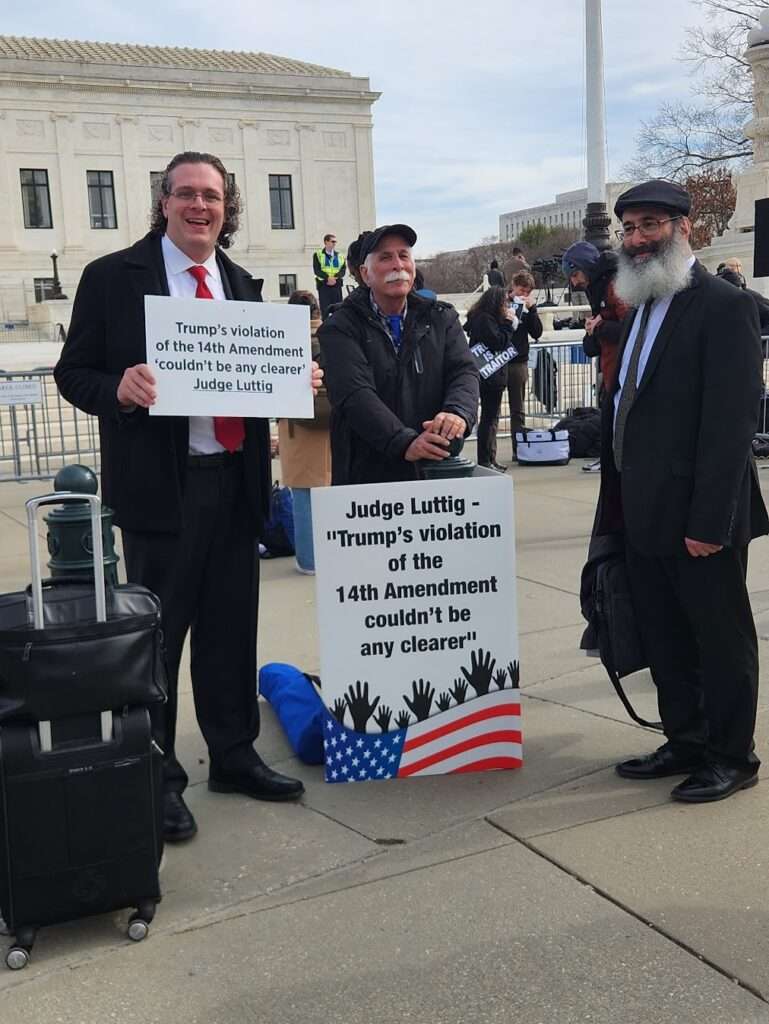
After we left the Court, Seth and I took what I imagine will be a Dewey-defeats-Truman photo.
I asked Prof. Akhil Amar whether he was inclined to respond to Prof. Lash's response to the Amar brothers' amicus brief in Trump v. Anderson, and Prof. Amar suggested that I might publish a reply by Prof. Amar's research assistants at Yale Law School (Arshan Barzani, Samarth Desai, Jacob Hutt, and Jordan Kei-Rahn), which I am glad to do; all that follows below is their work:
[* * *]
We are research assistants to Professor Akhil Reed Amar at Yale Law School. We write to address some spirited but misguided critiques Professor Kurt Lash has made in response to the amicus brief of Professor Amar and Professor Vikram Amar in Trump v. Anderson.
Respectfully, we also write to raise serious concerns about the reliability of Professor Lash's writings on Section 3 and to make clear what the historical record does—and does not—say.[1]
By answering seven questions, we will show that (1) there was a First Insurrection, (2) John B. Floyd, in addition to other Buchanan Administration officials, participated, (3) Section 3 is self-executing, and (4) Section 3 covers the presidency.
Today, the Supreme Court will hold oral arguments in Trump v. Anderson, the case addressing whether Donald Trump is disqualified from the presidency under Section 3 of the Fourteenth Amendment. Co-blogger Josh Blackman and I discussed and debated the case for almost an hour on C-SPAN's Washington Journal program. As regular readers know, Josh believes the Court should rule Trump is not disqualified, while I think they should rule that he is.
The video is available here. If I can figure out a way to embed it in this post, I will do so. But so far, I have not been able to.
My amicus brief in the case, which argues that disqualification under Section 3 does not require a prior criminal conviction, is available here. I have previously written about other issues related to the Section 3 litigation, most extensively here and here.
Josh's amicus brief (written on behalf of Prof. Seth Barrett Tillman) is available here.
[Note: This is the ninth in a series of essays responding to objections that have been made to enforcing Section Three of the Constitution. The first eight essays can be found here, here, here, here, here, here, here, and here.]
A question regularly raised about our interpretation and explication of Section Three is how its rules might bear on various different factual patterns, real or imagined. Does conduct of a particular description, in a specific set of circumstances, on its own unique facts, constitutes having "engaged in" "insurrection or rebellion" within the meaning of the Constitution? What about this situation? What about this one?
Accepting as given our account of Section Three's terms – "insurrection," "rebellion," "engaged in," "aid or comfort to" – folks frequently ask how these legal definitions and standards apply to a variety of real or hypothesized situations. Our answer is that the facts matter. Further, the determination of what the facts are is by and large committed to the legal process – the record amassed at trial and the ensuing judgment of the trier of fact.
As we put it in our forthcoming article, The Force and Sweep of Section Three, it "is not for us to say who all is disqualified by virtue of Section Three's constitutional rule." (Ms. at 126).
That is the duty and responsibility of many officials, administrators, legislators, and judges throughout the country. Where they are called on to decide eligibility to office, they are called on to enforce Section Three, applying the Constitution's legal standard to the facts before them in a given instance.
The point is worth repeating, sharpening, and emphasizing: whether and precisely how the legal standards of Section Three apply in particular cases are matters to be determined in the usual manner that questions of how the law applies to a particular set of facts are determined. They are decided by the usual legal processes of a civil trial in which a trier of fact – a judge or a jury, depending on the type of case and in some circumstances the choices of the parties – determines what the true facts are, when there is a genuine dispute over facts material to how the relevant legal standard applies.
Professor Amar's argument renders the presidential succession acts of 1792 and 1947 unconstitutional by barring putting the Speaker of the House of Representatives and the President Pro Temper of the Senate in the line of succession to the presidency
Professors Akhil Reed Amar and David Vikram Amar argue that President Donald Trump is covered by the phrase in the Fourteenth Amendment, Section 3, that disqualifies a person who holds "any office *** under the United States" from being eligible to be elected President, if he has engaged in an insurrection, after swearing an oath to support the Constitution. The Amar brother's position is that the presidency is an "office *** under the United States", and that Donald Trump is disqualified from being elected President in 2024 even though the entire Republican Party overwhelmingly wants Trump to be their nominee.
The Incompatibility Clause of Article I, Section 6 says that "no Person holding any Office under the United States, shall be a Member of either House during his Continuance in Office." And, the Presidential Succession Clause of Article II, Section 1 says that in the event of a vacancy in both the presidency and the vice presidency "Congress may by Law [declare] what Officer [legislative or executive] shall then act as President." For most of American history, the Speaker of the House of Representatives and the President Pro Tempore of the Senate have been ahead of the Cabinet in the line of succession to the presidency. That arrangement is as American as apple pie.
Under Professor Amar's theory that the President holds an Office under the United States for the purposes of Section 3 of the Fourteenth Amendment, it is unconstitutional for Congress to put the Speaker of the House of Representatives or the President Pro Tempore of the Senate in the line of succession to the Presidency, as Congress has done since 1947, because doing so would violate the Incompatibility Clause. (A Member of either House would unconstitutionally get to hold, simultaneously, their congressional seat and an Office under the United States while they served as Acting President).
In fact, the Presidential Succession Act of 1792, which was passed by the Second Congress, which was full of framers of the Constitution, and which was signed into law by President George Washington put legislative officers in the line of succession to the presidency because the Founding Fathers did not believe that the Presidency was an Office under the United States. The Founding Fathers discussed and debated this very question, and James Madison lost while making the exact same argument that the Amar brothers make as to Section 3 of the Fourteenth Amendment that the Presidency is an Office under the United States.
The Amar brothers think that our current setup of having legislative officers in the line of succession to the presidency is unconstitutional as they argued in print in Akhil Reed Amar & Vikram David Amar, Is the Presidential Succession Law Constitutional?, 48 Stanford Law Review 113 (1995-1996). I once agreed with the Amar brothers on this issue but have since changed my mind. I strongly doubt that the nine current justices of the Supreme Court realize that any ruling that Donald Trump is ineligible to be on the Colorado primary ballot will end up as a side-effect gutting the Presidential Succession law.
The Supreme Court in Trump v. Anderson should not hold that the Presidency is an office under the United States because, if it does so, the Presidential Succession Acts of both 1947, and of 1792, would be rendered unconstitutional, even though the Founding Fathers meant for legislative officers to be eligible to be put into the line of succession to the Presidency, and such legislative officers have been in the line of succession to the presidency for most of American history. The Amar brothers would repudiate 171 years of historical practice of legislative officers being in the line of succession to the presidency. It is far more democratic to put elected Speakers of the House of Representatives and Presidents Pro Tempore of the Senate in the line of succession to the Presidency than it is to put un-elected Cabinet Secretaries in the line of succession. The Amar brothers are just plain wrong in arguing that the President holds an "office *** under the United States" under Section Three of the Fourteenth Amendment.
They are also wrong in Trump v. Anderson in calling on the Supreme Court to let each of the fifty States have their own rule as to what constitutes an "insurrection". The whole point of the Fourteenth Amendment was to rein in State power and to impose some uniform national rules. This is especially needed with rules concerning eligibility to hold national offices. See U.S. Term Limits v. Thornton, 514 U.S. 779 (1995); Powell v. McCormack, 395 U.S. 486 (1969). Letting 1,000 flowers bloom on the fifty State Supreme Courts, as to presidential eligibility requirements, is more likely to produce a weed garden than it is the Rose Garden.
[This post is co-authored with Professor Seth Barrett Tillman]
After the 2020 Presidential Election, we thought that we were done with pressing debates with a litigation-focus about the Constitution's "office"- and "officer"-language. The Emoluments Clauses litigation, which stretched for the entirety of President Trump's four-year term, would be dismissed as moot. And, we could return to our regularly-scheduled scholarly pursuits. But then, January 6 happened. That day, we both immediately realized that Section 3 was on the table. Like the Groundhog Day, or The Godfather Part III, we feared that we would be dragged back into the debate about whether the President was an "Officer of the United States" or held an "Office under the United States." Our fears were well founded.
We started writing on the topic on January 7, and published our first blog post in the wee hours of January 8. And on January 20, we published our first post arguing that Trump was not an "Officer of the United States" for purposes of Section 3. You'll see that the arguments we raised in that post are generally consistent with the positions we've advanced before the United States Supreme Court and with those advanced by Trump's counsel.
Over the past three-plus years, we have written a lot about the implications of January 6. Tomorrow, on February 8, 2024, the Supreme Court of the United States will hear oral argument in Trump v. Anderson. In this post, we will provide a compendium of our Section-3-related articles, presentations, briefs, etc.
Sweeping and Forcing the President into Section 3, 15th Annual Hugh & Hazel Darling Foundation Originalism Works-in-Progress Conference, San Diego, California (2/10/24).
Over the past three years, what is above reflects our primary Section-3-related output. It is possible that we missed a few items—especially during the hurly-burly of rapid developments in the last few months. Of course, during this time period, we have also published on topics wholly unrelated to Section 3 and the Constitution's "office"- and "officer"-language, all the while attending to our teaching and other academic and professional duties.
[This post is co-authored with Professor Seth Barrett Tillman]
Michael Luttig, who served on the U.S. Court of Appeals for the Fourth Circuit, and as General Counsel of Boeing, has been one of the more vocal proponents of the view that Trump should be disqualified from the ballot. On January 29, Luttig was the lead signatory of an amicus brief to the Supreme Court, which was joined by Peter Keisler, Larry Thompson, Stuart Gerson, and Donald Ayer. Richard D. Bernstein served as counsel of record.
On Tuesday, Keisler and Bernstein published a guest post on the Election Law Blog. Their Tuesday guest post responds to Trump's reply brief, which had been filed on Monday. And in turn, Trump's Monday reply brief advanced several positions about the Sinecure Clause and the Incompatibility Clause; we had developed the same lines of argument in our post on the prior Sunday. Today, Wednesday, we will respond to several arguments that Keisler and Bernstein made. And tomorrow, Thursday, the Supreme Court will hear oral argument in Trump v. Anderson.
First, Keisler and Bernstein argue that the Sinecure Clause demonstrates that the words appoint and elect are used in the Constitution "interchangeably." They write, "The Text Of The Sinecure Clause Confirms That The Constitution Uses 'Appointed,' 'Elected,' And 'Chosen' Interchangeably." (And odd comments given that the Sinecure Clause does not use "chosen" at all. We will come back to "chosen" below.) This line of argument is part of their position that the President is an appointed "Officer of the United States" whose appointment is not provided for in Article II, Section 2. The Sinecure Clause, also known as the Ineligibility Clause, provides:
No Senator or Representative shall, during the Time for which he was elected, be appointed to any civil Office under the Authority of the United States, which shall have been created, or the Emoluments whereof shall have been encreased during such time. (emphases added)
On Sunday, we published a post about Section 3 of the Fourteenth Amendment and the Sinecure Clause. U.S. const. art. I, § 6, cl. 2. We see that Trump's reply brief advanced an argument based on the Sinecure Clause (p. 9); the substance of the brief's argument is the same as the one we put forward in our recent post on that clause. (p. 9.) Likewise, Trump's reply brief advanced an argument based on the Incompatibility Clause (p. 13); again, the substance of the brief's argument is the same as the one we put forward in our recent post on that clause. (p. 11).
Keisler and Bernstein contend that "elect" and "appoint" in the Sinecure Clause are used interchangeably. We draw just the opposite conclusion. Where the same sentence uses the phrase "appoint" and "elect," the presumption ought to be that those words have different meanings. Senators and Representatives are elected and "civil Office[s] under the Authority of the United States" are appointed. These words are not interchangeable.
Today I participated in a Rappaport Forum discussion at Harvard Law School titled "Rule by One Judge: The Question of Universal Injunctions." My fellow participant was Professor Mila Sohoni, and our moderator was Professor Guy-Uriel Charles. It was an excellent discussion, and you can watch it here.
Two of the students who attended sent me this very interesting note afterwards, which I am posting with their permission:
Today at Harvard Law School's Rappaport Forum, Professor Guy-Uriel Charles moderated a fantastic conversation between Professors Mila Sohoni and Sam Bray on the legality of "universal injunctions." To highlight the real world stakes of the debate, Professor Charles asked the panelists why there's been a sudden uptick in universal injunctions in recent years. The answers highlighted the link between the increasing prominence of federal courts and the dysfunction of Congress.
Professor Sohoni pointed to the phenomenon of "old statutes, new problems" as one of the key drivers behind the recent spike. As she put it, we have to consider nationwide injunctions against the executive's "background level of illegality." As Congress fails to legislate on the issues that matter most, federal agencies step in to fill the void—often with only a tenuous claim to statutory authority. Hence the uptick in controversial rules—and attendant universal injunctions—in matters relating to topics like gun control and contraception.
Professor Bray expressed concerns about the anti-democratic nature of universal injunctions: after all, a single district court judge places the policy priorities of a duly elected president on hold. If one shares Professor Bray's concerns, then one should think critically about reforming Congress so that it can live up to its legislative responsibilities. If Congress were capable of legislating once again, it would pass new statutes to respond to new problems. There'd be less of a need for agencies to interpret outdated statutory authority in novel, aggressive ways. As a result, there'd be fewer occasions for single district judges to issue universal injunctive relief that places presidents' policy agendas on hold.
There's no single fix to Congress's retreat from relevance. In this fall's issue of National Affairs, we proposed one: reforming the Senate filibuster. Our proposal is simple: if the Senate can't clear a 60-vote supermajority threshold, it should instead just have to clear a simple majority threshold twice, with an election in between. As we explain in the article, this reform would empower Congress to legislate a bit more on the issues that matter, while also enhancing deliberation. It might even improve the overall tenor of our politics.
Turns out our proposal might also help make universal injunctions less frequent and less consequential.
Thomas Harvey & Thomas Koenig are students at Harvard Law School. Follow them on Twitter @Tom_Harvey94 and @thomaskoenig98.
The incident occurred in 2021 before the Norman-Midwest City girls high school basketball game when an announcer for a livestream cursed and called one team by a racial epithet as the players kneeled during the national anthem.
The broadcasters told their listeners on the livestream that they would return after a break. Then one, apparently not realizing the audio was still live, said: "They're kneeling? (Expletive) them," one of the men said. "I hope Norman gets their ass kicked … (Expletive) (epithet)."
Sapulpa, one of two announcers, was initially identified by the newspaper as the person who made the racist comment…. Matt Rowan, the owner and operator of the streaming service, later told The Oklahoman he was the person who made the remarks….