The Volokh Conspiracy

Mostly law professors | Sometimes contrarian | Often libertarian | Always independent | Est. 2002

The Volokh Conspiracy

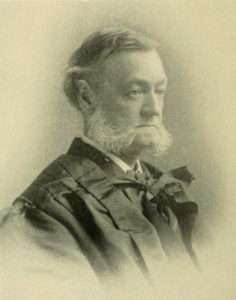
JD Vance on Justice Scalia in 2014

"He's become a very shrill old man. I used to really like him, and I used to believe all of his stuff about judicial minimalism was sincere. Now I see it as a political charade."

|

One of the rites of passage of becoming a prominent conservative politician is that your former friends disclose private correspondences to the mainstream media. And so it has come to pass for JD Vance. One of Vance's YLS classmates gave the New York Times more than 90 emails and text messages from 2014-17. Some of the passages reflect on the Supreme Court:

In 2014, they were both near the beginning of their careers, about a year out of law school.

Mr. Vance shared that he was planning to buy a house in Washington, D.C., with his wife, Usha, whom he also met at Yale.

The Vances could afford a house in Washington's highly priced market partly because Mr. Vance was starting a job in Big Law. "Blech," he wrote then, indicating his distaste for a career he had already decided against. He would remain with the white-shoe firm Sidley Austin for less than two years.

In the same exchange, Mr. Vance also wrote about his wife's interviews with justices of the Supreme Court, where she was seeking a clerkship. Mr. Vance worried that her seeming politically neutral, or lack of "ideological chops," could harm her chances.

"Scalia and Kagan moved very quickly," Mr. Vance wrote, referring to Antonin Scalia, the conservative justice who died in 2016, and Elena Kagan, one of the court's current three liberal justices, "but she was just not going to work out for Scalia."

Nelson wrote back, "His homophobic screeds are hard to believe in 2014."

"He's become a very shrill old man," Mr. Vance responded. "I used to really like him, and I used to believe all of his stuff about judicial minimalism was sincere. Now I see it as a political charade."

Mrs. Vance would end up clerking for Chief Justice John G. Roberts Jr.

Wow. There is a lot to unpack here.

First, it is well known that Vance has done a 180 on Trump. He used to speak of Trump in the harshest terms, but has now come to become one of Trump's most ardent defenders. I think it would have been expected for a Yale conservative* to be critical of Trump before 2016. But Vance's criticism of Justice Scalia was a different matter altogether. This email came in 2014, the year after Justice Scalia's Windsor dissent. This is almost certainly what Vance's friend referred to as "homophobic screeds."

Windsor was one of Scalia's last, great dissents. Here is the intro:

This case is about power in several respects. It is about the power of our people to govern themselves, and the power of this Court to pronounce the law. Today's opinion aggrandizes the latter, with the predictable consequence of diminishing the former. We have no power to decide this case. And even if we did, we have no power under the Constitution to invalidate this democratically adopted legislation. The Court's errors on both points spring forth from the same diseased root: an exalted conception of the role of this institution in America.

Justice Scalia was the scion of the conservative legal movement. At times he drove all of us nuts, but we would never say he was engaged in a "political charade." If you were to take a poll of Federalist Society members in 2014, how many would attack Scalia with such language?  I suspect it is a vey small number. Indeed, I'm not even sure that Vance was ever a FedSoc member. I graduated law school only a few years before him. I first learned of him when Hillbilly Elegy burst onto the scene. I remember being surprised to learn he was a recent YLS grad, since I had never heard of him. I am far more troubled by Vance's criticism of Scalia than anything he ever said about Trump.

Second, Vance provides some unwitting insights into the clerkship game. He describes Usha Chilukuri, his future wife, as politically neutral, and lacking "ideological chops." At Yale, a Supreme Court clerkship is considered something of a birthright--the only question is which justice will hire them. That the same candidate was even considering applying to both Justice Kagan and Justice Scalia (of "homophobic screed" fame) suggests that she was willing to appeal to both sides of the spectrum. Scalia was known to hire counter-clerks, but Usha does not strike me as counter-clerk material.

Third, Vance provides some even more unwitting insights into the types of judges who ultimately hired a really smart law clerk who lacks "ideological chops": Amul Thapar on the Eastern District of Kentucky, Brett Kavanaugh on the D.C. Circuit, and Chief Justice Roberts on the Supreme Court. In 2014, these were judges who did not impose any sort of FedSoc litmus test on their hiring, and were known to hire clerks from both sides of the spectrum. And so they did with Usha.

***

It is always precarious to judge a person by things they did in their youth. People can grow from setbacks in their past. Indeed, I think much of the blowback of my post on Kamala Harris's bar failure missed the point. I noted at the end some other very prominent people failed the bar, and went onto great success. I've also written about Joe Biden's law school plagiarism, Elena Kagan's mediocre 1L grades, and the fact that Mitt Romney never even took the bar!

How then to explain these comments from Vance only a year after he graduated from the most elite institution. Was he just telling a liberal friend the standard liberal party line? Did he truly did not understand what Justice Scalia was doing--perhaps owing to his deficient legal education from a left-wing faculty? Did he never seek out any opportunities to learn about Scalia from FedSoc events, or otherwise? Or did he really believe what he wrote about Justice Scalia? If so, did he ever stop holding those views? And what kind of judges would Vance recommend for the courts? I'd like to hear some answers to these questions.
Free Speech

"Two Men Plead Guilty to Acting as Illegal Agents of the PRC Government and Bribery"

|

From Thursday's press release by the Justice Department (see also the Indictment itself):

JOHN CHEN and LIN FENG pled guilty to acting as unregistered agents of the government of the People's Republic of China ("PRC") and bribing an Internal Revenue Service ("IRS") agent in connection with a plot to target U.S.-based practitioners of Falun Gong—a spiritual practice banned in the PRC….

According to Indictment and other court documents:

From at least approximately January 2023 to May 2023, CHEN and FENG worked inside the United States at the direction of the PRC Government, including an identified PRC Government official ("PRC Official-1"), to further the PRC Government's campaign to repress and harass Falun Gong practitioners. The PRC Government has designated the Falun Gong as one of the "Five Poisons," or one of the top five threats to its rule. In China, Falun Gong adherents face a range of repressive and punitive measures from the PRC Government, including imprisonment.

As part of the PRC Government's campaign against the Falun Gong, CHEN and FENG engaged in a PRC Government-directed scheme to manipulate the IRS's Whistleblower Program in an effort to strip the tax-exempt status of an entity run and maintained by Falun Gong practitioners ("Entity-1"). After CHEN filed a defective whistleblower complaint with the IRS (the "Chen Whistleblower Complaint"), CHEN and FENG paid $5,000 in cash bribes, and promised to pay substantially more, to a purported IRS agent who was, in fact, an undercover officer ("Agent-1") in exchange for Agent-1's assistance in advancing the complaint. Neither CHEN nor FENG notified the Attorney General that they were acting as agents of the PRC Government in the United States.

Read More

The Constitution as an Allocation of Competences

|

It [i.e., the Supreme Court] must look to the Constitution, be it with a large or small C, written or unwritten (or both), for it is the constitution of a society which represents the fundamental allocation of competences within that society. It is in its constitution that a society comes to terms with the homely truth that every decision must finally be taken on the managerial, prudential, particularistic judgment of somebody, and yet very few decisions indeed may be left to the judgment of everybody at once. It is in the constitution that a society recognizes that everyone is in principle capable of the Olympian view, and yet in fact most persons will differ when they take it. The Constitution, in short, is a necessary, prudential arrangement for the allocation of competences to take a prudential view. And a court, no less than anyone else, will fail to respect the prudence of the Constitution, if it ignores the limitations on its own scope for making prudential judgments.

Charles Fried, Two Concepts of Interests: Some Reflections on the Supreme Court's Balancing Test, 76 Harv. L. Rev. 755, 772 (1963).

Political Ignorance

J.D. Vance, Taxing the Childless, and the Power of Framing

The controversy over Vance's advocacy of higher tax rates for childless adults illustrates the power of framing.

|

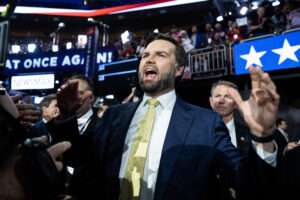
J.D. Vance at the Republican National Convention
J.D. Vance at the Republican National Convention (Tom Williams/CQ Roll Call/Newscom)


I am, to understate the point, no fan of Republican VP candidate J.D. Vance and the "national conservative" ideology he espouses. But much of the backlash generated by his 2021 statement that childless adults should pay higher tax rates is  a matter of framing. It highlights how people can have widely divergent reactions to similar policy proposals, depending on how they are described.

Many are forgetting that the childless already pay higher taxes than parents with the same incomes.  Under current law, most parents are entitled to the child tax credit. My wife and I have two kids, and we claim it whenever eligible to do so (under current law, whenever our household income is under $400,000). When we take the credit, we end up paying less in taxes than would a childless couple with the same income.

The child tax credit enjoys broad bipartisan support. Many Democrats argue it should actually be bigger. Why is it so popular? Because it's framed as giving parents lower tax rates, rather than making childless people pay higher ones. Described in those terms, almost everyone loves it!

On the other hand, when Vance says childless people should pay higher tax rates and takes swipes at "childless cat ladies," he comes off like an intolerant, misogynist creep, and many people hate him. Maybe that's exactly what he deserves; I'm not shedding any tears for him. But most of the same people are happy to support much the same policy if it's described in different terms.

Lower tax rates for parents and higher ones for childless adults are two sides of the same coin. One unavoidably implies the other. The different reactions to the two descriptions are the result of a "framing effect:" where views on policy ideas are driven by wording rather than substance.

In a world where voters are highly knowledgeable about policy and carefully evaluate alternative ideas, framing effects wouldn't matter much. But, in reality, most voters are rationally ignorant about policy, and often do a poor job of evaluating the information they do get. For that reason, framing effects often have a big impact.

If I were advising Vance (don't worry, it's never going to happen!), I would tell him to stop talking about cat ladies, and instead say something like this:

"I want to give a bigger tax break to America's hard-pressed parents, so they can better provide for their  children. Parents and kids need a break from heavy taxes and high prices. After all, children are our future!" Maybe combine it with an ad in which Vance appears with a group of mothers and kisses some babies.

Is  the child tax credit actually a good idea? Should we increase it? I'm far from certain.  But framed in these positive terms (as tax relief for parents, rather than as forcing the childless to pay higher taxes), it sure sounds good to most people.

One can tell a similar story about Vance's advocacy of giving extra votes to parents. He described it as  forcing childless people to "face the consequences and the reality" and not get "nearly the same voice" in our democracy. That sounds awful and predictably generates negative reactions. But the same idea can also be described as providing greater voice for children's interests by allowing parents to represent them more effectively. Indeed, that is precisely how extra-votes-for-parents has been defended by left-liberal advocates, such as Harvard political scientist Paul Peterson, and political commentator Michael Kinsley (Peterson would give parents the option of letting the kids cast the vote themselves if the parents believe their children are up to it).

They didn't frame the idea as penalizing the childless, but rather as giving greater clout to children's interests. But, as with relative tax rates, the two are just different ways of describing the same thing. Since political influence is a zero-sum game, giving more votes to Group A necessarily reduces the proportional electoral weight of B, C, and D.

I am not convinced parents should get extra votes for their children. On the other hand, I have tentatively defended the idea of letting knowledgeable children (those with political knowledge levels at least as great as that of the average adult voter)  cast votes for themselves. I think that would improve the quality of political decision-making at the margin. But I have to acknowledge it would reduce the political power of adult voters. Still, I don't frame it that way when I argue for it.

I came up with this idea before I had kids of my own. But my nine-year-old is now a big fan of it!

Here, my point is not to defend any particular voting scheme, but to highlight the framing effects. Peterson, Kinsley, and others didn't get as much backlash as Vance, in large part because they described the same idea in more positive terms: as increased voice for parents and children, rather than as decreasing the power of the childless.

Judge in N.Y. Trump Fraud Civil Case Refuses to Recuse

|

From Thursday's decision in People v. Trump, by N.Y. trial judge Arthur Engoron:

This action, familiarity with which the Court assumes, arises out of a years-long investigation that plaintiff, the Office of the Attorney General of the State of New York ("OAG"), conducted into certain business practices that defendants engaged in from 2011 through 2021. OAG alleged that the individual and entity defendants committed repeated and persistent fraud by preparing, certifying, and submitting to lenders and insurers false and misleading financial statements, thereby violating New York Executive Law § 63(12).

In a Decision and Order dated September 26, 2023, this Court granted plaintiff summary judgment only on liability and only on the first cause of action.

On February 16, 2024, following a three-month trial, this Court issued a Decision and Order After Non-Jury Trial finding defendants liable on the remaining six causes of action. The Court ordered certain injunctive relief, including the continuation of the Hon. Barbara Jones (ret.) as an Independent Monitor of the Trump Organization, which obligates the Court to maintain jurisdiction over this action despite the trial's conclusion.

On May 8, 2024, NBC New York reported that Adam Leitman Bailey, Esq., a lawyer with no connection to this case, boasted that several weeks before I issued the Decision and Order After Non-Jury Trial, he "approached the judge presiding over Donald Trump's civil fraud case to offer unsolicited advice about the law at issue in the case."

On July 11, 2024, this Court so-ordered, in part, defendants' subpoena to Bailey, directing him to disclose any documents or communications in his possession that involve, discuss, or in any way refer to this action.

Defendants now move, pursuant to 22 New York Administrative Code § 100.3(E)(1), for me to recuse myself, or, in the alternative, for an evidentiary hearing before another justice on the communications and their potential impact on the Court's decision.

The Unsolicited Ex-Parte Communication

Read More

Sports

How to Fix the Dark Side of the Olympics

The Olympics are a great sports event, but one that also often causes great harm. Here are five reforms that can fix that.

|

Today is the first day of the 2024 summer Olympic Games, held in Paris. I'm a big sports fan, and I love watching the games. But it's also true that the Olympics have awful dark sides. Past games have featured horrible forcible displacement of residents to make way for stadium construction, saddled taxpayers with huge cost overruns, and served as propaganda showcases for brutal authoritarian regimes, such as those of Russia, China, and Nazi Germany.

This year's games are less bad than many previous ones. France, for all its faults, is not a mass-murdering authoritarian state, like Russia or China. And the Paris organizers have, to some extent, kept costs down by relying on existing facilities. Nonetheless, some migrants and homeless people have been forcibly displaced for the games (researchers estimate that  some 12,500 people were forced out), and I will be very surprised if French taxpayers avoid being burdened with severe cost overruns, even if they are smaller than those for many previous Olympics.

It doesn't have to be that way. In 2022, in the aftermath of the awful Beijing Winter Games, I outlined a series of reforms that can fix the dark side of the Olympics, while preserving their role as a great athletic competition:

1. No public subsidies. Let the games be funded purely by private organizations and sponsors, as was largely the case for the successful 1984 Olympics in Los Angeles. That way, no one has to pay for the games, except those who profit from them and the audience that voluntarily chooses to watch.

2. No forcible displacement of residents, private businesses, or civil society    organizations. We can and should hold sports events without kicking innocent people out of their homes.

3. No hosting rights for authoritarian human rights violators. There are plenty of possible Olympic venues that aren't controlled by likes of Vladimir Putin and Xi Jinping. Denying these types of rulers hosting rights won't fundamentally alter their regimes. But it will at least damage their image and deny them propaganda victories.

4. There must be full freedom of speech in the Olympic Village and all other Olympic venues. At the very least, athletes, journalists, and spectators should be entirely free to criticize the host government and its policies (or any other government for that matter) [freedom of speech has often been violated when authoritarian states host the Games].

5. There must be no "public health" measures blocking normal human interaction between athletes, members of the media, and residents of the host city. Such measures defeat the whole point of having the Games in a particular city in the first place. If the Games are to be held in a "bubble," that can be done almost anywhere. Moreover, scientific evidence increasingly shows that lockdowns and other similar restrictions on freedom of movement do little to stop the spread of Covid, while causing enormous harm. But if a city really is somehow too disease-ridden to allow normal human interaction, it is also too disease-ridden to host the Games.

Point 5 was inspired by the ridiculously oppressive Covid restrictions at the 2022 Beijing Games. It will only occasionally be relevant. But the others have broader applicability.

I also explained how the US and other liberal democracies could force the International Olympic Committee (IOC) to adopt these reforms:

[N]one of these ideas are likely to be adopted by the notoriously corrupt International Olympic Committee. Time and again, the IOC has proven that it is willing to tolerate almost any injustice, so long as the organization and its leaders benefit.

But the United States and other liberal democracies can easily force through these reforms simply by making them a condition of future participation in the games. Without the participation of the US and its allies, IOC revenue would plummet, as the value of broadcast rights massively declines.

The question is whether the US and other Western governments have the political will to do what needs to be done. On that score, I am far from optimistic….

[T]he US and other democracies can make these demands more credible by threatening to host alternative Winter and Summer games of their own. This would undermine the objection that boycotts unfairly deprive athletes of the opportunity to compete at the highest level. I suggested a similar strategy to force the IOC to move the 2022 games out of Beijing.

I remain pessimistic that this strategy will actually be pursued anytime soon. But when and if we have the will, there is a way.

Free Speech

Accused Salman Rushdie Stabber Also Charged with Support for Hezbollah

|

From a Justice Department press release; Matar is also awaiting trial for attempted murder in New York state court:

A grand jury returned a three-count indictment charging Hadi Matar, 26, of Fairview, New Jersey, with attempting to provide material support to Hizbollah, a designated foreign terrorist organization, engaging in an act of terrorism transcending national boundaries and providing material support to terrorists.

"We allege that in attempting to murder Salman Rushdie in New York in 2022, Hadi Matar committed an act of terrorism in the name of Hizbollah, a designated terrorist organization aligned with the Iranian regime," said Attorney General Merrick B. Garland. "The Justice Department will prosecute those who perpetrate violence in the name of terrorist groups and undermine the basic freedoms enshrined in our Constitution." …

According to the court documents and statements made by the government in court, between September 2020 and August 2022, Matar, attempted to provide material support and resources to Hizbollah, a designated foreign terrorist organization. Matar did this by attempting to carry out a fatwa calling for the execution of Salman Rushdie, which Matar understood was endorsed by Hizbollah.

Read More

Parental Rights

"The Facts Alleged … Tell a Remarkable Story of Resilience and Duplicity" Related to Adoption of Afghan Orphan

|

From Doe v. Mast, decided Wednesday by Judge Norman Moon (W.D. Va.) (for more on the recent Virginia Court of Appeals decision voiding the adoption, see this AP story [Martha Mendoza, Juliet Linderman & Claire Galofaro]):

The facts alleged in Plaintiffs' complaint tell a remarkable story of resilience and duplicity. In the aftermath of a September 2019 joint operation by the United States and Afghan militaries conducted in rural Afghanistan, "Baby Doe" was found in the rubble of her family's home. Her parents and siblings lay dead. She was seriously injured, and was, as a result, taken to a U.S. military hospital for emergency treatment. A short time later, the International Committee of the Red Cross ("ICRC") and the United States and Afghan governments began trying to find, and reunite Baby Doe with, her biological family in Afghanistan.

In February 2020, their efforts paid off. Baby Doe and her family were reunited. Plaintiffs John Doe (Baby Doe's cousin) and his wife Jane Doe are a young, married Afghan couple who became Baby Doe's guardians. They raised Baby Doe as their own daughter for a year and a half. But, at the same time, an American couple's efforts to remove Baby Doe from their care were well underway.

Defendant Joshua Mast—a Marine Corps Major and Judge Advocate—was stationed in Afghanistan in the fall of 2019 where he became familiar with Baby Doe and her case. Joshua knew that the ICRC was searching for Baby Doe's family. Yet in October 2019, Joshua and his wife Defendant Stephanie Mast asked a Virginia family court for temporary custody of Baby Doe, claiming that she was "stateless," and that the Afghan government would soon waive its authority (also called "jurisdiction") over her. At the time, Baby Doe had never been to Virginia. Or the United States. Stephanie had never met her. But based on their representations, the Virginia family court awarded temporary custody to the Masts. Days later, Stephanie secured an interlocutory order of adoption from the Virginia Circuit Court, designating Joshua and Stephanie Mast as Baby Doe's father and mother.

Then, the day before Baby Doe was to be reunited with her biological family in Afghanistan, the Masts came to this Court and sued the government, asking for an emergency order stopping the transfer. Joshua's brother, Defendant Richard Mast, represented them in all these proceedings. When this Court asked Richard why Joshua and Stephanie wished to stop Baby Doe's return to her relatives in Afghanistan, he responded falsely that they did not seek to adopt Baby Doe—only to get her medical care in the United States. This Court denied the motion.

Read More

Supreme Court

"Wall Slammer" Kagan Seems to Endorse Ethics Code Enforcement at Supreme Court

Candid end of term comments from one of the Court's progressive justices.

|

Justice Elena Kagan did not write many opinions this term -- eleven total including her concurrences and dissents -- but she had quite a bit to say in remarks to the Ninth CIrcuit Judicial Conference earlier today, including how she handles her frustration with decisions that don't go her way.

Earlier this year, Justice Sotomayor acknowledged occasionally crying over decisions behind closed doors, Kagan confessed to a different response: "I get where the frustration comes from. I'm more of a wall-slammer."

The most headline-grabbing aspects of Justice Kagan's remarks concern the potential of an enforceable ethics code for the Supreme Court. From Politico's report,

"The thing that can be criticized is: Rules usually have enforcement mechanisms attached to them, and this set of rules does not," Kagan told a meeting of federal judges and lawyers.

Kagan said she welcomed the code the court announced last November but that the absence of any means of enforcing it was a glaring omission.

"It's a hard thing to do to figure out who exactly should be doing this and what kinds of sanctions would be appropriate for violations of the rules, but I feel as though we, however hard it is, that we could and should try to figure out some mechanism for doing this," . . .

"I think it would be quite bad … for us to do it to each other," she told the Ninth Circuit Judicial Conference.

One alternative she suggested was some sort of committee of lower court judges who could consider ethics complaints against sitting justices. She also suggested that creating such an enforcement mechanism could benefit justices falsely accused of unethical conduct.

"It would provide a sort of safe harbor. … Sometimes people accuse us of misconduct where we haven't engaged in misconduct. And, so, I think both in terms of enforcing the rules against people who have violated them, but also in protecting people who haven't violated them, I think a system like that would make sense," she said.

Justice Kagan also expressed concern about the proliferation of concurrences that attempt to spin or reframe majority opinions (something Justice Kagan did very little of this term, authoring only two concurrences).

"Everybody sort of tries to spin it one way or another," Kagan said. "Often people use separate opinions to pre-decide issues that aren't properly before the court and that may come before the court in a year or two and try to give signals as to how lower courts should decide that, which I don't think is right." . . .

"I don't know how lower courts are supposed to deal with it really. Mostly, I think they should deal with it by ignoring it, basically," she said.

Textualism

Should Consumers Expect to Find Bones in "Boneless Wings"?

"Boneless wings" aren't wings, so does that mean they don't have to be boneless either? The Ohio Supreme Court weighs in.

|

If a restaurant customer finds a bone in an order of "boneless wings" can they sue? What if the bone causes them an injury?

Today, in Berkheimer v. REKM L.L.C., the Ohio Supreme Court affirmed a lower court judgment concluding that a customer could not sue a restaurant for negligence over an injury allegedly sustained by a chicken bone found in an order of "boneless wings."

Here is how Justice Deters opens his opinion for the four-justice majority:

Michael Berkheimer sued a restaurant, its food supplier, and a chicken farm after he suffered serious medical problems resulting from getting a chicken bone lodged in his throat while he was eating a "boneless wing" served by the restaurant. The trial court determined that as a matter of law, the defendants were not negligent in serving or supplying the boneless wing, and the Twelfth District Court of Appeals affirmed that judgment.

Berkheimer contends that the court of appeals focused on the wrong question—whether the bone that injured him was natural to the boneless wing—in incorrectly determining that the restaurant did not breach a duty of care in serving him the boneless wing. Berkheimer maintains that the relevant question is whether he could have reasonably expected to find a bone in a boneless wing. And he argues that the resolution of that question should be left to a jury.

We conclude that the court of appeals got it right. In a negligence case involving an injurious substance in food, it is true—as Berkheimer argues—that whether there was a breach of a duty of care by a supplier of the food depends on whether the consumer could have reasonably expected the presence of the injurious substance in the food and thus could have guarded against it. But that consideration is informed by whether the injurious substance is foreign to or natural to the food. The court of appeals correctly applied this blended analysis in determining that there was no material question of fact about whether Berkheimer could have reasonably expected a bone to be in the boneless wing and thus could have guarded against it. We therefore affirm the judgment of the Twelfth District.

And from the part of the opinion discussing what one should expect from an order of "boneless wings":

Berkheimer protests that the court of appeals did not give due consideration to the fact that the food item was advertised as a "boneless wing" and that there was no warning given that a bone might be in the boneless wing. Regarding the latter argument, a supplier of food is not its insurer. And regarding the food item's being called a "boneless wing," it is common sense that that label was merely a description of the cooking style. A diner reading "boneless wings" on a menu would no more believe that the restaurant was warranting the absence of bones in the items than believe that the items were made from chicken wings, just as a person eating "chicken fingers" would know that he had not been served fingers. The food item's label on the menu described a cooking style; it was not a guarantee.

The dissent wonders what would happen in cases involving food that was advertised as lactose-free or gluten-free. Obviously, such cases are not before us. But unlike the presence of the bone in this case, the presence of lactose or gluten in a food that was advertised as lactose-free or gluten-free is not something a consumer would customarily expect and be able to guard against.

Justice Donnelly wrote the three-justice dissent. It begins:

The result in this case is another nail in the coffin of the American jury system. The majority has taken it upon itself to decide the facts of this case and has determined that there is no set of facts under which appellant, Michael Berkheimer, the plaintiff in the underlying negligence action, can establish the defendants' negligence. Today, the majority declares as a matter of law that no reasonable person could consider the facts of this case and reach a conclusion contrary to the one it reaches. This is, of course, patently untrue given that I and two other justices of this court dissent from the  majority's judgment.

And from the portion of the dissent on what "boneless" means with regard to "boneless wings":

The absurdity of this result is accentuated by some of the majority's explanation for it, which reads like a Lewis Carroll piece of fiction. The majority opinion states that "it is common sense that [the label 'boneless wing'] was merely a description of the cooking style." Majority opinion at ¶ 23. Jabberwocky. There is, of course, no authority for this assertion, because no sensible person has ever written such a thing. The majority opinion also states that "[a] diner reading 'boneless wings' on a menu would no more believe that the restaurant was warranting the absence of bones in the items than believe that the items were made from chicken wings, just as a person eating 'chicken fingers' would know that he had not been served fingers." Id. at ¶ 23. More utter jabberwocky. Still, you have to give the majority its due; it realizes that boneless wings are not actually wings and that chicken fingers are not actually fingers.

The majority's burst of common sense was short-lived, however, because its opinion also says that no person would conclude that a restaurant's use of the word "boneless" on a menu was the equivalent of the restaurant's "warranting the absence of bones." Id. Actually, that is exactly what people think. It is, not surprisingly, also what dictionaries say. "Boneless" means "without a bone." . . .

The question must be asked: Does anyone really believe that the parents in this country who feed their young children boneless wings or chicken tenders or chicken nuggets or chicken fingers expect bones to be in the chicken? Of course they don't. When they read the word "boneless," they think that it means "without bones," as do all sensible people. That is among the reasons why they feed such items to young children. The reasonable expectation that a person has when someone sells or serves him or her boneless chicken wings is that the chicken does not have bones in it. . . . Instead of applying the reasonable expectation test to a simple word—"boneless"—that needs no explanation, the majority has chosen to squint at that word until the majority's "sense of the colloquial use of language is sufficiently dulled," In re Ohio Edison Co., 2019-Ohio-2401, ¶ 67 (DeWine, J., concurring), concluding instead that "boneless" means "you should expect bones."

Amy Coney Barrett

The Supreme Court's "Scholar Justice"

John McGinnis on Justice Amy Coney Barrett

|

A substantial amount of Supreme Court commentary after this past term has focused on Justice Amy Coney Barrett. See examples here, here, and here. Much of the commentary highlights cases in which she wrote separately or broke with other conservative justices. One commentator even referred to her as the "loneliest justice." Relatively little of the commentary has dug very deep into her emerging jurisprudence.

Over at Law & Liberty, Professor John McGinnis offers an insightful analysis of Justice Barrett's early jurisprudence. While he does not agree with everything she has written, he offers a sympathetic take. Her differences with other justices are not a consequence of her moderating or succumbing to the "Greenhouse effect," but rather reflect a sincere effort to get things right.

Liberal hopes and conservative fears about Barrett, however, are misplaced. It is true that she is becoming increasingly confident as she enters her fourth year on the Court. But her decisions are not dictated by ideology but rather by intellect. She is the only former law professor among the originalist-oriented judges and spent much of her time as an academic working on interpretive theory—originalism in constitutional law and textualism in constitutional law. She sees it as part of her judicial duty to make the decisions following these theories as principled and rigorous as possible. In trying to work the law pure, she will naturally depart from some of the rationales and results of her colleagues. Justice Barrett deserves praise for charting her own course.

After surveying and assessing Justice Barrett's approach to originalism, textualism, and the "passive virtues" of judging, he concludes:

This approach should remind us that any legal movement like originalism cannot be sustained only by judges but depends on a larger legal culture. Through both her theorizing and incrementalism, Barrett is helping to summon that culture into being. Commentators are correct that Barrett is forging her own path. But her actions do not signal an ideological shift but rather an effort to make the law more coherent and legitimate. She is embracing the role of the scholar-judge, a position that great justices like Joseph Story and Antonin Scalia also once occupied to the great benefit of legal stability and coherence.

Politics

Jarkesy Should Not Have Been So Easy For Justice Barrett

There are tensions between Jarkesy, CFPB, and Vidal.

|

Justice Barrett has explained that she writes separately when she has the need to articulate some differences with the majority opinion. I previously wrote that Justice Barrett should have written separately in Loper Bright, to explain her views on stare decisis and tradition. Chevron has been on the books for nearly half a century, and has become a settled practice in Congress, in the Executive Branch, and in the lower courts--basically everywhere except the Supreme Court. This would seem to to be the sort of thing Justice Barrett would have concerns about jettisoning, rather than Kisorizing, but she remained mum.

I have similar thoughts about Jarkesy. This case was screaming for a Barrett concurrence. Why? There are tensions between Jarksey and some of Barrett's prior writings and joins about "tradition" or settled practice. 

In Jarkesy, Justice Sotomayor's dissent observes that there is nearly a century of practice in which agencies have adjudicated civil penalties "in house," rather than in federal court. This longstanding practice should be entitled to some weight, no? And Sotomayor cites Justice Barrett's Vidal concurrence, as well as Justice Kagan's CFPB concurrence, which Justice Barrett joined:

Read More

Politics

Kamala Harris Failed The California Bar On Her First Try

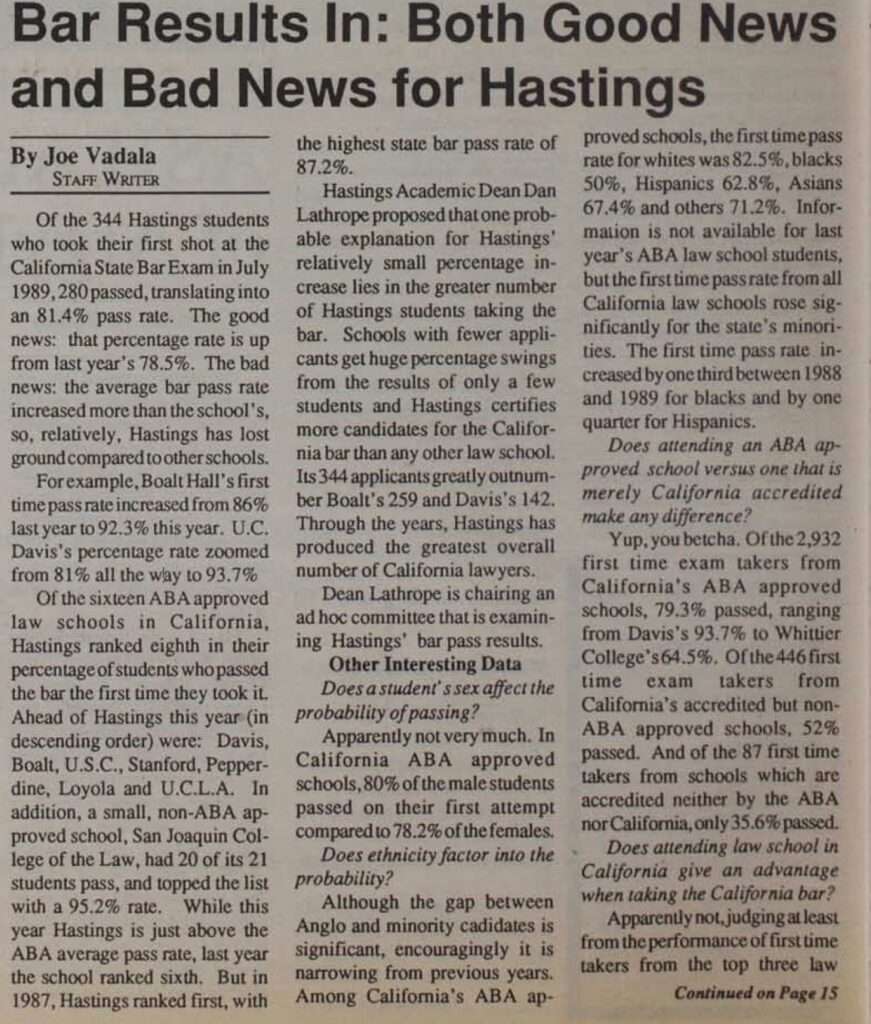
In July 1989, UC Hastings Had A 81.4% Pass Rate.

|

Vice President Kamala Harris graduated from UC Hastings Law School in 1989, and sat for the July 1989 California Bar. She did not pass on her first try. (Brett Stephens flagged this issue in his column.) According to Politico, Harris spent her 2L summer at the San Francisco District Attorney's Office, which offered her a job as a deputy DA after she passed the bar. Harris was admitted one year later in June 1990.

In July 1989, the pass rate for Hastings was 81.4%. The Hastings Law News had this report.

Harris is in good company with other famous people who failed the bar.

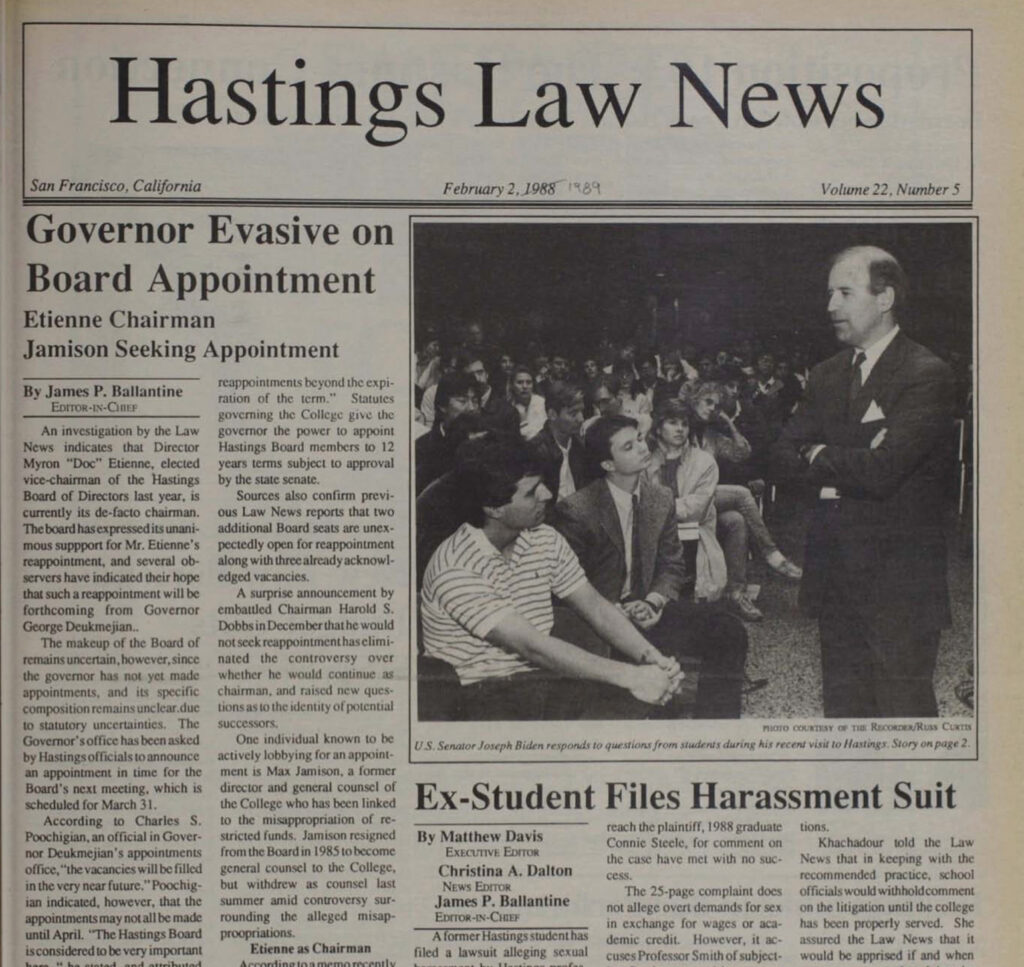
And in a coincidence, then-Senator Biden spoke at Hastings in February 1989 during Harris's 3L year.

More