
The Volokh Conspiracy

Mostly law professors | Sometimes contrarian | Often libertarian | Always independent | Est. 2002

The Volokh Conspiracy

Tariffs

Perils of Broad Presidential Power Over Tariffs

Donald Trump's plan for massive tariff increases is particularly dangerous because the White House could likely implement it without any new congressional authorization.

|

NA

Donald Trump's plan to impose massive 10% or greater tariffs on all imported goods is a centerpiece of his potential second term policy agenda. If implemented, it would cause enormous harm to the US economy, raise prices on many goods, and seriously damage relations with our allies. The potential damage is likely to be enormous. Trump's tariff plan is even more dangerous than it might be otherwise, because he can probably implement it without any new congressional authorization.

As Trump himself puts it,  "I don't need Congress [to impose tariffs]…. I'll have the right to impose them myself, if they don't." If he's right, that differentiates it from many other harmful policy ideas put forward by presidential candidates, that do require new legislation, which would often be difficult or impossible to push through a closely divided Congress. That's true of Kamala Harris's awful rent control and price control plans, for example (she has recently scaled back the price control proposal).

Is Trump right to claim the president has unilateral authority to start a massive trade war? Under current legislation and judicial precedent, the answer is likely yes. My Cato Institute colleagues Clark Packard and Scott Lincicome have published a valuable new analysis of this crucial issue. Here's the summary of their findings:

Article I, Section 8 of the US Constitution grants Congress the power to "lay and collect Taxes, Duties, Imposts and Excises," and to regulate commerce with foreign countries. From the founding of the republic through the early 1930s, Congress set tariff rates through legislative revisions to the US tariff schedule. Low tariffs were initially imposed to raise revenue for the federal government, but tariffs became a tool to protect domestic producers from foreign competition. Throughout this period, tariff rates fluctuated with the makeup of Congress, while the president was largely a bit player in setting international trade policy.

This approach to US tariffs changed dramatically following the disastrous Trade Act of 1930, better known as the Smoot-Hawley Tariff Act after its sponsors Rep. Willis C. Hawley (R‑OR) and Sen. Reed Smoot (R‑UT). The act was signed by President Herbert Hoover in June 1930 over the objection of virtually every prominent economist at the time; it became the largest tariff hike in US history, inflicted serious damage to the US economy and international relations, and vividly demonstrated the shortcomings (and outright corruption) of congressional tariff-setting.1

In response, Congress delegated large amounts of its international economic authority to the executive branch in 1934 and through subsequent laws, under the prevailing assumption that the president was far less likely than Congress to be influenced by parochial interests and rent-seeking lobbyists—and thus far less likely to repeat Smoot-Hawley. For about 85 years, this bipartisan approach proved successful: major tariff hikes and trade wars were avoided and international trade flourished.

That changed with the 2016 election of Donald J. Trump.

Upon taking office, President Trump used the powers granted to him by Congress to take a series of unilateral actions that radically upended US international economic policy. Most prominently, Trump imposed national security tariffs on imported steel and aluminum from virtually every country—including longstanding allies—and hiked tariffs on more than half of all goods from China, which was at that time the United States' largest import supplier.

Although the Biden administration promised to turn the page on its predecessor's unilateralism, it instead repeatedly defended the Trump administration's tariffs—and the broad authority Congress delegated to the executive branch—in court. President Biden also maintained most of the tariffs in original or modified form. The administration has even increased some of the China tariffs, citing the same laws and regulations that Trump abused in 2018.

In his 2024 presidential campaign, former President Trump has promised even more aggressive unilateral protectionism in the future. In particular, Trump has promised an across-the-board 10–20 percent tariff on all imports from every country and a 60 percent tariff on all imports from China; he claimed in September 2024 that he could do so without congressional approval.2 Economists and other trade policy experts have warned that such tariffs would harm both the US economy and the country's foreign policy.3 However, some have sought to temper these concerns by confidently noting that practical and legal constraints would prevent a future President Trump from enacting broad tariffs without congressional consent.

As this paper explains, such confidence is mostly misguided. Several US laws provide the president with vast and discretionary authority to unilaterally impose sweeping trade restrictions, and no institution—not Congress, not domestic courts, not US international agreements—provides a quick, surefire check on such actions. Thus, while the durable implementation of broad and damaging US tariffs is not guaranteed, its risk—and related economic and geopolitical risks—will remain real and substantial until US law is changed to limit presidential tariff powers. We therefore recommend Congress enact such amendments immediately.

Packard and Lincicome are right to urge Congress to cut back on the powers it has delegated to the president in this field. But, sadly, that's unlikely to happen anytime soon. Thus, if Trump wins the election, there is a good chance he could impose his enormous new tariffs without the need for new legislation.

Elsewhere, I have argued that the current sweeping delegation of tariff authority to the president is unconstitutional because it violates nondelegation principles. I am not alone in that view among scholars and judges. But adopting it would require the courts to reverse or at least significantly alter current precedent. We can't count on that happening, especially in the near future. So far, the Supreme Court, including its current conservative majority, have been very wary of giving real teeth to nondelegation.

The Court has been more aggressive in its use of the "major questions" doctrine, which requires Congress to "speak clearly" when authorizing an executive branch agency to exercise "decisions of vast 'economic and political significance.'" Partly on that basis, the Court invalidated President Biden's massive student loan forgiveness plan last year. But, as Packard and Lincicome explain, the laws delegating tariff authority to the president are very broadly worded. That might well be enough to qualify as a "clear" statement under the major questions doctrine; exactly how much clarity MQD requires is itself far from clear, under current Supreme Court precedent. Also, it is not certain the Supreme Court will apply MQD as aggressively when it comes to tariffs and other international relations issues, as it does elsewhere.

Packard and Lincicome also note that courts upheld a variety of dubious Trump tariffs during his first term, despite serious flaws in the rationales offered by the federal government. Perhaps things would be different for the much more sweeping tariffs Trump plans this time around. But we can't count on that.

In sum, there is at least a high probability that if Trump wins the election, he will be able to implement his dangerous tariff agenda, and Congress and the courts would do unwilling or unable to stop him. As we consider which candidate is the lesser evil in this year's election, this sad reality should carry a lot of weight.
Free Speech

"Illinois Revokes 'October 7' License Plates"

|

So reports The National News Desk:

Illinois Secretary of State Alexi Giannoulias revoked five "October 7" license plates from state drivers this week after receiving complaints about them.

One such license plate went viral on X after it was shared by Jewish advocacy organization StopAntisemitism. The image shows the plate surrounded by a "free Palestine" frame.

Here's the Tweet:

Is this constitutional? Well, there's a hot debate about that, though the rule adopted by most lower courts would suggest the answer is "no."

The question is whether the license plate is seen as "government speech" or as the driver's own "private speech." (The license plate frame is clearly the driver's private speech.) If it's government speech, then the government can choose which viewpoints to speak and which not to, much as the government can choose which monuments to put up in a park, or even which monuments to accept when people offer to donate them. If it's private speech, even within a government-run program—such as, for instance, trademarks within a trademark registration system—then the government must administer the program in a viewpoint-neutral way.

Read More

Free Speech

Journal of Free Speech Law: "Is John Stuart Mill's On Liberty Obsolete?," by Vince Blasi

A new article from the Daedalus (Journal of the American Academy of Arts and Sciences) Future of Free Speech Symposium.

|

The article is here; the Introduction:

Without a doubt, the most widely read and closely studied argument for the freedom of speech ever written appears in John Stuart Mill's On Liberty. Marking in 1959 the centennial of the essay's publication, Isaiah Berlin opined that Mill's "words are today alive and relevant to our own problems; whereas the works of James Mill, and of Buckle and Comte and Spencer, remain huge, half-forgotten hulks in the river of nineteenth-century thought." According to Berlin:

Mill's central propositions are not truisms, they are not at all self-evident…. They are still assailed because they are still contemporary…. Mill looked at the questions that puzzled him directly, and not through spectacles provided by any orthodoxy…. One of the symptoms of this kind of three-dimensional, rounded, authentic quality is that we feel sure that we can tell where he would have stood on the issues of our day…. Surely that alone is some evidence of the permanence of the issues with which Mill dealt and the degree of his insight into them. Because … his conception of man was deeper, and his vision of history and life wider and less simple than that of his utilitarian predecessors or liberal followers, he has emerged as a major political thinker in our own day.

Berlin's "day" was the middle of the twentieth century. My question is whether sixty-five years later he plausibly could have maintained Mill's contemporaneity in the face of the various ways that digital technology has altered the dynamics of human belief formation and persuasion.

To address this question, I identify the distinctive concerns, assumptions, concepts, objectives, and derivations that have given Mill's argument its preeminence for a century and a half. Then I canvass the changes wrought by digital technology in how speakers formulate their messages and generate attention to them, and how audiences notice, receive, and potentially act on such messages. Finally, I assess whether, in the light of such changes, On Liberty remains an instructive resource for thinking about what Mill terms "the liberty of thought and discussion" and its cognate liberties.

And the concluding paragraphs:

Read More

Foreign Relations Law

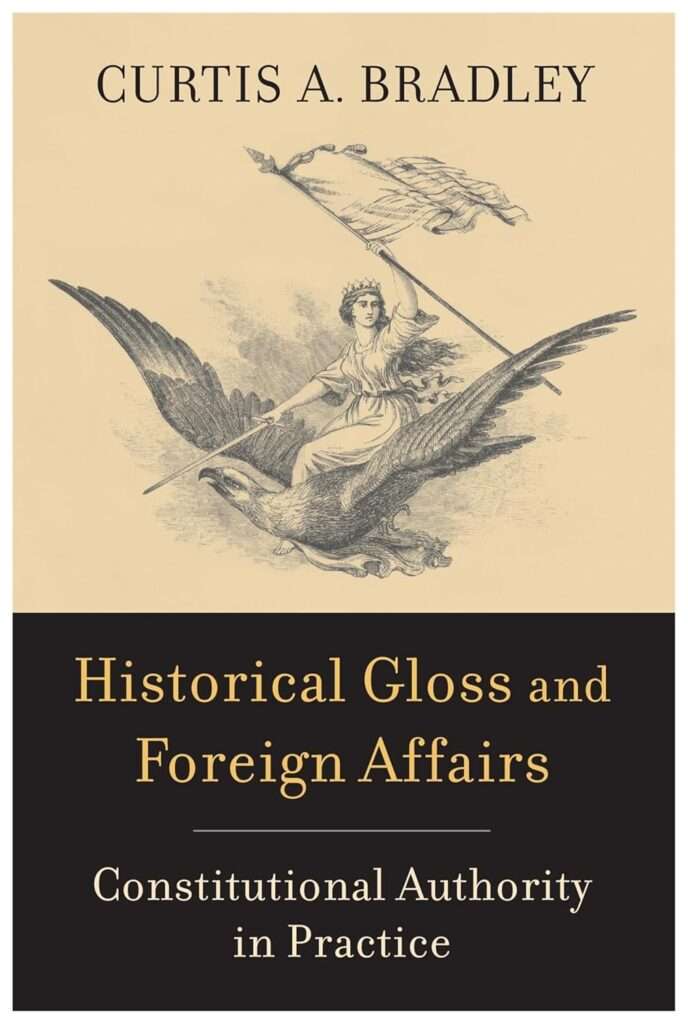
New Book on Historical Gloss and Foreign Affairs, Part IV

The use of military force.

|

This is the fourth of five posts about my new book, Historical Gloss and Foreign Affairs: Constitutional Authority in Practice. In the last post, I discussed the termination of U.S. treaties and executive agreements. In this post, I consider the distribution of authority between Congress and the President with respect to the use of military force.

The Constitution gives Congress the power to declare war, but many military conflicts do not involve formal declarations of war, and that was true even at the Founding. And the Constitution makes the President the Commander in Chief without defining the nature or scope of that role.

There has long been uncertainty about the interaction of these provisions. There have always been questions, for example, about the extent to which the President can take defensive military actions without seeking congressional approval and when (if ever) Congress needs to declare war in order to authorize hostilities.

As with the issue of treaty termination discussed in my last post, the history here is complicated.

It was always thought that presidents had some defensive war authority, but the bounds of it were unclear. Presidents authorized many low-level uses of force unilaterally throughout the nineteenth century, sometimes controversially. But the big wars against foreign powers—the Quasi-War against France at the end of the 1700s, the War of 1812 against Britain, the Mexican-American War in the 1840s, and the Spanish-American War at the end of the nineteenth century—were all authorized by Congress.

Read More

DIG Glossip And Leave Evidentiary Hearing For Clemency Proceedings or Federal Habeas Review

A Court that lacks jurisdiction cannot remand for further proceedings.

|

Glossip v. Oklahoma is a case stranger than fiction. I won't even attempt to rehash all of the details here. Rather, I will opine on the possible path forward.

Based on oral argument, several Justices indicated that the Court should vacate the lowe court opinion, and remand the case for an evidentiary hearing. But there is a threshold problem: the Court can only vacate and remand the case if the Court finds that it has jurisdiction to even entertain the case. And the jurisdictional issues are extremely complex. The Justices would have wade through the nuances of Oklahoma post-conviction law, parse a less-than-helpful decision from the Oklahoma Court of Criminal Appeals, and make a finding about whether there is an adequate and independent state law ground. Remember, any decision issued in this context would affect the scope of review in cases involving defendants not named Glossip. This is not a ticket good for one ride.

The Supreme Court does not have a magic wand to order lower courts to hold evidentiary hearings to pursue justice. The Court can only do something if it has jurisdiction. And the Court always has the obligation to determine its own jurisdiction. The Court could not issue a short per curiam order remanding the case for further proceedings without walking through the jurisdictional mine field. I suspect it may be hard to count to five for that opinion with an eight-member bench (Justice Gorsuch is recused).

In the normal course, where the Justices find that a factual record is incomplete, the result is a DIG: dismiss the writ as improvidently granted. The Supreme Court is not a Court of error correction or record supplementing. I can't recall any other case where such an unclear record came to the Court, and the remedy was to order more fact finding! The parties made their record, and they have to live (or die) with it.

But there is still hope for Glossip. Footnote five of the Court Appointed Amicus brief pointed out the obvious:

Petitioner remains free to assert his Brady and Napue claims in a subsequent federal habeas petition, subject to applicable limitations.

If the Court were to DIG this petition, Glossip could bring (yet another) federal habeas petition, raising the exact same issues. And I suspect a federal district court would hold a full evidentiary hearing to interpret the notations about "Dr. Trumpet?" and "Lithium?" The two prosecutors likely would give fulsome testimony. That case will eventually reach the Supreme Court, yet again. By that point, Oklahoma may adopt the Swiss death pod as a method of execution. Of course, the standard of review on a habeas is more stringent than on direct appeal. But if there are such clear Napue and Brady violations, the conviction will be almost certainly be vacated--especially if the Attorney General does not oppose Glossip's federal habeas petition.

There is another option, which the Court-appointed Amicus raised at oral argument: clemency.

This Court should accordingly dismiss the case for lack of jurisdiction, leaving Petitioner free to pursue state law clemency or other available relief.

Previously, the clemency vote tied 2-2, with one recusal. (The fifth member was married to the prosecutor). Now, there are new members of the board, and the vote may come out differently. Indeed, it would not be difficult for the clemency board to hold a hearing on these issues. That would be a heckuva lot simpler than going through AEDPA. And if, after the hearing, the board finds that clemency is appropriate, politically-accountable actors, and not judges, can make that decision.

In the classic Case of the Speluncean Explorers by Lon L. Fuller, the fictional Supreme Court of Newgarth considers whether to affirm the death sentence of hikers who were trapped in a cave, and resorted to cannibalism. Chief Justice Truepenny finds imposing the death sentence was required by law, but asked the Executive to commute the sentences. Ironically enough, Trupenny does not think it appropriate for the Executive to hold hearings!

In a case like this the principle of executive clemency seems admirably suited to mitigate the rigors of the law, and I propose to my colleagues that we follow the example of the jury and the trial judge by joining in the communications they have addressed to the Chief Executive. There is every reason to believe that these requests for clemency will be heeded, coming as they do from those who have studied the case and had an opportunity to become thoroughly acquainted with all its circumstances. It is highly improbable that the Chief Executive would deny these requests unless he were himself to hold hearings at least as extensive as those involved in the trial below, which lasted for three months. The holding of such hearings (which would virtually amount to a retrial of the case) would scarcely be compatible with the function of the Executive as it is usually conceived. I think we may therefore assume that some form of clemency will be extended to these defendants. If this is done, then justice will be accomplished without impairing either the letter or spirit of our statutes and without offering any encouragement for the disregard of law.

Then again, Justice Keen faults the Chief Justice for transcending the role of the courts:

The first of these is whether executive clemency should be extended to these defendants if the conviction is affirmed. Under our system of government, that is a question for the Chief Executive, not for us. I therefore disapprove of that passage in the opinion of the Chief Justice in which he in effect gives instructions to the Chief Executive as to what he should do in this case and suggests that some impropriety will attach if these instructions are not heeded. This is a confusion of governmental functions - a confusion of which the judiciary should be the last to be guilty.

Truepenny's approach has never appealed to me personally, but whenever I teach the case, some students find it better than the other alternatives of stretching the law to reach a just result.

If the Court does DIG the case, there could be concurrence spelling out what could happen going forward--both in terms of whether a federal court should hold an evidentiary hearing, or leaving the door open for clemency.

It takes five votes to DIG. There is an alternative. A 4-4 split would affirm the lower court by an equally divided margin. A 4-4 affirmance would have the same practical effect as a DIG. The lower court affirms, and Glossip gets a few more bites of the apple. With either a DIG, or a 4-4, Glossip will get another clemency vote, and have a shot at an evidentiary on post-conviction relief. I don't see any compelling reason for the Court to decide this case, and it cannot do a drive-by remand without wading through the tough jurisdictional issues.

What Happens When The Federal Rules of Civil Procedure Violate Federal Law?

The Federal Judiciary's Rules Committee will find out if it adopts the "Random Case Assignment" Policy

|

Life-tenured judges play the long game. Last spring, the Judicial Conference adopted, without any debate, a "binding" policy that would force reassignment of cases seeking nationwide relief. After some controversy, the mandatory policy suddenly became "optional guidance." And over the past few months, a handful of districts have adopted this policy. The overwhelming majority have done nothing. And other districts, including the U.S. District Court for the Northern District of Texas, rejected the policy. This process played out exactly as Congress intended: 28 U.S.C. 137 expressly delegated rules concerning case assignment to "the rules and orders of the court." Each District Court can decide these matters for itself.

But if at first you don't succeed, try, try again. Or in the world of the federal judicial bureaucracy, send it to a committee! Tomorrow, the Rules Committee will consider the issue of case assignment. And they will consider whether to adopt the Judicial Conference's reassignment policy by virtue of modifying the Federal Rules of Civil Procedure. If you read Page 415 of the agenda (and who hasn't!), you will find that the committee expressly recognizes that this might be contrary to federal law!

There is also a strong argument that assignment of cases among the judges in a district is within the Congress's jurisdiction. Since the Judiciary Act of, Congress has statutorily provided for case assignment to be left to the districts in the first instance, and this remains the case today. 28 U.S.C. § 137(a) provides that, "[t]he business of a court having more than one judge shall be divided among the judges as provided by the rules and orders of the court.

In the wake of the Judicial Conference guidance, Senators McConnell, Cornyn, and Tills stated their views in a letter to the Chief Judge for the Eastern District of Kentucky: It is Congress that decides how cases should be assigned in the inferior courts and Congress has already spoken on this issue in an enacted statute: Congress gave that power to the individual district courts. Whatever the Judicial Conference thinks you ought to do, what you actually choose to do is left to your court's discretion under the law.7

A Federal Rule of Civil Procedure could potentially supersede this statute if it complies with the strictures of the Rules Enabling Act and is approved by Congress. It would require consideration of whether a rule regarding case assignment is within the Enabling Act's delegation of authority to "prescribe general rules of practice and procedure," 28 U.S.C. § 2072(a). One could assert that a rule governing the assignment of cases is one of practice and procedure, as it does not implicate the merits of any claim. Such a judgment must be considered in the context of the history of the Congressional delegation of power to divide judicial business to the districts themselves. This issue will remain on the Advisory Committee's agenda as the districts continue to react to the Judicial Conference guidance. The Reporters will continue to monitor the situation as it develops.

Let's be very clear here what is going on. Senator Schumer and some law professors complained about a handful of federal judges. The judges and private members of this committee seem poised to accede to that criticism, even if it means adopting a potentially unlawful rule of Civil Procedure. And who would adjudge whether that reassignment policy is lawful? The same judges who authorized the rule.

Senator McConnell harpoons this proposal in National Review:

Simple statutory interpretation shows why the judicial bureaucrats have it wrong. The case-assignment statute has its roots in the Judicial Code of 1911. Two decades later, in 1934, Congress enacted the Rules Enabling Act, which governs the civil rules. Against that backdrop, Congress then enacted the case-assignment statute in 1948, directing that cases "shall be divided" among the judges in a district as the court sees fit.

Knowing full well that the Rules Enabling Act was out there, Congress gave a directive — not a suggestion — to the district courts, over which it has constitutive authority, as to how they must administer their dockets.

The Justice Department is skeptical. It says if this were the case, surely Congress "would have left some evidence in the statute's text or legislative history." Legislative history — the last refuge of a textual scoundrel.

The statute's text is the evidence: Congress mandated how the courts must manage their dockets. We should all take that at face value and not look for some broad, amorphous grant of legislative power to the judicial bureaucracy.

Indeed, the Supreme Court has warned against assuming that Congress has delegated broad legislative authority to other branches of government. Usually that's in the context of the executive branch, but it ought to apply to the judiciary, too. We can't assume that Congress gave the judicial bureaucracy a roving commission to rewrite the case-assignment statute through the Rules Enabling Act.

Why? Why do this? Remember, under the Rules Enabling Act, unless Congress passes a statute, through bicameralism and presentment, to disapprove of a rule, it goes into effect. And that process is subject to a filibuster. It cannot be that a handful of federal judges can override a federal statute unless Congress enacts a new statute.

And while we're at it, I've long thought that the Rules Enabling Act violates the Non-Delegation Doctrine. Relatedly, Ethan Leib recently wrote that the Federal Rules of Evidence are unconstitutional.  If the Rules Enabling Act actually gives the federal judiciary the power to override a federal statute, unless Congress disapproves, then the Non-Delegation Doctrine may have another very good year. Tread carefully. Or better yet, let five members of the Supreme Court give some clear guidance on nationwide injunctions and universal vacatur, so we can settle this madness in a way that is fair to all sides--not unilateral disarmament.

Free Speech

School Board Restrictions on "Abusive," "Personally Directed," and "Obscene" Public Comments Violated the First Amendment …

at least as those terms had been interpreted by the school board, holds the Eleventh Circuit.

|

From yesterday's decision in Moms for Liberty-Brevard County v. Brevard Public Schools, written by Judge Britt Grant and joined by Judge Barbara Lagoa:

For many parents, school board meetings are the front lines of the most meaningful part of local government—the education of their children. And sometimes speaking at these meetings is the primary way parents interact with their local leaders or communicate with other community members. No one could reasonably argue that this right is unlimited, but neither is the government's authority to restrict it.

A group called Moms for Liberty brought this lawsuit on behalf of members who say their speech was chilled and silenced at Brevard County School Board meetings. According to the Board's presiding officer, their comments were "abusive," "personally directed," "obscene," or some combination of the three. Because the first prohibition was viewpoint based, the second was both unreasonable and vague, and the application of the third was (at a minimum) unreasonable, these policies are unconstitutional….

We agree with the parties that the school board meetings here qualify as limited public forums because they are created "for certain groups or for the discussion of certain topics." The Brevard County School Board meetings are for parents and community members to "express themselves on school matters of community interest." In a limited public forum, the government's restrictions on speech "must not discriminate against speech on the basis of viewpoint," and "must be reasonable in light of the purpose served by the forum." …

[A.] We start with the policy permitting the Board's presiding officer to interrupt speech seen as "abusive." The way that Board Chair Belford interprets and enforces the rule diverges from the common understanding of the word "abusive." … Belford said the policy would prohibit calling people "names that are generally accepted to be unacceptable." That definition is constitutionally problematic because it enabled Belford to shut down speakers whenever she saw their message as offensive.

Read More

Free Speech

State Threatens Media with Criminal Punishment for Spreading Supposed Health-Related Disinformation

|

From a letter sent by the Florida Department of Health General Counsel to a television station about this ad that supports Florida's Amendment 4:

The Florida Department of Health has been notified that your company is disseminating a political advertisement claiming that current Florida law does not allow physicians to perform abortions necessary to preserve the lives and health of pregnant women.

{The advertisement is displayed on the home page of the Amendment sponsor's website under the title "Caroline." See https://floridiansprotectingfreedom.com/. The woman featured in the advertisement states: "The doctors knew if I did not end my pregnancy, I would lose my baby, I would lose my life, and my daughter would lose her mom. Florida has now banned abortion even in cases like mine."}

This claim is categorically false. Florida's Heartbeat Protection Act does not prohibit abortion if a physician determines the gestational age of the fetus is less than 6 weeks. § 390.0111(1), Fla. Stat. After 6 weeks, an abortion may be performed if "[t]wo physicians certify in writing that, in reasonable medical judgment, the termination of the pregnancy is necessary to save the pregnant woman's life or avert a serious risk of substantial and irreversible physical impairment of a major bodily function of the pregnant woman other than a psychological condition." § 390.0111(1)(a), Fla. Stat. The two-physician requirement is waived in the case of an emergency medical procedure. § 390.011(1)(b), Fla. Stat. And while 'physicians must exercise professional skill, care, and diligence to preserve the life and health of a fetus in the third trimester, "if preserving the life and health of the fetus conflicts with preserving the life and health of the pregnant woman, the physician must consider preserving the woman's life and health the overriding and superior concern." § 390.0111(4), Fla. Stat.

The advertisement is not only false: it is dangerous. Women faced with pregnancy complications posing a serious risk of death or substantial and irreversible physical impairment may and should seek medical treatment in Florida. However, if they are led to believe that such treatment is unavailable under Florida law, such women could foreseeably travel out of state to seek emergency medical care, seek emergency medical care from unlicensed providers in Florida, or not seek emergency medical care at all. Such actions would threaten or impair the health and lives of these women.

Under section 386.01, Florida Statutes, "the commission of any act, by an individual, municipality, organization, or corporation … by which the health or life of an individual, or the health or lives of individuals, may be threatened or impaired" constitutes a "sanitary nuisance." The Department of Health, upon determining the existence of such nuisance, must notify the person or persons committing the nuisance "to remove or cause to be removed the same within 24 hours." § 386.03(1), Fla. Stat. If the nuisance is not removed within the time prescribed, the Department is authorized to institute legal proceedings under section 381.0012, Florida Statutes, to obtain an injunction. § 386.03(2)(c), Fla. Stat. The Department is further authorized to "[i]nstitute criminal proceedings in the county court in the jurisdiction of which the condition exists against all persons failing to comply with notices to correct sanitary nuisance conditions." § 386.03(2)(b), Fla. Stat. Creating, keeping, or maintaining a nuisance injurious to health is a second-degree misdemeanor. § 386.051, Fla. Stat.

Read More

Ghost Guns and the Mischief Rule

|

Yesterday's argument in Garland v. VanDerStok was about a statutory interpretation by the Bureau of Alcohol, Tobacco, Firearms, and Explosives. At issue is whether the statute allows the ATF to regulate "ghost guns," which are made from do-it-yourself kits and which allow users to evade serial number and background check requirements. Given the tenor of oral argument, the Court seems likely to side with the ATF.

Solicitor General Prelogar made a reference to an "anti-circumvention" principle, and there is a good basis for that principle in a traditional statutory interpretation doctrine. In The Mischief Rule, I describe two functions of the mischief rule: providing a stopping point (a phrase borrowed from Richard Re) and preventing evasion close to the line. The first function predominates and the second is rare. The first function prevents the executive or the courts from taking an old statute and applying it to a new mischief. The second function lets the executive or the courts keep someone from circumventing an old statute with respect to the old mischief.

The ghost guns case, and perhaps most of the recent spate of cases involving expansive agency definitions of gun terms in statutes, can be thought of as instances of the second, less common function of the mischief rule. A ghost gun kit is an obvious circumvention of the tracing related rules (serial numbers, background checks, etc.). The anti-circumvention idea the Solicitor General mentioned is well within the mischief rule, a traditional principle of statutory interpretation.

Politics

I'm No Fan of "Woke" Ideology, but This Is Going a Bit Far

How do you know she is a witch?

|

From Judge Kari Dooley's opinion last week in Indelicato v. Shipman & Goodwin LLP:

Pro se Plaintiff Joseph Indelicato [III] [a Georgetown-trained lawyer] filed this employment discrimination complaint against Defendant Shipman & Goodwin LLP ("Shipman"), in which he claims both religious and race-based discrimination in connection with the termination of his employment as an attorney at the Shipman law firm. Plaintiff, who is a white Christian, alleges that he was terminated as a result of a manufactured harassment complaint by a co-worker of South Asian national origin.

Plaintiff named as additional defendants the United States of America, the Federal Bureau of Investigation, Christopher Wray (Director of the FBI), Georgetown University, Feng K. An, District Judge Sarala Nagala, Tanya Hughes, Jason Thody, Frank Blando, 30 Arbor Street LLC, Matthew Berger, and the U.S. Equal Employment Opportunity Commission. These defendants are alleged to be co-conspirators with Shipman in a multi-year, overarching conspiracy to destroy Plaintiff's life and the lives of other white Christian people.

The opinion goes on in some detail, but closes thus:

[T]he Court concludes that the SAC [Second Amended Complaint] is subject to dismissal in its entirety because the allegations are, simply put, fantastical and delusional and therefore beyond this Court's ability to adjudicate…. As detailed above, the SAC is replete with such fantastical allegations. In support of his purported gender and religion discrimination claims, Plaintiff invokes numerous antisemitic writings and falsehoods (including by citation to Mein Kampf), to allege that there is a vast, primarily Jewish conspiracy involving federal and state government agencies, the judiciary, private law firms, private universities, national political parties, and various foreign nations, which culminated in his termination.

Read More

Free Speech

Journal of Free Speech Law: "Opening Dialogue" (The Future of Free Speech Symposium) by Lee C. Bollinger & Geoffrey R. Stone

The introduction to a symposium reprinted from Daedalus, the Journal of the American Academy of Arts and Sciences.

|

The article is here, though you can also read the full symposium; the introductory paragraphs (from Lee Bollinger's part of the dialogue):

To set the stage for the excellent essays that make up this volume on the future of free speech, let's begin where we often do when thinking together about the First Amendment: with some basic facts and fundamental observations about the constitutional command that "Congress shall make no law … abridging the freedom of speech, or of the press."

Of course, in the United States, "free speech" is not only part of the constitutional Bill of Rights; it is also a cultural and social norm by which we choose to live. Several of the essays in this volume therefore take note of how the meaning and health of "free speech" depend both on judicial interpretations of the First Amendment and on how all citizens and institutions interpret and abide by the general principle. Still, in our highly legalized, and constitutionalized, national culture, it is only natural that the interpretation of the constitutional right drives both the public and the private spheres in which "free speech" operates.

To begin, here are several observations worthy of note for those not fully steeped in the First Amendment. First, the idea of a First Amendment right of free speech, as we understand it today, is a relatively recent invention. The Supreme Court's jurisprudence on the First Amendment dates back to only a little more than a century ago. Although the First Amendment has been part of the Constitution since 1791, the Court did not begin interpreting its meaning until 1919, in cases arising out of World War I. (To mark the centennial of that moment, in 2019, we convened a group of prominent scholars, judges, and lawyers to create a collection of provocative and insightful essays in a book we called The Free Speech Century.)

Since 1919, there have been thousands of judicial decisions about "free speech" and "free press," which together constitute a massive and complex jurisprudence around the subject of the First Amendment. You and I are the professorial by­product of that development. When we began teaching as law professors in 1973, the First Amendment was merely one part of a conventional course on Constitutional Law. Within a few years, though, the Supreme Court's First Amendment jurisprudence became so dense and complex as it decided ever-more cases on these issues that law schools and constitutional law scholars thought it appropriate to subdivide the field of constitutional law into separate, free-standing courses, one of the most important of which focused exclusively on the First Amendment.

Over the past century, the scope of protections afforded citizens under the First Amendment has ebbed and flowed, although for the most part it has expanded dramatically. At the very beginning, in 1919, in the context of the hysteria surrounding World War I and the Bolshevik Revolution, the U.S. government prosecuted and punished people who merely dissented from the government's prevailing views, especially about the war and the draft. Looking back on that era today, it is surprising that the Supreme Court chose not to use the First Amendment to protect those who challenged the government's policies from often severe censorship. From the standpoint of how our nation now views the First Amendment, this was an inauspicious beginning indeed….

Foreign Relations Law

New Book on Historical Gloss and Foreign Affairs, Part III

Terminating treaties and executive agreements.

|

This is the third of five posts about my new book, Historical Gloss and Foreign Affairs: Constitutional Authority in Practice. In the last post, I discussed the rise of executive agreements. In this post, I consider how the United States terminates and withdraws from treaties and executive agreements.

The Constitution specifies a process for making treaties (requiring the advice and consent of two-thirds of the Senate) but it does not mention anything about terminating or withdrawing from them. Yet the United States must have the same ability as other nations to get out of its treaty commitments—for example, when the other party is breaching the treaty or when circumstances have changed such that the treaty relationship no longer makes sense.

Many modern treaties in fact have withdrawal provisions, allowing parties to leave the treaty after giving notice, and surely the United States has a right to invoke those provisions.

But how is this to be done? Must the President go back to two-thirds of the Senate and get its permission before withdrawing? The history on this subject is complicated, as I documented in a 2014 article.

When presidents wanted to terminate treaties in the nineteenth century, then generally sought Congress's or the Senate's approval. That started to change in the early twentieth century, and then unilateral presidential terminations started becoming the norm in the Franklin Roosevelt administration in the 1930s and 1940s.

Read More

Free Speech

Young Kansas City Chiefs Fan's (and Family's) Defamation Lawsuit Against Deadspin Based on Blackface Allegations Can Go Forward

To support the Chiefs, the young fan "wore Native American headdress, painted his face black and red, and donned a Chiefs jersey"; Deadspin said this was "black face" and showed "hate" towards "Black people and the Native Americans."

|

From yesterday's by Delaware trial court Judge Sean Lugg in Armenta v. G/O Media, Inc.:

Deadspin published an image of a child displaying his passionate fandom as a backdrop for its critique of the NFL's diversity efforts and, in its description of the child, crossed the fine line protecting its speech from defamation claims.

On November 26, 2023, the Armenta family, a mother, father, and their minor son, traveled from California to Las Vegas, Nevada to attend an NFL game between the Las Vegas Raiders and the Kansas City Chiefs. To support his favorite team, H.A., the Armentas' minor son, wore Native American headdress, painted his face black and red, and donned a Chiefs jersey. During the game, a television broadcast focused briefly on H.A. Soon afterwards, still images, or "screenshots," of the television broadcast circulated online.

The following day, Deadspin published an article, with an accompanying screenshot, describing the boy as wearing "Black face" in a display of racial animus toward African Americans and "Native headdress" to display his hatred toward the Native American. The article further surmised that Raul and Shannon Armenta, H.A.'s parents, taught H.A. that hatred.

The court allowed the Armentas' defamation claim against Deadspin to go forward:

Read More

Sixth Circuit

Sixth Circuit Allows Enforcement of Ohio Law Barring Foreign Expenditures on Ballot Initiatives

A divided circuit panel stays the district court's injunction against enforcing Ohio's law.

|

Today a divided panel of the U.S. Court of Appeals for the Sixth Circuit granted the state of Ohio's application of an emergency stay of a district court injunction barring enforcement of an Ohio law prohibiting foreign nationals from spending money to support or oppose a ballot initiative. The district court concluded that the plaintiffs were likely to succeed in their challenge to the law. In OPAWL - Building AAPI Feminist Leadership v. Yost, a divided panel of the Sixth Circuit disagreed.

Judge Thapar wrote for the court, joined by Judge McKeague. Judge Davis dissented.

Writing for the panel, Judge Thapar rejected the plaintiffs' arguments that the prohibition is overbroad and that it unconstitutionally restricts the First Amendment rights of lawful permanent residents. While lawful permanent residents have First Amendment rights, Judge Thapar explained, the state also has a compelling interest in preventing foreign money from distorting domestic self-government.

the "exclusion of aliens from basic governmental processes is not a deficiency in the democratic system but a necessary consequence of the community's process of selfdefinition." Cabell v. Chavez-Salido, 454 U.S. 432, 439 (1982). States can prevent non-citizens from serving as probation officers, see id., or teaching in public schools, see Ambach v. Norwick, 441 U.S. 68 (1979). Why? Because the "distinction between citizens and aliens, though ordinarily irrelevant to private activity, is fundamental to the definition and government of a State." Id. at 75. "It is because of this special significance of citizenship that governmental entities, when exercising the functions of government, have wider latitude in limiting the participation of noncitizens." Id. So, excluding non-citizens from certain activities can advance a compelling interest when those activities form part of the "the process of democratic selfgovernment." Bluman, 800 F. Supp. 2d at 287.

Campaign contributions and independent expenditures are part of our process of democratic self-government. Under Supreme Court precedent, the activities of self-government "include functions as unrelated to the electoral process as teaching in public schools and serving as police and probation officers." Id. at 288 (citations omitted). "[S]pending money to influence voters and finance campaigns is at least as (and probably far more) closely related to democratic self-government than serving as a probation officer or public schoolteacher." Id. at 288–89. It's thus unsurprising that the dissenters in Citizens United emphasized that the Court has "never cast doubt on laws that place special restrictions on campaign spending by foreign nationals." Citizens United v. Fed. Election Comm'n, 558 U.S. 310, 423 (2010) (Stevens, J., concurring in part and dissenting in part). For this very same reason, courts have upheld large-donor disclosure requirements because, in part, they help "ensure that foreign nationals . . . do not seek to influence United States' elections." Indep. Inst. v. Fed. Election Comm'n, 216 F. Supp. 3d 176, 191 (D.D.C. 2016), aff'd, 580 U.S. 1157 (2017); see also SpeechNow.org v. Fed. Election Comm'n, 599 F.3d 686, 698 (D.C. Cir. 2010). . . .

the Supreme Court's approval of excluding foreigners from the process of self-government applies with full force to Ohio's restrictions on lawful permanent residents' political spending. "The statute does not serve a compelling interest in limiting the participation of nonvoters in the activities of democratic self-government; it serves the compelling interest of limiting the participation of non-Americans in the activities of democratic self-government." Bluman, 800 F. Supp. 2d. at 290 (emphasis in original). By definition, lawful permanent residents are not American citizens. Therefore, we have no trouble concluding that Ohio has a compelling interest in preventing foreign influence in its elections and that Ohio's interest extends to preventing independent expenditures by non-citizens.

The court further concluded that the law was sufficiently tailored to this interest.

Ohio can take steps to assure its people that foreign interests haven't unduly swayed its elections without abundant "proof by documentary record." Id. at 447. Addressing a widespread perception of foreign interference makes "perfect sense." Nixon, 528 U.S. at 390. "Leave the perception of impropriety unanswered, and the cynical assumption that [foreign] donors call the tune could jeopardize the willingness of voters to take part in democratic governance." Id. Thus, contrary to the district court's finding, Ohio met its burden of linking spending by lawful permanent residents to preventing foreign interference in Ohio's elections.

Similarly, to maintain public confidence in fair elections, the Court has permitted states "to respond to potential deficiencies in the electoral process with foresight rather than reactively." Munro, 479 U.S. at 195. For example, the Supreme Court has recognized that because "[e]lections vary from year to year, and place to place," it can be "difficult to make specific findings about the effects of a voting regulation." Burson v. Freeman, 504 U.S. 191, 209 (1992). As a result, requiring precise proof of those effects "would necessitate that a State's political system sustain some level of damage before the legislature could take corrective action." Munro, 479 U.S. at 195. So too with a campaign finance restriction: quantifying the precise effects of non-citizens' political expenditures is all but impossible.

Judge Thapar's opinion concludes:

The state of Ohio passed a law restricting the ability of foreign nationals to contribute to state campaigns and make independent expenditures related to state ballot initiatives. Concerns about foreign interference in American politics aren't new. And Ohioans and their representatives have a compelling interest in regulating such influence. We can't interfere with their judgment unless the First Amendment demands it. And here, it doesn't.

Judge Davis dissented. Her dissent begins:

Ohio's § 121 is unlikely to pass constitutional muster applying either strict or intermediate scrutiny. The state is therefore unlikely to prevail on the merits and a stay of the district court's grant of injunctive relief is not warranted. For this reason, I disagree with my colleagues and respectfully dissent.

To begin, § 121 distinguishes itself from federal restrictions on campaign contributions and expenditures under the parallel Federal Election Campaign Act ("FECA") in one constitutionally important way: it defines "foreign national" more broadly than the term is defined in identical contexts. Unlike FECA, § 121 includes lawful permanent residents ("LPRs") in its definition of foreign national. Compare 52 U.S.C. § 30121(a)(1) with Ohio Rev. Code Ann. § 3517.121(A)(2)(a). In defining foreign nationals this way, the law directly burdens LPRs's First Amendment rights. And beyond that, the law implicitly burdens United States citizens based on certain affiliations with LPRs as well as advocacy organizations with LPR members in ways that create uneven regulation of speech when compared to corporations.

United States citizens and lawful permanent residents have First Amendment rights. See Bridges v. Wixon, 326 U.S. 135, 148 (1945) ("Freedom of speech and press is accorded aliens residing in this country."). And I agree with my colleagues' observation that Ohio's statutory regulation of independent expenditures and campaign contributions constitutes a restriction on speech. See Buckley v. Valeo, 424 U.S. 1, 16-23 (1976). As such, § 121 necessarily receives First Amendment scrutiny. The questions that remain, then, are what type of scrutiny should apply and whether Ohio has met its burden under the appropriate level of scrutiny. The answer to the latter question is where I respectfully part ways with the majority.

Thoughts on the Lackey v. Stinnie Oral Argument

|

The Court's argument this morning in Lackey v. Stinnie showed some fractures among the justices. My prediction is that there will be a majority in favor of the petitioners, though that is not a totally confident prediction: several justices were clearly in favor of the petitioners, a couple were in favor of the respondents, and the rest asked some questions of each side that did not clearly reveal their thinking.

But the basic reason for the prediction is that the argument took place on more or less formalist territory--a statute with a term of art, a set of precedents that focus the inquiry for attorneys' fees on final judicial action, the policy decisions to depart from the American Rule being made by Congress not the Court, and the characteristics of the preliminary injunction that distinguish it within the timeline of litigation. The terrain on which the discussion happened was not about how the Court can set optimal incentives for public interest litigation. And in this case the formalist terrain is friendly for the petitioner.

There were two strong points made in favor of the respondents. One is the recently unsplit circuits--the Fourth Circuit had a bright-line rule against fee-shifting after a PI, but now that it just reversed that rule en banc (in the case below), there is no circuit that clearly takes that position. One rejoinder to that is that the various tests used are a mess. But another is that  most of the circuits can get it wrong--which is probably a lesson from yesterday's argument in Royal Canin USA. Still, a strong point for respondents is the lack of support in the courts of appeals.

The other point that seemed to carry some weight for the respondents was a hypothetical from Justice Jackson where someone sues today to be able to participate in a parade tomorrow, gets a PI, and then has gotten all the relief needed, because the parade is over. Is that plaintiff a prevailing party? Some of the reasons why the plaintiff might still care about the case came out at oral argument--an annual parade, a request for damages, a declaratory judgment. But several other points are worth making.

First, in the scenario described, the plaintiff would almost certainly not get a PI because of laches in waiting to sue until the day before the parade. So part of what makes it a great hypo--the perfect fit between the PI and all of the relief that is wanted and possible--requires facts that would make a PI unlikely in the real world.

Second, there are lots of older cases saying that a preliminary injunction is never supposed to give you all the relief you want. That traditional principle isn't repeated very much by courts now. But it's a reminder of just how unmoored the PI is becoming from its "hold in place" function.

Third, the answer to the hypo is, as the attorney for the SG's office suggested, that the person who gets the PI for the parade is simply never a prevailing party. There has been no determination of the merits--no judgment of any kind. Even though the compressed timetable of the hypothetical makes it very advantageous to the plaintiff to have the PI, it is still not the relief sought. The complaint could not have been filed asking only for a PI. It would be good in the hypo for the court to consider moving up the decision on the merits to that day before the parade (either summary judgment or trial), but without that, the plaintiff is not a prevailing party.

Read More

More