The Volokh Conspiracy

Mostly law professors | Sometimes contrarian | Often libertarian | Always independent | Est. 2002

The Volokh Conspiracy

AI in Court

Corpus Linguistics, LLM AIs, and the Assessment of Ordinary Meaning

As we show in a draft article, corpus linguistic tools have been shown to do what LLM AIs cannot—produce transparent, replicable evidence of how a word or phrase is ordinarily used by the public.

|

More and more, judges are seeing the assessment of ordinary meaning as an empirical matter—an inquiry into the way legal words or phrases are commonly used by the public. This inquiry is viewed as furthering some core tenets of textualism. It views the assessment of the ordinary meaning of words as transparent, determinate, and constraining—much more so than a free-wheeling inquiry into the intent of the legislative body.

For many years and for many interpretive questions, dictionaries were viewed as the gold standard. To resolve an interpretive question, all the judge had to do was declare that the ordinary meaning of the text controls, note that dictionaries are reliable evidence of such meaning, and cite a dictionary definition as the decisive basis for decision.

Over time, both scholars and judges have come to question the viability of that approach—especially in cases where competing dictionary definitions provide support for both sides of a case. In that event, a judge's intuitive preference for one definition over another isn't transparent. And it isn't any more constraining than a subjective assessment of legislative intent.

That does not mean that the ordinary meaning inquiry is lost. It just means that we need more sophisticated tools to answer it.

Increasingly, scholars and judges are acknowledging that the empirical dimensions of the ordinary meaning inquiry call for data. And they are turning to tools aimed at producing transparent, replicable evidence of how the language of law is commonly or typically used by the public. A key set of those tools come from the field of corpus linguistics—a field that studies language use by examining large databases (corpora) of naturally occurring language.

Read More

Immigration

Trump's Plan to Use the Alien Enemies Act of 1798 as a Tool for Mass Deportation

The plan is illegal. But courts might refuse to strike it down based on the "political questions" doctrine.

|

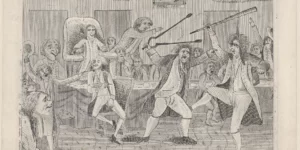
Cartoon depicting congressional debate over the Alien and Sedition Acts.


Donald Trump recently announced his intention to use the Alien Enemies Act of 1798 as a tool for mass deportation of immigrants. The Alien Enemies Act is a component of the notorious Alien And Sedition Acts. It's the only part of that legislation that remains on the books today. Unlike the more sweeping Alien Friends Act, which gave the president broad power to deport and bar any "aliens as he shall judge dangerous to the peace and safety of the United States," and was therefore rightly denounced as unconstitutional by James Madison, Thomas Jefferson, and others, the Alien Enemies Act allows detention and removal only when there "is a declared war between the United States and any foreign nation or government, or any invasion or predatory incursion is perpetrated, attempted, or threatened against the territory of the United States by any foreign nation or government." In that event, the president is given the power to detain or remove "all natives, citizens, denizens, or subjects of the hostile nation or government, being of the age of fourteen years and upward, who shall be within the United States and not actually naturalized."

Katherine Yon Ebright of the Brennan Center has an excellent explanation of why the Alien Enemies Act cannot legally be used against migrants from countries with which the US is not at war. Here's her summary of her analysis:

As the Supreme Court and past presidents have acknowledged, the Alien Enemies Act is a wartime authority enacted and implemented under the war power. When the Fifth Congress passed the law and the Wilson administration defended it in court during World War I, they did so on the understanding that noncitizens with connections to a foreign belligerent could be "treated as prisoners of war" under the "rules of war under the law of nations." In the Constitution and other late-1700s statutes, the term invasion is used literally, typically to refer to large-scale attacks. The term predatory incursion is also used literally in writings of that period to refer to slightly smaller attacks like the 1781 Raid on Richmond led by American defector Benedict Arnold.

Today, some anti-immigration politicians and groups urge a non-literal reading of invasion and predatory incursion so that the Alien Enemies Act can be invoked in response to unlawful migration and cross-border narcotics trafficking. These politicians and groups view the Alien Enemies Act as a turbocharged deportation authority. But their proposed reading of the law is at odds with centuries of legislative, presidential, and judicial practice, all of which confirm that the Alien Enemies Act is a wartime authority. Invoking it in peacetime to bypass conventional immigration law would be a staggering abuse.

She makes several other good points, as well. If you're interested in this issue, read the whole thing!

I would add that the "invasion" or "predatory incursion" in question must be perpetrated by a "foreign nation or government." That excludes illegal migration or drug smuggling perpetrated by private individuals, which is what we see at the southern border today. One can argue that use of the word "nation" in addition to "government" means the former has a different meaning from the latter. Perhaps so. But "nation" still doesn't include private individuals. Rather, it could apply to state-like entities that are not recognized governments. For instance, the Hamas terrorist organization that brutally attacked Israel on Oct. 7, 2023 is not a recognized government, but did - at least until recently - have state-like control over Gaza. The same could be said for some Founding-era Indian nations (which the US and European states didn't recognize as full-fledged governments) and groups like the Barbary pirates, who were agents of Arab north African states.

Elsewhere, I have explained why Founding-era understandings of "invasion" are limited to large-scale armed attacks, and do not cover things like illegal migration or drug smuggling (for more detail, see my amicus brief in United States v. Abbott).

Despite the strong legal arguments against it, there is a chance Trump could succeed in using the Alien Enemies Act as a tool for detention and deportation. As Ebright notes, courts might rule that the definitions of "invasion" and "predatory incursion" are "political questions" that courts aren't allowed to address. Several previous court decisions have held that the definition of "invasion" in the Constitution is a political question (thereby preventing state governments from invoking broad definitions of invasion under the Invasion Clause of Article IV in order to be able to "engage in war" in war without federal authorization), though many have simultaneously held that an illegal migration does not qualify as "invasion" because an invasion requires a large-scale armed attack (see pp. 20-22 of my amicus brief).

Ebright argues (correctly, I think) that even if the definition of "invasion" is usually a political question, the use of the Alien Enemies Act as a tool for mass detention and deportation of migrants from countries with which the US is not at  war should fall within the exception for "an obvious mistake" or "manifestly unauthorized exercise of power" (Baker v. Carr (1962)). I would add that the entire political question doctrine is an incoherent mess, and courts should not extend it further.

Nonetheless, there is a danger they could apply it here, and thereby let Trump get away with a grave abuse of power that could potentially harm many thousands of people. Mass deportations of the kind envisioned by Trump would  create disruption, increase prices and cause shortages. They  also destroys more American jobs than they creates, because many U.S. citizens work in industries that depend on goods produced by undocumented workers. In addition, large-scale detention and deportation routinely sweeps in large numbers of US citizens, detained by mistake because of poor-to-nonexistent due process protections.

It's also worth noting that the Alien Enemies Act applies to any migrants from the relevant countries who have not been "naturalized," which includes legal migrants even permanent resident green card holders. If Trump is able to use it at all, it could be deployed against legal immigrants no less than illegal ones. And he and his allies have repeatedly made clear they want to slash legal migration no less than the illegal kind.

If Trump returns to power, it is possible this particular plan will be stopped by the courts. But that is far from certain. Ebright also recommends Congress simply  repeal the Alien Enemies Act (there are plenty of other tools to deal with actual threats to national security); I agree, but it's unlikely to happen anytime soon. Thus, the only surefire way to block this dangerous abuse of power is to defeat Trump in the election.

UPDATE: Prof. Michael Ramsey commented on this post here. I responded in a follow-up post.

Artificial Intelligence

Thomas R. Lee & Jesse Egbert Guest-Blogging About AI and Corpus Linguistics

|

I'm delighted to report that Prof. Thomas R. Lee (BYU Law, and former Justice on the Utah Supreme Court) and Prof. Jesse Egbert (Northern Arizona University Applied Linguistics) will be guest-blogging this coming week on their new draft article, Artificial Meaning? The article is about artificial intelligence and corpus linguistics; Prof. Lee has been a pioneer in applying corpus linguistics to law. Here is the abstract:

The textualist turn is increasingly an empirical one—an inquiry into ordinary meaning in the sense of what is commonly or typically ascribed to a given word or phrase. Such an inquiry is inherently empirical. And empirical questions call for replicable evidence produced by transparent methods-not bare human intuition or arbitrary preference for one dictionary definition over another.

Both scholars and judges have begun to make this turn. They have started to adopt the tools used in the field of corpus linguistics—a field that studies language usage by examining large databases (corpora) of naturally occurring language.

This turn is now being challenged by a proposal to use a simpler, now-familiar large language model (LLM)—AI-driven LLMs like ChatGPT. The proposal began with two recent law review articles. And it caught fire—and a load of media attention—with a concurring opinion by Eleventh Circuit Judge Kevin Newsom in a case called Snell v. United Specialty Insurance Co. The Snell concurrence proposed to use ChatGPT and other LLM AIs to generate empirical evidence of relevance to the question whether the installation of in-ground trampolines falls under the ordinary meaning of "landscaping" as used in an insurance policy. It developed a case for relying on such evidence—and for rejecting the methodology of corpus linguistics—based in part on recent legal scholarship. And it presented a series of AI queries and responses that it presented as "datapoints" to be considered "alongside" dictionaries and other evidence of ordinary meaning.

Read More

Free Speech

Journal of Free Speech Law: "Hostile State Disinformation in the Internet Age," by Richard A. Clarke

A new article from the Daedalus (Journal of the American Academy of Arts and Sciences) Future of Free Speech Symposium.

|

The article is here; the Introduction:

State-sponsored disinformation (SSD) aimed at other nations' populations is a tactic that has been used for millennia. But SSD powered by internet social media is a far more powerful tool than the U.S. government had, until recently, assumed. Such disinformation can erode trust in government, set societal groups—sometimes violently—against each other, prevent national unity, amplify deep political and social divisions, and lead people to take disruptive action in the real world.

In part because of a realization of the power of SSD, legislators, government officials, corporate officials, media figures, and academics have begun debating what measures might be appropriate to reduce the destructive effects of internet disinformation. Most of the proposed solutions have technical or practical difficulties, but more important, they may erode the First Amendment's guarantee of free speech and expression. Foreign powers, however, do not have First Amendment rights. Therefore, in keeping with the Constitution, the U.S. government can act to counter SSD if it can establish clearly that the information is being disseminated by a state actor. If the government can act constitutionally against SSD, can it do so effectively? Or are new legal authorities required?

The federal government already has numerous legal tools to restrict activity in the United States by hostile nations. Some of those tools have recently been used to address hostile powers' malign "influence operations," including internet-powered disinformation. Nonetheless, SSD from several nations continues. Russia in particular runs a sophisticated campaign aimed at America's fissures that has the potential to greatly amplify divisions in this country, negatively affect public policy, and perhaps stimulate violence.

Read More

Academic Freedom

Kansas Prof Removed after Viral Video of Classroom Remarks

|

A health sports instructor at the University of Kansas is out of a job after a video clip of his in-class behavior went viral. The university's statements do not inspire confidence, even though the professor might well have been out of bounds.

Libs of Tiktok posted a short clip of an instructor in a classroom at the University of Kansas. In the clip, he seems to say in the middle of a class session, "There are going to be some males in our society that will refuse to vote for a potential female president because they don't think females are smart enough to be president. We could line all those guys up and shoot them. They clearly don't understand the way the world works." Suddenly remembering that he is being recorded, he then adds, "Did I say that? Scratch that from the recording. I don't want the deans hearing that I said that."

There is, of course, no context to the 32 second clip, though surrounding reporting suggests that the statement was made in the midst of a health sports class at some point this semester. The university announced yesterday that the instructor was under investigation, saying "His intent was to emphasize his advocacy for women's rights and equality, and he recognizes he did a very poor job of doing so." Today, the university announced that the professor had "left the university."

"The free expression of ideas is essential to the functioning of our university, and we fully support the academic freedom of our teachers as they engage in classroom instruction. Academic freedom, however, is not a license for suggestions of violence like we saw in the video," [Provost Barbara] Bichelmeyer said. "While we embrace our university's role as a place for all kinds of dialogue, violent rhetoric is never acceptable."

The Foundation for Individual Rights and Expression (FIRE) immediately issued a statement defending the professor. "The viral video shows an instructor making an off-handed joke—not communicating a serious intent to commit unlawful violence," [Graham] Piro said in a statement. "That's protected speech, and people advocating that the instructor be punished for his expression are advocating for the erosion of the First Amendment." Today, FIRE pointed out that the classroom statement could not credibly be viewed as a "true threat." As a consequence, FIRE asserts it is protected by the First Amendment and the instructor should be immune from adverse employment consequences for his actions. [The Academic Freedom Alliance has not made any statement on this matter, and I speak for myself alone here.]

I think the situation is more complicated that FIRE has so far made out, but that Kansas is focusing on the wrong issue. The core problem is not one of "violent rhetoric" and whether or not this speech is an example of a true threat. The core problem is one of unprofessional classroom behavior.

As it happens, I discuss such a scenario in You Can't Teach That! I argue there that traditional academic freedom principles and government employee speech doctrine as it applies to university professors should be understood to protect controversial classroom speech that is both germane to the class and professionally competent. Faculty speech in the classroom that is neither germane nor competent, however, is unprotected, and professors can be properly disciplined for such speech. For example, a chemistry professor who spends part of her class time stumping for Kamala Harris or an astronomy professor who instructs her students that the moon is made of green cheese is operating outside the bounds of academic freedom or First Amendment protections and can properly be disciplined. An African-American history professor who spends class time propounding critical race theory, on the other hand, should be understood to be operating within those protections.

But what about the Kansas sports health professor. The question is less about the violence of the political rhetoric than the fact of the political rhetoric. From the book:

Some academic disciplines have relatively well-defined boundaries regarding their subject matter, but others might be much more capacious such that it is less clear what topics might not be germane to a given class discussion. A lecture on early nineteenth century American literature might be expected to roam further afield than a lecture on thermodynamics. Allowances must likewise be made for speech that is non-germane from a subject matter perspective but that is apposite from a pedagogical perspective. Professors who tell jokes to help build community and sustain interest might be engaging in speech that is non-germane when taken in isolation but that makes sense in context. Professors pushing such boundaries no doubt owe the students an obligation not to be unnecessarily controversial. Jokes, asides, illustrations, and analogies should not themselves become a source of tension. A professor who "livens up" his lectures with a running series of acerbic political comments is not off the hook for introducing unnecessarily controversial material into the class simply because he finds his own remarks witty, just as courts have not been impressed with professors who aver that their sexually lewd remarks or crude language in class are just part of their teaching technique. Education is a social endeavor and professors cannot be expected to robotically stick to a script, but frequent digressions into tangential topics of conversation risk crossing the boundaries of academic freedom, especially when those digressions are contentious.

The question at hand is whether an instructor in a health sports class should be trying to "emphasize his advocacy for women's rights and equality" and encourage his students to vote for Kamala Harris. The answer to that question is probably "no," and it really does not matter whether he did a good job in his advocacy or a poor job or used violent rhetoric or some other form of rhetoric. A state university has both the authority and the responsibility to make sure that professors in its classroom engage in professionally appropriate speech and do not abuse their captive audiences by engaging in professional misconduct. Professional misconduct can get a professor disciplined, and even fired. A professor has no right to commandeer his health sports class in order to engage in political advocacy.

The Kansas instructor was at best dancing on the line, even if this single episode might not justify harsh discipline. But university officials should at least be asking the right questions about what is at issue in the case.

Free Speech

Journal of Free Speech Law: "Empowering Speech by Moderating It," by Danielle Keats Citron & Jonathan Penney

A new article from the Daedalus (Journal of the American Academy of Arts and Sciences) Future of Free Speech Symposium.

|

The article is here; the Introduction:

A myth of epic proportion has gained traction: that any effort to moderate online speech is a zero-sum game, with free expression as the loser. When social media companies remove destructive posts that violate terms of service, people cry, "Censorship!" Alex Jones, founder of the far-right conspiracy news site Infowars, accused YouTube of "killing the First Amendment" after the company blocked videos that revealed maps of the homes of Sandy Hook families. This isn't just an extremist view: the Pew Research Center has found that a majority of people believe that companies are engaged in "political censorship" when they moderate content. Some legislators have made this view a cornerstone of their political philosophy. At a House Oversight and Accountability Committee hearing in February 2023, Representative Lauren Boebert denounced Twitter as a "speech overlord." To the company's former head of Trust and Safety, Yoel Roth, she angrily admonished, "How dare you" shadow-ban my posts (even though no evidence supported the claim and former Twitter executives denied it). Representative Marjorie Taylor Greene stated that Big Tech was silencing Americans. The censorship narrative has gained traction in state legislatures as well. Underlying this view is the assumption that content moderation has no upside for free expression.

The outcry is similarly strident at the suggestion that law should curtail online abuse. Online assaults that include doxing, intimate privacy violations, and threats are dismissed as weak attempts to "blow off steam." Any effort to address them is viewed as a threat to free speech. The ACLU, for instance, has adamantly opposed the passage of laws penalizing the nonconsensual disclosure of intimate images. These laws risk chilling legitimate expression, the ACLU has argued, even though the laws made clear that they would not cover matters of legitimate public interest. Under law's blighting stare, free expression is impossible.

Read More

Politics

Short Circuit: A Roundup of Recent Federal Court Decisions

Abusive speech, criminal rioting, and Bellamy salutes.

|

Please enjoy the latest edition of Short Circuit, a weekly feature written by a bunch of people at the Institute for Justice.

Granted! Vacated! Remanded! This week, SCOTUS revived IJ client Mason Murphy's retaliatory arrest claim against an officer who arrested him for walking on the wrong side of a rural road in Missouri—an offense that never results in arrest in that jurisdiction. On remand to the Eighth Circuit, Mason will now have another shot at showing that he should be able to proceed with his First Amendment retaliation claim. The GVR also means that both of the two lower court decisions to exclude allegations like Mason's (that no one else has been arrested for the same conduct) are no longer good law. (The other case of course being IJ's monumental win in Gonzalez v. Trevino in June.) Click here to learn more.

New on the Short Circuit podcast: Our annual Supreme Court preview live at UNC Law.

New on the Unpublished Opinions podcast: Short Circuit's sister podcast has its own feed and logo and everything! The latest episode dives into, inter alia, reading the cases you cite, SCOTUS special masters, riparian rights in space, and judicial namedropping.

Read More

Administrative Law

The Appointments Clause Goes Fishing

A successful appointments clause challenge to Regional Fishery Management Councils. (Updated to fix block quotes)

|

Under the Magnuson-Stevens Act, Regional Fishery Management Councils are tasked with developing and revising fishery management plans to help ensure that offshore fisheries are utilized sustainably. A council's proposals are subject to approval and revision by the Secretary of Commerce, but councils retain the ability to block or veto certain actions by the Secretary. Council members are appointed by the Secretary of Commerce.

After the Mid-Atlantic Council adopted a plan lowering the catch limits for certain fish species, commercial fishermen sued. Among other things, they argued that council members are "officers of the United States" under Article II. And, since council members are not appointed by the President, the fishermen argued, they should not be able to adopt such regulations.

In Lofstad v. Raimondo, a divided panel of the U.S. Court of Appeals for the Third Circuit agreed with the fishermen that council members are officers, but not with regard to the remedy sought. Judge Stephanos Bibas wrote for the court, joined by Judge Freeman. Judge Rendell dissented.

Judge Bibas summarized his opinion:

The buck stops with the President—but not when unelected officials get a veto. Under a federal fishing law, a Regional Council can veto some actions taken by the Secretary of Commerce. That power is significant. But the Council members were never appointed by the President, as the Constitution requires. Two fishermen rightly challenge this scheme. The remedy, we hold, is to sever the pocket-veto powers so the Council plays only an advisory role.

According to Judge Bibas, the council's ability to block regulatory actions by the Commerce Secretary represents the sort of significant authority that makes a government actor an "officer" for constitutional purposes.

The Council's pocket-veto power is especially significant because it undermines the democratic chain of command. The Constitution trusts the President with significant powers, like the veto, because he is elected and accountable to the voters. Executive officers below the President are not. So they must be "accountab[le] to the public through a clear and effective chain of command down from the President, on whom all people vote." Arthrex, 594 U.S. at 11 (internal quotation marks omitted).

The Council's pocket-veto powers thwart that chain of command. The Council need not reflect the President's views because it is an advisory body. But the Secretary of Commerce, who heads the Department of Commerce, answers to the President and the people. And Council members can refuse to let her set up limited-access fisheries, delegate to states, or repeal a plan. By blocking her actions, the Council wields significant authority. And no one can override the Council's pocket veto (unlike the President's limited veto). That is enough to make Council members officers, not employees.

The council members are also "principal officers" because their veto authority is final and unreviewable, and can countermand the decision of a cabinet secretary. The council's other powers, however, are not of constitutional significance.

Finding a constitutional problem with the structure of fishery regulation under the Magnuson-Stevenson Act, the next question for the court was the proper remedy -- and here the court gave the petitioners less than they were hoping for.

The fishermen ask us to invalidate the amendment. But we need not go so far. When a statute is constitutionally flawed, "we try to limit the solution to the problem, severing any problematic portions while leaving the remainder intact." Free Enter. Fund v. Pub. Co. Acct. Oversight Bd., 561 U.S. 477, 508 (2010) (internal quotation marks omitted). Even though this statute has no severability clause, we can sever an unconstitutional provision unless Congress evidently would not have passed the remaining parts without the invalid ones. Id. at 509. To figure this out, we look at the statute's text and historical context. Id.

Even if we knock out the pocket vetoes, the statute remains "fully operative." Id. (internal quotation marks omitted). The Council's "most significant responsibility" is drafting proposed plans; that duty remains untouched. NRDC v. Nat'l Marine Fisheries Serv., 71 F. Supp. 3d 35, 40 (D.D.C. 2014) (K.B. Jackson, J.). What is more, the government conceded at argument that these pocket-veto provisions are rarely used and that severing them would not disrupt the statutory scheme. So we will sever the pocket-veto powers in Sections 1854(c)(3), 1854(h), and 1856(a)(3)(B). Those severances suffice to remove the Council's significant authority.

Without those powers, the Council members are mere employees who fall outside the  Appointments Clause. They did not use their unconstitutional powers to enact or tweak the amendment in this case. Their advisory role in proposing the amendment plus its implementing regulation was proper.

Judge Bibas' opinion concludes:

Executive officials who have significant authority must be properly appointed. Because the Council members were not, we sever the pocket-veto provisions that gave them significant authority. Without those powers, the Council members are no longer officers but rather employees. As employees, they need not be appointed by the President or Secretary. We will thus reverse the District Court's order granting summary judgment for the government and instead render judgment for the fishermen, relieving the  Council of its significant authority.

As noted, Judge Rendell dissented, rejecting the majority's conclusion that the councils exercise "significant authority" and lamenting the decision to "gut[] the powers given the Councils by Congress." In her view, the court should "avoid rewriting the legislative scheme," especially where (as here) binding precedent does not require it.

It will be interesting to see whether the Solicitor General seeks further review.

Judiciary

The First Real Judicial Filibuster

Remembering the first time a partisan Senate minority blocked a judicial nomination that enjoyed majority support.

|

On May 9, 2001, President George W. Bush nominated Miguel Estrada to the U.S. Court of Appeals to the D.C. Circuit. If confirmed, Estrada would have been the first Latino to serve on this court, but it was not to be.

At the time of Estrada's nomination, the Senate was split 50-50, leaving Vice President Dick Cheney as the tie-breaking vote. A few weeks later, Senator James Jeffords switched his party affiliation, handing Senate control to the Democrats, who refused to act on Estrada's nomination. As was revealed in leaked memoranda from Senate leadership and the Judiciary Committee, Senate Democrats feared confirming Estrada would set him up for a subsequent Supreme Court nomination and it would be too politically difficult to oppose the first Latino nominated to the High Court.

Republicans regained control of the Senate in the 2002 election, but Miguel Estrada would still not get confirmed. In March 2003, forty-four of the forty-nine Senators in the Democratic caucus voted against cloture, blocking full consideration of the nomination. There would be six more cloture votes on the Estrada nomination over the next six months, all of which failed. This marked the first time in our nation's history that a filibuster was used to block a judicial nomination that enjoyed majority support.

The fight over Miguel Estrada's nomination may not have attracted the same degree of attention as Supreme Court battles, but it had a dramatic effect on how many conservatives and Senate Republicans viewed the judicial nomination process -- and led to the regular use of cloture as a means of slowing or blocking judicial nominees. Prior to Miguel Estrada, it had never been the case that a judicial nominee had been required to have the support of 60 Senators to be confirmed.

Prior to the Estrada nomination, it was unusual for a cloture vote to be required, and the sole time a cloture vote had failed and a judicial nomination was unsuccessful*, the nominee in question (Associate Justice Abe Fortas who had been nominated to be Chief Justice) faced bipartisan opposition and lacked majority support. (Indeed, many saw the cloture vote as a test to see whether 50 Senators would support him -- a test Fortas failed.) 1968 was the first time a cloture vote had ever been requested for a judicial nominee, and such votes remained a rarity for the next thirty-five years. Judges opposed by forty-some Senators were the exception, to be sure, but they were also routinely confirmed. (I have surveyed this history before, and also recommend this CRS Report on the subject.)

The Estrada filibuster marked a dramatic escalation in judicial nomination obstruction -- and that escalation was ratcheted up further when, after Senate Republicans filibustered Democratic nominees, Senator Majority Leader Harry Reid forced through a reinterpretation of Senate rules to preclude filibusters for judicial nominations (the so-called "nuclear option"). Filibusters were apparently only to be allowed for Republican nominees.

The latest installment of Ed Whelan's highly informative Confirmation Tales series revisits the Estrada nomination, and how it poisoned the well for comity and cooperation on judicial nominations, with an interview of Steven Duffield. who worked for the Senate leadership at the time. Among other things, Duffield recounts how Senate Republicans lacked the votes to "go nuclear" at the time (though fear that they might get to 50 votes for a rule change ultimately led to the "Gang of 14" deal to temporarily set the filibuster aside), and how the judicial confirmation battles of the 2000s established a new norm under which it was appropriate to oppose a judicial nominee for no reason other than disagreement with his or her judicial philosophy. (For more on this history, see this post and the links therein.)

From the Duffield interview:

Just as we warned at the time, the Democrats' decision to filibuster the Estrada nomination was a major inflection point, both in the confirmation wars and in the history of the Senate more broadly.

Let's start with the confirmation wars. The filibuster fundamentally changed the expectations regarding how senators in the party opposite the president's party would assess lower-court nominees: the fight over judicial philosophy was now front and center.

The question of "competence" versus "ideology" (or "judicial philosophy") was still being hotly contested in the early 2000s. Senator Orrin Hatch, who had famously supported Bill Clinton's nomination of Ruth Bader Ginsburg to the Supreme Court, tried valiantly to convince senators that, except in truly extraordinary circumstances, the core question should be competence. It's a battle he was already losing when Estrada was nominated, and we saw it die altogether during 2003. It's now a relic of the past. . . .

The animosity and the frustration with a party-wide assault on comity and cooperation have certainly migrated into other areas, with a tit-for-tat environment that has made the Senate far weaker as an institution than it was or than it should be. People might hate the "club" culture of the old Senate, but is this better?

It is deeply regrettable that a handful of activists were able to persuade the filibustering senators that it was better to unravel the Senate's messy but still-effective ecosystem than to do the hard work of persuading their Republican colleagues to oppose the nominees on the merits. We have a far less productive Senate today because of those judgment errors in 2003.

There are several more Confirmation Tales posts on the Estrada nomination and inauguration of the filibuster as a means of blocking confirmation, and they are largely consistent with a point I have often made on this blog: There was no meaningful history of filibusters, or even cloture votes, prior to the Estrada nomination, and the use of a filibuster to block a highly qualified, broadly esteemed nominee who enjoyed bipartisan, majority support, was a major turning point in judicial confirmation battles. Indeed, it is quite possible that had Miguel Estrada been confirmed, we would have a more functional Senate, and Merrick Garland would be a Supreme Court justice instead of Attorney General.

*Update: I revised this sentence to note there were two instance between 1968 and 2003 in which cloture votes failed, but the nomination proceeded and the nominee was confirmed. This occurred with the 1971 nomination of William Rehnquist to the Supreme Court (whom some Senate Democrats attempted to filibuster when he was nominated to be Chief Justice as well) and the 1999 district court nomination of Ted Stewart, who was subsequently confirmed 95-3.

Foreign Relations Law

New Book on Historical Gloss and Foreign Affairs, Part V

The growth of presidential power.

|

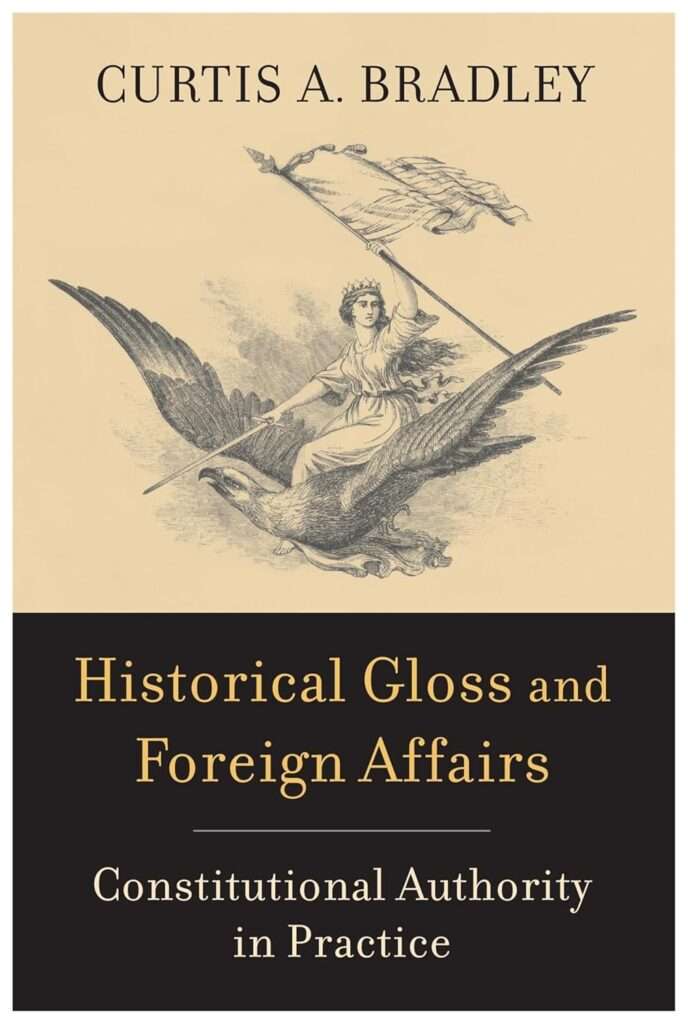
This is the fifth of five posts about my new book, Historical Gloss and Foreign Affairs: Constitutional Authority in Practice. In the last several posts, I discussed examples of foreign affairs authority that have been heavily informed by historical practice. In this post, I address the concern that the historical gloss approach to constitutional interpretation unduly favors presidential authority.

The three examples that I've covered in my prior posts all involve a growth of presidential foreign affairs power over time, and, as I discussed in those posts, historical gloss is a mainstay of the executive branch's constitutional reasoning.

As compared with Congress, the executive branch also has an easier time creating non-judicial precedent, given that it is controlled by a single party and faces lower collective action hurdles. Not surprisingly, therefore, the most common objection to a gloss-based approach to the separation of powers is that it enhances executive power.

One difficulty in assessing this objection is that it is not clear what the baseline should be in determining whether the executive has too much foreign affairs power. Should it be the amount of authority that George Washington had (or thought he had)? There are some obvious problems with using that as the baseline, including the fact that the Washington administration was itself unsure about the scope of its foreign affairs powers and Washington was conscious that he was setting non-judicial precedent that might become historical gloss.

Read More

Second Amendment Roundup: The VanDerStok Argument

Whether ATF may criminalize conduct remains the central issue.

|

Pundits have tried to read the tea leaves following the argument in the Supreme Court in Garland v. VanDerStok on October 8.  In its Final Rule, ATF expanded the definition of "firearm" beyond what Congress provided in the Gun Control Act (GCA), and it expanded the definition of "frame or receiver" beyond the agency's own definition that was on the books since 1968.  In the argument, serious questions were raised about the extent to which an agency may revise a criminal statute.

That concern was expressed right at the beginning when Justice Thomas asked Solicitor General Prelogar whether the regulation "cover[s] all of Chapter 44," which is the GCA portion of 18 U.S.C. (the federal criminal code), and whether it "appl[ies] under 924," which is the GCA section that provides criminal penalties.  Prelogar's response was "yes" to both.  So whether a person is committing a felony depends on whether the more narrow definition of "firearm" enacted by Congress, or the broader definition adopted by ATF, applies.

Justice Kavanaugh probed in detail into the implications of the agency's expansion of the reach of the criminal law.  Expressing concern about mens rea, he noted that "this is an agency regulation that broadens a criminal statute beyond what it had been before."  "So what about the seller," he asked "who is truly not aware … that they are violating the law and gets criminally charged?"

Prelogar responded that the requirements of having a license and of serializing firearms are subject to a "willfulness" requirement (see § 924(a)(1)(D)), but not conducting a background check only requires "knowledge" (§ 924(a)(5)).  Under the "knowing" standard, a person need not know of a legal duty but simply knows that he didn't conduct the background check.

But not to worry, Prelogar assured the Court, "on the background check, if you have a seller out there who wants guidance about whether, with respect to particular types of products, … the person can seek a classification from ATF."  But that presupposes that you even know to ask for a "mother may I" classification letter from ATF.  And as persons in the industry are painfully aware, ATF may take up to a year to issue a letter, if it responds at all.  More fundamentally, that presupposes that the agency itself, rather than the statute, determines what is lawful.

So, Justice Kavanaugh continued, "you truly believe you're not violating the law, could you be charged under that provision?"  Prelogar responded: "As a theoretical possibility, I think only with respect to background checks, it's possible you could…. I don't think the government would be likely to charge someone in that kind of situation."

That's an extremely naive assurance.  Why would ATF not cause the prosecution of a person merely because he "truly believed" he was not violating the law?  Countless persons have been subjected to GCA prosecutions without any regard to whether they understood the requirements of the law or, even more so, ATF's complex regulations.

While many federal prosecutors use good judgment in whether to initiate prosecutions, there are plenty who are interested in their batting average.  In U.S. v. Moore, recently decided by the Eleventh Circuit, Judge Barbara Lagoa wrote that the defendants in that case "are felons for having violated a statute that no reasonable person would understand to prohibit the conduct they engaged in."  But the assistant U.S. attorney, "taking a page out of Inspector Javert's playbook," secured an indictment and got his conviction.  You'll recall the inspector from Victor Hugo's Les Misérables, who relentlessly persecuted anyone he could.

So Prelogar's assurance about persons caught up in the maze of ATF's regulations not being prosecuted rings hollow.  One more exchange with Justice Kavanaugh bears attention.  He referred to "a lot of classification letters that were out there, this was to collect everything and put everyone, as you say, on notice."  What was perhaps unknown is that, when it adopted the Final Rule, ATF repudiated the validity of all of its prior classifications, wiping out a half century's worth of interpretations on which the industry and the public relied.  As 27 C.F.R. § 478.12(f)(2) states:

Prior determinations by the [ATF] Director that a partially complete, disassembled, or nonfunctional frame or receiver, including a parts kit, was not, or did not include, a "firearm frame or receiver" … as those terms were defined prior to April 26, 2022, shall not continue to be valid or authoritative after that date. Such determinations shall include those in which the Director determined that the item or parts kit had not yet reached a stage of manufacture to be, or include, a "firearm frame or receiver"….

That alone refutes the argument that ATF was continuing to follow what it had always done.  The meanings of "firearm" and "frame or receiver" became a tabula rasa by administrative decree, uninformed by fifty-two years of usage.  And yet Prelogar asserted in her opening statement that the Final Rule is "consistent with how ATF has interpreted and implemented the Act across five decades and 11 different presidential administrations."

To Prelogar's suggestion that the Final Rule simply extended the past regulations, Justice Kavanaugh responded: "Some expansion. Some expansion."  Prelogar responded, "only with the addition of looking at jigs."  But that too was a great leap forward.  Never before had ATF considered jigs, tools, and blueprints to be among the parts from which a firearm may be fabricated.

As he has done repeatedly in other cases, Justice Gorsuch was concerned about "lenity, notice."  And he called attention to the government's summary judgment brief in Syracuse v. ATF, No. 1:20-cv-06885 (S.D. N.Y. 2021), representing that "an unfinished frame or receiver does not meet the statutory definition of 'firearm.'" Prelogar responded that "ATF has always looked at whether a partially complete frame or receiver can be brought to functional condition quickly, easily, and efficiently."  But the Final Rule goes far beyond that.

One of the several elephants in the crowded room is that the definition of "firearm" in § 921(a)(3)(A) includes a weapon that "may readily be converted" to expel a projectile, but its further definition in (B) of "firearm" as "the frame or receiver of any such weapon" includes no readily-convertible language.  And there are other contrasting definitions.  As Justice Barrett pointed out, the definitions of "destructive device" and "machinegun" "reference parts in the way that this definition [firearm] does not."  This case is about the meaning of statutory text, and the textual contrast could not be more stark.

Justice Barrett also referred to Fifth Circuit Judge Oldham's "concern that because AR-15 receivers can be readily converted into machine gun receivers, that this regulation on its face turns everyone who lawfully owns an AR-15 into a criminal."  Prelogar denied "that a statutory reference to one thing includes all other separate and distinct things that might be readily converted into the thing that's listed in the statute itself."  But the problem is that "machinegun" is also defined to "include the frame or receiver of any such weapon" (26 U.S.C. § 5845(b)), and it only takes drilling two holes to convert a semiautomatic receiver into a machinegun receiver.  Prelogar added that ATF "has never suggested that AR-15s, standing alone, are regulated machine guns."  True enough, but that could change, just as the Final Rule here obliterated decades of prior understandings.

If a statute restricted shorts, Prelogar analogized, it would not regulate a pair of pants, "even though the pants could be readily converted into shorts."  And if the person possesses a pair of scissors?  The scissors would be equivalent to the tools and jig here.

Justice Jackson asked about how the government phrased the question presented in this case as whether certain items are "firearms" within the meaning of the statute. That framing "doesn't seem to account … for the actual claim that the challengers have made here, which is that the agency has exceeded its statutory authority."  And that issue reduces to whether the agency can, by regulation, criminalize conduct that Congress has not criminalized.

On behalf of the respondents, Peter Patterson posed the clear statutory argument, but as an alternative offered ATF's pre-Final Rule test of "whether critical machining operations had taken place."  Justice Barrett asked: "So would you say that it's like the ordinary usage? Now everybody just understands based on long standing practice that this critical machining test is the point at which the frame or receiver [comes into being]?"  Patterson agreed.

That scenario could be where the Court decides the case.  It will obviously focus on statutory text.  Congress defined "firearm," and just last term, in Dep't. of Agriculture Rural Dev. Rural Housing Service v. Kirtz, the Court wrote: "When Congress takes the trouble to define the terms it uses, a court must respect its definitions as 'virtually conclusive.'" But the Court may also take comfort in respondents' alternative position, which incorporates a general rule about critical machining operations that ATF followed before it adopted the Final Rule, and to which the industry and the public were accustomed.


Supreme Court

Business and the Roberts Court Revisited

An examination of how Donald Trump's appointments to the Supreme Court have affected business interests.

|

The Roberts Court has long been described as a "pro-business" court. News reports summarizing John Roberts' first term as Chief Justice described the Court as business friendly. A New York Times Magazine profile was simply labeled "Supreme Court, Inc." Activist groups tallied the win-loss record of the Chamber of Commerce, and academics published quantitative assessments purporting to show that the Supreme Court under Chief Justice Roberts was more sympathetic to business interests than any Court in decades.

I have been skeptical of the "pro-business" label as a useful description of the Court from the outset. Quantitative assessments of the Court's decision-making have their place, but qualitative assessments of the Court's decisions is necessary to evaluate the extent to which the Court's decisions are benefitting or assisting business interests. Further, insofar as business groups tend to win in some sorts of cases but not others, it is more useful to describe the Court's jurisprudence with more nuance and precision. A simply hashtag label is not that informative.


9780199859344

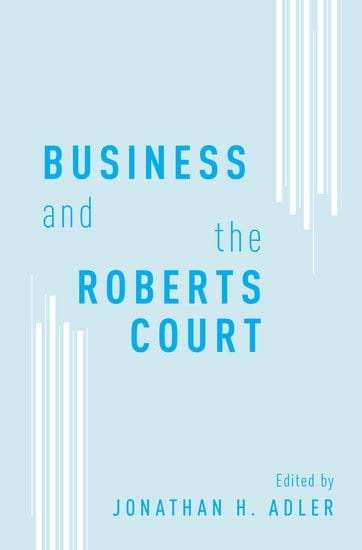
My 2016 book, Business and the Roberts Court sought to take a deeper look into the Court's handling of business-related cases. In this volume, subject-matter experts looked at different aspects of the Court's jurisprudence. Was the conclusion that the Court is "pro-business"? Here is how I summarized the findings:

Where business interests seek outcomes that are in line with the justices' doctrinal commitments, they can expect to prevail.  Yet where business interests are unable to marshal arguments that appeal to the justices' underlying judicial philosophies, their odds are less favorable, no matter how much business groups may believe is at stake.  So rather than say this is a Court that is "pro-business," it is more accurate to say that this is a Court that business likes — except when it doesn't.

Since then, the debate over whether to characterize the Court as pro-business has continued. In 2022, for instance, Lee Epstein and Mitu Gulati published an analysis of the Supreme Court's treatment of business cases between 1920 and 2020.

Earlier this semester, I presented a new paper revisiting the question whether the Supreme Court is properly characterized as "pro-business" and offering a preliminary assessment on the extent to which Donald Trump's appointment to the Court have made the Court more (or less) business-friendly. The paper is part of a symposium to be published in The Annals of the American Association of Political and Social Science. Here is the abstract:

The Roberts Court has long been characterized as a pro-business court, perhaps the most pro-business court in a century. Insofar as this alleged pro-business orientation is due to the Court's Republican-appointed majority, President Trump's appointments to the Supreme Court should have magnified the Court's pro-business orientation. Yet there are reasons to question the general characterization of the Court as "pro-business" as well as the assumption that an increase in the Court's Republican-appointed majority has increased any probusiness orientation. Quantitative analyses often fail to account for the relative importance of individual decisions, the broader, legal context in which the Court's decisions are made, or how the Court's decisions alter or depart from pre-existing legal baselines. While President Trump's appointments to the Court have fairly consistently voted to restrain the power of administrative agencies, they have not consistently supported outcomes that are beneficial to business. In some areas in particular, such as cases involving state laws that may fragment or burden national markets, the Roberts Court may actually be less sympathetic to business interests than it was prior to Trump's appointments to the Court.

On the one hand, the Roberts Court has become more skeptical of agency power and the administrative state. Thus insofar as one considers "pro-business" to mean "anti-regulatory," one may conclude that the Court has become more solicitous of business concerns since Justices Gorsuch, Kavanaugh, and Barrett replaced Justices Scalia, Kennedy, and Ginsburg.

On the other hand, the Court appears to have become more skeptical of business arguments in favor of federal preemption of state regulations, whether under preemption doctrine of the Dormant Commerce Clause (think of cases such Virginia Uranium and National Pork Producers Council), while simultaneously becoming less solicitous of business arguments seeking to limit state court jurisdiction in tort suits (see, e.g., Mallory). This shift is particularly interesting as it appears to mark a shift in the Court's jurisprudence -- and a shift that is due, in part, to Trump's appointments, Justice Gorsuch in particular.

While any assessment of the affect of Trump's appointments to the Court is necessarily preliminary, I believe these shifts underscore the point that it is more helpful to think about the doctrinal commitments of the justices than to focus on broad characterizations such as "pro" or "anti" business. So, for example, one might characterize the Court's emerging jurisprudence as one that is skeptical or hostile to federal regulation, but solicitous of state law. Insofar as this is a fair characterization, it would highlight how the Court looks favorably on business concerns in some areas (such as where business groups challenge federal regulatory agencies), but is unsympathetic in others (such as where business groups seek to constrain state authority). And whether these tendencies are good or bad is a separate question entirely.

Harvard Officially Allows Protestors Ten Minutes to Disrupt Events

Elite University or Unruly Kindergarten?

|

From Kassy Akiva's X feed:

At Harvard for an event with Mosab Hassan Yousef [author of Son of Hamas].

The organizers were just forced to read a note from the Harvard administration stating that disrupters are allowed to make noise for 10 minutes before being removed.

Here's the full statement the students had to read to the audience:

"A quick note before we begin—Harvard University is committed to maintaining a climate in which reason and speech provide the correct response to a disagreeable idea. Speech is privileged in the University community. There are obligations of civility and respect for others that underlie rational discourse. If any disruption occurs that prohibits speech the disrupters will be allowed for up to 10 minutes. A warning will be issued to all disturbers at the 5-minute mark explaining that the protesters are disrupting the event and ask them to stop. Any further disruption that prevents the audience from adequately hearing or seeing the speakers will lead to the removal of the disrupters from the venue."

More