The Volokh Conspiracy

Mostly law professors | Sometimes contrarian | Often libertarian | Always independent | Est. 2002

The Volokh Conspiracy

Climate Change

Supreme Court Refuses to Resurrect the Kids Climate Case

Unsurprisingly, no justice showed any interest in reviving a lawsuit that should have died long ago.

|

In yesterday's Orders List, the Supreme Court denied the petition for a writ of mandamus in In re Kelsey Juliana, a last ditch attempt to revive the so-called "Kids Climate" case. At long last, this audacious effort to claim that the federal government is violating the constitution by failing to take more action to address climate change may be put to rest.

As I noted when the petition was filed, there was no chance the Supreme Court would act on this request, a point on which Dan Farber agreed. Nonetheless, the New York Times reported credulously on the filing, as if it had any legal merit or likelihood of success.

The Department of Justice recognized that the petition posed no risk and waived filing a response. Yesterday, not a single justice indicated any interest in the case.

From the start, Juliana was the sort of case that made for interesting discussions in the faculty lounge, but had no more than superficial grounding in any applicable precedent or doctrine (a point I briefly develop in this forthcoming symposium essay). Yet insofar as it attracted attention and resources, it risked diverting the focus of climate change efforts away from things that could be potentially meaningful.

I think one can finally say that Juliana is gone for good, and that climate law will be better for it.

Politics

Part IX: Equal Protection of the Law - Sex Discrimination and Other Types

An Introduction To Constitutional Law Video Library: Frontiero v. Richardson (1973), Craig v. Boren (1976), U.S. v. Virginia (1996), Cleburne v. Cleburne Living Center, Inc. (1985), Romer v. Evans (1996)

|

Sex Discrimination on the Burger Court

⚖️ Frontiero v. Richardson (1973)

⚖️ Craig v. Boren (1976)

⚖️ U.S. v. Virginia (1996)

"Heightened" Rational Basis Scrutiny

⚖️ Cleburne v. Cleburne Living Center, Inc. (1985)

⚖️ Romer v. Evans (1996)

Read More

District Court Issues Universal Injunction In Louisiana Ten Commandments Case

The court rules that "the Act cannot be enforced throughout the state."

|

Louisiana law requires the posting of the Ten Commandments in public school classrooms. A group of Plaintiffs challenged the ordinance. These Plaintiffs are faith leaders, parents, and others who object to the display of the Ten Commandments on Establishment Clause grounds.

The District Court ruled that the posting of the Ten Commandments was unconstitutional. I may address the First Amendment analysis elsewhere. Here, I'd like to focus on the scope of the court's remedy:

The Court has ruled that the Act is facially unconstitutional. That is, H.B. 71 is unconstitutional in all applications. As a result, the Act cannot be enforced throughout the state. While AG Defendants do not have to serve each school with a copy of this ruling, they certainly will be ordered to provide notice to all schools that the Act has been found unconstitutional, particularly since the burden on AG Defendants to accomplish this task is minimal.

Though this ruling only applies statewide, it is a universal injunction. It provides relief beyond the named plaintiffs, and their children. It applies to all schools in the state, even schools at which there were no objecting parents/plaintiffs. There is no certified class, so Rule 23 is out. Under Labrador v. Poe (see here and here), this universal injunction seems too broad. Relief should be targeted to those who are injured. This standard ought to apply in the state context, especially when it is a federal court granting relief.

This issue will be appealed to the Fifth Circuit shortly. Putting aside the merits question, the court may see fit to narrow the scope of relief.

Discrimination

Courts Shouldn't Rely on Election Returns to Give Trump a Blank Check for Policies Motivated by Unconstitutional Discrimination

The key issue in such cases is the motivation of the official who adopted by the policy, not who voted for him.

|

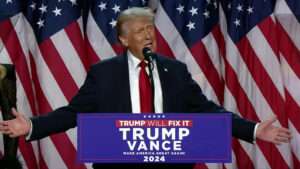
Donald Trump at a lectern
Donald Trump. (Fotogramma/Zuma Press/Newscom)


During Donald Trump's first administration, his travel ban policy barring almost all migration from several Muslim-majority nations was challenged in court on the grounds that it was unconstitutional because motivated by anti-Muslim bias. Co-blogger Josh Blackman argues similar arguments should not be accepted by courts in the next Trump administration because polling data indicates Trump made significant gains among Hispanic and Muslim voters in the 2024 election. Judges should not take his advice. The key issue in cases where seemingly neutral policies are challenged for having unconstitutional discriminatory motives is the motivation of the people who adopted them, not the backgrounds of the people who voted for them.

In the travel ban case, the main evidence against Trump was not who voted for him in the 2016 election, but his own repeated statements indicating that his intention was to target Muslims for exclusion, plus the extreme weakness of the supposed "security" rationales for the ban. This should have led courts to strike down the travel ban based on longstanding precedent holding that evidence of unconstitutional discriminatory motive (such as discrimination based on race, ethnicity, or religion) should lead to invalidation unless the government can show it would have adopted the same policy even in the absence of such illicit motivations. Ultimately, a closely divided 5-4 Supreme Court upheld the travel ban on the grounds that the executive deserves special deference on immigration policy that would not be extended in almost any other context. Elsewhere, I have argued this double standard is badly misguided. Be that as it may, no one on either side of that litigation argued the issue turns on survey data, election returns, or the ethnic and religious composition of the electorate that voted for Trump.

Voters are not the ones who adopt these policies. Moreover, the fact that a candidate has supporters from a given ethnic or religious group doesn't mean he cannot or will not adopt policies biased against them. He might, for example, do that to satisfy other (to him, more crucial) constituencies. Democrats, for example, routinely get strong support from Asian-Americans (far higher percentages than Trump got from Hispanics or Muslims in 2024), but also support various racial preferences that discriminate against them. Such voting patterns also don't necessarily show that members of the groups in question actually believe the candidate isn't biased against them. Many Hispanics and Muslims likely voted for Trump on "lesser evil" grounds, or because of anger at the Democrats at the state of the economy.

Of course, Josh Blackman's ultimate position may be that courts should ignore evidence of motive entirely. On that view, if a policy is facially neutral, it should be upheld, regardless of the possible motivations behind it.

In addition to going against many decades of precedent, that position would have terrible consequences. As I explained in a post written during the travel ban litigation:

If the Supreme Court rules that campaign statements cannot be considered, that would create a very dangerous precedent. Politicians could openly advocate discriminatory policies during the campaign, then rely on more careful and euphemistic phrasing after they take office. On the campaign trail, they can openly say they want to target blacks, Muslim, atheists, Evangelical Christians, or some other minority group. Afterward, they can adopt a policy targeting some seemingly neutral characteristic that closely correlates with membership in the group in question. And, after taking office, they can stick to carefully scripted official justifications for their actions that elide the true purposes.

I would add that one can use facially neutral criteria that correlate with group membership to target almost any racial, ethnic, or religious minority. Policymakers who seek to discriminate against blacks in hiring could reject applicants from majority-black neighborhoods or graduates of historically black colleges. As long as the policy in question doesn't explicitly reference race, but merely enumerates neighborhoods or colleges, you're in the clear! Want to exclude Orthodox Jews? Adopt a policy barring the hiring of people who refuse to work on Saturdays (the Jewish sabbath).

Clever policymakers can easily come up with similar facially neutral, but pretextual ways to target almost any minority group. Indeed, such strategies were repeatedly used by state and local governments to discriminate against blacks after the courts struck down open racially discriminatory policies.

It's worth noting that excluding evidence of discriminatory motive from judicial scrutiny would shield discriminatory policies condemned by the right, as well as those opposed by the left. For example, universities and selective public high schools with left-leaning administrations sometimes try to use facially neutral admissions criteria to to keep down the percentage of Asian and white students [my wife, Alison Somin, was one of the lawyers representing the Asian-American plaintiffs challenging one such policy, in a case that almost reached the Supreme Court]. If evidence of motive is excluded, educational institutions would have a virtual blank check to use seemingly neutral criteria to get around the Supreme Court's 2022 decision barring most racial preferences in college admissions.

Indeed, defenders of such preferences could adopt Josh Blackman's election-returns argument. After all, the left-wing Democrats who enact these policies often win majorities of Asian voters, and they get large percentages of the white vote, too, even if a minority. Many of the relevant policymakers are even whites or Asians themselves.

In the travel ban case, the Supreme Court ultimately did not rule that campaign statements or other evidence of discriminatory motivation should be ignored. Instead, as noted above, it based its ruling on the supposed special deference due to the executive on immigration policy. That was a bad ruling. But a holding indicating that evidence of discriminatory motive is barred more generally would have been much worse.

In sum, election returns should not influence judicial evaluations of possibly discriminatory policies. If such cases arise in the second Trump administration, as they did in the first, the focus should be on motives of the officials who actually adopted the policy in question.

Election 2024

The Election Wasn't a Realignment - or a "Mandate"

Trump's victory was narrow and largely caused by public anger at inflation and price increases.

|

NA

There is a lot of talk about how the election result is a great realignment and/or a "mandate" for Trump's policies.  The available evidence doesn't support such notions.

When all votes are fully counted, it looks like Trump will have won the popular vote by 1.5  points and have 1-4 point margins in the 7 swing states. That's not the kind of large margin of victory typically associated with realignment elections in which large blocs of voters shift from one party to another (e.g. 1932 or 1980). It's actually a narrower victory than Bush won in 2004 or Obama in 2012.  Few would argue either of those wins was a realignment or a mandate. Biden in 2020 won the popular vote by a bigger margin (about 4.5 points) and had nearly the same electoral vote margin (306 for Biden in 2020; 312 for Trump this year). For those keeping score, I wrote at the time that Biden didn't have a mandate either. Trump's popular vote margin may actually be a little smaller than Hillary Clinton's was in 2016 (yes, obviously, she lost the electoral college).

House and Senate results are consistent with the above. The GOP will have only a narrow House majority (probably about 220-215). The Republicans gained only 4 seats in the Senate, despite a very favorable map, and actually lost 4 of 5 swing-state Senate races, despite Trump winning all five of those states on the top of the ballot.

Around the world, there has been a big backlash against incumbents because of inflation/price increases. As I noted in a preelection post, this is standard "retrospective voting" (punishing incumbents for perceived bad conditions), and it was weighing heavily against the Democrats. The others who faced elections all got clobbered or are about to be. The Democrats actually greatly outperformed these background conditions by losing only narrowly.

It is true there has been a bigger shift in the Hispanic vote than elsewhere. Exit polls suggest Trump lost it by only about 53-45 (some polling data shows a weaker performance for Trump). However, that means he got about the same share of the Hispanic vote as….. George W. Bush in 2004 - the last time the GOP ran a presidential campaign with this highly favorable background conditions.

Also, it has long been clear that Hispanic identity is highly fluid and diverse, and therefore that the group is far less politically monolithic than, e.g., blacks. Many second and third generation Hispanics don't even identify as "Hispanic" or Latino on surveys. It's possible the GOP will be more competitive for Hispanic votes from now on. But even that would be something of a continuation of possible preexisting trends. This fluidity of the Hispanic vote undercuts the validity of both left-wing hopes of building a dominant coalition based on "woke" identity politics and right-wing paranoia about a "great replacement."

I do recognize that the election result is painful and disappointing for those (emphatically including me!) who hoped Trump's awfulness and that of the MAGA movement generally would enable Kamala Harris to overcome the background conditions and win. These factors did likely help keep the election close, however. The Democrats only lost narrowly, and did not get massively clobbered like most other incumbent parties buffeted by post-pandemic inflation and price increases.

The narrowness of the victory and the major role of anti-incumbent economic "retrospective" voting also undercuts claims that Trump has a "mandate" for his policies, in the sense that the election indicates there is strong majority public support for them. Preelection survey data on policy actually indicates most of his policies were actually less popular than those of the Democrats.

Some political scientists reject the entire notion of a mandate, arguing the idea is incoherent and not supported by evidence. I myself have long argued that a policy's popularity says little about whether it is right or just. Many good policies are highly unpopular, and terrible ones sometimes win majority support. Think, e.g, of widespread public support for slavery and racial discrimination throughout much of American history. Thus, I would oppose much of Trump's agenda, regardless of whether he has a "mandate" or not. But for those who believe mandates exist, and give them more normative weight than I do, it's worth noting there was no such mandate in this election.

None of this proves that the Democratic Party has optimal issue positions or that Kamala Harris was a great candidate. Neither is true. They do have some unpopular positions (e.g. - on various "woke" issues). And Harris surely had a variety of flaws. But the same is true of the Republicans and Trump (who, unusually for a winning presidential candidate, has a highly negative approval rating that is about 8 points underwater). If not for inflation and price increases, above, the Democrats would have won relatively easily, despite their very real weaknesses on some issues.

In post-election analyses, it's typical for pundits to say the losing party would do better if only they adopted more of the commentator's own positions. Not me! I know all too well that I have many unpopular views. I'm the guy who wrote a book that explains why political ignorance and bias lead majorities of voters to hold positions that are badly wrong on many issues. There and elsewhere, I also highlighted flawed "retrospective voting" of the kind that played a big role in the Democrats' defeat above (blaming incumbents for bad conditions even if they didn't cause them, and voting for policies that may actually make them worse, as Trump's tariff and immigration policies will with prices).

I readily admit that a party that ran on a platform adopting all my views would get clobbered. But that fact doesn't prove the 2024 was a mandate or a realignment.

More Rock and Roll, From My "Commonplace Book"

Number 8 in a series of sense and nonsense from my files

|

This is #8 in a very occasional series plucked from my files of quotes and snippets and what-have-you. I've spent a lot of time over the last year or so immersed in the early history of rock-and-roll, both because I find it inexhaustibly fascinating [a shout-out to Andrew Hickey's stupendous "History of Rock Music in 500 Songs" podcast] and because I'm thinking of writing something "serious" about the way that several arcane provisions of US copyright law affected the structure and development of the music industry in the '40s and '50s. So this post, and probably others into the future, will be full of rockandroll-iana. 

  1.  Jerry Leiber and Mike Stoller started writing songs together as teenagers, two East Coast Jewish music nerds recently transplanted with their families to Los Angeles. They had their first (of many) #1 hits before either turned 20 years old - "Hound Dog," recorded in 1953 by Big Mama Thornton (and by many, many others in subsequent years). They went on to become one of the most successful songwriting duos in the early years of rock-and-roll, with a long string of mega-hits (Jailhouse Rock, Stand By Me, On Broadway, There Goes My Baby, Love Potion #9, Yakety-Yak . . .) to their credit.

Stoller was the better technical musician of the two, a talented classically-trained pianist (a big Bartok fan, apparently) whose true passion was jazz and rhythm-and-blues. He was able to persuade the great jazz pianist James P. Johnson to give him lessons in stride/boogie-woogie piano, a style that Johnson himself had basically invented back in the 1910s and 20s, and which Johnson had taught to, among others, Fats Waller and Willie ("The Lion") Smith, and whose influence on a whole generation of great jazz pianists is impossible to overstate.

Stoller later said: "It was as if Beethoven were giving me lessons — except that, unlike James P. Johnson, Beethoven had never given lessons to Fats Waller."

2.  Rock Around the Clock

I always thought Bill Haley was a lucky one-hit wonder who stumbled onto his 1955 megahit by chance. Wrong, wrong. Haley was a hard-working pro; he and his band (the "Comets") had a #1 hit in 1953 with "Crazy Man Crazy," and they worked hard to find the next big thing. Haley had a day job as a DJ at a local radio station in southeast PA, which meant not only that he heard pretty much everything that was being recorded at the time, but also that the band had access to an empty studio they could use after closing hours to work on their songs. And because the station had (primitive) tape equipment, they could record themselves and listen to what they had come up with - an almost unheard-of luxury for a 50s band. They did dozens of shows, for free, at local high schools; Haley wanted to see what kind of songs teenagers were getting into, and he would constantly change the band's set-list as they watched what the kids reacted to.

The original version of Rock Around The Clock was recorded and released in 1953 by "Sonny Dee and his Knights." The record flopped, but Haley heard it and wanted to work up a cover version; his producer at the small record label he was signed to (Essex Records), however, didn't like the song and wouldn't let the band record it, going so far as to tear up the sheet music in the studio when Haley brought it in for a recording session. But in 1954 Haley signed with Decca, and got to work with their star producer, the legendary Milt Gabler (Billy Crystal's uncle, as it happens), who had worked with Billie Holiday, Big Joe Turner, Lionel Hampton, Louis Jordan, Louis Armstrong, and other R&B and jazz giants.

Gabler, it turned out, wasn't too crazy about the song either, but he let the band record it and Decca released it in 1954 as the B-side (!!) to a pretty dopey novelty song, "One Man (and 13 Women Around)." Sales were disappointing - it almost (but not quite) made it into the top 50 on the Billboard Pop chart.

That would've been that, but the following year (1955) Richard Brooks, who was directing the film "Blackboard Jungle," asked Peter Ford, the teenage son of the lead actor in the film, Glenn Ford, to bring some of his favorite records to the movie set so Brooks could listen to them. Brooks wanted to hear what kind of music real teenagers were listening to (as opposed to the fictional teenagers in his movie, who were portrayed as swing jazz fanatics) so he could include some in his film in hopes of getting teenagers to come to the theater. He chose Rock Around the Clock, using the entire recording, start to finish, as background over the opening credits.

Mass hysteria ensued across the land. It was an early version of Beatlemania, but in movie theaters rather than live shows, and the kids weren't screaming like banshees, they were jumping up and down in their seats and dancing in the aisles. Theater owners in several cities had to call in the cops to quell it all, those old movie theater seats not having been engineered to withstand the pounding of teenagers jumping up and down on them.

Frank Zappa was one of those kids, and he had a very interesting observation about what made the whole thing so incredible:

"I remember going to see Blackboard Jungle. When the titles flashed up there on the screen, Bill Haley and his Comets started belting out 'One, Two, Three O'Clock, Four O'Clock Rock…' It was the loudest rock sound kids had ever heard at the time. I remember being inspired with awe. In cruddy little teen-age rooms, across America, kids had been huddling around old radios and crappy transistor radios and cheap record players listening to their 'dirty music.' ("Go in your room if you wanna listen to that crap…and turn the volume all the way down".) But in the theatre watching Blackboard Jungle, they couldn't tell you to turn it down. I didn't care if Bill Haley was white or black, phony or sincere…he was playing the Teen-Age National Anthem, and it was so LOUD we were all jumping up and down."

It went on, incidentally, to sell 25 million records.

If you haven't heard it in a while - or have never heard it (is such a thing possible?) - the original recording is here. Worth hearing, if only for Marshall Lyttle's fantastic slap-back bass and Danny Cedrone's terrific guitar solo.

Politics

Part VIII: Equal Protection of the Law - Discrimination on the Basis of Race

An Introduction To Constitutional Law Video Library: Brown v. Board of Education (1954), Bolling v. Sharpe (1954), Grutter v. Bollinger (2003) v. Bollinger (2003) v. Aaron (1958), Loving v. Virginia (1967), Regents of the University of California v. Bakke (1978), Gratz v. Bollinger (2003), Fisher v. University of Texas at Austin I (2013), Fisher v. University of Texas at Austin II (2016)

|

The School Desegregation Cases

⚖️ Brown v. Board of Education (1954)

⚖️ Bolling v. Sharpe (1954)

⚖️ Cooper v. Aaron (1958)

⚖️ Loving v. Virginia (1967)

Read More

"Mesaĝo en botelo," a Short Film in Esperanto

My contribution to this year's Esperanto film festival (I need your "likes" on YouTube).

|

I just made a new Esperanto film, which I've submitted to an Esperanto film festival (the 6th American Good Film Festival). (It's really short: under five minutes long. And don't worry: it has English subtitles.) It's called "Mesaĝo en botelo," or "Message in a bottle." My kids (and a couple of others) have acting or voice roles in it, and my twelve-year-old son Mark did the video editing. You might remember my Esperanto film from last year, "Honesta homo" ("An honest person"), which was about Diogenes.

I'm embedding the film below, but most importantly, please click through to YouTube and "like" ("thumbs-up") the video there: "audience favorite" gets a special prize in this film festival! Voting finishes on Monday, so please do it now.

(I don't think you can "like" a YouTube video when you watch it on this blog: click on the title at the top of the video to open it in YouTube.)

Thanks to Catie Neilson, the host of this year's festival, and Alex Miller, former vice president of Esperanto USA and indefatigable longtime organizer of this film festival for the previous five years. Click here to see the full set of films submitted to the festival. (Alex also organizes the local Atlanta Esperantist scene—if you find Esperanto interesting and are in the Atlanta area, let me know and I'll hook you up.)

Esperanto is the most popular of the constructed languages (and has been around longer than Klingon, Elvish, and High Valyrian), is extremely easy to learn, and is even easier to learn these days now that there's an Esperanto course on Duolingo. (Back in 1997-98, I had to learn it using a book. Now, I've finished the Esperanto and Klingon courses on Duolingo.) The film reflects that I visited Esperantists earlier this year in Białystok, Poland, where Ludwik Zamenhof, the guy who founded the language in the 1870s-80s, was born; and I might go to the world congress next year in Brno.

And remember, please click through to YouTube and "like" my video (and spread the word)!

Harris On Track for ~76M Votes, Trump for ~78.3M Votes (a Swing of ~4M to ~5M from Biden-Trump 2020)

|

The N.Y. Times reports that about 95.0% of all votes have been counted, with Harris at 71.7M and Trump at about 75M:

These 95.0% amount to 148.8M, so that means there are about 7.8M uncounted (that's 148.8M / 0.95 * 0.05), for a total number of about 156.6M. (All numbers are approximations.)

Most of those not yet counted votes are in California (4.2M there, since 25% of the votes there remain uncounted); quite a few are from Oregon, Washington, Arizona, Utah, and Colorado. These on balance tilt Democrat; so far California and Washington have split roughly 60-40 Democrat, though the other states are closer to 50-50 (and Utah has been splitting 60-40 Republican). This suggests that the 7.8M will split roughly 4.3M Harris to 3.3M Trump or thereabouts. Put together that means a likely final total of roughly 76M Harris and 78.3M Trump or so, give or take a few hundred thousand. (Maybe 2.3M or a bit more will go to third-party candidates.)

Again, when thinking about the 2020-to-2024 vote gulf, it's important to compare the 2020 final results with projected 2024 final results (or just wait until the 2024 final results are in), rather than 2020 final results with early 2024 results.

Journal of Free Speech Law: "Corporate Speech and Corporate Purpose: A Theory of Corporate First Amendment Rights," by Sean J. Griffith

|

The article is here; the Introduction:

Every spring, hot button issues of social policy are debated on the pages of corporate proxy statements. Recent examples include abortion rights, climate activism, discrimination against racial and religious groups, and transgenderism. In these debates, the affirmative side is taken by a shareholder putting forward a resolution for reform—a "shareholder proposal"—while the negative side is taken by the company, which seeks to persuade its shareholders to reject the proposal. The company publishes and disseminates the resolution along with the arguments of both sides in its annual proxy materials.

Shareholders submitted 889 proposed resolutions in 2023. A substantial majority of these (582 or 65%) raised questions of social policy. Of the social policy proposals, 188 (32%) urged action relating to climate change and greenhouse gas emissions. Meanwhile, 394 (68%) focused on other social issues, such as racial equity audits and diversity, equity, and inclusion (DEI) initiatives. Slightly more than half of all the shareholder proposals received by corporations in 2023 were ultimately voted upon. In some cases, proposals failed to reach the ballot because corporations successfully excluded them. More often, proposals were withdrawn in connection with a negotiated settlement in which the corporation agreed to some of the proponent's requests. Of the 483 shareholder proposals that went to a vote in 2023, 25 (5%) passed.

Why do American companies become laboratories of democracy during proxy season? Is it that managers sense some competitive advantage in turning their attention from the product market to the marketplace of ideas? Or is it that investors are more likely to subscribe to public offerings if the company promises them an opportunity to speak their mind on social issues? Neither is the case. While it may be true that some corporations have chosen to lean in to the culture wars, it is equally certain that many corporations would prefer to lean out and avoid such issues altogether, fearing distraction or backlash. But companies cannot opt out of shareholder proposals. Their participation is compelled by the government.

Companies publish and distribute shareholder proposals because Rule 14a-8 of the Securities and Exchange Commission compels them to do so. Subject to a set of exceptions and exceptions-to-the-exceptions, the shareholder proposal rule requires corporations to include shareholder resolutions and supporting statements of up to 500 words in the company's own proxy materials. Publication of proposals raising controversial social issues are compelled either (1) under an exception to the "relevance" exemption, requiring companies to include proposals that "raise issues of broad social or ethical concern related to the company's business" even if they are not quantitatively relevant to corporate revenues or assets, or (2) under an exception to the "ordinary business matter" exemption, requiring companies to include proposals that "raise[] issues with a broad societal impact, such that they transcend the ordinary business of the company." These exceptions have swallowed the rule to the point that the majority of shareholder proposals now raise controversial issues of social policy.

But government compulsions to speak are constitutionally suspect. The First Amendment of the U.S. Constitution prohibits the government from "abridging the freedom of speech," and Supreme Court doctrine has long held that speech is abridged both when it is restricted and when it is compelled. Rule 14a-8 compels speech. Through it the SEC, an agency of the government, compels corporations to speak on social controversies. While the government does not choose the words spoken—the matters are put forward by shareholders, not the government—the government compels speech by requiring companies to publish shareholder proposals that comply with the SEC rule. Moreover, the structure of the rule and the choices made by the SEC in applying it regulate the content of speech in a way that is not "content-neutral." This raises the question: Does Rule 14a-8 violate the First Amendment?

Read More

Free Speech

Court Rejects Claim That Columbia Improperly Suspended Students for Justice in Palestine Chapter

N.Y. law provides for some judicial review of private universities' actions, when a university fails to "adhere[] to its own published rules," thus rendering its "actions were arbitrary or capricious"; but that standard, the court holds, wasn't met here.

|

From last week's decision by trial court judge Nicholas Moyne in Columbia Students for Justice in Palestine v. Trustees of Columbia Univ.:

After reviewing the record, the Court finds that Columbia University's decision to temporarily suspend the petitioners from their status as recognized student groups was neither arbitrary or capricious, irrational or in violation of clearly established University policies. Accordingly, the petition is denied and the cross-motion to dismiss the petition is granted.

All students and student groups at Columbia are subject to and required to comply with Columbia's Special Events Policies which govern, inter alia, when, where and how events on campus, including protests and demonstrations, may be held and what notice needs to be given to university officials prior to the commencement of any student group events, demonstrations or protests. Following the horrific events of October 7 and the intense divisions and controversies that occurred in their aftermath, Colombia University amended its policies because, in its words, the "University has an obligation to ensure that all members of our community can participate in their academic pursuits without fear for their safety."

The Special Events Policies has previously required that only recognized student groups can organize events and that they must work with administrators in advance to reserve space and secure approval for campus events. After October 7, changes were made to the policies concerning the consequences of non-compliance. For example, a new provision was added to the University Event Policy on October 24, 2023 to provide that "University groups … who proceed with Special Events, Vigils or Demonstrations that have not been approved … will be subject to discipline and sanctions," expressly warning that "[s]tudent groups proceeding without approval may lose the right to sponsor events and/or become ineligible for University recognition or funding."

Read More

Who We Are

Ruminating on what happened last week.

|

Well, we (see below) did it!  We elected the guy who had tried to overthrow the duly elected government of the United States to be our President. Like a lot of people, I'm trying to understand what that means, both for the moment and going forward.

Bret Stephens, in a NY Times essay Eugene referred to in an earlier post, chides Harris supporters who rationalize their loss to a man "they saw as a twice-impeached former president, a felon, a fascist, a bigot, a buffoon, a demented old man …" by adopting the theory that "a nation prone to racism, sexism, xenophobia and rank stupidity fell prey to the type of demagoguery that once beguiled Germany into electing Adolf Hitler."  This, Stephens asserts, illustrates the "broad inability of liberals to understand Trump's political appeal except in terms flattering to their beliefs, [which] is itself part of the explanation for his historic, and entirely avoidable, comeback."

OK, fine. Let's have that conversation. Let's put aside all talk of racism, sexism, xenophobia, homophobia, or stupidity. What happened on Tuesday was not about any of that; it was about taxes and trade, and/or the overall state of the economy, and/or the rights of trans people, and/or immigration policy, and/or access to abortions, and/or vaccine mandates, and/or any of all of the many other issues on which Harris and Trump had vastly differing views.

My problem with that is that I can't get past the threshold. As I've said before, for me,  involvement in, or overt support for, an attempt to subvert the peaceful transfer of executive power through unconstitutional extra-judicial means is absolutely disqualifying in a presidential candidate.

[I should add that I am not talking about a legally-enforceable disqualification, such as the one enacted as part of the 14th Amendment, or criminal liability, or anything of that nature. I'm talking about my vote - my personal determination of who I think is fit to lead the country.]

I had always thought, to the extent I had occasion to think about it, that pretty much everyone felt pretty much the same way.  There's not much, in our system of government, more fundamental than the idea that we get to choose those who govern us, and that our choice, whatever it may be, will be respected. We can throw the bums out, as needed.  We express our choice(s) through the ballot box.  We have a process, worked out over the last 200+ years, to count up the votes and to declare a winner and a loser, at which point the losers make way and the winners take over. It's pretty basic and pretty straightforward, no?

Obviously, not everyone feels the same way. Many of my fellow-citizens - perhaps even a majority - disagree with me.  I'm trying to understand how that can be true. Just as a matter of logic, it must be that either (a) they don't think that Trump was a participant in the scheme to overturn the 2020 election results, or (b) they don't think that participation in such a scheme is disqualifying in this sense.

Precisely because the American people are not stupid, I rule out (a).  I mean, come on.  It's not like Trump has backtracked, disavowed the scheme, apologized, or, as far as I can recall, said a single critical thing about the members of the armed mob that broke into the Capitol (reserving his  criticism for those who refused to carry out their parts in the scheme, like Mike Pence and Brian Kerr). He was with them in spirit - the pressure on Pence, the fake electors, the phone calls to State election officials, the failure to step in for four hours after the Capitol perimeter was breached, . . . Everybody gets what was going on, right? He did what he did, and he's proud of it.

So it must be (b).

That, I admit, makes me pretty nervous. I don't know what kind of country we have if we no longer have a shared vision of the inviolability of our election results. I guess I'm about to find out.

Is this a case of "trying to understand Trump's appeal in terms that are flattering to my beliefs," in Stephens' terms?  Maybe. I'll let you decide.

So that's the "it" in "we did it." Let me say a few words about the "we."

Americans are proud - justifiably - of living in a place where "we, the people," get to decide who our rulers are going to be.  We weren't the first to come up with the idea, but we were the first to implement it on a large geographic scale, and the processes we have developed to do that, imperfect though it surely is, has stood us in reasonably good stead for over 200 years.  We get, more or less, the government we want, and we resolve our differences about precisely what it is that we want through the ballot box.

Obviously, I didn't elect him.  But he didn't steal the election (though I strongly suspect that he would have tried, as he tried before, had he needed to). He didn't even need the built-in small-state bias of the Electoral College.  As far as I can tell, he won, fair and square.

So that's who we are: The kind of people who would elect this guy to be our President. He speaks now for all of us, including those of us who can't stand him and didn't vote for him. That's the way it works.

So I suppose that means that I can't really complain if he brings about the kind of change he talked about: imposing high tariffs on imported goods, deporting large numbers of undocumented immigrants (and policies designed to stanch the flow of new immigrants into the country), dismantling Obamacare, no new restrictions on armed weaponry, elimination of the child tax credit, relaxation of environmental standards across-the-board, dismantling the federal civil service and the Department of Education, . . . That's what we want, so it's going to be hard to complain if/when he tries to give it to us - at least, not if he does so via legal and constitutional means.

To my way of thinking, it's a nightmare scenario. But it's apparently what we want, and it might well be what we get. I don't think the American people will like living in that country. I could be wrong about that, but I'm already looking forward to the 2026 midterms.


Guns

What Happens When Someone Is Denied Gun Based on Long-Ago Criminal Case, and the Underlying Court Records are Missing?

|

From Zundel v. City of Jamestown, handed down Thursday by the North Dakota Supreme Court (opinion by Justice Jerod Tufte):

… Thomas Zundel attempted to buy a firearm, but the purchase was denied when a background check using the National Instant Criminal Background Check System (NICS) revealed a 1990 simple assault charge in Jamestown Municipal Court. NICS showed the charge was continued for a year and Zundel was ordered to participate in counseling. NICS failed to confirm a conviction. Zundel filed a voluntary appeal of the NICS denial with the FBI. The FBI determined the 1990 case was a "potential prohibitor" and told Zundel to contact the Jamestown Police Department to obtain the missing information on the charge within 88 days or the file could not be processed.

Zundel attempted to obtain records from the Stutsman County Clerk of Court and the Jamestown Municipal Clerk of Court, but both responded that they had no records relating to his arrest or conviction or any other records of a court case. He also requested records from the Jamestown Police Department, Jamestown City Attorney, North Dakota BCI, and FBI. None had any records beyond the criminal background check reflecting a 1990 arrest by the Jamestown Police Department for simple assault annotated as "CONTINUED FOR 1 YR PENDING COUNSELING OUTCOME." Zundel explained to the FBI that his search for records had failed and requested a favorable adjudication.

The FBI denied the appeal, holding the absence of a final disposition meant the potentially prohibiting record could not be nullified.

The court refused to just close the assault case outright in a way that would restore Zundel's rights:

Zundel … argues this Court should declare he was not convicted of domestic violence in relation to his November 1990 simple assault charge and his right to possess a firearm was not legally impaired…. Zundel asks us to resolve whether the facts underlying the Jamestown Municipal Court simple assault case from November 1990, or the nature of any resulting conviction, involved domestic violence without any evidence in the record on which we could make such a finding.

But it orders the lower courts to search and, if necessary, supplement the records:

Read More

Free Speech

No Gag Order Against Sean Combs Accusers (and Other Prospective Criminal Trial Witnesses)

|

From Judge Arun Subramanian's opinion Friday in U.S. v. Combs (S.D.N.Y.):

On October 20, 2024, defendant Sean Combs moved for an order prohibiting prospective witnesses and their attorneys from making extrajudicial statements that he argues will substantially interfere with his right to a fair trial. In terms of who those "prospective witnesses" are, Combs clarified that the category includes "all those who claim to be victims." …

Combs's authorities don't support a gag order applicable not only to trial participants, but also to any alleged victim and their lawyer. Local Rule 23.1 doesn't authorize this kind of relief. The limitations of that rule don't even apply to witnesses, let alone prospective ones that haven't yet been identified. They certainly don't apply broadly to any alleged victims and their lawyers.

Even Local Rule 23.1(h), which allows the Court to issue "special order[s]" related to extrajudicial statements, only applies to "parties and witnesses." And to impose a special order, the Court must consider whether it "will be necessary to ensure an impartial jury and must find that other, less extreme available remedies, singly or collectively, are not feasible or would not effectively mitigate the pretrial publicity and bring about a fair trial." Among the remedies that the Court is required to consider are "a searching voir dire, emphatic jury instructions, and sequestration of jurors," matters that Combs hasn't addressed. A "gag order" under Rule 23.1(h) is an extreme remedy "to be issued only as a last resort." What Combs seeks goes even further.

Combs's Sixth Amendment authorities don't support his proposed order either. In Sheppard v. Maxwell (1966), the Supreme Court observed that the "trial court might well have proscribed extrajudicial statements by any lawyer, party, witness, or court official which divulged prejudicial matters," but it did not indicate that blanket restrictions on potential witnesses, or even more broadly, all alleged victims, would be appropriate. In Neb. Press. Ass'n v. Stuart (1976), the Court only suggested that "trial courts [could] in appropriate cases limit what the contending lawyers, the police, and witnesses may say to anyone."

Read More

Constitution

In Praise of Ignoring Facts: A Review of Jack Balkin's "Memory and Authority"

Why constitutional theory needs more theory.

|

Recently I posted a new paper on SSRN, "In Praise of Ignoring Facts." It's a critical review of Jack Balkin's book Memory and Authority: The Uses of History in Constitutional Interpretation, part of a symposium on the book organized by the William & Mary Bill of Rights Journal. Here's the abstract:

Lawyers and judges invoke history for lots of reasons, some of them purely rhetorical or instrumental. That's why we academics have to hold their feet to the fire, sifting through their arguments for the implicit theories that treat some historical facts as more significant than others. Yet much modern con-law literature takes precisely the opposite tack, criticizing this effort at theoretical abstraction and parsimony as a form of intellectual blinders.

Jack Balkin's Memory and Authority offers an admirable account of how American lawyers make use of history. But treating every use of history, including every instrumental use, as equally authoritative for the law is fatal to any theoretical project. That includes Balkin's own "thin" theory of constitutional law, which stretches itself past the breaking point to accommodate the changing winds of social movements or modern demands for legitimacy. Instead, constitutional theory needs more theory: less court- or lawyer-watching and more effort to distinguish the content of the law from everything else that shapes what courts and lawyers do.

And from the introduction:

Read More

More