


The Volokh Conspiracy

Mostly law professors | Sometimes contrarian | Often libertarian | Always independent | Est. 2002

The Volokh Conspiracy

Judiciary

Why Did the D.C. Circuit Make It More Difficult to Find Opinions? -- Redux [UPDATED]

A good example of why the D.C. Circuit's website upgrade was actually a step backwards.

|

[See Update.]

Last fall, I noticed that the U.S. Court of Appeals for the D.C. Circuit had redesigned portions of its website, creating a new opinions portal. Alas, as I noted at the time, the new portal actually made it more difficult to find opinions because it lacks a search function.

Today the D.C. Circuit provided a good example of how this supposed "upgrade" was nothing but, at least if one is concerned about public access to the work of our federal courts.

Today the D.C. Circuit denied a petition for en banc rehearing in Lewis v. Becerra. There were no noted dissents, but Judge Pillard offered an opinion respecting the denial which comments on the panel opinion.

Seeing this, some might want to read the original panel opinion, perhaps to note who was on the panel or to look at the passages Judge Pillard cites (using the slip op's pagination)--and therein lies the problem. Because the D.C. Circuit website no longer has a a search function on its opinion page, there is no way to do this from the website. It is possible to browse by date, but no way to search by docket number or party name.

This change may not be a problem for biglaw attorneys (or even academics) with Westlaw or Lexis subscriptions of PACER access. But for others--like, say, the general public--this is a real problem. (Yes, I was able to find the original panel opinion, but why should i have to resort to other websites or services to do so? And what about members of the general public who may not know as much about how to track such things down, or how to track down cases where party names change or that involve repeat litigants.)

Note that my complaint is not that the D.C. Circuit failed to design a website that suits my tastes. Rather it is that the D.C. Circuit revised its website in a manner that eliminated prior functionality--functionality that is easy to provide, that the court used to provide, and that serves the aim of enhancing public access to the work of federal courts.

Court websites should be enhancing public accessibility, and this is particularly true for appellate courts. In this respect, the D.C. Circuit's recent revisions to its website--however aesthetically pleasing--are a major step backwards, and that's a shame.
Free Speech

A Test Suite for Proposals to Restrict "Doxing"

|

The term "doxing" is not well defined, but is often used broadly to refer to publicly disclosing a person's name, photograph, address, phone number, employer name, and the like, in connection with some express or implied condemnation of the person. The concern is that such disclosure can instigate or facilitate violence or vandalism targeting the person, or the sending of threats, or the sending of insulting messages, or economic retaliation (often through the person's employer). Different states have different rules dealing with such matters, and they generally define "doxing" differently, both as to what information is covered, who is protected against such disclosure, what (if any) specific purposes on the discloser's part must be shown to lead to liability, and more.

In any case, in thinking about the subject (and especially the questions that aren't limited to information such as social security numbers, bank account numbers, and the like), I came up with a set of hypotheticals that I hoped might be helpful. If any of you are interested in this, I'd love to hear your thoughts about which, if any, of these situations should lead to, say, criminal or civil liability (and, briefly, why). One can of course think that none should lead to liability—at least unless the allegations are false and therefore libelous, or are part of a criminal conspiracy involving the speaker, or involve some other factual feature not included in the hypothetical—or one can think that all should, or one can come to some conclusion in between.

Some doxing rules might not involve criminal or civil liability, and might not be subject to First Amendment restraints: For instance, a private university might restrict such speech by its students (especially about other students, staff, or faculty), or a social media platform might restrict such speech on the platform, or a newspaper might set up editorial policies about what kinds of material it publishes. But for purposes of this comment thread, I thought it would be good to focus on criminal or civil liability.

[1.] Dentist Who Shot Cecil the Lion: In 2015, Minnesota dentist Walter Palmer was publicly "named and shamed" through many people's social media posts for killing Cecil, a famous Zimbabwe lion, on a hunting trip. This led to likely economic harm to his practice, and to his "receiv[ing] a slew of death threats on social media." How the Internet Descended on the Man Who Killed Cecil the Lion, BBC, July 29, 2015. Assume the posts identified Palmer and the name of his dental practice.

[2.] Central Park Karen:

Read More

Religion and the Law

Prof. Michael McConnell on The Supreme Court's Religion Docket

|

I'm delighted to be able to pass along this item from my Stanford colleague Prof. Michael McConnell (Stanford Law School), one of the nation's leading scholars on the Religion Clauses:

The Supreme Court has a unique opportunity this Term (or next) to hear four cases with major implications for religious liberty. One case is already on the merits docket—Catholic Charities Bureau v. Wisconsin Labor and Industry Review Commission, which involves a challenge to Wisconsin's determination that Catholic Charities is not sufficiently religious to qualify for an exemption from the state's unemployment program.

This Friday, the Court will consider adding three more:

  • Apache Stronghold v. United States—in which Native Americans are challenging the federal government's plan to destroy a sacred site by turning it into a copper mine.
  • Mahmoud v. Taylor—in which Muslim parents are challenging a school district's refusal to notify parents or let children opt out when teachers present controversial readings on sex and gender identity.
  • Roman Catholic Diocese of Albany v. Harris—in which religious groups are challenging New York's mandate to cover abortions in their health insurance plans.

(Full disclosure: I participated in amicus briefs in all four cases.)

While these cases may seem unrelated, they converge on two pressing issues that have divided lower courts, distorted the law, and harmed religious liberty. The Court should hear all four cases. Here's why.

[1.] Apache Stronghold and Mahmoud present the first issue that has divided lower courts: What kind of "burden" on religious exercise triggers heightened judicial scrutiny?

The Apaches have been worshipping at their sacred site, Oak Flat, since before European contact. Oak Flat occupies a unique role in Apache cosmology as a site of specific religious rites that cannot take place elsewhere. Now the government plans to transfer Oak Flat to a mining company that will destroy it—ending Apache rituals forever. This would seem to be a textbook case of a "substantial burden" on religious exercise under the Religious Freedom Restoration Act (RFRA). Yet the en banc Ninth Circuit, in a 6-5 ruling, held that there is no "cognizable" burden at all. According to the court, "the Government's management of its own land and internal affairs" does not burden religious exercise unless the government also coerces, discriminates, imposes a penalty, or denies equal rights.

Read More

Free Speech

Is Threatening to Kill Jews Generally—with No Person or Institution Specifically Named—Punishable?

Not under California law, a court says. (Federal law and the law in other states may be different.)

|

From People v. Farca, decided last week by California Court of Appeal Justice Tracie Brown, joined by Contra Costa County Judge Danielle Douglas:

Around June 2019, Farca had two accounts on Steam, an online gaming website and social platform…. The name of one of Farca's accounts was "Adolf Hitler (((6 MILLION)))." The description of the account said "Brenton Tarrant is a hero!!" and had an icon of the flag of New Zealand. Brenton Tarrant shot and killed about 50 Muslim people at mosques in Christchurch, New Zealand. The description of the Steam account also stated, "I have a fully semi automatic assault weapon AR15 with multiple high capacity magazines. Wanna see a mass shooting with a body count of over 30 subhumans?" The Nazi party in World War II referred to Jews as subhumans.

Using that account, Farca sent a message to three other users, saying, "I currently own an AR15 semi auto rifle but I can buy/make the auto sear and get the M16 parts kit. What do you think of me doing what John Earnest tried to do, but with a Nazi uniform, an unregistered and illegally converted 'machine gun' and actually livestreaming it with Nazi music? I would get a body count of like 30 kikes and then like 5 police officers because I would also decide to fight to the death 1) you don't surrender to the ZOG 2) ever watch US prison documentaries? Also I would not spam full auto, I would just use it for clusterf,ucks [sic] of kikes. Generally you want to be on semi auto only so you don't waste ammo plus depending on the target richness and need for suppression eventually I may go low on ammo so I would need to resupply from the dead officers since it's 5.56." Farca also posted, "I just would need a better target than f,ucking [sic] some random synagogue with kikes that aren't really a threat. Preferibly [sic] with some high value targets, even though they would have their own security." John Earnest shot and killed one person at a synagogue in Poway in early 2019. "Kike" is a derogatory term for a Jewish person.

Acting on a tip from the FBI, Detective Gregory Mahan of the Concord police found Farca's Steam posts. The FBI tip identified the Steam user as Farca. Mahan conducted a background check and discovered that Farca lived in Concord and had purchased a "stripped lower" for an AR-15 a few months earlier. A stripped lower is the most basic part of a firearm on which a gun is built by adding other components….

In [a search of] Farca's bedroom, police found, among other things, an AR-15-style semiautomatic rifle with a pistol grip, detachable magazine, telescoping stock, and two types of scopes…. Also in Farca's home were a Japanese sword, a military-style combat fixed-blade knife, and a military-style camouflage uniform. Farca had numerous history books about World War II and Nazi Germany, as well as two pro-Jewish books. Laptops and a cell phone in Farca's room had a large amount of anti-Semitic and pro-Nazi material, including a copy of Mein Kampf, as well as a video of the Christchurch shooting. The laptops were linked to the Steam accounts. The Internet history on Farca's laptops and phone included searches for "Concord police scanner," "First Lutheran Church in Concord," "sf jewish library," and "sf jewish museum." The devices had saved copies of Steam chats and Youtube comments in which Farca's account mentioned suicide by cop, being willing to slaughter law enforcement officers, and not being willing to go to prison.

Deborah K., the executive director of a synagogue in Lafayette, learned through a media article and law enforcement bulletin that Farca had been arrested less than 10 miles from the synagogue and had said online that he wanted to attack Jewish people and kill police. She also learned that the police seized an assault weapon during the search. Deborah K. felt concerned or threatened because of her knowledge of the attacks earlier that year by Tarrant and Earnest and the fact that Farca was arrested nearby with the means to carry out an attack. She contacted the local police, and the synagogue hired armed, full-time private security. Deborah K. knew that Farca had not posted anything directly identifying her synagogue or its rabbi or congregants….

The court upheld Farca's weapons-related convictions, as well as a conviction for threatening a police officer (for more on the facts of that, see the opinion), but it vacated his conviction for "interfering with another person's exercise of civil rights by threat of force … through his online posts":

Read More

Hail to the Chief!

Texas welcomes Chief Justice Jimmy Blacklock and Justice James P. Sullivan

|

It is a new era in Texas. Chief Justice Nathan Hecht stepped down in December after a distinguished career that spanned more than three decades. I would wager the parents of Hecht's final crop of clerks were not even in college when Hecht was appointed to SCOTX.

Today, Governor Abbott has elevated Justice Jimmy Blacklock to the Chief Justice Position.

Governor Abbott first appointed Justice Blacklock to the Court in 2018. Justice Blacklock was born in Houston and grew up in Missouri City, Texas, where he attended public school, graduating from Elkins High School. He then graduated from the University of Texas at Austin and from Yale Law School. Before joining the Court, Justice Blacklock served as Governor Abbott's general counsel and in the Attorney General's office, where he practiced appellate litigation among other duties. Justice Blacklock was appointed by President George W. Bush to serve in the U.S. Department of Justice's Civil Rights Division. He clerked for Judge Jerry Smith on the U.S. Court of Appeals for the Fifth Circuit and worked in private practice in Houston and Austin. He lives in Austin with his wife and their three daughters.

And Abbott nominated James P. Sullivan to fill Justice Blacklock's old seat.

Sullivan has served as the governor's General Counsel since 2021. He previously served as Assistant Solicitor General of Texas and Deputy General Counsel to the governor. He earned his Bachelor of Arts degree at Rice University. A Harvard Law graduate, Sullivan was a law clerk to Judge Thomas B. Griffith on the U.S. Court of Appeals for the D.C. Circuit, has served as an adjunct professor at George Mason University, and has been an appellate litigator in private practice.

Congratulations to them both!

Political Ignorance

How Political Ignorance Helped Cause the January 6 Attack and Trump's Subsequent Political Comeback

Voter ignorance and bias in evaluating political information were major factors in both.

|

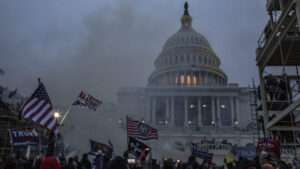
Rioters outside the U.S. Capitol on January 6.
The attack on the Capitol. January 6, 2021. (Probal Rashid/ZUMAPRESS/Newscom)


Today is the fourth anniversary of the January 6, 2021 attack on the Capitol, and - ironically - also the date Congress certifies Donald Trump's victory in the 2024 presidential election. As I have previously written, widespread voter ignorance and bias in evaluating political information played a major role in both causing the attack, and facilitating Trump's subsequent political comeback.

I wrote about the role of ignorance and bias in causing the attack in a 2022 post.As explained there, ignorance and partisan bias enabled Trump to  persuade a large part of the GOP base that the 2020 election was somehow stolen from him, even though that claim was a blatant lie.

More recently, Trump's 2024 win was itself facilitated by ignorance, in ways I outlined in a post written just before election day:

Ignorance and bias are playing a huge role in Trump's relative success. Polls consistently show that a third or more of Americans - including a large majority of Republicans - believe Trump's lies about the 2020 election, despite the overwhelming evidence against them, including numerous court decisions rejecting Trumpian claims of voter fraud (including some written by conservative judges appointed by Trump himself). Ignorance and partisan bias are great enough that many millions of GOP base voters reject fairly obvious facts here. If you believe the 2020 election was "stolen" from Trump, then his reaction may well seem justified, or at least excusable.

But this isn't the full story. If Trump only had the support of voters who actually believe his lies about the 2020 election, he could still have won the 2024 GOP nomination. But he would be losing the general election in a landslide of about 60-40 or even more. He remains competitive with Kamala Harris because there are many voters (probably around 10-15% or so of the electorate) who reject his take on 2020, but prioritize other issues, such as the economy or immigration.

Here, more conventional political ignorance is playing a role. Surveys indicate that the economy is the highest priority for voters, including swing voters, and many are angry about the inflation and price increases that took place in 2021-23…. Swing voters blame incumbent Democrats for the inflation and price increases, even though actually both parties supported the policies that caused them (primarily massive Covid-era spending). Even worse, they tend to think Trump will bring down prices, even though his agenda of massive tariff increases and immigration restrictions would predictably raise them.

The problem of voter ignorance and biased evaluation of information isn't limited to GOP voters or the political  right. It's a serious problem on the left, too, though right-wing version more immediately dangerous now. See my discussion of left-wing ignorance and bias here.

Sadly, there is no quick and easy solution to these problems. But I go over various possible strategies in this 2023 article. See also my book Democracy and Political Ignorance (introduction available for free here) for much more extensive analysis of the problem and possible solutions.

I've been writing about the dangers of political ignorance since long before the rise of Trump, beginning with my  1998 article "Voter Ignorance and the Democratic Ideal." Early on, it was mostly left-liberals who opposed me, arguing ignorance is not much of a problem. In the Trump era, the ideological and partisan valence of political ignorance has flipped. But it remains a grave danger, nonetheless.

Free Speech

David Hommrich Wins Case (Now Called Hommrich); Legislator Files Memo About "Closing the Hommrich Loophole"; Hommrich Sues for Defamation

|

Here's Mr. Hommrich's argument, as quoted in the Pennsylvania Record (Nicholas Malfitano) early last year:

"Plaintiff Hommrich is a pioneer in the development and production of solar energy within the Commonwealth, and his company has worked to further develop the use of solar energy as a sustainable and environmentally prudent alternative energy resource in Pennsylvania. Plaintiff's company is a legally compliant, qualified customer-generator that participates in a net-metering program – a program through which utility companies purchase excess (or 'net') solar energy produced by the company at retail value and use such surplus as an alternative energy source for electricity," the suit stated.

"Plaintiff was a successful party in the 2021 Supreme Court of Pennsylvania ruling that affirmed the Commonwealth Court's holding that the Public Utility Commission exceeded the scope of its regulatory authority, by issuing regulations which limited the eligibility of otherwise qualified participants in a net-metering program, and such restrictions were in direct contradiction with the plain meaning and purpose of the Alternative Energy Portfolio Standards Act. Per the Court's ruling in Hommrich, 'The PUC's definitions restrict the field of qualifying participants [in the net-metering program] and, in the process curtail the development of alternative renewable energy in the Commonwealth."

The suit continues the Hommrich decision "contained no mention of any ambiguity or inconsistency within the AEPS Act, no allusion or implication that the Court's ruling regarding the Act thus created a 'loophole,' enabled exploitation of the law, or other similar verbiage; rather, the Court deemed the plain meaning of the terms defined within the Act were unequivocal, and the PUC's modified definitions constituted a violation of its regulatory authority under the Act."

"On Oct. 3, 2023, at 3:18 p.m., defendant published a memorandum to all Senate members titled, 'Renewable Energy & Warehouse Solar Procurement Act.' The memorandum provides that defendant intends to introduce legislation to address perceived gaps in the AEPS Act 'upon the recommendation of the Public Utility Commission,' thus closing the 'Hommrich Loophole by limiting net metering to customer-generator systems designed to generate no more than 110% of the customer-generators' requirements for electricity. Defendant's memorandum pairs plaintiff's name with the term 'loophole,' a term which is widely recognized to refer to an ambiguity in the law which an individual or corporation has exploited for gain," the suit said.

Read More

Guns

Ohio Court Strikes Down Categorical Prohibition on Gun Possession by People Under Indictment

A few months ago, the Sixth Circuit upheld the federal categorical prohibition on gun acquisition and transportation by people under indictment.

|

An excerpt from Friday's long decision in State v. Brown, written by Ohio Court of Appeals Judge Pierre Bergeron, joined by Judge Jennifer Kinsley:

In 2023, a grand jury indicted Mr. Brown on one count of robbery …. The court released Mr. Brown on bond with an electronic monitoring unit ("EMU") ankle monitor, but it did not place any restrictions on his ability to possess a firearm. During a home visit by the EMU team, they located a loaded firearm in his apartment. This discovery spawned a new indictment pursuant to R.C. 2923.13(A)(2) for having a weapon under a disability.

The State's robbery case against Mr. Brown eventually collapsed, which led to the dismissal of those charges against him. But …. the weapons under a disability case was still at play ….

[Under Bruen], we ask whether the disarmament imposed by R.C. 2923.13(A)(2), as applied in this case, falls within our Nation's historical tradition of firearms regulation…. [T]he State offers no evidence of any specific historical tradition, dating back either to the founding or reconstruction era, of categorically disarming individuals based solely on the fact of their indictment—either in general, for violent crimes, or for robbery in particular….

Instead, the State tries to broaden the aperture, insisting that felonious behavior justifies a determination that someone cannot be trusted with firearms. In other words, the State suggests that history and tradition grant the states the power to disarm any person found to have engaged in felony conduct.

But … Mr. Brown … had only been indicted for a felony offense when the State charged him with possessing a weapon under a disability…. [A]ny categorical felon-disarmament rule would necessarily rest on the disarmed individual's conviction. And a felony conviction, to the founding generation, meant at least two things: (1) trial by jury, and (2) a heightened burden of proof, understood today as proof beyond a reasonable doubt….

Read More

Free Speech

Private Voluntary Bar Association Has First Amendment Right to Discriminate Based on Race, Sex, Sexual Orientation

|

Dec. 20's N.J. appellate court decision in Saadeh v. N.J. State Bar Ass'n (opinion by Judge Allison Accurso, joined by Judges Katie Gummer and Kay Walcott-Henderson) upheld various race, sex, sexual orientation, and other preferences that the New Jersey Bar Association—a private, voluntary organization that had as members 16,000 of the 98,000 New Jersey licensed lawyers—set up for various leadership positions. The court applied Dale v. Boy Scouts of America (2000), which held that the Boy Scouts had a First Amendment right to exclude gays from being assistant scoutmasters, who helped convey the Scouts' values; the same, the court held, protected the Association's decisions:

[T]he Bar Association qualifies as an expressive association, and … compelling it to end its practice of ensuring the presence of designated underrepresented groups in its leadership would unconstitutionally infringe its ability to advocate the value of diversity and inclusivity in the Association and more broadly in the legal profession.

The record reflects the Association's many forms of public expression and advocacy on matters of public concern, including the importance of diversity within the Association, in the legal community, and in continuing legal education…. [T]he Bar Association also engages in expressive activity in determining the composition of its governing Board of Trustees and other leadership bodies.

The Association's by-laws are explicit in requiring representation of a cross-section of its membership on the Board of Trustees, the Nominating Committee and JPAC [Judicial and Prosecutorial Appointments Committee]. In addition to allocating slots to members representing the county bar associations and a mix of sections, the by-laws also reserve slots for members representing demographic groups historically underrepresented in the Association's leadership, a consciously deliberate choice expressing the Association's vision of diversity and inclusion in the Association and in the broader legal community.

Given the Bar Association engages in expressive activity and that it does so through its method for filling at-large seats on its Board of Trustees, Nominating Committee and JPAC, we next consider whether compelling the Association to alter or eliminate its inclusion program "would significantly affect" the Association's "ability to advocate" its viewpoints. See Dale.

As the Bar Association argues in its brief, its "message is clear"; it "deeply values diversity in the legal profession," and it expresses that value in the "intentional makeup" of the Board and Committees that lead the Association. The Bar Association's decades-long commitment to diversifying its leadership, as established in the record, leaves no doubt about the sincerity of its commitment.

Read More

Fareed Zakaria, "The Crisis of Democracy Is Really a Crisis for the Left" / "Why Is the Left Flailing? Look at New York vs. Florida"

|

An interesting column yesterday in the Washington Post. An excerpt:

The crisis of democratic government then, is actually a crisis of progressive government. People seem to feel that they have been taxed, regulated, bossed around and intimidated by left-of-center politicians for decades — but the results are bad and have been getting worse.

New York, where I live, and Florida, where I often visit, provide an interesting contrast.

They have comparable populations — New York with about 20 million people, Florida with 23 million. But New York state's budget is more than double that of Florida ($239 billion vs. roughly $116 billion). New York City, which is a little more than three times the size of Miami-Dade County, has a budget of more than $100 billion, which is nearly 10 times that of Miami-Dade. New York City's spending grew from 2012 to 2019 by 40 percent, four times the rate of inflation. Does any New Yorker feel that they got 40 percent better services during that time? …

Read More

Free Speech

"Encouraging Debate, Not Settling It": Bret Stephens Interviews Vanderbilt Chancellor Daniel Diermeier

|

A very interesting exchange in the Autumn 2024 Sapir Journal; a short excerpt, just to give a flavor of the whole thing:

We've seen the same data, and I've been very concerned about the drop in approval and trust in higher education. The decline has been larger among people on the conservative side of the political spectrum, but it's across the board, from the Left and the Right. My sense is that it comes from two concerns. From the progressive side, the concern is that highly selective universities are perpetuating inequality. And the concern from the Right is that we're woke factories….

The question of the politicization of higher education has come into stark relief after what we've seen last year: the conflict in the Middle East and the drama on campus. These developments have elevated into the public consciousness concerns that have been present for years. They now are front and center, much more serious, and they require a course correction by many universities….

If you look back, there were three pillars of how a university thought about its role in society.

Read More

Free Speech

Federal Court Declines to Issue Harassment Restraining Order Related to Crypto Litigation

An interesting window into how courts sometimes think about such requests; this decision turned heavily on the fact that plaintiff had already gotten a state court harassment restraining order against the defendant.

|

From Judge Maame Ewusi-Mensah Frimpong's Dec. 26 opinion in Thomson v. Persistence Technologies BVI PTE Ltd.; Thomson is apparently a "[b]illionaire publishing heiress" and part owner of Thomson Reuters, and the lawsuit claims over $24+M in damages, related to Thomson's investment in the XPRT altcoin:

Thomson alleges, in summary, that Richardson and other Defendants conspired to target Thomson and induce Thomson to invest in a certain cryptocurrency, and made a series of false statements to both Thomson and the public in furtherance of this. Richardson alleges in turn, via her counterclaims, that she and Thomson were friends, that Thomson demanded that Richardson invest in cryptocurrency on Thomson's behalf, that Thomson made rude statements to Richardson and called on Richardson at all hours with requests, and that Thomson eventually made defamatory statements about Richardson….

An order prohibiting a party from harassing another party is appropriate in at least some circumstances. Courts in this district and elsewhere have recognized that it may be permissible and necessary to enjoin a litigant from harassing another party. See, e.g., Beyond Blond Prods., LLC v. Heldman (C.D. Cal. 2022) (issuing an injunction against "threatening or harassing emails" and other conduct); United Artists Corp. v. United Artist Studios LLC (C.D. Cal. 2019) (issuing an injunction against certain conduct that "constitute[s] harassment and would be performed with the intention of intimidation"); see also Test Masters Educ. Servs., Inc. v. Singh (5th Cir. 2005) (upholding a portion of the district court's injunction prohibiting Defendant "from threatening or harassing" plaintiff, plaintiff's counsel, or other associated individuals). These courts generally recognize that injunctions against harassing conduct are, to some extent, in tension with the First Amendment's protections on free speech, but nevertheless hold that such injunctions are constitutional in some circumstances, as "courts have rejected arguments that the First Amendment allows a person to make harassing or threatening communications." Beyond Blond; see also United Artists ("even under the First Amendment, courts do have the power to enjoin harassing communication"); Test Masters ("Courts have made a distinction between communication and harassment … The difference is one between free speech and conduct that may be proscribed.").

Although these opinions are not binding, the Court is aware of no precedent pointing the other way on the general question of whether orders of the nature Thomson requested are at times permissible. The Court finds that if Thomson could show sufficient harassment, then it would be appropriate for the Court to grant the Application. But given the Ninth Circuit's guidance cautioning courts regarding injunctions that control litigants' behavior, and given the First Amendment concerns that such injunctions implicate, the Court will not grant such an injunction absent a strong showing.

Read More

Endangered species

"There Is, Technically, No Snail Darter," But the Snail Darter Still Delayed the Tellico Dam

A case study in how the Endangered Species Act encourages the politicization and distortion of science.

|

In the 1970s, the discovery of the Tennessee snail darter in the Tellico River was used to halt completion of the Tellico Dam under the Endangered Species Act (a tale many law students learn in TVA v. Hill). The dam was only completed after Congress expressly exempted it from the ESA's dictates.

It has long been understood that the snail darter was the right species at the right time, as it gave dam opponents a powerful legal weapon. Now, the New York Times reports, it turns out the snail darter was not really the right species, as it is not a distinct species at all.

"There is, technically, no snail darter," said Thomas Near, curator of ichthyology at the Yale Peabody Museum.

Dr. Near, also a professor who leads a fish biology lab at Yale, and his colleagues report in the journal Current Biology that the snail darter, Percina tanasi, is neither a distinct species nor a subspecies. Rather, it is an eastern population of Percina uranidea, known also as the stargazing darter, which is not considered endangered.

Dr. Near contends that early researchers "squinted their eyes a bit" when describing the fish, because it represented a way to fight the Tennessee Valley Authority's plan to build the Tellico Dam on the Little Tennessee River, about 20 miles southwest of Knoxville.

"I feel it was the first and probably the most famous example of what I would call the 'conservation species concept,' where people are going to decide a species should be distinct because it will have a downstream conservation implication," Dr. Near said.

What Dr. Near is hinting at is the incentive structure created by the ESA--an incentive structure that encourages the distortion and politicization of scientific findings.

Under the ESA, the listing of a species (or subspecies or distinct species population) triggers regulatory restrictions, such as those that halted the Tellico Dam. Section 7 of the Act, for example, bars federal agencies from undertaking actions that could jeopardize a species' survival or destroy any of its critical habitat.

As I explained in this paper, this means that if an interest group wants to influence regulatory decisions under the ESA, they need to influence the scientific findings that trigger regulatory constraints. What should be policy fights over whether the benefits of a project justify harms or risks to particular species instead become fights over whether something is a species or is at risk of extinction. Thus political and ideological concerns infect what should be scientific disputes over how best to identify what constitutes a distinct species.

From the article:

Dr. Plater, who also argued successfully for the fish in the Supreme Court case, took issue with the Yale study. He said the approach favored by Dr. Near and colleagues makes them genetic "lumpers" instead of "splitters," meaning they reduce species instead of making more. He believes the findings also lean too heavily on genetics.

"Whether he intends it or not, lumping is a great way to cut back on the Endangered Species Act," Dr. Plater said of Dr. Near.

Dr. Near said being described as a "lumper" was a pejorative in his world, and he added that most of the research he and colleagues had performed had resulted in speciation splits, including a 2022 study.

While the intent of the ESA is to provide greater protection of species, it is not clear the hard regulatory trigger actually maximizes the effectiveness of species conservation efforts. As I noted in this paper on the ESA's 50th anniversary, the Act has been far less successful at recovering species than one would like, and its unforgiving regulatory structure may be part of the reason.

More



