The Volokh Conspiracy

Mostly law professors | Sometimes contrarian | Often libertarian | Always independent | Est. 2002

The Volokh Conspiracy

Free Speech

"North Texas Man Who Threatened to Shoot and Kill ICE Agents Charged in Federal Court"

|

From Monday's Justice Department press release:

A North Texas man who threatened to shoot and kill ICE agents was arrested and charged in federal court …. Robert Wilson King, 35, was charged on April 3, 2025, via criminal complaint with transmitting an interstate threat….

According to the complaint, on March 29, 2025, King allegedly posted a threat on a social media platform, stating, "If I see ICE agents in my neighborhood I'm opening fire. It's time to stop being p****** [expurgation in original -EV] and put the second amendment to work. ICE are not real cops, they are a secret police force with no real legal authority. Kill them."

Read More

Free Speech

"Climate Activist Found Guilty in Defacing Degas Exhibit at National Gallery of Art"

|

From Tuesday's Justice Department press release:

Timothy Martin, 55, of Raleigh, North Carolina, was found guilty by a federal jury for his role in the April 27, 2023, defacement of an art exhibit at the National Gallery of Art in Washington, D.C.

The verdict was announced by U.S. Attorney Edward R. Martin, Jr., and Special Agent in Charge Sean Ryan of the FBI Washington Field Office Criminal and Cyber Division.

President Trump directed federal authorities in a March 2025 Executive Order to Make D.C. Safe and Beautiful by launching a multi-faceted initiative to address both crime and beautification. This includes the creation of the D.C. Safe and Beautiful Task Force to coordinate law enforcement efforts, and a program to restore and enhance the city's public spaces.

Read More

Immigration

Supreme Court Rules Trump Administration Must "Facilitate" Return of Illegally Deported Salvadoran Migrant

Unanimous ruling is a big win for immigrant rights. But it does have unfortunate ambiguities.

|

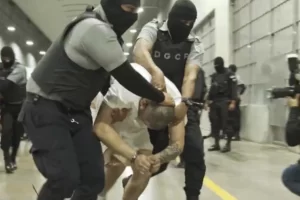
Kilmar Abrego Garcia, led by guards through the Terrorism Confinement Center in Tecoluca, El Salvador. (NA)


Tonight, the Supreme Court unanimously ruled that Trump Administration must "facilitate" the return of Salvadoran migrant Kilmar Abrego Garcia, whom it had illegally deported to brutal imprisonment in El Salvador's awful CECOT prison (despite his never having been convicted of any crime). The Court largely affirmed earlier rulings by the district court and Fourth Circuit. This is an important win for immigrant rights. The justices rejected the administration's dangerous position that it can deport and imprison anyone it wants - including US citizens - and then be immune from judicial review, so long as the incarceration is done by a foreign state, even one acting at the direction of the US government.

But there is an unfortunate ambiguity in the Court's ruling. Here is the key passage:

Due to the administrative stay issued by the Chief Justice, the deadline imposed by the District Court has now passed. To that extent, the Government's emergency application is effectively granted in part and the deadline in the challenged order is no longer effective. The rest of the District Court's order remains in effect but requires clarification on remand. The order properly requires the Government to "facilitate"Abrego Garcia's release from custody in El Salvador and to ensure that his case is handled as it would have been had he not been improperly sent to El Salvador. The intended scope of the term "effectuate" in the District Court's order is, however, unclear, and may exceed the District Court's authority. The District Court should clarify its directive,with due regard for the deference owed to the Executive Branch in the conduct of foreign affairs. For its part, the Government should be prepared to share what it can concerning the steps it has taken and the prospect of further steps.

The ambiguity here is what exactly it means to "facilitate" Abrego Garcia's return to the US. Does it require the government to do everything possible to ensure that return, merely make some token effort, or something in between? To my mind, the best interpretation is "everything possible." That reading is implied by the Court's admonition that the government must "ensure that his case is handled as it would have been had he not been improperly sent to El Salvador." The only way to do that is to actually return him! 

As a practical matter, Abrego Garcia is only being held by El Salvador because the US government wants him to and is paying the Salvadoran government to incarcerate him and other deportees (including many illegally deported under the Alien Enemies Act). All Trump has to do to get any of these people released is credibly convey to the Salvadoran that that is what he wants. But I worry the Trump administration will drag its feet and claim all the Supreme Court ruling requires is make a pro forma request that the Salvadorans know they could refuse without suffering any adverse consequences.

In my analysis of the lower court rulings, I explained why, in this context, there is no good reason to grant any deference to executive claims that the president cannot be required to return a prisoner held by a foreign state. Nonetheless, the administration is likely to continue its efforts to weasel its way out of doing the right thing.

At the very least, there will probably be further wrangling in the lower courts over the exact meaning of "facilitate" and how it may or may not differ from "effectuate." This is the kind of word game some lawyers like to play - even if it's also the kind of thing that causes many people to hate lawyers! It might even be entertaining - except for the fact that as long as this goes on, an innocent man will continue to rot in a terrible prison, where he was unjustly sent without any due process.

Perhaps this ambiguity was the price of getting a unanimous ruling. But it's unfortunate, nonetheless.

In a concurring statement joined by the other two liberal justices, Justice Sonia Sotomayor outlines the stakes of the case, and gives her own interpretation of what the ruling requires:

The United States Government arrested Kilmar Armando Abrego Garcia in Maryland and flew him to a "terrorism confinement center" in El Salvador, where he has been detained for 26 days and counting. To this day, the Government has cited no basis in law for Abrego Garcia's warrantless arrest, his removal to El Salvador, or his confinement in a Salvadoran prison. Nor could it….

The Government now requests an order from this Court permitting it to leave Abrego Garcia, a husband and father without a criminal record, in a Salvadoran prison for no reason recognized by the law. The only argument the Government offers in support of its request, that United States courts cannot grant relief once a deportee crosses the border, is plainly wrong….

Because every factor governing requests for equitable relief manifestly weighs against the Government, Nken v.Holder, 556 U. S. 418, 426 (2009), I would have declined to intervene in this litigation and denied the application in full.

Nevertheless, I agree with the Court's order that the proper remedy is to provide Abrego Garcia with all the process to which he would have been entitled had he not been unlawfully removed to El Salvador. That means the Government must comply with its obligation to provide Abrego Garcia with "due process of law," including notice and an opportunity to be heard, in any future proceedings... It must also comply with its obligations under the Convention Against Torture…. Federal law governing detention and removal of immigrants continues,of course, to be binding as well. See 8 U.S. C. §1226(a) (requiring a warrant before a noncitizen "may be arrested and detained pending a decision" on removal; 8 CFR§287.80)2) (2024) (requiring same)…. In the proceedings on remand, the District Court should continue to ensure that the Government lives up to its obligations to follow the law.

Sotomayor is right on all points. And the only way to ensure the government "lives up to" all these obligations is to ensure that Abrego Garcia is actually returned to the United States. Giving it the old college try won't cut it.

But Sotomayor, like the Court's ruling, does not unambiguously define what it means to "facilitate." And her statement, on behalf of only three justices, is not by itself legally binding.

An ethical government would avoid further litigation and just simply ensure Abrego Garcia's return. They could easily do that! Indeed, they  would have done so - at the very least - as soon as they realized he had been illegally deported in the first place.  Both respect for the rule of law and minimal common decency require them to promptly return a man they have admitted was illegally deported and imprisoned. But this administration, to put it mildly, doesn't much care for either law or decency when they get in its way.

In sum,  the Court's decision is an important win for immigrants, and setback for the administration. But it has a notable - potentially problematic - ambiguity.  Just how much of a problem that turns out to be remains to be seen.

The Chief Justice "Facilitates" Another Shadow Docket Compromise In Noem v. Garcia

The Trump Administration didn't lose but it didn't quite win either.

|

Another day, another shadow docket compromise. This evening, the Court issued a short three paragraph per curiam opinion in Noem v. Garcia. In short, the Court found that that the District Court could not order the Executive Branch to negotiate the return of Garcia, but instead could only require the government "facilitate" Garcia's return. This outcome was entirely predictable. On Monday, I wrote:

I think the most likely outcome is that Roberts follows the lead of Judge J. Harvie Wilkinson on the Fourth Circuit: deny the application, but "clarify" that the District Court can only require the President to "facilitate" the return of the alien.

The Chief Justice (almost certainly) wrote the per curiam order, which states:

The rest of the District Court's order remains in effect but requires clarification on remand. The order properly requires the Government to "facilitate" Abrego Garcia's release from custody in El Salvador and to ensure that his case is handled as it would have been had he not been improperly sent to El Salvador. The intended scope of the term "effectuate" in the District Court's order is, however, unclear, and may exceed the District Court's authority.

I nailed this one 100%. "Clarify" and "facilitate" is all that was needed.

Now, let's get into the nitty gritty.

First, the Court repeats this strange argument that an order with a deadline in the past is no longer in effect:

Due to the administrative stay issued by THE CHIEF JUSTICE, the deadline imposed by the District Court has now passed. To that extent, the Government's emergency application is effectively granted in part and the deadline in the challenged order is no longer effective.

The Court employed this reasoning in the USAID case:

Given that the deadline in the challenged order has now passed, and in light of the ongoing preliminary injunction proceedings, the District Court should clarify what obligations the Government must fulfill to ensure compliance with the temporary restraining order, with due regard for the feasibility of any compliance timelines.

This argument makes no sense. When a court's deadline has passed, that means the government has failed to comply with the order. It doesn't meant he deadline is "no longer effective." This argument even makes less sense when the reason why the deadline lapsed is that a Justice granted an emergency stay. How can it be that a single Justice's administrative stay can vacate a lower court injunction? A stay only puts a ruling on hold. I would like someone with more knowledge of appellate procedure to explain how this works. But the Chief found some new game to avoid the usual rules of procedure, and he will keep playing it.

Second, the Court provides this order:

The application is granted in part and denied in part, subject to the direction of this order.

I searched the Supreme Court database on Westlaw for the phrase "The application is granted in part and denied in part." There were zero hits. I also searched for "subject to the direction of this order." There were zero hits. There are some serious John Roberts machinations going on here.

The government's application asked the Court to vacate the district court's injunction. Did the Court actually vacate the district court's injunction? Well, it didn't say it was doing so. Rather, it relied on the locution of "clarification." But in every sense, the Court vacated the District Court's injunction. The injunction said the alien had to be returned by a certain date, and the government does not have to return the alien by that date. The injunction was vacated. This is similar to what happened in the USAID case, where it denied the government's request to block the funding injunction, but the Court still asked the District Court to clarify the scope of the order to spend $2 billion.

Given that the deadline in the challenged order has now passed, and in light of the ongoing preliminary injunction proceedings, the District Court should clarify what obligations the Government must fulfill to ensure compliance with the temporary restraining order, with due regard for the feasibility of any compliance timelines.

If in fact the Court vacated the District Court's injunction, in what regard was the government's application denied? It wasn't. The application was granted in full. The government didn't get all the relief they wanted, but that isn't what "denied in part" means. This is sort of the inverse of San Francisco v. EPA where Justice Barrett purported to "dissent in part" where she in fact dissented in whole. Once again, the Court is playing fast and loose with terminology to obscure what it is actually doing. It seems good for the press to report something is "denied in part," as it seems that the Court ruled against Trump. But it didn't.

At least this order is not an advisory opinion, like the USAID case. The Court clearly grants the application, at least in part, which gives it the power to issue an order to the lower court. No, jurisdiction is not some kind of "shiny" bobble.

Third, there is a minimal statement about the separation of powers:

The District Court should clarify its directive, with due regard for the deference owed to the Executive Branch in the conduct of foreign affairs. For its part, the Government should be prepared to share what it can concerning the steps it has taken and the prospect of further steps.

This is a clear reversal of Judge Thacker's opinion for the Fourth Circuit, which found the executive branch had no countervailing interest in this case. Judge Thacker would have ordered the return of Garcia, post haste. What does the Chief Justice require: be prepared to share information. That is not much. All the government needs to say is "we think the prospects of Garcia's return are bleak" and they will have complied with this order.

Here, the Trump Administration did not lose, but it didn't quite win either. This is similar to the JGG case where the administration won on the venue question, but lost on the ability to summarily remove alleged alien enemies.

Fourth, Justice Sotomayor's statement provides a gloss of the majority's opinion:

Nevertheless, I agree with the Court's order that the proper remedy is to provide Abrego Garcia with all the process to which he would have been entitled had he not been unlawfully removed to El Salvador. That means the Government must comply with its obligation to provide Abrego Garcia with "due process of law," including notice and an opportunity to be heard, in any future proceedings. Reno v. Flores, 507 U. S. 292, 306 (1993). It must also comply with its obligations under the Convention Against Torture. Federal law governing detention and removal of immigrants continues, of course, to be binding as well.

I am fairly confident Justice Sotomayor overreads the majority. The majority said none of these things. I am also fairly confident the judges of the Fourth Circuit will dutifully cite Justice Sotomayor. That may be why she wrote a "statement" rather than a dissent.

The Court is moving more expeditously through the emergency docket then I expected. And in case you missed it, today Circuit Justice Kavanaugh granted an administrative stay in an Ohio election case.


Donald Trump

The Tariff Madness Isn't Over

Even after Trump paused some of his new tariffs for 90 days, we still have the highest average tariffs in over a century and the biggest trade war since the Great Depression. Real relief will only come if Congress or the courts deny Trump the power to do this.

|

NA

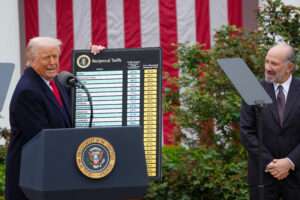
When Donald Trump paused many of his awful "Liberation Day" tariffs yesterday, there was some understandable relief. Some even seem to assume the tariff crisis is over. For example, Democratic Senate Leader Charles Schumer, posted on Bluesky that "History will remember April 9, 2025 as America's actual liberation day—the day that President Trump backed down from his ridiculous tariff fiasco."

But any celebration is premature. The truth is Trump has not fully backed down. A whopping 10% tariff on nearly every nation in the world is still going into effect immediately, along with a huge increase on tariffs for Chinese goods (up to 145%).  It's enough to impose a huge tax increase on Americans (an average of  $4700 per household). And the additional "reciprocity" tariffs are only paused for 90 days, not cancelled.

Even with the pause, we now have the highest overall average effective tariff rate since 1909 - higher even than the infamous Smoot-Hawley tariff of 1930 that played a major role in deepening the Great Depression.  And that includes high tariffs on nations like Switzerland and Israel, which don't impose any tariffs on  US goods - thereby giving the lie to the notion that Trump's trade war is about breaking down "unfair" trade practices by other nations.

Moreover, so long as Trump seemingly has the power to impose massive tariffs at will, the crisis will not be over, even if he suspends all of them. Investors and producers will still face a climate of uncertainty, destroying incentives to make any kind of long-term commitments. Why build a factory, invest in one, or commit to a long-term contract, if your business could be wiped out any time the man in the White House wakes up on the wrong side of his bed, and decides to trash the world economy again?

The only way to truly end this crisis is to curb the power of the president to set tariffs. That could be done by Congress passing a law constraining the executive. There is in fact bipartisan legislation before the Senate and the House that would do exactly that, by voiding any tariffs imposed by the executive unless Congress passes a law approving them within 60 days. But even if it passes (which is far from guaranteed), Trump would veto it, and there is little or no chance that supporters can muster the two-thirds supermajorities in each house needed to override.

That leaves the second path to restoring stability: courts should strike down Trump's tariffs because they are illegal. In a previous post, I detailed multiple reasons why this is the right conclusion. They include the statutory text of the International Emergency Economic Powers Act of 1977 (IEEPA) (which, among other things, does not authorize tariffs), the major questions doctrine, nondelegation, and more.

The Liberty Justice Center and I are  proceeding with our planned lawsuit challenging the "Liberation Day" tariffs on behalf of US firms that import goods from the many countries targeted with tariffs. Other groups are also likely to file cases.  If we prevail, there may be true liberation from this insanity.

UPDATE: The original version of this post said the China tariff was set at %125. But it is actually now at %145. I apologize for the mistake, which has now been corrected.


Supreme Court

Supreme Court Upholds Order Telling Trump Administration to "Facilitate" Return of Armando Abrego Garcia from El Salvador

Without any recorded dissent, the justices rebuke the Trump Administration's cavalier disregard for due process.

|

This evening the Supreme Court effectively denied the Trump Administration's request that it vacate a district court order demanding that the federal government effectuate the return of Armando Abrego Garcia to the United States from El Salvador. This is consistent with last week's opinions in Trump v. J.G.G. in which all nine justices indicated that the federal government must provide due process to individuals allegedly subject to deportation.

As a technical matter, the Trump Administration's application was granted in part and denied in part, but in substance it denied the Administration's sought after relief by concluding that the district court "order properly requires the Government to "facilitate" Abrego Garcia's release from custody in El Salvador and to ensure that his case is handled as it would have been had he not been improperly sent to El Salvador." The order also called for the district court to clarify parts of its order, and noted that parts of the order (such as the deadline) were no longer operable.

The unsigned order drew no dissents, though Justice Sotomayor issued a separate statement respecting the order joined by Justices Kagan and Jackson.

The text of the order is below the jump.

Read More

crime victims

The Utah Supreme Court Rules That Sexual Assault Victims Cannot Be Forced to Testify at "Rape Shield" Hearings

The Court follows my argument that the purpose of a rape shield hearing is to ... well ... shield rape victims.

|

Today the Utah Supreme Court agreed with my argument that a defendant cannot compel a rape victim to testify at a "rape shield" hearing. Instead, the defendant must establish (if he can) the admissibility of prior sexual history evidence in other ways, such as a proffer of anticipated testimony and legal argument. The Court's ruling solidifies the protections offered to victims under Utah's Rule of Evidence 412. And because Utah's rule uses the same language found in the federal rules and many state provisions, it will serve as a valuable precedent in other cases.

I previously blogged about the case here.  In a nutshell, in the federal system and all states, "rape shield" rules require pre-trial hearings on whether evidence relating to a rape victim's prior sexual history is admissible at trial. For example, Utah's Rule of Evidence 412 (which parallels Federal Rule of Evidence 412) requires a defendant who intends to introduce a victim's prior sexual history evidence to make a detailed proffer of the relevance and purpose of the proposed evidence. The trial judge then holds a hearing and determines the admissibility of the evidence. But what if the defendant wants to subpoena a victim to the hearing and question her about prior sexual history as part of that determination? Is forcing a rape victim to testify consistent with the rule?

In December, I argued the case to the Utah Supreme Court on behalf of a victim, T.T., explaining  that the rule does not allow defendant to compel victims to testify at such a pre-trial hearing. Today, the Utah Supreme Court agreed with my position:

T.T. argues that once the district court ruled that Jolley [the defendant] had identified "enough specific evidence of prior sexual behavior between him and T.T. to obtain a hearing, no justification existed for forcing T.T. to take the stand and be questioned about her prior sexual history." As she explains, the "only purpose of the rule 412 hearing at that point was to give T.T. an opportunity to be heard about the admissibility of the evidence—not to allow Defendant to force T.T. to take the stand so he could question her."

We agree with T.T. and conclude that both the district court and Jolley fundamentally mistake the purpose of a rule 412 hearing. As discussed, rule 412 requires a party intending to offer evidence that falls within the scope of rule 412's exceptions to "specifically describe[] the evidence" in a motion. Utah R. Evid. 412(c)(1)(A). In other words, it is the moving party's obligation to identify the evidence it seeks to admit in advance of the rule 412 hearing. See id. And, as our court of appeals has explained, that description should be specific enough to allow "the district court to, among other things, assess the probative value of the evidence and balance that value against the considerations rule 403 enumerates." See State v. Bravo, 2015 UT App 17, ¶ 27, 343 P.3d 306. It is not the district court's burden at the hearing to identify evidence for the moving party. Nor is it the victim's obligation to provide testimony at the hearing so that the moving party can meet its burden.

The Court also emphasized that a Rule 412 hearing is not designed for discovery. Instead, a "rule 412 hearing is designed for the presentation of argument on the admissibility of evidence already identified in motion by the moving party; it is not designed to uncover or test that evidence."

I worked closely on the case with the Utah Crime Victims' Legal Clinic, including its capable director Heidi Nestel, and the Clinic's skilled trial court attorney on the case, Crystal Powell. I understand that the Clinic is already citing today's decision to help prevent rape victims from being forced to testify in other cases. This is as it should be. As the Court observed today, "Rule 412 ensure[s] that sexual assault victims are not deterred from participating in prosecutions because of the fear of unwarranted inquiries into the victim's sexual behavior."

Organ transplants

End Kidney Deaths Act Reintroduced in Congress

While not as good as full legalization of organ markets, the act could save lives by giving kidney donors a $50,000 tax credit.

|

NA

On Tuesday, GOP Rep. Nicole Malliotakis and Democratic Rep. Josh Harder reintroduced the End Kidney Deaths Act. This law would give kidney donors who donate kidneys to strangers a $50,000 "fully refundable" tax credit, and thereby incentivize organ donation. Currently, some 40,000 Americans die each year of kidney failure, for lack of available organs. Thousands more suffer for years on kidney dialysis, while waiting for organs to become available.

This terrible tragedy could be entirely eliminated simply by legalizing organ markets. The End Kidney Deaths Act stops short of that. But it would nonetheless be a major step in the right direction. I assessed its strengths and weaknesses here:

An estimated 40,000 Americans die every year for lack of kidneys available for transplant. If enacted, the End Kidney Deaths Act would save many of these people. In addition, as [Dylan] Matthews points out, the $50,000 per kidney tax credits would easily pay for themselves, because kidney dialysis is vastly more expensive, and Medicare ends up paying for most of that expense. If more people suffering from kidney failure could get a new kidney quickly, the government would save a lot money on dialysis expenses, and those people would be able to be more productive (as well as avoiding great pain and discomfort)….

The major shortcoming of the End Kidney Deaths Act is the implicit price control it creates. By setting the payment at $50,000, it prevents higher payments where that would be necessary to ensure adequate supply. While the Act would save thousands of lives, the estimates Matthews cites (some 6000 to 11,500 additional kidney donations per year) would still leave us many thousands of kidneys short, thereby still dooming many people to needless death, or at least additional years on kidney dialysis.  This problem might be especially acute for patients whose genetics make it unusually difficult to find a matching donor. Conversely, if some potential donors are willing to sell for less than $50,000, there is no good reason to ban such transactions.

Full legalization of organ sales, with no price controls, would fix these problems. It's basic economics 101 that markets function best if prices are allowed to fluctuate in response to supply and demand. In a free market, insurance companies, medical care providers, and others have every incentive to pay what it takes, as the alternative of kidney dialysis is far more expensive. If necessary, the government could subsidize consumption by the poor, as it already does for kidney dialysis and many other health care expenses.

I would add that the $50,000 tax credit is stretched out over a five year period ($10,000 per year). It would be better if donors got paid immediately (thereby strengthening the incentive to donate). I make the case for full legalization of kidney sales in greater detail in this article, where I also address various objections.

Despite its weaknesses, passage of EKDA would be a big improvement over the status quo.  Congress should enact it as soon as possible. Informed sources indicate to me EKDA has a good chance of passing in this Congress, because it enjoys substantial bipartisan support. I hope they are right.

Tariffs

President Trump's Reduced Tariff/Taxes Are Still Unconstitutional

We need a district judge to enter a nationwide injunction putting a stop to these huge unilateral, presidential tax increases on ordinary working-class people.

|

President Trump blinked today after his "Liberation Day" tariff/taxes catastrophe led to the worst S & P stock market performance for the start of a presidency since George W. Bush's first term. Trump reduced his blanket tariff for most nations to 10% (for 90 days) while raising tariff/taxes on imports from China. Tariff/taxes remain on imports of steel and aluminum and on trade with Canada and Mexico. Consumers will soon see rapidly rising grocery market prices for fruit and vegetables because of the Mexico tariff/taxes, and consumers will see the price of televisions, electronics, and iPhones skyrocket because of Trump's tariff/taxes on imports from China.

The U.S. Constitution gives Congress the power to impose tariff/taxes in Article I, Section 8, clause 1, and it gives Congress the power to regulate commerce with foreign nations in Article I, Section 8, Clause 3. Trump incorrectly claims that Congress has delegated that power to him under the National Emergencies Act (NEA) and the International Emergency Economic Powers Act (IEEPA) by declaring multiple "national emergencies" related to border security; the hollowing out of the United States' manufacturing base; the existence of trade deficits; and the threat posed by rising Chinese power, which Americans have known about since President Obama wisely pivoted U.S. security concerns to China fifteen years ago.

Webster's Dictionary defines "emergency" as follows: "1: an unforeseen combination of circumstances or the resulting state that calls for immediate action; 2: an urgent need for assistance or relief." The problems President Trump is concerned about are ones that he has complained of for his whole forty years in public life, and Congress and the American people have known about them for decades. They are not unforeseen threats that require urgent action like a Russian or Chinese nuclear attack on the United States, nor are they problems in need of such urgent relief that Trump can address them while bypassing Congress. The statutes Trump invokes, NEA and IEEPA, were passed in the 1970's to curtail presidential claims of emergency power, not to broaden such power.

Read More

Second Amendment Roundup: Supreme Court Should Resolve Proximate Cause in S&W v. Mexico

Illinois court shows need to lay the issue to rest.

|

As I posted here, the March 4 oral argument in Smith & Wesson Brands v. Estados Unidos Mexicanos appeared to go well for S&W and not well for Mexico.  Mexico's lawsuit seeks to hold America's federally-licensed firearm industry responsible for the cartel violence that plagues Mexico.  The Protection of Lawful Commerce in Arms Act (PLCAA) prohibits lawsuits against the gun industry for crimes committed by third parties.

PLCAA does allow an action in which [1] a manufacturer or seller "knowingly violated a State or Federal statute applicable to the sale or marketing of the product, and [2] the violation was a proximate cause of the harm for which relief is sought."  It was suggested in oral argument that Mexico's aiding and abetting theory did not meet element [1], rendering it unnecessary to resolve [2].  Yet leaving the latter, the proximate-cause issue, in limbo will result in continuing legal uncertainty and ongoing attacks on the industry facilitated by courts that are allowing the most extreme theories of proximate cause in which remoteness is disregarded.

The latest example is the denial by Judge Jorge L. Ortiz of the motion to dismiss in Kelly Roberts v. Smith and Wesson Brands, Circuit Court 19th Judicial District, Lake County, Ill. (April 1, 2025).  In 2022, Robert Crimo III murdered seven people and injured dozens more with an S&W rifle in Highland Park, Illinois.  He has pleaded guilty and faces life in prison.  His father pleaded guilty to reckless conduct for helping his son obtain the rifle while knowing of his mental health issues.

The lawsuit against manufacturer S&W, the distributor, and the retailer that sold the rifle is exactly the kind of case PLCAA was enacted to prevent.  The Roberts plaintiffs alleged that S&W advertisements intentionally promote militaristic misuse of firearms, especially among young people.  (Of course they don't.)  S&W responded that "the claimed harm is the aggregate result of numerous intervening (including criminal) acts by third parties not under Smith & Wesson's control," and that "Plaintiffs fail to allege, as they must, that they even saw the Smith & Wesson advertisements they complain of, let alone that they were deceived by them."

The plaintiffs responded that inferences could be made that Crimo saw and was influenced by the ads because he played shooter video games and S&W ads somehow mimic such games.  Judge Ortiz agreed that the inferences sufficed to show knowing violation of an Illinois law against engaging in deceptive and unfair practices, specifically by "promot[ing] a firearm-related product that encourages unlawful paramilitary activity."  He held that "Plaintiffs have alleged sufficient facts to conclude that Smith and Wesson's marketing strategies of targeting younger demographics and promoting unlawful military type assaults created a foreseeable risk of injury to Plaintiffs."

"Factual causation," the court ruled, was established by "numerous allegations of unlawful marketing techniques and statutory authority that Smith and Wesson marketing and advertisements violated."  "Legal cause" sufficed that "Smith and Wesson's unlawful conduct created a condition that foreseeably led to the shooter's criminal act."  With conclusions like that, the proximate-cause requirement may as well be erased from PLCAA.

It goes without saying that it is sheer lunacy to claim that S&W ads encourage "unlawful paramilitary activity" and promote "military type assaults."  But the purpose of such lawsuits, orchestrated by Everytown for Gun Safety, is to destroy America's lawful firearm industry.  Making a mockery of PLCAA, not to mention the Second Amendment, is the game that's being played.

That's all the more reason for the Supreme Court definitively to resolve the proximate-cause issue in Smith & Wesson Brands v. Estados Unidos Mexicanos.


Tariffs

Trump Partially Pauses "Liberation Day" Tariffs

But 10% tariffs are still being imposed on nearly all countries, without any letup. And we are still moving ahead with our lawsuit challenging them.

|

President Donald Trump signs two executive orders on April 2 instituting tariffs
President Donald Trump signed two executive orders on April 2 instituting tariffs on a wide range of countries. ( Andrew Leyden/ZUMAPRESS/Newscom)


Today, Donald Trump partially paused his massive new "Liberation Day" tariffs. However, a whopping 10% tariff on nearly every nation in the world is still going into effect immediately, along with an enormous increase on tariffs for Chinese goods (up to 125%). And the additional massive "reciprocity" tariffs are only paused for 90 days, not cancelled.

For these reasons, the Liberty Justice Center and I are still proceeding with our planned lawsuit challenging these tariffs on behalf of US businesses that import goods from the affected countries. We will not stop unless and until this unconstitutional usurpation of power is ended completely, and permanently.

We are close to finalizing our list of clients and hope to be able to file the case soon.

I explained why the "Liberation Day" tariffs are illegal in greater detail here.

Immigration

ACLU Files Habeas Class Action to Block Alien Enemies Act Deportations

This case has crucial implications for the ability of migrants to effectively challenge illegal AEA deportations.

|

ACLU

In my recent post about the Supreme Court's ruling in Trump v. JGG, the Alien Enemies Act case, I noted that the impact of the decision will in large part be determined by whether non-citizens slated for deportation under the AEA will be allowed to bring habeas class actions to challenge them. If class actions are permitted, then individual detained immigrants won't have to bring separate habeas cases to challenge their deportation (which many may not have the resources or the knowledge to be able to do effectively). Rather, public interest groups and others can bring systematic challenges on behalf of large groups.

Yesterday, the American Civil Liberties Union filed a habeas class action lawsuit on behalf of migrants slated for AEA deportation, currently detained in New York. They seek to certify a class that includes "All noncitizens in immigration custody who were, are, or will be subject to the March 2025 Presidential Proclamation entitled 'Invocation of the Alien Enemies Act Regarding the Invasion of the United States by Tren De Aragua' and/or its implementation." This includes virtually everyone who might be deported by the administration under its Alien Enemies Act Proclamation.

I am not an expert on class actions. So I cannot say much about the likelihood of success for this suit. I must largely leave that issue to others with greater expertise.

But I will note that it is not unusual for class actions to include class members who are located in different places around the country.  This situation strikes me as the kind of scenario for which class actions were created. We have a likely illegal policy that potentially harms a large number of people around the country, they have a common interest in stopping it, but many would find it difficult or impossible to bring individual lawsuits. For obvious reasons, immigrants detained by ICE may find it hard to bring individual habeas petitions, even though the Supreme Court has ruled that they "must receive notice after the date of this order that they are subject to removal under the Act [and] [t]he notice must be afforded within a reasonable time and in such a manner as will allow them to actually seek habeas relief in the proper venue before such removal occurs."

Elsewhere I have written about why the Administration's invocation of the AEA is illegal, and would set a very dangerous precedent if allowed to stand. People slated for deportation to brutal imprisonment in El Salvador should at the very least have a meaningful opportunity to raise these issues in court. The class action pathway seems like the best remaining available means to ensure they get the due process to which they are entitled under the Constitution.


Seventh Circuit Judicial Council Dismisses Misconduct Complaint Against Judge Vaden

Oh, and by the way, the complainant is a prisoner who had a "role in firebombing and vandalizing Jewish houses of worship."

|

In December, I wrote about a misconduct complaint filed against Judge Stephen Vaden of the Court of International Trade. The complaint charged that the Columbia boycott violated the code of judicial ethics.

Today, the Seventh Circuit Judicial Council dismissed that complaint. Here is the crux of the analysis concerning the boycott:

Except to the extent prohibited by these regulations and guidelines, judges have wide discretion to establish their own screening and selection criteria in appointing law clerks. This latitude permits judges to make distinctions among applicants based on their own determinations of the relevant criteria or qualifications, including where the applicants were educated. Some judges only hire graduates of certain law schools. Some tailor their preferences to the specific needs of their court or chambers—for example, by looking for candidates from law schools with excellent writing or trial advocacy programs or strong core curricula in relevant subject areas. Relatedly, some judges only consider candidates with a GPA in the top 10 or 20 percent of their law-school class (or some other academic cutoff). Some require membership in the law review or moot court team. Others prioritize candidates from law schools in their state or circuit.

In the same way, a judge may refuse to hire law clerks from a law school or university that has, in the judge's view, failed to foster important aspects of higher education like civility in discourse, respect for freedom of speech, and viewpoint nondiscrimination. Accordingly, the law-clerk hiring boycott is neither inconsistent with the integrity of the judicial office nor likely to diminish public confidence in the judiciary.

That should have been obvious from the outset.

At long last, this saga draws to a close. I am grateful to my friends at First Liberty, as well as Lisa Blatt and her colleagues at Williams & Connolly, for representing Judge Vaden.

Then again, it is worth noting how the complaint was filed. The Seventh Circuit also includes this tidbit that has, until now, not been publicized:

The complainant is serving a sentence in a state prison after a jury found him guilty of arson, terrorism, and other crimes stemming from his role in firebombing and vandalizing Jewish houses of worship.

I remain troubled how the judicial ethics process can be weaponized. This case was another episode of lawfare against the judiciary.

Free Speech

AP Gets Preliminary Injunction Reversing Exclusion from Oval Office Press Pool

|

I'm on the road and can't discuss this in detail, but I thought I'd pass along a few excerpts from today's decision by Judge Trevor McFadden (D.D.C.) in AP v. Budowich:

About two months ago, President Donald Trump renamed the Gulf of Mexico the Gulf of America. The Associated Press did not follow suit. For that editorial choice, the White House sharply curtailed the AP's access to coveted, tightly controlled media events with the President. The AP now sues the White House chief of staff, her communications deputy, and the press secretary (collectively, "the Government"), seeking a preliminary injunction enjoining the Government from excluding it because of its viewpoint.

Today, the Court grants that relief. But this injunction does not limit the various permissible reasons the Government may have for excluding journalists from limited-access events.

It does not mandate that all eligible journalists, or indeed any journalists at all, be given access to the President or nonpublic government spaces. It does not prohibit government officials from freely choosing which journalists to sit down with for interviews or which ones' questions they answer. And it certainly does not prevent senior officials from publicly expressing their own views.

No, the Court simply holds that under the First Amendment, if the Government opens its doors to some journalists—be it to the Oval Office, the East Room, or elsewhere—it cannot then shut those doors to other journalists because of their viewpoints. The Constitution requires no less….

Read More

More