"The answer to the question of whether Mr. Trump can act as our President is so obvious, even a machine can see it," John Doe argued in his filing yesterday, citing ChatGPT output. He went on to offer "a full-throated concurrence" "authored" by Grok. (To be fair, he acknowledged that "[t]he tech isn't perfect," and supplemented the argument with a citation to Michael Luttig & Laurence Tribe's article in The Atlantic sharply condemning the Supreme Court's decision in Trump v. Anderson—yet of course the district court is bound by Trump v. Anderson, whether or not it agrees with the decision.)
Judge Allison Burroughs, however, declined yesterday to let Doe intervene:
A party may intervene as a matter of right under Rule 24(a) if it meets the following four requirements:
First, the application must be timely. Second, the applicant must claim an interest relating to the property or transaction which is the subject of the action. Third, the applicant must be so situated that the disposition of the action may as a practical matter impair or impede [its] ability to protect that interest. Fourth, the applicant must show that [its] interest will not be adequately represented by existing parties….
"[A] party to claim standing [to intervene] must have an interest distinct from that of every other citizen or taxpayer." …
Federal district court Judge Fernando Rodriguez ruled that Trump invoked the AEA illegally, and that migrants threatened with deportation under the Act can file class action habeas petitions.
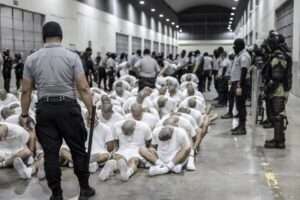
A prison guard transfers deportees from the U.S., alleged to be Venezuelan gang members, to the Terrorism Confinement Center in Tecoluca, El Salvador. Mar. 16, 2025 (El Salvador Presidential Press Office)
Today, US District Court Judge Fernando Rodriguez (Southern District, Texas) issued two important ruling against the Trump Administration in J.A.V. v. Trump, an Alien Enemies Act case. The first holds that Trump's invocation of the AEA is "unlawful" and imposes a permanent injunction against its use against migrants involved in the lawsuit. The second certifies that Venezuelan migrants targeted by Trump's invocation of the Act may file a habeas corpus class action to challenge its use against them.
The AEA can only be used to detain and deport immigrants in the event of a declared war, or an "invasion" or "predatory incursion" perpetrated by a "foreign nation or government." Judge Rodriguez, a Trump appointee, ruled that the AEA's use by Trump against Venezuelan migrants who are supposed members of the Tren de Aragua drug gang is illegal because TdA's activities don't qualify as an "invasion" or "predatory incursion":
Petitioners' briefing contains numerous sources contemporaneous to the enactment of the AEA in which "invasion" and "predatory incursion" expressly reference or imply military action.Those sources include dictionary definitions, historical records such as letters, and court decisions….
Respondents do not challenge these usages. Instead, they contend that other contemporaneous sources reflect a broader understanding of "invasion," with no express or implicit military requirement. In support of their construction, however, they provide only two examples, both of them from dictionaries….
To augment the parties' submissions, the Court reviewed numerous historical records using "invasion," "predatory incursion," and "incursion" for the period from 1780 through 1820…. In the significant majority of the records, the use of "invasion" and "predatory incursion" referred to an attack by military forces. This held true even when the historical record did not concern the Revolutionary War or the War of 1812. The usages of "predatory incursion" at times referred to entries by Native Americans into the western territories, as did usages of "incursion." But even these records refer to an organized group of armed individuals entering an area to attack a fort, settlement, or town, and the writer typically discussed the need for a military response to the entry….
The Court's research for judicial decisions that utilized "predatory incursion" during the relevant time period returned only two results. In both usages, the courts referenced "predatory incursions" to describe conduct by Native Americans, in one instance as part of an "Indian war" and in the other in connection with the authority of a military officer. See Huidekoper's Lessee v. Douglass, 3 Cranch 1, 7 U.S. 1, * 7 (1805) (explaining the passage of a statute as motivated by the fact that "an Indian war existed on [Pennsylvania's] frontier[,]" and the state's population were "bound by their dearest interests to watch and repel the predatory incursions of the Indians"); Russell's Lessee v. Baker, 1 H. & J. 71, 1800 WL 441, at *6 (Gen. Ct. Maryland 1800) ("But it does not follow under this grant of power that he had a right to declare war or make peace; for there is no instance of a captain general of an army having the power, as captain general, to do either. The powers, granted under this section of the charter were granted to guard against and repel the predatory incursions of the Indians . . . and to prevent and to suppress insurrections[.]")….
Judge Rodriguez also notes that references to "invasion" in the Constitution refer to armed military attacks, and this should affect interpretations of its use in the AEA, enacted just a few years earlier.
He also rejects the idea that the meaning of "invasion" and "predatory incursion" are "political questions" not subject to judicial review.
This ruling follows similar decisions by a federal district court in Colorado, and Judge Henderson of the D.C. Circuit, all of which also rejected the "political question" argument and held that, in the AEA, "invasion" and "predatory incursion" refer to armed attacks. Multiple earlier court decisions have reached the same conclusion with respect to the meaning of "invasion" in the Constitution. There is a growing consensus on this question among both liberal and conservative judges. The Colorado decision was issued by a liberal Biden appointee. But Henderson and Rodriguez are both conservative Republican appointees. So far, Judge James Ho of the Fifth Circuit is the sole judicial dissenter on the meaning of "invasion." I critiqued his position here.
I have defended the view that "invasion" requires a military attack, in greater detail in my own previous writings on the meaning of the term in the AEA and the Constitution.
There is one potentially significant flaw in Judge Rodriguez's analysis. While he concludes that the meaning of "invasion" is not a "political question," he argues that the factual determination of whether an "invasion" exists is. So far, the Trump Administration has not claimed there is an armed attack on the US conducted by a foreign nation or government, and thus he rules against them. But if Trump - or a future president - were willing to lie about this issue, and falsely assert there is such an armed attack, Judge Rodriguez would presumably defer.
I think this reasoning is a mistake. Making determinations about relevant facts is a standard function of the judiciary. If the law says the government is allowed to do X whenever Y occurs, courts must make a determination on whether Y has actually happened or not. Otherwise, the government could do X anytime it wants simply by asserting Y has happened, even if the claim is false. This is especially dangerous in case of emergency wartime powers that severely curtail civil liberties, like those authorized by the AEA (detention and deportation with little due process, even for legal immigrants). I would add that, under the Constitution, a state of "invasion" allows state governments to "engage in war" in response and the federal government to suspend the writ of habeas corpus (thereby empowering it to detain people - including US citizens - without due process). Such sweeping authority cannot simply be left to the unreviewable discretion of one person. That's the kind of arbitrary royal prerogative the Founders sought to prevent.
It may be reasonable to defer to the executive on factual issues when the evidence is close, and ambiguous, and the government is making use of some kind of superior expertise. But not when the assertion that an "invasion" exists is pretty obviously false, and pretextual.
I will not comment on the class action ruling in detail, as I am not a class action expert. But it is significant. For reasons I summarized here and here, class action certification is crucial to ensuring that migrants targeted for deportation under the AEA have a meaningful opportunity to contest the government's actions in court.
I feel like I owe libertarians an apology, for severely underrating their ideology. I was so focused on its theoretical flaws that I ignored its political importance. I concentrated only on the marginal benefits that might be achieved by building on our economic system's libertarian foundation, ignoring the inframarginal losses that would happen were that foundation to crumble. I had only a hazy, poor understanding of the historical context in which libertarianism emerged, and of the limitations of libertarianism's most prominent critics.
The most obvious thing that has prompted me to make this apology is Donald Trump's disastrous tariff policy….
I should also have realized that as right-leaning ideologies go, American libertarianism was always highly unusual. I had lived in Japan, where the political right is protectionist, industrialist, and sometimes crony-capitalist. I should have realized that this was the norm for right-leaning parties around the world, and that the American right's Reaganite embrace of free markets and free trade was the anomaly. That, in turn, should have given me a warning of what would happen if libertarianism fell in America.
I did not understand the relevant pieces of history, nor did I think carefully enough about what I had observed overseas. And so when I was a graduate student writing about the ills of libertarianism, I imagined that the realistic alternatives to the American system of 2007 were either the gentle progressivism of Bill Clinton and Barack Obama, or the vigorous nation-building of FDR and Eisenhower, rather than the madness of a charismatic populist with zero understanding of economics….
I'd be lying if I said that Trump's madness is the only thing that made me feel more sympathy for libertarianism. Over the past decade, I've seen the excesses of progressive economic ideology more clearly than I ever did as a graduate student.
Contrariwise, I've grown more critical of libertarianism over the last few years, because I've come to recognize that too many libertarians confuse proper skepticism of government and preference for voluntary markets with crude anti-governmentism, which is not the proper lesson from the classical liberal tradition. The crude anti-governmentists tend to eventually find themselves drifting to the Glenn Greenwald-esque left or the racist and populist alt-right. Both those ideologies provide a much more satisfyingly universal hostility to the US government than the much more nuanced philosophy championed by the likes of Epstein, Friedman, and Hayek. Both seem to appeal specifically to followers of the late Murray Rothbard, whose hostility to anything and everything related to the US government I increasingly believe has really harmed libertarianism and opened it to all sorts of crackpots.
In any event, I don't agree with everything Smith says, but I found his essay thought-provoking. As they say, read the whole thing.
Yesterday, I wrote about Libby v. Fectau. In this case, the Maine Speaker of the House stripped a member of her right to vote--and ability to represent her constituents. Libby filed an emergency application on Monday, April 28 with Justice Jackson. The application explained that the Maine legislative session begins on May 6. Unless a stay is granted, votes will be held, but Libby will be unable to vote. That danger is completely irreparable. Abrego Garcia may one day be brought back to the United States. Probationary employees can be rehired. Cancelled funds can later be disbursed. But the Maine legislature will not hold a "do-over" vote. Even if the Court is not inclined to grant relief, one would think that the Circuit Justice should at least have the case fully briefed to permit a prompt resolution of the case. But Justice Jackson had other plans.
Today, May 1, three days after the application was filed, Justice Jackson called for a response. And she gave the respondents a full week to reply. She set the deadline for May 8--two days after the Maine legislative session begins. Even assuming the full Court promptly rules on the matter, there will be injuries that cannot be remedied.
Justice Jackson has been very critical of the shadow docket rulings. She referred to standing as a "shiny" object, and referred to the United States as just another party. On the full court, she has but one vote. But as Circuit Justice, she has the only vote. I wonder if Justice Jackson is putting her views on the shadow docket into play. In other words, she can call for a response when she finds it appropriate to do so, and will not follow the deadline requested by the Applicants. In doing so, she can frustrate the ability of the full Court to grant emergency relief.
I checked the high-profile shadow docket entries over the past few months to see how much time elapsed before there was a call for response, and how long the deadline was. I've also noted in parentheses the total time that elapsed from the application until the reply was filed. Here is the set (and please email me if I made any errors):
Libby v. Fectau - Application filed on 4/28, J. Jackson calls for response on 5/1, due 5/8 (11 days)
Trump v. J.G.G. - Application filed on 3/28, CJ Roberts calls for response on 3/28, due 4/1 (5 days)
OPM v. AFGE - Application filed on 3/24/25, J. Kagan calls for response on 3/27/25, due 4/3/25 (11 days)
Noem v. Garcia - Application filed on 4/7/25, CJ Roberts calls for response on 4/7/25, due 4/8/25 (2 days)
Trump v. CASA - Application filed on 3/13/25, CJ Roberts calls for response on 3/14/25, due 4/4/25 (Oral Argument set for 5/15/25)
Trump v. Wilcox - Application filed on 4/9/25, CJ Roberts calls for response on 4/9/25, due on 4/15/25 (7 days)
A.A.R.P. v. Trump - Application filed on 4/18/25, stay granted on 4/18/25, response filed on 4/19/25 (1 day)
U.S. v. Shilling - Application filed on 4/25/25, J. Kagan called for response on 4/24/25, due on 5/1/25 (7 days)
Chief Justice Roberts consistently calls for a response when the application is filed, or the next day. With the exception of the birthright citizenship case, which was set for oral argument, Roberts has set the deadline as long as six days, usually three days, and sometimes even shorter. (In A.A.R.P., the deadline came after the Court's stay.) In two cases, Justice Kagan granted a full week. Justice Jackson has now granted a week in one case, and two days in another.
I'm not sure if we have enough data points to figure out a pattern here. But at a minimum, Justice Jackson has signaled that she will move at her own pace, and not the schedule requested by the applicant.
What, then, is a litigant to do if a Circuit Justice does not timely call for a response? Could they seek relief from another Circuit Justice? Or ask the application to be referred to the full Court? Or maybe they can direct the application to the full court in the first instance, and bypass the Circuit Justice? I have a sinking feeling that in A.A.R.P., even though the case was nominally referred to Circuit Justice Alito, the case was decided in the first instance by the full Court. There simply was not enough time for all of the steps to have taken place on Good Friday.
May Day should be a day to honor victims of an ideology that took tens of millions of lives. But we should also be open to alternative dates if they can attract broad enough support.
Today is May Day. Since 2007, I have advocated using this date as an international Victims of Communism Day. I outlined the rationale for this proposal (which was not my original idea) in my very first post on the subject:
May Day began as a holiday for socialists and labor union activists, not just communists. But over time, the date was taken over by the Soviet Union and other communist regimes and used as a propaganda tool to prop up their [authority]. I suggest that we instead use it as a day to commemorate those regimes' millions of victims. The authoritative Black Book of Communism estimates the total at 80 to 100 million dead, greater than that caused by all other twentieth century tyrannies combined. We appropriately have a Holocaust Memorial Day. It is equally appropriate to commemorate the victims of the twentieth century's other great totalitarian tyranny. And May Day is the most fitting day to do so….
Our comparative neglect of communist crimes has serious costs. Victims of Communism Day can serve the dual purpose of appropriately commemorating the millions of victims, and diminishing the likelihood that such atrocities will recur. Just as Holocaust Memorial Day and other similar events promote awareness of the dangers of racism, anti-Semitism, and radical nationalism, so Victims of Communism Day can increase awareness of the dangers of left-wing forms of totalitarianism, and government domination of the economy and civil society.
While communism is most closely associated with Russia, where the first communist regime was established, it had comparably horrendous effects in other nations around the world. The highest death toll for a communist regime was not in Russia, but in China. Mao Zedong's Great Leap Forward was likely the biggest episode of mass murder in the entire history of the world.
November 7, 2017 was the 100th anniversary of the Bolshevik seizure of power in Russia, which led to the establishment of the first-ever communist regime. On that day, I put up a post outlining some of the lessons to be learned from a century of experience with communism. The post explains why the lion's share of the horrors perpetrated by communist regimes were inherent flaws of the system. For the most part, they cannot be ascribed to circumstantial factors, such as flawed individual leaders, peculiarities of Russian and Chinese culture, or the absence of democracy. Some of these other factors, especially the last, probably did make the situation worse than it might have been otherwise. But, for reasons I explained in the same post, some form of dictatorship or oligarchy is virtually inevitable in a socialist economic system where the government controls all or nearly all of the economy.
While the influence of communist ideology has declined since its mid-twentieth century peak, it is far from dead. Largely unreformed communist regimes remain in power in Cuba and North Korea. In Venezuela, the Marxist government's policies have resulted in political repression, the starvation of children, and a massive refugee crisis - the biggest in the history of the Western hemisphere.
In Russia, the authoritarian regime of former KGB Colonel Vladimir Putin has embarked on a wholesale whitewashing of communism's historical record. Putin's brutal and indefensible invasion of Ukraine owes more to Russian nationalist ideology than communism. But it is nonetheless fed in part by his desire to recapture the supposed power and glory of the Soviet Union, and his long-held belief that the collapse of the USSR was "the greatest geopolitical catastrophe of the century." It is also telling that most communists in Russia and elsewhere have joined with many far-right nationalists in backing Putin's line on the war.
In China, the Communist Party remains in power (albeit after having abandoned many of its previous socialist economic policies), and has recently become less tolerant of criticism of the mass murders of the Mao era (part of a more general turn towards greater repression).
China's horrific repression of the Uighur minority is reminiscent of similar policies under Mao and Stalin, though it has not - so far - reached the level of actual mass murder. But imprisoning over 1 million people in horrific concentration camps is more than bad enough.
Far-left support for Hamas since the horrific October 7, 2023 terrorist attack is yet another reminder of the inherently evil nature of communist ideology. Backing terrorism is part of a long history of support for repression and mass murder. Not all extreme socialists of the type who support Hamas are communists. But the latter are a subset of the former.
In a 2012 post, I explained why May 1 is a better date for Victims of Communism Day than the available alternatives, such as November 7 (the anniversary of the Bolshevik seizure of power in Russia) and August 23 (the anniversary of the Nazi-Soviet Pact). I also addressed various possible objections to using May Day, including claims that the date should be reserved for the celebration of labor unions.
But, as explained in my 2013 Victims of Communism Day post, I would be happy to support a different date if it turns out to be easier to build a consensus around it. If another date is chosen, I would prefer November 7; not out of any desire to diminish the significance of communist atrocities in other nations, but because it marks the establishment of the very first communist regime. November 7 has in fact been declared Victims of Communism Memorial Day by three state legislatures.
If this approach continues to spread, I would be happy to switch to November 7, even though May 1 might be still more appropriate. For that reason, I have adopted the practice of also commemorating the victims of communism on November 7.
I would also be happy to back almost any other date that could command broad support. Unless and until that happens, however, May 1 will continue to be Victims of Communism Day at the Volokh Conspiracy.
Whatever one thinks of the relevant legal and constitutional issues regarding the Trump administration's campaign to revoke visas from and deport students it deems antisemitic and supportive of terrorism, one should be clear on exactly what views and backgrounds some of these people have. You often won't find out from mainstream media sources.
A case in point is Columbia [edit: undergrad]* student Mohsen Madawi, who won a habeas petition yesterday. Judge Geoffrey Crawford bought the portrayal of Madawi's as a peace-loving conciliator hook, line, and sinker. This despite a rather significant detail buried in the opinion:
In its response, the Government directs the court's attention to an incident in summer 2015 when a gun shop owner told Windsor, Vermont police officers that Mr. Mahdawi had visited his store twice, expressing an interest in learning more about firearms and buying a sniper rifle and an automatic weapon and that he "had considerable firearm experience and used to build modified 9mm submachine guns to kill Jews while he was in Palestine." (Doc. 42-2.) The store owner stated that Mr. Mahdawi took photos of the store and its merchandise. (Id.) The store owner gave the police the name of a fellow gun enthusiast who stated that he had a similar conversation with Mr. Mahdawi at the "Precision Museum" in Windsor where the enthusiast served as a volunteer tour leader. During that conversation, Mr. Mahdawi allegedly told the gun enthusiast, "I like to kill Jews." (Id.)
Mahdawi denies the allegation, and his lawyers told the court that the FBI agent who investigated "was satisfied with his explanation and closed the investigation." The government acknowledged that the investigation ended without charges, but it was not "closed" in any official way.
Judge Crawford concludes:
The court has considered the allegations made by the gunsmith in 2015. If true, they are highly damaging to Mr. Mahdawi's chances of release and of having any future in the United States at all. In 2015, the FBI conducted a thorough investigation of the allegations and found no basis to act. Had the statements attributed to Mr. Mahdawi been true, they would have resulted in some official response. In a case of the dog that did not bark, the FBI concluded its investigation without taking action. That decision gives rise to a reasonable inference that the agency charged with the protection of the public from crime found no basis for proceeding against Mr. Mahdawi in any venue.
I don't know why the FBI did not refer Mahdawi's case to ICE, especially given the background of 9/11 in which suspicious statements by students who turned out to be hijackers were ignored, but I do know why the FBI didn't charge him criminally; even if the FBI had found the allegations to be 100% true, it's not a crime in the US to have participated in criminal activity in Israel. Nor is it a crime to muse about how one likes to kill Jews. So Judge Crawford has no basis for suggesting that the FBI's failure to charge Mahdawi amounts to a finding that the incidents never happened. (As an aside, my friend Ilya Somin seems to think that musing about killing Jews at a gun shop shouldn't make an alien deportable or even ineligible for an initial visa so long as the statement is deemed protected by the First Amendment for citizens. I think that's nuts.)
To my utter lack of surprise, the story on the case in the New York Times today makes no mention of Mahdawi's apparent history of wanting to kill Jews. The Times also gave Mahdawi a laudatory profile a while back, with the headline, "He Wanted Peace in the Middle East. ICE Wants to Deport Him." No mention that he wrote a poem circulated on Facebook in 2013 celebrating a terrorist responsible for the notorious Coastal massacre in Israel in 1978, which left 38 Israelis dead, including many children.
More recently, here he is on 60 Minutes, while stating he is not "justifying" Hamas's 10/7 massacre, he also notably declines an open invitation to criticize it, stating that he can empathize with the sentiments that in his view led to it: "To empathize is to understand the root cause and to not look at any event or situation in a vacuum. This is for me the path moving forward." Call me crazy, but I'm thinking that someone who is really the peace-loving humanitarian portrayed by the Times wouldn't hesitate to condemn the massacre, torture, rape, and kidnapping of thousands of innocents by a terrorist theocracy. I might especially be inclined to do so if I had been previously investigated by the FBI for talking about killing Jews while perusing weapons in a gun store.
And here he is at Columbia in November 2023, leading chants of "From the River to the Sea, Palestine will be Free." I listened to the whole speech so you don't have to, and it also includes a couple of subtle antisemitic allusions. He tells his audience that their voices are more important that the "money" that Columbia is paying attention to. I would let that one pass, except that he later says that he and his audience are in "the belly of the beast, the Big Apple" but won't be silenced. Why is New York City the Belly of the Beast? Who is trying to silence them with their money? I think we know.
Mahdawi should have been deported in 2015, assuming the statements of the gun store owner were deemed credible. And for these purposes, talking about being involved in killing Jews and enjoying killing Jews is quite sufficient to me to justify deporting him now. As for the habeas petition, he doesn't strike me as an immediate threat nor as much of a flight risk, so I'm not sure why he was arrested to begin with, as opposed to just receiving notice that his lawful status was revoked.
*Added: Contrary to my original post stating that he is a grad student, Mahdawi is an 34 year old undergraduate student at Columbia's School of General Studies. This is a program for "nontraditional," often foreign, students who generally would not have the credentials to get into Columbia College. This raises some interesting questions. He's been here since 2015 but is still pursuing an undergraduate degree? Even though he already has a Bachelor's degree in Computer Engineering from Birzeit University in the West Bank, and previously studied at Lehigh University? According to the Judge Crawford's decision, his permanent address is in Vermont. But he's pursuing a degree at Columbia in New York City? He was married to a US citizen for several years, but now is divorced. If he has employment, the judge didn't mention it in discussing why he's not a flight risk. How is he sustaining himself? Judge Crawford didn't seem to be interested in these questions, but they are certainly worth asking.
Lawyer/podcaster Irina Tsukerman interviewed about the Trump tariff litigation for her Washington Outsider report podcast. The interview was conducted before the recent filing of new cases challenging Trump's IEEPA tariffs by twelve states led by Oregon and the Pacific Legal Foundation. Thus, we couldn't cover those two suits. But, otherwise, this is the most extensive interview I have done on the tariff litigation yet. Among other things, we discussed the case filed earlier by the Liberty Justice Center and myself. I cover the legal issues at stake in more detail in my Lawfare article, "The Constitutional Case Against Trump's Trade War."
My colleagues at the Cato Institute have, together with FIRE and other groups, filed an amicus brief in the case of Ozturk v. Trump, explaining why speech-based deportations of foreign students violate the First Amendment. As the brief explains, Ozturk is a Tufts graduate student detained for an anti-Israel op ed in a campus paper that, however flawed, does not endorse Hamas terrorism, or indeed even mention it.
Thomas Berry of Cato and FIRE attorney Conor Fitzpatrick have a helpful summary of the brief:
Rumeysa Ozturk is a graduate student at Tufts University. Ozturk is a Turkish citizen who was living in the United States on a student visa. On March 25, Ozturk was approached and surrounded by six plainclothes officers, stripped of her cellphone and backpack, handcuffed, and taken into custody in an unmarked vehicle. Unbeknownst to her, the United States had revoked her visa just days earlier. Ozturk was transferred to Vermont and then Louisiana, where she remains in custody.
A provision of federal immigration law grants the secretary of state the authority to deport an alien if the secretary "has reasonable ground to believe" that the alien's "presence or activities in the United States … would have potentially serious adverse foreign policy consequences for the United States." The government cited this provision in revoking Ozturk's visa, without specifying why it believed her presence would have adverse foreign policy consequences.
Evidence indicates that Ozturk's visa was revoked solely on the basis of an op-ed she co-authored for a student newspaper. That op-ed criticized the Tufts University administration for dismissing certain student government resolutions. The op-ed argued that these resolutions would have held "Israel accountable for clear violations of international law" in Palestine.
Ozturk has petitioned a federal court to order her released, and Cato has joined a broad coalition of groups, led by FIRE, to file an amicus brief supporting that petition. In our brief, we explain that noncitizens residing in the United States have the same First Amendment rights as citizens. The Supreme Court said as much in Bridges v. Wixon (1945), where the Court remarked that "freedom of speech and of press is accorded aliens residing in this country." And the Supreme Court also affirmed this principle in Bridges v. California (1941), a case in which the Court invalidated the criminal convictions of several people, including a non-citizen, because those convictions violated the First Amendment.
As our brief further explains, Ozturk's op-ed was protected speech. The government has not alleged that Ozturk was providing material support to terrorists, nor has it alleged that her op-ed fell into any other exception to the First Amendment (such as insurrectionary speech). If a citizen were punished for the same op-ed, such punishment would be a blatant First Amendment violation. Ms. Ozturk's punishment is no different.
Finally, our brief emphasizes that Ozturk's detention is irreconcilable with the Supreme Court's admonition that colleges and their "surrounding environs" are "peculiarly the 'marketplace of ideas.'" There are more than a million international students studying at America's universities. None of them will feel safe criticizing the American government —in class, scholarship, or on their own time—if a current or future secretary of state may, at his unreviewable discretion, arrest and detain them based on their spoken or written advocacy.
As Justice Frank Murphy wrote in a concurrence in the Wixon case, the freedom of foreign nationals lawfully residing in the United States is "not dependent upon their conformity to the popular notions of the moment," because the First Amendment "belongs to them as well as to all citizens." Ozturk's detention and the revocation of her visa violate the First Amendment, and the courts should order her released.
I agree with all the above, and am glad to see Cato joined this brief! If I have a reservation, it's that the brief seemingly concedes the constitutionality of at least some speech-based denials of the right to enter the US, but argues that full First Amendment protection applies to foreign students and others once in the US. In my view, speech-based entry restrictions are also unconstitutional. But the courts need not resolve that issue in this case.
In previous posts, I have explained why speech-based deportations are unconstitutional - there is no immigration exception to the First Amendment or most other constitutional rights - and urged universities to file lawsuits challenging Trump's speech-based deportation policy. I am glad to see that many schools (including my undergraduate alma mater Amherst College) filed an amicus brief supporting a lawsuit brought against the policy by the American Association of University Professors. But schools should do more.
Courts are beginning to rule against speech-based deportations, including in yesterday's federal district court decision freeing Palestinian immigrant student Mohsen Mahdawi from detention. U.S. District Judge Geoffrey Crawford wrote that "Noncitizen residents like Mr. Mahdawi enjoy First Amendment rights in this country to the same extent as United States Citizens. If the Government detained Mr. Mahdawi as punishment for his speech, that purpose is not legitimate, regardless of any alleged First Amendment violation. Immigration detention cannot be motivated by a punitive purpose. Nor can it be motivated by the desire to deter others from speaking." See also this recent preliminary ruling in the AAUP case.
People sometimes ask me whether I would still oppose speech-based deportations of people whose views I find highly objectionable. The answer is that I'm already doing that. As I have previously noted, I have little sympathy for recent anti-Israel campus protests, and for the views of many of the students targeted for deportation by Trump. But, as always, free speech rights are not limited to people whose views are inoffensive. Freedom of speech must include "freedom for the thought that we hate." That holds true for foreign students and other non-citizens no less than for US citizens.
Today's decision by Judge Geoffrey Crawford (D. Vt.) in Mahdawi v. Trump allows a legal permanent resident to be bailed out of detention, pending his immigration hearings. And the bail analysis requires considering whether Mahdawi raises "substantial claims" that his deportation (on the grounds that "[t]he Secretary of State has determined that your presence and activities in the United States would have serious adverse foreign policy consequences and would compromise a compelling U.S. foreign policy interest") would violate the First Amendment. The court concludes that he has indeed raised such claims:
Noncitizen residents like Mr. Mahdawi enjoy First Amendment rights in this country to the same extent as United States citizens. See, e.g., Bridges v. Wixon (1945) (holding that a noncitizen who published communist literature was protected by First Amendment); Kwong Hai Chew v. Colding (1953) (noting that the First Amendment does not distinguish "between citizens and resident [noncitizens]"); United States v. Verdugo-Urquidez (1990) (confirming that resident noncitizens "enjoy certain constitutional rights," including "First Amendment rights"); Rafeedie v. I.N.S. (D.D.C. 1992) ("Plaintiff is entitled to the same First Amendment protections as United States citizens, including the limitations imposed by the overbreadth and vagueness doctrines."); OPAWL – Building AAPI Feminist Leadership v. Yost, (S.D. Ohio 2024) ("[T]he Supreme Court has never held that the First Amendment fails to protect [noncitizens'] political speech to the same extent it protects citizens' political speech."). That includes the right to be free from retaliation for the exercise of his First Amendment rights. See Ragbir v. Homan (2d Cir. 2019) (holding that legal permanent resident could not be deported in retaliation for his protected speech even where he was deportable on other grounds)….
[Mr. Mahdawi's] speech, which advocated for a peaceful resolution of the conflict in Gaza and opposed Israel's military campaign, is at the heart of an ongoing political debate among the American people. "Because [Mr. Mahdawi's] speech concerns 'political change,' it is also 'core political speech' and thus 'trenches upon an area in which the importance of First Amendment protections is at its zenith.'"
Mr. Mahdawi's speech does not appear to fall within any areas in which the First Amendment permits restrictions based on the content of speech. The Supreme Court recently summarized these areas: "incitement—statements direct at producing imminent lawless action and likely to do so," "defamation—false statements of fact harming another's reputation," "obscenity—valueless material appealing to the prurient interest," and "true threats of violence."
In a memorandum written by Secretary of State Marco Rubio, the government accused Mr. Madawi of "engag[ing] in threatening rhetoric and intimidation of pro-Israeli bystanders" at a protest. A bail hearing is not the time to make detailed findings on the merits of the First Amendment claim. On the limited record available, Mr. Mahdawi has provided enough information to show that his speech was protected….
When a murderer kills a victim, including a child, the murderer has directly and immediately eliminated the victim's ability to earn income. The only remaining issue is to reasonably estimate the size of that loss.
Today the Arizona Supreme Court handed down an important ruling on restitution in homicide cases. Interpreting Arizona's restitution statutes, the Court concluded that they require restitution for future lost income in homicide cases. The victim's family can establish the amount of restitution that is owed through reasonable estimation.
In Arizona, a victim has a right to receive full restitution from persons "convicted of the criminal conduct that caused the victim's loss or injury." See Ariz. Const. art. 2, § 2.1(A)(8). In a homicide case, the appropriate family representative for the victim steps into the victim's shoes for restitution purposes. The goal of restitution in Arizona (as in most other jurisdictions) is to restore victims to the position they were in before the loss or injury caused by the crime.
In earlier cases, Arizona courts held that "restitution should be ordered for losses that (1) are economic; (2) would not have been incurred by the victim but for the criminal offense; and (3) were directly caused by the criminal conduct." And these earlier cases held that future economic losses were recoverable.
In today's decision, the Arizona Supreme Court rejected a murderer's argument that a child's future lost income was not directly caused by the homicide. The Court explained that "where the criminal conduct directly caused the victim's future … lost wages, [the victim's] murder directly caused [the] claimed loss. [The victim's] future ability to earn wages was directly and immediately eliminated with his death, and no other causal events occurred or remained to occur to produce that result. In other words, the loss was direct and immediate."
The Arizona Court of Appeals had reached a different conclusion. But today the Arizona Supreme Court reversed, holding that the court of appeals "mistakenly conflated the cause of [the victim's] future lost wages with the calculation of that loss." The court of appeals had concluded that future lost wages were consequential damages because "so many undetermined causal factors contributed to the six-year-old [victim's] projected earnings that the trial court had no basis to validly calculate an amount." But the Arizona Supreme Court held that these are separate inquiries: "If criminal conduct directly caused a victim's loss, … any uncertainty in calculating that loss does not negate the causation finding. Rather, once the right to restitution is established, the inquiry turns to whether the victim has sufficiently demonstrated the amount of the loss so that restitution can be ordered."
Turning to the issue of the amount of loss, the Arizona Supreme Court instructed that the victim "must provide a reasonable basis for estimating the incurred loss." The Court cited the Restatement (Second) of Torts § 912 cmt. a. (Am. L. Inst. 1979), which explains that injured persons should provide a "definiteness of proof as to the amount of damage as far as is reasonably possible" and noting that "an injured person [should] not be deprived of substantial compensation merely because he cannot prove with complete certainty the extent of harm." The Arizona Supreme Court remanded so that the victim's family could present the evidence on expected future lost earnings caused by the murder.
Today's Arizona Supreme Court decisions parallels a ruling that I made as a federal district court judge. In U.S. v. Serawop (as ultimately affirmed on remand), I awarded $325,751 in restitution to a mother whose three-month-old baby was criminally killed. I relied on lost income calculations by an expert accountant. Presumably in this Arizona case, the victim's family can provide similar, reasonable calculations. In my decision, I reasoned that where a killer has deprived the victim of a chance to succeed in life, a judge's discretion should be exercised in favor of the victim.
Note: The victim in this case was represented by Colleen Clase of Arizona Voice for Crime Victims. I provided advice to AVCV as they were pursuing this claim.
The Court moves heaven and earth to block removal of alleged gang members who are almost certainly removable, but stays silent when citizens of Maine lose their elected representative.
Laurel Libby is an elected representative in Maine. The Speaker of the Maine House stripped Libby of the right to vote in the legislature due to her comments about transgender athletes in sport. The District Court and First Circuit denied relief. Ed Whelan has more about the controversy here.
In this application, Petitioners seek an injunction pending appeal requiring the Clerk to count Libby's votes. That interim relief simply restores the status quo of equal representation, bringing the Maine House back into conformity with every other State and Congress. Petitioners respectfully request that relief before May 6, 2025, when the House convenes yet another floor session where every legislator but Libby may vote.
As of the evening of Wednesday, April 30, Justice Jackson still has not called for a response. Getting a ruling by May 6 would have been difficult, even with a prompt turnaround time. But this petition has now been sitting on the docket for two days without any motion. And forget about an administrative stay!
It seems the Court's preferences are fairly clear, as we saw in the denial of the application in the Ohio ballot case. The Court moves heaven and earth to block removal of alleged gang members who are almost certainly removable, but stays silent when citizens of Maine lose their elected representative. I'm glad everyone's priorities are straight.
Presidential power must stem from the Constitution or a statute, and the tariffs imposed by President Trump are unauthorized by statute, making them both unlawful and unconstitutional.
President Trump has raised or lowered tariffs/taxes, or he has threatened other nations that he will do so, on an almost daily basis since Inauguration Day. He does not have the legal authority to do so.
The U.S. Constitution authorizes the imposition of tariffs in the very first clause of Article I, Section 8, which famously grants Congress eighteen, and only eighteen, limited and enumerated legislative powers. That Clause provides that:
The Congress shall have Power To lay and collect Taxes, Duties, Imposts and Excises, to pay the Debts and provide for the common Defence and general Welfare of the United States; but all Duties, Imposts and Excises shall be uniform throughout the United States.
This provision stems from centuries of conflict in Great Britain (and the colonies) about the location of the power to tax, and from the American Revolutions rejection of Parliament's effort to impose "taxation without representation" on the colonies.
Samuel Johnson's 1755 Dictionary of the English Language defines a Duty as a "Tax; impost; custom; [or] toll." It defines an Impost as "a tax; a toll; [or] a custom paid." A tariff is either a "duty" or an "impost," and the power to impose such tariffs/taxes is therefore explicitly given to Congress, not the President, by the Constitution. From the Tariff Act of 1789, passed by the First Congress, to the Tariff of Abominations passed in 1828, to the Smoot-Hawley Tariff passed in 1930, it has always been understood that the Constitution gives only Congress the power to impose, raise, or lower tariffs, which are taxes. It does not give that power to the President.
Under case law going back to the nineteenth century, Congress can delegate some measure of power to the President to adjust tariff rates, but President Trump can only impose, raise, or lower tariffs if Congress has delegated that power to him by statute. J.W. Hampton, Jr. & Co. v. United States, 276 U.S. 394 (1928). He also can only do so as long as the delegation of power by Congress is guided by "an intelligible principle." This is a wise and good feature of our Constitution, a document which should be revered and followed, not trashed.
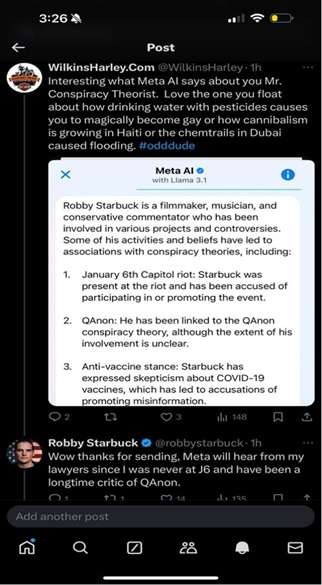
Imagine waking up one day and learning that a multi-billion-dollar corporation was telling whoever asked that you had been an active participant in one of the most stigmatized events in American history—the Capitol riot on January 6th, 2021—and that you were arrested for and charged with a misdemeanor in connection with your involvement in that event.
Further imagine that these accusations were completely false: that you were at your home in Tennessee on January 6th, and that you had never been accused of committing any crime in your entire life; in fact, you hadn't received as much as a parking ticket in over a decade. But despite their utter baselessness, these false statements were widely believed because they were made by one of the most powerful and credible technology companies in the world.
Finally, imagine that the technology company continued to publish these and other lies about you for nine months after you first asked them to stop. And that based on the lies it created, the technology company was recommending that no one should associate or do business with you—and even worse, that "authorities should consider removing [your] parental rights" to "protect" your own children from you.
This is what happened to Plaintiff Robert ("Robby") Starbuck, who first learned in August 2024 that Meta Platforms, Inc. ("Meta") was spreading these damaging lies about him via its chat bot, Meta AI.
The article, based on Prof. Ginsburg's Melville B. Nimmer Memorial Lecture, is here; the Introduction:
Much American copyright rhetoric vaunts technological progress and economic incentives. One reading of the constitutional copyright clause characterizes copyright as a necessary (if unappealing) encouragement to the advancement of innovation. These emphases tend to obscure the centrality of human creativity to copyright law and theory.
In this article, provocatively titled "Humanist Copyright," I develop a counter-narrative. I seek to highlight the role of human authorship in the copyright scheme. The title references not only current debates over AI-generated outputs but also the proposition that authors' rights embody and advance human achievement. Copyright celebrates human creativity, for multiple reasons, economic and social, but also grounded in the person of the author. I trace these concepts to Italian Renaissance humanism and the emergence of the author as entrepreneur.
My exploration of the role of authorship proceeds in three parts: historical, doctrinal, and predictive. First, I will review the development of author-focused property rights in the pre-copyright regimes of printing privileges and early Anglo-American copyright law through the 1909 U.S. Copyright Act. Second, I will analyze the extent to which the present U.S. copyright law does (and does not) honor human authorship. Finally, I will consider the potential responses of copyright law to the claims of proprietary rights in AI-generated outputs. I will explain why the humanist orientation of U.S. copyright law validates the position of the Copyright Office and the courts that the output of an AI system will not be a "work of authorship" unless human participation has determinatively caused the creation of the output.
Justice Gorsuch wrote for the Court, joined by the Chief Justice, and Justices Sotomayor,, Kavanaugh, and Barrett. Justice Thomas dissented, joined by Justices Alito, Kagan, and Jackson.
This split is particularly interesting because it cannot be explained by usual ideological or doctrinal categories. This is not a right-left split, nor a formalist-pragmatist split. The opinion also does not divide the justices along other identifiable methodological lines, as the Court's most committed textualists are divided. While it is not unusual to see the Chief join the Trump nominees in disagreement with Justices Alito and Thomas, we don't typically see the liberal justices split in this way (Sotomayor v. Kagan and Jackson), and the opinion.
For what it's worth, this is the sixth opinion this term in which the Court has split 5-4, and we have seen only one 6-3 split thus far, but the Court still has a ways to go before the end of the term. The justices have issued 25 opinions in argued cases (and 29 opinions overall) so they have over half of this term's cases left to resolve.
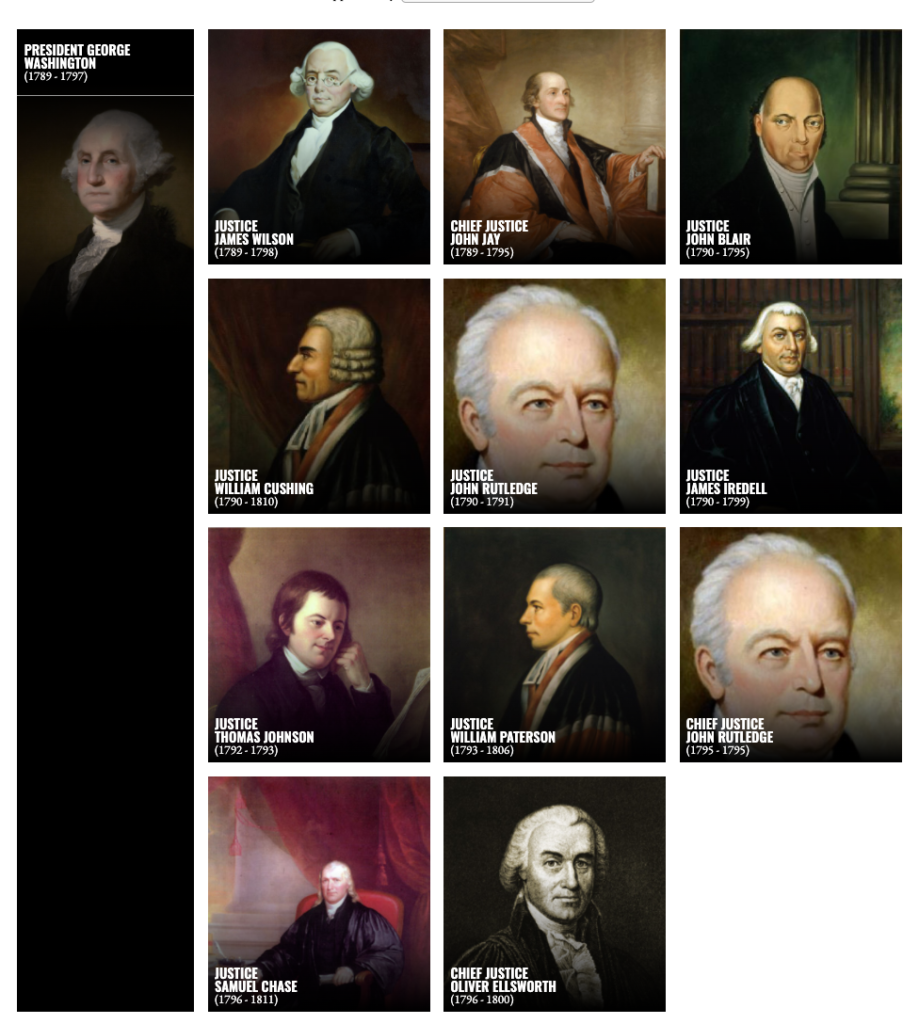
4/30/1789: President Washington's inauguration. He would appoint eleven members to the Supreme Court: Chief Justices Jay, Rutledge, and Ellsworth, and Justices Wilson, Blair, Cushing, Rutledge, Iredell, Johnson, Paterson, and Chase.