There is much to say about the oral argument yesterday in Trump v. CASA. For now, I stand by my prediction from Tuesday:
A few colleagues said I was wrong, and that the merits issue was not adequately briefed. I'm not so concerned. The Court can always restore the case to the docket for the fall and order supplemental briefing. Injunctions are in place now, so time is not of the essence.
Justice Gorsuch asked General Sauer, point blank, "How do you suggest we reach this case on the merits expeditiously?" Gorsuch asked NJ Solicitor General Feigenbaum , "how would you get the merits of this case to us promptly." Gorsuch asked again, "I appreciate that. How do we get to the merits fast?"
I expect this case to be restored to the docket with argument in the fall. The Court could follow the timeline from Citizens United v. FEC. Recall that case was initially argued in March 2009. Malcolm Stewart (infamously) said that the government could ban books. That argument did not go over so well. The majority apparently was prepared to declare unconstitutional the campaign finance regulation. According to Jeffrey Toobin, Justice Souter and other prevailed on the Chief Justice to re-argue the case to ensure the issue was clearly presented. Roberts went along with this strategem. On the very last day of the October 2008 Term, the Court restored the case to the docket for reargument during a special September sitting:
This case is restored to the calendar for reargument. The parties are directed to file supplemental briefs addressing the following question: For the proper disposition of this case, should the Court overrule either or both Austin v. Michigan Chamber of Commerce, 494 U.S. 652 (1990), and the part of McConnell v. Federal Election Comm'n, 540 U.S. 93 (2003), which addresses the facial validity of Section 203 of the Bipartisan Campaign Reform Act of 2002, 2 U.S.C. 441b? The briefs, not to exceed 6,000 words, are to be filed simultaneously with the Clerk and served upon opposing counsel on or before 2 p.m., Friday, July 24, 2009. Amicus briefs, not to exceed 4,500 words, may be filed with the Clerk and served upon counsel to the parties by 2 p.m., Friday, July 31, 2009. Reply briefs, not to exceed 3,000 words, may be filed with the Clerk and served upon opposing counsel on or before 2 p.m., Wednesday, August 19, 2009. The case is set for oral argument at 10 a.m., Wednesday, September 9, 2009.
September 9 was Justice Sotomayor's first day on the Supreme Court, and Elena Kagan's first oral argument, ever. Justice Kagan said the government could not ban books, but her explanation why did not make any sense. The case was decided on January 21, 2010, shortly before the State of the Union. And the rest is history.
I think the Court will follow a similar trajectory.
This evening I spoke to the Orlando Federalist Society Chapter, one of my favorite chapters, about a new topic. It was titled "President Trump Has To Obey The Constitution, But So Does Chief Justice Roberts." This speech is based on a forthcoming piece in Deseret Magazine. I've written quite a bit of late about the three Trump appointees. I thought it was time to focus on the Chief Justice as well.
I apologize for not writing about the birthright citizenship case yet. This speech took up much of my day. Stay tuned for more.
According to the reports in Hebrew media, Judge Ehud Kaplan of the Hadera Magistrate's Court reacted in astonishment to the police's argument, saying: "I thought I had seen everything in 30 years on the bench."
UPDATE 5/15/2025 (post moved up): Anthropic's lawyers filed a declaration stating that the error was not the expert's, but stemmed from the (unwise) use of Claude AI to format citations.
The Trump administration has exhibited a dangerous pattern of invoking spurious emergencies to undermine the Constitution, threatening liberty and circumventing Congress. This is most evident in the fields of immigration and trade policy. If not stopped, or at least curtailed, these policies could harm millions of people, imperil civil liberties, and compromise our constitutional system. Abuse of emergency powers is far from unique to the current administration. But Trump has taken this tendency to new heights…..
On immigration, Trump asserts vast emergency powers by claiming that illegal migration and drug smuggling amount to an "invasion," issuing an executive order to that effect. He further claims that this authorizes him to invoke the Alien Enemies Act (AEA)—a 1798 law that can be used only in the event of war, "invasion," or a "predatory incursion" by a foreign government. Trump's invocation of the AEA is—so far—limited to alleged members of the Venezuelan drug gang Tren de Aragua (TdA). But similar reasoning could be used to target migrants from almost any country that is a source of illegal migration or drugs….
These measures set the stage for the administration's dangerous—and illegal—uses of the AEA. Trump's "invasion" theory goes against extensive evidence that, under the Constitution and the AEA itself, "invasion" means an "operation of war" (as James Madison put it), not mere illegal border crossing or drug smuggling. Before Trump, the AEA had been used only three times, all during major wars against foreign powers: the War of 1812, World War I, and World War II. As several courts have now ruled, a "predatory incursion" (which is an alternative ground for invoking the AEA) is also a type of military attack. If illegal migration and drug smuggling qualify as "invasion," then the U.S. must necessarily be in a state of "invasion" at all times, since these phenomena are ubiquitous….
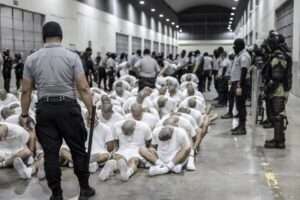
Trump has used the AEA as justification for deporting people to imprisonment in El Salvador without due process (and, in many cases, in error)—and then claiming that they cannot be returned on the grounds that they are in the custody of a foreign power. This is a blatant violation of the Fifth Amendment, which requires "due process of law" before anyone can be deprived of "liberty…."
With his "Liberation Day" executive order, Trump has imposed massive tariffs on goods from almost every nation in the world, triggering the biggest trade war since the Great Depression. This order relied on the 1977 International Emergency Economic Powers Act (IEEPA), which can be invoked only in the event of an "emergency" arising from an "unusual and extraordinary" threat from abroad. Trump's invocation of emergency powers to impose the "Liberation Day" tariffs suggests that the president can impose a tariff of any amount, on goods from any country, for any reason. If long-standing (and generally harmless) trade deficits that supposedly justify these measures qualify as an "emergency" and an "extraordinary and unusual threat," the same can be said of virtually anything. Indeed, Trump now threatens to use IEEPA to impose 100 percent tariffs on foreign-produced movies, based on the dubious claim that they pose "a National Security threat…"
But Trump's abusive emergency power claims are distinctive in the enormity of their scope. Using claims of "invasion" to shut down most legal migration across the southern border and engage in deportation and imprisonment without due process is unprecedented. Shutting down asylum condemns hundreds of thousands of migrants to poverty and oppression. If allowed to continue, deportation without due process could similarly be used against others, including legal immigrants and even U.S. citizens.
Using a fabricated "emergency" as a pretext to start the biggest trade war since the Great Depression is also an unprecedented abuse of the system of emergency powers, one that will impose some $1.4 to 2.2 trillion in tax increases on Americans over the next decade. By comparison, Biden's $400 billion student loan forgiveness power grab seems relatively modest….
In the long run, constraining dangerous emergency powers requires both judicial and legislative vigilance. Courts would do well to enforce the ordinary language definition of "emergency" as a sudden unexpected crisis, not just any possible public policy problem. As a House of Representatives report leading to the enactment of IEEPA explained, "emergencies are by their nature rare and brief, and are not to be equated with normal ongoing problems…."
Congress should adopt legislation limiting presidentially declared emergencies to 30 days, unless it affirmatively votes to extend such emergencies. This would represent a marked improvement on the current system, under which Congress can terminate a presidentially declared emergency only by passing a new law—a near-impossible feat, given the two-thirds supermajority required to override a nearly inevitable White House veto….
On Monday, Chief Justice Roberts spoke at the Georgetown Law School. Among other things, the Chief repeated his concern about threats to the rule of law and judicial independence. From Politico's report:
Chief Justice John Roberts described the rule of law as "endangered" and warned against "trashing the justices," but speaking in Washington Monday he didn't point fingers directly at President Donald Trump or his allies for publicly excoriating judges who've ruled against aspects of Trump's agenda.
"The notion that rule of law governs is the basic proposition," Roberts said during an appearance at Georgetown Law. "Certainly as a matter of theory, but also as a matter of practice, we need to stop and reflect every now and then how rare that is, certainly rare throughout history, and rare in the world today."
While the Chief Justice may not have "point[ed] fingers" at President Trump or his allies in these remarks, the Chief Justice has responded to President Trump's criticisms of federal judges and calls for impeachment. Indeed, contrary to Politico's suggestion, the Chief Justice has been rather consistent in calling out threats to judicial independence and the rule of law from all quarters--and in this he is the exception.
As I discuss in my latest Civitas Outlook piece, the Chief Justice has been consistent in his appeals to and defense of these principles, whereas most of his critics have not been.
Speaking in Buffalo on May 7, the Chief Justice reiterated his views, noting, "impeachment is not how you register disagreement with decisions." As Roberts explained, judicial independence is "central" to the constitutional structure, adding that "the only real political science innovation in our constitution… is the establishment of an independent judiciary." Alexander Hamilton in Federalist No.22 lamented that the lack of a federal judiciary "to expound and define" the "true meaning" of the laws was among the crowning "defects" of the Articles of Confederation. For the judiciary to play that role, Roberts noted, it cannot be under the sway of either of the other branches. The "innovation" embodied in Article III "doesn't work if the judiciary is not independent."
Donald Trump is hardly the only one to have earned rebukes from the Chief Justice for unwarranted attacks on the judiciary. The Chief Justice's most recent year-end report on the state of the judiciary—released before Trump returned to office – inveighed against threats of violence, intimidation, misinformation about judicial decisions, and threats to defy court orders as serious threats to judicial independence. Though some may have forgotten by December 2024, some prominent progressive voices had suggested that the Biden Administration should consider defying court orders and ignoring the Supreme Court's decisions on high profile matters.
And we should not forgot the Chief Justice's forceful statement in response to Senator Schumer's threatening remarks in front of the Court in 2020.
Those who care more about judicial independence and the rule of law than they do about policy victories or partisan advantage would do well to emulate the Chief Justice's approach. Alas, it seems most commentators only raise concerns about the rule of law when the threats come from an opposing tribe. This feeds cynicism about appeals to such principles and undermines efforts to defend the rule of law.
The failure of legal elites to call out the efforts of prior Democratic administrations to ignore legal constraints and evade judicial review does not excuse the Trump Administration's conduct. Two wrongs do not make a right, and there are plenty of wrongs.
But if one is concerned about defending the rule of law, recognizing that threats may come from multiple directions is necessary, as a matter of prudence and civic hygiene. If one wants to be taken seriously as a defender of neutral values, and not merely a partisan wielding whatever rhetorical sword is useful in the moment, one has to aspire toward consistency. . . .
When legal elites turn a blind eye to threats to judicial independence and the rule of law from their political allies, they degrade the value of their voices. The ability to identify transgressions against one's own interests is a sign of good faith and demonstrates that the principle actually matters and is not simply a useful cudgel to wield in political combat. Conspicuous failures to call out offenses and transgressions by one's allies undercut the speaker's moral authority and make it easy for others to write them off as mere partisan actors deploying aspirational rhetoric. Appeals to neutral principles are heard as political subterfuge—perhaps with reason.
Current concerns about the rule of law are justified. The Trump Administration has shown insufficient regard for legal constraints on executive power and has been unduly adversarial with the federal courts. Some of the administration's actions reek of deliberate indifference to constitutional constraints and a lack of good faith. At the same time, some lower court judges have overreacted, stretching their authority to issue nationwide injunctions and block contestable exercises of executive power. If the rule of law is to be defended, it must be defended on principle, with neither fear nor favor for the direction from which such threats emerge.
Many conservatives concerned about the Trump Administration's legal transgressions will nonetheless refuse to play by rules the opposition will not abide by. Rule of law constraints for thee, but not for me, is not a viable option. Asking constitutionalist conservatives to play Charlie Brown trying to kick the football will end the game, and likely on terms no one will like. Those who would preserve judicial independence and rule of law values should heed this message and emulate the Chief Justice's even-handed concerns before it is too late.
I disagree, on the merits, with President Trump's executive order denying birthright citizenship to children of non-citizens who are born in the United States because their parents were here without a green card. I will explain my reasons for disagreeing with the President in more detail in a future blog post. My reading of the Constitution, the caselaw, the scholarly commentary, and of our history leaves me persuaded that United States v. Wong Kim Ark, 169 U.S. 649, 693 (1898), was correctly decided 127 years ago. Justice Gray's opinion in that case for six justices of the Supreme Court is far more persuasive and more thorough than is Chief Justice Fuller's dissent.
I disagree, however, with the increasingly aggressive issuance of nationwide injunctions by the federal district courts, including the nationwide injunctions at issue in Trump v. CASA, a birthright citizenship case which is presently before the Supreme Court. Article III, Section 2 of the Constitution explains that "The judicial Power shall extend" to nine, and only nine, categories of specific cases or controversies. The federal courts do not have the power to decide issues nor are they the sole expositors of the meaning of the Constitution.
The Constitution never mentions the word "interpretation." It never expressly grants any actor a power of interpretation and does not expressly grant courts a power of judicial review. The only powers granted by the Constitution are legislative, executive, and judicial powers. All of those powers require those who exercise them to engage in interpretation to ascertain the scope and limits of their powers (and the powers of other actors), but those powers of interpretation are incidental to the exercise of [the legislative, the executive, and the judicial power]. [Steven Gow Calabresi & Gary Lawson, The Meese Revolution: The Making of a Constitutional Moment 192 (2024).]
As former Attorney General Ed Meese explained in his October 21, 1986 speech on "Departmentalism" at Tulane University, all three departments of the federal government must interpret and enforce the Constitution when they perform their own distinctive functions. Congress must interpret and follow the Constitution when it makes the laws, the President must interpret and follow the Constitution when he executes the laws, and the Article III federal courts must interpret and follow the Constitution when they are deciding one of the nine categories of cases or controversies that they have jurisdiction to decide. Presidents Thomas Jefferson, Andrew Jackson, Abraham Lincoln, and Franklin D. Roosevelt all said precisely the same thing as did Attorney General Ed Meese. [Steven Gow Calabresi & Gary Lawson, The U.S. Constitution: Creation, Reconstruction, the Progressives, and the Modern Era 111-114 (2020).]
It is true, as President Madison wrote, that "Without losing sight … of the co-ordinate relations of the three department to each other, it may always be expected that the judicial bench, when happily filled, will … most engage the respect and reliance of the public as the surest expositor of the Constitution" because of "the qualities implied in its members; … the gravity and deliberation of their proceedings; and by the advantage their plurality gives them over the unity of the Executive department, and their fewness over the multitudinous composition of the Legislative department." [Id. at 111-112.]
Adding to Mark Movsesian's tribute to his former boss - a "true gentleman," Movsesian calls him - I thought I might share a couple of stories about the "gentlemanly" side of Justice Souter. Though I knew Justice Souter hardly at all, he lodged himself in my memory as a result of a couple of encounters.
As many of you may know, there was (and, I trust, still is) a tradition at the Supreme Court that each chamber's clerks invite each of the other Justices, one at a time, to join them for lunch at some eatery near the Court. The year I clerked (1993-94, for RBG), we ended up having lunch with four of the Justices (Souter, Scalia, Rehnquist, and Thomas), missing out, for one reason or another given everyone's busy schedules and the general chaos that often prevails at the Court, on Kennedy, O'Connor, Stevens, and Blackmun.
Lunch with Souter was delightful, but what I remember most was that each of the clerks received a nice handwritten note from the Justice, thanking us for treating him to lunch. In each of the notes he inserted something that was pegged specifically to something we had said at lunch; in my case, he made reference to a couple of things I had mentioned regarding my kids, who were both in elementary school at the time - something about Sam's upcoming piano recital and Sarah's decision about which middle school she wanted to attend.
We were thoroughly charmed - he was actually listening to what we were saying!
Then, on the last weekend of the Term, when all the decisions had been issued and everyone was packing up for the summer break, I went down to Souter's chambers to see if any of his clerks were still around; I had become pretty good friends with a couple of them, and I wanted to say good-bye and see them off. As it happened, none of them was around - but the Justice was there, standing in his outer office chatting with his secretary. He immediately invited me in for a chat, and we spent the next 15 minutes or so sitting in his office talking about this and that - our plans for the summer, where I was going to be working next, the intriguing similarities and differences between New Hampshire (where his heart is) and Vermont (where mine is), and the like. It felt, more than just a bit, like we were old pals, just chewing the fat on a summer afternoon.
The ability to put people at ease like that is very rare, certainly among Supreme Court Justices; Souter managed to communicate a genuine warmth of spirit that was quite remarkable - "gentlemanly" in the best sense of the term. May he rest in peace.
The claims stemmed from the student's claim that classmates had harassed her, "doxed" her, and falsely accused her of assault in connection with the protests, and that as an indirect result she lost a job with a major law firm.
The following facts come from the amended complaint and are presumed true for purposes of this motion. All reasonable inferences are drawn in Elagha's favor.
Plaintiff Yasmeen Elagha … is a Palestinian Muslim woman who wears a hijab. She graduated from Northwestern's Pritzker School of Law … in May 2024 and is currently a licensed attorney practicing in Illinois….
While a law student, Elagha was very active in Pro-Palestinian, anti-war causes and organizations on campus. On or about November 16, 2023, Elagha attended a protest. Several law students followed and recorded Elagha and the other students participating in the protest, even when asked to stop. During the protest, other members of the Northwestern community made threatening remarks about the protesters' status at the university and their future job prospects, saying things like "we know people high up in university" and "good luck getting jobs after this."
Following the protest, pictures and videos of the protestors were shared on social media, including one post by another law student that garnered significant attention and attracted racist and harmful comments. Elagha had her private scholarship status exposed in a tweet by a fellow law student, though it was later deleted.
After the protest, a group of students, including Elagha, met with unknown Northwestern administrators to express their safety concerns and asked the school to issue a statement to promote civility on campus and to hold students accountable for doxing and harassment. {"Doxing" … "involves releasing someone's personal details onto the Internet in an easily accessible form … [and] [i]t may be used to humiliate, intimidate, threaten, or punish the identified individual."} Despite assurances that Northwestern would follow up on the students' concerns, no concrete actions were taken to address the threats or the doxing incidents. Since at least November 2022, Elagha made complaints in writing to Northwestern regarding the harassment and targeting she faced by other students, but Elagha did not receive any protections like other students of different racial and ethnic backgrounds had received.
In November 2022, Elagha filed a report with Northwestern's Office of Civil Rights ("OCR") against fellow law student Anita Kinney after Kinney publicly stated that she was "personally gunning for" Elagha after she sent a school-wide email supporting Palestine. Elagha asked Northwestern to issue a no-contact directive against Kinney as it customarily would have done when requested by students of other races. Northwestern ignored Elagha's request.
An indictment was unsealed today in the Southern District of New York charging Tarek Bazrouk 20, of New York, New York, with three counts of committing hate crimes in connection with his repeated assaults of Jewish victims in New York City between 2024 and 2025. Bazrouk was arrested this morning ….
"As alleged, on three separate occasions, Tarek Bazrouk deliberately targeted and assaulted Jewish victims at protests relating to the Israel/Gaza war," said U.S. Attorney Jay Clayton for the Southern District of New York. "Despite being arrested after each incident, Bazrouk allegedly remained undeterred and quickly returned to using violence to target Jews in New York City. This Office is dedicated to seeking justice for victims of hate crimes and will aggressively prosecute those who spread bigotry and discrimination through violence."
According to court documents, other public filings, and statements previously made on the record in this case, over the course of approximately nine months, Bazrouk physically assaulted three Jewish individuals at protests concerning the Israel/Gaza war. First, on April 15, 2024, Bazrouk — while wearing a green headband typically worn by Hamas terrorists — attended a protest concerning the Israel/Gaza war in Lower Manhattan, outside the New York Stock Exchange. During the protest, Bazrouk was arrested by officers from the New York City Police Department (NYPD) after lunging at a group of pro-Israel protestors. As Bazrouk was being escorted to an NYPD vehicle, Bazrouk kicked a different individual — Victim-1, a Jewish college student — in the stomach. At the time of the assault, Victim-1 was standing near other Jewish protestors, who were wearing kippahs (that is, brimless skullcaps traditionally worn by Jewish men), carrying Israeli flags, and singing Jewish songs.
On May 8, in its 7-2 decision by Justice Charles Johnson in State v. Gator's Custom Guns, the Washington Supreme Court upheld the state ban on the import and sale of magazines that hold over ten rounds. Last year I posted "Injunction Against Washington Magazine Ban Stayed Within Minutes," explaining how Superior Court Gary B. Bashor's 55-page preliminary injunction against the ban was stayed just 49 minutes after the state filed its appeal brief with the Supreme Court. The case is now remanded to consider the State's consumer-protection enforcement action against Gator's for alleged violation of the ban.
The court followed the now-familiar script that "large capacity magazines (LCMs) are not 'arms' within the meaning of either constitutional provision, nor is the right to purchase LCMs an ancillary right necessary to the realization of the core right to possess a firearm in self-defense." That is the case both under the federal Second Amendment and under Washington's guarantee that "The right of the individual citizen to bear arms in defense of himself, or the state, shall not be impaired…."
Based on Heller's quotation from a 1771 dictionary defining "arms" as anything that a man "useth in wrath to cast at … another," the court said that "the LCM itself does not cast the round but feeds the round into the firearm." Further, such magazines are supposedly not "integral components" of firearms because no firearm requires a magazine of the subject capacity to operate.
It goes without saying that no specific part of a firearm – the barrel, sights, safety, or stock – is used "to cast at another." And a magazine is necessary to feed a round into a semiautomatic firearm. The assumption that a magazine that holds ten or under rounds may be protected but one that holds over ten is not, has no constitutional basis. (As an aside, semiautomatics with a "magazine safety" won't fire at all without a magazine inserted.)
Recall that Heller held that "arms 'in common use at the time' for lawful purposes like self-defense" are protected. The Gator's court rejects "ownership statistics" on the basis that "whether LCMs are common in circulation does not inform this court whether they are 'commonly used for self-defense,' as how many LCMs are owned has no bearing on what those LCMs are actually used for." They are allegedly not so used because "the average number of shots fired in self-defense is merely 2.2."
It turns out that the Gator's opinion simply parrots the same playbook as the Ninth Circuit in its recent decision in Duncan v. Becerra upholding California's ban on mere possession of magazines that hold more than ten cartridges. See my post here. How did it come to this?
A federal court holds that "a series of grants with the ABA that funded services to victims of domestic and sexual violence" were terminated because the ABA had joined a lawsuit against the Administration.
A bit of legal background: Generally speaking, the government may not cancel contracts with private organizations based on the organizations' First Amendment activities (see, e.g., Bd. of Comm'rs v. Umbehr(1997)). The same is true of cancellation or denial of grants (see, e.g., Agency for Int'l Dev. v. Alliance for Open Soc'y Int'l(2013)). And filing lawsuits is generally seen as protected by the First Amendment right to "petition the Government for a redress of grievances."
Last month, Deputy Attorney General Todd Blanche issued a memorandum prohibiting all Department of Justice ("DOJ") lawyers from participating in events sponsored by the American Bar Association ("ABA") on official time. The reason, Blanche candidly explained, was that the ABA had recently joined a lawsuit against the Trump Administration {challenging the Administration's freeze on international development grants to the U.S. Agency for International Development and the Department of State}. The next day, DOJ cancelled a series of grants with the ABA that funded services to victims of domestic and sexual violence. The only explanation offered for the cancellation was a terse statement indicating that the grants "no longer effectuate[ ] … [DOJ] priorities." …
"[T]he First Amendment bars [government] retaliation for protected speech." … The ABA has made a strong showing that Defendants terminated its grants to retaliate against it for engaging in protected speech…. First, the Blanche Memo "openly acknowledges that plaintiff engaged in speech and other activities protected by the First Amendment." It identifies the catalyst for the memo and DOJ's change in policy as to the ABA: "[T]he ABA filed a lawsuit against the United States." And it describes the ABA's history of "tak[ing] positions on contentious legal, policy, and social issues" that "frequently have not aligned with the positions advanced by [DOJ]" and its "litigat[ion] in support of activist causes." This activity is protected under the First Amendment.
In a badly flawed decision, a federal district court ruled that Trump can invoke the AEA because the Tren de Aragua drug gang's activities amount to a "predatory incursion."
A prison guard transfers Alien Enemies Act deportees from the U.S., alleged to be Venezuelan gang members, to the Terrorism Confinement Center in Tecoluca, El Salvador. Mar. 16, 2025 (El Salvador Presidential Press Office)
For the last few weeks, there has been ongoing litigation over President Trump's effort to use the Alien Enemies Act of 1798 as a tool for mass deportation. The AEA allows detention and deportation of foreign citizens of relevant states (including legal immigrants, as well as illegal ones) "[w]henever there is a declared war between the United States and any foreign nation or government, or any invasion or predatory incursion is perpetrated, attempted, or threatened against the territory of the United States by any foreign nation or government." Four federal judges - three district courts and Judge Henderson of the DC Circuit - have ruled that Trump's invocation of the AEA is illegal because there is no declared war, and the activities of the Venezuelan drug gang Tren de Aragua (which Trump cites as justification for using the AEA) do not qualify as an "invasion" or "predatory incursion."
Yesterday, the Trump administration finally partially won one of these AEA cases, because Judge Stephanie Haines of the Western District of Pennsylvania (a Trump appointee) ruled in ASR v. Trump, that TdA's activities qualify as a "predatory incursion."
Importantly, the judge did not accept the Trump Administration's ultra-broad view of what counts as an "invasion." The focus is on "predatory incursion," a less clear and less well-understood term. Judge Haines rejected both the government's and the plaintiffs' proposed definitions and more or less split the difference between them. She decided that "predatory incursion" means "a hostile entry into the United States by a cohesive group of individuals, such as a military detachment or a designated Foreign Terrorist Organization, who are united by a common goal of causing significant disruption to the public safety—whether that be the safety of persons, properly, or pecuniary interests—of those within the United States."
This is less bad than accepting a broad definition of "invasion" (a move that would have terrible constitutional implications, such as giving the federal government the power to suspend the writ of habeas corpus at all virtually all times). It is also a bit less bad than adopting the administration's interpretation of "predatory incursion," which would include any illegal migration or drug smuggling.
Nonetheless, I still think Judge Haines got this question seriously wrong. Among other things, her definition of "predatory incursion" is broad enough to render "invasion" superfluous. By her definition, any "invasion" would also be a "predatory incursion." Any military attack or "operation of war" (as James Madison defined "invasion" in his Report of 1800 discussing the Alien and Sedition Acts, of which the AEA was a part) necessarily involves "a hostile entry into the United States by a cohesive group of individuals…. who are united by a common goal of causing significant disruption to the public safety." A longstanding rule of interpretation holds that courts should not interpret statues in a way that renders any part superfluous. This is particularly true of the "invasion" provision of the AEA, which has traditionally been considered a central element of the statute.
In addition, Haines' definition has the implication that the US experiences "predatory incursions" at virtually all times. After all, virtually any organized crime organization of international scope qualifies as "a cohesive group of individuals… who are united by a common goal of causing significant disruption to the public safety" especially if "public safety" includes protection of "pecuniary interests" (which Judge Haines says it does). Any organized group engaged in smuggling contraband qualifies! By that standard, the US was constantly undergoing "predatory incursions" during Prohibition, when there was constant illegal cross-border smuggling of alcoholic beverages, and that smuggling surely impacted the "pecuniary interests" of various US businesses that competed with bootleggers. This implication of Judge Haines' definition renders it absurd, and it thus violates the longstanding canon against absurdity.
Four other court decisions (including 2 by conservative judges) have more properly defined predatory incursion as a kind of lower-level military attack, smaller than invasion. This is in accordance with Founding-era evidence, and avoids the redundancy and absurdity created by Judge Haines' definition.
Judge Haines is also unpersuasive in concluding that TdA's "predatory incursion" is undertaken by "a foreign nation or government." She gives too much credence to the Administration's assertions - rejected by its own intelligence agencies - that TdA is operating at the behest of the Venezuelan government. More generally, she errs in following Judge Rodriguez of the Northern District of Texas (who nonetheless ruled against Trump), in giving broad deference to the administration's factual (as opposed to legal) claims about whether an "invasion" or "predatory incursion" has occurred.
I explained why such deference is misguided in my critique of Judge Rodriguez's opinion:
Making determinations about relevant facts is a standard function of the judiciary. If the law says the government is allowed to do X whenever Y occurs, courts must make a determination on whether Y has actually happened or not. Otherwise, the government could do X anytime it wants simply by asserting Y has happened, even if the claim is false. This is especially dangerous in case of emergency wartime powers that severely curtail civil liberties, like those authorized by the AEA (detention and deportation with little due process, even for legal immigrants). I would add that, under the Constitution, a state of "invasion" allows state governments to "engage in war" in response and the federal government to suspend the writ of habeas corpus (thereby empowering it to detain people - including US citizens - without due process). Such sweeping authority cannot simply be left to the unreviewable discretion of one person. That's the kind of arbitrary royal prerogative the Founders sought to prevent.
It may be reasonable to defer to the executive on factual issues when the evidence is close, and ambiguous, and the government is making use of some kind of superior expertise. But not when the assertion that an "invasion" [or a "predatory incursion"] exists is pretty obviously false, and pretextual.
I would add the same goes for claims that a private organization is actually acting on behalf of a state.
Judge Haines' decision is not all good news for Trump. She also ruled that the government isn't providing detainees adequate notice of their potential deportation, so for now deportation remains on hold for those covered by her ruling (not clear how many people are involved). Furthermore, (like earlier AEA decisions decisions by other judges), she at least implicitly rejected the view that the definitions of "invasion" and "predatory incursion" are unreviewable political questions.
But, overall, this is a poorly reasoned decision on several key points. I hope it will be reversed on appeal.
From today's Fifth Circuit decision in Speech First, Inc. v. McCall, written by Judge James Ho and joined by Judges Kyle Duncan and Andrew Oldham:
"Education should not be intended to make people comfortable; it is meant to make them think." Comm. on Freedom of Expression, Univ. of Chicago, Report of the Committee on Freedom of Expression (2015) (quoting President Hanna Holborn Gray).
But according to Speech First, Texas State University has adopted a harassment policy that reflects the opposite principle—and thus conflicts not only with basic pedagogical principles, but also the First Amendment.
Rather than welcome debate, the University prohibits "unwelcome verbal" or "written … conduct." The policy does not define what is "unwelcome," nor what constitutes "verbal" or "written" "conduct." But it appears to forbid speech that some individuals or groups could find uncomfortable—namely, speech about "race, color, national origin, age, sex, religion, disability, veterans' status, sexual orientation, gender identity, or gender expression" that some "reasonable person" could find "offensive" or "hostile."
Speech First contends that this policy will be used to target politically disfavored speech on sensitive topics like abortion, immigration, racial preferences in educational admissions, and transgender ideology. So it brought this suit challenging the policy under the First Amendment.
I blogged yesterday about AI hallucinations in court filings by prominent law firms, as well as a nonexistent source cited in an expert's declaration (the expert works for leading AI company Anthropic, though at this point it's not yet clear whether the error stemmed from an AI hallucination or from something else). But I thought I'd blog a bit more in the coming days about AI hallucinations in court filings, just to show how pervasive the problem is: I'm seeing court decisions about this every few days. And those decisions are likely just the tip of the iceberg, since many hallucinations won't be noted in court decisions, and the great majority of court decisions are state trial court decisions that don't show up on Westlaw.
Here's the first case that showed up in my daily WestClip query related to the subject, an opinion yesterday by Judge Rachel Kovner (E.D.N.Y.) in Ramirez v. Humala:
Plaintiff Ramirez's response letter, … signed by [her lawyer,] Ms. Stillman, cites eight cases. Of the eight, the Court was unable to locate four: (1) London v. Polish Slavic Fed. Credit Union, No. 19-CV-6645, 2020 WL 1275619 (E.D.N.Y. Mar. 17, 2020); (2) Rosario v. 2022 E. Tremont Hous. Dev. Fund Corp., No. 21-CV-9010, 2023 WL 1993700 (S.D.N.Y. Feb. 14, 2023); (3) Paniagua v. El Gallo No. 3 Corp., No. 22-CV-7073, 2024 WL 1046856 (S.D.N.Y. Mar. 11, 2024); and (4) Luna v. Gon Way Constr., Inc., No. 20-CV-893, 2022 WL 826856 (S.D.N.Y. Mar. 18, 2022). The Court ordered Ms. Stillman to either provide copies of the four cases or show cause why she should not be sanctioned for citing nonexistent cases pursuant to Federal Rule of Civil Procedure 11(b) and the inherent power of the Court.
Stillman explained that this originated in the work of her paralegal:
Ms. Ruiz[, Ms. Stillman's paralegal,] explains that she took the initiative to assist with the legal research for the reply and generated the citations at issue "using secondary tools, including public search resources and AI-based research assistants."). Ms. Ruiz did not check that the citations she had generated corresponded to real cases before passing them to Ms. Stillman. Ms. Stillman, in turn, relied on Ms. Ruiz, "a diligent and trusted member" of the team, and "did not independently verify each citation prior to filing."
The podcast, which runs about twenty minutes, is available here. We discussed some of the dangers of Trump's tariff policies, the state of the case, and what we learned about the Court's views from what was said at oral argument.
UPDATE: I am now able to embed the audio in this post. See below: