

The Volokh Conspiracy

Mostly law professors | Sometimes contrarian | Often libertarian | Always independent | Est. 2002

The Volokh Conspiracy

Second Amendment Roundup: 2d Circuit Upholds License Denials by N.Y. Judge

State Judges who deny gun licenses are held to enjoy absolute judicial immunity.

|

On August 18, the Second Circuit decided Kellogg v. Nichols, a suit under 42 U.S.C. § 1983 against a New York state judge who denied applications by two individuals for firearm licenses.  The court affirmed the district court's dismissal of their individual-capacity claims as barred by absolute judicial immunity and then dismissed their official-capacity claims for injunctive and declaratory relief as lacking an Article III case-or-controversy.

As Kellogg explains, the state judge denied applicant Kellogg's permit based on his "criminal arrest history and inadequate explanations for failing to disclose that history."  The reasons for the arrests are not stated. He also "ruled that [applicant] Harmon's criminal history, including a youthful-offender adjudication for first-degree robbery, likewise demonstrated that he lacked the requisite maturity or responsibility to have a license."  The applicants then filed suit in the U.S. district court alleging violation of their Second and Fourteenth Amendment rights.

Unlike some counties, the sitting judge is the licensing officer in Columbia County where the plaintiffs resided.  As plaintiffs pointed out, under New York state law, acting on a gun permit application is an administrative function.  Kellogg mentions none of the state precedents on point, but earlier this year, in In re Guthman, the Appellate Division, 4th Dept., held: "The appropriate procedure for the review of a determination of a County Court Judge, acting in [their] administrative capacity as the firearms licensing officer for the County of [Onondaga] under Penal Law § 400.00 (11) and § 265.00 (10), is not a direct appeal, but the commencement of a CPLR article 78 proceeding in this Court."  (Bracketed items in original.)  For that proposition, the court quoted In re Shuler (A.D., 2d Dept. 2009), which applied that rule to the County Court Judge of Westchester County.  Other New York precedents consistently characterize the proceeding as administrative.

While not mentioned in the Kellogg decision, for some unexplained reason the plaintiffs did not file an article 78 proceeding in the Appellate Division to appeal the denial of the firearm license.  If the ruling there was negative, they could have then filed their constitutional claims in the federal district court.

But Kellogg would recognize no construction of New York state law by New York state courts.  Under prior Second Circuit precedent, New York state court judges act in a judicial capacity when denying gun permits.  Libertarian Party of Erie Cnty. v. Cuomo (2d Cir. 2020), abrogated on other grounds by the Supreme Court's decision in Bruen.  That decision likewise failed to cite any of the New York state court decisions that construe their own law on that point.  Whatever happened to "recognition of the role of state courts as the final expositors of state law," as the U.S. Supreme Court has often reminded us?  E.g., England v. La. State Bd. of Medical Examiners (1964).

According to Kellogg, no Article III case or controversy exists between a judge who decides gun permit applications and a litigant who attacks the constitutionality of the statute.  That is why a litigant "seeking to enjoin the enforcement of a statute on constitutional grounds ordinarily sues the enforcement official authorized to bring suit under the statute," not "the court or judges who are supposed to adjudicate the merits of the suit that the enforcement official may bring."

The court added that the judge acts in a judicial role, not an administrative role, in part because: "New York State, acting through various law enforcement officers, and not the judge who adjudicates a firearms license, is authorized to enforce the licensing regime by prosecuting the unlicensed possession of a concealed firearm."  But the same could be said for the appeals board that hears appeals of license denials from non-judicial licensing officers such as sheriffs.  (See 9 NYCRR 6059.1).  Consisting of officials from state law enforcement agencies whose proceedings are purely administrative, the appeals board also would have no role in prosecuting offenders, yet it could be sued in a § 1983 action.

However, Kellogg did not "decide whether Article III would bar a similar action brought against a New York state police commissioner or county sheriff, say, who denies a firearms license application, … where those officers possess both the authority to adjudicate such applications and the power to enforce violations of New York's firearms licensing laws."  It certainly would not bar such action, as we know from the lead respondent in the caption of a certain familiar Supreme Court decision: "Kevin P. Bruen, in his official capacity as Superintendent of New York State Police."  As that decision notes, "Respondents are the superintendent of the New York State Police, who oversees the enforcement of the State's licensing laws, and a New York Supreme Court justice, who oversees the processing of licensing applications in Rensselaer County."

When what became Bruen was in the Second Circuit, styled New York State Rifle & Pistol Ass'n v. Beach, no absolute immunity or Article III impediment was held to preclude resolution on the merits.  That decision summarily affirmed Kachalsky v. County of Westchester (2d Cir. 2012),

which similarly raised no such defenses, instead holding on the merits that the New York "proper cause" requirement for licenses did not violate the Second Amendment.  While not mentioned in the appellate decision, the district court in the case (then styled Kachalsky v. Cacace (S.D. N.Y. 2011)) noted: "The State Defendants are judges on various courts within the New York State Unified Court System and, at the times of Individual Plaintiffs' full-carry permit applications … served as handgun licensing officers under NYPL Section 265.00(10)."  Again, no qualified-immunity or Article III issue there.

It is interesting that Kachalsky was authored by Judge Richard Wesley, who was also on the Kellogg panel.  Another panel member was Senior Judge Reena Raggi, who I encountered as the district judge in Richmond Boro Gun Club v. City of New York (E.D. N.Y. 1995), which upheld the City's "assault weapon" ban (albeit we raised no Second Amendment issue).  Author of Kellogg was Judge Raymond Lohier, who was on the panel that upheld the "assault weapon" bans of Connecticut and New York in New York State Rifle & Pistol Ass'n v. Cuomo (2d Cir. 2015).

It goes without saying that the Second Circuit is a tough place to litigate Second Amendment claims.  One could at least hope for a consistent application of the law by federal and state courts when the same state law is at issue, and in particular for deference to state courts for construction of state law.  The Second Circuit should reconsider whether New York judges assigned to engage in the administrative function of considering applications for gun permits are really engaging in a judicial function, which entails a neutral arbiter who decides cases argued by adversarial parties.
Who Was The Fourth Vote For Cert In Chiles v. Salazar?

In December 2023, only three Justices would have granted in Tingley v. Ferguson, which presented the same issue.

|

In December 2023, the Court denied cert in Tingley v. Ferguson. This case presented the question of whether a prohibition on conversion therapy violates the Free Speech and Free Exercise Clauses. Justices Thomas, Alito, and Kavanaugh would have granted cert. There was a square conflict between the Ninth and Eleventh Circuits, as Justice Alito pointed out in his dissent. At the time, I speculated that Justice Gorsuch--a usual First Amendment stalwart--was unwilling to vote to grant cert in his LGBT-related case.

Fast-forward to March 2025. The Court granted cert in Chiles v. Salazar, on appeal from the Tenth Circuit, which presents the same issue as Tingley.

Who was the fourth vote in Chiles? Did Justice Gorsuch change his mind on the issue? Was Justice Barrett satisfied that sufficient percolation had occurred after another split with the Tenth Circuit? Perhaps Barrett or Gorsuch wanted to take this case only after Skrmetti was settled? Perhaps the climate of the day on transgender issues, in the wake of Skrmetti, make this issue more palatable? Who knows?

Chiles will be argued on October 7, the second day of the term.

AI in Court

AI-Generated Porn … Litigation Filings (from a Prominent Plaintiffs' Class Action Firm in Lawsuit Against OnlyFans)

|

From Skadden Arps filing in N.Z. v. Fenix Int'l Ltd. last week, involving a class action against OnlyFans:

Plaintiffs' Opposition … cites 18 cases in attempting to argue that the Court should decline to partially reconsider its FNC [forum non conveniens] Order, or certify an interlocutory appeal, in response to the California Supreme Court's recent decision in EpicentRx, Inc. v. Superior Court (Cal. 2025). As discussed in detail below and in the accompanying Declaration of Or-el S. Vaknin, Plaintiffs attributed false, AI-hallucinated quotations or holdings to at least 11 of those cases. This is the third distinct filing over a monthlong period in which Plaintiffs have used non-existent quotations to attempt to defeat Fenix's requests for relief. This pattern of submitting false, AI-generated law is an "abuse of the judicial system" that harasses Fenix and wastes the Court's time and resources. It must be stopped. The Court should disregard Plaintiffs' latest tainted efforts and grant the Motion.

And another filing:

Although Plaintiffs had two months to craft their 11,515-word brief, they were evidently unable to find legitimate legal authorities supporting their arguments. On at least 20 occasions, Plaintiffs' Opposition cites imaginary caselaw, quotes invented language in real cases, summarizes non-existent court holdings and analysis, or responds to arguments Fenix did not make. (See Declaration of Or-el Vaknin (compiling examples).) For example, Plaintiffs ….

Law.com / The Recorder (Kat Black) passes along this statement from "Robert Carey, a Hagens Berman partner based … who is representing the plaintiffs," who "said that the briefs contained 'sections drafted by co-counsel outside our firm.'"

In those sections, quotation marks were improperly placed on the holdings of real cases, and inaccurate statements and citations appeared, including one citation to a case that did not exist. Our review did not catch those errors, and we take responsibility for that oversight. It should not have happened.

Law.com goes on to say:

The co-counsel, according to the statement, was a "Yale Law School graduate and trusted colleague who has provided excellent work for over a decade"—and was navigating an "intense family crisis" with her father, who had entered hospice earlier this summer after a long-term battle with Parkinson's disease and other medical conditions.

Read More

Free Speech

University of Oregon Concludes Law Review "Discriminat[ed] Based on Perceived National Origin" Against Israeli Author

|

From the University of Oregon School of Law's dean Friday:

Dear law community,

In February 2025, a civil rights complaint was filed against the Oregon Law Review (OLR) student organization, based on events that occurred in the 2024 spring semester. In August 2025, the university's Office of Investigations and Civil Rights Compliance completed its investigation and issued a report.

Because of FERPA, this report cannot be shared publicly. That said, we can provide these details: In April 2024, while selecting articles for the 2024-25 Volume 103, the OLR chose not to offer publication to an author who indicated they were faculty at Tel Aviv University. No law school administrators or faculty were involved in this decision. The following month, OLR board members asked a law school administrator to have a conversation with members who were concerned about the process.

After receiving the complaint in February, the university investigated both the OLR and the law school administrator who had the conversation. In early August, the university completed its investigation, finding the law school administrator not responsible for any policy violation. The university did, however, find the OLR responsible for violating University of Oregon policy and the Student Conduct Code. The investigation found that OLR engaged in conduct that, on its face, was discrimination based on perceived national origin. No findings were made about the intent that motivated the conduct.

Because of this finding, the university imposed an Action Plan on the OLR that must be completed by September 19, 2025. The Action Plan consists of the following four Action Items:

Read More

Economic Nationalism

Trump's Acquisition of Stake in Intel Highlights Similiarities Between Right-Wing Nationalist and Left-Wing Socialist Economic Policies

Both are prone to promoting government planning and control of the economy, and both have common flaws.

|

NA

Donald Trump's acquisition of a 10% federal government stake in Intel, a major electronics firm, is an example of the dangerous similarities between right-wing nationalist and left-wing socialist economic policies. Both favor extensive government control, direction, and - as in this case - even ownership of industry. As Reason's Eric Boehm points out, the idea of US government ownership of major computer chip manufacturers was previously advanced by socialist Senator Bernie Sanders. More generally, Steven Greenhut notes, "MAGA's 'right-wing' policies sometimes seem indistinguishable from left-wing ones." Government control of the economy is central to Trump's massive imposition of new tariffs, his immigration restrictions, and more.

In our 2024 article "The Case Against Nationalism," my Cato Institute colleague Alex Nowrasteh outline a wide range of similarities between nationalist and socialist economic policies, and also explained how they have common flaws:

Nationalists in the United States and elsewhere advocate wide-ranging government control of the economy, most notably in the form of industrial policy, protectionism, and immigration restrictionism. In this respect, the nationalism of the right has much in common with the socialism of the left. It's no accident that the more extreme early 20th-century nationalists, such as the Nazis and Italian fascists, explicitly sought to appropriate socialist economic policies for purposes of helping their preferred ethnic groups, as opposed to the more expressly universalist objectives of left-wing socialists. It should not, therefore, be surprising that nationalist economic policies have many of the same flaws as their socialist counterparts…

Given the overlap between nationalism and socialism, it should not be surprising that their economic policies have many of the same pitfalls. The most significant are knowledge problems and perverse incentives arising from dangerous concentrations of power.

During the mid-20th century, Nobel Prize-winning economist Friedrich Hayek famously argued that socialism cannot work because central planners lack the knowledge needed to determine which goods to produce and in what quantities — a concept commonly referred to as the "knowledge problem." Market prices, he argued, enable producers to know the relative value of different goods and services, and to determine how much consumers value their products.

Nationalist economic planners, like their socialist counterparts, have no way of knowing this information. They also have no good way of determining which industries government should promote and how much it should promote them….

For these reasons, nationalist economic planning has produced poverty and stagnation — much like its socialist counterpart. Such were the results in nations like Argentina (where nationalism wrecked one of Latin America's most successful economies), Spain, and Portugal under their nationalist regimes.

As for the incentive problem, nationalist economic policy — like socialism — requires concentrated government power. Only thus can politicians and bureaucrats promote their favored industries, exclude foreign goods and workers, and so on. Yet government actors are not disciplined by market prices, nor are they incentivized to seek profit by satisfying consumers like firms in the private sector. They are instead guided by the demands of political leaders and direct their energies toward pleasing state authorities, who increasingly control the purse strings….

Nationalism does not resolve the knowledge or incentive problems that undermine socialism; government-dominated economies have the same deficiencies regardless of whether the state swears allegiance to a mythical international proletariat, an ethno-cultural group, or a leader who supposedly embodies its culture and virtues… Depending on the degree of state control of the economy, the results may include mismanagement, cronyism, and economic ossification. Nationalism is no substitute for market prices and incentives.

As Alex likes to put it, nationalism is socialism with different flags, and more ethnic chauvinism.

Obviously, we are not the first to point out the similarities between nationalism and socialism. The great libertarian economist F.A. Hayek warned about the same tendency in his 1960 essay "Why I am Not a Conservative":

[T]his nationalistic bias… frequently provides the bridge from conservatism to
collectivism: to think in terms of "our" industry or resource is only a short step away from demanding that these national assets be directed in the national interest.

Not all conservatives are nationalistic in this way. Those who are not would do well to condemn right-wing central planning of the economy no less than the left-wing version. Both are harmful and dangerous, for many of the same reasons.

In addition to it similarities with socialism, nationalist ideology also poses some distinct dangers of its own, such as promoting ethnic bigotry and xenophobia and undermining democratic institutions in ways somewhat different from those characteristic of socialism. Nowrasteh and I cover them in some detail in other parts of our article.

Politics

Short Circuit: An inexhaustive weekly compendium of rulings from the federal courts of appeal

Remote quorums, jetway robberies, and the beauty of our constitutional republic.

|

Please enjoy the latest edition of Short Circuit, a weekly feature written by a bunch of people at the Institute for Justice.

New case: IJ client Khalilah Few invested her life savings trying to open a hair salon in Clayton County, Ga., but last month officials denied her a permit, saying the area is saturated with salons and that finally getting a business into the long-empty storefront that Khalilah rented and renovated is not "smart growth." Pshaw.

New on the Short Circuit podcast: Kangaroo courts and fugitive Russian jet-setters.

  1. Judge: The only way to remove an Article III judge is for Congress to impeach, and yet I have been effectively impeached by a judicial council that includes my accusers and witnesses. D.C. Circuit: It does seem like a constitutional problem that there doesn't seem to be a judicial forum to raise some of these constitutional claims. But we'd have to go en banc about it.
  2. In 2017, after student reports being sexually assaulted at D.C. high school, the principal says that the report is "bullshit" and that she will "go the extra mile" to "embarrass [the student's] ass." After security footage corroborates the student's account, the principal lies to the superintendent about what it shows. D.C. Circuit: A jury might think that's outrageous. Grant of SJ to the now-former principal is partially reversed. Read More

Judges

Judge Newman Loses Her Effort to Undo the "Temporary" Bar on Receiving Cases

The D.C. Circuit declines to reach the merits of many of the serious underlying constitutional questions.

|

I have previously blogged about the "stealth impeachment" of Judge Pauline Newman of the Federal Circuit. Judge Newman presented serious constitutional questions to the D.C. Circuit about her supposedly "temporary" suspension from active service on her court. Today, the D.C. Circuit rejected Judge Newman's challenges. The panel ruled that, under earlier Circuit precedent, it was barred from reviewing her constitutional arguments. The panel essentially remitted Judge Newman to the Judicial Conference to pursue the issues, while also suggesting some possible new judicial avenues Judge Newman might consider.

Some quick background: Judge Newman has been "temporarily" suspended by the Federal Circuit's Judicial Council due to her alleged failure to cooperate with a Special Committee of the Circuit. The Committee was investigating Judge Newman's alleged declining mental capacities. Judge Newman sought federal judicial review of whether her indefinite suspension violated her constitutional rights. But a judge on the D.C. District Court dismissed many of her claims as not subject to judicial review and rejected her facial constitutional challenges to the Judicial Conduct and Disability Act. She appealed to the D.C. Circuit.

In December, I joined former judges Janice Rogers Brown, Paul R. Michel, Randall R. Rader, Thomas L. Vanaskie, and Susan G. Braden in an amicus brief (written by experienced appellate lawyer Richard Samp) urging the D.C. Circuit to direct that Judge Newman's claims be reviewed on their merits. And Judge Newman herself weighed in with a powerful reply to the Judicial Council's position that it can simply suspend her from her judicial duties under the Judicial Conduct and Disability Act.

Today's panel decision concluded it was unable to review Judge Newman's most substantial constitutional claims on their merits:

As the district court recognized, our ability to review Judge Newman's statutory and constitutional claims is largely foreclosed by binding precedent. In McBryde v. Committee to Review Circuit Council Conduct & Disability Orders of the Judicial Conference of the United States, 264 F.3d 52 (D.C. Cir. 2001), this court held that Congress precluded our jurisdiction over statutory and as-applied constitutional challenges to judicial council orders. Id. at 58–63. Instead, McBryde concluded, Congress intended for those claims to be considered exclusively by the Judicial Conference. Id. This panel has no authority to depart from McBryde.

As a result, we have jurisdiction to consider only Judge Newman's facial constitutional challenge to the Act's case-suspension provision. Under well-settled standards for such claims, that facial challenge fails because—irrespective of whether the provision's application to Judge Newman is constitutional—Judge Newman agrees that the provision has many other constitutional applications.

Read More

Affirmative Action and the Dangers of Motivated Legal Reasoning

|

National Review reports that the Justice Department announced that it found my university, George Mason, in violation of Title VI:

At the center of the scandal is Gregory Washington, the university's first black president, whom faculty allege spearheaded the Northern Virginia school's diversity practices. In April 2021, for example, Washington penned a letter to the school's faculty and staff about how to promote "inclusive excellence" in hiring. "While a majority of our students are non-white," he wrote, "just 30 percent of our faculty are from ethnic minority, multi-ethnic, or international communities." And to achieve the university's vision, he continued, "we first have to adopt a broader, shared understanding of what 'best' means when recruiting faculty and staff at Mason."

"If you have two candidates who are both 'above the bar' in terms of requirements for a position, but one adds to your diversity and the other does not," Washington continued, "then why couldn't that candidate be better, even if that candidate may not have better credentials than the other candidate?"

I first learned of this plan early on: the new university administration's explicit goal was to use preferential hiring make the faculty and student body mirror the demographics of Northern Virginia. I objected, pointing out that regardless of one's policy preferences, using affirmative action in faculty hiring to achieve demographic "balance" was plainly illegal. I even offered to explain why.

The administration showed no interest. I was told that President Washington had already consulted a prominent law school dean, who assured him the plan was lawful.

Now, I can imagine legal advice along the lines of: "This is almost certainly illegal, but the chances of anyone suing or the university facing legal consequences are slim." That would have been accurate. Hundreds of universities maintained unlawful affirmative action programs for years, with little risk of challenge.

For instance, "minority-only" scholarships and fellowships—essentially 100% quotas—were common. No Supreme Court opinion, nor even a single Justice, has ever endorsed such quotas as lawful. Yet these programs continued largely unimpeded until 2025.

But there is a critical difference between telling clients, "You will probably get away with this," and telling them, "This is legal." And in my experience, academics often blur that line, twisting themselves into knots to argue that obviously unlawful racial preference programs were somehow permissible.

Why? There are two plausible explanations.

The simple explanation is that their belief in the justice of such programs, and their conviction that the courts have misinterpreted the law, clouds their judgment.

The more "academic" explanation is that they don't think the law "as written" is the real law. Instead, they implicitly distinguish between the law on the books and the law as actually applied.
Read More

Free Speech

No First Amendment Right to Spray Paint "Free Gaza" on State University of N.Y. Buildings

The court also rejected defendants' "necessity" defense.

|

From People v. Sanin & Guillotin, decided (generally correctly, I think) Aug. 8 by trial judge James Farrell of the Ulster County (N.Y.) County Court:

Defendants, Jamie Sanin and Charlie Liu Guillotin, former SUNY New Paltz students, were indicted on charges of Criminal Mischief in the Second Degree (Penal Law § 145.10]), Making Graffiti (Penal Law § 145.65) and Possession of Graffiti Instruments (Penal Law § 145.65) stemming from allegations that on October 6, 2024, they spray painted graffiti at various locations on SUNY New Paltz Campus with phrases such as "Your Tuition Funds Genocide" and "Free Gaza" and posted two posters containing similar statements. Two suspects wearing black coats with black hoods and black surgical masks were observed on surveillance video. A patrol officer observed two individuals matching the suspects' descriptions and ordered them to stop walking. The patrol officer smelled the strong odor of spray paint on the suspects, one suspect had spray paint on their clothing, and other suspect was carrying a shopping bag containing several cans of spray paint. The suspects, identified as defendants herein, were arrested and issued appearance tickets. Defendants were also issued "persona non grata" letters and advised not to return to campus lest they be subject to arrest for criminal trespass. Defendants now move to dismiss the indictment….

The "Making Graffiti" statute provides:

  1. For purposes of this section, the term "graffiti" shall mean the etching, painting, covering, drawing upon or otherwise placing of a mark upon public or private property with intent to damage such property.
  2. No person shall make graffiti of any type on any building, public or private, or any other property real or personal owned by any person, firm or corporation or any public agency or instrumentality, without the express permission of the owner or operator of said property.

The court rejected the claim that this violated the First Amendment:

Read More

Birthright Citizenship

Born in N.Y., Lived in U.S. for Nearly 70 Years, Subscribed Oath of Allegiance 5 Times—But, It Turns Out, He Isn't a U.S. Citizen

Was the father a consul or an attaché? It is on such matters that the law sometimes turns.

|

From Moncada v. Rubio, decided Wednesday by the Ninth Circuit (Judge Anthony D. Johnstone, joined by Judges Johnnie B. Rawlinson and Morgan Christen):

Roberto Moncada was born in New York City in July 1950. His father, a Nicaraguan national, worked for Nicaragua's permanent mission to the United Nations. For nearly seventy years, Moncada lived and worked in the United States as an American citizen. Five times he subscribed the oath of allegiance, and five times the government issued Moncada a passport. In the district court's words: "A child was born in America and told by the United States government—his government—that he was an American citizen. And … it told him this again and again and again and again."

The government repeatedly affirmed that Moncada's father's apparent status as a Nicaraguan consul did not confer diplomatic immunity on his children. So, the government explained, Moncada was born "subject to the jurisdiction" of the United States according to the Fourteenth Amendment. U.S. Const. amend. XIV, § 1. And under the Constitution, citizenship was his birthright.

But the government was, as the district court put it, "wrong all along." In 2018, the government reviewed its records and found that Moncada's father served as an attaché, not a consul, when Moncada was born. Unlike a consul, an attaché and his family possess full diplomatic immunity. So, the government now asserted, Moncada was not born "subject to the jurisdiction" of the United States. Therefore, he was not a birthright citizen. The government revoked Moncada's passport and told him he "did not acquire U.S. citizenship by virtue of [his] birth here."

Read More

Property Rights

Natural Property Rights: A VC Preview

Property rights, public law, the police power, and the eminent domain power.

|

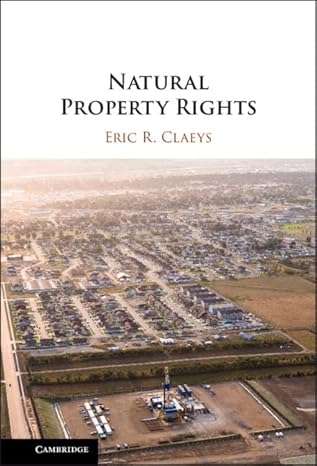
Thanks again to Eugene for letting me blog at the VC this week about my new book—Natural Property Rights, published with Cambridge University Press and available for purchase now digitally and in hardbound version, at a variety of bookstores.

Most American 1L property courses end with discussions of regulatory takings and eminent domain. I'll follow suit here.

Before I get started, though, a disclaimer. In the book I did not, and in this post I will not, make any claims about the legal meaning of any statute or constitutional clause. Natural Property Rights is a work of normative theory. It focuses on what statutes and constitutional guarantees should say, not on what any current statutes or guarantees do say.

Imagine that a local government makes it illegal to emit more than a certain level of smoke in a specific area of town. Is such a law just? Prima facie, the law interferes with factory owners' freedom to produce useful products. If residents and clean businesses have land near the factory, though, the law protects their rights to use their lots for their own uses. If the anti-smoke ordinance is an anti-pollution ordinance, in a rights-based system it is a legitimate exercise of the police power—or a genuine "regulation."

Read More

Separation of Powers

Who Is Lawfully Exercising the Powers of the U.S. Attorney for the District of New Jersey?

A district court ruling that Ms. Habba has been unlawfully exercising the powers of the New Jersey U.S. Attorney ducks the critical question of who can exercise those powers ... which is strong reason for doubting the ruling's reasoning.

|

Today a federal district court (Judge Brann) ruled that Alina Habba is not lawfully acting as the U.S. Attorney for the District of New Jersey. But, remarkably, the district court failed to explain who instead lawfully holds the power of the U.S. Attorney for that district. The district court apparently recognized the uncertainty that its ruling would create, staying the ruling pending the Justice Department's sure-to-follow appeal. But the fact that the district court's order gives no answer to that basic question is, itself, strong reason for questioning its reasoning. On my reading of the relevant statutes, Ms. Habba is currently lawfully exercising the powers of the U.S. Attorney for New Jersey via the interim appointment statute. And if for some reason Ms. Habba lacks authority under that statute, the Attorney General has authority to name someone to assist in carrying out the Department's prosecutions in that state—and the Attorney General has properly named Ms. Habba.

I've blogged about this appointment issue earlier. Because the details are important, a recapitulation is in order (with some minor details omitted—you can read the District Court's 77-page opinion for the full chronology). As with my earlier posts, I express no view on the merits of Ms. Habba's appointment, only its lawfulness.

On January 8, 2025, as President Trump's inauguration was approaching, President Biden's U.S. Attorney—Philp R. Sellinger (who had previously been confirmed to the Senate by voice vote)—resigned to make way for the new Administration's nominee. Upon Sellinger's resignation, his First Assistant U.S. Attorney—Vikas Khanna—became the Acting U.S. Attorney pursuant to the Federal Vacancies Reform Act (FVRA). (Since then, Mr. Khanna has left the Department to go into private practice.)

On March 3, 2025, the Trump Administration appointed John Giordano interim United States Attorney for the District of New Jersey, pursuant to 28 U.S.C. § 546's vacancy provision. (He later was nominated to be the new Ambassador to Namibia.)

Then, a little more than three weeks later, on March 27, 2025, Attorney General Pam Bondi appointed Alina Habba to that interim position. The next day (March 28), Ms. Habba was formally sworn in to the interim position. Ms. Habba was appointed based on § 546, which limits such interim appointments to a maximum of 120 days. 28 U.S.C. § 546(c)(2). Given an interim appointment running for 120 days, Habba's appointment would seem to have been set to expire on Saturday, July 26—120 days later.

On June 30, 2025, President Trump formally nominated Ms. Habba for the permanent position of United States Attorney for the District of New Jersey and submitted her nomination to the Senate. The Senate took no action on the nomination.

On July 22, 2025, the judges of the U.S. District Court for the District of New Jersey invoked their statutory power under § 546(d) to appoint Desiree Grace (Ms. Habba's then-First Assistant) as the interim U.S. Attorney, making that appointment effective on "July 22, 2025 or 'upon the expiration 120 days after appointment by the Attorney General' of the Interim U.S. Attorney Alina Habba, whichever is later."

The Justice Department was not pleased with that appointment. And so, on July 24, 2025, before the 120 days had expired, the President withdrew Habba's nomination. That same day—July 24—Habba resigned her interim position as United States Attorney. The Attorney General then immediately appointed her as a Special Attorney under 28 U.S.C. § 515, which appointment Ms. Habba accepted. Exercising her authority under 28 U.S.C. §§ 509, 510, 515, and 542, among other provisions, the Attorney General also designated Ms. Habba as the First Assistant in New Jersey, effective upon her resignation as the interim United States Attorney. As a result of her holding the position of First Assistant U.S. Attorney position in New Jersey, by operation of law, Habba then seemingly became the Acting United States Attorney under the FVRA, 5 U.S.C. § 3345(a)(1).

In addition, on Saturday, July 26, a senior Justice Department official notified the former First Assistant (Ms. Grace) that the President would have removed her from the position of United States Attorney if her judicial appointment to that office had somehow become effective. The notification indicated that, in taking that step, the President was exercising his authority under Article II of the Constitution and 28 U.S.C. § 541(c). The former vests "the executive power in" the President; the latter provides that "each United States Attorney is subject to removal by the President." At oral argument before the District Court, the Justice Department reported that this removal order came at the direction of the President. Ms. Grace was terminated from her position at the Justice Department.

With that background in mind, we can now turn to the district court's ruling. Contrary to the assumption that everyone was operating under (including the New Jersey judges), the district court ruled today that § 546's 120-day limit began running on March 3, when the Trump Administration first invoked the vacancy provision and did not re-set to a new 120 days with the subsequent appointment of Ms. Habba three weeks later. Because Court's ruling hinges on the precise language of § 546, I set out the statute's language in full:

(a) Except as provided in subsection (b), the Attorney General may appoint a United States attorney for the district in which the office of United States attorney is vacant.
(b) The Attorney General shall not appoint as United States attorney a person to whose appointment by the President to that office the Senate refused to give advice and consent.
(c) A person appointed as United States attorney under this section may serve until the earlier of—
(1) the qualification of a United States attorney for such district appointed by the President under section 541 of this title; or
(2) the expiration of 120 days after appointment by the Attorney General under this section.
(d) If an appointment expires under subsection (c)(2), the district court for such district may appoint a United States attorney to serve until the vacancy is filled. The order of appointment by the court shall be filed with the clerk of the court.

The Justice Department interprets the statute to mean that the Attorney General can make unlimited appointments under § 546(a) unless and until one of those appointments reaches the 120-day limit, at which point the appointing power shifts to the district court. A defendant being prosecuted by Ms. Habba reads the statute more narrowly, arguing  that while § 546 allows the Attorney General to make appointments of different  individuals, it imposes an aggregate limit for all such appointments of 120 days.

Read More

Legal Ethics

Ninth Circuit En Banc Dissent as to Sanctions on Lawyers in Kari Lake's Election-Related Litigation

|

From Judge Lawrence VanDyke's dissent from denial of rehearing en banc in Lake v. Gates, joined by Judges Consuelo Callahan, Ryan Nelson, Daniel Collins, Kenneth Lee, and Patrick Bumatay:

The panel decision in this case upheld a sanctions order under Rule 11 of the Federal Rules of Civil Procedure and 28 U.S.C. § 1927 against attorneys Andrew Parker and Kurt Olsen. Parker and Olsen (collectively, "Lead Attorneys") represented plaintiffs Kari Lake and Mark Finchem in election-related litigation.

As the district court candidly acknowledged, the sanctions were intended to "send a message" to similar litigants in election-based lawsuits and to discourage litigation disfavored by the court. Zealous to safeguard the "public trust," the district court read plaintiffs' complaint out of context and in the light least favorable to plaintiffs; imposed a heightened requirement that Lead Attorneys conduct "significant" pre-filing inquiries on the basis of their clients and their cause; levied sanctions on the ground that plaintiffs made claims that, as even the district court itself recognized, the complaint never actually stated; and badly misapplied the governing legal standards.

This case involved legal claims that might charitably be characterized as aggressive. It was a Hail Mary legal theory, especially as to standing. But we encounter Hail Mary legal theories regularly in our court in a variety of contexts, and while they almost always lose, they don't get sanctioned just because they are longshots. Many cases are dismissed because the asserted injuries are too speculative to support Article III standing. A great many more are dismissed for failure to state a claim on which relief can be granted.

Read More

Cancellation of DEI-Related Grants Likely Violates First Amendment, Ninth Circuit Holds

|

Today's Ninth Circuit decision in Thakur v. Trump (Judge Morgan B. Christen, joined by Judges Richard A. Paez and Roopali H. Desai) denied a stay pending appeal of a district court preliminary injunction that blocked the cancellation of certain research grants. In the process, the court concluded that the cancellation likely violated the First Amendment:

Plaintiffs are six researchers at the University of California (UC) who applied for and received multi-year federal research grants from … the Environmental Protection Agency (EPA) … and the National Endowment for the Humanities (NEH)….

In April 2025, EPA and NEH sent form letters to Plaintiffs informing them that their grants were terminated. The EPA form letter states: "the award no longer effectuates the program goals or agency priorities. The objectives of the award are no longer consistent with EPA funding priorities." The NEH form letter states: "[y]our grant no longer effectuates the agency's needs and priorities," and informs the recipient that "NEH is repurposing its funding allocations in a new direction in furtherance of the President's agenda."

Plaintiffs allege that these terminations resulted from agency implementation of at least eight Executive Orders the President issued in January and February 2025: Executive Orders 14173, 14151, 14168, 14154, 14217, 14238, 14158, and 14222. Executive Orders 14173 and 14151 (the "DEI Executive Orders") seek to eliminate diversity, equity, and inclusion ("DEI") and diversity, equity, inclusion, and accessibility ("DEIA") policies and initiatives from all aspects of the federal government. More specifically, Executive Order No. 14173, Ending Illegal Discrimination and Restoring Merit-Based Opportunity, states that "critical and influential institutions of American society," including the federal government and institutions of higher education, "have adopted and actively use dangerous, demeaning, and immoral race-and sex-based preferences under the guise of so-called 'diversity, equity, and inclusion' (DEI) or 'diversity, equity, inclusion, and accessibility' (DEIA) that can violate the civil-rights laws of this Nation." This Executive Order directs the Office of Management and Budget (OMB) to "[e]xcise references to DEI and DEIA principles under whatever name they may appear," including federal grants.

Read More

Guns

Medical Marijuana Users May Retain Second Amendment Rights

|

From yesterday's Eleventh Circuit decision in Fla. Comm'r of Ag. v. Attorney General, written by Judge Elizabeth Branch and joined by Judges Robert Luck and Gerald Bard Tjoflat:

[T]wo Florida medical marijuana users who wish to purchase guns and one gun owner who wishes to participate in Florida's medical marijuana program brought a pre-enforcement action seeking declaratory relief that 18 U.S.C. § 922(d)(3) and (g)(3), which prohibit unlawful drug users from possessing or being sold firearms, are unconstitutional as applied to them…. [T]he district court conducted Bruen's history-and-tradition test to determine if the challenged statutes were similar to historical gun regulations. The district court concluded that the laws and regulations at issue in this case were consistent with this Nation's historical tradition of firearms regulation and therefore did not violate the Second Amendment….

[We conclude that,] when viewed in the light most favorable to the plaintiffs, the allegations in the operative complaint do not lead to the inference that the plaintiffs are comparatively similar to either felons or dangerous individuals—the two historical analogues the Federal Government offers in its attempt to meet its burden. We therefore vacate the district court's order and remand for further proceedings consistent with this opinion….

Read More

So You're About to Start Law School: An Incoming Law Student's Guide

My tips for 1Ls, now up on Youtube.

|

Every fall, about 40,000 new first-year students begin law school in the United States.  Most have a lot of questions, and students who don't know many lawyers have the most questions of all. Back in 2007, I wrote a short essay, How to Read a Legal Opinion: A Guide for New Law Students, to help incoming students with the basic task of reading cases. More recently, I thought it would be useful to record a video to try to answer common questions students may have about the first month of law school—things like preparing for class, the Socratic Method, social dynamics, case briefing, study groups, and office hours.  The result is below. I hope students find it helpful.

If students find this useful, I might add others in the series, such as on studying for and taking exams.

More



