
9/1/1823: Justice Smith Thompson takes judicial oath.

Mostly law professors | Sometimes contrarian | Often libertarian | Always independent | Est. 2002

9/1/1823: Justice Smith Thompson takes judicial oath.
What's on your mind?
The mayor abandoned the plan after it aroused strong political resistance and threats of litigation.

I have previously written about how the town of Toms River, New Jersey, planned to use eminent domain to condemn the Christ Episcopal Church and build a park and pickleball courts on the spot. The plan seems to have been motivated by a desire to prevent the church from building a homeless shelter on part of its property. In late July, the mayor postponed a scheduled vote on the plan, after it met with widespread opposition, and leading public interest firms specializing in property rights issues (such as the Institute for Justice and the Pacific Legal Foundation) offered to represent the Church in potential legal challenges to the taking. The Becket Fund for Religious Liberty offered to help bring a case under the RLUIPA statute. I outlined some possible grounds for such a challenge here.
Last week, the mayor announced that the plan is being abandoned completely:
His announcement came during the New Jersey town's council meeting's public comment time when a speaker asked him to stop the seizure. He responded that a poll he commissioned showed that "it's pretty clear that the public does not support the eminent domain. We thought the church would be a willing seller and we're not moving forward with the eminent domain of the church."
He said the poll, which he noted had an error rate of plus or minus five, showed that "somewhere in the neighborhood" 60% of the town opposed his plan. (Rodrick had told Episcopal News Service in May that, if the plan had to be put to a vote, he expected 85% of township voters would support it.)
Following the mayor's reversal, the council entered an executive session to seek legal advice on whether it could decide to let the proposed ordinance die, as action on it had not been advertised as legally required. Despite some conflicting opinions from township attorneys, council members unanimously passed a resolution saying they would no longer try to acquire Christ Church's property by eminent domain….
The resolution apparently leaves open the possibility that a new resolution could be brought on the other five lots Rodrick also wants to take for parkland along the Toms River. Those lots are not adjacent to the church.
I think this happy outcome is a small, but notable example of how litigation can be combined with political action to strengthen protection for property rights and religious freedom. I am not sure whether the public opposition or the threat of a lawsuit was more important in forcing the local government to reconsider. But probably it was some combination of both. Seizing a church because it wanted to help the homeless doesn't look good; and if you are a local government trying to get away with a dubious use of eminent domain, IJ and PLF are probably the people you least want to see arrayed against you in court! I commend them for their outreach here.
I have long argued that a dual strategy combining litigation and political action is the right approach to strengthening protection for constitutional property rights, and many other important rights, as well. This incident doesn't, by itself, prove me right. But it's a case in point.
What's on your mind?
Grand jurors in the District of Columbia thrice refuse to indict a defendant for felony assault of a federal officer. And it happened again and again.
Last week, the U.S. Attorney for the District of Columbia sought to indict Sydney Reid on felony charges of assaulting an FBI agent, in violation of 18 U.S.C. § 111.
Here are some of the allegations in the criminal complaint:
4.ERO Officer Vincent Liang gave instructions to REID to step back and allow them to complete the transfer of the two suspects. REID continued to move closer to the officers and continued to record the arrest. Officer Laing reiterated to REID that she could not get any closer. REID got in Officer Laing's face, and he could smell alcohol coming off REID's breath. After multiple commands to step back, REID tried to go around Officer Laing by going up the side steps and attempted to get in between the FBI Agents and the second suspect being transferred into their custody.
5.As REID was trying to get behind Officer Lang and impede the transfer of the second suspect by inserting herself between the second suspect and the agents, Officer Lang pushed REID against the wall and told her to stop. REID continued to struggle and fight with Officer Lang. Agent Bates came to Office Lang's assistance in trying to control REID. REID was flailing her arms and kicking and had to be pinned against a cement wall.
6.During the struggle, REID forcefully pushed Agent Bates's hand against the cement wall. This caused lacerations on the back side of Agent Bates's left hand as depicted below.
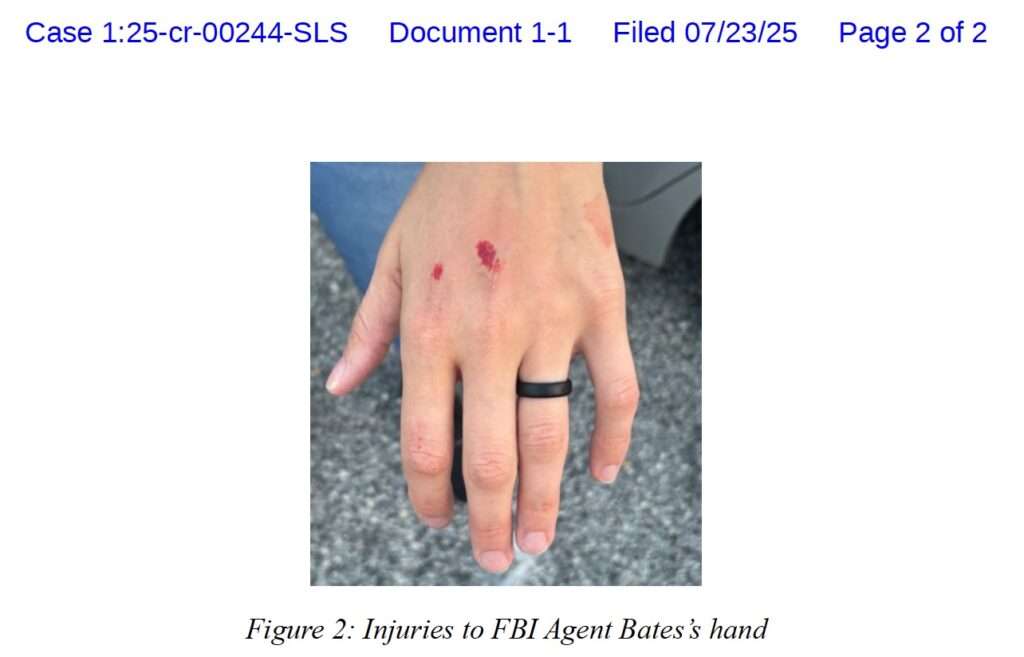
A federal magistrate found that there was probable cause to support the charge. Yet, on three occasions, a grand jury in the District of Columbia declined to indict. Instead, the U.S. Attorney filed an information for a misdemeanor violation of Section 111. A writer at MSNBC suggests that the grand jury's refusal to indict may be due to a weak cases being brought by the U.S. Attorney.
Since the failed indictment for Reid, there have been two more grand juries that failed to return a true bill.
It is possible that these juries are carefully attuned to the gradation between felonies and misdemeanors. May I suggest another possibility? Federal grand juries in the District of Columbia, made up (almost) entirely of critics of President Trump, are engaging in nullification of the Trump Administration's law federal enforcement efforts. I imagine this sort of active resistance will increase as more federal officers are fanned throughout the District of Columbia. The Capital likely seems something like this to D.C. residents:
Historically, at least, the concept of jury nullification was viewed as a popular check against tyrannical governments. I imagine an average D.C. resident who can take time off from work to serve extended periods of federal grand jury duty may see himself in that fashion.
During the Jack Smith saga, Trump argued that he could not possibly get a fair jury pool in the District of Columbia. I wonder if the same is true for cases brought by the Trump Administration?
"Miss Manners has much to commend her within a polite and respectful society, but we are not her enforcement division."
From Kansas Supreme Court Justice Caleb Stegall's concurrence in the judgment yesterday in In the Matter of Suzanne Valdez:
Back in 2021 at the height of the COVID-19 pandemic, the respondent Suzanne Valdez, a publicly elected official—the Douglas County District Attorney—made some intemperate comments about the chief judge of the district. Now, years later, after countless news stories, public outcry, lawyers hired, weeks and months of investigations and hearings, and a subsequent election for Douglas County District Attorney at which the respondent was unseated in part because of these charges—here we are. Was it worth it? No, it was not….
From [the panel decision], we can easily deduce that none of Valdez' comments were proven to be untrue or made with reckless disregard as to their truth. This includes the two comments found to be "undignified or discourteous." Now, given my personal experience with Chief Judge McCabria, I find the entire litany of allegations leveled at him by Valdez to be silly at best and scurrilous at worst—but this is entirely beside the point. Can we really say that truthful statements (or statements that cannot be proven untrue) can still be unethical if they are discourteous? If a judge acts in an undignified manner, is commenting on his or her behavior unethical? See In re Clark (Kan. 2022) (Stegall, J., concurring) ("[The judge's] behavior was embarrassing, foolish, and grossly immoral ….").
I have said it before, but it bears repeating—the practice of law is not a finishing school for debutants preparing for their first dance. "'There's no crying in baseball!' So intoned Tom Hanks' character in the film A League of Their Own…. It is a message the Kansas bar and bench—and our Disciplinary Administrator's office—should consider." … "[I]t does the judicial branch no favors to present publicly with a collective glass chin." … Miss Manners has much to commend her within a polite and respectful society, but we are not her enforcement division.
This is not, however, what is most important about today's case. There is much more at stake—the beating heart of our democratic process—unconstrained political speech. There is a disturbing trend in our body politic to turn "ethics" into a political widow maker—a recently dislodged calcium deposit stalking the arterial system of our campaigns, elections, and government—threatening a blockage at any time. The rallying cry of, "You can't say that!" accompanied by looming threats of punishment is a kind of atherosclerosis—a narrowing of our political arteries—that I cannot countenance.
For it cannot pass our notice that this entire process was aimed squarely at punishing political speech. Even after (perhaps especially after) Valdez was acquitted by the panel of the most serious charges (and now, finally, is absolved of all guilt by this court), we cannot turn a blind eye to the reality that this attorney disciplinary process played a starring role in an important public election in Douglas County. Without question it impacted the outcome—if perhaps not the ultimate victor. At a minimum, it affected the point spread, as Valdez received only 9% of the vote in the Democratic primary.
An excerpt from the long opinion earlier this week in In re Application for a Permit to Carry a Handgun by R.R., by N.J. Appellate Division Judges Joseph Marczyk and James Paganelli:
Detective Berry … testified regarding various emails petitioner sent to the Sayreville clerk referring to the "Blood of Christ" and an affidavit submitted by petitioner to Sayreville regarding "[o]ne's [e]ntire [z]ygote/[p]ellucid [m]embrane as the [s]ingular '[h]istorical & [p]resent, [r]eligious & [s]cientific, [n]ative & [c]ustomary, [t]ruth & [m]atter of [f]act' [p]roving [o]ne's [p]ersonal, [p]rivate, and [c]onfidential [p]roperty/[p]aramount [e]quity '[f]ound' within [o]ne's [o]riginal [b]iological /DNA [b]irthday '[c]ake' a.k.a. [o]ne's '[b]aggage and [e]ffects' a.k.a. [o]ne's [p]lacenta." Detective Berry testified he did not understand what petitioner was discussing, and the communications were "kind of rambling" and had nothing to do with petitioner's tax issues.
Detective Berry further testified regarding: petitioner's referencing credit as a "figment of the imagination," ballot harvesting schemes, the banking system being owned by the "cult," a Wisconsin election being rigged by dictators in Syria and Korea, a governor's handling of a teacher shortage, and references to a conservative song writer. Detective Berry stated that in his "training and experience," he never saw "an individual correspond with a government body" in this manner and that petitioner was "not really addressing any specific issue."
In one email, petitioner noted the SPD Chief was married and named his wife and his children. Detective Berry testified it appeared petitioner "cut and paste[d]" this information from the Chief's biography on the SPD's website. Detective Berry referenced this communication in his denial letter. He testified "the way that [petitioner] was interacting regarding his permit [application]" caused him concern, as petitioner "was demanding answers" and "wasn't letting the investigative process play out." He also testified petitioner's references to the Chief's family caused him concern.
In a 7-4 ruling, the en banc court upheld trial court ruling against all the challenged tariffs. The scope of the injunction against them remains to be determined.

Today the US Court of Appeals for the Federal Circuit ruled against President Trump's massive "Liberation Day" tariffs in VOS Selections v. Trump, a case filed by Liberty Justice Center and myself on behalf of five small US businesses (we have since been joined by prominent Supreme Court litigators Michael McConnell and Neal Katyal; Neal skillfully conducted the oral argument before the Federal Circuit). The ruling also covers the case filed by twelve states led by Oregon; they prevailed, as well. On these points, a 7-4 majority of the en banc Federal Circuit affirmed the earlier trial court decision issued by the Court of International Trade. The court also remanded the issue of how broad the injunction against the tariffs should be to the Court of International Trade. That litigation is, however, postponed until October 14, to give the government a chance to ask the Supreme Court to review the case.
The majority concluded that the tariffs in question are not authorized by the International Emergency Economic Powers Act of 1977 (IEEPA), and that the major questions doctrine precludes interpreting IEEPA to give the president the virtually unlimited tariff authority he claims.
The majority, concurring and dissenting opinions are 127 pages long, and I will not attempt to cover everything in them here. I will merely highlight some key points.
Here is an excerpt from the per curiam majority decision (issued in the name of all seven majority judges), explaining why IEEPA doesn't authorize the tariffs imposed by the president:
[I]n each statute delegating tariff power to the President, Congress has provided specific substantive limitations and procedural guidelines to be followed in imposing any such tariffs. It seems unlikely that Congress intended, in enacting IEEPA, to depart from its past practice and grant the President unlimited authority to impose tariffs. The statute neither mentions tariffs (or any of its synonyms) nor has procedural safeguards that contain clear limits on the President's power to impose tariffs….
[W]henever Congress intends to delegate to the President the authority to impose tariffs, it does so explicitly, either by using unequivocal terms like tariff and duty, or via an overall structure which makes clear that Congress is referring to tariffs. This is no surprise, as the core Congressional power to impose taxes such as tariffs is vested exclusively in the legislative branch by the Constitution; when Congress delegates this power in the first instance, it does so clearly and unambiguously…
Contrary to the Government's assertion, the mere authorization to "regulate" does not in and of itself imply the authority to impose tariffs. The power to "regulate" has long been understood to be distinct from the power to "tax." In fact, the Constitution vests these authorities in Congress separately. U.S. Const. art. I, § 8 cl. 1, 3; see also Gibbons v. Ogden, 22 U.S. 1, 201 (1824) ("It is, that all duties, imposts, and excises, shall be uniform. In a separate clause of the enumeration, the power to regulate commerce is
given, as being entirely distinct from the right to levy taxes and imposts, and as being a new power, not before conferred. The constitution, then, considers these powers as
substantive, and distinct from each other."); Nat'l Fed'n. of Indep. Bus. v. Sebelius, 567 U.S. 519, 552, 567 (2012) (holding that the individual mandate provision of the Patient
Protection and Affordable Care Act was a permissible exercise of Congress's taxing power but exceeded Congress's power to regulate commerce). While Congress may use its taxing power in a manner that has a regulatory effect,… the power to tax is not always incident to the power to regulate…Upon declaring an emergency under IEEPA, a President may, in relevant part, "investigate, block during the pendency of an investigation, regulate, direct and compel, nullify, void, prevent or prohibit" the "importation or exportation of . . . any property in which any foreign country or a national thereof has any interest." 50 U.S.C. § 1702(a)(1)(B). "Regulate" must be read in the context of these other verbs, none of which involve monetary actions or suggest the power to tax or impose tariffs…
The majority also emphasized that the government's claim to unlimited tariff authority goes against the major questions doctrine:
The Government's interpretation of IEEPA as providing the President power to impose unlimited tariffs also runs afoul of the major questions doctrine. See, e.g., Oral Arg.16at 19:28–19:39 (the Government stating "there is no limit on the cap of the tariff in IEEPA itself"). The Supreme Court has explained that the doctrine applies in "cases in
which the 'history and the breadth of the authority . . . asserted'" by the Government entails vast "economic and political significance."West Virginia v. EPA, 597 U.S. 697,
721 (2022)…. In such cases, there may be a "'reason to hesitate before concluding that Congress' meant to confer such authority." Id…. When the major questions doctrine is
implicated, the Government must point to "clear congressional authorization" for that asserted power. Id. at 732….The tariffs at issue in this case implicate the concerns animating the major questions doctrine as they are both "unheralded" and "transformative." Id. at 722, 724; see also
id. at 725 ("[J]ust as established practice may shed light on the extent of power conveyed by general statutory language, so the want of assertion of power by those who presumably would be alert to exercise it, is equally significant in determining whether such power was actually conferred.)" ….Since IEEPA was promulgated almost fifty years ago, past presidents have invoked IEEPA frequently. But not once before has a President asserted his authority under IEEPA to impose tariffs on imports or adjust the rates thereof. Rather, presidents have typically invoked IEEPA to restrict financial transactions with specific countries or entities that the President has determined pose an acute threat to the country's interests….
Additionally,… tariffs are a core Congressional power. The "basic and consequential
tradeoffs" that are inherent in the President's decision to mpose the Trafficking and Reciprocal Tariffs "are ones that Congress would likely have intended for itself." Nebraska, 600 U.S. at 506 (quoting West Virginia, 597 U.S. at 730). Moreover, the United States imports more than $4 trillion of goods annually; these imports account for 14 percent of the nation's economy. J.A. 215. The Government itself has claimed that the Reciprocal Tariffs will "generate between $2.3 trillion and $3.3 trillion over the
budget window…." The Executive's use of tariffs qualifies as a decision of vast economic and political significance, so the Government must "point to clear
congressional authorization" for its interpretation of IEEPA. West Virginia, 597 U.S. at 723…For the reasons discussed above, we discern no clear congressional authorization by IEEPA for tariffs of the magnitude of the Reciprocal Tariffs and Trafficking Tariffs.
Reading the phrase "regulate . . . importation" to include imposing these tariffs is "a wafer-thin reed on which to rest such sweeping power." Ala. Ass'n of Realtors v. Dep't of Health & Hum. Servs., 594 U.S. 758, 765 (2021)
The majority goes on to reject claims that the major questions doctrine does not apply to delegations to the president (their reasoning is similar to that which I outlined here). It also rejects the argument that the doctrine does not apply because tariffs are a "foreign affairs" power.
The majority did not address whether the government's claim of unlimited tariff authority would also run afoul of the nondelegation doctrine, which limits the extent to which Congress can delegate legislative authority to the executive. But it does note the significance of the fact that tariffs are a "core congressional power."
The majority explicitly chose not resolve the issue of whether IEEPA can be used to impose any tariffs at all. But their reasoning suggests either that such imposition is indeed categorically barred, or that any tariff authority that exists under IEEPA is strictly limited.
The concurring opinion, written by Judge Cunningham, on behalf of four judges goes further than the majority. It concludes that IEEPA does not authorize any tariffs at all. It also indicates that the sort of sweeping delegation of tariff authority claimed by the president here is precluded by the nondelegation doctrine, which limits the extent to which Congress can delegate legislative power to the president, relying in part on the Supreme Court's recent ruling in FCC v. Consumers' Research (which was helpful to our case in a number of ways):
The Government's interpretation of IEEPA would render it an unconstitutional delegation. Because taxation authority constitutionally rests with Congress, any delegation of that authority to the President must at least set out an intelligible principle that includes "both 'the general policy'" that the President "must pursue and 'the boundaries of [its] delegated authority.'" FCC v. Consumers' Rsch., 145 S. Ct. 2482, 2497 (2025)… Similarly, Congress must "provide[ ] sufficient standards to enable both 'the courts and the public [to] ascertain'" whether the President "has followed the law." Id…. Because this is undoubtedly a case that "affect[s] the entire national economy," the "'guidance' needed is greater . . . than when [Congress] addresses a narrow, technical issue." Id…. For taxes, both "quantitative" and "qualitative limits on how much money" the President can raise are permissible, but it would "pose a constitutional problem" if the "statute gives the [executive branch] power, all on its own, to raise [a] hypothetical $5 trillion" with no "ceiling." Id. at 2501–02.
The Government's interpretation of IEEPA would be a functionally limitless delegation of Congressional taxation authority.
The majority did however vacate the trial court's universal injunction against the tariffs, and remand the issue of the scope of the injunction to the trial court to determine how broad it should be, in light of the Supreme Court's recent ruling restricting universal injunctions, in Trump v. CASA. We have a variety of arguments as to why a broad injunction is appropriate in this case, even after CASA (see relevant section of our brief).
The dissent by Judge Taranto, on behalf of himself and three other judges, largely accepts many of the government's arguments. I won't go over them in detail here, as this post is already too long. Obviously, I have responded to these arguments in some detail in previous writings, and our legal team also did so in our briefs.
The court has, for the moment, stayed its ruling until October 14, to give the government a chance to ask the Supreme Court to review the decision. We shall see what the justices choose to do.
What's on your mind? (Other than the thread was late, sorry about that.)
I'll also be experimenting with a Sunday Open Thread this weekend.
"[Indiana's] approach furthers the state's interests the way an atom bomb would further the eradication of a residential ant infestation."
From Judge Ilana Rovner, joined by Judges Candace Jackson-Akiwume and Nancy Maldonado, in yesterday's Richwine v. Matuszak:
Through her business, Death Done Differently, Lauren Richwine offers services as a death doula. In her death doula capacity, Richwine discusses with her clients how they want to be remembered after death, helps clients write letters to loved ones, and provides emotional support to the dying. Richwine teaches families how to support the dying and, after an individual dies, she helps the survivors determine a funeral program, select services at the funeral home of their choice, and, under the supervision of a licensed funeral director, she verbally advises the survivors about the moving, bathing, and dressing of the deceased. She also attends the funeral. In addition to these services, Richwine educates her community and mentors other death doulas. Richwine is not a licensed funeral director, a fact her website mentions, but she performs her duties "in conjunction with and under the supervision of a licensed funeral director." …
Indiana demanded that Richwine stop, because an Indiana statute required a funeral services license to engage in much of this behavior; but this, the Seventh Circuit held, violated the First Amendment:
[T]he statute restricts the "practice of funeral service," which includes "the counseling of individuals concerning methods and alternatives for the final disposition of human remains." As applied to the plaintiffs, Indiana claims that a variety of speech-based activities constitute the unauthorized practice of funeral services. These activities include, but are not limited to, discussing options for the final disposition of human remains, including traditional burial, green burial, or cremation; helping survivors decide what should be included in the funeral program; supporting survivors while they pick products and services at the funeral home; and reviewing the funeral home's price list….
The statute clearly burdens speech that is protected by the First Amendment. That the plaintiffs' speech is subject to some level of protection is not in dispute. Even though the parties vigorously dispute which level of scrutiny should apply, we find no need to determine whether the statute should be subject to strict or intermediate scrutiny because, even under intermediate scrutiny, the statute fails to pass constitutional muster as applied to Richwine and Death Done Differently, based on the interests articulated by the state….
So a federal judge just held.
From today's decision by Judge John Mendez (E.D. Cal.) in Kohls v. Bonta:
AB 2839 regulates a broad spectrum of election-related content that is "materially deceptive" and permits any recipient of this content to sue for general or special damages. Cal. Elec. Code §§ 20012(b)(1), 20012(d). AB 2839 defines "materially deceptive" content as "audio or visual media that is intentionally digitally created or modified, … such that the content would falsely appear to a reasonable person to be an authentic record of the content depicted in the media." AB 2839 includes exceptions for candidates who make and share deepfake content of themselves and for satire or parody. In both these cases, the content must include a disclaimer that meets AB 2839's formatting requirements and must state that the content has been digitally manipulated….
The Court finds that AB 2839 discriminates based on content, viewpoint, and speaker and targets constitutionally protected speech.
They have done so banning or severely restricting low-cost "single-room occupancy" (SRO) housing.

The Pew Charitable Trust has a valuable new report on how state and local governments destroyed much of their potential low-income housing stock by banning or severely restricting "single-room occupancy" (SRO) housing. Here is the summary of the report and its findings:
Low-cost micro-units, often called single-room occupancies, or SROs, were once a reliable form of housing for the United States' poorest residents of, and newcomers to, New York, Chicago, San Francisco, and many other major U.S. cities. Well into the 20th century, SROs were the least expensive option on the housing market, providing a small room with a shared bathroom and sometimes a shared kitchen for a price that is unimaginable today—as little as $100 to $300 a month (in 2025 dollars).
In the late 19th and early 20th centuries, landlords converted thousands of houses, hotels, apartment buildings, and commercial buildings into SROs, and by 1950, SRO units made up about 10% of all rental units in some major cities. But beginning in the mid-1950s, as some politicians and vocal members of the public turned against SROs and the people who lived in them, major cities across the country revised zoning and building codes to force or encourage landlords to eliminate SRO units and to prohibit the development of new ones. Over the next several decades, governments and developers gradually demolished thousands of SROs or converted them to other uses, including boutique hotels for tourists. And as SROs disappeared, homelessness—which had been rare from at least the end of the Great Depression to the late 1970s—exploded nationwide.
Now, as a nationwide housing shortage has pushed rents and homelessness to historic highs, some states and localities are reconsidering the value of lower-cost, small units with shared kitchens, bathrooms, and amenities. Ironically, had SROs grown since 1960 at about the same rate as the rest of the U.S. housing stock, the nation would have roughly 2.5 million more such units— enough to house every American experiencing homelessness in a recent federal count more than three times over.
As governments throughout the United States seek to fill the gap in low-cost housing, one promising and inexpensive model is gaining traction: making shared housing legal, as it was for most of U.S. history. And one version of shared housing—converting some of the vast supply of office space left empty since the COVID-19 pandemic—looks especially promising: A single office building conversion could add hundreds of low-cost homes near jobs and transit, while a large high-rise could add more than 1,000 homes. Several states have passed laws in the last few years to remove local legal barriers to building SROs or converting certain existing buildings into SROs.
This brief explores the history of SROs and their close relationship with homelessness. It also looks at strategies for adding large quantities of inexpensive housing units to meet the needs of the nation's most vulnerable residents as well as others seeking low-cost housing.
The report notes that studies show that homelessness is in large part caused by high housing costs, and that cities where low-income housing is more widely available (because they have fewer regulatory barriers to it) have much lower rates of homelessness. Thus, exclusionary zoning is a major factor increasing homelessness. I have previously written about this here.
The report also notes that one facet of SRO restrictions is laws banning or severely restricting the ability of unrelated people to live together and share the rent and other expenses. In a post about the Pew study, economist Alex Tabarrok calls this "the war on roommates." Fortunately, some states have begun to cut back these restrictions:
Perhaps the simplest method of creating low-cost shared housing is to allow unrelated individuals to share a house in the same way that relatives are allowed to share a house. But many communities limit the number of unrelated people who can live together—in some places, to as few as two. Such laws make sharing a house for a group of roommates—which usually enables rents lower than having an individual apartment—illegal. The U.S. has a record number of unused bedrooms, but many cannot be rented because of restrictions on house sharing by unrelated roommates, even if that would be the most profitable use for the landlord and the most affordable option for the tenants. To enable this low-cost housing option, Iowa, Oregon, and Colorado all passed bipartisan legislation to strike down local codes that prohibit house-sharing (in 2017, 2021, and 2024, respectively).
In all of those cases, states have stepped in when localities did not act, authorizing lower-cost housing and limiting the ability of local governments to ban inexpensive housing. The aim of those laws is to increase the rental market for low- and moderate-income residents and make more use of existing housing stock. If these bills succeed, and a large number of micro-units reach market, their rents will likely be low, since individual rooms, when available, usually rent for far less than houses or apartments.
Many readers have probably had the experience of needing roommates - sometimes more than one roommate! - to be able to afford housing in a relatively expensive area. These kinds of laws make it very difficult to take advantage of this cost-saving effect. Such saving not only make housing more affordable, but also make it easier for lower-income people to "move to opportunity," thereby expanding their future earnings and making our economy more productive.
In a Texas Law Review article published last year, University of Wisconsin Prof. Josh Braver and I explain why exclusionary zoning violates the Takings Clause of the Fifth Amendment, which requires government to pay "just compensation" when it takes private property. There, and in an Atlantic article, we explain how litigation should be combined with political action to break down zoning restrictions on housing construction. While we did not focus on SRO bans specifically, they certainly fall within the scope of our argument.
A rescinded diploma, a brown seer stone, and a pointless waste of time.
Please enjoy the latest edition of Short Circuit, a weekly feature written by a bunch of people at the Institute for Justice. Read More
From yesterday's decision of the N.Y. intermediate appellate court in Stiloski v. Wingate, by Justices Mark C. Dillon, Paul Wooten, Lourdes M. Ventura, and Donna-Marie E. Golia:
In [his LinkedIn] post, the defendant held himself out to be a "Nonprofit Leader and Consultant." As relevant to this appeal, the defendant referring to an individual, readily identifiable as Stiloski, stated that "[a] Tarrytown extremist who supports neo-Nazi causes and does a ton of business with the Village placed a massive sign on his place showing a graphic middle finger aimed at our Black community." The LinkedIn post also included the hashtag "# blacklivesmatter," as well as a photograph depicting various signs, one of which stated "ALL LIVES CAN'T MATTER UNTIL BLACK LIVES MATTER!!," and a flag outside of the Tarrytown Village Hall….
The defendant's statements in the LinkedIn post, under the circumstances and in the context made, did not constitute nonactionable pure opinion. The defendant did not call Stiloski a "neo-Nazi," which arguably can be pure opinion. Rather, the nuanced statements at issue in the LinkedIn post, namely that Stiloski was a "Tarrytown extremist who supports neo-Nazi causes," can "readily be proven true or false" and, under these circumstances, in which the defendant held himself out to be a "Nonprofit Leader and Consultant" and the amended complaint alleged that the defendant is a well-known community activist, "signaled to the average reader or listener that the defendant was conveying facts about the plaintiff." Alternatively, the statements in the LinkedIn post are those of mixed opinion and, therefore, actionable, as "a reasonable reader would have inferred that the poster had knowledge of facts, unknown to the audience, supporting the assertions made."
From the complaint in Wilkins v. Seraphin (W.D. Tex.), filed yesterday; as always, remember that these are just allegations:
Defendant Kyle M. Seraphin has maliciously lied about Alexis Wilkins, falsely asserting that she—an American-born country singer—is an agent of a foreign government, assigned to manipulate and compromise the Director of the FBI. Defendant, a former FBI special agent himself, who now makes a living as a podcaster and political commentator—profiting on controversy and outrage—is using this fabricated story as self-enriching clickbait and has spread it to his sizable audience that follows his daily broadcasts on X, Rumble, and YouTube. Accordingly, Ms. Wilkins seeks to hold Defendant accountable for his malicious and knowing lies.
The Complaint claims that Seraphin stated this last week on his show:
It makes the case for abolishing ICE and transferring its funds to state and local police.

Today, The Hill published my article making the case for abolishing ICE and giving its funds to state and local police. Here is an excerpt:
The Immigration and Customs Enforcement agency has become notorious for its cruelty, abuses of civil liberties and racial profiling. As a result, the agency and the Trump administration's deportation policies generally have become increasingly unpopular.
Yet most Democrats have hesitated to call for its abolition, likely because of fear of seeming to be "soft on crime."
But there is a way out of this dilemma: Abolish ICE and give the money to state and local cops.
ICE's abuses are legion. Its agents routinely detain people with little or no due process, even seizing American citizens and legal permanent residents, as well as illegal migrants…
The ubiquitous use of masks by ICE agents and their refusal to identify themselves and their agency protects them from accountability, ensuring that those targeted often have no way of knowing whether they are being seized by ICE agents, regular law enforcement or common criminals….
The alarming extent of racial and ethnic profiling by ICE is shown by the fact that the agency's arrests in Los Angeles County declined by 66 percent after a federal court order barring the use of these and similar tactics. Conservatives and others who rightly seek a color-blind government must not turn a blind eye to racial discrimination by government agents who have the authority to arrest and detain people….
Conditions in ICE detention facilities are often abysmal, featuring overcrowding, inadequate food and denial of needed medical treatment. These conditions are unfit even for the worst imprisoned criminals — and most ICE detainees are far from that. Despite administration claims that ICE is protecting the public against dangerous criminals, 65 percent of people detained as of June had no criminal record, and some 90 percent had no convictions for violent or property crime. Overall, undocumented immigrants have much lower crime rates than native-born Americans….
Growing public awareness of ICE abuses has made the agency very unpopular. Recent survey data indicates that large majorities disapprove of it, and a large minority — almost 40 percent in a recent tracking poll — already wants to abolish it.
Yet most Democrats have hesitated to call for the agency's abolition, probably for fear of seeming to be soft on crime…. But opponents can avoid such accusations by combining abolition of ICE with reallocation of its funds to ordinary police, which would undercut accusations of being pro-criminal or anti-law enforcement. This could greatly expand support for abolition….
In my 2022 book "Free to Move," I proposed dismantling ICE and giving the money to ordinary police, perhaps in the form of federal grants to state and local law enforcement. Recipient agencies should be required to use the funds to target violent and property crime, and abjure ICE-style abuses.
Putting more ordinary police on the streets is an effective way to reduce crime rates, according to a long line of studies….
Focusing on undocumented immigrants is a poor use of law enforcement resources…. Transferring ICE funds to state and local police would allow a greater focus on violent and property crime, regardless of the perpetrators' background….
Abolishing ICE would not end all deportations. State and local authorities could still, in many cases, turn illegal migrants over to the federal government for removal… But abolishing ICE would make deportation much more dependent on state and local cooperation and would empower jurisdictions to make their own choices.
Leaving immigration restrictions more to the states would bring us closer to the Constitution's original meaning. The Constitution does not explicitly grant immigration authority to the federal government, and Founding Fathers such as James Madison and Thomas Jefferson rightly argued that it did not have any general power to bar migrants…..
What's on your mind?
Celebrate your independence with a subscription to Reason magazine, your most trusted source of honest, insightful news and analysis.




