The Volokh Conspiracy

Mostly law professors | Sometimes contrarian | Often libertarian | Always independent | Est. 2002

The Volokh Conspiracy

Politics

I Think I Know Why SCOTUS Does Not Grant Fourth Amendment Cases Anymore

Search and seizure cases are very fact bound. The Court wants to set general standards.

|

On October 15, the Supreme Court heard nearly 2.5 hours of oral argument in the Voting Rights Act Case. Without even taking a break, the Court heard the second case, fittingly titled Case v. Montana. It was obvious the Justices were spent. They said so. At one point, Justice Gorsuch referred to a case called Brigham City as Brigham Young. He apologized, and said "Sorry. I am tired." At another point, Justice Barrett apologized for mispronouncing Caniglia, and said "it's been a long day."

Still, for those who managed to slog through the arguments, there was an important takeaway. The Justices did not want to write an opinion based on the unusual facts of this case. They wanted to write a broader rule that would be easy to apply.

Fred Rowley, who represented Case, spent a lot of time discussing the particular facts that the police officers knew about the defendant. He mentioned several officers by name, and referenced what they said on body camera footage. This approach may have been appropriate for this case, but it was unusual. In most Supreme Court cases, the facts on the ground really don't matter. The Justices are trying to set some sort of national rule. In this case, Justice Jackson in particular seemed frustrated with the fixation on the record. At one point, Jackson interrupted Rowley, who was talking about the facts, and said "We're trying to think about a standard here." Later, Rowley was talking about knowledge that one of the officers had about Case. Jackson again said, "Well, setting aside this particular case, let me just try to understand the standard that you want us to apply."

Fourth Amendment caselaw can be very fact-bound. The Justices did not want to get into the weeds. They seemed content to just announce a test, and let the lower courts figure it out. In this case, the test is "objective reasonableness" from Brigham City. Justice Barrett, in particular, did not want to say what that test entailed.

JUSTICE BARRETT: But are you really saying that we should do something different than in Brigham City or --or muddy the waters by saying, oh, you know, objectively reasonable basis but could be reasonable suspicion?

MR. CORRIGAN: You're --you're correct on --on the first part, on your --on the former. We are not saying that they should --that the Court --that Brigham City means reasonable suspicion. What --what we're saying is, in some instances, it could, as you said Justice Barrett, yield a result like reasonable suspicion, just like it could yield a result like probable cause.

JUSTICE BARRETT: Well, we don't need to say that. I think that would be confusing. I think we could just say Brigham City, objectively reasonable basis to believe, and put a period on that.

MR. CORRIGAN: I --I agree, Justice Barrett.

JUSTICE BARRETT: Okay. Thanks.

Put a period on it and wrap it with a bow.

Justice Jackson tried to put forward some sort of "matrix" that would apply different factors. The SG favored a "sliding scale." But those tests didn't get much traction. Justice Gorsuch said, "Yeah, I don't understand the sliding scale thing at all, I'll be honest, so help me out."

The Court is content to speak in bright line rules. Fourth Amendment caselaw is seldom about bright line rules. The Court just didn't seem comfortable here. This case may illustrate why the Court grants so few Fourth Amendment cases.

I still think a DIG is possible. It is not at all clear to me why the Justices took this case. And if they aren't prepared to write a clean opinion applying the facts, I don't know how much can be gained.
Free Speech

First and Fourth Amendment Claims Based on Police Investigation of Gender Queer in Classroom Can Go Forward

|

From Galdos-Shapiro v. Town of Great Barrington, decided Oct. 17 by Judge Mark Mastroianni (D. Mass.):

Beginning in 2018, Plaintiff worked as an English Language Arts teacher at Du Bois Regional Middle School in Great Barrington, Massachusetts…. [Superintendent] Dillon appointed her advisor to the school's local chapter of the Gender and Sexuality Alliance ("GSA"). Although paid, this position was primarily administrative, as she oversaw the local branch of "a national network of student-run organizations which unite LGBTQ+ and allied youth in an effort to build their community and to enable them to organize around issues impacting them in their schools and communities." It was Plaintiff's job to "facilitate a space and opportunity for the students themselves to undertake activities." She therefore opened her classroom during the seventh and eighth grade lunch and recess periods each Friday for the GSA's student run meetings. Plaintiff additionally acted as faculty liaison to the school's student run "Black, Indigenous, and People of Color Club," a group that met during the weekly Friday "crew period." …

Gender Queer is a graphic memoir addressing "issues of self-identity, the confusion of adolescence, and coming out as nonbinary." … Gender Queer is not part of the curriculum at Du Bois. It is not required to be kept in any classroom, nor must it be read by any student who does not wish to do so. Rather, Plaintiff kept a personally owned copy of the book in her classroom.

At one point in time, Plaintiff loaned the book to Du Bois's library for exhibition during a "Banned Book Week," but normally the book resided on a special bookshelf within her room dedicated to the GSA. To access the book, an interested student was required to obtain permission from Plaintiff. During her tenure at Du Bois, only one student sought access to the book. This student and the student's parents were well known to Plaintiff, and it was Plaintiff's understanding that the student's parents approved of their child's access to the book.

Read More

AI in Court

Apparent AI Hallucinations in Filing from Two >500-Lawyer Firms

Don't assume your firm is safe.

|

From Monday's decision by Judge Michael Simon (D. Ore.) in Green Building Initiative, Inc. v. Peacock:

GBI cites Stell v. Cardenas, No. 3:21-cv-413-HZ, 2022 WL 1696093, at *6 (D. Or. May 26, 2022), and Page v. Parsons, 249 F. Supp. 3d 998, 1017 (D. Or. 2017). Stell, however, is totally fake; it is an "hallucinated" case. There is no case at 2022 WL 1696093. Nor does there exist a case with the parties "Stell" and "Cardenas" (in either orientation—in the District of Oregon or elsewhere). Moreover, Case No. 3:21-cv-413 is a real case, styled JS Halberstam Irrevocable Grantor Trust v. Davis, and it was presided over by the undersigned ("SI"), not U.S. District Judge Hernández ("HZ"). Further, that case was closed by judgment on May 9, 2022, and no decision was issued on May 26, 2022.

Read More

Judicial Experience and Judicial Selection

A thought in response to Josh.

|

In his post on why a President or Governor might select a judicial nominee who has no prior judicial experience, Josh suggests that it may be because you can get better insights into the non-judge's views of the law based on the cases they have litigated as a lawyer:

One possible reason is that lawyers get to pick their cases. By contrast, lower court judges can only decide the cases that come before them, and in most cases, are constrained by stare decisis. Their opinions are not a reflection of their personal views, but--or at least should--follow the law. Advocates, especially those who engage in strategic litigation, are differently situated. They can advocate for their bona fide conception of the law, and are not subject to the same constraints. In many regards, non-judicial experience may be the most useful metric for how a judge will decide cases. This dynamic may not always be the case, especially for lawyers in government service. There was a time when John Roberts signed a brief calling for Roe to be overturned, and we al know how Dobbs turned out. But on balance, the cases a lawyer takes, and the arguments he advances, is a useful predictor of judicial behavior.

I am skeptical that this is the typical reason. Even people with prior judicial experience were non-judges once.  And if the cases a lawyer litigates are revealing, presumably the Presidents and Governors would want to pick among older candidates with more litigation experience who have really had the chance to pick their cases.  I gather that is not happening, though.

It seems to me that the more common reason Presidents and Governors pick someone with or without experience relates to the politics of confirmation.  It's mostly a question of math.  How many votes do you need to confirm your candidate, and how many do you have? If you need the votes of wary legislators or even legislators from the other party to get your nominees confirmed, picking nominees with prior judicial experience can give those legislators comfort and maximize your odds of getting the nominees through. You can point to how well respected the judges already are, and you can show the record they established.  On the other hand, if you walk in with all the votes you need already, you don't need to go with someone who is already a judge.  You can pick the person you want.

Senator Cruz Warns About Rising Antisemitism on the Right

"But the danger that I want to highlight to you tonight is not antisemitism on the left. It is antisemitism on the right."

|

On October 19, Senator Ted Cruz spoke at the 45th Annual Night to Honor Israel.

The Wall Street Journal published an excerpt of his remarks:

There is a danger that is very real, and we've talked about antisemitism. Listen, about a decade ago, antisemitism began rising on the left, and the Democrat Party did nothing. And in the decade that followed, it has consumed the Democrat Party. I do not believe this is exaggeration to say there is a real and meaningful pro-Hamas contingent of the Democrat Party in Washington, and the remainder of the Democrats are terrified of the pro-Hamas contingent. We know that.

But the danger that I want to highlight to you tonight is not antisemitism on the left. It is antisemitism on the right. And I'm here to tell you in the last six months, I have seen antisemitism rising on the right in a way I have never seen it in my entire life. Listen, CUFI [Christians United for Israel] is extraordinary. The work that CUFI does is desperately, desperately needed. But I'm here to tell you the church is asleep right now.

If I pick up my phone and send out a tweet, if I say good morning, within minutes, I will have hundreds of blatantly antisemitic responses. When Prime Minister Netanyahu was here a few months ago, I sat down with him for a couple of hours. I raised this issue with him, and his first reaction was he said: Well, that's Qatar. That's Iran. They're paying for it. It's astroturf. And I said, Mr. Prime Minister, yes, but no. Yes, Qatar and Iran are clearly paying for it, and there are bots and they are putting real money behind it. But I am telling you, this is real. It is organic. These are real human beings and it is spreading. In the last year, we had three prominent voices on the right, publicly muse: Gosh, maybe Hitler wasn't that bad a guy after all. Yes he was—he was the embodiment of evil.

And I asked Prime Minister Netanyahu, I said, imagine how different American political history would've been if Rush Limbaugh had been an antisemite instead of a philosemite. We would have a fundamentally different country if Rush Limbaugh had spent years spreading poison. I want to tell especially folks that are no longer teenagers or in your 20s, this poison of antisemitism on the right, it is spreading with young people. It is gaining traction. Part of it is philosophical. There's an isolationism. So they will argue, what business do we have supporting Israel? Why should America support Israel? It's their problem. Let them deal with it.

And let me give you an answer as someone elected to represent 31 million Texans and fight every day for your jobs, your freedom, and your safety and security, the United States supports Israel not because we are helping out a down-on-his-luck neighbor. We're not engaged in a charity act. The United States supports Israel because it is unequivocally in the national security interest of the United States to support Israel.

Cruz is correct. Antisemitism is the world's oldest virus, and plagues all sides of the political spectrum.

Read More

A Preference For Non-Judges on the Supreme Court of Texas?

Governor Abbott's recent appointments to SCOTX did not come from the bench.

|

In the past, prior judicial service may have been seen as a stepping stone for a federal judgeship. For example, during President George W. Bush's administration, many district court judges were later elevated to the circuit court. Not so now. During President Trump's second term, all six circuit court nominees have lacked any prior judicial experience.

And we may be seeing a similar trend in Texas. Governor Abbott's past three appointments to the Supreme Court of Texas have not had any prior judicial service. The most recent nominee, Justice Kyle Hawkins, served as Texas Solicitor General and most recently was a partner at Lehotsky Keller Cohn. Justice James P. Sullivan, appointed in 2025, served as Governor Abbott's General Counsel. Justice Evan Young, appointed in 2021, was a partner at Baker Botts. And Chief Justice Jimmy Blacklock, appointed in 2018 was appointed while serving as Governor Abbott's general counsel.

Then again, Governor Abbott's other three nominees from 2019 and 2020 all came from an appellate court in my hometown of Houston: Justices J. Brett Busby, Jane Bland, and Rebecca Huddle.

Why might a President, or Governor, prefer lawyers who are not judges? One possible reason is that lawyers get to pick their cases. By contrast, lower court judges can only decide the cases that come before them, and in most cases, are constrained by stare decisis. Their opinions are not a reflection of their personal views, but--or at least should--follow the law. Advocates, especially those who engage in strategic litigation, are differently situated. They can advocate for their bona fide conception of the law, and are not subject to the same constraints. In many regards, non-judicial experience may be the most useful metric for how a judge will decide cases. This dynamic may not always be the case, especially for lawyers in government service. There was a time when John Roberts signed a brief calling for Roe to be overturned, and we all know how Dobbs turned out. But on balance, the cases a lawyer takes, and the arguments he advances, are a useful predictor of judicial behavior.

Parental Rights

Parental Rights Over Children's Religious Practice

|

From two interesting (and little-known) 1840s American cases that point in somewhat different directions.

[1.] In Commonwealth v. Armstrong, 1 Pa. L.J. Rep. 146 (Ct. Quarter Sess. Lycoming County 1842) (Lewis, J., apparently writing for three judges), the father threatened a Baptist minister with violence for baptizing the father's 17-year-old daughter (who had already been baptized Presbyterian, and whom the father had warned the minister not to baptize). The court concluded that the father had acted illegally, and ordered him to put up a $500 bond to assure his future good behavior. But because the decision of who should pay court costs was discretionary, the court concluded that it should evaluate the complainant minister's culpability as well:

If [the minister] has interfered with the lawful authority of the father over his own offspring, in its minority, and therefore provoked him in his excited feelings, to meditate the personal injury, and to make the threats complained of, it would be just that the [minister] should pay the costs which his own first wrongful act had occasioned.

And the court concluded the minister did act wrongly:

If [a father] should come to the conclusion that the attendance of his child upon the ministration of any particular religious instructor is not conducive to its welfare, he may prohibit such attendance, and confine it [the child] to such religious teachers as he believes will be most likely to give correct instruction and to secure its welfare here, and its eternal happiness in the world to come.

He cannot force it to adopt opinions contrary to the dictates of its own conscience, but he has a right to its time and its attention during its minority, for the purpose of enabling him to make the effort incumbent on him as a father, of "training it up in the way it should go." He may not compel it, against its own convictions of right, to become a member of any religious denomination; but after it has been initiated, with its own free will, into the religious communion in which its parent belongs, he may lawfully restrain it, during its legal infancy, from violating the religious obligations incurred in its behalf, by placing itself under the control of a minister whose opinions do not meet its parent's approbation.

Read More

Jack Smith Miscalculated The Odds of Drawing Judge Cannon, and After He Lost, Asked SG Prelogar For Permission To Seek Cannon's Removal

A new book provides an inside look to the Florida Special Counsel investigation.

|

Carol D. Leonnig and Aaron C. Davis, two reporters for the Washington Post, wrote a new book about Jack Smith's prosecution of Trump in Florida. These sorts of "inside look" books are always intriguing, but it is important to keep in mind who has the greatest incentive to talk to the press: people who are unhappy that their preferred outcome didn't happen. Everything in these books should be taken with a mound of salt.

The duo published an excerpt from the book, which includes this note on sourcing:

The account is drawn from interviews conducted for the book "Injustice," including with senior officials in the Trump and Biden administrations, government prosecutors and federal agents, as well as outside advisers who were firsthand witnesses to one of the most challenging periods in Justice Department history. Many people agreed to be interviewed only on the condition of anonymity because they feared damage to their careers or retribution from those angered by their candor.

I don't think these prosecutors are just afraid of retribution from Trump and Republicans. I think they are also afraid of retribution from Democrats as well. Look at what happened to those who spoke out against Biden's decision to stay in the race. And we haven't even started talking about the Autopen.

There is much here to cover.

First, Smith decided to bring the case in Florida rather than in DC. There were concerns that Trump would likely move to change venue, and any verdict could be overturned on appeal.

Curiously, Garland was not interested in the merits of the case, but was interested in whether Cannon would draw it:

Smith soon shared the prosecution memo with the attorney general's office, and a few days later he went to discuss the plan with Garland in person. The attorney general was known to get into the minutiae of some cases, but he didn't raise issues with the evidence or strength of the case. However, he did want to know more about the decision to seek an indictment in Florida. Smith and his team explained their analysis.

Yet, we learn that Jack Smith doesn't know how to forum shop. Specifically, he failed to accurately calculate the likelihood that Judge Cannon would draw the case:

Senior counselors followed up with Smith's staff and in the following days reported back that the concerns seemed sound. Some members of Smith's team, they reported, had also analyzed the likelihood Cannon would get the case, calculating the odds that she would be randomly assigned to oversee it at just 1 in 6.

But before a final decision was made, the team members realized they had not fully accounted for a key factor: judges' caseloads in the Florida district. Reexamining the pool of potential South Florida judges, they found that some judges located closest to Mar-a-Lago did not work full time or had trials scheduled that would limit their availability.

The real chance of drawing Cannon was far higher, nearly 1 in 3, they calculated.

Amateur move. Strategic litigators on both sides of the aisle keep very detailed statistics about how district court assignments work. These processes factor in the type and amount of cases that senior status judges draw (some senior status judges only take criminal or civil, but not both). These processes also look at a judge's caseload, to determine if they might request fewer cases. Some savvy lawyers even keep tabs on when judges announce they are taking vacations. I am very surprised DOJ did not have this skillset on board. Maybe the fact that the special counsel office is siloed from DOJ limited their access to this information. Or, DOJ may be so DC-focused, they don't pay attention to assignments in the hinterlands.

Second, we learn some details about Jack Smith's taking of the oath. The circumstances of this oath have always been shrouded in some secrecy. I know there have been FOIA requests about it.

Trump's announcement the next day that he would seek another term sent Garland's office right back to Smith. But the attorney general's senior staff recognized a potential issue. Following the operation, Smith had been prescribed powerful painkillers, and they worried the sedatives could compromise Smith's ability to legally take the oath of office. Smith decided to leave no doubt about his mental state: He discharged himself from the hospital against doctor's orders. At home, he went cold turkey, taking no prescription drugs before Garland announced his appointment on Nov. 18.

I guess he took the oath in the Netherlands? Who administered the oath, we do not know.

Third, after Judge Cannon found that Smith's appointment was unlawful, he asked Solicitor General Prelogar for permission to appeal, which she granted. And Smith also asked for permission to ask the Eleventh Circuit to remove Judge Cannon.

In August 2024, as Smith and his team were finishing up their appeal of Cannon's ruling, he had also secretly concluded that Cannon should be removed as the presiding judge. Smith presented the appeal to Solicitor General Elizabeth B. Prelogar for her approval, as special counsel regulations required. He also asked her if he could seek to have Cannon removed by the appellate court, an unprecedented move for a special counsel. . . .

Prelogar approved the appeal of Cannon's ruling but rejected Smith's plan to seek the judge's removal, saying he didn't have a strong enough basis to do so. Smith decided not to ask Garland to overrule Prelogar. If Smith had asked and Garland then turned him down, the Justice Department would have been required to notify Congress, and the disagreement would have surely become public.

I had long wondered whether Prelogar approved the appeal. It is said that the Special Counsel is "independent." But this is not true. Under DOJ regulations, the Solicitor General must approve any appeal. So yes, the Biden Justice Department did approve this appeal to the Eleventh Circuit. It is balderdash that political appointees were not involved in the prosecution against Trump.

The request to remove Cannon makes little sense. At this point, there was a final judgment, and the case was bound to the Eleventh Circuit and then to the Supreme Court. A remand to Judge Cannon could be more than a year away. Why would he want to remove her at this juncture? The higher court would either affirm or reverse the merits ruling.

Finally, Smith didn't need to ask Garland for permission. It is very likely that SG Prelogar asked AG Garland for his opinion. If so, there is a clear workaround to the rules concerning the interactions between the AG and Special Counsel.

There is another issue here that is not addressed. Judge Cannon found a violation of the Appointments Clause. She also found that there was not a valid appropriation for his prosecution. Smith did not seek a stay of that ruling. Therefore, every dollar spent after Judge Cannon's ruling, arguably, was unlawful. I do not know if there may be an Anti-Deficiency Act violation, or perhaps a possible qui tam action.

Politics

Calling High School Student "Low IQ" and "Special Ed" at School Meeting About Cheating Can Be Defamatory

|

From last week's decision in Hamson v. Foothills Christian Academy Soc'y of Backus, MN, decided by Minnesota Court of Appeals Judge JaPaul Harris, joined by Judges Francis Connolly and Jon Schmidt:

The following facts derive from the evidence in the summary-judgment record and are framed in the light most favorable to [Hamson] as the nonmoving [party].

Hamson was enrolled as a student at Foothills, a private school, for the 2021-2022 academic year. At that time, Foothills used a password-protected computer grading system to track student assignments and grades. Some teachers and administrators could only unlock assignments, review student progress, and grade work, while other teachers and administrators could also change or override grades.

During the school year, a teacher's aide learned that students were logging into the system using a teacher's credentials and changing their grades. Hamson's former teacher also noticed that Hamson's assignments were being modified in the system. The teacher's aide "conducted an in-depth investigation on every student within [the] high school classroom" to discover when the grades were being overridden, and by whom. This investigation took place on April 4, 9, and 11, 2022. During this investigation, the teacher's aide gathered "strong evidence" that several students, including Hamson, used a former teacher's account to access the system and change their grades. Ecker confronted Hamson, and she admitted that she altered her grades.

Read More

Fish

How Property Rights and Markets Are Overcoming the Marine Tragedy of the Commons

A discussion on the "Taboo Trades" podcast.

|

Last week, I was a guest on Kim Krawiec's "Taboo Trades" podcast--"a podcast about things we are not supposed to sell, but do anyway"--to discuss how tradeable rights have helped advance marine conservation. The discussion drew upon my (co-authored) article "Learning How to Fish," which had been previously published in the UCLA Journal of Environmental Law and Policy.

As we discussed, fishery conservation is a particularly good example of how property rights and markets can advance environmental goals. This is not merely a matter or economic theory, as we now have substantial empirical evidence of how the use of such tools can work.

One thing that is particularly neat about the "Taboo Trades" podcast is that it is put together by Professor Krawiec's class on "Taboo Trades" at the University of Virginia Law School. While Prof. Krawiec invites the guests, her students do most all of the questioning, which makes for a neat experience as the guest.

For those interested, the episode is available for a listen here.

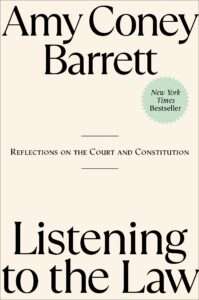
Amy Coney Barrett

Listening to Justice Barrett

My review of Amy Coney Barrett's Listening to the Law.

|

I reviewed Justice Amy Coney Barrett's Listening to the Law: Reflections on the Court and the Constitution for Civitas Outlook. My bottom line: the book is a worthwhile contribution to the shelf of books by sitting Supreme Court justices.

My review begins:

Amy Coney Barrett was not a likely judge, let alone a likely Supreme Court justice. A young Amy Coney did not even aspire to be a lawyer. She only settled on law school after college, over pursuing an English PhD, and excelled. She was an exceptional student who earned the admiration of her classmates and the profound respect of her professors, who would soon invite her to become a colleague. In 2002, she joined the faculty of the Notre Dame Law School, seeming to fulfill her professional vocation.

Just as her intellect had always attracted the notice of her peers, then-Professor Barrett attracted notice within the conservative legal movement. This led to her appointment to the U.S. Court of Appeals for the Seventh Circuit — one of several academics placed on the appellate bench during President Trump's first term — and just three years later, her elevation to the U.S. Supreme Court, replacing Justice Ruth Bader Ginsburg.

Within a year of joining the Court, Justice Barrett signed a book deal reportedly worth $2 million. The deal raised eyebrows in some quarters, even though most other recently confirmed justices have done the same, and some have earned more. Justice Barrett's book itself, Listening to the Law: Reflections on the Court and the Constitution, should not provoke much controversy, however. An instant New York Times best-seller, it is a valuable contribution to public discourse about the role of the courts and the Constitution.

Although Justice Barrett was an academic, this is not an academic book; far from it. Listening to the Law is written for an educated lay audience. It seeks to elucidate and explain, not break new ground. It is accessible and clear but not simplistic. In this regard, it has much in common with the late Chief Justice William Rehnquist's book on the Supreme Court, though it is also a bit more revealing and prescriptive. Indeed, Listening to the Law is likely the best lay introduction to the Court, the Constitution, and the reigning judicial philosophy in print. (And given how often critics of originalism struggle with fairly characterizing the target of their efforts, quite a few practitioners and legal academics would benefit from reading it too.)

The whole review is here.

Penguin/Random House

Politics

Review of The Heritage Guide to the Constitution in the Washington Free Beacon

"It is, quite simply, the most thorough, useful, and readable guide to our fundamental law available today.

|

Ilya Shapiro, my friend and frequent co-author, reviewed The Heritage Guide to the Constitution in the Washington Free Beacon.

Here is the introduction:

There's a familiar lament among constitutionalists—one heard at law schools, in courtrooms, and across think tank hallways—that most Americans know next to nothing about the nation's founding document. Ask a random college graduate about the Emoluments Clause or the Compact Clause and you'll get a blank stare. Yet even among lawyers and judges, constitutional knowledge is often shallow, piecemeal, or warped by ideology.

What's been missing is a single, reliable, readable, and comprehensive reference work that explains what the Constitution actually says, what its words meant to those who wrote and ratified them, and how those meanings have been interpreted over time

Enter The Heritage Guide to the Constitution, now in its third edition and more indispensable than ever. Originally published in 2005, with an updated edition in 2014, this volume has long been a mainstay for those of us who care about constitutional text, structure, and history. But the new edition isn't just an update. It's a major expansion and refinement, reflecting nearly a decade of scholarship, jurisprudence, and debate.

If the Constitution is our civic scripture, this is the annotated commentary you want by your side—with a foreword by former attorney general Edwin Meese and an introduction by Justice Samuel Alito! Kudos to lead editors Josh Blackman and John Malcolm (both friends and professional collaborators of mine).

And from the conclusion:

The Heritage Foundation has always seen itself as a steward of America's Founding principles, and this book is one of its finest contributions to that mission. In an era when too many view the Constitution as a "living" document to be bent toward whatever policy end is fashionable, the Heritage Guide offers a refreshing alternative: rigorous, sober, historically grounded analysis of the document as it is.

No single volume can settle every constitutional debate, but if you want a reference that will make you smarter every time you open it, this is it. It is, quite simply, the most thorough, useful, and readable guide to our fundamental law available today. And at a time when constitutional literacy has never been more needed, that makes it a civic treasure.

The Heritage Guide to the Constitution is what every serious student of American government—and every citizen who wants to remain free—should own. It doesn't tell you what to think; it gives you the tools to think constitutionally.

If you've purchased the book on Amazon, please leave a review!

AI in Court

Yasiel Puig, AI-Hallucinated Citations, Gambling, and Libel

|

From an L.A. Superior Court order earlier this month in Yasiel Puig Valdes v. All3 Media, LLC:

In reply, Moving Defendants contend that Plaintiff's opposition should be stricken for citing fabricated cases. Upon review of Plaintiff's opposition, the court confirms that Plaintiff improperly cited to "Edwards v. Hearst Corp. (1991) 53 Cal.3d 30, 43" and "Heath v. San Joaquin Comm. Hosp. Dist. (1993) 15 Cal.App.4th 708, 713-14". (Opp., at p. 5.) These cases apparently do not exist. At the hearing, the Plaintiff's counsel confirmed that those citations do not exist and appeared when Plaintiff's counsel sought the assistance of ChatGPT to assist him in filing the Opposition.

Read More

More