

The Volokh Conspiracy
Mostly law professors | Sometimes contrarian | Often libertarian | Always independent
Today in Supreme Court History: October 28, 1787
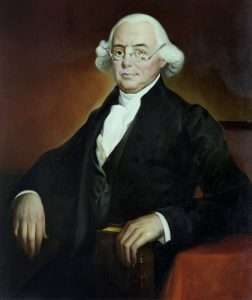
10/28/1787: James Wilson gives speech to the Pennsylvania ratification convention, arguing that there was no need for a Bill of Rights.

Editor's Note: We invite comments and request that they be civil and on-topic. We do not moderate or assume any responsibility for comments, which are owned by the readers who post them. Comments do not represent the views of Reason.com or Reason Foundation. We reserve the right to delete any comment for any reason at any time. Comments may only be edited within 5 minutes of posting. Report abuses.
Please to post comments
Good man. Judges and lawyers today will openly declare that you don't have a right at all if it isn't covered by the first eight amendments. Wilson was a prophet.
Wilson's speech in 1787 was important, but it wasn't his most important or clearest explanation of his thinking on this subject. Wilson's primary point was that the people, themselves, would be sovereign under our proposed Constitution, so they had no need for a bill of rights (which historically had provided protection only from the crown).
A bill of rights wasn't needed to protect the People from a monarch, because America could not have a monarch (Article I emphatically outlawed any "title of Nobility" granted by the U.S. or by any state). In Britain, Parliament was sovereign (with "absolute" unlimited powers) so a bill of rights could potentially protect British citizens from abuses by Parliament, but in America, the People (not Parliament) were the supreme legislative authority.
Wilson correctly saw our Constitution as establishing the sovereignty of the people. Our sovereignty and our Constitution's great legal power (over all public servants in any government (state, federal or local)) are established by several facts and principles, including the following.
First (as the Preamble emphasized), "We the People" collectively acted (as the supreme legislative authority in the U.S.) to "ordain and establish this Constitution for the United States of America" to "establish Justice" and "secure the Blessings of Liberty to ourselves."
Second (as Article VI emphasized), the People, themselves, ordained and established our "Constitution" as the paramount law in "the supreme Law of the Land." The People emphasized that our "Constitution" is the paramount law by further emphasizing that no laws purportedly enacted by Congress could be part of the "the supreme Law of the Land" except to the extent that such "Laws" had been "made in Pursuance" of our Constitution.
Third (as Article VI further emphasized), the People established that the first, foremost and constant duty of every legislator and "all executive and judicial Officers" (state and federal) is "to support" our "Constitution" in everything they do.
Fourth (as Article I emphasized), the People "vested in a Congress" only the power (and imposed the duty) to "make all laws" (and only laws) that are "necessary and proper" to support our Constitution, i.e., "all Laws” that are “necessary and proper for carrying into Execution” absolutely “all” the “Powers vested by this Constitution in" Congress or "the Government of the United States, or in any Department or Officer thereof” (including in the executive and judicial branches).
Fifth (as Article II emphasized), the People "vested in a President" only the power (and imposed the duty) to "take Care that the Laws" enacted or approved by Congress are "faithfully executed" and otherwise to "preserve, protect and defend" our "Constitution" to "the best of" his "Ability."
Sixth (as Article III emphasized), federal "judicial Power shall extend to all Cases, in Law and Equity, arising under this Constitution, the Laws of the United States, and Treaties" and "to Controversies to which the United States shall be a Party" (so no "judicial Power" can "extend" any further than permitted "under" our "Constitution," federal "Laws" and "Treaties")
Seventh (as Article VII emphasized) our original Constitution was ratified by "Conventions" of delegates chosen by the People (voters) specifically to represent the People to consider and eventually ratify our Constitution.
Wilson's views about the meaning of "sovereignty" continued to improve after 1787, but his explanation to others about how to see the sovereignty of the people continued to improve. Perhaps Wilson's best explanation was provided in his opinion as a SCOTUS justice in 1793 in Chisholm v. Georgia (https://supreme.justia.com/cases/federal/us/2/419/):
Although “the term SOVEREIGN” is not used in our “Constitution,” the Preamble is the “one place where it could have been used with propriety.” Only those “who ordained and established” our “Constitution” could “have announced themselves ‘SOVEREIGN’ people of the United States.”
Justice Wilson also highlighted how the first and foremost separation of powers in our Constitution is between the sovereign people and all public servants: “The PEOPLE of the United States” are “the first personages introduced.” After introducing the sovereign (the people), the text and structure of Articles I, II and III further emphasized the people’s sovereignty. They introduced our directly-elected representatives (Congress), then, our indirectly-elected representative (the president), and, last, our unelected representatives (judges). The people “vested” only limited powers in public servants in and under “Congress” (U.S. Const. Art. I, §1), the “President” (Art. II, §1) and the “supreme Court” and “inferior Courts” that “Congress” was delegated the power to “ordain and establish” (Art. III, §1).


