The Volokh Conspiracy

Mostly law professors | Sometimes contrarian | Often libertarian | Always independent | Est. 2002

The Volokh Conspiracy

Ilya Confusion At The Scalia Memorial Dinner

Justice Barrett mentioned Ilya Somin, but meant Ilya Shapiro.

|

For about two decades, there has been persistent Ilya confusion. Ilya Somin of George Mason University is often confused with Ilya Shapiro, formerly of the Cato Institute, and now at the Manhattan Institute. They both share the name Ilya, they both are legal scholars, and both share (or at least shared) similar philosophical views.

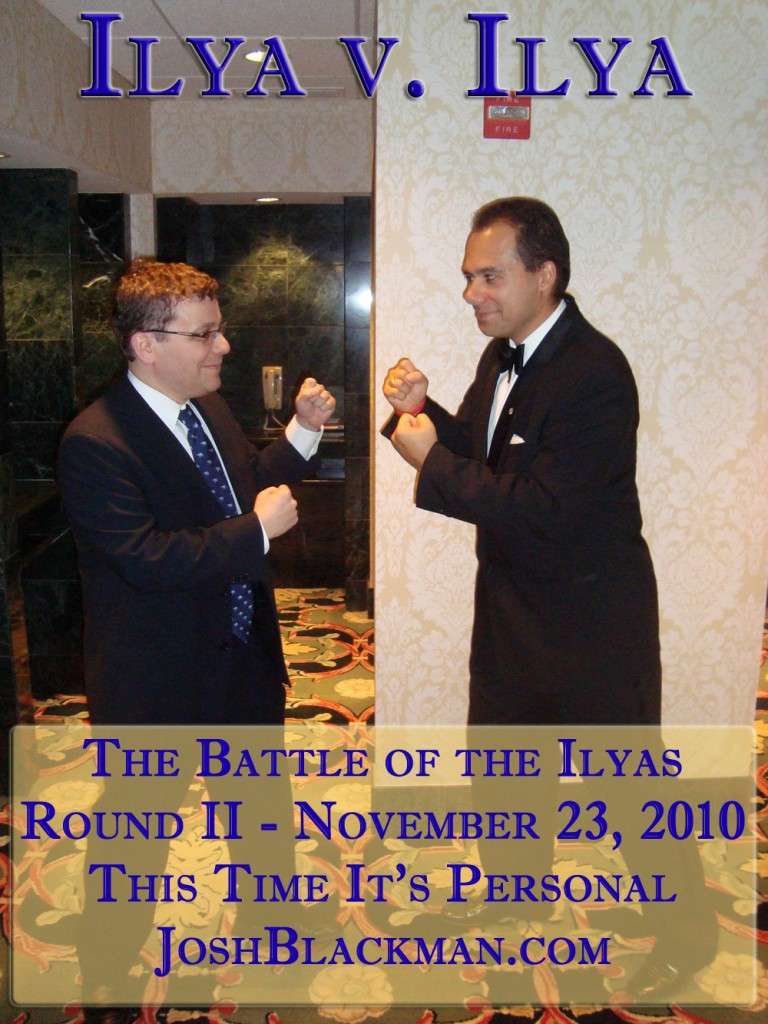
Longtime readers of JoshBlackman.com will recall that I wrote a series of posts about "Ilya Confusion" starting in 2010. Indeed, that year, I held the "Battle of the Ilyas," a trivia contest to determine who would be the real Ilya. For those keeping score, Ilya Shapiro prevailed.

Even then-Justice Willett tweeted about the Battle of the Ilyas!

Tonight, during the Scalia Memorial Dinner, there was another case of Ilya Confusion. Earlier in the program, Judge Amul Thapar praised Ilya Shapiro's presentation at NYU on October 7. There were efforts to cancel Ilya's talk, but the Chapter and many others rallied together to keep the event alive. Then, during Justice Barrett's discussion, she referenced Ilya Somin's talk at NYU. Woops. I was sitting at Somin's table, and we all started to chuckle.

Justice Barrett is just the latest person to fall for Ilya confusion. For whatever it is worth, I am often confused with Josh Hammer: a right-wing Jewish lawyer whose first name is Josh. But there was recently another first. I was at the Supreme Court on Wednesday, and a person on the public line asked me, "Are you Professor Will Baude?" I replied, "Close."


Update: This tweet sums things up.

crime victims

Judge O'Connor Grants the Government's Motion to Dismiss the Conspiracy Charge Against Boeing …

... but does so reluctantly, calling the objections to the dismissal "compelling" and castigating the Justice Department for its failure "to secure the necessary accountability to ensure the safety of the flying public."

|

Today Judge Reed O'Connor (U.S. District Court for the Northern District of Texas) granted the Justice Department's motion to dismiss the pending criminal charge against Boeing. In his order, Judge O'Connor essentially agreed with many of the factual objections that I have made for the families who lost loved ones because of Boeing's crime. But, reluctantly, Judge O'Connor dismissed the charge, concluding that he lacked a legal basis for blocking the Department's ill-conceived non-prosecution plan. On behalf of my clients, I will quickly be seeking review of this ruling by the Fifth Circuit. It is hard to understand how a dismissal that is so clearly contrary to the manifest public interest can be upheld.

I've blogged about the Boeing criminal case a number of times before, including here, here, and here. In a nutshell, Boeing lied to the FAA about the safety of its 737 MAX aircraft. The Justice Department charged Boeing with conspiracy for these lies, but then immediately entered into a deferred prosecution agreement (DPA) to resolve the criminal case. In subsequent litigation, I proved that the 346 passengers and crew on board two doomed 737 MAX flights were "crime victims" under the CVRA—they had been directly and proximately harmed by Boeing crime. This makes Boeing's conspiracy crime the "deadliest corporate crime in U.S. history," as Judge O'Connor described it.

But in earlier proceedings, Judge O'Connor concluded that he could not intervene to protect victims' rights, even though the DPA had been negotiated secretly and in violation of the families' CVRA rights. And the Fifth Circuit ruled that any intervention by it was "premature."

Then, in 2024, after Boeing breached its DPA, the Department proposed a guilty plea with Boeing to resolve the pending charge. Judge O'Connor rejected the plea deal last December. But, most recently, at the end of May this year, the Department backtracked. Instead of seeking a plea deal, it signed a non-prosecution agreement (NPA) with Boeing. After signing its NPA with Boeing, the Department filed a motion to dismiss the pending conspiracy charge under Rule 48(a).  The victims' families I represent objected. And today, Judge O'Connor overruled those objections and dismissed the case.

Judge O'Connor concluded that the victims' families' arguments against this dismissal were "compelling." For example, the families' had argued that simply dismissing the charges against Boeing could not ensure the public safety. Judge O'Connor summarized things pithily in recounting that "the Government's position in this lawsuit has been that Boeing committed crimes sufficient to justify prosecution, failed to remedy its fraudulent behavior on its own during the [term of the Deferred Prosecution Agreement] which justified a guilty plea and the imposition of an independent monitor, but now Boeing will remedy that dangerous culture by retaining a consultant of its own choosing." In light of that tortured history—and the Department's "continued failure to gain Boeing's compliance" with its previous DPA obligations—the victims' families are "correct," concluded Judge O'Connor, that the current NPA "fails to secure the necessary accountability to ensure the safety of the flying public."

Judge O'Connor also addressed the Justice Department's claim that it needed to enter into a non-prosecution agreement in order to assure an appropriate resolution. Judge O'Connor wrote that the Department's claim of "'uncertainty and litigation risk presented by proceeding to trial' is unserious. The [Department] has a confession from Boeing, signed by the CEO and Chief Legal Officer, admitting to all the elements of the conspiracy charge against it in the DPA. As such, the assertion that there is a legitimate risk that Boeing would be acquitted at a trial lacks support."

But even while agreeing with many of the victims' families' arguments, Judge O'Connor ultimately concluded that he had to approve the deal. First, Judge O'Connor concluded that the Department had complied with its Crime Victims' Rights Act (CVRA) obligations because it held a conference call with the families before reaching the deal.

More broadly, Judge O'Connor decided that he was not entitled to prevent the abuse of discretion that the dismissal embodied:

The Court recognizes that "in every political institution a power to advance the public happiness involves a discretion that may be abused." THE FEDERALIST NO. 41 (James Madison). Nevertheless, poor discretion may not be countered with judicial overreach: "the judges can exercise no executive prerogative, though they are shoots from the executive stock." THE FEDERALIST NO. 47 (James Madison). The Court acknowledges that it does not have the authority to deny leave because it disagrees with the  Government that dismissing the criminal information in this case is in the public interest. Accordingly, because the Government has not acted with bad faith, has given more than mere conclusory reasons for its dismissal, and has satisfied its obligations under the CVRA, the Motion to Dismiss is GRANTED.

Unsurprisingly, the families whom I represent strongly object to this dismissal and have asked me to pursue appropriate appellate review. For example, Javier de Luis of Massachusetts, who lost his sister in the 2019 crash of a Boeing 737 MAX 8 in Ethiopia, commented that: "The judge in this case agrees that Boeing cannot be trusted to put safety ahead of their own bottom line. He agrees that the DOJ motion is not in the public interest. Unfortunately, he also believes that he is powerless to do anything about it. But it is important for the public to understand these points. Boeing bought itself a get-out-of-jail-free card. I pray it is not paid for by future families, who will find themselves in our position, seeking justice for yet another plane full of innocent victims."

Paul Njoroge from Canada who lost his family—his wife and three small children—similarly commented: "Judge O'Connor's decision to grant the DOJ's request to dismiss this case feels like the justice system turning its back on us, the victims' families. We have been consistent in only demanding a day in court, the public against Boeing. We have not gotten that. Our pursuit for justice isn't about vengeance—it's about truth, transparency, and public safety. When a company's failures cost so many lives, ending a criminal case behind closed doors erodes trust and weakens deterrence for every passenger who steps onto a plane. The families have carried unbearable loss; the very least we deserve is a transparent process and real accountability. Anything less tells the world that powerful corporations play by different rules—and that cannot be the legacy of this tragedy."

I am now preparing to file a petition for a writ of mandamus to the Fifth Circuit—the procedural mechanism that the CVRA specifies for crime victims and their families to pursue appellate relief. In its previous ruling on this case, the Fifth Circuit denied the earlier petition that I filed, explaining that:

mandamus intercession is premature. Thus far, the district court has demonstrated careful competence that, whereas it cannot substantively revise the DPA between the Government and Boeing, it nonetheless must uphold crime victims' statutory rights at every stage of the court's criminal proceedings. If a sought-for final stage is a Government motion to dismiss, we are confident … that the district court will assess the public interest according to caselaw as well as the CVRA, including violations already admitted to, as well as any other circumstances brought to its attention by the victims' families. See United States v. Hamm, 659 F.2d 624, 629 (5th Cir. Unit A Oct. 1981) (en banc) (reiterating Supreme Court and prior Fifth Circuit precedent that district judges are empowered to deny dismissal when "clearly contrary to manifest public interest" as assessed "at the time of the decision to dismiss") ….

In today's ruling, Judge O'Connor appeared to believe that he was not, in fact, "empowered to deny dismissal" even though the dismissal was "clearly contrary to manifest public interest." I hope to convince the Fifth Circuit that Judge O'Connor got it wrong. If any dismissal is contrary to the public interest, this is the one. The law is not an ass, and trial judges need not stand idly by while an injustice is done.


Supreme Court

The Justices Are Skeptical of the Trump Tariffs, But Are They Skeptical Enough to Strike Them Down?

Some observations from yesterday's argument in Learning Resources v. Trump.

|

Yesterday, the Supreme Court heard oral argument in Learning Resources v. Trump, the challenges to the Trump Administration's "liberation day" tariffs. This is the first case in which the Supreme Court has heard oral argument on the merits of one of the Trump Administration's second-term initiatives, and is of great economic and political importance. It is also a case which could go either way, for reasons I explained here and in the Wall Street Journal.

At yesterday's oral argument, the justices were active and aggressive, posing challenging questions to all three of the advocates at argument. They showed significant skepticism of the government's arguments, as put forward by Solicitor General John Sauer, but also posed difficult questions to the attorneys representing the private and state respondents.

Over all, I think more justices showed more skepticism of the government's position, but the case remains difficult to call, as it represents a closer legal question than advocates on either side like to admit. It is also a case in which it may be difficult to rapidly produce a single rationale that commands at least five votes even if it appears that a majority of the Court is likely to vote against at least some of the liberation day tariffs.

I have a piece in The Dispatch with additional observations on the oral argument. It begins:

Solicitor General D. John Sauer opened his defense of the Trump administration's "Liberation Day" tariffs as the president would have wanted. He quoted President Donald Trump's insistence that the nation faces "country-killing" emergencies and emphasized the executive's broad authority to impose tariffs to avert "an economic and security catastrophe" and "public health crisis." But things went downhill for the president after the opening statement, as most of the justices seemed wary of Sauer's sweeping claims.

At the core of the argument in Learning Resources Inc. v. Trump is whether Congress, in enacting the 1977 International Emergency Economic Powers Act (IEEPA), delegated to the president the near-unlimited authority to impose tariffs on trade with foreign nations any time the president is willing to claim an emergency requires it. Under IEEPA, the president is authorized to "regulate … importation … of … any property" from foreign nations in order to deal with "any unusual and extraordinary threat, which has its source in whole or substantial part outside the United States," once the president declares the existence of a national emergency. This is an unquestionably broad foreign policy power. The question is whether it includes the authority to impose and set tariffs, and can be used to circumvent the procedures and constraints contained in those statutes expressly authorizing tariffs.

In addition to highlighting aspects of the argument that I found notable, I also raised the question of whether the Court will be concerned that the Solicitor General is defending the tariffs on somewhat different grounds than is the President in his public pronouncements. Sauer repeatedly insisted that these are only "regulatory tariffs," and were not adopted for the point of raising revenue, but Donald Trump's claims--some of which are quoted in the SG's brief to the Court--suggest something else entirely.

Despite President Trump's constant pronouncements that his tariffs will raise trillions in revenue, and could even supplant the income tax, the solicitor general insisted that the tariffs were "regulatory tariffs, not revenue-raising tariffs" that would be "most successful" if they never raised any money at all. This pivot was necessary for Sauer to defend the tariffs as a tool of foreign policy, and not of fiscal policy. While tariffs may operate as a tax, insofar as they involve demanding payment from those who import goods into the country, Sauer insisted that they were only used to advance the nation's foreign policy goals, with any revenue raised being a mere incidental benefit.

In the past, the court has been reluctant to place much weight on public statements by the president when evaluating the legality of federal government actions. In National Federation of Independent Business v. Sebelius, in which the Supreme Court upheld the Affordable Care Act, it did not matter that President Barack Obama had insisted that the Affordable Care Act's individual mandate was not a tax. And in Trump v. Hawaii, the court refused to probe the sincerity of the first Trump administration's justifications for barring immigration from multiple majority-Muslim countries despite Trump's statements suggesting he wanted a "Muslim ban."

The problem in this case, however, is that some of the relevant statements were in the government's own brief to the court, including the president's declaration that "because of the trillions of dollars being paid by countries that have so badly abused us, America is a strong, financially viable, and respected country again." It is one thing to disavow statements made on the stump or to the press. It is quite another to disavow those filed with the court.

In advance of the argument, I also appeared on C-Span's Washington Journal to discuss the case alongside Professor Chad Squitieri, who filed one of the few substantive amicus briefs on the side of the Administration. That video is available here.

I suspect the justices, and the Chief Justice in particular, would like to get this decision out quickly, even if only because the more tariff revenues that are collected, the messier this policy may be to unwind. But judging from the argument, I be surprised if we get a decision before the end of the year.

Calling Balls And Strikes During Warmup Pitches

Judge Matey explains that umpires indicate what the strike zone will be during warmup pitches that do not count.

|

During today's convention, Judge Paul Matey of the Third Circuit did a SOC! Sidebar on Baseball cards. Judge Matey has some insights on how baseball cards interacts with the law, but he made a point about calling balls and strike that I had never heard before.

By now, everyone knows Chief Justice Roberts's famous line that umpire simply call balls and strikes. But Judge Matey made a different point. Before a pitcher throws his first official pitch, he will throw several warmup pitches. Though these pitches do not count, the umpire will signal whether the pitch is a ball or a strike. These warmup pitches allow the pitcher to understand what the judge's strike zone will be. From game to game, an umpire might change his strike zone. But the hope is that an umpire will use the same strike zone in that particular game, or at least for that particular pitcher. That way pitchers, catchers, and batters know the rules of the game.

I think Matey had illustrated yet another reason why Roberts's analogy doesn't work. Lawyers do not get to throw throw warmup pitches in practice cases. They have only one shot to make their case. It is possible to guess on a strike zone based on past calls, but that practice is imprecise.

What about the Chief Justice? Roberts does not apply consistent strike zones--even in the same case. Do I need to mention NFIB v. Sebelius again? (I was surprised no one brought up the regulatory power of taxes yesterday during the tariff case.)

I am grateful to Judge Matey for this insight.

Judge Bumatay on Originalism, Stare Decisis, and the Party Presentation Rule

"When should circuit judges overturn their own non-originalist precedents? Spoiler alert—the answer is 'always.'"

|

This morning, Judge Patrick Bumatay of the Ninth Circuit gave the opening remarks at the Federalist Society Convention.

First, Judge Bumatay opined on the topic of horizontal stare decisis:

Second, bloodthirsty originalists must not hesitate to overturn non-originalist lower-court precedent.

Judges don't work with a blank slate. We often encounter non-originalist, bad decisions. And trust me–as a Ninth Circuit Judge, I face this problem more than most.

To be clear, I'm not talking about vertical stare decisis. No serious originalist judge would question our duty to follow the Supreme Court. As Justice Gorsuch recently said, "Lower court judges may sometimes disagree with th[e Supreme] Court's decisions, but they are never free to defy them."
What I am talking about is horizontal stare decisis. By that, I mean: when should circuit judges overturn their own non-originalist precedents? Spoiler alert—the answer is "always."

I've written about stare decisis and originalism in the lower courts here.

In his Story Lecture, Judge Oldham said that horizontal stare decisis should not exist at all. Judge Bumatay takes a more restrained approach, and argues that in every case, circuit precedents that are inconsistent with original meaning should be overruled. Of course, on the Ninth Circuit, Bumatay lacks the votes to take these actions. But an originalist judge should do everything in his power to pursue that worthwhile cause. Invariably, that will mean writing dissents from denial of rehearing en banc.

In the Ninth Circuit, we have a rule that we must sit en banc to overturn precedent. So this might mean we must call more cases en banc. I understand that seeking en banc review may have ramifications for collegiality on the court.
I know the sting of having a decision that I've written be later vacated en banc. And collegiality is important.
But collegiality isn't the end all and be all. To me, collegiality is more about how we treat each other, when we are off the bench. Outside of our writings. In those situations, we must always treat each other respectfully.

I agree with Bumatay that collegiality does not mean declining to vote for en banc. I made a related point last year:

I for one, reject the notion that collegiality entails a willingness to reconsider your views. It is always a judge's role to find the truth, and determine the best answer to a particular legal dispute by his or her best lights. And that process primarily entails weighing the arguments advanced by counsel, and deciding which side should prevail. To be sure, judges on a multi-member court will lobby one another for this position or that position. And to maintain relations, it is important to be willing to listen. But I do not think collegiality requires anything more than listening.

Second, Judge Bumatay discusses the gravitational pull of originalism:

In applying precedent, we must "bend" it in the direction of the original public meaning. That doesn't mean that we can take a "cramped reading" of precedent to "functionally overrule" it. But neither should we take an overly broad view of the precedent—allowing it to expand its reach. Instead, if we can find good-faith distinctions, then we should do so and return closer to first principles.
As I said, our duty is to apply the Constitution—not to extend precedent.
Justice Kavanaugh had it right when he explained that text, history, and tradition must function as the "gravitational pull" on our interpretation of precedent. So we can respect precedent even while pulling it in the direction of the Constitution's original meaning. So we don't need to wait for cases with a complete blank slate or questions of first impression for the Constitution's text and history to come into play.

I first developed this theme of originalism's gravitational pull back in November 2012, shortly after that year's FedSoc convention:

So, in this sense, originalism's gravitational pull tugs the Constitution towards original meaning, even if originalism is not advanced in a case that circles the orbit of New Federalism. Originalism is the hidden force that causes other things to shift, even if we don't directly see why. This is why "this far and no further" works, even when originalist arguments need not be made. Thus, scholars need to continue developing originalism so that the force, the pull, the tug remains to keep our Constitution shining bright and strong.

I thank Randy Barnett for offering this weighty idea as a way to explain the importance of originalism in our modern legal landscape. (See also Dworkin's related thoughts on "gravitational force.").

Third, Judge Bumatay would not be limited by the so-called party presentation principle:

Judges are never obligated to follow the parties' agreement to incorrect law. After all, the parties don't need to ensure the best interpretation of the law. Judges do. So even though judges generally rely on the arguments the parties advance, we should never cede our duty to independently interpret the law.
In my view, once a party raises a legal theory, judges may consider anything subsumed by that theory. So we can't completely refashion the parties' claims, issues, or legal theories.

But within a particular theory, judges may consider any arguments, sources, or authorities that may be helpful—including those not raised in the briefing. So even if the parties don't specifically make originalist arguments in a constitutional case, judges are free to—and indeed must—engage with the historical understanding of the constitutional text.

I am not a huge fan of the party presentation principle. Indeed, Judge Oldham made a related point. He said it was wrong to follow a circuit precedent when no originalist arguments were even presented.

Judge Bumatay offered a challenge to the judges in the room:

To the judges in the audience, I'm here to say that we can do originalism—not once or twice in a career—but once or twice in a day.

I immediately thought of Chief Judge Pryor's lecture at the University of Florida last year. He offered this observation.

My view comes from my experience. In two decades of judicial service, I have had to determine, as a writing judge, the original meaning of a constitutional provision in so few appeals that I can count them on one hand, and I would still have a digit left to count another.

There is a lot here to consider, and there is a brewing debate about lower-court originalism.

What a great way to kick off the convention.

The Tariff Case and Veto Overrides

It always takes a veto-proof majority to claw back the President's powers.

|

During oral argument in the tariff case, there was a recurring theme: if the Court agreed with the President that IEEPA grants this power, it would take a veto-proof majority in Congress to claw back that power.

Justice Gorsuch described delegation as a one-way ratchet that, as a practical matter, cannot be retrieved.

JUSTICE GORSUCH: Okay. You emphasize that Congress can always take back its powers. You mentioned that a couple of times. But don't we have a serious retrieval problem here because, once Congress delegates by a bare majority and the President signs it --and, of course, every president will sign a law that gives him more authority --Congress can't take that back without a super majority. And even --you know, even then, it's going to be veto-proof. What president's ever going to give that power back? A pretty rare president. So how --how should that inform our view of delegations and major questions? . . . But what happens when the President simply vetoes legislation to try to take these powers back? . . . Yeah. So Congress, as a practical matter, can't get this power back once it's handed it over to the President. It's a one-way ratchet toward the gradual but continual accretion of power in the executive branch and away from the people's elected representatives.

Justice Barrett returned to Gorsuch's question:

JUSTICE BARRETT: Okay. Then a question just to follow up on Justice Gorsuch's thing about how could Congress ever get this delegation back, you said, well, listen, you point to the --Congress's ability to terminate emergencies, which it's done. But, if Congress ever wanted to get the tariffing power back, it would have to have a veto-proof majority because, regardless of the emergency, so if Congress wanted to reject the --let's say that we adopt your interpretation of the statute. If Congress said, whoa, we don't like that, that gives a president too much authority under IEEPA, it's going to have a very hard time pulling the tariff power out of IEEPA, correct? . . .  But --but definitively interpreting a statute that grants presidential power makes it particularly hard to get the President to not want to veto something, which, as Justice was pointing out --Justice Gorsuch was pointing out, has him lose power. All right.

I'll admit, I was a bit perplexed by this concern. In any case where the Supreme Court adopts an interpretation of a statute that the President favors, it will take a veto-proof majority to modify that statute. Congress routinely revises statutes after a Supreme Court decision. In some of those cases, the President may favor the Supreme Court's reading, but for many institutional reasons, acquiesces to Congress's approach.

For example, President George H.W. Bush vetoed the Civil Rights Act of 1990, and Congress failed to override that veto. But one year later, Congress enacted the related Civil Rights Act of 1991. William Eskridge talked about this history here. This law was not a separation of powers bill, like IEPPA, but this history illustrates how politics works. I don't think the Justices fully realized that there are political costs to the President vetoing a bill. Indeed, pocket vetoes are used largely to avoid the spectacle of having to veto a bill.

This issue reminded me of a colloquy in Trump v. Anderson. Recall that a Section 3 disability could be removed by a 2/3 vote of each house--the same standard for overriding a veto. Justice Kagan posed this question:

Elena Kagan: -- because, if Congress has the ability to lift the vote by a two-thirds majority, then surely it can't be right that one House of Congress can do the exact same thing by a simple majority.

Jonathan F. Mitchell: Yeah, there certainly is some tension, Justice Kagan, and some commentators have pointed this out. Professor Baude and Professor Paulson criticized Griffin's Case very sharply.

Elena Kagan: Then I must be right. (Laughter.)

In case you forgot, Jonathan Mitchell represented Trump in this case.

The Justices are very concerned about the difference between a simple majority to pass a statute, and a 2/3 vote to reverse that action. Under the current political dynamic, the override of a veto is fairly rare. But I don't think that likelihood should inform how the Justices decide cases. The Court can only resolve judicial matters, and let the political chips fall where they may.

New in Civitas: "Eliminating Liberal Institutional Asymmetries"

"For now, the only way to advance conservatism is to eliminate liberal institutional asymmetries."

|

Civitas published my new essay, titled Eliminating Liberal Institutional Asymmetries. This piece ties together several themes I've discussed in recent months. From the introduction:

Since the New Deal, progressives have captured virtually every public institution and most private institutions in America. This result should not be surprising. O'Sullivan's First Law proclaims, "All organizations that are not actually right-wing will over time become left-wing." The all-too-common fear that power will be abused in the future presumes that power is not already being abused, regardless of who wins elections. When Democrats are in power, these institutions tend to instinctively support Democrats. When Republicans are in control, those institutions instinctively resist Republicans. Given these asymmetries, concerns about what would happen when the shoe is on the other foot are misplaced. Perhaps the single greatest opportunity of our current political moment is to eliminate these entrenched institutional asymmetries permanently. The political playing field should be level, allowing both sides of the political aisle to compete evenly in the arena of ideas. 

I focus on three asymmetries: the civil service, the academy, and the legal profession.

I hope this essay stimulates some debate. See you all at NLC!


Counting to Five for the Government In The Tariffs Case

I was in the Court, and I have a different take on the case.

|

This morning, I attended oral argument in the tariff case. I was seated shortly after 9:00 a.m. and did not leave until nearly 12:45 p.m. As a result, for nearly four hours, I was completely immune to everything that was said on social media, on prediction marks, and in the press. It seems that shortly after Solicitor General John Sauer sat down, headlines started popping up with a consistent description: the Justices asked "skeptical" questions of the government. Indeed, I suspect these headlines were written formed before Neal Katyal finished his argument for the Respondents.

The live-streaming of oral arguments has been a welcome development. But perhaps one drawback is that people make their assessments of big cases before they are over. And once a narrative takes old, everyone seems to glom onto it. As usual, I have an unorthodox take.

Without question the justices had skeptical questions for the Solicitor General. But several Justices seemed skeptical, and even frustrated by Neal Katyal's presentation. He was polished, but wooden. Far too often, it seemed like he was giving rehearsed answers, which were not entirely responsive to the questions that were asked. Katyal may have also misread the room, and came in far too overconfident after the Solicitor General sat down. This case is close, but I think that ultimately the tariffs are upheld. I say this as someone who has not formed a solid opinion on the matter. I really haven't blogged about the issue, and came into the argument with an open mind.

How do we count to five?

Read More

Guns

The Second Amendment and Foster Parents

|

From a South Carolina Attorney General opinion issued last week:

Dear Representative Gilliam:
You seek our opinion "on a matter important to all South Carolinians, especially those among us who are serving as foster parents to the over 4,500 South Carolina youths in foster care." Specifically, your letter states:

… [o]ur concerns and answers to our questions [require resolution] so that these dedicated volunteers retain their Second Amendment right to keep and bear arms—uninfringed—while they provide their generous and valuable help to children in need.

It is my understanding that caseworkers and other officials with the South Carolina Department of Social Services [SCDSS] are prohibiting foster parents from adopting a foster child so long as any firearms are present in their home.

Our research has not found any state code requiring a complete deaccession of household firearms by foster parents who are considering adoption of a foster child. [The opinion then cites SCDSS regulations and policies that require foster parents to generally keep firearms "stored in an inoperative condition in a locked area inaccessible to children." -EV] …

Read More

The Shortest SCOTUS Oral Argument In The Modern Era?

Coney Island Auto Parts, Inc. v. Burton was over in 37 minutes.

|

Today I attended oral argument at the Supreme Court. The first case of the day was Coney Island Auto Parts, Inc. v. Burton. This was not exactly a high-profile dispute. I had assigned this case in my Supreme Court simulation class, but I had a personal interest in the dispute. My mom grew up in Seagate, Brooklyn, about three miles from the auto shop. And Daniel Ginzburg represented the petitioner. The solo practitioner from Freehold, New Jersey was making his debut before the Supreme Court. His office was about 30 miles from my childhood home in Staten Island. This case felt very homey for me.

The question presented was fun, but nerdy: "Whether Federal Rule of Civil Procedure 60(c)(1) imposes any time limit to set aside a void default judgment for lack of personal jurisdiction."

Ginzburg told Bloomberg Law that big firms offered to take over the case, but he decided to argue it himself:

He said he rejected big firms' offer to work with him on this case because he thought this one "had a shot, and I didn't want to give up the opportunity to argue before the Supreme Court."

"Ever since law school it was viewed as a big deal," Ginzburg said. He added he doesn't see his lack of experience as an issue in a case such as this one, which turns on few facts and a specific legal issue that "only a civil procedure geek would love."

Ginzburg did not even know his opposing counsel, Lisa Blatt, who has now argued 55 cases before the Supreme Court.

"I had no idea who she was," said Ginzburg, 45, whose job largely consists of financial services litigation and semi-frequent appearances at state and federal courts in New York and New Jersey.

The arguments were, well short. At the 18-minute mark, the bench became silent. Ginzburg said, "If there are no further questions…" Chief Justice Roberts looked around and said "Thank you counsel." There was no seriatim round for the Petitioner.

Lisa Blatt presented about 14 minute of argument. Again, the bench was silent. At the 33-minute mark, Blatt said "If there are no questions, we would ask that the decision below be affirmed." Roberts looked around, and Blatt sat down. Again, no seriatim round. The Chief Justice invited Ginzburg to give a rebuttal. He spoke for about 3 minutes, without questions and sat down.

All told, the argument stretched about 37 minutes. The case started at 10:03 a.m. and concluded at 10:40 a.m.

Was this the shortest SCOTUS argument in the modern era? (By modern era, I am referring to the post-COVID format.) Perhaps a runner-up might be Hain Celestial Group v. Palmquist, which was argued after Coney Island. That case lasted only 41 minutes. (I didn't stick around for the second case; I had a FedSoc talk at the GW chapter at noon.) Maybe everyone on the bench (and me) was more focused on the case that will be argued tomorrow: TARIFFS!

In Coney Island, it seemed clear enough that the Justices had decided that they were going to vote for the Respondent, and didn't feel the need to ask further questions. Ginzburg was prudent to sit down early. I don't think arguing further was going to help his cause.

If I had to predict, Justice Jackson will get the assignment. She was extremely active with the questions, and Blatt referenced her by name several times. Justice Alito seemed a bit plussed, and he might write a concurrence. Justice Kavanaugh didn't say a word.

There were a few funny points.

In this case, virtually all of the circuits adopted a rule favoring petitioner. Justice Alito observed "almost all the courts of appeals have decided this question against you." Blatt replied:

And I think just last term you ruled against a case I argued when all the courts had gone our way.

The entire court burst out laughing. Justice Thomas let out two huge belly laughs, and was bending back in his chair. He lost it.

Blatt also referred to a judgment issued by a "Court of Clowns."

And you could --and if it's concededly, you know, on its face, it's issued by the court of clowns -

( Laughter.)

MS. BLATT: --you have to give effect to the judgment based on res judicata. And I will say, if you have a court of clowns example, you could probably get rid of that under the independent action for gross injustice.

I don't think she was referring to the Ninth Circuit…

Free Speech

No Injunction in Defamation and Copyright Case Stemming from "Africatown International Design Competition"

|

From Magistrate Judge Gray Borden's opinion Friday in Studiorotan LLC v. Howell (N.D. Ala.):

A team of researchers discovered the wreckage of the Clotilda, the last known slave ship in the United States, in 2018. The Clotilda "illegally brought enslaved individuals from Africa into Alabama around 1860, where the ship was scuttled and burned to hide evidence of illegal slave trading." Many of these slaves returned after the Civil War and founded Africatown near Mobile, Alabama….

Renee Kemp-Rotan, "an internationally regarded urban designer and master planner," operates Studiorotan. Defendant M.O.V.E. Gulf Coast CDC ("M.O.V.E.") "invited Studiorotan to Africatown and asked Studiorotan to be involved in a project that would bring many community-based, non-coordinated projects into a comprehensive plan, design and development for Africatown." In that vein, Studiorotan, M.O.V.E., and Defendant Vickii Howell developed a competition—the Africatown International Design Competition—"for professional architects to submit design boards and essays" related to the "Clotilda Discovery and furthering preservation and revitalization of the Africatown community."

Read More

What I Expect from the Court's Upcoming Term

Why I'm (mildly) optimistic about the Court's confrontation with presidential power

|

It has become commonplace to predict that the Supreme Court's current Term will be as consequential, for the Court and for the country, as any in living memory.  Across the board, the Administration has implemented dozens of policies that have been deemed unlawful – unauthorized by statute and/or unconstitutional – by lower courts.  Congress could do much to rein him in; as Madison[1] put it in Federalist 51, "the great security against a gradual concentration of the several powers in the same department, consists in giving to those who administer each department the necessary constitutional means and personal motives to resist encroachments of the others."  But Congress has, for reasons and in ways we need not go into here, appears to have abandoned all of its encroachment-resisting powers to the Executive branch.

That leaves the Judiciary.  The Supreme Court, having disposed of a number of procedural matters pertaining to the many legal challenges to Administration action currently flooding through the federal court system,[2] is soon to confront the merits of those challenges this Term, starting with the Tariff Cases (Trump v VOS Selections and Learning Resources v. Trump) on Nov. 5th and almost certain to include challenges to the birthright citizenship Executive Order, the Administration's federalization of the national guard to quell civil disturbances, the President's power to condition federal funding on various extra-statutory criteria of his own devising, the Administration's purported exercise of its powers under the Alien Enemies Act in its deportation program, and any number of other equally weighty matters.

Many friends, colleagues, and family members  - not to mention commentators and pundits - who are both deeply worried about the direction in which the Trump Administration is taking the country (as am I) and, more to the point for this blog post, deeply pessimistic about the Court's willingness to stand up to the President's authoritarian tendencies and to rein him in.

"The Court," they say, "has been giving the Administration one victory after another. It is clearly in Trump's pocket, willing to rubber-stamp whatever outrageous moves he makes."

I don't agree. I'm not among those who think the Court is in Trump's pocket, and I'm not merely hopeful but actually rather optimistic that, when confronted with the merits of the specific cases involving this Administration's penchant for lawlessness, the Court will push back against Presidential overreach. Read More

More