
Justice Alito Says Recusal in Suncor Energy v. Boulder County a "Difficult Judgment Call"
Bloomberg reports on why Justice Alito decided to recuse from the first case of the Supreme Court's term.

Bloomberg reports on why Justice Alito decided to recuse from the first case of the Supreme Court's term.

AI-powered license plate readers flagged an abnormal driving pattern. Then officers made up reasons to pull him over and interrogated him, and they faked a K-9 alert to justify a nonconsensual search.

While the White House settles for a voluntary accord, the Federal Trade Commission is preparing subpoena-like demands and plans to compel testimony from frontier lab executives.

Time to deploy gene drives to eliminate these disease-carrying pests?

Since 2020, We Heart Seattle has picked up over 2 million pounds of trash. In response, the state government is investigating the group for improper handling of materials.

The planned reforms could promote harm reduction by addressing a huge backlog that has resulted in routine violations of a statutory deadline.

A BLT looks simple, but bacon rules, lettuce labor shortages, and tomato tariffs show how government meddling can make even lunch more expensive.

Americans with upper, middle, and lower incomes are all better off today than in the 1970s or 1990s, new CBO data shows.

Californians can now sue federal officers for civil rights violations, but cops can still claim qualified immunity as a bona fide defense for official misconduct.
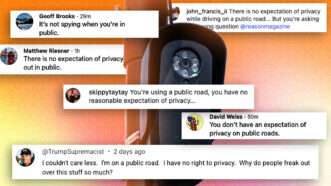
Defenders of Flock-style surveillance systems argue that people “have no reasonable expectation of privacy in public.” They're wrong.

Miami Beach detectives questioned Raquel Pacheco at her house over her pro-Palestine Facebook comments. A judge ruled several key claims in her First Amendment lawsuit against the city can proceed.
Tech CEO who sued over the publication had to pay about $400K in defendants' attorney fees as a result of the trial court's throwing out the lawsuit, and the Court of Appeal just affirmed the decision.
"Even if Congress were to enact a law clearly empowering Article III courts to vacate agency rules or regulations and automatically cause their erasure from the Code of Federal Regulations, vacatur would likely still be inconsistent with the limited nature of the judicial power and the non-delegability of core legislative power to the judiciary."

That means his ex-wife can talk about it on a podcast if she wants to. But you probably shouldn’t follow suit.
For twenty-five years I never had to think about freedom-of-information requests, but in the last year I have been the subject of two such requests.

Axel Kaiser discusses Latin America’s political realignment, the battle over culture, and why libertarians need to talk about virtue.

Department of Homeland Security
The feds’ response to a lawsuit over their voter fraud investigation program is an admission that their approach didn’t work. But some questions are still unanswered.

Plus: FlyDubai flight to Tel Aviv forced to emergency-land, ICE hiring surge, and more...
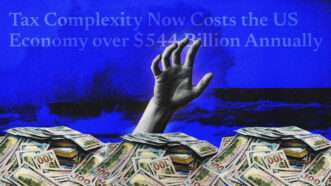
The complexity and burden of the tax code add insult to injury.

American politicians who cooperate with foreign activists, whether individual or institutional, often do more harm than good.

What’s on your mind?
It seems the Justices worked out a plan before the briefing concluded.

A GAO report notes that the Controlled Substances Act does not define "potential for abuse" or "accepted medical use."
Judge R. Nelson’s dissent from 9th Circuit’s Yukutake decision thoroughly analyzes footnote 9.
though concluding that the restriction is narrow.

As with similar cases at UVA and Duke Lacrosse, it's important to get the facts first.

Teenagers barred from social media are turning obscure corners of the internet into makeshift chat rooms.
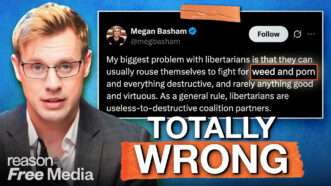
A Daily Wire writer went on a tirade against libertarians and got the movement all wrong.

TikTok must implement several new "safety" features, including time limits for kids and strict age-verification measures.
"People tend to think the times they are living in are the most unprecedented and unpredictable, but that is rarely the case."

The Trump administration revises wonky federal regulations to reduce home construction costs.

The city's ordinance targets price gouging that its own evidence doesn't show—and it could kill discounts that save shoppers money.

Angela Lipps is suing for $10 million after a Fargo police detective ignored evidence that she was innocent and arrested her anyway.

The Nazis were similar to socialists supporting economic statism, but different in other key aspects of their ideology.

Lawyers—not athletes, schools, or college sports—are the real winners of the Protect College Sports Act.

A new report from the Government Accountability Office reveals that federal drug regulators do not have any clear policies or procedures for making scheduling decisions.

There is a form of fame where people aren't really celebrities, or even "influencers"—just folks with a fandom.
Self-coronate yourself elsewhere.

Plus: Alaska's blue-collar jobs, SpaceX success, grade inflation, and more...
Celebrate your independence with a subscription to Reason magazine, your most trusted source of honest, insightful news and analysis.




