The 'Threat' That Supposedly Justified Killing 2 Boat Attack Survivors Was Entirely Speculative
The commander who ordered a second missile strike worried that the helpless men he killed might be able to salvage cocaine from the smoldering wreck.
Adm. Frank M. Murphy reportedly told lawmakers a controversial second strike was necessary because drugs on the burning vessel remained a threat.
Paul says Hegseth misled Congress about deadly strikes on alleged drug smugglers in the Caribbean.
Regardless of what the defense secretary knew or said about the September 2 boat attack, the forces he commands are routinely committing murder in the guise of self-defense.
Instead of asking whether a particular boat attack went too far, Congress should ask how the summary execution of criminal suspects became the new normal.
Even if you accept the president's assertion of an "armed conflict" with drug smugglers, blowing apart survivors of a boat strike would be a war crime.
A spending bill approved as part of the package that ended the federal shutdown aims to close a loophole that gave birth to $28 billion industry.

The president's authoritarian response to a video posted by six members of Congress, who he says "should be arrested and put on trial," validates their concerns.

Congress justified that National Firearms Act of 1934 as a revenue measure—a rationale undermined by the repeal of taxes on suppressors and short-barreled rifles.
The appropriations bill, which the House is considering, would wipe out an industry that offers alternatives to cannabis consumers in states that still prohibit recreational marijuana use.
The most common uses of "magic mushrooms" will never gain FDA approval.
President Trump’s pretextual claim that fentanyl carrying drug boats in the Caribbean are an existential threat to Americans doesn’t pass muster.
The government is tying itself in knots to cast murder as self-defense and avoid legal limits on the president's use of the military.
There are several problems with the president's math, which suggests he has accomplished an impossible feat.
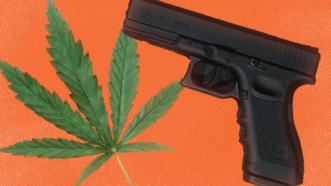
His administration is urging the Supreme Court to uphold a prosecution for violating a federal law that bars illegal drug users from owning firearms.
The Drug Policy Institute's Kevin Sabet debates Reason's Zach Weissmueller.
The potential for deadly error underlines the lawlessness of the president’s bloodthirsty anti-drug strategy.
The Singaporean government hanged Pannir Selvam this month, the 10th convict to be executed in 2025 for nonviolent narcotics violations.
The law applies to millions of Americans who pose no plausible threat to public safety, including cannabis consumers in states that have legalized marijuana.
Until now, the president concedes, interdiction has been "totally ineffective." Blowing up drug boats won't change that reality.
The president thinks he can transform murder into self-defense by executive fiat.
The lesson isn’t that decriminalization can’t work. It’s that Portland-style governance is broken.
Flawed research methods are misleading patients and might embolden prohibitionists. Marijuana has promise in treating certain sorts of discomfort, but some conditions still require powerful narcotics.
Author Joe Dolce explains how psychedelics are moving from counterculture to mainstream, with new science, shifting laws, and surprising therapies that promise to change how we treat addiction, anxiety, and self-discovery.
The president's new approach to drug law enforcement represents a stark departure from military norms and criminal justice principles.
Equating drug trafficking with armed aggression, the president asserts the authority to kill anyone he perceives as a threat to "our most vital national interests."
The agency's puzzling concerns about the Lykos Therapeutics drug application
The war on drugs authorizes police conduct that otherwise would be readily recognized as criminal.
The appeals court rejected most of the arguments in favor of that policy, saying "the government must show non-intoxicated marijuana users pose a risk of future danger."
The appeals court concluded that the government had failed to show that policy is consistent with "this Nation's historical tradition of firearm regulation."
Canada accounts for a tiny percentage of fentanyl smuggling, which cannot be stopped by trying harder.
The contrast between the two cases illustrates the haphazard impact of an arbitrary, constitutionally dubious gun law.
The success of "contingency management" belies the notion that addiction is an uncontrollable disease caused by a drug's impact on dopamine levels.
By almost every measure, America during the pandemic was a more dangerous, deadly, and dysfunctional place.
The former congressman, who died this week, transformed from a zealous prohibitionist into a drug policy reformer.
Six years after legalizing hemp and its by-products, the state is revising its drug policies and criminalizing products sold by thousands of Texas businesses.
That logic implausibly assumes presidents have the power to curtail substance abuse by attacking the drug supply.
Plus: A listener asks which domestic policy changes could realistically boost U.S. manufacturing without raising costs for consumers.
The survey estimates that 7.5 percent of America adults use illegally produced fentanyl each year, 25 times the rate indicated by a government-sponsored survey.
A new study being used to call for mifepristone restrictions relies on vague and dubious definitions of drug-related complications.
Even when they are less patently ridiculous, the metrics of success favored by government officials make little sense.
Bondi said the president's drug policy prevented the deaths of 75 percent of Americans, in just his first 100 days.
Using the military to wage the drug war in Mexico raises practical and constitutional issues.
The researchers found that drug seizures in San Francisco were associated with a substantial increase in fatal opioid overdoses.
The ruling by U.S. District Judge Jill Parrish emphasizes that religious freedom must protect "unpopular or unfamiliar religious groups" as well as "popular or familiar ones."
How pot bureaucrats used legal weed to push their social justice agenda
Researchers gave psilocybin to two dozen religious clergy. Was it guided by science, religion, or some awkward combination?
Reason is an independent, audience-supported media organization. Your investment helps us reach millions of people every month.
Yes, I’ll invest in Reason’s growth! No thanksEvery dollar I give helps to fund more journalists, more videos, and more amazing stories that celebrate liberty.
Yes! I want to put my money where your mouth is! Not interestedSo much of the media tries telling you what to think. Support journalism that helps you to think for yourself.
I’ll donate to Reason right now! No thanksPush back against misleading media lies and bad ideas. Support Reason’s journalism today.
My donation today will help Reason push back! Not todayBack journalism committed to transparency, independence, and intellectual honesty.
Yes, I’ll donate to Reason today! No thanksSupport journalism that challenges central planning, big government overreach, and creeping socialism.
Yes, I’ll support Reason today! No thanksSupport journalism that exposes bad economics, failed policies, and threats to open markets.
Yes, I’ll donate to Reason today! No thanksBack independent media that examines the real-world consequences of socialist policies.
Yes, I’ll donate to Reason today! No thanksSupport journalism that challenges government overreach with rational analysis and clear reasoning.
Yes, I’ll donate to Reason today! No thanksSupport journalism that challenges centralized power and defends individual liberty.
Yes, I’ll donate to Reason today! No thanksYour support helps expose the real-world costs of socialist policy proposals—and highlight better alternatives.
Yes, I’ll donate to Reason today! No thanksYour donation supports the journalism that questions big-government promises and exposes failed ideas.
Yes, I’ll donate to Reason today! No thanksDonate today to fuel reporting that exposes the real costs of heavy-handed government.
Yes, I’ll donate to Reason today! No thanks