

Americans Are Wealthier Than 30 Years Ago. Here's the Data To Prove It.
Americans with upper, middle, and lower incomes are all better off today than in the 1970s or 1990s, new CBO data shows.

The economic populism that has consumed the Republican Party in recent years rests largely upon the claim that America is in decline—and that we are falling behind because other countries (or immigrants from those countries) are "ripping us off," as President Donald Trump likes to put it.
You'll often hear a similar story of economic decline from figures on the political left too, although they are more likely to blame capitalism. "The most important political division in our times is not between Democrats and Republicans, or socialists and capitalists," wrote Tim Wu, a Democratic strategist and veteran of the Biden administration, in a recent New York Times essay, "it's between those who think today's economic system is fair and working well for most people, and those who do not."
Both narratives are incorrect.
The Congressional Budget Office's (CBO) latest report on American households' income, released this week, shows that Americans are significantly wealthier than they were 30 or 50 years ago. Poorer households are earning more. Wealthier households are earning more. And, yes, that's after adjusting for inflation.
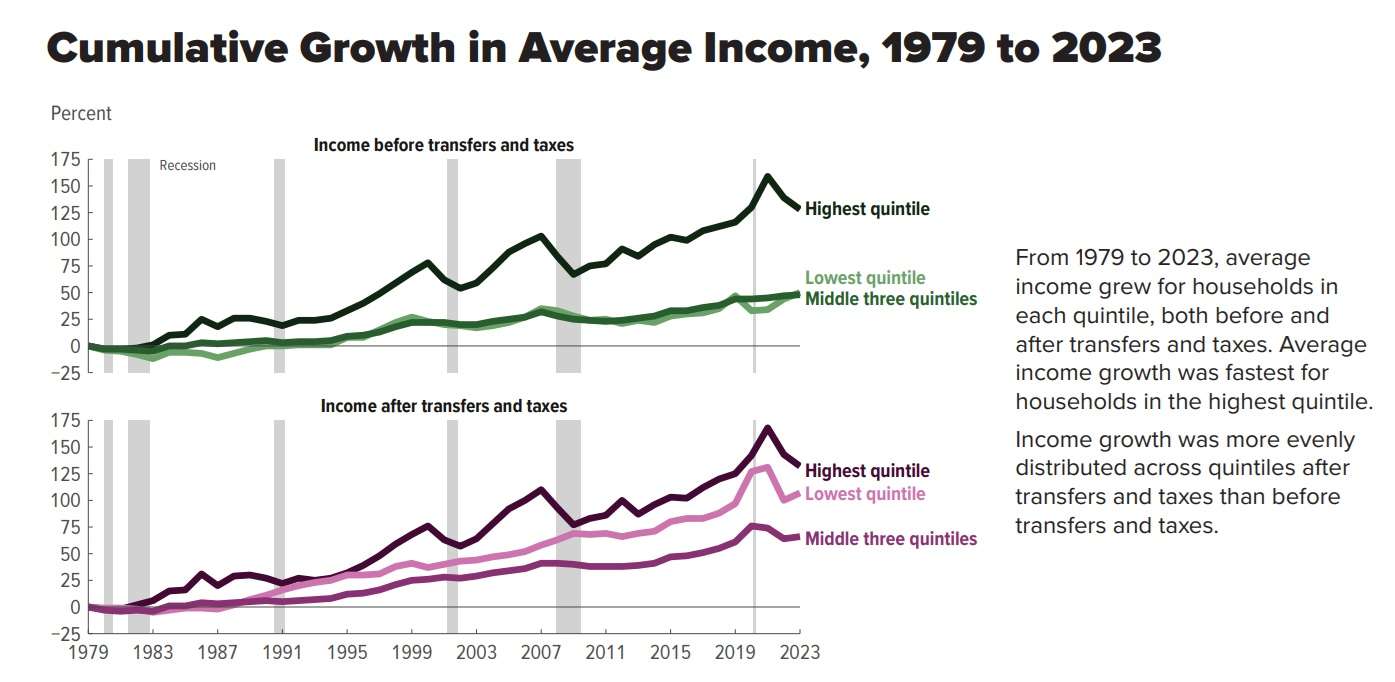
In fact, poorer Americans have seen the largest relative gains over the past few decades—a fact that is particularly inconvenient for populists on both right and left.
As Scott Lincicome, vice president of general economics at the Cato Institute, pointed out after crunching the CBO's data that the poorest fifth of the income distribution—that is, the 20 percent of American households earning the least annually—has seen its average household income climb by 50 percent since 1979. When government transfers and tax policies are taken into account, that same segment of the population has seen its income double over the same period.
The middle class is doing quite well too. Incomes are up by 44 percent for the median household since 1979, and they have increased by 70 percent when taxes and transfers are included. And, again, this is after accounting for inflation.
In 1990, the average middle-class household earned about $84,700 annually (in 2023 dollars). In 2023, that same segment of the population took home more than $131,000.
The growth since the 1990s is particularly interesting, as nearly all of that has been achieved since the North American Free Trade Agreement (signed in 1992) was in place and since China joined the World Trade Organization (in 2001), the two events that right-wing populists tend to highlight when discussing the supposed hollowing out of America's middle class. The income data tells a very different story.
Economic populists like to pretend that this is an either-or situation. Vice President J.D. Vance, for example, believes that it would be foolish to trade 1 million imported toasters for "a single American manufacturing job," as if the outsourcing of manufacturing would necessitate a decline in Americans' living standards.
Good news! We don't have to choose. Manufacturing jobs may have declined in recent decades, but the American middle class today has access to more affordable goods and better-paying jobs—including better-paying blue-collar jobs.
Of course, it is also true that many Americans feel like they are struggling right now. Inflation is outpacing wage increases, and higher interest rates make it harder to afford a house, a car, or anything else that requires borrowing.
Even so, the context matters. Americans of all income levels are doing far better today than in the recent past. That's a fact worth celebrating. Instead, politicians are constantly trying to turn it into a grievance, as if someone else's success might mean your failure.
The solution to today's economic problems, then, is not to blame the system that has allowed incomes to rise so steadily and so high. If politicians succeed in dismantling capitalism or eroding free trade to return America to the past, they will likely find a future where everyone is poorer.




