

Cops Used AI Surveillance To Detain an Innocent Texas Driver. His Lawsuit Just Got the Program Struck Down.
AI-powered license plate readers flagged an abnormal driving pattern. Then officers made up reasons to pull him over and interrogated him, and they faked a K-9 alert to justify a nonconsensual search.
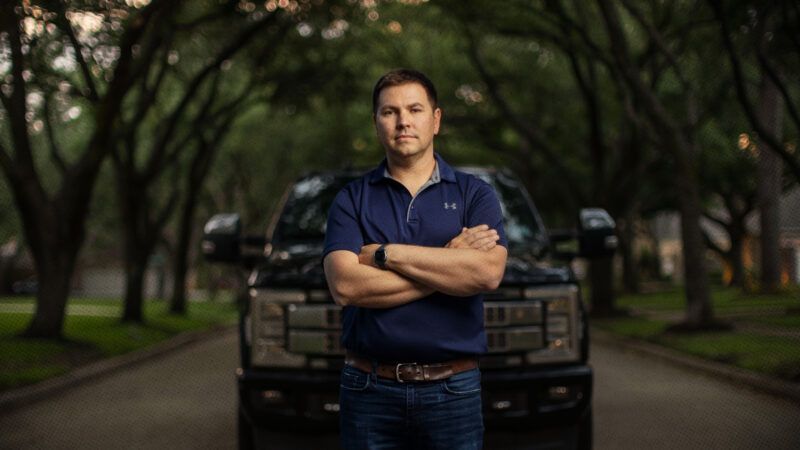
A federal jury on Monday found Bexar County, Texas, liable for systematically violating thousands of Americans' Fourth Amendment rights for years through a criminal interdiction unit. The victory underscores that the Constitution requires searches to be reasonable and prohibits dragnet policing.
On March 16, 2022, Alek Schott was driving home from a work trip near San Antonio, Texas, when he was stopped by a Bexar County Sheriff's Office (BCSO) deputy for allegedly drifting lanes. But what should have been a quick stop turned into an hourlong, unconstitutional fishing expedition. Rather than simply writing a ticket, Deputy Joel Babb asked Schott to "step out and sit in [the police cruiser's] passenger seat while I do your warning," according to the complaint filed in federal court on behalf of Schott by the Institute for Justice, a nonprofit law firm. Once in the police car, Babb began questioning Alek on a variety of topics, including where he worked, the purpose of his travel, and where he lived while he looked up Alek's criminal history.
After interrogating Schott for 10 minutes, "Babb admitted the purpose of the stop was never really about a traffic violation," writes the suit. As part of the Criminal Interdiction Unit, Babb said he didn't write traffic tickets. Instead, he stopped drivers to look for "human smuggling, drug smuggling, and all those things like that." Babb proceeded to ask Schott about illicit drugs, whether he was carrying cash, and whether he'd consent to a search of his vehicle.
But Schott refused. Still, this wouldn't be the end of the stop. After being denied consent to search and without evidence of any wrongdoing, Babb called for a K-9 unit to walk around the vehicle, according to the suit. When the K-9 unit finally arrived, body camera footage shows the officer walk the dog around the truck. In the reflection of Schott's vehicle, the officer can be seen gesturing upward and signaling toward the dog. The dog jumps up and places its paws on the vehicle in response, and the officer records a positive alert.
For the next 40 minutes, Schott sat in the back of the police cruiser while officers ransacked his truck. But they found nothing.
Before leaving, Babb gave Schott a copy of his "warning," and "reassured [him] that he'd done his best to put everything back, 'cause nine times out of ten, this is what happens'—meaning that BCSO officers typically find nothing when searching a vehicle," argues the complaint.
Schott's own dashcam footage later confirmed he'd never drifted lanes as Babb alleged, the suit explains. So following the traffic stop, Schott filed a complaint with the BCSO internal affairs department, asserting he'd been stopped without cause, detained for over an hour, and searched for no legitimate reason. But the agency refused to take Schott's complaint seriously, telling him, "If you don't like how we conduct our business, you should file a…lawsuit," writes the lawsuit.
And so he did, untangling a web of pretextual stops, unconstitutional searches, and mass government surveillance in the process.
The BCSO's systematic violation of Americans' Fourth Amendment rights occurred in five steps, beginning with a nationwide network of license plate readers. These AI-powered cameras would notify local law enforcement of any travel deemed abnormal, and BCSO deputies would then conduct pretextual traffic stops to investigate the suspicious drivers. Once pulled over, officers interrogated the drivers, and if they "refused to consent to a search, a K-9 alert from a manipulated dog supplied the probable cause to search anyway," according to the Institute for Justice's press release.
The Criminal Interdiction Unit "ran thousands of drivers through that routine—humiliating, invasive interrogations and searches of people who had done nothing wrong," said the nonprofit's senior attorney Josh Windham in a statement. "It all rests on the idea that if you watch enough innocent people closely enough, criminals will fall out," he continued.
The Fourth Amendment requires officers to have real reasons to stop, hold, and search, according to Christie Hebert, an Institute for Justice attorney and lead counsel on Schott's case, who spoke at a press conference on Wednesday. "Officers have to actually have a belief that you are committing a crime, and these officers didn't have that," she said, accusing the BCSO officers of dragnet policing, making everyone a suspect, and thinking they were above the Fourth Amendment. "Every agency in the state of Texas should be on notice that we are prepared to enforce this jury's verdict."
Along with the jury's vindication of Americans' Fourth Amendment rights, Schott was awarded $76 to represent a dollar for each minute he was unconstitutionally detained. "This is a major win for freedom of travel and constitutional rights," Schott said during Wednesday's press conference. "This has been a large consumption for four years to get some government accountability, and we finally have a jury that agrees that what they did was unconstitutional."




